Threshold Country Plan/ Implementation Project was a major failure

Introduction
It was interesting to see almost the entire Cabinet turn out on February 17 at a ceremony at the Georgetown Club to mark the end of the Guyana Threshold Country Plan/ Implementation Project (GTCP/IP). The two-year project, financed by a US$6.7 million grant from the (US) Millennium Challenge Corporation (MCC), was launched on January 14, 2008, reportedly with the specific aim of supporting government’s efforts to overcome the country’s serious fiscal challenges while also streamlining the business registration process.

With the project closure coming soon after the 2010 Budget projecting a record deficit for 2010, it had to be diplomacy rather than reality for Director of Threshold Programmes, Mr Malik Chaka, to report to the assembled dignitaries on the successful implementation of the project, an assessment echoed by President Jagdeo and Dr Ashni Singh, Minister of Finance. Even if the 2010 Budget was overlooked, the assessment was not borne out by the results of other elements of the project. Indeed, the ultimate test is that Guyana did not qualify for further assistance under the programme, a sign of failure, not success.

From conception to conclusion, Guyana’s performance on the project was sub-par. Identified by the MCC on November 8, 2005 as eligible to receive Threshold Programme funding, Guyana had to secure assistance from the MCC to enable it to make its proposal. That was accepted by the MCC on June 27, 2007.

E-mail and telephone consultancy
During the course of the project, US consultants MetaMetrics Inc provided “performance-based management systems technical assistance… through email and telephone communications.” According to this firm’s website, the Government of Guyana requested the support of the MCC to provide technical, institutional and operational support in:

(i) the preparation and implementation of a value-added tax (VAT) while at the same time strengthening the institutions involved in tax administration and tax policies;

(ii) the transformation of Customs administration;

(iii) transformation of the institutions that provide fiduciary oversight on the utilization of public resources; and

(iv) completion of government procurement reforms.

According to the Final Draft Report (FDR) dated June 26, 2006, the project was a continuation of the government’s “comprehensive fiscal reforms” in the area of reducing the fiscal deficit and improving transparency, accountability and fiduciary oversight. According to the FDR, these reforms, which have received financial support from the World Bank, IMF, IDB and the CARTAC, are expected not only to alter the fundamental structure of revenues and expenditures but more importantly, to strengthen the institutions involved in tax administration and oversight, leading eventually to a progressive reduction in the fiscal deficit.

The plan
Nathan Associates Inc, another US consulting firm was appointed Implementing Partner for the project. The ‘local’ face of the project was Dr Coby Frimpong, supported by a small number of Guyanese employees. The government would, of course, be aware of how the US$6.7 million was spent, and in the spirit of transparency and accountability, should disclose how much was paid to MetaMetrics, Nathan, and Dr Frimpong who for many years was the country’s highest paid consultant, until that prize went to another foreign, non-resident consultant. It would be interesting to know too, whether the value of the grant has been incorporated in the national accounts, as required by the Fiscal Management and Accountability Act.

MetaMetrics noted that the Guyana Threshold Country Plan Implementation Project would be conducted through the following six tasks:

1) Strengthening tax administration

2) VAT implementation

3) Creating tax policy and forecasting analysis capability

4) Improving expenditure planning, management, and controls

5) Empowering and creating capacity within two principal parliamentary fiduciary oversight committees

6) Business registration and incorporation

Assessing success
It is submitted that it is against these objectives that the success – or failure – of the project should me measured. Let us look at these, though not necessarily sequentially. Item 2 of course came one year after VAT had been introduced, and it would be disingenuous for the project managers to claim any success from VAT’s implementation. Mr Chaka’s praise of the collection of “more taxes and customs revenue” was not only ill-informed but is also not the kind of comment one expects.

Did he know, for example, the government’s commitment to make VAT and excise tax revenue neutral, when in fact it turned out that collections were 48% over budget, because of an error in the rate? Had any work been done by the consultants, they would have realised that the government, even after discovering its error, never publicly admitted or corrected it, or honoured its revenue-neutral commitment.

An informed analysis of the tax collections should extend beyond crude numbers to the composition of the direct and indirect taxes garnered by the GRA. The analysis should examine the composition of the taxes collected by revenue type, sectors, regions, and classes of taxpayers. Did any of the consultants realise that using loopholes and tax shelters one major entity subject to a nominal rate of tax of 45% pays only 14% of profits in taxes? And that many others in a similar situation are not that different? Or that a person receiving a $10 million dividend from any such company pays no income tax, while an employee of the company earning $100,000 per month is required to pay income tax of $260,000 per year? Or that any pension, without limit, is tax free? Perhaps the consultants should have explained their concept of tax equity, to allow a fairer assessment of their own measure.

The missing GRA’s Annual Reports
It will take a dedicated column to examine the tax take and how the self-employed continue to evade taxes on a massive scale. The consultants should have asked the Minister of Finance why he has not brought in regulations to give teeth to the section of the Income Tax Act which empowers the Revenue to apply a presumptive method of determining the income of certain self-employed individuals. Suffice it to say that all the self-employed taxpayers of the country pay a mere 2% of the total income and corporation taxes collected by the GRA. This modest increase by this large group is partly because, as this column has consistently pointed out, a number of previously incorporated trading companies have de-registered, immediately and automatically reducing their tax rate from 45% to 33⅓% and excluding them from the minimum corporation tax of 2% of turnover. If proof be needed, the numbers show that corporation tax as a percentage of tax revenues has declined from 23% to 20% from 2006 to present. Yet, the self-employed percentage has remained fairly flat.

But tax administration would also require better governance, accountability and transparency in the Revenue Authority. I have recommended on numerous occasions that the annual report of the GRA provide useful statistical data on revenue collections to enable informed statistical analysis. Instead, in blatant violation of section 28 of the Revenue Authority Act, the Minister consistently fails to lay the annual report in the National Assembly. This is the same Minister who in his 2010 budget speech railed against persons not providing information to his Bureau of Statistics, describing non-compliance as “unacceptable and unlawful,” and threatening steps to enforce the law.

The missing tax policy
In relation to task 3 above, there has been no progress and therefore, not surprisingly, no report. The consultants were of course at a disadvantage. If the government and the Minister are not serious about tax policy, no consultants could make them become so. It takes a special government to care about tax sources or their impact.

Others care only about quantum and this government has been almost unique in that it has never been hard-pressed for revenue to finance its policies – some good and others less so. Debt-write off, on the back of poor country status, helped the government increase expenditure on the social sector, such as health and education. And just when the write-offs started to dry up, there came the annual windfall from the VAT and Excise Tax. VAT and Excise Tax in 2010 will double the collections in 2006 of the taxes they replaced, even as the economy grew by an average of 3% over the five year period.

Bureau of Statistics workshop
The consultants also probably did not notice, but according to the 2010 budget speech, the country is not nearly as poor as the government was representing it to be. With the Finance Minister now saying that the economy is actually 69% better off than would have been previously calculated, each Guyanese is now much, much better off than we had been told, if not felt. No one has bothered to say how rebasing could actually increase the value of goods and services produced in the country, but the public would no doubt be looking forward to the workshop which the Minister of Finance promised that the Bureau of Statistics would host “shortly” to provide technical details on the rebasing exercise.

Had the rebasing been done earlier, we may very well not have qualified for some of the assistance and concessions we have received from all and sundry.

But there is a more direct connection to tax revenues. The working person is paying income tax at 33⅓% taxes and VAT at an average of a minimum of 10% (to allow for zero-rating and exempt supplies), averaging about 40% and on top, another 5% to NIS which is a form of taxation. At the other extreme are companies, self-employed persons including the new army of government consultants and contract employees; those whose salaries are exempt and whose income comes from unearned income, such as dividends, interest and rents, bear considerably less than half the tax borne by the employed persons.

Since 1994, I have pointed out the inequities in our tax system. These were later identified in National Development Strategy 1 and 11. In fact this is what NDS 11 says, in part, about our tax system:

“Income taxes in Guyana appear to be inherently unfair, since persons in the informal economy, and almost the entire agricultural sector, indeed almost all in the self-employed category, do not pay them…”

If anything, despite all the studies, consultancies and promises, the situation has become worse.

To be continued
Numbers are what you want them to be

Introduction
Mark Twain said, “there are three kinds of lies: Lies, damned lies, and statistics.” I won’t be allowed to say that in these hallowed columns, particularly in relation to the National Accounts announced by Senior Minister of Finance Dr Ashni Singh in Budget Speech 2010. But I do draw attention to that speech and specifically paragraph 4.146 in which the Minister announced that the Bureau of Statistics had completed the technical work required “towards the rebasing of our National Accounts framework as well as updating the basket of goods and services underlying computation of our Consumer Price Index (CPI).” As if to lend some authority to that work, the Minister announced that this was done “with external assistance and support.” The National Accounts presented by the Minister are now “rebased to 2006 prices” and are introduced from January 2010, along with the new CPI.

Of course, the Bureau of Statistics has not distinguished itself for its independence, nor has its professional image been helped by the government and this Minister in particular. Business Page of February 7, 2010, under the caption ‘Budget 2010 – Looking back,’ noted that the Minister would be ahead of the bureau if, soon after he announced his statistics on GDP and CPI, the bureau gave those numbers its blessing. There is no prize for guessing that what was feared, actually happened. The official website of the Stats Bureau has now endorsed the Minister’s numbers. Perhaps the bureau would also explain how VAT collections declined by 3 % while the sector to which it most applies – distribution – is reported to have grown by 6%. And why all the hard-to-measure sectors, like transportation and rental, reflected growth. Are we so dumb as to take these at face value?

Singular control
It is fortunate for Dr Singh, but less so for the country, that directly or indirectly, he either influences or controls the spending (as keeper of the Consolidated and Contingencies Funds), the record-keeping (the Accountant General Department) and the measurer (the Stats Bureau). In addition, he has the potential to influence the auditor (the Audit Office). Each of these entities is headed by an employee on contract, which is not an arrangement conducive to demonstrations of independence.

This column supports rebasing which is recommended by the UN and is done routinely across continents. But it would have been useful if we had used the expertise of the University of Guyana in the exercise and done it with some form of consultation, explanation and information. With so much of the information on consumer spending empirical, anecdotal and incapable of precise measurement, it would have been helpful to have the widest possible engagement on its construction, but this is simply not this Minister’s style.

The justification for rebasing is simple enough. As the Minister explained, up till 2009, the base year for Guyana’s National Accounts was 1988. He further explained that as the years progressed, there was increased likelihood of errors in measuring the level of growth and other components of the National Accounts.

This is because the prevailing price and cost structures in the base year become progressively less relevant for calculating volumes of output and for estimating value added. Also of relevance, is what is called the industry cycle as new products, technologies, and industries take the place of, or add to, those prevailing in the base year.

Never was so good
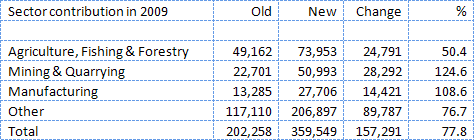
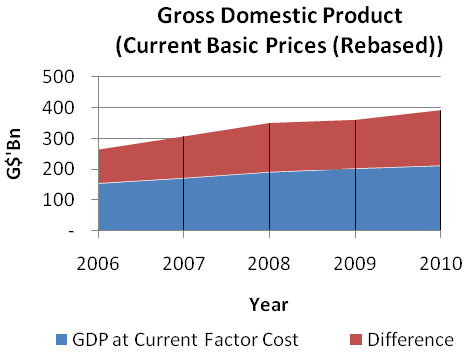
The Minister announced that the results have been predictable and that as a result of the rebasing to year 2006, the estimated weight of agriculture, fishing and forestry and of government has declined, while the weight of mining and quarrying, manufacturing, and services has increased. The rebasing has resulted in an upward revision in the estimates of nominal GDP. (See table and chart extracted from the Minister’s data.) Prior to the rebasing being brought into effect, Guyana’s GDP at market or purchaser prices for 2010 would have been estimated at $268.5 billion, but with rebasing, this has increased by 69% to $448.1 billion.

Adjusted for the rebasing, this is how the economy’s performance appears for the years 2006 to 2010 projected.

But rebasing has other consequences. In addition to the economy being larger, it means that other figures, like the amount of debt to the size of the economy, are better, while tax to GDP or government spending as a fraction of the economy, are lower. Based on his rebased numbers, Guyana is now one of the least taxed countries in the region, despite having the highest corporate tax rates and the most punitive system of personal taxation. It is true that many major sectors – like sugar, bauxite and forestry – make only a small contribution to the tax revenues of the country. Rusal and BOSAI enjoy generous tax concessions in bauxite while Barama’s capacity to make losses and still survive goes down in the business folklore of Guyana, and perhaps the world.

The private sector’s understanding
The concept of transfer pricing, one of the most common forms of exploitation by multinationals, clearly does not apply to Guyana. And what seems not to be understood by our captains of industry – who are also the beneficiaries of tax concessions and a liberal interpretation of the tax laws – is the difference between the nominal rate of tax and its effective rate.

Take our commercial banks for example. The nominal rate of corporation tax that applies to banks is 45%. Yet, according to their most recent reports, these banks paid an average of 26%, within the range of 14% and 39%. And the shareholders pay no tax on the dividends. Quite what the President of the Georgetown Chamber of Commerce therefore means when he suggested that his Chamber was not too concerned about Budget 2010 since tax reform is on the horizon, is anyone’s wild guess.

But let us for one moment accept the Minister’s new numbers. It means that tax evasion by the business community is taking place on a scale previously unimaginable and/or the incidence of loss-making and tax exempt operations is much bigger than we think. The Auditor General (ag) simply ignores the law that requires him to do an annual audit of concessions under the Tax Holidays Act. But there is no ambiguity or uncertainty that the workers are taxed at close to 50%, taking income tax, VAT and NIS into account. On the other hand, the business community as a whole probably bears tax at less than 10%! Yet, the Minister of a government that claims working-class roots could not see it fit to reduce the personal tax rate of 33⅓%, or increase the measly US$175 per month personal allowance.

Know only mistrust
While I know a little about taxation, I confess that economics is not my field, and I therefore called several entities to help me understand the re-basing. The Minister of Finance Dr Ashni Singh, as usual, did not take my call; the head of the Stats Bureau, also as usual, was out of the office and at the Ministry of Finance, while relevant academics at the University of Guyana claimed no participation in the exercise by the Stats Bureau.

With mistrust everywhere it is sad, but not unexpected, that official statistics and reports of transactions are not well regarded by Guyanese. Think of the ‘now you see them now you don’t’ state-owned properties that are sold off; or of the conflicts of interest among important state institutions; or of the violations of the constitution and the Fiscal Management and Accountability Act; or of the incestuous relationships between the politicians and some members of the business community; or of the government’s unwillingness to entertain MP Raphael Trotman’s Freedom of Information Bill. It would be hard not to be cynical and distrustful.

And those who care only about the bread and butter or rice and curry issues, are hardly likely to be impressed by the announcement that her/his personal GDP has jumped to US$2,308.50 but s/he still cannot find a job, or is in receipt of a pension of $6,600 per month. And even for those who have jobs, their food basket costs easily exceed their income. These issues do not seem to matter to the Minister of Finance or his Bureau of Statistics.

NICIL is in violation of the law

Ram & McRae in its Budget Focus 2010 drew attention to one example of the subversive manner in which funds constitutionally due to the Consolidated Fund are diverted into a government owned company with the impressive sounding name of National Industrial Commercial and Investments Ltd (NICIL). The steps are as follows: 1. “vest” into this company assets belonging to the state; 2. have the company sell those assets; 3. use the money thus received for unconnected purposes, without authority or oversight; 4. pay any chicken feed balance as dividends into the Consolidated Fund.

The company can even divert sewage. It financed the multi-million dollar sewage diversion for the Kingston phantom hotel project that refuses to go away. In 2007, it also used $5,000,000 of Lotto funds generously made available to it by President Jagdeo, to “support public viewing of FIFA [2006] World Cup Football.”

The Directors of the Company on record, as they were at 2004, were Mr Saisnarine Kowlessar (then Minister of Finance); Dr. Ashni Singh (then Director of Budget); Dr Roger Luncheon (Head, Presidential Secretariat); Mr Geoff Da Silva (Executive Director, GO-Invest) and the ubiquitous Mr Winston Brassington, Executive Director of NICIL.

The Secretary and Legal Officer of the company is Ms Marcia Nadir, attorney at law.

The law requires all companies to have annual audits, and to file an annual return with the companies section of the Deeds Registry. The return must be accompanied by audited financial statements, and must contain information on the directors, the company secretary, and the shareholders.

Additionally, an annual report, which is distinct from the annual return and audited accounts, must be submitted to the Minister no later than six months after year-end. He then has three months to lay these over in the National Assembly.

Now this is the situation:

1. The company has not filed any annual return for more than ten years.

2. No report and accounts have been laid in the National Assembly for the same period.

3. No notice has been filed to show that Mr Saisnarine Kowlessar has been replaced as a director.

Non-compliance constitutes an offence for which the company and every director and officer, including the secretary, are liable. They stand accused of gross violations of the law. Frighteningly, they also control, directly or indirectly, the billions of taxpayers’ money in the National Budget and the nation’s public assets.

The Registrar of Companies is responsible for enforcing the act and has the power to strike companies off the register. She has been demanding compliance by private companies. Why is nothing being done against NICIL and its directors?

That other contract scandal

Introduction
Ram & McRae in their Focus on the 2010 Budget drew attention to a section of their 2009 Budget Focus which examined the explosion of the number of ministries between 1992 and then. In addition to including a table and commentary listing the ministries, the firm noted that a number of ministries, including the Ministry of Finance, have two ministers and some even have parliamentary secretaries as well. It pointed out that masking these numbers was a vast battery of consultants, contract employees and advisors, particularly in the Office of the President, where several former ministers are guaranteed a position, often more sinecure than substantive, and apparently indefinitely. In the Ministry of Local Government, there are two former ministers who are now employed as consultants, reportedly on the same terms and conditions they enjoyed as ministers.

Hard hearing, poor sight
The firm opined that given the country’s economic conditions and needs, the compensation paid to these persons, all of them on contract, and therefore outside the terms, conditions and low salaries of the public service, placed too great a burden on the taxpayers. It called for a major reorganisation and rethink of the public sector. As expected, the recommendation fell on deaf ears. In fact, the situation has gone well beyond poor management and now seems reckless, even as the donor community and the multilateral financial agencies turn a blind eye as they hand over additional billions into the bottomless treasury.

Yet, the Ministry of Finance, which has moved from 20 contract employees in 2008 to 80 in 2010, a 300% increase, seems unwilling and/or unable to engage in even the most elementary analysis of the billions which the Minister Dr Ashni Singh, loves to rattle off in his Budget speech. If the ministry would even do a cursory examination, it would realise from publicly available data on employment cost and revenue expenditure, that employment cost as a percentage of expenditure rose from 13% in 1992 to 32% in 2009. It would have realised too, that except for the significant increases awarded by the Armstrong Arbitration Tribunal at the end of the nineties, the increases have largely been as a result of a substantial spike in the number of contract employees across the central government, and the huge sums some of these people are paid.

As a result of this 300 % increase in the Finance Ministry, the wages and salaries for contract employees moved from $33 million in 2008 to a budget of $92 million in 2010 under Programme 31, Ministry Administration! The Minister is, regrettably to me, truly following in the footsteps of the President, both as a technician and a politician.

Whereas in 2004, the percentage which the wages and salaries of contracted employees bore to the total wages and salaries of all employees was 8.9%, that percentage is budgeted to jump to 21.5%, with 5% of this coming in 2010 alone.

Wages and salaries costs for contract employees will rise in 2010 by 36.7% over 2009. By contrast, the wages and salaries for 21,154 persons in all the other categories of public servants – teachers, nurses, police, soldiers, clerks, etc. – rises by a mere 4.8%. That does not seem equitable or just, but the unions representing the public workers have been emasculated – either by their leaders or the employers. Of course, not every contract employee gets seven figure packages and the perks that go with them. Like the Orwellian Animal Farm, and our own private sector, some contract employees are more equal than others.

The bigger culprits
The table below showed the employment information in some of the principal agencies at the end of 2009 and 2010.

Source: Public Sector 2010 Estimates

Can’t beat OP
The Ministry of Finance is fast catching up on the worst offender, the Office of the President, where the number of contracted employees for 2010 has increased from 82 in 2008, 85 in 2009 to 106 in 2010. But while the increase in 2009 may appear insignificant, the cost is not. Line item 6116 under Programme 11 Administrative Services shows that of an approved wages and salaries budget of $21 million for 2009, actual spending was $42 million, a 100% increase. Dr Singh should explain what constituted the increase and the source of the financing, and whether this was financed from any of the Minister’s supplementaries. Programme 12, Presidential Advisory, which cannot even house the number of advisors and contract employees the President surrounds himself with, will increase that number by another 17 in 2010, at an additional cost of fifty million dollars.

Programme 12 includes former members of the government whose performance as ministers was, at best, mediocre; party apparatchiks and their relatives; those who use public resources to engage in personal and private business or run sports events, or who cannot find an office and work from their homes, or who seem unable to understand their functions and duties.

We have in the Office of the President an Advisor on Governance, but bills passed by the National Assembly lapse for want of presidential assent. Ironically, the holder of that post, Ms Gail Teixeira is also a key member of the Parliamentary Management Committee that should oversee the business of the National Assembly and the effecting of the laws passed.

But the Ministry of Health, whose senior minister has his own views on the need to comply with laws and systems of procurement and indeed most other things, must surely warrant attention with the number of contract employees fast approaching one thousand, even as the exodus of nurses continues unabated. Agriculture is not half as bad but the annual increase in this ministry and the education ministry needs to be watched, particularly in some of their programmes.

Sporting exit
In the Ministry of Culture Youth and Sport, all thirteen of the employees in Sports, are contract employees. The Department of Sport has not been constituted for more than two years and its audits are several years in arrears. Yet, the National Assembly will soon be giving it another hundred million dollars. I sincerely hope that the ministry will address and arrest this situation, sooner rather than later.

The Public Service Ministry also has a significant number of contract employees. This ministry is responsible for ensuring that the public service is properly organised and has a pool of persons on the fixed establishment to ensure that institutional memory survives any personnel changes. This practice, of which the Office of the President is at the centre, effectively subverts Article 201 of the Constitution that envisages the role of the Public Service Commission as being principally responsible for the employment of public officers.

A more recent convert to the syndrome are the regions, and it is perhaps not without significance that Region Six, the cradle of the ruling party, has both the highest number of employees among the regions and is doubling its number of contract employees in 2010. But so too are Regions 3, Essequibo Islands/West Demerara; Region 2: Pomeroon/Supernaam; and Region 5: Mahaica Berbice. In a year of regional elections and one year before the national elections, such a situation has to be viewed with skepticism and concern. This copying of a bad practice was called by ol’ people: “monkey see, monkey do.”

I called the Public Service Commission for an input on this issue but when the Chairman, Mr Ganga Persaud realised I was on the phone, he had suddenly “stepped out,” prompting me to ask his secretary whether he had a secret exit.

Conclusion
This other ‘contract’ phenomenon allows the ministers and the politicians, many of whom with no business experience or expertise have the freedom to create as many job positions as they wish, unhindered by any strictures of the Public Service Commission, or any principles of proper human resource administration. Contract employees are not eligible to join the Public Service Union but receive a generous gratuity every six months. The more senior contract employees enjoy generous tax and duty concessions, even as they also benefit from state-owned vehicles, chauffeurs and other staff that mask the true value of the cost of such employees.

Hopefully, the National Assembly will seek some sensible answers to this rapidly developing abuse that has effectively made the public service, once again, subject to party paramountcy.

Estimates do not disclose total cost of overseas visits for Office of the President

In responding to concerns about the cost of presidential travel, Finance Minister Dr Ashni Singh is quoted as saying that “over the past three years, the average annual expenditure for the entire government on travel has been $200M.”

The 2010 Estimates which Dr Singh presented just three days ago has a head ‘Transport, Travel and Postage’ under which is a line item ‘Overseas Conferences and Official Visits.’ The Estimates disclose nil costs for the Office of the President, the Ministry of Foreign Affairs and indeed all the ministries, departments and regions, barring the Finance Ministry and the Guyana Defence Force. It is under these two budget agencies from which Dr Singh would have derived his $200 million figures. But it would have been helpful and reassuring if Dr Singh had indicated, at least for the Office of the President, the total cost of overseas visits for the period, the subject of concern and speculation.

Dr Singh should have explained whether that line item includes per diem allowances and other costs associated with overseas visits, and indicate if payment for any such trips is reflected under any other line item, or channelled through any other government agency or controlled entity. The entourage to witness the President receiving an honorary doctorate in Russia included Mr Winston Brassington, head of NICIL. Details that would indicate the propriety of the financial arrangements for that trip (which had some private elements to it), would help to dispel many of the public concerns and neutralise speculation.

The in-country costs of presidential visits are invariably met by the host country. Dr Singh should disclose whether Dr Jagdeo has been receiving per diem for such visits, and the amounts paid to him for the past three years.

Finally can Dr Singh please say whether he agrees with a response to an Audit Office 2003 query on overseas travel, that the “concerned official” (suspected to be the President) is exempted from clearing his travel advances. If the President is not exempted, can Dr Singh tell us the number and value of advances the President has outstanding.