
The Amaila Falls Road Project: Whose synergy? – part 4

Introduction
Today’s column continues this series on the award of a US$15.4 million contract made by the government to Synergy Holdings Inc. for the construction of a road leading to the Amaila Falls, the site identified for the hydro-electricity project (AFHEP). Let us start with what we know: Mr Fip Motilall was given a licence by the President to develop the Amaila hydro project; the contract to construct the road to the project site flies in the face of common sense, economic logic and the Procurement Act; there are conflicting estimates of the cost and consequences to electricity consumers of the cost of power when the hydro-electricity facility comes into commercial operation. Beyond these basic pieces of information, there is a huge void. While the public pleads in vain with the government for details, columnists and letter writers seek to fill the void by undertaking extensive research to help the public understand what is being done in their name and for which they will bear the costs and receive the benefits.

The opposition PNCR a couple of weeks ago asked for the tabling of the Amaila Falls arrangements in the National Assembly. Nothing has been heard about that request but the leadership of that party was given a wonderful opportunity earlier this past week to pursue it when President Jagdeo invited them to meet him over local government elections. It was an opportune time to remind the President that under item 6 of the May 6, 2003 Communiqué he had committed to lay in the National Assembly “all existing and future agreements for GPL and the rest of the electricity sector.”

They could have gone further and reminded President Jagdeo that he had said to President Carter in August 2004 that “the government stands by all the commitments made in this agreement between him and PNC Chairman [sic] Corbin.”

Broken promises
Broken promises from President Jagdeo are nothing new but what is new and painful is that we are left with huge and frightening information gaps on critical aspects of what could be the largest project ever to be undertaken in the country. We cannot forget the President’s record on the largest to date – the Skeldon Factory in which he played the deciding role and which leaves the country in a big financial hole. The Skeldon project has so far been an embarrassing and costly burden – perhaps even bigger than critics had warned – and the demands on the taxpayers keep rising while budget targets made by the corporation’s dream team one year become useless the next.

As Skeldon has shown, the bigger and grander the project, the higher the risks and the greater the consequences of failure. Unfortunately caution is not a virtue associated with this government, and we seem to run blindly into disaster. The parallels between GuySuCo’s Skeldon Project and the Amaila project are frightening.

Conflicting numbers
There are essentially two projects involved with Amaila – the road and the hydro-electricity project itself. That the road project will cost taxpayers only the face value of the contract (US$15.4 million) cannot be assumed. The Request for Proposal said nothing about duty and tax concessions borne by the taxpayers but which could have made a huge difference to the bid price if one bidder was given exclusive assurance about tax concessions, disguised subsidies, or overruns.

The engineer’s estimate of the cost of the road project including bridges is in excess of US$20 million so we have to prepare ourselves for some major cost overruns. Dr Luncheon who was the first to defend the contract process now says that Synergy is behind the eight ball, which in billiards means in a losing position. If translated that means that Synergy cannot deliver on the contract, then the government will have no option but to throw more money into the road contract.

Dr Luncheon should have been more direct and tell us what the failure by Synergy to deliver the road project on time and on budget will mean, which is what the public needs to know. Instead it is another layer of confusion, coming just a couple of days ago after the government sought to contradict its own project manager/sponsor over the cost of the hydro project. In a letter to the local press Mr Rafael Herz, Sithe’s designated Project Manager said the estimated cost of the dam, powerhouse, transmission line and substations was US$650 million (including an estimated US$190 million for the transmission line and other supporting infrastructure). Two days later the government disputed the number, placing the figure at $495 million inclusive of the transmission line. And if we go back one year ago, the President had announced that “final studies” on the project would have been completed in August 2009 and that the bid for the project was US$600M. The final studies have clearly not been done, or costs determined.

Assuming there is a cost number, somewhere in this range, someone should say what it is. The difference between the two most recent numbers is 31% of what the government is now saying the figure should be. Hopefully, the press will seek an explanation from Mr Herz. Amid all the confusion then there is a project of at best uncertain cost. The reality is that there may be no actual number because there is as yet no contract for the construction of the hydro project itself. We know that Mr Motilall has the licence but whether that allows him to decide who will build the hydro-electricity project is not known, or what the guaranteed/ ceiling price which GPL, the project’s customer will have to pay. The terms of the licence could help but that too is top secret.

The project licence
If anyone knows anything about the licence for the big deal that person is not letting on. Under the Hydro Electric Power Act (HEP), any licence has to be applied for to the Chief Works and Hydraulics Officer and is issued by the President. The application would contain critical technical and financial information evidencing vital capacity to fund, build and operate a hydro-electricity project. Since Synergy does not now possess those virtues, it was unlikely to have had them at the time the licence was issued to it in July 2002. It should therefore consider itself lucky that the President issued it with a licence in 2002 and then extended it first in October 2004, and then in 2006 for one year, even as its inadequacy became increasingly obvious. Section 7 of the HEP requires the payment of rent and royalties about which nothing has been heard, including whether Synergy has met such payment obligations. This is all very forgiving, considering the Financial Management and Accountability Act which requires special legislative authority.

A May 2006 MOU referred to in the third part of this series provided that the extended licence “shall be terminable by the government at any time during the one year extension” if Synergy failed to complete certain targets. The one year came and went, targets were set and missed, while Synergy committed to but never supplied a 25 MW thermal generating plant, because it never found the money to do so. Surely very few other than the President would entrust a 154 MW hydro-electricity project to a person who could not deliver a 25 MW of thermal power which can be bought on the internet.

But when it comes to Synergy all we have had from the government is grandstanding. In early 2008 the President threatened that if financial closure did not take place soon, the company would lose the “franchise” to build and operate the hydro facility. More than two years later, instead of terminating the licence and seeking a more reputable licensee, the government is now planning to put more taxpayers’ money into Synergy’s hands.

Scale of the project
Uncertainty also arises over the scale of the project and whether it is a single phase project or whether the 154 MW is just for starters. In August 2009 it was reported that Phase I would involve the installation of 154 MW capacity, Phase II 410MW and in Phase III, it would reach a further 1060 MW. If this is anywhere close to serious, we have to ask whether the Amaila Falls area has that volume of water, whether the second and third phases of the project go automatically to Synergy, who will buy this extra capacity, who will finance the later phases, and when does the BOOT kick in.

The Russians with their bauxite and the Brazilians have already indicated that they have their own ideas and ambitions about hydro-electric power in Guyana, which suggests that they are not interested in doing business with Synergy or Amaila. So the expansion may be a dream, a distraction or idle talk. Whichever it is, the public needs to know.

Start date
For starters, Synergy was under an obligation to begin construction of the hydro-electricity project in 2007 with commercial operation taking place in 2010. It failed miserably. The project manager-designate now says that construction will begin in early 2011 but with two caveats. The first is the completion of the road to enable the transportation of equipment and machinery and the second, obtaining debt financing. Now those are major caveats.

There is a lot of cynicism around and many even doubted that the AFHEP would get started. I think that with the single-mined obstinacy of the President and his adventurous way of committing state funds, the project will get going. But the President is returning from Oslo empty handed and with growing uncertainty about the timing of the inflow from Norway. The Budget already has a huge hole and his expressed impatience in Oslo when he realised the Norwegians and other donors were not sending him back with a bagful of money was his recognition of a potentially major setback. Maybe there is a link between human rights, extra-judicial killings and Amaila. On the positive side, the East Bank Demerara schoolchildren are spared the need to line the road for the President’s return which will be contrastingly low key.

Next week we look at cost, sources of funding and their implications for rates.
Ms Teixeira was incorrect on how commissions of enquiry are set up

I can only speculate whether it was a momentary lapse that caused Ms. Gail Teixeira to mis-speak about the basis and mechanism of commissions of enquiry (Stabroek News, May 22, 2010: No info, no phantom probe – Teixeira). Faced with persistent questions on the phantom squad for which her government is again under scrutiny, Ms. Teixeira told the media that “the constitution clearly states how a commission is set up to inquire.” That is not correct.

How a commission of enquiry is set up and functions are provided for not in the Constitution but under the Commission of Enquiry Act Cap. 19:03 under which only the President may appoint a commission of enquiry. If Ms. Teixeira truly believes what she said, then she must be confusing commissions of enquiry with the constitutional commissions such as the Judicial Service Commission and the Rights of the Child Commission.

As a former Minister of Home Affairs and now one of the country’s hugely expensive political contract employees paid to advise on governance, Ms. Teixeira is expected to know the contents of the Constitution. It forms the basis of the country’s governance system. Her statement suggests that despite her long association with the PPP/C which in opposition criticised the Guyana Constitution as creating a dictatorship, Ms. Teixeira never understood the Constitution, and as Minister and now advisor on governance, still does not.

If Ms. Teixeira has any interest in good governance, she would be advocating the removal of those dictatorial elements in the Constitution, and supporting those calling for the abolition of the dictator-creating executive presidency. More practically, she should be ensuring that all the constitutional commissions – including the Public Procurement Commission – are appointed, provided with adequate resources and functional, and the post of Ombudsman filled.

The Amaila Falls Road Project – whose synergy? – part 3

Introduction
Last week I addressed the process by which Synergy was awarded the contract with a price tag of US$15.4 million for road and transmission line construction in connection with the Amaila Falls Hydro Electricity Project (AFHEP). The process was led by the government-owned private company NICIL, identified as the agency responsible for coordinating the project. The Request for Proposals was in the name of the Government of Guyana through NICIL. Now it must be remembered that in 2003 the National Assembly passed a Procurement Act which requires the government to comply with the provisions of the act in relation to all procurements. With a contract price of over G$3 billion, the contract comes easily under the National Tender Board. It seems, however, that the government was unwilling to take the legally mandatory route, choosing instead NICIL, seen as a pliant and useful vehicle by which the Procurement Act could be bypassed, without anyone noticing or complaining, and with complete impunity.

Of the seventeen firms originally registering an interest in the project, only the following four submitted tenders which, given the scope and challenges inherent in the work to be done, should have excited some concern at the governmental level. An obvious problem was the short time frame for putting together a proposal requiring considerable details which because of its involvement in the project over several years, gave Synergy a distinct edge.

1. Synergy Holdings Inc – USD15,400,000

2. A consortium comprising, B&J Civil Works, Ivor Allen & Dynamic Engineering Co Ltd – USD16,650,000

3. BK International Inc – USD21,037,500

4. Mr. Roopan Ramotar – USD26,000,000.

No right to complain
By virtue of their submission, only those four – or rather three, since the successful bidder is not expected to complain – enjoyed a right to challenge any perceived wrongdoing in the tender process. The law allows complaints only from a supplier or contractor who claims to have suffered, or who may suffer loss or damage due to a breach of a duty imposed on a procuring entity by the act and its subsidiary legislation. It also gives them the right to ask for information relating to the qualification, or lack thereof, of suppliers or contractors that submitted tenders.

Taxpayers who bear all costs, including the cost of corruption and inefficiencies should these occur, are not the suppliers or contractors and so they have to stand on the sidelines as passive victims, unable to challenge any substantive or procedural legal improprieties, however egregious or unlawful.

The law provides that where a contract has already been awarded, a complaint can be made to the Bid Protest Committee required under the act, but this is yet to be appointed. Not surprisingly the Finance Ministry does not seem to be aware of the rules governing the establishment of this committee, or maybe it suspects that no one would dare protest.

Despite the misgivings about the project award, none of the bidders is willing to challenge the propriety of the process or to ask for information presumably because they all benefit from other government contracts and would fear jeopardising their chances with other contracts. In their own way, the contractors contribute to the lawlessness and boldness that underlie this bid process and award.

Synergy’s qualifications
The Procurement Act sets out the criteria which a contractor must meet to qualify for a particular contract. These are essentially but not identically set out on page 8 of the RFP issued by NICIL. Information is widely available that Synergy did not meet any of these tests, but owing to sloppy background checks or self-delusion, the Ministry of Finance (MoF), NICIL and the government seem to think otherwise. For example, the MoF claims that Synergy has expertise and experience in building roads through forests, a claim that even Synergy does not make, and which is not supported by readily available information.

Synergy is a company in which Mr Fip Motilall is the sole director and secretary. Its total authorised capital is US$25,000 but because it has never filed an annual return it is not possible to know whether it has issued any shares or whether it has ever had its books audited. In other words, for all we know Synergy may be a paper company with no shareholders, no money, no audit and no other statutory compliance. Clearly, compliance with basic law is not seen as an impediment for the award of a government contract worth US$15.4 million. Co-incidentally, Synergy shares this disregard for the law with NICIL, the project co-ordinator.

Fact, fiction and fantasy
Synergy’s greatest strength seems to lie in its luck and the salesmanship of Mr Motilall, a Guyanese who migrated to the US several years ago. He successfully persuaded the US government to provide him with funds to do a study of the Amaila Falls hydro-project, and the Guyana government to enter into an agreement for his company to develop that project into an operational entity.

On its website, Synergy describes itself as the developer to design, build, own and operate a hydroelectric plant in Guyana. One immediately notes the absence of any obligation to transfer the plant to the government and wonders whether this is another attempt to mislead potential investors. The company claims that in 1997, it identified a dire need for electrical power generation in Guyana and sought to fill this need by harnessing the hydro potential of the country. In 1998, it joint-ventured with Harza Engineering Company to fund and perform a detailed feasibility study and Environmental Impact Assessment (EIA) for which it wrongly claims that it took a loan from the US Trade Development Agency (US TDA). In fact it was a grant.

The dissimulation continued with the assertion that the project had attracted equity investors and multi-lateral banks to finance the construction. Synergy is now looking for financing, even as Sithe describes itself as the project sponsor. What is true is that the company has been granted a licence to undertake the AFHEP although the particulars of that licence are not a matter of public information. Under the 2003 Jagdeo-Corbin agreement such matters are required to be tabled in the National Assembly.

Broken promises
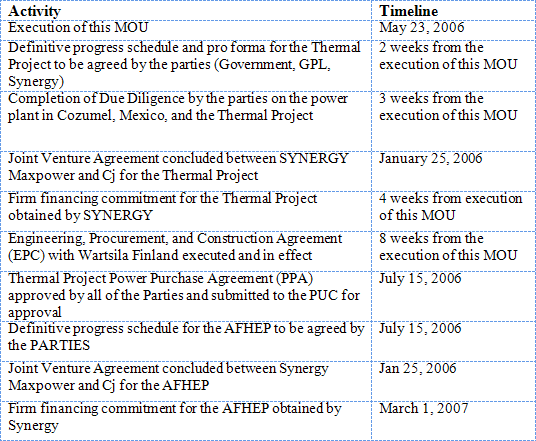
On May 23, 2006, an MOU was signed between the developers and government and Guyana Power and Light Inc (GPL) for the development of the project. Here is a schedule of commitments and dates contained in Section 3 of the Schedule to the May 2006 MOU. Notice that Synergy has breached every one of its obligations under the MOU, most of which should have led to the immediate termination of licence, MOU and dealings.

Hydro by Christmas 2010
Emboldened by the brazen complicity of the government, Mr Motilall seems completely unmoved by his otherwise embarrassing incapacity to meet his obligations even within an unreasonable time. In fact, despite his failure his company’s website continues to tell the world that “the schedule that was agreed upon has the start of construction of AFHEP in August 2007 with commercial operation on the last quarter 2010. In the interim, Synergy and its partners agreed to supply a thermal power plant of 25 MW (to be operational in March 2007) as a way to meet GPL’s demand for power until the hydro-power plant can be built.

The hydro project will assimilate the thermal plant upon its commissioning and the 25 MW thermal power plant will most likely operate in a back-up capacity after 2010.” As my twelve year old would say, “Yeah, right.”

Next week we will look at the financial provisions of the several disparate documents and statements made on the project.

Wall Street Journal not Economist

In early January this year, Stabroek News reported on a Wall Street Journal/Heritage Foundation 2009 Index of Economic Freedom. That sparked the usual outrage from the government led by President Jagdeo, and supported by the usual letter writers including Ms Marissa Lowden, whose contributions have dried up since her departure from Dr Prem Misir’s office. For some reason, the Kaieteur News only recently carried a report on the same index.

The government reacted as it knows best – instinct over common sense and power over brain, again led by the champion driver, this time supported by the three doctors Ashni Singh, Prem Misir and Randy Persaud, and Marissa’s ghost. The fact that none of them recognised that the later report had no originality was bad enough. If they had, they would have had the upper hand and precious state resources could have been better used elsewhere. But lead letter writer Dr Randy Persaud in the Stabroek News of May 8 (‘Organizations like the Heritage Foundation and the Economist are attempting to usurp the authority of the multilateral institutions’) combined a pedantic and political approach, concluding with a professorial pronouncement on the report’s perceived authors as well as its imagined “basic mistakes” which he claimed even a sixth grader would have recognised, even though he himself seemed unable to identify any. This cleverness backfired with several serious errors in his letter.

Here are some of those errors with elaborations inserted for Dr Persaud’s enlightenment.

1. The report was an international index, not a country report as suggested by Dr Persaud.

2. For this particular index, Heritage partners with the Wall Street Journal of the USA, not the Economist of the UK.

3. The index is available free online, with methodology and all. Therefore, it is inaccurate to state that there is no transparency in the index’s publication and that the index is a commercial venture.

4. The Economist might be an institution but it is not an organisation, nor does it publish a country report. The Economist is a weekly news magazine. Also, the Economist Intelligence Unit, a leading research and advisory firm, in addition to consulting, publishes quarterly Country Reports for subscribers.

5. The IMF and the World Bank, among other multilaterals, are endowed with authority to provide reliable economic data and analyses. In fact these institutions rely almost entirely on the “official” statistics published by governments, including Guyana’s. Perhaps Dr Persaud could be encouraged to tell Guyanese who endowed them with proprietary authority that others can usurp. Or why his President rejected the World Bank’s “authoritative” index and analysis in their 2009 ‘Doing Business’ series, which was less than complimentary about Guyana’s business climate.

6. The rankings, Dr Persaud claims, are not based on actual performances, but biased towards narrow ideological criteria. Again, if Dr Persaud would break ranks and tell the nation about the government’s actual performance on corruption, it then could be able to test how ideological or biased is the index’s Guyana’s percentage rating of 26.5 in ‘Freedom from Corruption.’ The cynic might argue that that score reflects a pro-government bias!

7. The organisations he identified (Heritage and Economist) have their roots in the Cold War era. The reality is that the Economist first appeared one hundred and three years before the Cold War began in 1946 and that it is the IMF and the World Bank which are rooted in the Cold War, formed in the US by the West, as their tools of economic colonization and control. (See Cheddi Jagan’s West on Trial.)

I once wrote in a response to another letter that I had never seen so many errors in a single letter. I now need to review that assessment. Other than the above, I share with Dr Persaud an ideological dislike for the conservative, pro-capitalist Heritage Foundation.

The Amaila Falls Road Project – whose synergy? – part 2

Introduction
Very little would be known about Synergy Holdings Inc but for a remarkable display of journalistic persistence that deserves an award for champion investigative reporting, not derisive and unpresidential talk about the fabulous five unnamed “bitter old people.” The only “official” information available on the whole saga, other than the heady and often misleading pronouncements from the President and the Head of the Presidential Secretariat are:

1. the Request for Proposal issued by the Government of Guyana/National Industrial and Commercial Investments Limited (NICIL); and

2. a press release issued by the Ministry of Finance dated April 15, 2010 seeking to justify the award of the road contract to Synergy.

The successful bidder has been largely invisible, incommunicado and silent, apparently out looking for equipment and setting up an office it can call its own. From there it will direct and oversee the upgrading of 85 km of roadway, construction of 110 km of virgin roadway through forests and pontoon crossings at the Essequibo and Kuribrong rivers, and clearing a pathway along the roadways to allow for the installation of 65 km of transmission lines. No easy task.

Cake-shop, rum shop or talk shop
The roads and bridges have to meet certain standards that would allow for the passage of heavy vehicles under all conditions, including the torrential and sustained rainfall which takes place during several months of each year, often making even well-constructed roads impassable. The roads are not only for the purpose of transporting machinery, plant, personnel and supplies to the site located on the Kuribrong River which is a tributary of the Potaro River. They will need, over decades, to be in a constant state of repair to allow for regular traffic in some of this country’s most difficult terrain.

That the nearest current access point is the airstrip at Kaieteur Falls gives an idea where the hydro-project site is located, and what would be involved. Mr Motilall and his company are in diverse businesses with a range of skills, but road-building capacity and experience are not among them. How he managed to convince President Jagdeo and Winston Brassington’s NICIL that he could also build roads is a mystery. To actually build roads in such harsh and demanding conditions within the timeframe would require a miracle.

But for Guyanese this is not a matter of words in the cake shop, rum shop or talk shop, among the young, or any group of grumpy and bitter old people. If the road works do go wrong – and it will not need Murphy’s Law for that to happen – the entire hydro-project will be at risk and the centrepiece of the country’s LCDS in trouble. If we are to avoid that, we have to get it right every step of the way, every metre of it. Like the people of Uganda where Synergy’s connections are labouring over the construction of the Bujagali hydro-power facility, we will be left with a white elephant and a massive debt. The economy is already carrying the cost of the GuySuCo’s investment debts. Another mistake of that magnitude will be crippling. As the largest investment this country has even undertaken, this project cannot absorb further incompetence or corruption.

The bond and the insurance company
The construction has to take place within eight months, an ambitious and possibly unrealistic deadline set by no less a person than the President himself. To demonstrate the government’s seriousness, the RFP specifies that time is of the essence for the completion of the contract. If the contract is not substantially completed within that time the government of Guyana/NICIL can call in the bond issued by the Hand-in-Hand Insurance Company for the performance of the contract. But there is where things get murky and messy.

Part of the package to be submitted by the bidder is a bank bond (emphasis mine). Such a bond was not submitted by Synergy. It is possible that Mr Fip Motilall’s attempt to secure a bank bond did not succeed for the simple and practical reason that the country’s several banks did not consider Synergy a good risk for the project. Since the bank bond is a required content of the proposal submitted for consideration, failure to submit one should have led to an immediate rejection of Synergy’s bid.

Synergy could not get a bank bond so it presented to the Government/NICIL an insurance bond instead. No one knows what went on behind the closed doors of NICIL and whether there were any consultations among Synergy, NICIL and the Hand-in-Hand Insurance Company Limited (HIH) that led to an agreement that a bond issued by an insurance company would be accepted by NICIL as a substitute. This has never been publicly addressed by any of the parties and all we have is an unidentified source in the insurance company saying that it is relying on the commitment of the government/NICIL to the project as its security for the issue of the bond. None of the parties has sought to deny this. What happens if things go wrong and the government seeks to enforce the bond?

The Bank of Guyana’s role
The implications go beyond non-compliance with the RFP. It exposes policy holders of the insurance company to a potential loss of three hundred million dollars which would imperil its capital base and its operational capacity. It is as though Hand-in-Hand has learnt nothing from the experience of its subsidiary the Hand-in-Hand Trust (HIHT) which lost several hundreds of millions of dollars in Stanford and would have to consider itself lucky that the Bank of Guyana, as the financial sector regulator, did not step in and enforce the law regarding the impairment of capital.

Since that hit to HIHT’s financial statements, the Bank of Guyana has been assigned the role of regulator for the insurance sector and it ought to have considered whether the bond places the insurance company under any significant risk. The BoG should be concerned about the poor track record of the insurance company to carry out proper due diligence as so damningly demonstrated by Professor Clive Thomas in an exchange with Hand-in-Hand CEO Keith Evelyn.

Act 2 Scene 1 NICIL
But such considerations only matter to the few who are concerned whether the bid process was serious and legitimate. The steps towards, and the circumstances surrounding the award of the contract, invite the question as to whether or not the winner of the bid was decided in advance.

Enter NICIL, a state-owned company increasingly at the centre of much of government action that is wrong, illegal and unconstitutional and for which it has become a vehicle of convenience.

NICIL was never formed to do what it is now doing. It is a company operating under the Companies Act and the Public Corporations Act set up with its first purpose being to subscribe for, take or otherwise acquire and hold shares, stocks, debentures or other securities of any company, co-operative society or body corporate. To divert sewerage pipes, to hijack and hold public monies, to build roads and administer funds of the Guyana Geology and Mines Commission are simply out of its remit.

Here is a company that cannot keep its own books but was retained to keep the accounts of the Berbice Bridge Company Inc. In umpteen years it has not filed an annual return in accordance with the law but its CEO can find the time to perform corporate secretarial services to another company. As recently as March 2010, it continued to display its commingling role in state assets by shuffling property between Property Holdings Limited, NICIL and the Privatisation Unit, all of which are headed by Winston Brassington.

Its very role in the Synergy contract makes the whole transaction malodorous.

The Procurement Act
I now turn to an examination of that role. The Procurement Act 2003 regulates the procurement of all goods and services by a procuring entity. “Procurement” under the act means acquisition by any means, including purchase, rental, lease or hire-purchase, of goods, or services, or of construction services. A “procuring entity” is any ministry, department, organ or other unit, or any subdivision thereof, of the government that engages in procurement.

The Procurement Act allows for various types of tender boards while the Procurement Regulations 2004 sets out the value threshold that determines the type of board under which a particular tender would fall. With a value of $3 billion, the Amaila Falls Road Contract brings it squarely under the jurisdiction of the National Tenders Board.

NICIL is not the procuring entity but according to the RFP is the vehicle through which the Government of Guyana has acted to advertise for tenders and select the successful bidder. It is not known whether the government obtained advice on the matter from the Attorney General, its principal legal adviser, or whether NICIL acted on the advice of its in-house attorney Ms Marcia Nadir-Sharma, or whether the matter was considered by anyone.

What is known is that there is no provision in the Procurement Act for the National Tenders Board, or the government, or indeed any other tender board to delegate any of its powers and obligations under the act. I have seen correspondence issued by NICIL in respect of the Amaila contract and in none of it does NICIL indicate that it is acting as an agent for the government or any ministry.

To be continued