
Annual reports 2011: Guyana Bank of Trade and Industry and Sterling Products Limited

Introduction
Business Page today continues its review of the annual reports of companies for the year 2011 by covering two of the public companies in the Beharry Group – the Guyana Bank for Trade and Industry and Sterling Products Limited. GBTI held its 24th Annual General Meeting on April 3, while Sterling held its AGM on April 18. Secure International Finance Company Incorporated (Secure) owns 61% of the outstanding shares in the Bank and 58.1% of the shares in Sterling. In turn, Secure is 100% owned by Edward B. Beharry & Company Limited, a private company. The reports show that the Bank recorded a 15% increase in profits after tax while Sterling’s profits after tax increased by 20%.

GBTI Highlights
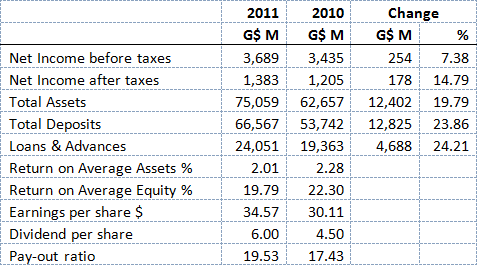
The Bank has nine branches including one at Lethem, making it the first and only banking service outside of the cities and towns of Guyana. Over the past five years, GBTI has witnessed truly impressive growth winning the favours of the government in a number of foreign and locally financed lending schemes, some of which come with tax breaks. In 2006 it was awarded a contract “to carry out the implementation of a Financial Facility to improve the competitiveness of the Rice Sector in Guyana,” and in 2011 it entered into a contract with the Ministry of Finance in respect of “loans to non-traditional agricultural exports, aquaculture, fruits and vegetables and livestock.” Financing for this comes from the IDB and the interest on the loans is exempt from corporation tax. Taking advantage of a number of tax shelters the Bank’s effective tax rate is less than 30%, compared with the nominal rate of 40% on the profits earned by commercial banks.

Asset structure
The Bank’s total assets at the end of 2010 were $75B, reflecting a growth of $12.4B (20%) over 2010 and accounting for 23% of Total Commercial Bank Assets in Guyana. The Bank’s assets as a percentage of commercial bank assets grew by 2 percentage points over 2010. Of the Bank’s assets, some $8.3 billion, or more than 10% was held overseas “so as to benefit from more attractive returns from yet safe instruments.”

At December 31, 2011 loans and advances amounted to $24,051 million, a 24% increase over 2010. The report states that loans to all sectors of the economy increased in 2011and that lending to individual customers increased by $3.1 billion while lending to business enterprises increased by $13.6 billion, which in total exceeds the $4.7 billion increase in total loans and advances. There is a similar discrepancy in the information on loans in the Agriculture Sector which in one case is shown as increasing by $2.8 billion and in another by $1.1 billion. In yet another table, loans and advances to the Agriculture Sector are shown as $2.342 billion while in a narrative they are stated as $9.7 billion.

Income statement
Neither the Chairman nor the CEO discusses lending and deposit rates in the absence of which only very rough calculations can be computed. These show that the average rate paid on savings accounts was 2.03% and on term deposits 1.91%. Taking all deposits into account the average interest paid by the Bank is about 1.5%, compared with the average rate on lending of close to 12%.

GBTI has always earned significant commissions and foreign exchange gains and in 2011 the amounts earned exceeded the Bank’s entire salaries bill. As a consequence of the operating performance, earnings per share (EPS) rose by 5.3% to $34.59, encouraging the directors to increase dividends per share from $4.50 to $6.00 giving a payout ratio of 19.53%.

GBTI continues to be one of the country’s strongest banks and has several committees designed to enhance better governance and better results. Its high quality annual report is upbeat and positive, justified by the results it has been delivering. There are however some technical areas for improvement in meeting IFRS and other regulatory requirements.

Sterling – Highlights

Statement of Income
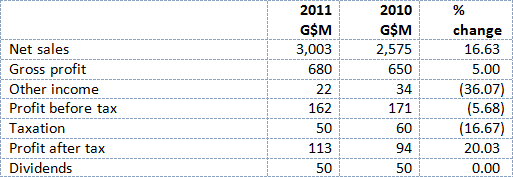
For the first time in the company’s history, turnover topped the G$3.0 billion mark, although this has come with a reduction of G$9.7 million in after-tax profit, down 5.6% to $162.1 million from $171.9 million in 2010. Chairman Dr Leslie Chin attempts to explain this as “due to sales and marketing expenditure directly associated with enhancing distribution of our products. With additional spending in the area of marketing and distribution the company saw the relative return on investment as a total business expanded,” which must have confused the shareholders in attendance.

The Chairman also reports that export sales grew by 5.5% or by G$9.9M over year 2010 sales without stating the level of export sales, which too is not shown in the financial statements. From note 22 dealing with credit exposure it is apparent that the company does business with Grenada and Trinidad and Tobago, with two of the top balances being with customers from those countries.

He does however report that the company has seen “growth in some Caribbean Countries, whilst others present problems with respect to competitiveness.” Sterling is potentially one of Guyana’s manufacturing exporters and for years it has sought to “explore ways and means to have our products on the shelves of businesses in the Caribbean.”

Gross margin has declined from 25.3% to 22.6% while other income has also fallen, from $34.9 million to $22.3 million even as distributing and marketing expenses have increased by $25 million. Once again the company incurs finance costs from an overdraft, even as it holds more than two hundred million dollars in fixed deposits.

With the reduction in the tax rate from 35% to 30% the company’s tax charge has declined by $29 million, of which a significant portion is due to the tax effect of depreciation. Basic earnings per share increased from $6.18 to $7.42 while dividend per share has increased from $3.30 to $3.50. The increase is not reflected in the table above as dividends are only recognised in the financial statements when paid.

The balance sheet of this company is strong with both adequate working capital and healthy liquidity. One of the commendable features of this company is that it has maintained its defined benefit schemes for its employees while so many others are switching from defined benefit to defined contribution scheme. Hopefully, it keeps it that way.

Contrary to what Luncheon claims NICIL is a government company

I find the earlier pronouncements of Drs Roger Luncheon and Ashni Singh and now Mr Winston Brassington that National Industrial and Commercial Investments Limited (NICIL) is a private company with the legal right to withhold public moneys annoying, self-serving, misinformed and mischievous. It is sad, and even dangerous, that individuals with the power to make major decisions over the resources of the country and the lives of its people can be so deficient in their knowledge and reckless in their actions.

Dr Luncheon wrongly informed the media that there are “20-something articles that underpin the creation of NICIL and none of them says that money from NICIL has to be put in the Consolidated Fund.” Mr Brassington adds his share of vacuity with his pronouncement that “proper accounting requirements dictate that money from the sale of government assets should first be placed in the company account, provided it can adequately discharge all of its liabilities.” In my 42 years as a professional, I have never heard anything so absurd and facile.

In fact, the Articles of Continuance of NICIL comprise nine articles (see attached) and it operates under, and is classified by the Companies Act 1991 as a “Government Company.” The Act imposes on NICIL the following obligations over and above those imposed on companies generally:

1. that sections 48 and 49 of the Public Corporations Act dealing with accounts and audits apply;

2. NICIL is required to submit to the Minister of Finance an account of its transactions and audited financial statements no later than June 30 of the following year; and

3. the Minister of Finance is required to lay in the National Assembly the statement of transactions and the audited financial statements no later than September 30, ie, within 90 days of receiving them.

The public is reminded that the Chairman of NICIL is Dr Ashni Singh and the Minister to whom he must submit the report and accounts is the same Dr Ashni Singh. If it was only these breaches of which he is derelict, it would still be a serious matter. But there are more, and worse. The Government of Guyana “vests” lands and other properties in NICIL – on whose Board also sit Drs Luncheon and other Cabinet members – which then sells the assets and pockets the money. The government also uses NICIL to collect dividends from Guyoil, GT&T and other investments which are also retained by NICIL.

This scheme, which assumed scandalous proportion under the Jagdeo-Ashni Singh duo, has become a ruse to get around Article 216 of the Constitution which requires “All revenues raised or received by Guyana to be paid into and form one Consolidated Fund.” By their own boasts, NICIL has collected tens of billions of dollars and not paid these into the Consolidated Fund.

To any ordinary person, so far as the land transactions are concerned, NICIL is merely an agent for the government. Therefore, the moneys it collects should be paid over to the Ministry of Finance to be deposited into the Consolidated Fund. Instead, in an arrangement which in neighbouring Trinidad would be considered criminal, NICIL’s board uses the funds as a second budget to do the things which the Finance Minister would not be comfortable in bringing to the National Assembly, like the Marriott Hotel, like getting involved in Pradoville 2 and for miscellaneous purposes including secret overseas trips, etc. Article 217 of the Constitution dealing with spending public moneys does not allow any of these.

Now, to go back to the absurdity about state companies being subject only to the company laws, I refer the financial doctors to the following two documents: 1) the Report of the Working Party on the Harmonization of Company Law in the Caribbean Community, and 2) the Report of the Review Committee on the Companies Act of Guyana.

This is what the Working Party Report under the heading Public Accountability has to say in paragraphs 19.142 [in part] and 143:

“Whether the company is a mixed enterprise or wholly State owned, public funds are employed for the capital of the company. In the view of the Working Party, this introduces an important dimension with which existing company law does not deal….”

“With respect to companies with capital drawn from public funds, however, the State shareholder is in theory the party which should ensure that proper use of those funds is taking place. In practice, this cannot provide a system of accountability to the public for the effective use of public funds. It by no means follows that the assessment of the State as shareholder with respect to the running of the company will stand up to scrutiny when viewed as a public investment. Increasingly, arguments are made in this context for some additional mechanism whereby the performance of the company in relation to the investment of public monies is subject to accountability beyond the company itself.” And the Guyana Review Committee appointed by the Hoyte administration to consider the report of the Caricom Working Party proposed the adoption of its recommendation that “wholly-owned government companies should be constituted under the Public Corporations Act.

Presciently, the authors of the Working Party Report, including our own Bryn Pollard, were saying thirty years ago, that there could be no accountability under the NICIL-type model, even if it did not have the degree of egregiousness practised by Drs Singh and Luncheon and Mr Brassington.

And finally, with respect to the chorus that it is for the directors to decide if and when NICIL would pay any dividends to the government, let us recall that in 2009, the government, a mere 20% shareholder in GT&T, caused that company to pay more than $6 billion in dividends. And guess who the Finance Minister was and who was the government director on the Board of GT&T when that “persuasion” took place? Dr Ashni Singh and Mr Brassington respectively.

Now the same Messrs Luncheon, Singh and Brassington are bold enough, in respect of a 100% government company in which public property is routinely vested, and which has a 100% Cabinet Board, to plead impotence in calling for a dividend which the country badly needs to help the working and the non-working poor.

To show how reckless and ridiculous it has become, only a couple of years ago the government forced the Geology and Mines Commission to pay $1.8 billion to NICIL to build/repair roads in the hinterland communities, all done by way of a Cabinet directive signed by Dr Luncheon.

For too long constitutional violations, financial improprieties, mis/malfeasance in public office and breaches of fiduciary duties have been tolerated by this bleeding country. It is time for the talking to stop and for the courts in Guyana, and if necessary the Caribbean Court of Justice, to be invited to address these matters. Sooner rather than later some Guyanese will decide that enough is enough.