
Dear Editor,
Guyana’s electoral fiasco may have overshadowed the other major crisis which it faces, the COVID – 19 pandemic. As of Saturday April 11, Guyana had carried out 193 COVID – 19 tests, of which 45 were positive, with six deaths. A review of the COVID – 19 data[1] for forty-five countries from across the world shows the USA, the wealthiest country in the world, having the highest number of deaths (21,409), with the fear that the peak may not yet have been reached. The USA also tops the chart for the greatest number of tests carried out by any single country.
USA/Europe
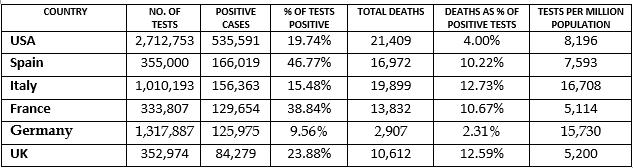
The next four countries in terms of deaths are Italy, Spain, France and the United Kingdom. In terms of tests carried out relative to population, Italy which has the second highest death rate has carried out the highest number of tests measured in relation to population, followed by Germany at 15,730 tests per million of population. Spain had the highest percentage of positive cases (46.77%) of number of tests carried out. Counterintuitively, Italy had the lowest percentage of positive cases to tests, confirming the widely held observation that the Italian cases were concentrated in particular areas. Italy and the UK had the highest percentage of deaths to tests carried out. The success story is arguably Germany which has about the same number of cases as France but did three times as many tests and suffered only one-fifth of the fatalities.
Here is what the Table shows for six countries in these geographical areas:
South East Asia
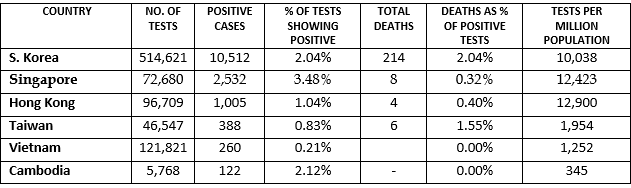
Perhaps because of their proximity to China, the countries of South East Asia responded early and aggressively. Singapore, South Korea, Cambodia, Taiwan, Vietnam and Hong Kong appear to have managed the pandemic far better that the countries of Europe and the USA. South Korea is widely held up to be the gold standard for management of the virus with the highest number of tests overall. However, that number translates to 10,038 per million of population which is lower than Singapore and Hong Kong, both of which recorded less than half percent of deaths to number of positive cases. In fact, only South Korea had a relatively significant number of deaths (214) with Singapore, Hong Kong and Taiwan having 8, 6 and 4 deaths respectively with Vietnam and Cambodia reporting not a single death from the disease. Both these countries had considerably lower incidence of tests than the first category selected above with Cambodia being particularly low at 345 tests per million of population.
Commentators from western countries were quick to point out that China where the virus started was able to manage the virus using measures that the west would find unacceptable. Of course, Singapore, South Korea, Hong Kong and Taiwan provide an instant rebuttal.
Africa
The countries of Africa have also performed well with very few deaths as the following table shows. Nigeria is a huge country with close to 200 million people spread over nearly one million km2. Ghana was the leader in number of tests, almost double the number done by Nigeria, Kenya, Rwanda and Uganda, the latter two recording no COVID – 19 death. Despite having one of the lowest test rates in the world – 24 out of every million – the percentage of those tested proving positive was in single digit at 6.36%.
Nigeria’s strong epidemic response infrastructure is in large part responsible for their relative success. The Nigerian Centre of Disease Control has been investigating pandemic preparedness for the last three years. At the time of the incident case, they had already established Public Health Emergency Operations Centres (PHEOCs) in 23 out of the 36 states in Nigeria for the purpose of detecting, preventing, monitoring, preventing epidemics. The country’s experience with Ebola also bolstered its response. The incidence case was detected within 48 hours of the person arriving in Nigeria.
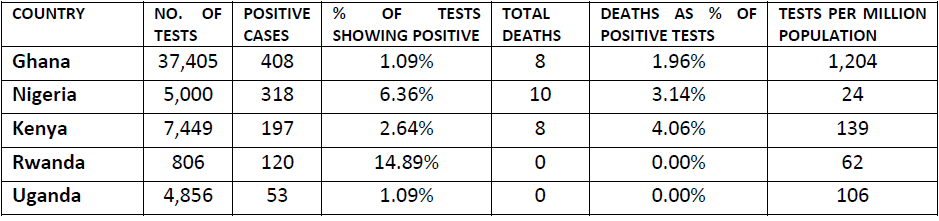
Readers will recall that the region was ravaged in 2014 – 2016 by the dreaded Ebola virus disease (EVD) which like the corona virus traced its origin to wild animals. The fatality rate of the EVD reached 60%. The African countries took strong and effective public health measures in the aftermath of the EVD and the benefits may be paying off. Rwanda’s rate of positive test was 14.89% which is more consistent with the rate experienced in the European countries.
South America
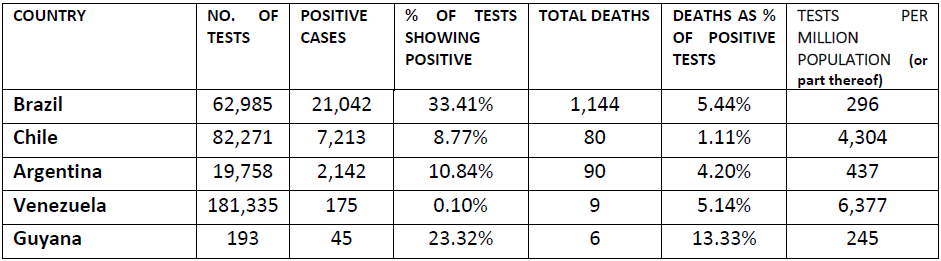
Brazil’s ultra-right wing President Bolsonaro is among the handful of world leaders still scoffing at the threat of coronavirus to public health. It is no surprise then that relative to population, Chile has tested fourteen times the number tested in Brazil. Troublingly for the people of the South American giant is that one in three persons tested came out positive and more than 5% resulted in death. Chile’s tests are also coming back with a fairly high positive rate and a 1.1% death rate.
The real exceptional case in South America is Venezuela which only last month was predicted in the western media, to become an epicentre of the virus. In fact, Venezuela has carried out one of the highest test rates per million of population (6,377), among South American and Caribbean countries. Only Chile (4,304) and Barbados (2,599) come anywhere close. For convenience I have placed Guyana among the South American countries as it shares land borders with Brazil and Venezuela.
Of the forty-five tests carried out by Guyana, 23.3% were positive and resulted in six deaths. Guyana has its own special problems having alienated itself with electoral shenanigans meaning that there is no legitimate Government, the President is in hibernation and the Minister of Public Health seeming to be out of her depth. Meanwhile, the outgoing Government’s application for modest assistance from the World Bank has been stuck in the system.
The Caribbean
Comprising mainly island states, the six countries which include Guyana, are in lock down and are already facing serious fiscal and economic challenges, which are getting worse by the day. Tourism plays a significant role in the economies of all the OECS countries including Antigua and Barbuda, Barbados and to a lesser extent Jamaica, all countries included in the Table. Haiti, another such country, has suffered from one calamity after another over several years. COVID-19 could therefore only exacerbate an economy under severe stress.
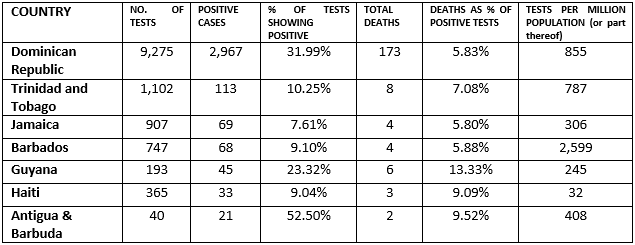
Except for Barbados, significant testing does not appear to be part of the strategy of these countries of the Caribbean. Although it is possible that this is simply because of the unavailability of these tests either because of funding or the mentality that COVID – 19 was a “Chinese thing” that would not come to these shores. Deaths in all the countries remain in single digits with some of them resulting from imported cases, as is the case of Guyana where Patient Zero was a visiting American Guyanese.
Antigua & Barbuda stands out as the only country in the world that has had positive test result in excess of 50%. For its part, Guyana ranks highly in this metric at 23.32% and it is unclear why neither Antigua & Barbuda nor Guyana is not extending their test. This apparent reluctance only fuels speculation, especially in Guyana where statistics have been controlled by a very partisan politician.
Lessons for Guyana
The statistics do not offer any clear direction for Guyana. South Korea is considered a gold standard in testing because it began widespread testing very early. Guyana did not do so and is now well past that stage. It is not clear how many test kits Guyana has and why these have not been used. The entire process is being controlled by a Minister better known for her partisanship than for her competence.
For all the conflicting directions in which the statistics point, there are a few ways in which COVID – 19 can be defeated. Social distancing, the wearing of masks, personal hygiene, including the proper washing of hands, contact tracing, the wide availability of tests and early results. Additionally, a challenge of this magnitude requires strong and informed leadership, teamwork, trust and resources. At the national level, Guyana has failed in almost every single matrix.
No one knows what resources are available, the national leadership is exclusive rather than inclusive, the President seems himself to be in lockdown, the Government is paralysed by its own making, there is no Parliament to make laws and most of the initiatives come from a disparate number of political and other groups. All of this in a country that is considered among the least prepared to deal with the virus.
Meanwhile, major sections of the country are in lockdown or underperforming as a result of the combined effects of the unwillingness of the loser of the March 2 elections to concede defeat and a weak response to COVID – 19.
Except for non-essential services, the country’s economy is on lockdown until May 4th. Many businesses have sent home workers but with no assurance of payment. Some businesses will find it difficult to resume. In the country’s first year as an oil producing country, Government projected revenue will take a substantial hit, partly as a result of the sharp decline in oil price. There is no consensus of the elements of the decision to reopen the country’s border and its economy.
When the lockdown is over, the electoral and constitutional mess will continue. 2020 will go down as one of the most difficult years in the history of the country.
13 April 2020
[1] Source: https://www.worldometers.info/coronavirus