Every Man, Woman and Child in Guyana Must Become Oil-Minded – Column 142 – November 2, 2024

Renegotiations, Referendums, and Reality – response to Ram & McRae’s Survey

Introduction


The response to Ram & McRae’s recent survey on the 2016 Petroleum Agreement was revealing, particularly Vice President Bharrat Jagdeo’s immediate dismissal of its findings and his attempt to shut down any discussion of a referendum. His reaction betrays a troubling resistance to public discourse about Guyana’s most valuable natural resource.

Let us be clear: it is not within any VP’s power to decide whether Guyanese can have a referendum. The Constitution establishes referendums as a democratic tool, with such decisions resting with the National Assembly and the President, not with a party official, however high up. While Mr. Jagdeo is the General Secretary of the ruling party, he is not even the First Vice President – that position belongs to Brigadier Mark Phillips by virtue of his position as Prime Minister.

Campaign Promises vs. Current Reality


Mr. Jagdeo’s dismissal of a referendum on the Agreement is particularly revealing, given his party’s explicit promises during the 2020 election campaign. The PPP/C’s manifesto and numerous campaign speeches promised not just to review but to actively renegotiate the contract’s terms. Now, the VP attempts to rewrite history, claiming “we showed that we can get more out of the contract” through peripheral arrangements like the gas-to-energy project and Local Content Law.

The evidence suggests otherwise. The gas-to-energy project’s terms remain outside of the 2016 Agreement and are troublingly opaque, with mounting questions about its actual cost to Guyanese taxpayers. Even the Local Content Law is defined far too broadly, and the promised review due in 2023 has still not been done. And while essential for domestic business participation, it does nothing to address the Agreement’s fundamental inequities. Most critically, the cost recovery provisions still allow operators to claim up to 75% of revenues, leaving Guyana with a diminished share of its resource wealth, environmental protections remain inadequate, and worse of all, Jagdeo and the PPP/C are placing the myth of sanctity of contract over national sovereignty. Please see columns 133 – 135. Egregiously, the country is without the all-important Petroleum Commission, with the unacceptable substitute being the VP himself and the Ministry of Natural Resources, with its poor track record.

The VP’s claim that a referendum would “complicate” the electoral process defies constitutional precedent and global democratic practice. Numerous countries, including several Caribbean nations, routinely conduct referendums alongside national elections, recognising both the cost efficiency and democratic value of such exercises. The actual “complication” appears to be his reluctance to face the electorate’s direct verdict on this crucial issue and his own stewardship of the sector.

“Suspect” Survey


Mr. Jagdeo’s description of the survey as “suspect” demands examination. The survey itself was a global survey using Google Forms. Additionally, it was distributed to all leading members of private sector organisations and political parties in Guyana – including the PPP/C, where he serves as long-term General Secretary. If the results are “suspect,” one must ask why his party and supporters, who received direct invitations, chose not to participate and offer opposing views.

Understanding Survey Methodology


Meanwhile, Mr. Freddie Kissoon’s critique in the state-owned media reveals mistaken facts relevant to his academic training and fundamental misunderstandings about research methodology. He confuses basic facts, citing wrong numbers and mischaracterising the nature of the initiative. A survey serves different purposes from a poll – it gathers detailed information and insights about specific issues rather than predicting population-wide views. Our exercise was explicitly designed as a consultative survey seeking informed stakeholder feedback about particular aspects of the Petroleum Agreement. The valuable responses received, including a detailed technical analysis of contract provisions, demonstrate the success of this approach.

Conclusion


The passionate reactions to this survey from high officials and their supporters suggest it has struck a nerve. The underlying message resonates clearly: there is substantial public concern about the Agreement’s terms, and these concerns cannot be dismissed through procedural objections or deflections about methodology.


Its findings present a critical test of our democratic principles. The Ali Administration’s resistance to discussing modifications to an Agreement that will shape Guyana’s fortunes for generations reveals a troubling gap between democratic rhetoric and practice. Their continued refusal to engage with these concerns suggests a deeply worrisome possibility: they fear what a genuinely informed and empowered electorate might decide about an Agreement that will shape Guyana’s destiny for the remainder of this century and beyond. Their resistance to democratic consultation raises the profound question of whether they truly serve the interests of the Guyanese people or other, less public interests.

Every Man, Woman and Child in Guyana Must Become Oil-Minded – Column 141 – October 25, 2024

Introduction

Survey Shows Overwhelming Support for Renegotiation of Petroleum Agreement

Introduction

The results of a recent survey on the 2016 Petroleum Agreement with ExxonMobil and partners reveal overwhelming public support for renegotiation, with serious concerns about key provisions of the Agreement. The survey, conducted by Ram & McRae using the Google Forms platform  attracted 135 responses from a diverse group of respondents including professionals, academics, students and citizens, provides compelling evidence that the Government’s “sanctity of contract” position is at odds with public sentiment.

Key Findings

An overwhelming 94% of respondents believe the Government should seek to amend the current Petroleum Agreement, with only 6% either opposed or unsure. This stark statistic alone should give pause to those who continue to defend the status quo. The survey revealed that only 3.8% of respondents were satisfied with the existing provisions of the Agreement. The remaining 96.2% identified multiple areas requiring modification:

  • 83.2% want the royalty rate revised
  • 79.4% called for changes to tax payment arrangements
  • 66.4% seek modifications to tax certificates
  • 66.4% want the revenue guarantee revised
  • 61.8% support ring-fencing provisions

Governance and Oversight

On the critical question of oversight, nearly half (49.6%) of respondents favor a fully independent Petroleum Commission, while 44.4% support a combination of government and independent oversight. Only a small minority supported exclusive political control, highlighting the public’s disfavour of the current arrangements under which Vice President Jagdeo reigns supreme to the exclusion of everyone else.

The survey also revealed deep concerns about the Natural Resource Fund’s withdrawal rules. A mere 9.8% consider the current withdrawal levels appropriate. Maybe respondents are alert to the fact that under a 2023 amendment to the Natural Resources Fund Act, almost the entire amount of the first US$2,000 Mn. from profit share and royalty can be withdrawn and spent – no questions asked. It is ironic that the beneficiaries of this profligacy are arguing that more ought to be left in the Fund as intergenerational savings.

Fairness and Profit-Sharing

When presented with actual data showing Guyana’s modest and mildly declining share of oil lifts (from 13.04% in 2020-21 to 11.97% in 2023), an overwhelming 87.8% of respondents rated the current profit-sharing arrangement as either “somewhat unfair” or “very unfair.” Only 3.1% considered it fair, providing a clear mandate for revision of these terms.

Obstacles to Change

Asked to give their views on what they consider the key obstacles to renegotiation, respondent cited as the principal reason identified as the top reasons the following:

  • lack of political will (80.3%)
  • fear of potential economic repercussions (53%)
  • diplomatic concerns (44.7%)
  • Legal constraints 37.9%).

The reasonable inference to be drawn from “Legal Constraints” is a reference to the sanctity argument so warmly embraced by the Government in place of their commitment to “review and renegotiate”!

Public Awareness

A striking 86.5% of respondents believe there is insufficient public awareness about the Agreement’s specific provisions. This suggests that greater public education could further strengthen the case for renegotiation. It is however surprising for another reason: no day passes without a news article and more making adverse comments on the Agreement. 

Article 31.2 and Path Forward

While 53% of respondents were aware of Article 31.2 of the Agreement which allows for amendments with contractor consent, 47.4% view the current silence on invoking this provision as a missed opportunity by the Government to seek and obtain better terms. The main factors contributing to this silence were identified as:

  • Lack of public awareness (72.5%)
  • Political reluctance to challenge powerful oil companies (62.6%)
  • Inadequate technical capacity (35.9%)
  • Fear of damaging Guyana’s reputation (33.6%)

Conclusion

The survey results paint a clear picture: there is strong public support for renegotiating the 2016 Petroleum Agreement. The current “sanctity of contract” stance by the Government which had promised to renegotiate the Agreement appears increasingly untenable in the face of such overwhelming public sentiment for change. As one respondent noted, “The supremacy of Guyana’s Sovereign tax laws should be maintained. The contract broke one law to install another.”

The challenge which Guyana faces is to translate the strong and compelling public sentiment expressed in this survey into political action. Neither of the two major political parties has given Guyanese any reason to suggest that they are prepared to take decisive action to change this lopsided and penal arrangement. With general elections approaching in 2025, political parties would do well to heed these findings and recognise that the public’s patience with contemplating living with the 2016 Agreement beyond the middle of this decade is fast evaporating.

Every Man, Woman and Child in Guyana Must Become Oil-Minded – Column 140 – October 18, 2024

Exxon and Partners – Relinquishment Time

Introduction

President Irfaan Ali enjoys his encounters with international journalists, including BBC’s Steve Sackur and more recently New York Times’ International Climate Correspondent, Somini Sengupta. While the President has ably navigated the questions posed to him, he has benefitted from some important questions which Sackur and Sengupta failed to ask – like how he moved from “renegotiation” to “sanctity of contract.” Or the reason(s) for his country’s refusal to join more than 90% of the open countries of the world in signing the global Framework imposing a minimum corporation tax rate of 15% on companies like Exxon, Hess and CNOOC. Whether intended or otherwise, the beneficiaries are the oil companies, the sufferer being Guyana, It now begs the question whether a local journalist would raise these vital topics.

As if the 2016 Agreement is not sweet enough – no taxes, low royalty and a 40-year stability –  there is the relinquishment provision which gives Exxon almost exclusive control of the country’s most important sector for decades to come. While Exxon headlines the Stabroek Block, it controls the equivalent of 21% of Guyana’s total area of 83,000 square miles, through its involvement in the Stabroek Block, the Canje Block and the Kaieteur Block. With the exception of the East India Company up to 1857, there are no comparable statistics anywhere in the world, where a company enjoyed such dominant control over any country.

Contract Administration  

Having resiled from its renegotiation commitment, the Administration, ignoring the signal failures identified below, boasts about its contract administration, meaning how the Ministry of Natural Resources oversee the operation of the various Petroleum Agreements entered into by the Government of Guyana. Each and every failure comes at a cost and while the focus has understandably been about the Stabroek Block, it has detracted from Exxon’s role in two other blocks – the Kaieteur Block and the Canje Block, with significantly smaller areas than Stabroek.

Contract administration is a critical aspect of resource management, where the State must ensure that contractors fully meet their legal, fiscal, environmental and other obligations under their Agreements. Equally important is avoiding situations where, through poor oversight, negligence, or incompetence, companies receive greater benefits and more latitude than are legally permissible. Unfortunately, from the very inception of the 2016 Agreement, there have been concerning lapses in administration.

Contract failures and relinquishment

Raphael Trotman allowed Exxon to claim US$460 million in pre-contract costs, significantly more than their own financial statements revealed. Eight years after the Agreement was signed, not a single Ministerial audit has been completed, with only two audits combining several years instead of the required seven annual audits. Then there is the case of a staggering sum of US$211 million of unsupported expenditure being cleared at an administrative level rather than by the Minister of Natural Resources. These issues are facilitated by inadequate accounting and reporting, weak and permissive environmental oversight, and a lack of disclosure and accountability.

Another critical failure is in the handling of relinquishment provisions under the various Petroleum Agreements. “Relinquishment” refers to the obligation of oil companies to give up, within no more than ten years, the area over which they are granted a prospecting licence. This provision is crucial for ensuring that areas not explored, or which are proven unproductive are returned to the State, allowing for potential reassignment or conservation.

To understand the scale of this issue, let us examine the three Blocks where Esso is the Operator. According to the Guyana Geology and Mines Commission, these Blocks are as follows:

First, two quick asides. Exxon was permitted extraordinary latitude under the relinquishment clause of the 1999 Agreement, and now, under the legally questionable 2016 Agreement, it is allowed seven years instead of the usual four before it relinquishes any of the vast blocks it was awarded. Utilising an exception permitted in the then law, all that is required of Exxon after four years is to request a renewal, without any obligation to relinquish.

At the end of this renewal period, which lasts for three years, Exxon must request a further three-year renewal but must relinquish at least 20% of the original Contract Area, excluding Discovery and Production Areas. The retained area should comprise no more than two discrete areas, no piece by piece. At the end of that second renewal period, i.e., after 10 years, Exxon shall relinquish the entire Contract Area, with the exception of Production and Discovery Areas and Areas under Appraisal Programmes.

The Agreement was signed, dated and executed on 27th June 2016 but notarised on 7/10/2016 – which can be interpreted as 7th October 2016, or 10th July 2016. Even if we accept the word of Exxon’s former clandestine public official doing secret PR work for the company, Exxon should have given up 20% of the Stabroek Block no later than 7th October of this month. The big question is whether any such relinquishment has been effected.

For the Canje Block, 20% of the contract area should have been handed back by 4th March 2019, and another 20% by 4th March 2022, with the remainder to be handed back by March 2025. For the Kaieteur Block, 20% of the contract area should have been handed back by 28th April 2019 and another 20% by April 2022, with the remainder to be handed back by April 2025.

Question of Administration

All companies awarded petroleum agreements must apply for renewal of their licenses before the current period ends. This is crucial because each renewal comes with the obligation to give back (relinquish) part of the area they control. In this regard, I do not recall any public disclosure of timely applications for renewals, the extent of the relinquishments and whether the applications were granted.

The administration of the petroleum agreements covering vast areas of Guyana’s territory is about the country’s sovereignty as well as our national patrimony. The public has a right to know how these areas are being managed. Any carelessness in administration comes at a huge cost to Guyana, and by not enforcing relinquishments as stipulated, the country can lose opportunities to re-auction areas bringing in substantial revenues since the country is de-risked.

Conclusion

The administration of Guyana’s oil blocks reveals a complex picture of rapid development coupled with significant challenges. While the success of the Stabroek Block has brought benefits, the apparent lack of enforcement of relinquishment provisions in other blocks raises serious concerns about the overall management of our oil resources.

Next week, we will look at the Prime Minister Samuel Hind’s defence of Exxon.

Every Man, Woman and Child in Guyana Must Become Oil-Minded – Column 139 – October 5, 2024

The PNC-R’s 20-Point Plan for Guyana’s Oil and Gas Sector Part 2 And Questions about Sale of Oil

Introduction

Today’s column concludes the review of the PNC-R 20-point plan launched at a press conference hosted by its Leader Aubrey Norton last month. Unfortunately, neither Norton nor any in his circle of leadership has subsequently promoted the plan by interviews, letters or public engagements. True to form, the first critical response came from the Vice President Bharrat Jagdeo who is not without his own problems with the sector. The plan has, however, won the full-throated support of Dr. Vincent Adams, who is a member of the AFC and, more directly, a member of the Committee appointed by the AFC to prepare its own policy paper on the oil sector. Notably, the publication of the AFC’s policy on petroleum is several weeks late, with no explanation offered to the public.

The PNC’s plan has managed to avoid addressing some of the glaring deficiencies and omissions in the content and operationalising of the 2016 Petroleum Agreement, even within a wordy and extensive twenty points. At best, the plan could be considered cautious, conservative and careful, the minor changes here and there doing nothing to assure Guyanese that the PNC-R has the will or the capacity for any meaningful, let alone fundamental change to the 2016 Agreement. The party’s approach may be politically calculated to avoid alienating international oil companies or risking Guyana’s reputation, as does the PPP. Or maybe, like the PPP, it has swallowed the cool aid of “sanctity of contract.” In other words, there is little that separates the PPP/C and the PNC-R on their attitude to the Agreement.

Electoral interest over the national interest

Perhaps the most glaring issue with the PNCR/APNU’s plan is its complete lack of urgency or timelines. The plan is essentially a promissory note contingent on the party winning the next elections in November 2025 – more than a year away. This delay is particularly egregious given that the Norton leadership has several years to observe how the agreement has operated against the national interest.

Instead of urgently addressing the matter and taking a clear position – one way or the other – the PNC-R has chosen a “kick the can down the road” strategy that may have no political benefit other than that it will not have to follow-through, since success in winning the next elections is only a remote possibility. But any responsible, major opposition party is required to be consistently vigilant, representing those who voted or will vote for it. For the majority of Guyanese, this is not an election issue. It is a reality of everyday life, of our patrimony, of our sovereignty, our integrity, the future of our country, and of every Guyanese present and future. Every day that passes under the current agreement represents a missed opportunity to secure better terms for the Guyanese people with the potential of bringing in billions of US dollars.

This approach is particularly disappointing given the high stakes involved. Guyana’s oil resources represent a once-in-a-generation opportunity for national development. Every barrel of oil extracted under the current terms represents revenue lost to the Guyanese people. The PNC-R’s willingness to allow this situation to continue unchallenged for years to come is a serious abdication of responsibility and a betrayal of the trust placed on it by more than two hundred thousand voters.

The plan’s emphasis on building institutional capacity, reference to local content and environmental considerations is commendable but without a clear commitment to renegotiating the terms of existing agreements, there is little value to this plan. It might have been better if the PNC-R had described the document as a statement of intent or a policy framework paper but as a plan, it is really of little use and value.

Conclusion

Perhaps most critically, the plan’s failure to directly address the 40-year stability clause represents a significant missed opportunity. This clause, which effectively freezes the regulatory environment for four decades, is a major constraint on Guyana’s sovereignty and ability to adapt its policies as circumstances change. By not challenging this clause, the PNCR/APNU may be acquiescing to a long-term limitation on Guyana’s control over its own resources and muzzling its parliament,

The plan’s reluctance to commit to renegotiation and its failure to address the stability clause suggest a preference for the status quo over pursuing transformative change. This is not what Guyana needs and not what the people want. It does nothing to persuade any objective person to lend their support.

Where is this $1,500,250,000 ($1.5 Bn)?

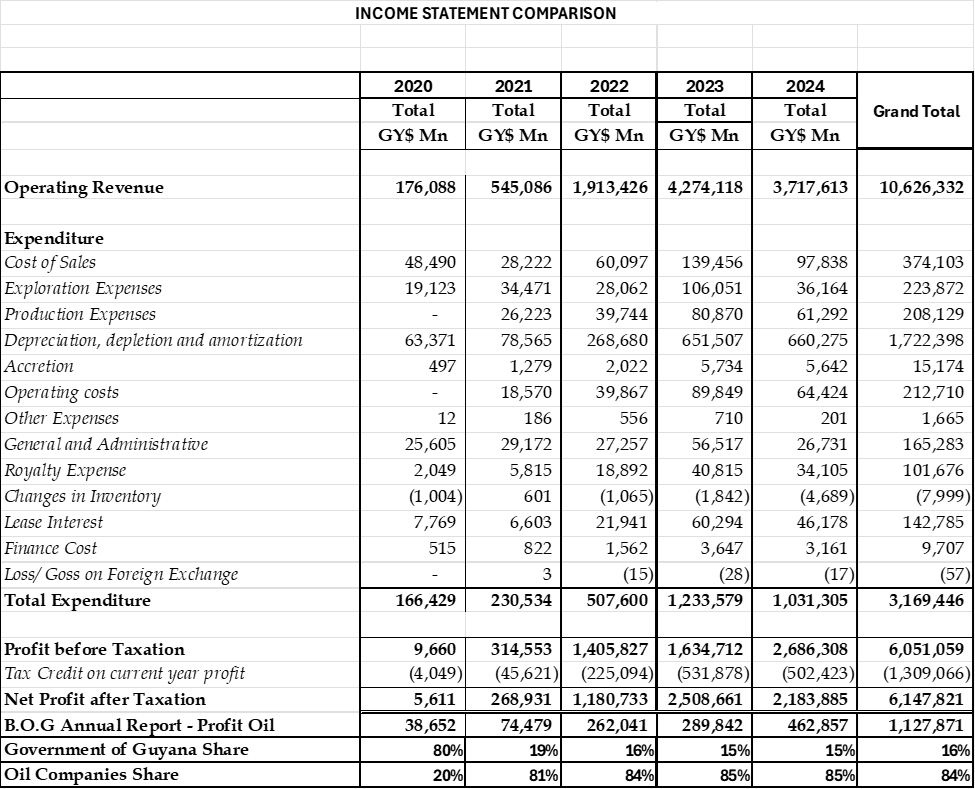
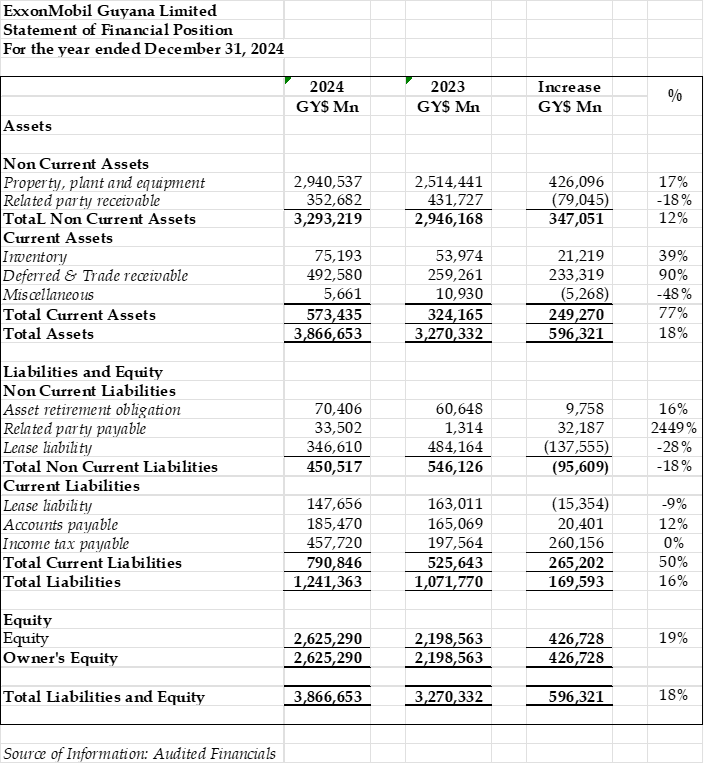
The Government of Guyana is inviting tenders for the sale of its share of profit oil under the 2016 Petroleum Agreement. In his 2024 Budget Speech, the Senior Minister responsible for Finance gave particulars of the lifts received by Guyana under the 2016 Petroleum Agreement in 2023 and earlier this week the Minister of Natural Resources disclosed limited payment terms by the selling agents of the seventeen 17 million barrels of oil making up those lifts.

As the table below shows, the Government has received $1,500 Mn. from its selling agents which under the Extractive Industries Transparency Initiative (EITI) Rules to which Guyana subscribes, requires full disclosure of:

  • The volume of the production sold.
  • The revenue received from the sale.
  • The buyer(s) of the government’s share of production.

Commission earned on Sale of Government oil

Source Budget Speech 2024 and Minister of Natural Resources – Kaieteur News Article

There are several deficiencies. It requires the average reader to make assumptions about the number of lifts sold and to compute the amount of revenue received. There is information on the gross sums received from royalty, but no disaggregation of the royalty  received from each of the contractors. Nothing on the identity of the buyers, their country of operations, or the terms of the respective sale.

Regarding the agents, it is highly unusual for agents to pay commission to their principals, but the oil universe is populated by dealers involved in sanction-busting, money laundering, drug trafficking and arms trading, so stranger things do happen. 

The table also shows that Guyana sold almost two-thirds of its oil via an agent (BB Energy) who is paying just over one-third the rate of commission payable by the other agent. That defies business logic and certainly needs some investigation. Had all the oil been sold via the agent paying the higher rate (JE Energy), the revenue earned would have US$11.9 million, meaning that we would have earned US$4.5 Mn more than we did, while if the composition of the sale had switched, we would have still earned a more modest but still significant US$2.2 million more. Significantly, the names of the agents suggest that they are unincorporated entities!

But there is an even more immediate, fundamental and direct concern about this revenue, and that is the absence of information on how the money is accounted for. A search of the Natural Resources Fund shows only three sources of income – royalties, the revenue from profit oil and interest earned. Similarly, the Revenue Estimates presented to the National Assembly do not disclose any information on this significant source of revenue.

This non-disclosure is concerning, in violation of the country’s obligation under its EITI membership, the rules of accountability and transparency, and a government’s duty to disclose. This will almost never happen if we had an empowered, independent Petroleum Commission but will almost always happen once we retain the existing inept supervisory arrangement over the oil companies currently in place.

Next week will deal with this month’s scheduled relinquishment.

Every Man, Woman and Child in Guyana Must Become Oil-Minded – Column 138 – September 28, 2024

The PNC-R’s 20-Point Plan for Guyana’s Oil and Gas Sector

After years of dithering and delays, the People’s National Congress Reform (PNC-R) recently unveiled a 20-point plan – more a statement of intent – for managing Guyana’s fast-moving oil and gas sector. This plan, coming eight years after the signing of the 2016 Petroleum Agreement by the PNCR-led coalition, and after four years of silence and ambivalence from Aubrey Norton as Leader of the Opposition, represents at best a promise to review rather than act. While the plan outlines a comprehensive set of policies and strategies, it also raises questions about its effectiveness in addressing the fundamental issues which the country faces with respect to the sector.

Strengths of the Plan

The plan demonstrates a commendable attempt to address a number of aspects of oil and gas sector management with firm statements on:

  1. The proposed establishment of an Advisory Team (AT) of professionals within 90 days of taking office will bring much-needed expertise to the government’s decision-making process. This interdisciplinary approach, including specialists in business, law, economics, and engineering, among others, could lead to more informed and holistic policymaking.
  2. The establishment of an independent Petroleum Commission which strengthens governance, enhance oversight and reduce political interference in the sector’s management.
  3. On environmental protection, including the reinstatement of full liability coverage and prohibition of gas flaring, and concerns about the industry’s environmental impact.
  4. The emphasis on capacity building, skills development, and involvement of the diaspora in the oil and gas sector could potentially boost local content and expertise over time.
  5. The commitment to transparency, including the publication of information protocol, which would restore public trust and enhance accountability in the sector.
  6. The proposal for an independent Inspector General’s (IG) Office with a 24/7 anonymous hotline is a novel idea to address concerns about corruption and improprieties, if properly staffed by honest professionals.
  7. A formal feasibility study to determine the viability of creating a National Oil Company (NOC) and/or a local refinery is not without some merit, but the lessons of Trinidad and Tobago should give us pause.

Limitations and Concerns

Unfortunately, these positive developments are undermined by an equal number and arguably more serious limitations on key issues, such as: 

  1. Paying the taxes for the oil companies: It is mindboggling that the PNC-R is not insulted by this effrontery. In this day and age, how can any government pay the taxes of any company at the expense of the country’s public servants and services? What was needed on this issue is immediate advocacy for the Government to sign the OECD/G20 Tax Framework which would bring in immediate and substantial revenues and restore some decency to the arrangement.
  1. Royalties: This is a non-renewable resource and once Exxon and its mates have walked away with the lion’s share of oil revenue, Guyanese will have to live with the consequences, including the environmental implications. All for 2%!
  1. Ringfencing: This is elementary and common in the oil sector, follows the matching concept in accounting, and is permissible under existing legislation. What is there for the PNC-R to review and consider? Does it know that come the end of 2027 the matter will be moot since the Exploration Licence will have expired?
  1. Local Content: Seemingly unaware that local content was part of the mid-eighties legislation, the plan does not establish policies, strategies and targets for increasing resident Guyanese participation in the industry. Its nemesis also boasts of local content legislation but ignores the fact that this only succeeds with robust supervision and weeding out the pervasive “Guyanese for sale” practice used blatantly to circumvent the legislation.
  1. Revenue Management: The plan’s approach to the Natural Resource Fund (point 17) is vague, seemingly not sufficiently informed, merely committing to a review and potential restructuring. Given the critical importance of managing oil revenues for Guyana’s development and intergenerational savings, this point warranted more detailed treatment.
  1. Stability Clause Unaddressed: Equally disappointing is the failure to confront the 40-year stability clause in the current agreement, which not only limits Guyana’s ability to adjust to new and unforeseen developments but more seriously, places a fetter on the powers conferred by the Constitution on the National Assembly to make, amend and repeal laws in the nation’s interest. One has to assume that this is no accidental omission, and it places the PNC-R in the same position as the PPP/C – the dubious embrace of sanctity of contract over permanent sovereignty over natural resources and the primacy of the Constitution.
  1. Renegotiation: Nothing disappoints about this plan like the failure to commit to contract renegotiation as and when circumstances warrant. While point 10 mentions a “top-to-bottom review” of the 2016 Stabroek Block Production Sharing Agreement (PSA), the plan is silent on this singular opportunity afforded under the Agreement to address the disastrously fundamental imbalances in the current agreement.
  1. Vague Language: Many points in the plan use non-committal language such as “review,” “evaluate,” and “study,” without any commitment to action. This ambiguity and timidity, even if accidental, can easily accommodate to inaction or minimal change if the PNCR comes to power.
  1. Timeline and Implementation: While the plan sets a 90-day timeline for establishing the Advisory Team, which is as far as it goes on any timeline or implementation strategies. You can never miss a non-deadline!

To be concluded Next Week