
On the Line: Annual Report 2012 – Demerara Distillers Limited

Introduction
The conglomerate, Demerara Distillers Limited, which has as its flagship the world famous El Dorado rum, will be holding its annual general meeting next Friday April 26 when the directors will report on the performance and state of affairs of the parent company and its ten subsidiaries and one joint venture. One of those subsidiaries, Breitenstein Holdings BV, a Netherlands company has two distribution companies in the Netherlands and four in the United Kingdom. The joint venture is listed as a Manufacturing and Distribution company in Hyderabad, India. At least two of the subsidiaries – Distillers Gas Company (sic) and Demerara Contractors and Engineers Limited – seem to have disappeared from the radar, the first mentioned as dormant in a note to the financial statements and the second receiving no mention in any of the documents making up the Annual Report. Included in the financial statements of the group as Associate Companies are Diamond Fire and General Insurance Inc. and National Rums of Jamaica Limited, 19.5% and 33.33% of whose shareholding respectively is owned by the group.

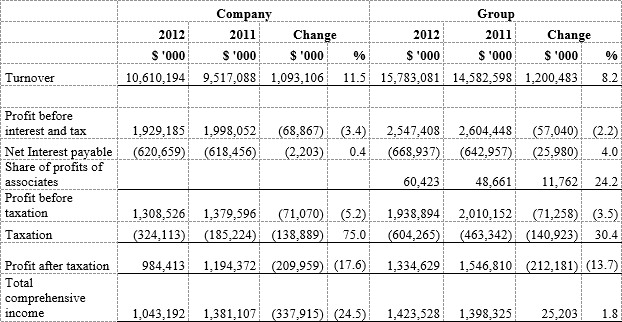
The Guyana Stock Exchange, itself stunted by conflicts of interest and a tolerance of a culture of weak governance among the handful of public companies, has been far from impressed with the group, attributing to it one of the lowest Price Earnings (P/E) Ratio. The consolidated financial statements show that turnover of the company has risen by 11.5% but that there were declines in profit before interest and taxes (5.2%), profit after taxes (17.6%) and total comprehensive income by nearly 25%. The combined performance of the subsidiaries was flat. Turnover (sales) increased from $5,065 million to $5,173 million, or by 2.1%, less than the rate of inflation. Profit before tax of the subsidiaries remained the same but after tax profits fell from $352.4 million to $350.2 million, a decline of 2.1%.
2013.04.21_Table1

A significant contributor to the change was explained in the Chairman’s Report as due to a “deferred tax charge of $230 million as against $65 million in 2011.” No explanation was given for this increase, nor do the financial statements give any hint, particularly since there was no significant acquisition in fixed assets, a major factor in making a provision for deferred taxes, as the tax allowance is very often significantly higher than accounting depreciation in the first year.

The important stock market consideration, Earnings Per Share (EPS) of the company fell from $1.55 per share to $1.28 per share dragging down that of the group’s EPS from $2.01 to $1.74 per share. However, with the way Guyana’s media overacts to absolute numbers, the market price for the shares has not been adversely affected. Or perhaps the market is responding to an increase in the dividends per share from $0.48 per share to $0.52 per share. Incidentally, someone in the company should tell the Company Secretary that Guyana abolished cents as a unit of currency in 1998!

Continue reading “On the Line: Annual Report 2012 – Demerara Distillers Limited”
On the Line – Demerara Tobacco Company Limited: Annual report 2012 – Conclusion

Introduction
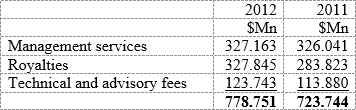
I closed last week by introducing a table which set out the transactions between Demtoco and other companies in the group. Of particular interest were the following charges:

2013.04.14_Table1

These charges are not only unusual for an entity that buys a branded product and does nothing else but sell that product to a single customer; they are also unlikely. The charges have two financial and fiscal effects. First, they transfer income from Demtoco to its group companies not in the form of dividends available to all shareholders. Second, to the extent that they are charged against income for purposes of the computation of taxes, they reduce the company’s taxable profits, and hence the tax payable by the company.

Continue reading “On the Line – Demerara Tobacco Company Limited: Annual report 2012 – Conclusion”

On the Line – Demerara Tobacco Company Limited: Annual Report 2012

Introduction
The Demerara Tobacco Company Limited (Demtoco), held its Annual General Meeting this past Tuesday April 2, 2013, kicking off the season of annual general meetings of Guyana’s public companies with a December 31 year end. All public companies are of course regulated under the Securities Industry Act and the Companies Act. And, too, they all fall to be taxed under the various tax laws of Guyana. Or do they?

70% of Demtoco’s shares are held by British American Tobacco International Holdings (UK) Limited which in turn is a wholly-owned subsidiary of British American Tobacco plc. (BAT), also of the UK. Cheddi Jagan, no slouch for an economist, used to love measuring the power of the international companies by comparing them with the size of Third World countries’ economies. He would have hated Guyana’s economy’s relative size compared with BAT whose turnover across the world is six times the GDP of Guyana.

Continue reading “On the Line – Demerara Tobacco Company Limited: Annual Report 2012”

Not a watershed budget for the poorer person

As Guyanese analyse the Budget for 2013 it is useful to compare some of the numbers with how they are presented and received. There is no group which has welcomed the Budget more than the Private Sector Commission, one representative describing it as our (PSC) budget.

Let us take the apparently straightforward example of the reduction in the rate of personal income tax from 33⅓% to 30%. Readers will note that not only do individuals not have the benefit like dependents allowances while companies are allowed to deduct almost all their expenses, but the individual is still paying the same or higher rate of tax than non-commercial companies do, that is 30%.

If we exclude the personal allowance of $50,000 per month an individual’s nominal and actual tax rate is the same: 30%. Compare this with say GBTI whose nominal corporate tax rate is 40% but which enjoys a host of tax shelters. Its effective corporate tax rate for 2011 is 26.82%. Shareholders of GBTI pay no tax on dividends while its employees pay 30%. Even if we say that the company and the shareholder are the same – which it clearly is not – the shareholders’ tax rate is 26.82%. That is inequitable.

But let us get back to the benefits of the reduction in the rate of income tax and the increase in the rate of NIS, both of which impact on take home pay, or as the PSC says, spending power. In dollar terms, for each $10,000 earned by the worker the tax saving is $333. It means this: the worker who was earning $50,000 per month at December 31, 2012 gets nothing out of the budget; one who earned $60,000 per month takes home $333; one who earned $80,000 takes home $680 more, etc. The earliest point at which the increased take home pay exceeds $10,000 per month is for employees earning $380,000.

Note that I have not taken the projected inflation of 3.5% for 2013 into account. If that is done the income level at which there will be a net saving is for employees earning $296,000 per month. All persons earning below that income per month will actually be worse off.

The PSC is right: this is a watershed budget – but not for the poorer person.

Keeping it in the Family

Introduction
For decades, perhaps in some cases even close to a century, family businesses have formed the backbone of the Guyana economy. Some of these, like Psaila Bros., Rodrigues Limited, the Wright Brothers (Russian Bear) Bettencourts, Elias and Sons, D. M. Fernandes Ltd., R. B. Gajraj and Sons Limited, Jaikaran’s Drug Store, may have faded out of national memory. Some are in transition such as A. Mazaharally & Sons Ltd., A. Amerally and Sons Ltd., Toolsie Persaud Limited., A.H. & L. Kissoon Ltd. and Rahaman Soda Factory Ltd. We recall too the name B. & J. Khan and Daughters suggesting no sons.

Then there are a few family businesses which have survived but are not particularly active such as C.R. Jacobs and Ltd. and Central Garage Ltd. Of the still surviving and active family businesses John Fernandes Limited is perhaps the most successful, and prominent, growing into, by acquisition and organic growth into a conglomerate although A. Gafoor & Sons Limited has grown into a huge operation in its chosen line of business. And let us remember too that Banks DIH Ltd started as D’Aguiar Bros Limited and that Bookers itself that once was the B in British Guiana was once Booker Bros.

Why some of those family businesses succeeded while others failed requires much more than a newspaper column and would make an interesting study for the resourceful student of the University of Guyana. Indeed, such a study would make for a good book.

Continue reading “Keeping it in the Family”