Commercial Registry making it more difficult and costly to do business in Guyana.

Dear Editor,

By a 2018 amendment to the Anti-Money Laundering…. Act, the Companies Act was amended to require companies to file with the Commercial Registry “relevant information of beneficial ownership on a regular basis or on demand from the Registrar.” Failure to do so carries an astounding “fine of not less than 10 million nor more than $40 million and to imprisonment for a term not exceeding three years.”

The amendment makes it clear that beneficial ownership means ownership by an individual of voting rights represented by 25% of the share capital of the company. Yet, the Commercial Registry is asking for particulars of beneficial ownership which is stated as a company and particulars of shareholders who own below 25%, clearly in violation of the law.

I have made representation to various interested parties and to the Commercial Registry. Instead of correcting its error, the Commercial Registry is doubling down, requiring not only the information on shareholders below 25%, but is now requesting a copy of the Directors Resolution. Apparently, the Commercial Registry does not appreciate that a resolution is an internal document while documents filed with the Commercial Registry are public documents. With a little bit of experience, the public officials would know that the preparation of beneficial ownership information is an administrative function carried out, even at the highest level in any company, at that of the company secretary.

Unfortunately, this is not the only irrational and unlawful request by the Commercial Registry. A couple days ago, they refused to accept a foreign passport as an ID because the person who migrated to Guyana years ago, “does not have a foreign residential address”. Then we hear that it is the FIU or some official from the AG’s Chambers.

The recently passed Guyana Compliance Commission Act gives the Commercial Registry even more powers and functions. Unless there is a drastic change in how such powers and functions are exercised, individuals and entities will find it increasingly difficult and more costly to do business in Guyana.

Christopher Ram

Anti-Money Laundering

Dear Sir,

Your very useful article on the findings reported in the interim report of the Caribbean Financial Action Task Force (SN 18/09/23) indicates that accountants and lawyers do not fully understand their AMLCFT obligations. While that is indeed so, I do not believe that it would be fair to attribute to the members of those professions all the blame for that situation.

One of the contributory factors is that despite the provision several years ago in Schedule 4 to the Anti-Money Laundering Act for the Minister of Finance to designate a Supervisory Authority for both accountants and lawyers, it is barely a month since a Compliance Commission was created and designated as that supervisory authority. And as of today’s date, that Commission is yet to be appointed.

While I do not speak for either profession, I have been involved in training and sensitisation programmes with both accountants, more than five years ago, and attorneys as recent as last Saturday. I believe I am right in saying that members of both professions understand the importance of their compliance for their professional standing and for the country. But they do have a right the question legislation which seeks to upend principles sacred to their profession, the society at large and the Constitution.

For fear of being named by the international Financial Action Task Force as a non-compliant anti-money laundering country, Guyana at times has shown an almost obsequious willingness to comply with all anti money laundering recommendations and principles on a one-size-fits-all basis. To the Government I would say that Anti-money laundering involves more than the Financial Intelligence Unit, the Police, various designated activities such as banking, securities and the financial institutions and supervisory authorities.

It should involve, among others, the Integrity Commission and the Guyana Elections Commission which have been derelict in their statutory obligations. It is an absolute disgrace that the Chair of GECOM would make the lame excuse that GECOM “never operationalised” the provision of the legislation regarding expenditure by political parties. Just thinking of the unaccounted, untransparent and unlawful transactions involving hundreds of millions both before and after the 2020 elections is frightening. And GECOM does not care.

And the FIU itself, the premier anti-money laundering state entity in Guyana, needs more resources to carry out its functions and obligations. Despite the plethora of AML legislation passed over the past five years, Parliament has not provided that body with commensurate resources. Bodies such as the Gold Board, the Forestry Commission and the GGMC would need to set up AML Units if they can properly carry out the functions of a supervisory authority. And might I add that in my opinion, it is inappropriate to the GRA to be designated as a supervisory authority.

I commend the Government for its commitment to ensure that Guyana remains an AML compliant country. The commitment must be matched by the provision of adequate resources and properly thought-out decisions, consultation and legislation.

Christopher Ram

Exxon’s mystery accounting

Maya Angelou, American literary giant and civil rights activist once said, “When people show you who they are, believe them the first time”. Unfortunately, when Esso showed us who they were from the first decade of this century, we not only did not believe them, but successive governments spinelessly conspired with them to cheat current and future generations of Guyanese of their patrimony.

A couple months after being awarded the petroleum deal of the 20th. century by the PPP/C in 1999, Esso claimed “force majeure” of the entire contract area of 26,808 sq. km because of an issue involving Suriname at one extreme of the contract area, claiming that they were prevented from carrying out their contractual obligations, presumably within any part of the contract area. What a brazen lie.

Yet, the PPP/C Government meekly acquiesced.

When in October 2008 after force majeure was lifted, Esso sought and the PPP/C entered into an Addendum to the 1999 Agreement, modifying the description of the contract area, the relinquishment obligation, and the initial period of the exploration programme.

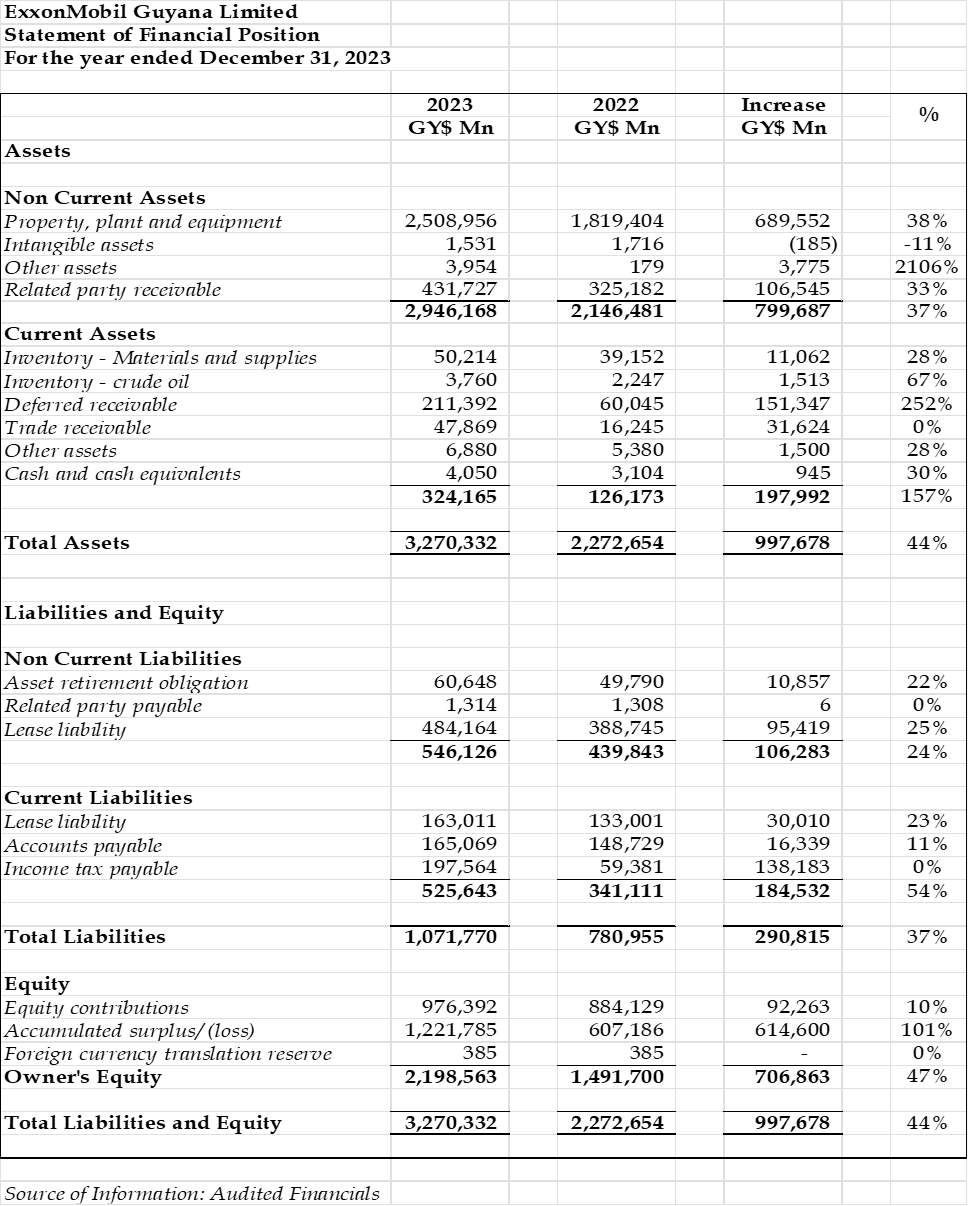
Esso never accounted in its local books for huge and undisclosed sums received from Shell under an assignment and Farm out Agreement in 2009 for a 25% participating interest in the Stabroek Block. That was dodgy accounting at best.

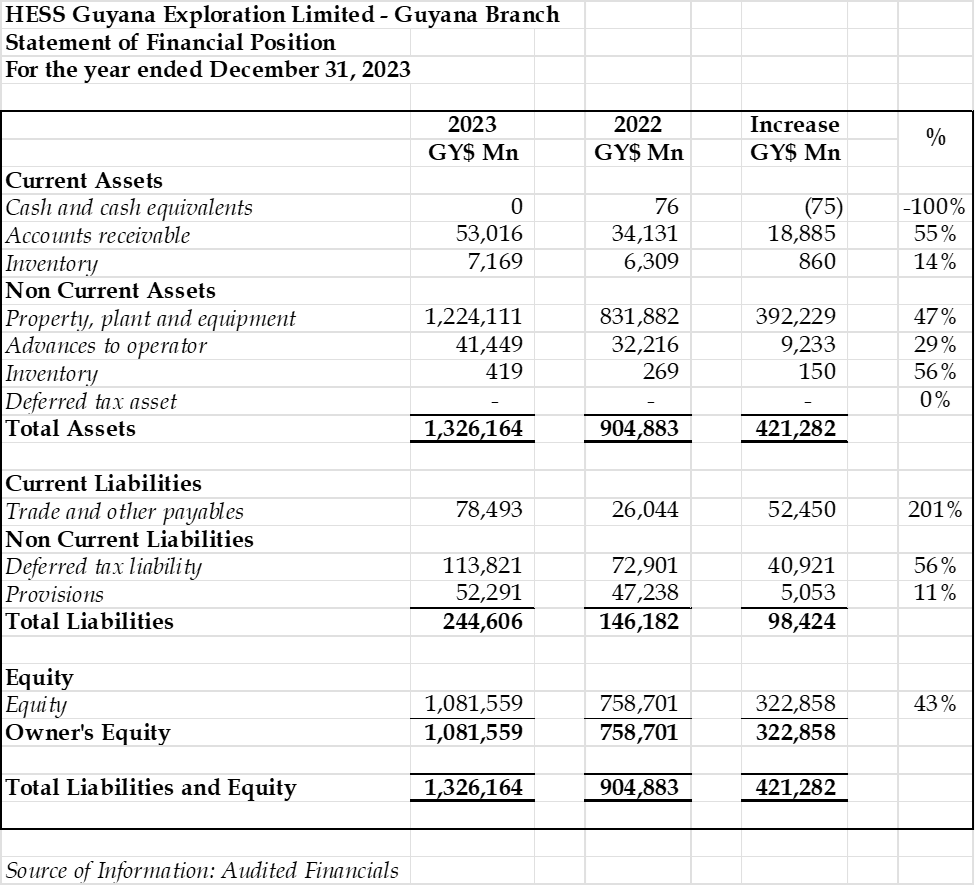
Having got away with that dodgy accounting, Esso repeated the fake accounting when in 2011, Shell forked out more money to double its participating interest. Those moneys never found their way in the books of Esso. Shell later withdrew and in 2014, Esso sold participating interests to Hess (30%) and CNOOC (25%) in the Block. Effectively, Exxon sold the same rights twice, but never accounting for it once.

Those revenues should have been accounted for as credits, thus reducing the amount of contract cost recoverable by Exxon. Who knows, Exxon may have recovered as much from Shell, Hess and CNOOC as they themselves may have invested. Exxon has made profits without even having to invest their own money.

In 2015, when a team from the Petroleum Unit of the GGMC headed by Commissioner Newell Dennison visited the Exxon’s Head Office in Texas to discuss then current issues, the bullies from Texas inhospitably told them that the only thing to be discussed was a new Agreement.

When Dennison complained to Petroleum Minister Raphael Trotman in a written Memo of being “confronted” on a new Contract, Trotman did nothing. In fact, his Ministry started working towards the infamous 2016 Petroleum Agreement – shockingly, with the help of Exxon’s top lawyers.

To give legitimacy to the new Agreement, a Bridging Deed was concocted to make the 1999 Agreement part of the 2016 Agreement. By Trotman’s own admission in his recent book, the so-called signing bonus was not a signing bonus at all, but a sum to pay legal fees partly to protect Exxon’s interest.

Trotman of course had denied any such signing bonus until the veracity and his duplicity and mendacity were exposed in the media. To this day, he has been unrepentant.

In the new Agreement, at paragraph (k) of Section 3 of Annex C, Esso and its accomplices claimed from the Government US$460.2 Mn. as the combined pre-contract costs incurred by Exxon, CNOOC and Hess up to December 2015. Embarrassingly, their own audited financials for that year showed they had only expended AT A MAXIMUM US$368 Mn. If that is not fraud, I would like someone to tell what is a fraud!

Trotman commissioned an independent investigation by a UK law firm Clyde & Co “into the circumstances leading to the execution of the 2016 Petroleum Agreement”. Their report is a damning indictment of Exxon which actually wrote for Trotman the Cabinet Paper seeking approval of the 2016 Agreement. Neither Trotman nor his successor Vickram Bharrat made the report public.

Additionally, despite the incriminating information of Trotman’s and the APNU+AFC’s conduct in the execution of the Agreement, the PPP/C has refused to hold an inquiry, presumably to protect Exxon from public scrutiny and the discovery and exposure of their accounting shenanigans.

Trotman has suffered the lion’s share of blame and ignominy for the giveaway of the country’s patrimony. But the PPP/C is no less culpable. It was the PPP/C under Janet Jagan that started the whole monkey business. And the PPP/C that allowed the generous force Majeure in 2008 when the current VP was President. It is the PPP/C too that has refused to take up the damning Clyde & Co report. And it is the PPP/C that has played around with the IHS Audit report issued nearly three years ago.

We are paying the price for not believing the character which Exxon showed us close to 25 years ago.

Truth eliminates ignorance

Dear Editor,

The protection of the public from untruths, half-truths, misrepresentations and distortions dictates that I make an exception to my unwillingness to engage Mr Joel Bhagwandin in any place or in any capacity. As shown in the examples set out in this letter, his multiple-part responses in the print and social media to my repeated assertions about Esso’s financial shenanigans are replete with those four dangers.

Mr. Bhagwandin cannot even get a matter as basic as the date of the 2016 Petroleum Agreement correct – it is 27 June 2016 and not October 2016 as he asserts – but yet claims that I am “misleading” the country; that I have committed “a multiplicity of errors”; and that I have “inadvertently considered” the 2016 Agreement in respect of Pre-Contract Costs.

In an apparent attempt to rebut my assertion that the US$460.2 Mn claimed by Esso and the Co-venturers as pre-December 2015 expenditure was overstated by around US$92 million, he omits from his extract of the relevant and critical words “all such costs incurred under the 1999 Petroleum Agreement prior to yearend 2015….” to identify the period for which the US$460.2 Mn is claimed.

The distortions and dishonesty do not end there. Mr. Bhagwandin claims to have obtained Esso’s financial statements for the period 1999 – 2015. That is most certainly a falsehood. Esso itself admitted to the IHS auditors that it had “purged data prior to 2004” in accordance with its document retention policy. Mr. Bhagwandin also claims receipt of audited financial statements of Shell, which had bought a 50% interest in the Stabroek Block. That too, is most likely a falsehood. As I am pointing out in my Oil and Gas column this coming Friday, the Commercial Registry has no record of any annual return filed by Shell, let alone any financial statements. I do not care whether Mr. Bhagwandin is singing to and for Esso and Shell. I am far more concerned with the litany of falsehoods and misrepresentations being fed to a trusting and unsuspecting public.

Mr. Bhagwandin also demonstrates some mathematical limitations by claiming that “Having examined ExxonMobil’s and its Co-venturers financial statements for the period up to 2016, and 2017, total (cumulative) expenses up to 2016 amounted to US$382.3 Mn. and in 2017, total expenses for that year amounted to US$109.3 Mn., giving rise to a total up to 2017 of US$491.6 Mn.” If Bhagwandin’s 2016 numbers are correct – which they are not – then he is suggesting that Exxon’s overstatement is greater than my US$92 Mn!

Whether Mr. Bhagwandin has read and understands the very provision in the Petroleum Agreement which he has so infamously misquoted, speaks to his comprehension. But there are also mathematical deficiencies on display as well. Only by the strangest maths – or inexplicable credits – can the accumulated cost at December 2016 be less than the accumulated cost at December 2015! Put another way, Mr. Bhagwandin is suggesting that the total expenditure for the two years 2016 and 2017 – immediately after the discovery of oil – was only US$31.4 million (US$491.6 Mn – US$460.2Mn). Even common sense would caution against such an absurd proposition. But nothing it seems, restrains Mr. Bhagwandin.

Mr. Bhagwandin has expressed a desire to debate with me on oil and gas. He will have earned such a privilege when he can demonstrate:

• that he understands the difference between GAAP and generally accepted accounting principles (one is capitalised and specific to the USA, the other is generic across jurisdictions), each with its own nuanced meanings and applications;
• that he is capable of understanding the difference between the Minister’s audit under Article 23 of the 2016 Petroleum Agreement, and the right of the GRA to carry out a tax audit of the returns of any taxpayer under the tax laws;
• that he has read and understands the (Guyana) Revenue Authority Act and critically, the powers and functions the Act confers on the Authority and on the Commissioner General;
• that he understands the legal concepts of intra vires and ultra vires;
• that he has read the IHS final audit report in which Exxon admits that its claim of US$460.2 Mn. of expenses prior to 2016 (meaning 2015 and earlier) is overstated by an unspecified sum, because of “items erroneously included in the cost bank”; and
• that he is capable of engaging honestly and quoting correctly.

Considering Mr. Bhagwandin’s demonstrated deficiencies in arithmetic, integrity, comprehension, analytical capabilities and legal and accounting questions on which seeks to pronounce, he is unworthy of a debate with anyone, and in my case, any further exchanges.

Christopher Ram

Every Man, Woman and Child in Guyana Must Become Oil-Minded – Part 110 – October 20, 2023

From Destiny to Prosperity Part 1.


Introduction


Today’s column begins the review of Trotman’s book From Destiny to Prosperity – the names of two of the first three Floating Storage and Production Offshore vessels (FPSO) in the petroleum operations conducted by the Contractors in the Stabroek Block, the other being Unity. The book explains that the choice of names was intended to reflect Trotman’s assessment of Guyana’s trajectory as a petrostate.


The book has 10 chapters and six appendices over 187 pages, each chapter representing an “individual episode in time and circumstance”. Appendix C is a report submitted to Trotman by Mr. Newell Dennison, the head of the GGMC, of a meeting he and his deputy attended in Texas at Exxon ‘s offices, a couple months before the signing of the 2016 Agreement. While the meeting was intended to be a technical meeting, Exxon not only raised contractual matters, but it also resisted reasonable points raised by the Guyana team. Whether or not it had any instructions to do so, the report by the GGMC team suggests that the team did not clarify that contractual matters were not part of the team’s remit.


Appendix D reproduces a statement by Minister of Foreign Affairs Carl Greenidge delivered on 14 December 2017 in the National Assembly on the issue of the signing bonus. Trotman’s narrative on the signing bonus is addressed more fully later in this review. Interestingly, Greenidge’s speech was delivered two weeks before the government finally released the 2016 Agreement, confirming a signing bonus. That statement is unsparing of this columnist, no doubt for having first exposed the payment of a signing bonus, two months earlier. Because this review is neither about Greenidge nor me, I leave the matter there, for now.


Motive


In a nine-page Preface to the book, Trotman sets out as his motive for writing it, the need for Guyanese to hear from him definitively on certain matters, that he does not set out to apologise but to explain, to give his side, his context, and even his defence to the “lies, half-truths, misunderstandings, misinformation and vile accusations that have been uttered”. In more restrained language, he explains that much of what he wrote is meant to provide the context surrounding the signing of the 2016 Production Sharing Agreement.


Describing his twenty-eight years in public life as both exciting and gut-wrenching, Trotman praises Presidents Hoyte and Granger for their patriotism, leadership and greatness. He explained “The Bahamas encounter” as a brief conversation in that country with Granger in which the latter set out his vision for Guyana and they shared their collective hope of a change from the “dark, divided and dystopian body politic of Guyana”.

Trotman also recalled that at a meeting at the Public Buildings after the 2011 election results had been declared, Granger proposed to Donald Ramotar, president-elect, that all the parties should come together and form a government of national unity. Ramotar recalls such a meeting but not the specifics of such a call.


Trotman acknowledges two mistakes by him that can prove fatal in politics – expecting others to come to his defence, and his failure to respond to critics.


Chapter 1: Becoming a Minister


In chapter one, the writer traces his political pedigree to his maternal grandfather and recounts his own career in public service covering city council, Member of Parliament, Speaker of the National Assembly and leader of the Alliance for Change, which in coalition with the A Partnership for National Unity won the 2015 elections against considerable odds. Describing Guyana’s democracy as poisoned by ethnic tensions and suspicions, Trotman considers himself as fortunate and blessed to have worked with two presidents, Desmond Hoyte and David Granger, who both possessed qualities of humaneness and greatness and from whom he learnt valuable lessons. While crediting David Granger’s integrity, intellect, and deep love for country, he stated that Granger was definitely not a politician.


Trotman acknowledges that it was Moses Nagamootoo who as a fellow UG student, first stirred his latent interest in politics. He also claims that despite having successfully managed the 2015 alongside Joe Harmon, his name was not submitted for a ministerial position under the terms of the Cummingsburg Accord between the APNU and the AFC. Instead, he was tipped to be named as an advisor and then, to his confusion and surprise, he learnt via a telephone call from a secretary that he would be named a cabinet minister with responsibility for the “national patrimony”, a term no doubt the brainchild of President Granger. Yet, by then, he had no call or conversation with the President, and it was Trotman who subsequently asked for a meeting with Granger.

It was only after several months of confusion that he learnt that he was also be responsible for governance issues, part of which was the writing of the code of conduct for ministers and members of cabinet. In a subsequent cabinet reshuffle, the portfolio of governance was transferred to Prime Minister Moses Nagamootoo while Trotman was re-designated Minister of Natural Resources, handing him what he describes as the “poisonous petroleum chalice.”


Chapter two: The Vision


In this , Trotman sets out the APNU+AFC’s vision for the natural resources sector which he credits entirely to President Granger. Granger had defined the Ministry’s role to be “ensuring the responsible exploration and exploitation of natural resources, land management, rivers and the sustainable mack, management of mines, forests and other natural assets.” In a nod to the political culture of Guyana, he discloses that he lost friends and valuable family relationships because of his inability to grant jobs to people without requisite qualifications and those who sought preferential treatment for the award of contracts and mining and forestry concessions.


Trotman claims as two areas of success Guyana’s signing on to the Extractive Industries Transparency Initiative (EITI) for which he gave kudos to Mike McCormack, the GHRA head, and the Youth in Natural Resources programme. In respect of the EITI, he expressed the belief that there were many then who opposed transparency, some of whom “still linger” and are now “more emboldened.” Such serious accusations without examples do an injustice to those who supported transparency.


Chapter 3: Putting Systems in Place


The writer lists the several government agencies for which he had ministerial responsibility, including Forestry, the Gold Board, the GGMC and the EPA, described by him as a” massive responsibility, and admittedly, unwieldly at times.” Of these, he described the GGMC, under which there has long been a Petroleum Unit, as the most difficult to oversee, functioning “almost with a mind of its own”. While claiming that senior officers of the GGMC were capable, he makes the not-too-subtle point that they were also suspicious of, and marginally resistant to change. Trotman also relates his concerns about rumours of impropriety in the GGMC, citing a specific example when he threatened the head of GGMC of calling in the Police over reports of corruption by “some misguided and unscrupulous GGMC officer.”


Another major challenge identified by him as “managing” the miners – over the tension between large and small miners, insufficient land for mining, raiding and illegal mining, and pollution and environmental degradation. The waning influence of the big miners following the discovery of oil was not in any way helped by President Granger’s description of the mined landscape in the hinterland as “abscesses”, and the efforts to assist small miners owing to the influence of Minister Simona Broomes.


Trotman recounts fewer problems with forestry and the gold and diamond sectors, noting the independence he gave chairpersons Mr. Stanley Ming at the GGMC, Ms. Jocelyn Dow at the Forestry Commission and Ms. Jocelyn Williams and later, Mr. GHK Lall at the Gold Board.


Next week’s column will focus on Chapters 4 and 5 – Interaction with Exxon and the 2016 Production Sharing Agreement.