Business and Economic Commentary by Christopher Ram Part 9

September 6, 2024

Introduction

Today’s Commentary returns to the saga of the Banks DIH Limited and its share exchange which has roiled the market, creating a huge problem for insurance companies, commercial banks and pension schemes. Meanwhile the company displays hubris, disdain and contempt for its shareholders, almost inviting them to go to court. Like the politicians, Banks claims that it “has the votes”, less than ten percent of shareholders by number – but with four shareholders accounting for 82% of the votes cast – to compel all shareholders to exchange their shares in a company that has operated successfully for 68 years to become a shareholder in a shell holding company.  

The manner in which the Company has gone about this Scheme of Arrangement is amateurish, without a proper understanding of the law, and violative of every element of transparency, shareholder relationship, basic communication and good corporate governance. In its haste to disenfranchise its shareholders, the company appears to have overlooked the definition of a shareholder to include “a person who agrees to become a shareholder and whose name is entered in the company’s register of members.” [s. 535 (u) (i) of the Companies Act[.

As if that were not bad enough, the company did not address in its application to the Court, or at the Special Meeting of the shareholders, the requirement of section 219 (1) ( e ) for provision to be made for any persons, who within such time and in such manner as the Co directs, dissent from the compromise or arrangement. It is regrettable and unfortunate that the Court did not appear to consider this vital minority shareholder protection in giving its approval of the Scheme of Arrangement. This oversight was compounded by an ex parte application from which the regulator, or any person acting on behalf of the minority shareholders, was excluded. Was this an accident, an oversight or a recognition that such a scheme, properly interrogated, had little chance of succeeding and its only recourse was this awful option.

Emboldened by its victory over unsuspecting shareholders, the company is now on a campaign of coercion to have shareholders exchange their shares in Banks DIH Limited for shares in a company of which they know nothing, and which is no more than a shell. But there is a truly consequential matter of law which the company appears not to know or understand: and that is that for the acquiring company, the pre-acquisition profits of a subsidiary are capital and not revenue. By allowing themselves to be duped into the share exchange, shareholders are giving up some $53,400 Mn. of distributable profits.

Alphabet/Google vs. Banks DIH/Banks DIH Holdings 

A couple nights ago, on a Private Sector Commission group chat, there was circulated, without comment or identity, the following:

‘Alphabet Inc. will replace Google Inc. as the publicly traded entity and all shares of Google will automatically convert into the same number of shares of Alphabet, with all of the same rights. Google will become a wholly owned subsidiary of Alphabet. Our two classes of shares will continue to trade on Nasdaq as GOOGL and GOOG.’

Whether this is a case of a “little knowledge” can only be speculated, but it seems that another PSC former official was the purveyor of the post. Surely context matters and Delaware, USA laws applicable to  cannot Alphabet/Google cannot be assumed to apply to Guyana. In fact, it is inapplicable. Here are some of the principal differences. The Alphabet and Google 2015 transaction was no sham restructuring, but a genuine separation of Google’s core businesses from its other more risky ventures and projects, such as self-driving cars. If not by design, but surely in effect, the only change is that pre-SoA Banks DIH shareholders are cancelled and become shareholders of a new holding company, a separate legal entity hiding behind what lawyers call a veil. Other than this unequal exchange, there is no restructuring with Banks DIH continuing to hold its subsidiaries, including Citizen’s Bank Limited and Banks Automative and Services Inc.

Another reason for the Alphabet/Google exchange was to increase transparency. In the case of Banks DIH Limited, the motive is the very opposite. No more would shareholders be able to ask questions about Banks’ procurement policies, or the logic of transactions passing through Florida on their way to Europe, or question the role of its directors, independent and non-independent. Under the new Arrangement, a handful of directors, including Banks DIH Chair and CEO, will form the entire Board of the holding company.

Regulatory oversight

The Alphabet/Google restructuring was subject to rigorous regulatory scrutiny by the U.S. Securities and Exchange Commission (SEC). Alphabet’s Form 8-K filing was highly comprehensive, with detailed financial disclosures, governance changes, and segment reporting. The regulatory filings included risk factors, pro forma financials, and extensive information to ensure transparency and protect shareholder interests. The Form had over one hundred Exhibits, full particulars of the directors and officers, compensation plan, Code of Conduct and Transfer Restriction Agreements with Directors.

Banks DIH went surreptitiously and directly to the Courts, bypassing the Regulator, not once but twice. And the only document of any relevance is a report used as the basis for the action which is hidden from shareholders because it is confidential. Again, I ask whether the battery of advisers is aware of section 140 of the Companies Act. Maybe it realises that compliance would require recognition of dissenting shareholders. Whatever it otherwise is, this is a clear case of contempt for shareholders and disregard for corporate governance.

Transparency  

Alphabet provided investors with detailed disclosures, including segment reporting and, likely, pro forma financial statements to help investors understand the financial implications of the new structure.

Banks DIH has offered none. Shareholders did not have any information to make an informed decision and those who supported the resolution were taking a shot in the dark, a leap of faith in a company whose share price slid from $300 in March 2022 to $108 in April 2024.

While the Scheme of Arrangement states that the new exchanged share will be listed at the price of DIH shares at the time of delisting ($180), the SOA states that those shares have been valued at $1 each! Maybe the directors will explain why a share valued at $1 will be listed at $180.

Retained Earnings

When Google restructured into Alphabet, Alphabet was not subject to any restrictions on retained earnings as is the case in Guyana. No wonder then, as the SOA has volunteered, the shares in the new holding company are valued at $1 per share.

Conclusion

Meanwhile, there is no trading in the shares of Banks DIH Limited while Thirst Park tries its best to persuade shareholders to exchange their shares, and to get the belated approval of the Guyana Securities Council. As other companies which have sought to privatise public companies, including J.P. Santos Limited and Guyana Stockfeeds Limited, Banks DIH Limited will never be able to reduce the number of its shareholders below 50, the “private company” requirement under the Securities Industry Act. So, there will be two public companies, Banks DIH Limited and Banks DIH Holdings Inc., one which is traded on the Stock Exchange, and the other not traded.

Did these companies not consider this possibility as well? Or will they now seek another Court Order by the ex parte route? One wonders whether in his sunset years, Chairman Clifford Reis and company will be able to fix the worst company law/corporate governance fiasco in Guyana’s history, all of their own making. Directors have two principal duties – a fiduciary duty to the company which encompasses its shareholders and employees as well as a general duty of care. It would be a colossal tragedy if these are sacrificed on the altar of anyone’s ego.
Business and Economic Commentary by Christopher Ram Part 8

July 12, 2024

Court woes for Banks DIH Limited

Court setback

Banks DIH Limited and its newly minted holding company Banks DIH Holdings Inc. (BDIHHI) had a setback of some significance in the courts in an action brought against the Guyana Securities Council. (See Stabroek News of Wednesday 9 July). Dissatisfied with the failure by the Securities Council to give speedy blessing to their efforts to restructure Banks business, the two companies, through a strong legal team, approached the court for judicial review. It was over the Council’s delay in endorsing a plan which would see the iconic company ceasing to be a public company and now to be owned by a newly created holding company. That plan involves shareholders in the long-established company exchanging their shares for the uncertainty of a newly minted, ill-defined holding company.

The decision by the court must have come as a total surprise to the companies which enjoyed a rather easy ride, obtaining a stage one approval without even notifying, let alone engaging, the Council. It was even easier at the level of the shareholders who offered overwhelming support for a scantily defined and hardly understood and communicated plan. A booklet circulated to shareholders selling the idea offered information that was at best unclear and imprecise, and worse, inadequate and troubling. As I think about it now, that document was as important as a prospectus but was subject to none of the stringent conditions of a prospectus.

The essence of the assurance to shareholders was that the move was part of a broader strategy to streamline the company’s corporate structure and meet evolving financial regulations. To achieve this objective, the directors of Banks DIH Limited would make the company into a private company, shielding its tons of retained earnings from shareholders. To do this, the directors needed the approval of the Securities Council to deregister the much-loved company. And that is when the problem started.

Ruling on favour of the regulator

The GSC’s position it seems was “not so fast”, asking the company for more information. It seems that this displeased the directors who approached the courts, arguing that the GSC’s actions were unreasonable, an abuse of power, and contrary to law. The court ruled that the Securities Council was indeed subject to judicial review, a process which involves an examination of the legality of the decision-making process, but not the merits of the decision itself.  Except for that small mercy, the court rejected the arguments of the companies and refused to grant the several orders sought. Accordingly, the court found that the GSC’s request for additional documentary evidence was both lawful and necessary, and found no evidence that the GSC failed to consider the applications or acted in bad faith.

The companies are now required to provide the Council with the information it needs within seven days after which the Council has a further fourteen days to decide on the application. I have deep concerns about the adventurous move by the directors and hope that the company will reconsider its decision. This is a poorly conceived plan and there is no doubt that quite a few shareholders are hoping that the directors are courageous enough to walk away from this extravagant idea.

Running out of ideas

Readers will recall that the very Council which the directors have vigorously challenged in court, was recently requested by the same directors to investigate the poor performance of the company’s shares on the Stock Exchange. Maybe the price fall is less about manipulation or small shareholders and more about matters which cause more than a little concern among shareholders. Maybe there is a link between the share price and the serious questions about the composition of the company’s board of directors – many of whom are not independent of the Chairman -, the routing of transactions with Europe via Florida at great cost to the company, the expensive, inflated share buyback in 2016, and the appearance that the company has run out of ideas.

With respect to the great plan, it would be useful for the directors to share their understanding and impact of the following provisions of the Companies Act dealing with dividends and retained earnings. .  

52 (5) “Where a particular company becomes the subsidiary of another company, any dividend paid to the other company out of profits of the particular company, acquired before it became a subsidiary of the other company, shall be treated as capital, and not as profits of the other company.”

53 “Where a company acquires all or enough of the shares of another company to control all of the other company’s activities, the pre-acquisition profits of the acquired company shall be treated as capital of the acquiring company.”   

Conclusion

Banks DIH Limited, once respected for its civility and decent conversation, seems no longer interested in open and respectful exchanges. Indeed, the decision by the Court included what it referred to as a postscript in which the tone of the exchanges, particularly by the company, was harshly criticised. But hubris is no substitute for good corporate practices. Banks as a company needs some serious reflection and retreats (pun intended). It needs a more enlightened and informed approach to management in the third decade of the twenty-first century. The structure has served the company well. If it ain’t broke, don’t fix it. Business is far more about business than it is about structures.

This project will have far more unintended consequences than the directors can imagine. This is no time for such risks.

Business and Economic Commentary by Christopher Ram Part 7

June 22, 2024

Banks DIH’s call for a suspension in trading in its shares

Introduction

Banks DIH Limited, a blue-chip company on the domestic scene, has asked the Securities Council of Guyana to suspend the trading of its shares on the Guyana Stock Exchange. While I am not aware of any precedent for such a request in Guyana, the request is often justified where there are concerns about unfair trading or market manipulation. In a circular to its thousands of members, the company’s Board of Directors expressed concern that there is a continuing pattern of an unusual reduction in the price of BDIH shares involving very small trading. It notes that for the period 2019 to 2023, revenue increased by 48.8 % and profit after taxation increased by 79.7 % but yet the Company’s share price declined from $300 per share in March 2022 and to $115 per share in May 2024. The Circular added that “such a comparison of the price of shares going down at the same time that profits are going up defies any logical explanation” and raises fundamental questions as to the integrity of the Stock Market. Even more strongly, the Circular added that “[A]ny reasonable person would consider that the Stock Market in Guyana cannot be taken seriously!”, with an exclamation mark.

An accusation of market manipulation is a serious one indeed, particularly coming from one of the country’s best-known public companies. What is worse is that the company appears to have formed its conclusions, even before calling on the Security Council to undertake an investigation of the reasons for the price movement and to “rectify the present state of affairs.” To put the small shareholders at some ease, the fall does not affect them and others who do not intend to sell their shares, but only traders, brokers, pension schemes and similar entities which are forced to recognise the loss in value.

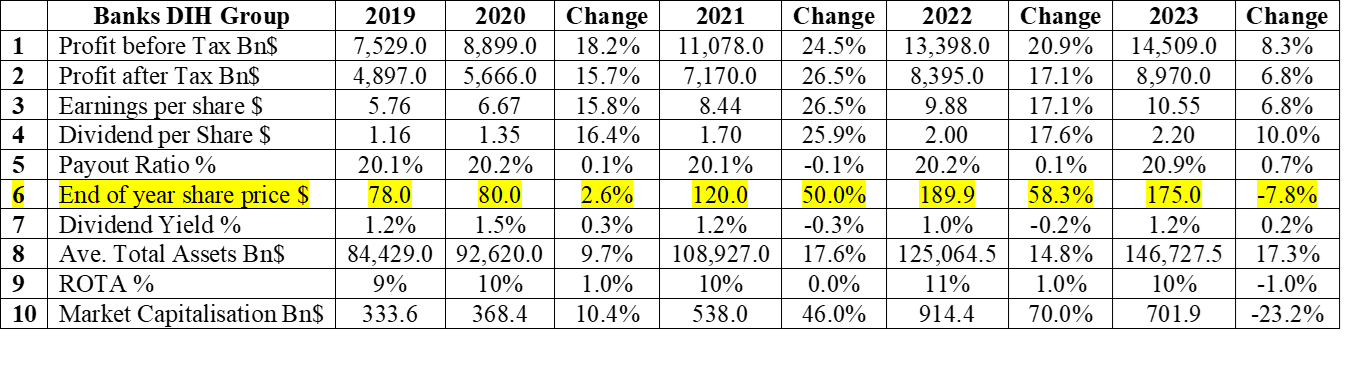
There is another side to the question of the share price of the company which this columnist has raised before. The significant increase in the share price over the period 2019 to 2023 was correspondingly much greater than its increases in profits, as reflected in the Table below, previously published by me as a letter to the Editor. (S/N 02 -02- 2024). Seeing their results as much as a public relations issue as a statement on their performance, companies take credit when their share prices increase but seek to avoid responsibility when they fall.

Source: Annual Reports of Banks DIH and GASCI website

The company should also address the historical, low dividend yield arising from the ownership of its shares and to offer an explanation and justification for the company’s policy of hoarding cash at the expense of shareholders. A small holding in the company is hardly worth the transaction cost for the modest dividends paid to its multitude of small shareholders, in three separate tranches. At the time of writing, I have on my desk three Banks DIH share certificates, one for 135 shares, one for 90 shares and the other for 910 shares, all issued by the company which the owner is offering for sale. Shareholders obviously have a right to sell their shares and if the company wants to stop small trades, then it needs to amend its by-laws and/or carry-out a large scale buy back of such small holdings.

Share price performance also reflects other variables. For example, the directors recently persuaded its shareholders to support the adventurous idea of converting itself into a holding company while making this iconic company into a private company. To borrow from the Circular, that step “defies any logical explanation,” but despite grave questions being raised, there is no indication that this move will not take place.

Observers are aware too that this company has been lukewarm at best on an effective Code of Corporate Governance and not only holds to a single person being the Chairman and the CEO, no succession plan and a majority of directors who are employees of the company and the Group. No wonder then that in relation to the ordering of goods from Europe through a company in Miami, the directors have opened themselves to charges of a breach of fiduciary duty to protect the best interest of the company. While one cannot be sure where this gross breach is on a scale with the accusation which the company is making against anonymous persons, to ignore such concerns only compounds the absence of responsible and proper governance in the company. For the company to be taken seriously, it must be willing to urgently review the governance and procurement practices of the entire group and to discontinue wasteful practices.

One final thought. While the company calls for the suspension of trading in its shares, it advises shareholders that their shares can be transferred at the Banks DIH Shares Registry, which would seem to be an avenue of share trading which is no more transparent than the issue being complained about.

Conclusion

It is true that the company has increased turnover and profits substantially over the years but its inconsequential revenue from exports shows the absence of any serious strategies and policies over those very years, or for the future. Investors in Guyana long for investment opportunities and look to the existing as well as new companies to offer fresh ideas and possibilities. Hopefully, the company will cooperate fully with any investigations by the Securities Council and the Stock Exchange. It must be prepared to share information on share activities by its own Share Registry and to actively support the efforts of the Securities Council to put in place a modern Code of Corporate Governance and Social Responsibility.

Business and Economic Commentary by Christopher Ram Part 6

March 22, 2024

Time for a fairer Compulsory Acquisition law

Introduction

As Guyana continues on its extensive infrastructural works to cope with a fast-growing economy, one area of law – compulsory acquisition of land – has been sidestepped and ignored, almost exclusively to the detriment of property owners. While the holding of property is a constitutionally protected right under the Guyana the Constitution, this country, in common with countries around the world, allows the Government, under strict conditions, to acquire private property. Under US jurisprudence, the concept is called “eminent domain.”  

The insertion of the term “public purposes” in the name of our law may be designed to take the sting out of the appropriating citizens’ property, while seeming to promote national development and patriotism. In practice, the law invites and paves the way for a very imbalanced relationship between the Government and the citizen with the Government using the coercive force of the law against the timidity of all but the well-heeled in society. In fact, many people whose lands are acquired are sufficiently intimidated by an army of officials and their entourage on being told what they will be paid, they just say yes. This then allows the Government to boast that it has consulted, praising those who are intimidated as patriotic and those who want adequate compensation as anti-progress and anti-development.

Yet, the very essence of how the Act maintains some of the more obnoxious features from ancient times is not only disturbing but would be considered unacceptable and appalling in any open democratic society. For example, the principle of market value which assumes a willing seller is a non-starter since the property owner is at least reluctant, while the so-called buyer is using statutory powers to get a deal. The owner hardly ever wants to sell, while the Government obtains title whether there is agreement or not. All for a sum that the “seller” will soon spend and go broke.

Guyana

The fact is that the Guyana Act is woefully deficient, having come down from more than one hundred years ago, with minimal amendments – some of it for the worse.Ironically, the only amendment for this century was railroaded to facilitate the gas-to-shore project. And let us not believe that this is a West Demerara problem. Land on the East Bank of Demerara is also at risk of being compulsorily acquired under the same project. Because our law firm represents two persons whose land is being taken away under this project and because one of the persons has taken legal action, I am unwilling to say anything much at this stage. What I can say is that it is ironic that a government that boasts about its working-class credentials is prepared to cheat many of its own supporters.

India

About ten years ago, India recognised the weaknesses in their similar legislation and passed a most progressive act – the Land Acquisition, Rehabilitation and Settlement Act. As a model, that Act is hard to beat and if the Guyana Government or the Opposition was truly alert, the Indian Act would be so useful as a model. Containing an extensive preamble as well as a statement of objects and reasons, the Act is designed to ensure a participative, informed and transparent process for land acquisition and appears to be a people-first enactment. Even as India anticipates industrialisation and the development of essential infrastructural facilities, the Act is intended to operate with the least disturbance to the owners of the land and affected families while providing just and fair compensation to affected families. In fact, the preamble regards those persons as partners in development, no worse off after the acquisition than they were before.

To start with, “public purpose” is comprehensively defined, so that government’s scope for  intervention in acquisition is limited to defence and certain development projects only. The nonsense of running highways through residential communities as the Government is doing in Prashad Nagar just outside of Georgetown is hardly likely to be permitted under the India legislation.

Elaborate protection

The Act requires that the consent of at least 80% of the project affected families be obtained through a prior inform process while the urgency clause permitted under the Act is limited to projects for national defence, security purposes and rehabilitation and resettlement needs in the event of emergencies or national calamities only. The Act also provides a comprehensive compensation package for owners and affected persons, including a solatium and a scientific method for the calculation of the value of the property.

An important feature of the Act is the requirement for a Social Impact Assessment Study, its public hearing and appraisal by an Expert Group of independent persons. In a nod to the rural and agricultural communities, that value is augmented by a factor of two in rural areas. The Administrative machinery too is quite formidable with consultations and defined roles for the Panchayats, Municipalities and Districts involving the Collector, Administrator, Presiding Officer, Judges and of course the Courts. Despite or because of all these features, India has some of the most interesting cases on the subject that would be most helpful in any review of the law.

The problem for the people is that the Government seems happy with a loose, ancient and unfair framework that works against the people.

Business and Economic Commentary by Christopher Ram Part 5

March 8, 2024

A Table of a Chart and a Graph

Introduction

Today I will deliberately use the Chinese aphorism that “a picture is worth a thousand words” with great effect. So, with two pictures, we start with two thousand words which takes me over my word limit. Some weeks ago, the Government announced that two historic cricket grounds and green spaces in Georgetown are being handed over to its Middle Eastern friends from Qatar and their exclusive clientele for the paltry sum of $2 Bn, or less than US$10 Mn! Forget for a moment that the President and Vice President seem incapable of distinguishing between the State and the Government, or that selling in the absence of a robust valuation was their alleged ground for wanting to jail former Finance Minister Winston Jordan.

As dessert, VP Jagdeo, who is no stranger to tax holidays, indicated that the Qataris will have a 10-year tax holiday! We recall that about fifteen years ago, Jagdeo publicly insulted the late Yesu Persaud for being ignorant of the tax laws when the icon asked for equality and equity of tax concessions. Yet, any ignorance was on the part of Mr. Jagdeo who had extended concessions to his friend Dr. Bobby Ramroop, which the law did not allow. Mr Jagdeo showed no embarrassment or contrition over his error but rushed to change the law to accommodate Dr. Ramroop.

The wealthy poor

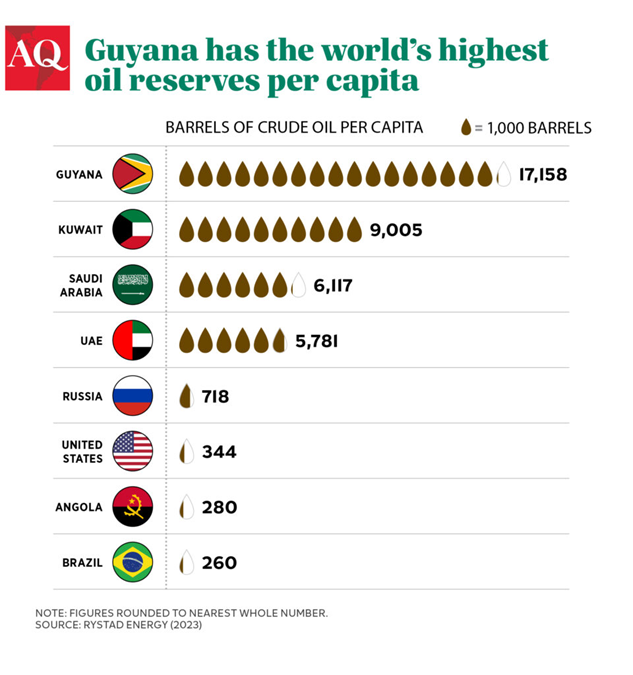
Let us look at the two charts. The first is by energy consultants Rystad Energy (which is duly acknowledged) showing that Guyana now has the highest per capita petroleum of any country in the world. And by far. Even if we estimate the population to be 800,000, it means that each Guyanese has a claim to 16,250 barrels of oil, the value of which at roughly US$80 per barrel, means that every man, woman and child is worth about US#1.3 Mn! For the moment, let us forget that Exxon and the Government are concealing several additional billions of barrels from Guyanese. Of course, these are gross values from which expenses have to be deducted, as they are for every other country on the chart. By any measure, however, that is a lot of money.

Sadly, these numbers seem to mean nothing to this Administration or to suggest to them that there ought to be a better revenue sharing between Guyana and the oil companies. Nor does It stir them that Guyanese are still queuing for freeness, teachers have to strike for better pay, and the working struggle to make ends meet even as the oil companies take a disproportionate share of the patrimony of the people and their officials live a life that would make the British Raj envious.

Tax to GDP ratio

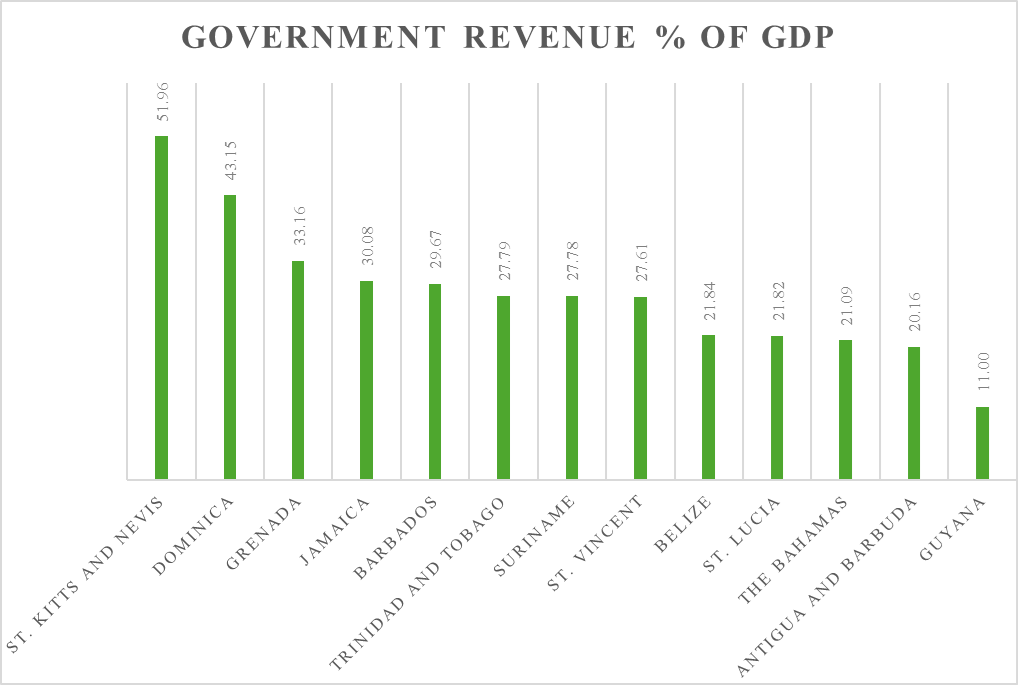
Now for the second graph. It shows the tax collected by the central Government relative to the gross domestic product of the country. By this measure, Guyana has the lowest tax to GDP ratio across the entire Commonwealth Caribbean countries. It further tells us is that Guyana collects even less tax as a proportion of GDP than the near-tax free countries of the Caribbean. Guyana’s ratio is about a quarter of Dominica’s, a third of Grenada’s, and about half of Antigua and Barbuda’s, its nearest comparator.

Source: International Monetary Fund Website. All percentages are stated for 2022 except for Guyana which is stated for 2023.

It is difficult to accept that Guyana’s economic managers can believe that oil revenues displace the need for taxation and that we can go handing out tax concessions to any friend or flatterer. That is the President’s chosen role in the economy. He gave away huge tax concessions to the CPL cricket extravaganza – outside of the law – and continues to do so whenever he brings regional artistes to entertain the masses.  

But the VP will not be outshone. He has taken it upon himself not only to give away state land without any consideration of its implications for the national interest but also tax holidays to persons who have neither applied for nor are entitled to them. The Income Tax (In Aid of Industry) Act is clear – it must be for “new economic activity of a developmental and risk-bearing nature”. It seems that neither the Vice-President nor the President has any respect for the laws or resources of the country, or the intelligence of its people. 

Guyana recently entered into a Double Taxation Treaty with the United Arab Emirates that is all one-sided. That has not even made the news. But now, completely outside of a treaty, the Qataris enjoy exceptionally cheap land, irreplaceable resources, no taxes and the red carpet. This cannot be rational, responsible or reasonable. It is more like recklessness and drunkenness with power. Or is it the resource curse?