Hand-in-Hand Trust and the Brassingtons – Conclusion

Introduction
Today’s column completes a three-part article looking into the operations of this non-bank, deposit-taking financial institution as well as its murky relationship with the brother of a related party. Neither the company nor Mr Winston Brassington has responded to the claim by this column that by virtue of NICIL’s 10% shareholding in the Hand-in-Hand Trust (HIHT/the company) Winston and his brother Jonathan are guilty of using insider information in a substantial share transaction with the company.

It is instructive that all of this has surfaced even as we hear from the US that Rajat Gupta, who reached the pinnacle of corporate America was this week convicted of leaking inside information to his friend hedge-fund manager billionaire Raj Rajaratnam, who is himself serving an 11-year jail term for using insider information. Of course, as we say, this is Guyana where suspected corporate wrongdoings go uninvestigated, let alone prosecuted as we have seen in Globe Trust, Clico, NICIL and others.

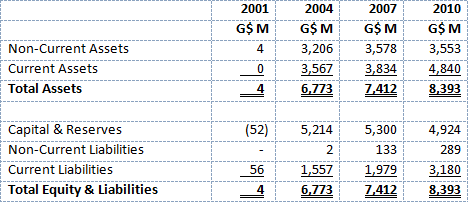
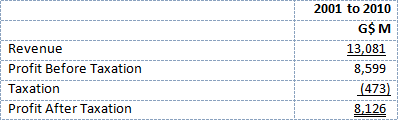
In this concluding part I turn attention to the annual report and audited financial statements of the company Hand-in-Hand Trust Corporation Inc for the years 2007-2011. Here is a summary of the income statement extracted from the audited financial statements.

Over the five years the company’s after tax losses amount to $650 million of which $1,179 million arose from losses on investments, mainly in Stanford Investment Bank and to a lesser extent, Smith Barney, the US brokerage and investment banking house. In fact if a questionable gain on disposal to its parent of its only long-term asset is discounted, the losses incurred by the company over the period would be an astounding $900 million. Whoever decided on the Stanford investment has imposed on the company and by extension the insurance company with a huge loss overhang. Indeed had it not been for the very convenient sale and lease back of its office property, the company would have recorded a pre-tax loss of $158 million in 2011.

There are two reasons for considering the gain questionable: one accounting and the other law. The company entered into a sale and lease back agreement with its majority shareholder of its Middle Street premises. Ignoring relevant accounting standards, the company has failed to disclose the terms of that agreement and dismissed my own query to them for particulars of the transaction.

The balance of probability is that this transaction constitutes a finance lease and accordingly, the gain on disposal ought to have been deferred and recognised over the life of the lease. Recognising the $264 million gain therefore appears improper or aggressive revenue recognition and may have been entered into as a device to improve the company’s capital base for purposes of the FIA.

The legal reason is whether or not the company should have sought shareholders’ approval of the transaction under section 140 of the Companies Act which requires both a quantitative as well as a qualitative test for determining whether or not section 140 applies. With Hand-in-Hand Trust and its parent the Hand-in-Hand group sharing a common CEO – Keith Evelyn – the transaction without approval of the minority shareholders, is less than wholesome.

Other income comprises mainly fees charged for the seven pension plans with a combined balance of $14.9 billion at December 31, 2011, mortgage fees and management fees. On the expenditure side, the company has managed its expenditure well with a 21% increase between 2011 and 2007. There was a spike in the 2009 expenses because the financial statements were for an 18-month period, a change not mentioned in the directors’ 2009 report.

The company’s accounts show regular recoveries of doubtful debts and reversal of diminution in value of properties which have mitigated the other substantial losses incurred by the company.

Compensation
The practice among companies paying comparatively larger sums to its key management personnel is evident with HIHT which paid an average in excess of $1.2 million per month to this group, estimated at more than eight times the average of the rest of the staff. Perhaps more significantly is the 8% per annum interest rate which the company charges its staff.

The financial statements do not indicate the actual rate of interest charged on a director’s (sic) mortgage which at December 31 was a whopping $95.9 million compared with staff mortgages of $7.0 million. According to the notes, “[T]he rates of interest and charges have been similar to transactions involving third parties in the ordinary course of business.”

Balance sheet
The balance sheet too raises some concerns in addition to the treatment of the sale and lease back arrangement. One person very familiar with the measurement of capital adequacy has expressed some scepticism about the company’s computation of the Tier 1 capital adequacy which the accounts claim stood at 31% at December 31, 2011 and total tier 1 and tier 2 capital of 35% and the comparative 14% in 2010. What is certain is that a significant part of an increase would be attributable to the sale of the building which released hundreds of millions in capital reserves. A realised gain is obviously more valuable than one that is unrealised.

Nor do I think that the amount of $778.0 million shown as Term Deposits is properly described since a significant portion of this relates to recoveries in CLICO Trinidad, but which are in the form of bonds maturing several years hence. The related parties balance is a sum receivable from the company’s parent for the sale of the building.

Other risks in the balance sheet include some of the investments in which there has either been a judgment or the filing of legal action. These can result in some losses to the company. On the other hand, if the stock market in the US does improve then some of the Smith Barney losses will be reversed, creating a gain.

The company’s non-accrual loans to total loans has declined from 28.8% in 2007 to 5.2% in 2011, allowing the company to reduce its loan loss provision from 8.4% to 1.5%. That percentage is as good as most other financial business in the country. As Darren Sammy would say, that is a good thing to take into 2012. Deposits have declined from $7,206 million at June 2008 to $5,708 million at December 31, 2011, a decline in excess of 21%. The company also saw the number of pension schemes under management reduced by one during the period.

I must also comment again on the issuing of preference shares and their redemption within one month of the balance sheet date. As noted last week, there is some doubt whether the redemption met the statutory requirements.

Conclusion
In mortgages, the company competes with the New Building Society which enjoys tax exempt status, and the larger financial houses with a far greater income base over which to spread their expenditure. For its trust business to succeed, it will have to attract what are called high net worth individuals. In this regard, its main competitor is probably Trust Company Guyana Limited which has the benefit of being a member of the DDL group which includes two public companies, of which one is a successful bank.

There also seems to be a lot of room for improvement in ethical and governance conduct at the senior level. It was dismissive if not insincere in its response to my written questions while itself having been treated very kindly by the regulator which has not been known for strict insistence on accounting and reporting. Even as the company seeks to expand its income base by entering the lending business, it needs to consider its risk profile and to learn from its Stanford experiences from which it still has not recovered. And at a wider level, the company must be hoping that the high real estate prices can be sustained.

The company faces a challenging future.

Hand-in-Hand Trust and the Brassingtons – Part 2

Introduction
Notwithstanding the caption of this article, the first part in last week’s Business Page dealt not with the Hand-in-Hand Trust Corporation Inc (HIHT/the company) but with Winston Brassington and his brother who Winston boasted had saved HIHT from the fate of Clico. I explained then that instead of using any speculative language with potentially adverse consequences to the company I would write the company for specific information and/or clarification on the company’s financial statements, the impact of its investment in Stanford Investment Bank, the directors’ efforts to rebuild the company’s capital base and its relationship with the Brassingtons.

Following receipt of my list of twenty-one questions, Mr Hewley Nelson, the company’s Managing Director and its finance officer visited me to give some explanations on the financial statements which are audited by Maurice Solomon & Co. Mr Nelson was as helpful as he could be, clarifying some of the disclosures in the financial statements and conceding that the notes to the financial statements could have been more explicit. I was told that persons “higher-up” would address me on the several other issues raised in my correspondence.

In the circumstances, I was optimistic about a factual and candid response from a company whose very survival depends on its own transparency and the public trust. Unfortunately the response communicated to me was disappointing. So be it. At the appropriate points in this column I will refer to the partial exchange which took place.

Jonathan Brassington
Let us start with the Brassingtons and the 2,250,000 shares issued to Jonathan Brassington in 2009. The general law and practice regarding the issue of new shares is to offer them first proportionately to existing shareholders so that the balance of control is unaffected by new issues. If this rule of pre-emptive right was followed, the offer of the shares would have had to be made to Hand-in-Hand Insurance group (90%) and NICIL (10%), leaving no place for Jonathan – or indeed anyone else – unless some shareholder(s) had passed up on the offer. To ascertain this, I asked the following questions:

Do the articles of Hand-in-Hand Trust Corporation Inc (Company) provide for pre-emptive rights on the issue of new shares?

How many shares were offered to the Hand-in-Hand group for the 2009 issue?

Was a prospectus or information package issued for the 2009 share issue? If yes, can I be provided with a copy?

How was the company informed that a Mr Jonathan Brassington might be interested in taking up shares in the company?

Was Mr Jonathan Brassington permitted to carry out a due diligence prior to his application and who carried this out on his behalf?

The company’s response – signed by someone who is certainly not among the higher-ups – that “All our shareholders were examined and approved by the Bank of Guyana” matches Dan Brown’s Da Vinci Code for mystery, complexity and improbability. I consider it perfectly proper to conclude that the company is willing to conceal the details of its transaction with the Brassingtons which many find improper and unlawful. That does so little to help strengthen the company’s reputation for integrity when under pressure. Or indeed for that matter of the Bank of Guyana which had not previously distinguished itself in its supervision of Globe Trust and Clico.

Hoops of circumvention
Readers and the public have a much better memory and sense of integrity than they are often credited with. They will recall how Mr Keith Evelyn, group CEO of the Hand-in-Hand Group including HIHT, took the country through a series of meandering hoops of circumvention after the news broke about the company’s investment in Stanford Investment Bank (SIB). Here is the sequence to which I add my comments.

On February 21, 2009, Mr Evelyn confirmed that the Trust Corporation had investments in Stanford International Bank (SIB) but said that “they are not substantial … and efforts are being taken to safeguard against possible losses.”

Four days later President Jagdeo publicly revealed that HIHT’s exposure to the Stanford group amounted to $827 million (US$4 million) and another to $297 million (US$1.5 million) invested on behalf of pension funds. As CEO of the group Mr Evelyn’s description of the investment as “not substantial” cannot be dismissed as ignorance on his part. Even the understandable motive to prevent any run on HIHT, a deposit taking financial institution, ought not to justify the misrepresentation contained in Mr Evelyn’s February 21 statement.

At that point the quantum and impact had been set straight, or partially so, by Mr Jagdeo – who himself understated the significance of the loss to HIHT by an inappropriate reference to its total assets and his description of the institution as having a “capital adequacy ratio of 26.9 per cent as at the end of January 2009.” But clearly not straight enough for Mr Evelyn who one week later announced that even in the possibility only of HIHT losing its investment in Stanford, it would remain a stable and safe institution. Yet, in the same statement about HIHT’s strength, Mr Evelyn announced that the Hand-in-Hand Group of Companies had submitted for the Bank of Guyana’s approval a plan to “restore HIHT’s capital adequacy.”

Neither Mr Jagdeo nor Mr Evelyn has ever explained why it was necessary to restore something that was never less than strong, that was above the industry average and above statutory requirement. Characteristically, Mr Evelyn announced that since approval might “take any time between two weeks to three months” the restoration plan could not be released to the public. It actually took the Brassingtons’ deal to bring some sunlight to the whole episode.

Poor standards
Then finally, two days later, unable to hold the fort weakened by damning information available to the world but only belatedly acknowledged by HIHT, Mr Evelyn announced in Stabroek Business that the investment in Stanford was “a loss and we’ll have to record it as a loss, that is what any prudent institution would do.” Had the institution recognised the need for such prudence and transparency earlier, maybe we would have been spared the loss of more than US$5 million.

The institution has clearly recovered from the imminent dangers it faced post-Stanford. But it seems not to have overcome the institutional and national culture of secrecy and evasion so pervasive in the corporate world. Here was a unique opportunity for the directors, including Chartered Accountant Paul Chan-a-Sue, Dr Ian McDonald, banker Alan Parris, Charles Quintin and Mr Timothy Jonas of de Caires, Fitzpatrick & Karran to let Mr Evelyn and his management team know that the HIHT was moving on to higher ground – ground on which is imposed on directors a statutory fiduciary duty to act honestly and in good faith with a view to the best interest of the company and a general duty of care to others, including in this case depositors. That specifically with respect to financial institutions, there is a fit and proper test that directors should meet. Mr Evelyn’s conduct appears to have fallen below those standards and the directors should have long since confronted this issue. Instead, they follow his lead refusing to give direct answers to questions on matters of public and depositors’ interest.

With the silence of the Bank of Guyana and non-interest by the Financial Intelligence Unit (the anti-money laundering agency) or the Registrar of Companies which has the power under section 506 of the Companies Act to apply to the court for an investigation order in respect of the shareholding in any company, the matter of the Brassingtons would appear to be closed to the public. In the case of the Bank of Guyana, the HIHT’s directors claim that the company’s shareholders “were examined and approved” by the central bank.

The lesson from the Brassingtons
We are unlikely ever to know whether HIHT’s parent company refused to take up the new shares in HIHT, whether a prospectus or issue memorandum was issued by HIHT for the 2009 share issue, whether Brassington, Evelyn or other directors approached Jonathan Brassington, and who carried out the due diligence on Jonathan’s behalf before he undertook his only public investment in Guyana. Their answer also puts a lid on the identity of the two pension funds which lost some $297 million of their funds under HIHT’s management. No doubt no one will ever be held responsible.

But before leaving the Brassingtons, just a brief comment on Winston’s claim that his brother rescued HIHT from a Clico-type collapse. The actual increase in the share capital was $500 million of which the Hand-in-Hand Group contributed $270 million, Jonathan Brassington $225 million and NICIL $5 million. This means that the HIHT group gave up a chance to take up $180 million of the new shares while NICIL gave up their right to take up $45 million – those shares were all taken up by Jonathan. Winston Brassington’s assertion that Jonathan saved HIHT can only be correct if no one else, including the HIHT group or NICIL was not prepared to take up any of those shares and if those shares were crucial to the restoration of the company’s capital base. That too we will never know, nor why the Bank of Guyana had not taken steps to suspend the licence of the company when the Stanford investment wiped out its capital base.

The number of shares available for take up by the shareholders, the amounts given up and the impact on capital is shown in the following table:

Another issue about shares
On August 24, 2011 the company had another share issue; this time in the form of 150 million preference shares approved by a resolution of the company to which are inscribed the signatures of Marcia Nadir-Sharma on behalf of NICIL and Winston Brassington on behalf of his brother. While these are only $1 shares, the proceeds did make the 2011 balance sheet look even stronger, adding another $150 million in stated capital.

While any concern about window-dressing could not be supported by available facts, the company’s failure to mention the redemption in a note to the 2011 financial statements as a post-balance sheet event, does not help the company. Indeed, that failure is compounded by another failure to make any reference to this 2011 share issue in the section Background on page 1 of the 2011 Annual Report which ends abruptly with the 2009 share issue.

The law requires that preference shares can only be redeemed out of a fresh issue of shares for the purpose of the redemption, or out of profits available for distribution. At December 31, 2011 the company had accumulated losses of $171M and there is no information that suggests that there was a fresh issue of shares to finance the redemption.

To be continued

Note: Ram & McRae acted as advisor to the Privatisation Unit on the privatisation of the GNCB Trust in 2002. The issues raised in this column all relate to events which took place at least seven years after that engagement came to an end, and are all matters in the public domain.

Hand-in-Hand Trust and the Brassingtons – Part 1

Introduction
I intended to start today a two-part column on the recent disclosures on Hand-in-Hand Trust Corporation Inc. I wanted to evaluate the annual reports of the company and do an examination of the role played or not played by Mr Winston Brassington and his brother Jonathan Brassington in what the first Brassington described as “saving the company from going down the Clico road.” Ideally I would have preferred to consider the company’s financial position prior to its becoming another victim of Allen Stanford’s high profile Ponzi scheme, its performance since then and its current financial position, before addressing the role of the Brassingtons.

I am in possession of the company’s 2011 annual return, report and audited financial statements which I think raise some serious questions which in the interest of the public and more specifically of depositors of money in HIHT need to be answered. But aware that too many unanswered questions about a financial business can have serious consequences, including the loss of confidence in the institution, I will seek first some clarification from the company before commenting on the company’s performance and condition. Of course I am not unaware of the reluctance of the company and especially its point man Mr Keith Evelyn to avoid the press when things are not going well. On this occasion, such an approach is foolhardy and counterproductive and must be discouraged by the board chaired by the more enlightened Paul Chan-a-Sue.

Winston’s rescue
The board must surely recognise that Winston Brassington’s famous rescue statement was intended not to defend the Hand-in-Hand Trust but solely to counter strong public suspicions that he had misused information acquired in his official capacity for the benefit of his brother. In fact, what he did say amounts to an indictment of the Bank of Guyana as financial sector regulator, as well as the standards of governance in HIHT of which one of the country’s oldest insurance companies is a controlling shareholder.

That $225 million can save a company which was a victim of one of the region’s most high profile Ponzi schemes suggests either that there was in fact no real problem in the first place – an unlikely proposition given that the company’s equity base had been completely wiped out – or that the rescue was not as solid or deep. If the latter is the case, then the company’s financial problems and its damaged capital base might merely have been deferred rather than solved.

In a long interview given to the Stabroek News Mr Brassington side-stepped the question of whether his brother Jonathan Brassington benefited from insider information before investing in HIH Trust by stating that he had done nothing illegal or unethical. Adding that the government company of which he Winston is head, had ceased to be represented on HIHT’s board from 2002 onwards, he disclosed that he and his entity “only had access to information which a normal shareholder would have access to – annual reports.” For good measure, Winston added that “the financial institution’s business is confidential other than what is in the financial statements.”

Memory lapse
In this matter, Mr Winston Brassington either suffered a critical memory lapse or is simply dissembling. Any increase in a company’s share capital requires an amendment to the company’s articles by way of a resolution passed at a shareholders’ meeting. This has nothing to do with the company’s annual report. As the representative of the government’s 10% shareholding in the company, Mr Winston Brassington would have received a notice of the meeting and a copy of the proposed resolution to increase the company’s share capital.

Mr Brassington is also reported as saying that he had sought to clear his action by writing to the Minister of Legal Affairs and Attorney General and to the Minister of Finance. He said that both of them had responded that they found no conflict of interest in his brother taking up shares in the company. Again, Mr Brassington might wish to reflect on the fact that conflict of interest is not how honest one might think one is, but whether there is in the mind of the ordinary person the perception of a conflict. The fact that Mr Brassington sought out what he might have considered independent opinion suggests that even in his own mind there was a perception of a conflict.

Exchange

To ensure maximum fairness to Mr Brassington, early last week I sent to him the following email:

Dear Winston,

I propose writing on Hand-in-Hand Trust this weekend and would be grateful if you would provide me with a response to the following:

1. a) Did Jonathan learn that HIHT was looking for investor(s) by way of any public announcement by HIHT?

b) If the answer to a) is no, did you approach him and if so in what capacity?

c) Does Jonathan have any other major investment (over $25 million) in Guyana?

2. Did you play any role in Jonathan’s due diligence investigation in HIHT? (This does not mean that there would be a conflict.).

3. Do you hold a power of attorney for Jonathan in respect of his shares in HIHT?

4. Did the Attorney General and Dr. Ashni Singh provide you with written responses to your request for advice on whether or not there was or was likely to be a conflict of interest?

Thanks and I am again extending an invitation to you to come on Plain Talk.

Christopher Ram

To which Mr Brassington responded as follows:

Chris:

I have already responded to many of the relevant issues on this matter.

Regards

WB

Insider information
More developed markets and economies have been grappling with the phenomenon of insider dealing for decades. These almost invariably deal with the use of information by “insiders” a term generally defined to mean directors and officers but which in some cases includes a 10% shareholder as NICIL is in Hand-in-Hand Trust. The rationale here is that of the fiduciary obligation imposed by law on those in a position of trust, an obligation owed in any case to the company and not to any shareholder or member of the public.

Guyana’s general laws on the use of insider information are not well developed and any progress appears to have ceased with the Securities Industry Act 1998. The 1991 Companies Act was an improvement over the Companies Act it replaced, but as far as insider trading goes, it deals with the concept only in respect of narrowly defined transactions and persons. The Financial Institutions Act and the Securities Industry Act are both limited in their scope and only to companies within the ambit of those two Acts. The FIA’s provisions deal with conflicts of interest involving directors and officers and the disclosure of customer information, while the SIA defines “insider” to include a person (an outsider) who is informed of a material confidential fact by an insider.

This is not unlike the UK Criminal Justice Act 1993 which creates a distinction between a primary insider (a person who has direct knowledge of inside information) and a secondary insider (a person who learns inside information from an inside source). Under this definition, Winston Brassington would clearly be, at the very least, a secondary insider, except that the SIA deals only with a certain kind of company.

Wrong advice
But even applying private laws as Dr Luncheon (“NICIL is a private company”) and Mr Brassington (“I did nothing illegal”) seek to do, Mr Brassington may in fact be considered an insider. The general perception is that he made use of confidential information (an offer) which was not available to members of the public.

More relevantly, the persons who are reported to have supported or defended Mr Brassington including two Attorneys General, a Finance Minister and a medical doctor fail to recognise that his conduct has to be judged against the specific circumstances involving a public officer and a state company in which matters like conflicts of duties and duties are as likely to arise as those of conflicts of interest and duties in a private sector setting, which the Companies Act addresses. It would be unfair to expect Dr Luncheon and possibly Dr Singh to know that the framers of our Companies Act had explicitly rejected the Companies Act as the medium under which government companies should operate. That concession is certainly not available to any Attorney General.

A different dimension
But it suits their purpose to look at these general laws rather than whether Mr Brassington’s role was tantamount to misconduct in public office, which is a common law offence. Few would ascribe to the Guyana Police Force any capacity to recognise any breach of the Companies Act let alone pursue such a complex matter of misconduct in public office which seems relevant to this issue. Nor would they be able to count on the office of the Director of Public Prosecutions which appears to suffer from a crisis of confidence about its ability and capacity. In any case, the Attorney General Mr Anil Nandlall has already pronounced, gratuitously and wrongly in my view, that there is no conflict of interest.

It ought not to come as a surprise to Mr Brassington’s assurers that a recent West Indian book, Corruption: Law, Governance and Ethics in the Commonwealth Caribbean written by Derrick V McKoy, a former Jamaican Contractor General deals extensively with the question of such misconduct. What I found surprising is that in the nascent Caribbean jurisprudence, there is already a useful body of case law on the subject.

Conclusion
As the Ombudsman of Victoria Australia wrote in a paper recently sent to me, he finds particularly troubling the widespread, mistaken belief that a conflict of interest is not of concern if there is no actual wrongdoing. He noted that the ‘perception’ of a conflict of interest – even when the conduct of a public officer is nothing short of exemplary – is as damaging to public trust as any misconduct.

The Guyana State Corporation of yesteryear has effectively been replaced with nothing. There is a vacuum in the governance of state-owned companies particularly in key organisations where ministers and their surrogates play a dominant role. Mr Bharrat Jagdeo has left a legacy of weak, corrupt or no governance. Things will get worse, particularly as the state increases its participation in the economy. The deafening silence of regulators in the face of calamitous developments in Globe Trust and Clico will almost certainly guarantee that they are not the last of the country’s financial failures.

We need to have rules of governance of state-owned or controlled enterprises. The head of one state body should never be placed in a position where he or a family member has to use their personal resources to save a regulated financial business as the Brassingtons claim to have done. The OECD has published a model Governance of State-owned Enterprises which we may find helpful. Let us use it.

Next week I will review the annual reports of Hand-in-Hand Trust Corporation Inc.

Note: Ram & McRae acted as advisor to the Privatisation Unit on the privatisation of the GNCB Trust in 2002. The issues raised in this column all relate to events which took place at least seven years after that engagement came to an end and are all matters in the public domain.

On the line – Guyana Power and Light, Inc, 2007-2010

Introduction
Amidst the din and controversy of ‘to cut or not to cut’, Guyana Power and Light Inc, the country’s number one, state-owned electricity supplier was voted the sum of five billion dollars in the 2012 Budget. This is $1 billion less than requested by the Finance Minister as a 2012 budget measure. It is a topsy-turvy world for GPL. In 2009 the company reported profits after tax of $1.8 billion and at December 31, 2010 the company was sitting on cash resources of $2.8 billion, perhaps the highest ever cash balance reported by any Guyana company outside of the commercial banks.

As this column surveys the operations of the company over the four years 2007-2010, a scenario emerges of a yo-yo performance with losses of $1.6 billion in 2007 and $1.9 billion in 2008 and profits of $1.8 billion in 2009 and $553 million in 2010. And nine months after reporting the cash hoard, taxpayers in 2011 were forking out $1.5 billion from the increasingly abused Contingencies Fund in subsidies.

Chairman Winston Brassington explained, or rather excused the significant 69.4% fall in 2010 profits from 2009 as largely on account of an increase in fuel costs of $3.5 billion above 2009 costs of $13.1 billion. This is surprising because the company has been spending massive sums to reconfigure its plants to enable it to use the lower cost Heavy Fuel Oil (HFO). And with some success: raising HFO use to 80% in 2010. The word is that the problems might lie much deeper than the cost of fuel and may have something to do with huge bungling at the Cane Field operations in Berbice. But that is supposed to be a secret.

Losses
In his 2010 report, the Chairman speaks of a 3% reduction in technical and commercial losses which he attributed to overall efficiencies from the implementation of the new US$3M customer information system, meter change-out programmes and efforts to reduce thefts. If the 2011 figures confirm the reported 3% decline, that would be very good news. Particularly since the 2010 performance is in spite of an increase in technical losses from an estimated 13.4% in 2009 to 14.3% in 2010, which the Chairman attributes to the “distribution and transmission network reflecting its age and limited capacity relative to demand.”

Total generation in 2010 was 626 GWh (gigawatt hours) of which GuySuCo Skeldon – using Wartsila generators – supplied GPL with 60 GWh, with the remaining 566 GWh being produced by GPL. Of the GPL portion, 441 GWh (78%) was generated by GPL owned, but Wartsila operated units and 125 GWh (22%) from GPL owned and operated generating sets. Surely this makes it all the more troubling that the company maintains perhaps the highest paid set of top management in any company in Guyana – an average of ten million dollars per annum for 29 employees – including arguably the highest paid CEO in the country.

Over the period peak demand has ranged from 94.8 MW in 2007 to 100.6 MW in 2010 while available capacity has been 124 MH in 2007 to 124.3 MW in 2009 and 121.5 MW in 2010. The company does a poor job therefore of load planning and/or explaining why across the country consumers have to face outages with such irritating frequency.

Income statement
Here are some extracts from the income statements for the years 2007 to 2010.

Turnover has increased over the four year period by 33.8% while generation cost has risen by a smaller 17.6%. Indeed generation cost in 2007 was 85% of turnover and in 2010 it was 74.9%. According to the Chairman the revenue growth reflects the increased number of customers and volume, as well as a portion of the loss reduction benefits flowing into revenue.

Employment cost as a percentage of turnover was 12.8% in 2007 but declined to 8.8% in 2010. It is an interesting statistic that 3% of the employees account for 16% of the employment cost. No wonder then that the Chairman in his 2010 report explained the remuneration of the management team is “reflective of international standards.” Reflecting the increasing share of outsourcing, employment numbers fell by 30% between 2007 (1320 employees) and 2009 (912 employees) but rose again in 2010 by 94 to 1006 employees.

Interest cost has declined from $403 million to $90 million as the government seems to absorb increasing sums of debts for the company and converts net liabilities into equity on which any returns are looking extremely unlikely in the foreseeable future.

The only payment of taxes reflected in the company’s cash flow statement is a sum of $77 million in 2010, despite the substantial profits in 2009 and 2010 and the charges for property taxes in each of the years 2007 to 2010.

Balance sheet
The company’s net equity position has increased from $8.2 billion to $12.0 billion while its fixed assets have increased from $11.2 billion to $16.8 billion, or some 49%. With the company’s billing system improving, the $4.8 billion of accounts receivables on a turnover of $26.6 billion, or 66 days worth of sales, is still high. But that $4.8 billion is net of $6 billion provision for bad debts, excluding related parties balances. That makes the collection situation desperate with the provision for bad debts at 60% of customer account balances.

The Chairman reports that collections were 99.6% of 2010 billings which would suggest that the bulk of the accounts receivables is irrecoverable and will have to be written off. Since the provision has already been made such action will have no impact on the income statement.

Another account receivable under serious doubts is the related party balance of $791 million net from the state partner-in-need GuySuCo. Any payment of this balance in the near future will have to come from the government, which really means the taxpayer.

On the liability side the company is shown as owing some $22 billion, with the prospects of actual cash outlays being about $15 billion, mainly to the government for the use of PetroCaribe funds, Infrastructural Development Project and an IDB loan and to third parties of another $3 billion.

The question which the National Assembly should have asked is how much of the $5 billion subsidy will be going to pay operating debts and how much to capital expenditure which is being partly financed by the Chinese and to a lesser extent the IDB.

Theft
Much is made of the efforts to stamp out electricity theft. The company is looking at the wrong places. Yes, there are some working class areas where theft is indeed rampant. But it takes only one businessman to steal the electricity consumed by 500 hundred and more small consumers. What is worse the company knows who the real thieves are but they are some of the country’s “reputable” business persons – the same ones who dodge corporation tax, pay their employees under the table, convert VAT to other income and who will run to the courts pleading their innocence! If we want to deal with electricity theft we have to deal with the real thieves, not the small thieves.

Conclusion
If the situation is seen to be bad now, Amaila will make it worse. The company can now sell only around 600 MWH. Yet it has to guarantee the purchase from Sithe Global of approximately 900 MWH. It will have to pay for that at the switch, whether or not it can sell the power. When Amaila comes on stream, GPL will still have to keep its own plant and that of Wartsila as the back-up. GuySuCo will find that GPL no longer needs it. Leguan and Wakenaam will have to continue operating as they do now. The current costs being met by GPL will not disappear.

The prospects for GPL are not good. Its GuySuCo receivable balance is in jeopardy. Its recent survival has been due to the grace of the Consolidated Fund. Its management has failed to reduce one of its most expensive costs – commercial losses – because they are looking in the wrong direction. The company has spent billions on transmission and distribution without any noticeable results. Lured by Chinese renminbi, it is taking on some huge debts not related to Amaila. These will have to be serviced. Amaila will simply be too heavy a burden for GPL.

But then its Chairman Winston Brassington is also the executor-in-chief of NICIL which will impose Amaila on GPL – whether they like it or not. Or whether there is a conflict or not.

On the Line: National Communications Network Inc. (2004-2006) and Guyana National Newspapers Limited (2006-2008)

Introduction
Last week we sought to conclude our review of the financial statements of NCN for the three years from 2004 to 2006. Readers will recall that NCN recorded losses in each of the three years but massaged each year’s loss into a profit as a result of subventions from the state. Such operating subventions came to an abrupt end with President Ramotar’s assent to the legislation withdrawing $81 million of proposed subvention although an amount of $65 million has been approved under the Office of the President for capital expenditure for NCN.

I commented last week on the poor quality of the information contained in the audited financial statements as well as on what appears to be unacceptably poor audit quality by Mr Deodat Sharma, long acting Auditor General. NCN does not show segmented information derived from its distinct operations such as Television and Radio, and it was not therefore possible to analyse the information presented. Using the revenue numbers for 2006 and applying available television hours only, the recovery rate hovers around 20%. If, as must be the case, part of the reported revenues is derived from radio then something is seriously wrong with the marketing, management, finance and production departments of the company.

It boggles the mind that an entity that generates revenue of more than half-a-billion dollars, that enjoys very known tax concessions, that has access to all the material of the government‘s formidable information capacity and that has not had to meet any economic or commercial test, cannot make a profit. But let us move on to the Guyana National Newspapers Limited, the printers and publishers of the Guyana Chronicle which boasts on its masthead that it is the country’s most widely circulated newspaper.

GNNL
In my research for today’s column I found that the company had very recently submitted to the Registrar of Companies its 2007 and 2008 financial statements and reports contained in a single good quality report that fails to identify its printer. While welcoming the apparent attempt at improved filings with a view to eventual compliance with the law, one must still wonder why the filing for 2007 was not done ever since the audit report was issued in October 2008. This comment applies too in respect of 2008, the audit report for which was issued since November 2009.

One cannot be sure why the Chairman Keith Burrowes, an advocate of accountability, would have held back on the 2007 report in which he reported on exceedingly favourable performance by the company and failed to address for 2008 some of the operational challenges facing the company, including a balance sheet that does not show a true and fair view. Surely any responsible chairman would follow the advice of his auditors and make some provision against doubtful debts.

Big loss
In his 2008 report he simply acknowledged the loss and then looked for its causes. What he failed to explain however is how in the space of one year the company can turn a profit of $26.2 million into loss of $7.3 million. To be fair, the directors do state in their report that the concept of good corporate governance has become one of the company’s cornerstones, and that it has an internal auditor who reports to the Chairman. The legal advisor is listed as Ms Jaya Manickchand who enjoys political connections with the government and who was recently made a Gecom Commissioner by the PPP/C.

Despite the welcome appointment of an internal auditor, one of the first things to note is that the audit report has moved from a clean opinion in 2006 and 2007 to an adverse opinion in 2008 in which the auditor indicates that the company’s financial statements do not give a true and fair view of the company’s financial position, its performance and its cash flows for the year. This extreme position was taken by the auditors because of the uncertainty that some $50 million shown as receivables will be collected. If these, as the auditors fear, are not recovered then some 18% of the total assets of the company will have vanished.

The Board it seems is in denial about these balances, and one must wonder how many are political debts for the 2006 elections or for the supply of newspapers to government agencies and departments, which are practically imposed. At some point the company has to bite the bullet or the auditor may have to withdraw from the engagement.

Significantly, there are no notes on related party transactions or balances making the claim of good corporate governance hollow, even by way of discussions.

Statement of income

Source: Audited financial statements

As the table above shows revenue has fallen in both 2007 and 2008 with a reduction in revenue in 2008 of $2 million per month, or roughly 7%, or 10% over the two years 2006 to 2008. In 2007 the company cushioned the $14 million fall in revenue by reducing expenditure by $20 million, as a result of which profits almost doubled. By contrast, in 2008 expenditure actually increased while sales declined, the classic double whammy.

According to Chairman Mr Keith Burrowes, the increase was due primarily to higher raw material costs which account for 23% of total expenditure, fuel and electricity 6% and labour 41%. The company must be one of the few entities that has managed to reduce their electricity/fuel costs, doing so by a whopping 18%. The company too, must be one of the first public sector entities in recent times to engage in voluntary staff reduction with the labour force declining from 117 employees in 2003 to 93 in 2008, or the equivalent of one lay-off for every five! Labour cost in the same period has shown an interesting curve dipping between 2004 and 2007 but then jumping by 15% in 2008. Average annual employment cost per person increased significantly over the period:


Source: Chairman’s report 2008

What was also noticeable was that even when the company slashed the number of staff from 102 to 92 in 2007, its salary bill declined by a mere 2.4%, suggesting that it was the low level staff who were terminated.

Statement of financial position

Source: Audited financial statements

I have already referred to the concerns of the auditors about the receivables figure which must inevitably include substantial amounts owed by government agencies. I would add another caveat and that is in relation to the level of inventories which showed a 51% increase in 2008 over 2007, from $37 million to $56.0 million. The company’s circulation is falling to what would normally be considered unsustainably low levels, and one has to speculate on the rationality of buying newsprint when the prices are at one of their historic peaks. In any case, unless the entire industry in Guyana and abroad has it wrong, the company’s inventory holding makes no commercial sense.

For a full four years, the balance sheet of the company has been carrying a dividend payable figure of $18.1 million and one must wonder why the Privatisation Unit/NICIL, which claims to consolidate GNNL’s financial statements into its own, has not taken up these dividends given that they became legally due when passed at the relevant AGM.

Falling circulation
But with all the deniability of its receivables and the uncertainty about its inventories, the real story of GNNL is best told in its circulation numbers. On page 25 of the 2008 annual report there is a chart intituled Circulation Average (2004-2008). While the directors deserve credit for this disclosure, the manner in which the time series run is misleading. The numbers on the left of the chart are the lowest and instinct would lead one to think that the upward movement to the right points to higher circulation in the later years. Alas, it is just the opposite. The reader reviewing the chart from right to left soon realizes that the circulation has in fact been falling and the bars on the left – the lowest – are the most recent, ie, up to 2008. A clearer presentation is as follows:


Chart: Circulation figures 2003 – 2008

A closer look at revenue from newspaper circulation reveals an average 33% discount on the cover price which might be considered high for the industry. To add to the effective cost, the company spends almost 25% of net circulation revenue on circulation costs and therefore incurs total costs of almost 50% on the cover price. Advertising income represents 64.9% of total income in 2008 compared to 59.9% in 2006 and no doubt a substantial proportion of that income is from government. But there is a complete lack of disclosure of related party transactions from which one would have been able to determine the exact influence on the company. These are some of the issues which Mr Burrowes chose to side-step.

Conclusion
This review has highlighted the many failings of the accounting and auditing of the two major commercial communication arms of the state. The fuzzy accounting at NCN was below even the most modest standard of acceptability while the financial statements of the Chronicle company have been certified as wrong and misstated.

Chronicle is heading for some real challenges, while the NCN will soon be forced to run like a business. Unfortunately, given the number of years in arrears, Guyanese will have to endure many more annual reports before we have an insight into how they cope.