The Minister of Finance has kept his Budget Speech promise to come back to the National Assembly to a) raise the debt ceiling b) to revise upward the NRF withdrawal rule and c) saving an increasing share of the inflows into the Fund. Earlier yesterday, via the Fiscal Enactments (Amendment) Bill 2024 – a format which is typically utilised for amendments to tax legislation – the Minister delivered more than even his most optimistic supporter would have expected.
As the Table below shows, the Minister has increased the borrowing ceiling for Public (Domestic) Loans by 100% from G$750,000 Mn. to G$1,500,000 Mn. and the borrowing ceiling for External Loans by 66.7% from G$900,000 Mn. to G$1,500,000 Mn.
Debt Ceiling – Guyana Millions of Dollars
Years
Pre 2021
2021
2022
2023
2024
% increase 2020/ 2024
Domestic
150
500
500
750
1,500
900
External
400
650
650
900
1,500
275
It means that since the PPP/C came to power in August 2020 they have increased the domestic debt ceiling by 900% and the external debt ceiling by 275%. By any measure, even for the fastest growing economy in the world, these are staggering increases, with obvious consequences. The domestic debt reported in the Budget Speech at December 2023 was $569,913 Mn. which means that he can borrow as much as $931,000 Mn. more on the domestic market. The 2024 Budget showed that the Government proposes to borrow in 2024 some $189,522 Mn. (net) from the domestic market and $206,394 Mn from external sources.
The Minister is giving himself a massive borrowing space both from local and external sources. It would be interesting to see the private sector responds to this proposal which can crowd out local borrowings and possibly carry up the cost of capital.
The NRF
Contrary to the statement in the Budget Speech, the proposal by the Minister to increase the automatic withdrawals from the NRF will significantly reduce what is left for intergenerational savings and for expenditure stability in periods of downturn. To give one simple example, after US$2,000 Mn. of earnings from profit share and royalty, only US$50 million would be saved under the new arrangement, compared with US$750 million under the replaced formula. Let us take it further but expressed another way, savings of US$1,710 million would have been saved from earnings of US$3,000 Mn. under the existing system. Under the new proposal it would require earnings of US$6,000 Mn.!
The Minister has delivered on his promise to increase the borrowing ceilings and NRF withdrawals. Understandably, he has not been able to achieve the trick of withdrawing more and saving more at the same time.
Ram & McRae expressed concern in its Budget Focus that it is dangerous for any Government to treat the NRF like some ordinary piece of legislation. Sadly, that fear has been realised.
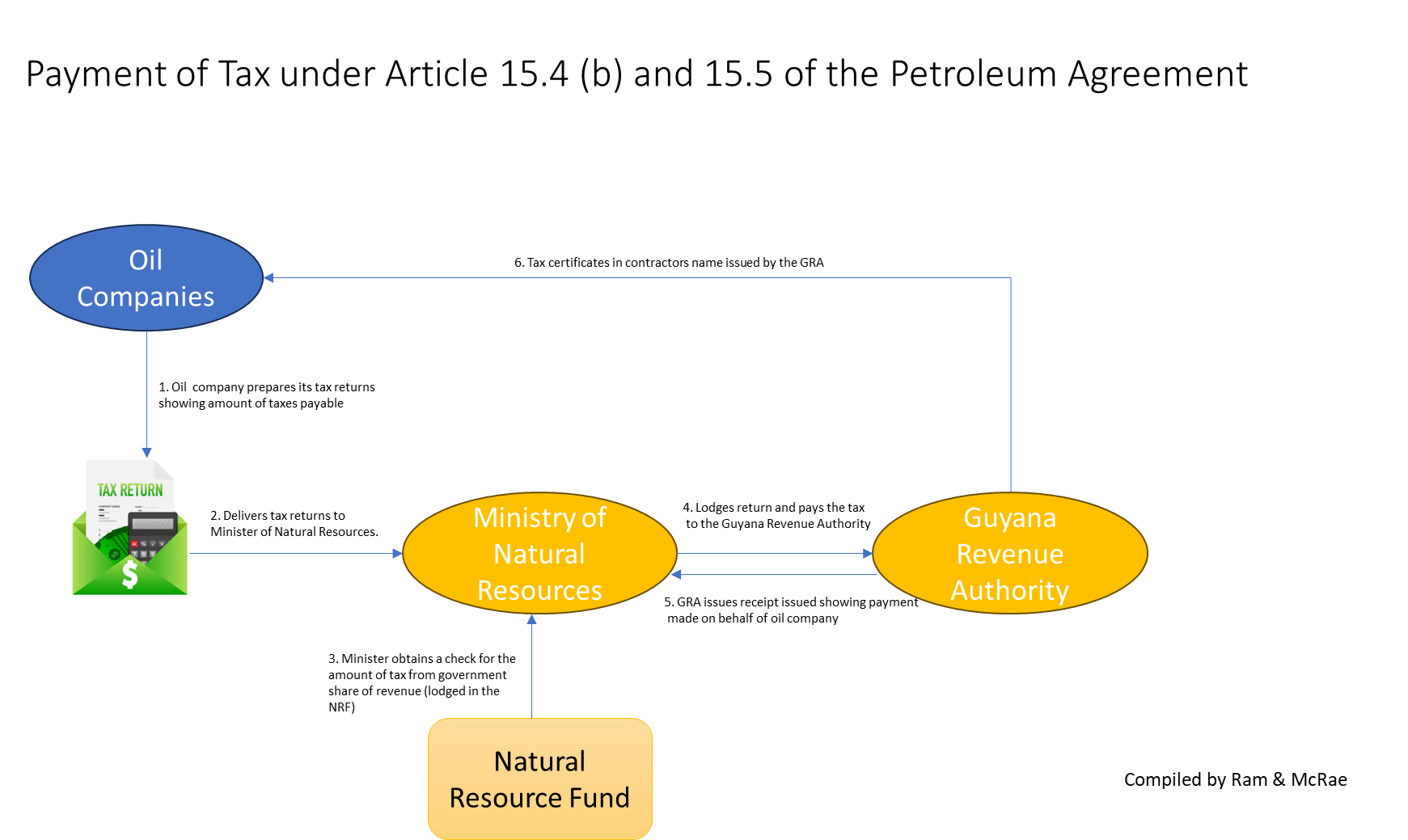
We recall from Column 119 that while the tax is paid by the Government of Guyana, the oil companies receive from the Guyana Revenue Authority ‘proper tax certificates’ in their names. These certificates are not some paper transactions but grant to the oil companies real economic value and substance since they produce them with their tax returns in their home countries as evidence of having paid those taxes and received a credit therefore. Just as a reminder, the current tax rate applicable to oil companies as a non-commercial company is 25% of their taxable profit.
Other tax goodies
This brings us to another tax benefit. Under Guyana tax laws, subject to any Double Taxation Agreement – which in any case does not apply to any of the oil companies – the remittance or deemed remittance of profits is subject to a withholding tax of 20%. The benefit of the exemption from withholding tax – for itself and its affiliated companies, (cousins and all!) – which is seen from this simple example: a Guyanese resident abroad who owns and leases her house in Guyana for an annual rental of G$100,000 will have to bear Withholding Tax of $20,000 on that amount. If for some reason, the Government agrees not to enforce that obligation, that person benefits from $20,000 – without a receipt! The value of the receipt is an additional benefit.
The 2016 Agreement provides that the oil companies are not subject to any “tax, duty, fee, withholding, charge or other impost, applicable on interest payments, dividends, dim dividends, transfer of profits or deem remittance of profits from contractors, affiliated companies or non-resident subcontractors branch in Guyana to its foreign or head office or to affiliated companies.”
As shown in the table, the value of that benefit is 20% of the 75%, or 15% .
Exclusive of the corporation tax receipt to the Government (into the Consolidated Fund from the Natural Resource Fund), but inclusive of the tax benefits to the oil companies, the Government gets 39.5% and the oil companies get 90%. If we include the tax receipt to the Government, the Government gets 52% while the oil companies benefit to the tune of 90%.
As the Table shows, regardless of what is included or excluded, the oil companies receive far more from their operations in Guyana than the Government of Guyana does, ranging from 1:1.6 to 1:2.3. Or we can put it another way. For every barrel of oil Guyana gets, the oil companies can receive twice as many. Regardless of how it is computed, or what is included or excluded, our total gross share is 9.1%. It is simply amazing that any Guyanese would accept, let alone defend this atrocity.
Net versus gross
One final point. The receipts by the Government are gross of expenses. The oil companies walk away with pure economic value, including the cash proceeds from their share of profit oil. Out of its earnings, the Government has to meet all the expenses of the administration and oversight of the sector. These include the Ministry of Natural Resources, the Environmental Protection Agency, the ministerial audit, the use of the court system to fight Guyanese seeking a fairer deal and better contract administration.
This in no way is intended to suggest that the country has not benefitted from the production of oil. One only has to look at the national budget of which oil revenue accounted for 36% of budgeted revenues in 2023, and significant foreign exchange earnings from which the country benefits. Against these, the economist would consider the externalities arising from oil production. But that is outside the scope of column written by an accountant.
The debate of 50:50 profit share has blinded Guyanese about the obnoxious scale of generosity offered to Exxon and why it is so resistant to talk of renegotiation. Not only do the oil companies not pay any Corporation Taxes, but they walk away with a certificate for the taxes and are exempted from any taxes in Guyana – right up to 2057! Given that this is a post-discovery contract which should not have been awarded in the first place, it might possibly be the worst oil contact ever!
When Exxon threatened Newell Dennison in April 2016 at its Texas campus with no investment without a new Agreement, these were the benefits it wanted to secure. When Brooke Harris, Exxon’s top official, was bombarding Trotman and Legal Officer Ms. Joanna Homer of the Ministry of Natural Resources Ministry, with emails, the objective was no different. When Harris drafted the Cabinet Paper for Trotman, it was no different. And when Exxon complained to Granger that Trotman was having “misgivings”, Granger was blind to Exxon’s objective and the consequences for Guyana.
Over time, the media have unmasked the travesty with which the Granger Administration has shackled Guyana for more than a generation. It can be no excuse that the model used for the 2016 Agreement originated from then President Donald Ramotar and Natural Resources Minister Robert Persaud. To overcome the inconvenience that no oil company could get a second agreement over blocks already relinquished, it is highly unlikely that Exxon and some of our own people, did not have a hand in the concoction called the bridging deed. On top of all of these, Trotman unwisely used a pre-discovery model agreement for post-discovery circumstances. That was a most unforgivable and catastrophic error by the APNU+AFC.
Conclusion
The advertisement by Exxon reproduced in column 119 is more than mere distortions and propaganda. It is an insult to the senses and sensibilities of Guyanese. Not even the British colonisers ever boasted of “building Guyana”. Here, the greatest coloniser of all, aided, abetted and enabled by the current Government telling us that they are building Guyana. They are indeed, if by “building Guyana they mean exploiting our country’s natural resources for a measly 2% royalty, paying no taxes, forcing our government into an international conspiracy to defraud the US IRS, demands absolute security and protection while posing grave risks to the environment and eroding the country’s reputation as a protector of the environment.
I close with this thought. Would a counter-billboard to that placed by Exxon to rebut Exxon’s deception be permitted by the Demerara Harbour Bridge?
Mr. Anil Nandlall S.C. Attorney General and principal legal adviser to the Government has written rather disparagingly about comments I made in my last Friday‘s Stabroek News oil and gas column. Without naming me or addressing any of the extensive data, sources and arguments I used in arriving at my findings, he claims that my assertions were “grounded in a shocking misunderstanding and misinterpretation of the intendment policy and express provisions of the Natural Resource Fund Act 2021, as well as a misconception of certain elementary principles of law”. In his opinion, they were so serious “that to leave such legal fallacies untraversed on the public record would be a grave omission.”
Unwittingly acknowledging the ubiquity and the connection between actions of the Government and private and political corruption, Anil thought it necessary to point out that I made no accusation about corruption. I apologise for disappointing him. More substantially, Mr. Nandlall seems to misunderstand the differences in the nature and functions between a Natural Resources Fund and a Consolidated Fund because “[the funds] will eventually be deposited into the Consolidated Fund”. At best, that is misleadingly simplistic.
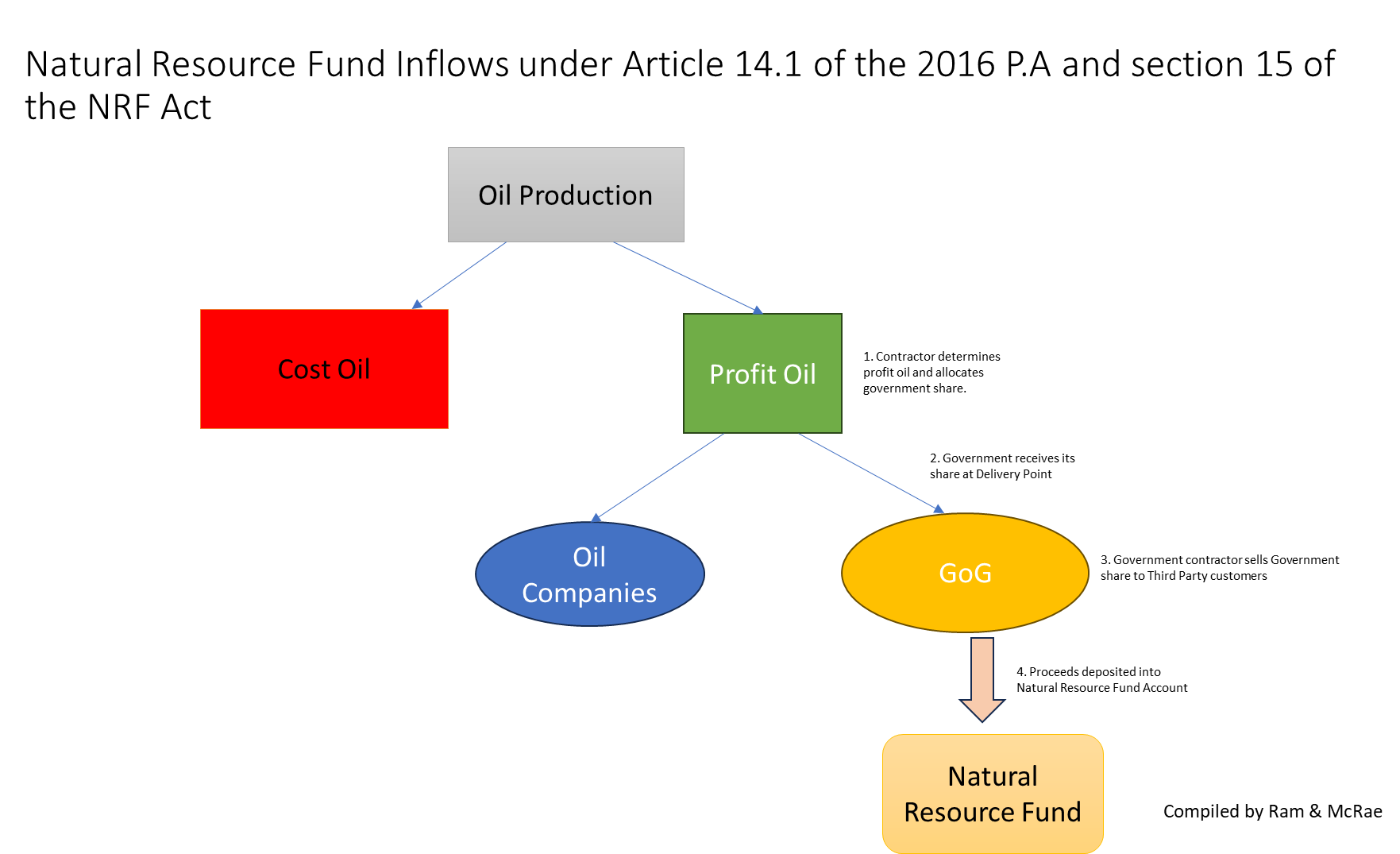
The NRF is a sovereign wealth fund established under separate legislation to garner, manage, invest and use the proceeds from the exploitation of non-renewable resources for current and future generations. Its structure, objectives and management are vastly different from those of the Consolidated Fund. A properly managed NRF aims to use only the income generated from the investment of the funds in the NRF. On the other hand, the Consolidated Fund is effectively the operating fund for the day-to-day financial operations by ministries, departments and other budget agencies of the government. It is managed by public servants in a very decentralised framework.
Mr. Nandlall is not alone in confusing the two funds. That same conflation was made in a 22 June 2022 article in the Stabroek News quoting the Commissioner General of the Guyana Revenue Authority. One hopes that this misconception is not the reason for the confusion whether moneys were paid to the GRA for it to issue receipts and tax certificates to Hess and Exxon to claim credit in the USA for tax “paid” in Guyana.
Anil’s volunteering that section 15 (1) and (2) of the NRF Act authorises petroleum revenues to be paid directly into the Fund is not relevant to anything in my column. The point the column made is that the NRF Act does not provide for the withdrawal of money from the Fund to pay the taxes for the oil companies, an omission I described as a disconnect, and for which I made a recommendation. Instead of acknowledging the omission and committing to fixing it, Anil cites the supremacy provision of section 45 of the flawed Act and that the “draughtsman’s mind was alive” to what taxes are to be paid directly to GRA – another irrelevant non sequitur.
More seriously, Anil asserts that the provisions in the Agreement on taxation have “obviously been overtaken by the Natural Resource Fund Act”. He has achieved by default – and unilaterally to boot – provisions which the Government has claimed are sacred and beyond renegotiation.
Anil also displays surprising carelessness when he claims as “a very rudimentary principle of law that if a contract conflicts with a Statute, the Statute shall prevail.” I need to remind him of the Rudisa v Guyana case [2014] CCJ (OJ) in which he was lead Counsel for Guyana. The judges lost no time in rejecting his argument that a failure by Guyana to honour its Treaty obligation was somehow excusable because of good faith efforts by the then PPP/C Government.
Ruling against Guyana, the CCJ unanimously re-affirmed the legal principle “pacta sunt servanda” (“agreements must be respected). Just in case Anil thinks that the reason for the CCJ’s decision was that the matter arose solely out of the Revised Treaty of Chaguaramas, it is in fact a long-standing principle laid down in Trendex Corporation v Central Bank of Nigeria [1977] 1 QB 529 that sovereign immunity, including lawmaking, does not generally apply to commercial cases.
Anil’s argument that the NRF Act applies to the 2016 Agreement, and by implication with retroactive effect, is not without considerable difficulties. But even if those hurdles are crossed, it is unlikely that this extends to making the stability clause(Article 32) in the Agreement inoperable. That clause, while not forbidding any changes in the law, provides, inter alia, that “the Government shall promptly take any and all affirmative actions to restore the loss or impaired economic benefit to Contractor, so that the Contractor receives the same economic benefit under the Agreement that it would have received prior to the change … “
Prior to Nandlall’s statement, there was nothing in the public domain to suggest that the new legislation affects the 2016 Agreement in any manner, let alone requiring resolution. For example, the most recent audited annual financial statements of Hess and Exxon continue to reflect no change in their entitlement, or their understanding of the tax provisions. Mr. Nandlall’s reactive interpretation will certainly excite them.
Meanwhile, Mr. Nandlall can help Guyanese in providing answers to the following questions.
Does his statement on his Facebook page represent his and the Government’s official position, or was it personal and unofficial?
Did he or the subject Minister, at any time since the passage of the NRF in 2021, have any discussion with Exxon, Hess and CNOOC on his interpretation of the implications and consequences for the Agreement?
Were his interpretation and its consequences accepted by the oil companies?
Was there a resolution in accordance with Article 32 (3) and how was that resolution formalised?
Since he does not agree with my interpretation of Article 15 (4) (b) of the Agreement regarding Government’s obligation to pay the tax out of its share of profit oil, can he say what the correct interpretation is?
By virtue of section 45 of the NRF Act to which he accords supremacy status, is Guyana now relieved of the obligation to pay the taxes of the oil companies?
Would he be kind enough to provide a schedule, with particulars, of the Certificates of Taxes issued by the Guyana Revenue Authority under Article 15 of the Agreement?
What was the source of the money used to pay such taxes for the oil companies?
If no Certificates of Taxes were issued, were there any other receipts, acknowledgments, documents or confirmation from the GRA to the oil companies of taxes paid on their behalf?
Given Anil’s assertion that the Agreement is overtaken by legislative changes, does he consider that further changes are within the exclusive powers of the Government, without restoration of benefits?
I share with Guyanese three very fundamental concerns about the 2016 Agreement.
The use of the Government’s share of oil profits to pay the taxes on behalf of the oil companies.
The stability clause which effectively deprives Guyana of legislative sovereignty until 2057 – give or take a couple of years.
The Government’s insistence on the sanctity and inviolability of the 2016 Agreement, making it beyond renegotiation.
Mr. Nandlall’s response to the column suggests that he has found a magic formula to overcome those concerns. If his statement represents the Government’s position, it is the best news for the country at the beginning of a new year. It also portends that Guyana can settle other concerns about the environment, insurance, level of royalty and allocation of profits in the Agreement without adverse implications.
Finally, it would certainly be preferrable for the conversation I am having with Anil to take place more widely, including in the National Assembly. Currently, that is wishful thinking. But I do believe that Anil is committed to constructive dialogue and that he too recognises the benefit of our exchange.
I therefore welcome his response and look forward to his answers to my questions and confirmation of my conclusions.