Predictions 2010

Introduction
Accustomed only to the arcane drudgery of a calculator and a columnar pad, I turned to the Angel Gabriel and the Deity Ganesh for divine guidance in looking at the world in 2010. They point to a different world in 2010 from the one predicted by the Economist’s publication of that name. But then what can one expect from someone who thinks that Guyana is on the African coast? Inspired by such dual divinity I see for Guyana the best of times and the worst of times, spectacular winners and catastrophic losers, drug pushers and soup drinkers, strike-breaking employers and spineless unionists, ambitious turks and aging politicians, their sell-by dates long past. With predictions, the probability of success is 50/50 – either right or wrong. Accordingly, mine come with the usual exclusionary clauses about non-responsibility – the type clients receive from their accountants and policy-holders from insurance companies. With this in mind, let us look into Guyana 2010 in which there will be several developments in politics, the economy and the government and private sector to comfort Guyanese bracing for tough times ahead.

The economy
Fed up with the bureaucracy and transparency of Norway and the EU, the government will advance and rename the Low-Carbon Development Strategy to the Loving Chinese Democratic Systems. Same LCD S… Chinese logging companies will replace Barama as the bête noir of the forestry sector. The Indians will give a further loan to the country to help maintain the traffic lights and to promote culture. Venezuela will provide PetroCaribe funds to help us police our ‘shared’ territory. The boys from Brazil will help finance the Road to make it easier for their illegal exploitation of our forests and gold-mining activities, while their female siblings will take over our social scene, creating more unemployment for our ladies.

To align its logo with practice, the PPP will trade its emblem, the cup, for a set of environmentally-friendly, bio-degradable plastic bowls – the large one for begging and several smaller ones for soup drinking. China will provide the bowls under a Grant Aid Agreement with the Ministry of Finance under which the Chinese will be permitted to compete locally with our merchants of ‘pirated everything,’ and will be exonerated from any liability for the mess-up with the Skeldon Factory. Their consultants will help us with our electricity – funded of course by the Chinese currency. The Grant Aid Agreement will be submitted to the United Nations as the model for non-transparency and non-accountability for resource-rich, low-income countries willing to submit to new age exploitation by the new rich and powerful.

The Minister of Finance will publish his biggest ever Budget within the three month deadline. He will make the decline of the first half year of 2009 into a full year growth – all due to the export of “non-traditionables.” The Minister of Finance will assist the Bureau of Statistics in compiling the GDP and the inflation rates – they will both be favourable, the numbers I mean. Clive Thomas will see red. There will be no available statistics on unemployment and no disclosure statistics on VAT. Inquiries on the absence of related numbers in the areas will be attributed to the high probability of bias in observers.

Dr Ashni Singh will, for the first time, read the Bank of Guyana half-year report before tabling it in the National Assembly. His own mid-year report will be several months late but stamped several months earlier. No change. The Auditor General’s Report for 2008 will be released one year late. Again no change. The Public Accounts Committee will again not notice.

The GRA will announce a tax amnesty, to be followed by a partial one for illegally imported vehicles; automatic and full amnesty will be granted for vehicles found housed in politically connected residential compounds. Not to be outdone, the Ministry of Home Affairs will broadcast its own amnesty for illegal firearms. It will pay $10,000 for every handgun surrendered, and $50,000 for each Kalashnikov-type weapon. Funds will come from the police budget, which will be replenished by the secret results of a resumption of talks with the Brits. If the British talks collapse, patriotic business elements will fund the programme from VAT and/or Customs duties and/or NIS not paid to the government.

The amnesty will be accompanied by the removal out of existence of all records related to taxes; the opposition will be supportive since there will be a removal of its own 100 million dollar debt from all associated files and papers.

To ensure consistency, in 2010 the government will award the same single digit raises (3% for sugar workers, 6% for public servants, and so on) that it offered in 2009 to workers in various sectors. To ensure the same consistency, it will vote and award to itself the same near 100% increase package that it did in 2006. The opposition will, once again, be on the receiving end, which will reiterate the new spirit of inclusion and sharing.

Politics
Despite an easily explained haemorrhaging at the Local Government Elections, the PNCR’s life will be prolonged due to intensive financial care by Dr Jagdeo.

Ravi Dev, pushed by Freddie and helped by Donald Ramotar, will take off his toupee and his mask and join the PPP. GAP-ROAR will read of this slow-breaking news in the press. Carvil Duncan of the GLU will move formally into the Office of the President while Komal Chand of GAWU will be described as a “private trade unionist” responsible, along with the weather, for the continued decline in sugar.

Jagdeo will not get a Nobel mention and blackouts will continue. Several areas of the country will experience unusual weather patterns leading to flooding. There will be no Freedom of Information Act but the President’s friend will be granted a radio licence to help anonymously and financially with the Third Term. He will fail. Ramotar will be named the PPP/C presidential candidate with the slogan ‘More of the Same.’ Robb Street will replace Vlissengen Road as the Centre of Power.

The Minister of Destruction will demolish the Cenotaph for impeding the flow of traffic. He will also facilitate the removal and retirement of long-suffering politician-turned-mayor-turned-letter-writing evangelist Hamilton Green who will take up residence in one of the many vacant rooms at Sophia.

Business initiatives
Guyoil will become a subsidiary of GWI. This will ensure a guaranteed supply of high quality, designer water additives for its fuel pumps. Guyanese consumers are free to demonstrate their now legendary adaptability by utilizing this enhanced fuel for potable purposes, as circumstances warrant.

The Lotto Company under direction from the government will have a new management team drawn from PNC ranks. It will be seen as another example of ongoing government outreach to the main opposition and, given the latter’s history of rigging and fooling everyone for decades, of aligning the right people with the right job. This Lotto shakeup is a contingent arrangement. If the PNC is successful in this assignment, it will be awarded by CGX a management consulting contract to provide it with proven expertise on its oil rigging setup.

One man’s pudding is another’s poison will find very visible proof in 2010. On the one hand, the suitcase businesses will reap a bonanza on sales of customized cell phones, radar detectors and telecommunications scrambling devices, as citizens seek to neutralize the government’s advantage relative to speeding and eavesdropping. On the other, the Bureau of Standards will be overwhelmed by nervous owners trying to obtain official confirmation of sellers’ adherence to truth-in-marketing standards on equipment purchased. The bureau will not concern itself with frivolities surrounding legality and appearances. It will simply limit itself to the sellers’ statements and assurances of performance and physical condition.

A long overdue development will be the partial re-engineering of the GGMC. The units responsible for oversight of miners and producers will become part of a revitalized CLICO offshoot. Experts will reason that this makes perfect sense given CLICO’s now well known proprietary early warning system. Miners will be alerted when to play by the rules and not tamper with troy declarations; political powers will be guided by protective leaks to withdraw from costly surprises produced by whistleblowers, the media, or dogged auditors; and in-house parties will retreat into bureaucratic shelters of ignorance and amnesia. As such, the CLICO system will relay timely information to major stakeholders searching for any edge or advantage.

Several monuments to money laundering will rise to the sky and the trade in non-prescription drugs will gain recognition in the national accounts “in appreciation of its contribution over two decades to the national economy, parties’ coffers and the stability of the Guyana Dollar.”

In other developments, insurance companies will decline coverage to any party that identifies GPL as an official energy source. The same insurance companies will go on record to stress that they have no concerns with illegal connections to the same disputed energy source. Super salaries remitted will be justified as a response to local cost of living realities. There might also be a blurb about the cost of attracting and retaining qualified help along the lines of the once highly publicized Bernard Kerik recruitment foray.

Governance
The President will prove to be very prescient, that stresses in advanced economies will have consequences in Guyana. It does not matter that his prescience is three years late, for the delayed effects will be felt in major areas of commercial activity. There will be consequences, and sacrifices must be made all around. Customs bodies will experience a decline in charitable contributions, and law enforcement ranks will feel the pinch through a decline in involuntary tipping traditions. Tender board people will share the pain.

In an attempt to assuage the critics, there will be presidential releases about a push towards more transparency in government accounting. Contracts will be executed with unemployed accounting alumni from Arthur Anderson, Enron, Madoff and Stanford to avoid any allegations of domestic taint. People from NBS, Republic, and CLICO will be quietly persuaded not to apply. The government will express confidence that all Guyana will be reassured.

The GRA will declare the President non-resident for tax purposes under section 2 paragraph … of the Income Tax Act Cap. 81:01 which requires minimum residence of 183 days in the tax year. This will have no effect on taxes the President traditionally does not pay, since he will claim exemption under section 6, arguing that he exercises his employment abroad and that the thousands of US dollars per trip he receives for staying at friends and relatives, arises outside of Guyana and is therefore exempt.

The head of state will alone burn more dollars in aviation fuel in 2010 than the rest of the nation will expend on gasoline.

Sports
Two top Guyanese spinners – Prem and Randy – will be included in the West Indies team for the World 20/20 championship.

They will perform well on home turf prepared by their side-kick at NCN, but fail outside – taking the team’s chances of success with them. Considered a high risk for this gentleman’s game, another top spinner from the same local club will have to stay at the Office to man the telephone. Brazil will not win the World Cup. Woods will return with a new logo – a hungry looking cheetah – with a warring bevy of waitresses awaiting him at the 19th hole.

Conclusion
Finally, as an indication of its vaunted strategic planning capabilities, the government has already identified several factors that will be rolled out for anticipated business distresses in 2010.

They include: El Nino (La Nina is on standby); foreign terrorist masterminds (wherever located); unattractive US dollar (ugly Americans); lowered overseas demand for local products (except pharmaceuticals); decreased remittances from overseas-based Guyanese (cheap and unreliable); and rising oil prices (whichever year they occur).

In other words, the government is not responsible and has an exit strategy that lays the blame elsewhere. Anywhere else, but not with the government. It seems that 2010 promises to be the best of times and the worse of times.

Next week, it’s back to reality.
Two per cent growth in the economy is wishful thinking

In looking to 2010, Business Page predicted that the 2010 Budget speech would make the economy’s decline of the first half year of 2009 into a full year growth. No sooner had I submitted that column than no less a person than the President himself, in his New Year’s message, reported “preliminary indications that the economy registered a positive growth rate of about 2% in 2009.” He was careful not to provide any support for such assessment, restricting his only specific comment to the sugar and bauxite sectors whose performance he described simply as “below expectations.”

But that limited comment is enough to caution even the most casual observer not to take the President’s assessment seriously. In November 2009, reporting a 1.4% decline in the economy for the first half of the year, the Minister of Finance reported a 19.3% half-year decline in sugar, a 6.7% decline in rice and flat performance in mining and quarrying. For the remainder of the year, the Minister expected the performance of rice to deteriorate and for mining and quarrying to do substantially worse than they did in the first half. We know too that bitter industrial relations since June 2009 ensured that sugar’s woes continued and, quite possibly, deteriorated in the second half of the year.

Even GuySuCo’s CEO, in his New Year message seemed keen to forget 2009 even as he expressed some optimism for 2010. If a miracle had in fact taken place and Guysuco had transformed a 19.3% decline in the first half of 2009 to a full year 10% growth, the corporation and the President would surely have noticed it.

The revised outlook for a 2.5% growth in real GDP, including all economic sectors, predicted in November by the Minister of Finance, was premised on the full-year growth (of 10%) in sugar – equivalent to a turnaround of 36% for sugar in the second half of the year! That simply did not take place and no other sector of significance could have made up for the loss. To put the numbers another way, non-sugar growth was expected to come in at 1.5%, so that the economy did substantially better than the Minister of Finance expected less than eight weeks ago.

The President’s assessment of an overall 2% growth seems more a mixture of wishful thinking, political rhetoric and self-vindication for his firewall assurance, than a serious, informed or honest assessment by someone trained in economics. Having done his political work, he has now placed the Minister of Finance, the Bank of Guyana and the Bureau of Statistics under immense pressure to produce numbers to vindicate yet another of his assessments.

They may oblige. It is hard to be confident about the integrity of the statistics coming out of a Stats Bureau that would not publish the monthly Georgetown price data it collects, usually doing so only after the Minister has announced suitably relevant numbers in his half-year report or his Budget speech. And the fiasco of conflicting rates of 2009 first half (un)real GDP growth, reported in the Business Page series (November/December), but which neither the Minister nor the Bank considered worthy of a public explanation, has similarly affected the credibility of both the Bank of Guyana and the Minister of Finance.

It seems to me that in relation to statistics on the economy and financial information coming out of the government, 2010 will be no different from 2009 and before.

Christmas 2009: End of a troubled year and a nameless decade

Introduction
The word ‘merry’ fits in with Christmas as horse goes with carriage. For all but the most ascetic among Christians, its religious significance is celebratory and material, rather than religious, demonstrating the depth of God’s love for mankind, a manifestation of redemption and adoption, in which God gave his son to save mankind from their sins. Ian McDonald often reminds us how, as we grow older, one year seems rapidly to morph into another, pausing only for the special significance and memories which each Christmas leaves with us, as it flies past into the New Year. As we watch our children grow into adulthood, we inevitably reflect, often through deceptively tinted lenses, how Christmas was better in our childhood days. How conveniently we forget that Christmas for most of us was special because toys and ‘ice apples’ and grapes and black cake and new clothes were reserved for Christmas. We forget too that in between, life was challenging, as we shared with our siblings and country cousins not rooms but the floor; indoor plumbing and telephones were for the residents of the few big houses occupied by the village elite, their children sent to high schools on their way to studying abroad; and that in those days a job in the public sector meant something – whether as a pupil teacher, a trainee nurse, a policeman or a class two civil servant. In those days a bank job was reserved for persons with colour and connections, except for the messengers and cleaners. Few holders of such jobs now have the means to change the curtains, to buy new clothes and exchange gifts.

We forget too that in those days, infant mortality was common, that the funerals our parents attended were for persons who would now be considered young, that life expectancy was much lower then than now. We had the excitement of a nation-in-the-making and now are justified in regretting that our freedom fighters and founding fathers wasted some wonderful opportunities to forge our country into a modern state; that for us development meant migration and that for many today a full family Christmas means bringing at least some of the siblings or their children into the sitting room, thanks to the technological revolution that allows Skype to provide low cost telephone and video contact with those in North America and Europe.

The Danish Santa
So what was Christmas 2009 like? This was a Christmas when we were led to believe that our itinerant President would return to Guyana on the Danish Santa’s sleigh, overloaded with LCDS and REDD and REDD + money from the Copenhagen Climate Change Conference. We were led to believe by no less than a major international management consulting outfit that forgoing exploitation of our forests would contribute vastly to the world’s economy and that the rich countries were conservatively indebted to us to the tune of more than half a billion United States dollars annually. How, we wondered, could the world not accept such a gift accompanied by the transport over 80% of the country which our President was personally offering to convey to them, spending the better part of his final term in office and several millions of Guyana taxpayers’ dollars to do so. Success at Copenhagen could have been a fillip for the third term advocates, justification that if Obama could get a Nobel, then why not Jagdeo?

Instead the conference flopped and the Danish Santa never arrived. The President returned home with no fanfare and carefully avoided the siren sounds of the motorcade from Timehri to the unclean and uncleaned capital city, instead quietly slipping into the Ogle aerodrome, a multi-million dollar government gift to a select few in the private sector. Obviously disappointed, the President then used the first press conference after his unheralded return to criticise, not too subtly, one of his ministers whose own Christmas gift was the short memory of Guyanese, and to blame his Danish hosts and its President for the “chaos and mismanagement” of the conference.

Donor of the month
Identified too for President Jagdeo’s tongue-lashing was the United States of America which was represented in the closing stages of the conference by President Obama. According to President Jagdeo, the US bore the brunt of the responsibility for Copenha-gen’s failure, that its inflexibility doomed the conference and that instead it should have partnered with the China, the world’s worst emitter, but our donor of the month. Our President seems unconcerned too about China’s human rights record, or that it has no qualms about executing persons convicted of rioting. Those who are aware that it was Obama, along with the Chinese President Hu Jintao and the leaders of South Africa, India, Russia and Brazil who drafted the final agreement coming out of Copenhagen immediately recognise President Jagdeo’s exoneration of China as cynicism and opportunism in rewarding China for its Guyana $1 billion grant to this country one day earlier. Since Santa has never publicly proclaimed any identity with Christianity and the Chinese yuan, which like its government is atheistic, President Jagdeo had no objection to a Chinese Santa instead of a Danish one.

Four men
So how then do we look back on Christmas 2009 which brought the curtain down on a decade described by Professor Timothy Garton Ash of Oxford University as the “nameless decade”? In last week’s column we recounted that the country and the world’s economy started the year with the possibility of dire consequences, consequences from which the world was fortuitously spared. In such an eventful year it is inevitable that there would have been some who stood out, who contributed to the events that shaped the world, whether for the better or worse.

It is a year when four men of African ancestry – all but one American – made the news and captured the emotions and imagination of the world. The Nobel Committee awarded its Peace Prize to US President Barack Obama, a surprising decision that drew more attention to the donor than the recipient. On January 20 President Obama became the first African American to occupy the White House and carried the honour and the responsibility of being the President of the world’s largest economy and most powerful, if waning country. Young, articulate, intellectual and energetic, Obama’s effectiveness so was circumscribed by America’s domestic politics that he was unable to live up to his international rock star image and to bring his prestige to solve global problems.

The next was legend Michael Jackson, musician, dancer and entertainer in a career spanning forty years. During that time, he had earned for himself the accolade of greatest entertainer ever, but had drawn wide, negative media publicity for redesigning his face, nose and skin colour and for allegations of child sexual abuse from which he was exonerated by the courts. It took his shocking, sudden and still mysterious death in June to regain the public adulation he had enjoyed for about half of his public life, his live memorial service attracting an audience of up to one billion people. Immediately he replaced the iconic Elvis Presley as the most successful dead entertainer.

The Tiger slows, Usain bolts
The third was Tiger Woods, arguably the world’s most talented golfer ever, history’s highest earning and richest sports personality and the Associated Press Athlete of the Decade. A whistle-clean career carefully cultivated over fifteen years came crashing down in less than fifteen days following a minor vehicular accident that led to revelations of domestic problems and later multiple cases of infidelity in which numerous women came out of the woodwork to claim dalliance with him. The golfer has now taken indefinite leave from golf to work on his marriage, hopefully with his wife having no access to his golf clubs!

The Jamaican sprint sensation Usain Bolt at the 2008 Summer Olympics in Beijing China became the first man to set world records in all three sprinting events at a single Olympics and during 2009 became the first man to hold the 100 and 200 m world and Olympic titles at the same time. The sprinter has given his country and our region publicity that for a change, it could consider as being positive and useful. Usain’s achievement is one of which all Caribbean people can truly be proud and offers hope and pride for us all. Ironically the major beneficiary of Usain’s exploits was the sports goods manufacturer Puma, rather than any business from the region.

Heroes and villains
But what about the heroes and villains of the financial world – those who got the world into the mess and those who helped to save it? The popular middle-America weekly Time magazine has named Ben Shalom Bernanke, the Federal Reserve chairman as its Personality of the Year for his “monumental influence on the world’s most important economy” and because “his creative leadership helped ensure that 2009 was a period of weak recovery rather than catastrophic depression…” Coincidentally, Bernanke was a scholar of the Great Depression and not only recognised the depression that appeared on the horizon in mid-2008 but put all his energies and reputation into preventing it from happening. Another candidate for the title was the sprinter Usain Bolt while it was also clear that two European leaders – Gordon Brown of the UK and Nicholas Sarkozy of France had done much to build a reputation as the David that kept the Depression Goliath at bay.

Corporate fraudsters
The world in 2009 also saw its fair share of corporate fraudsters and the drum roll immediately announces Bernard Madoff of the US, B. Ramalinga Raju of Satyam Computer Ltd of India and ‘Sir’ Allen Stanford of Texas, US and Antigua and Barbuda. Bernard Madoff, a star of Wall Street, former chairman of the Nasdaq Stock Market and founder of Bernard L Madoff Investment Securities LLC, was sentenced to 150 years behind bars on conviction of the biggest financial swindle in history, a Ponzi scheme that robbed trust and pension funds of an estimated US$50 billion.

Stanford, seen as the saviour of West Indian cricket with the introduction of the hugely popular 20/20 format, became one of the most recognised faces in the Caribbean. His fall from grace matching his meteoric rise, Stanford is now behind bars in the US, awaiting trial for selling investors high-yielding certificates of deposit on the basis they were safe and liquid investments.

Repercussions
Stanford had his impact on Guyana with the Hand-in-Hand Trust coming up short of millions of its own and others’ pension funds. Making the news too was the collapse of the insurance giant, Clico, a victim and perpetrator of abuse of fiduciary obligations that is costing policyholders and pension schemes, including the National Insurance Scheme, several billion dollars.

At year end there is still uncertainty when some of the money which was recovered through the generosity or guilt of a regional country would be paid. For these, there have been no investigations or enquiries.

It seems that some drug barons and corporate fraudsters enjoy immunity not only from prosecution but investigations as well.

Next week, we look forward to 2010.

Brightening prospects – The Ram & McRae Business Outlook Survey 2010

Introduction
Today’s column draws heavily on the Business Outlook Survey 2010, an annual survey which Ram & McRae has been carrying out for sixteen years. While the overall coverage of the press conference announcing the results of the survey was, as usual, good, I was surprised at the number of media who offered the mild criticism that the event clashed with a sitting of the National Assembly. One of them even suggested that the firm should shift the time of the press conference! I hope this is not an indication that parts of our media do not have the barest of resources to cover more than one event simultaneously.

In its introductory comments on the survey, the firm noted that the survey was taking place in a year that began with the world confronted by real fear of another Great Depression, the possibility of a return to protectionism and the collapse of the world’s increasingly globalised financial system. Armageddon was averted, and according to the publication, World Economic Situation and Prospects (WESP), a joint product of the Department of Economic and Social Affairs, the United Nations Conference on Trade and Development and the five United Nations regional commissions, the global economy began to recover from the second quarter of 2009, aided by massive fiscal stimuli and intervention by governments that seem suddenly to resurrect Lord Keynes. WESP noted, however, that the recovery, which is still taking place, has been uneven and that conditions for sustained growth remain fragile.

Unsatisfactory
Here at home, despite the huge sums from our donors specifically to rebuild the statistical and financial capacity of the relevant agencies, national financial and economic statistics remain unsatisfactory. This column over the past few weeks has been at pains to point out the considerable confusion caused by conflicting statistics published by the Bank of Guyana and the Ministry of Finance. The Bank of Guyana has now quietly amended its own figures on its website by way of a footnote in its half-year report, but which now introduces an inconsistency with its conclusion. It is ironic that even as the Bank does this, it received from the survey respondents the highest number of ‘excellent’ ratings among public sector entities.

The agreement on a decline in the economy’s performance in the half year seems to suggest that the decline continued into the second quarter of the year, unlike the rest of the WESP recovery countries. Let us hope it will not take several more years before Guyana joins the rest of the modern world in offering quarterly economic statistics including labour data and regional activities.

Copenhagen fails
As the 2010 survey was being carried out, the world’s – and Guyana’s – attention was focused on Copenhagen, Denmark where the world’s leaders were haggling over a solution to a phenomenon with potentially devastating consequences for the environment. The report noted that signs coming out from that conference were not good, a view that has been confirmed by the failure of the more than one hundred leaders to arrive at meaningful and necessary action to protect the environment and secure the future of planet earth. No amount of diplomatic acrobatics or linguistics by Ban Ki-Moon, the UN Secretary General, could mask the huge failure that Copenhagen has turned out to be. Ram & McRae had noted that no amount of fiscal stimulus could substitute for the tough economic and political decisions which a solution demands, decisions which China and to a lesser extent the USA were unwilling to make. Having said that, Copenhagen represented a failure of leadership, preparation and execution all around.

The good, the bad and the…
The survey’s introductory remarks included a reminder that Guyana was spared a repeat of the Bartica-Lusignan type murderous attacks of the previous year. Businesses were not prepared, however, to give the security forces much credit for this and indeed, the Guyana Police Force and its supervising Ministry of Home Affairs were rated poorly in terms of effectiveness among public sector entities. The government however was far more generous to the security forces, not only in terms of huge budgetary increases but also in the payment of bounties, a dangerous policy if ever there was one.

Not surprisingly, the Low Carbon Development Strategy as a concept received a highly favourable rating, as did the new prevention of money laundering legislation and the repeat of the proposal for a credit bureau. Not only Guyana but the world agrees with some form of LCDS – which essentially calls for simultaneous development of the economy and the protection of the environment. It is not hard to understand too why the respondents supported anti-money laundering legislation. Those engaged in tax evasion, money laundering, corruption and who dominate the criminalised sector have a huge advantage over those who run reasonably honest businesses. Previous money laundering legislation did not work, and I do not think it is too early to fear that, as presently organised, the new arrangements are going to be any more successful.

Confidence levels
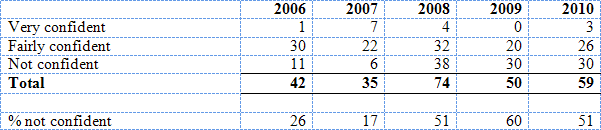
The survey report noted that confidence levels in the business sector had fallen significantly in recent years, and in the 2009 survey, none of the respondents was confident that the economy would improve and sixty per cent were positively not confident about the country’s economic prospects. The percentage of respondents who are now less pessimistic than the year before has fallen by 9% to 51%, the same level as in 2008 but still far from the levels of confidence reflected in the 2006 and 2007 surveys. After the re-election of President Jagdeo in 2006, only 17% of the private sector had expressed pessimism about the economy. That percentage has increased two-fold, in contradiction to what the leaders of the private sector have been singing to the government over the past couple of years.

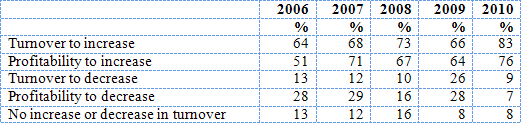
A summary of the responses is as follows:

2009.12.20_Table1

One feature of the annual surveys has been that whatever their outlook of the economy might be, respondents always were more confident about their own operations, management and prospects. None of them plans any contraction of their business and they expect – in percentages unprecedented in recent years – increases in turnover and profitability. In its comment on these expectations, Ram & McRae expressed the hope that the increasingly confident business community, including the cash-rich financial sector, would provide the investment the country badly needs to generate employment, foreign exchange and taxes, to help in the development of the country.

Self-confidence

2009.12.20_Table2

Public/Private Sector performances
For the first time since the firm initiated a Business Outlook Survey sixteen years ago, it asked respondents to rate twenty-one public sector entities with which businesses interact and to rank them from poor (ineffective) to excellent (very effective). Respondents were given the option of not providing a rating for any of the entities, an option taken up by an average of eleven respondents – either opting out of the question or not having done business with the body.

Getting high ratings in order were the Ministry of Agriculture, the Bank of Guyana and the Ministry of Labour, with GPL rated the poorest. Of concern is the NIS which was rated eleventh in a group that includes the Guyana Police Force, the Ministry of Home Affairs and the Office of the Commissioner of Insurance and, of course, GPL. The Commercial Court was rated higher in terms effectiveness than the High Court.

Of the ten NGOs, the two trade union umbrella bodies were rated lowest in terms of effectiveness, with the Trades Union Congress slightly ahead of the Federation of Independent Trade Unions with thirty-seven respondents (80%) and thirty-six respondents (84%) rating them as ineffective or marginally effective, respectively. Neither received an ‘excellent’ rating from any respondent.

At the other end of the scale, the Institute of Chartered Accountants of Guyana and the Guyana Manufacturing and Services Association were rated highest with fourteen (33%) and ten (22%) rating them as effective or very effective respectively. Interestingly the private sector organisations the Guyana Manufacturers Association and the Georgetown Chamber of Commerce received considerably higher ratings than the Private Sector Commission, which more often than not claims to speak on behalf of the private sector.

Conclusion
All the indicators and informed projections point to a retreat from the free-fall in world trade, industrial production, asset prices and global credit availability which had threatened to push the global economy into another great depression in 2009. Since the second quarter of 2009, economies across continents have been improving at varying rates of growth. International trade and global industrial production have also been recovering noticeably, with an increasing number of countries registering positive quarterly growth of gross domestic product (GDP). That revival has been driven in no small part by the effects of the massive policy stimuli injected worldwide since late 2008, and by strong cyclical inventory adjustment. But as the UN World Economic Situation and Prospects (WESP) 2010 notes, the recovery is uneven and conditions for sustained growth remain fragile. Credit conditions are still tight in major developed economies, unemployment is still high and businesses are still wary of expanding the productive capacity until more certainty and stability appear.

At home, despite serious warning signs in agriculture, bauxite and manufacturing, the Minister of Finance predicted a significant turn around in the second half of 2009 while the President seems over-enthused about the economy’s prospects with some US$30 million coming to the country next year under the Guyana-Norway LCDS Memorandum of Understanding.

In the report’s conclusion, the firm expressed its continued conviction in the usefulness of the survey despite the apparent disregard by the government of the wider views of the private sector expressed in confidential, independent and professionally compiled reports. I am convinced that the government’s failure to treat with meaningful tax reform has contributed to the continuing, widespread and massive tax evasion. It has failed to incorporate into the formal economy the huge parallel economy and it has demonstrated neither the will nor the capacity to deal with the criminalised segment of the economy, corruption, and white collar crime. Unemployment and under-employment are officially non-issues, even as the country laments the loss of professional and other skills to migration.

Noting that the short-term political advantages gained by allowing these issues to be driven by electoral considerations are far outweighed by the long-term economic costs, the firm was not hopeful that these issues would be addressed in a year preceding important general elections.