
Guyana hosts regional accounting conference

Introduction
Guyanese accountants are this weekend hosting their counterparts from the region in the annual conference of the Institute of Chartered Accountants of the Caribbean (ICAC). This is the region’s umbrella body bringing together accountants of the English-speaking Caribbean. According to the ICAC website its membership is currently made up of seven members and four affiliates. The members are the national institutes of the territories of the region each of which operates under domestic statute.

The conference comes at another of those times when circumstances force the profession and/or the state to confront issues affecting the public interest. Sometimes the profession is affected indirectly rather than directly. One such example was in 1862 when the UK Parliament quickly reversed the 1856 Companies Act which had all but abandoned the mandatory accounting and auditing requirements of the 1844 Companies Act, encouraging a form of laissez-faire accountability. But the most dramatic and direct example of reform within recent memory was the Enron debacle which was quickly followed by a series of corporate failures forcing the US to pass the Sarbanes-Oxley Act in 2002. Failure was not restricted to the companies involved, but affected one of the pillars of the auditing profession – the prestigious Arthur Andersen which gave up its licences after being found guilty of criminal charges relating to the firm’s handling of the audit of Enron. The firm won something of a Pyrrhic victory when the Supreme Court of the United States overturned the verdict, but by then the firm’s demise had been sealed.

Blurring profit and professionalism
Only a few years preceding the Enron failure, Arthur Levitt, Chairman of the Securities and Exchange Commission of the US had said of the profession: “The audit profession has a long and distinguished history of guarding the integrity of our companies’ financial statements. They must live up to their history… I fear that the audit process, long rooted in independence and professionalism, may be diminished in the name of these increasingly lucrative and commercial opportunities.”

In other words accounting and auditing had become a business and the profession was in danger of individual accountants and firms putting profit and personal interest before the profession. The challenge for the society and the profession is how to balance the pursuit for profits with the objectives of the profession to set and maintain the highest standards of professionalism, to attain the highest levels of performance and generally to ensure that the public is convinced that the hallmark of the profession – independence and integrity – remains intact.

A market economy requires that there be credibility in information and information systems that are fed to shareholders and the public. And that persons who are certified by the accounting bodies to offer professional accounting and auditing services possess the highest standards of technical competence, experience and expertise and performance. Such issues must be ever present in the minds of those with responsibility for the proper functioning of our society.

Top of the chain
The region’s laws give to the accounting profession major and valuable roles to perform in the proper functioning of the economies of the countries. In Guyana these include the Companies Act, which assigns to the accounting profession the power to set and oversee the application of accounting standards and invests it with the sole authority to carry out the audits of locally incorporated or external companies registered to carry on business in Guyana. The Corporation Tax Act requires all companies to support their tax returns with financial statements audited by members of the Institute of Chartered Accountants of Guyana. The Securities Industry Act and the Financial Institutions Act all assign or delegate to the profession specific roles with regard to compliance with internal controls.

Under the principles of corporate governance the accounting profession in the role of internal auditors is regarded as one of the pillars of sound corporate governance, and in many jurisdictions the Audit Committee is one of the standing committees of the board with defined powers, rights, obligations and reporting responsibilities.

Increasingly too, accountants because of their facility with figures have risen up the corporate ladder and many of the region’s CEOs are either accountants or are MBAs majoring in finance or accounting. By law they sit at the top of the accounting pyramid. In practice they can be both the players and scorers adding to the challenge of meaningful regulation. Those are immense privileges that are sadly not always matched by commensurate responsibilities.

Making accountants more accountable
Enron and its ‘side-kicks,’ Tyco International, Adelphia, Peregrine Systems and WorldCom may have been perceived by the regional profession as a US problem, and it seems that the region saw itself as a witness to a fascinating spectacle, but no more. Now, faced with Stanford and Clico is the profession in the region right to ignore the possibility that these major disasters which continue to have ripple-down effects on households are as much governance and regulatory failures as they are accounting failures? Hopefully the accountants meeting at the Conference Centre would find time to address this critical issue.

The US tried its best in the face of resistance from the profession to make the profession more accountable, and following the Sarbanes-Oxley Act, self-regulated peer reviews at accounting firms were replaced by independent inspections conducted by the Public Company Accounting and Oversight Board. But that applies only to the US.

Here in the Caribbean, characterised by the smallness of our economies and countries and the nature and size of business units, it is no surprise that the accounting profession is dominated by sole practitioners or partnerships of no more than a handful of persons. There is limited scope for second reviews, peer reviews and quality control or in-house capability to deal with complex technical or ethical issues. And with only four major accounting firms in the world – down from eight a couple of decades ago – real choice even for the big companies is seriously limited for purchasers of audit services. Yet self-regulation is regarded as sacrosanct.

All national legislation provides for a self-regulated profession in which the accountants make or adopt their own technical, professional and ethical rules and oversee and discipline – or fail to discipline – individual members and firms where their conduct has brought the accounting profession into disrepute. It is perhaps no surprise then that one of the objectives of the ICAC is the preservation of the self-regulatory nature of the profession. The profession forgets at its peril that in many cases the failures surface soon after the auditors for those companies have given them a clean bill of health.

Education
It would seem that the Caribbean Institute has abandoned one of its founding objectives, and that is the creation of a standard regional accounting examination, administered initially by one of the international accounting bodies. At the time that decision was taken there was considerably greater disparity in corporate and tax legislation and relevant textbooks were unavailable. Such restrictions have been reduced.

There has been much by way of reform if not harmonization in corporate law and our countries, with the exception of The Bahamas are all signatories to what is popularly referred to as the Caricom Double Taxation Treaty. There is now an excellent text by Dr Claude Denbow on taxation in the Commonwealth, and the region’s law schools have a considerable amount of material on corporate law.

As new legislation is enacted in the region to give effect to the Revised Treaty of Chaguaramas, as the profession is held to be part of the fight against money-laundering, and as our professionals if not our artisans move freely around the Caribbean, the dream of a Caribbean professional accounting qualification that begins with a degree programme from our regional universities should be revived.

The region’s lawyers and doctors have done it. There seems no reason for accountants to hold on to the coat-tails of international accounting bodies principally from the UK to shape our accounting education in the second decade of the 21st century.

Ethics and insurance
Accountants have a duty not only to act ethically, but also competently. Shareholders, investors, tax authorities and other users of the financial statements rely heavily on the yearly financial statements of a company, as they can use this information to make informed decisions about investment and taxation – two issues of major public importance.

The journals of the major accounting bodies reflect an alarming increase in the number of complaints lodged against accountants and auditors. That must be a fraction of the actual incidence of this phenomenon. The public is largely unaware of the finer points of professional ethics, and accountants are loathe to report on their colleagues since they may be as equally culpable. And even if a complaint is lodged, the rules for addressing it are too often unclear and allow for such complaint to be heard only by accountants.

The danger is that self-investigation can become self-protection.
Finally our accountants ought to place on their agenda another problem facing the public in the region, and that is that the bulk of the professional accounting practitioners have no professional indemnity insurance. The regional or national bodies do not require it and the insurance industry is hesitant to offer it. So the client who receives sub-standard advice or shoddy work from his accountant is often left with practically no recourse but to end the relationship. That is no remedy.

Hopefully even as the Caribbean accountants enjoy Guyana’s hospitality and grapple with arcane concepts of IFRSs, the financial crisis and modernising corporate legislation, they will reflect on their overriding duty to the public and the need to restore public confidence in the profession.
On the line: Demerara Tobacco Company Limited Annual Report 2008

Introduction
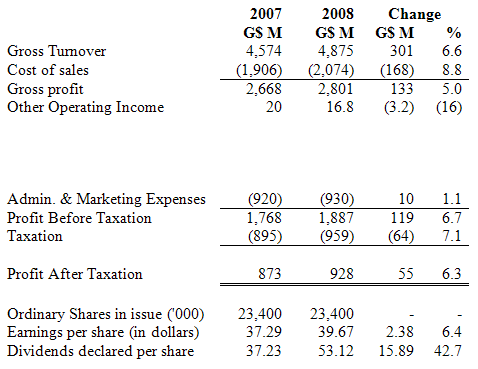
The Annual General Meeting of the Demerara Tobacco Company Limited, the tobacco trading company was held on March 31, 2009 making it the first company with a calendar yearend to have presented its 2008 annual report to its shareholders. In fact its financial statements were signed off by the auditors within five weeks of the end of calendar year 2008, which is commendable, but with effectively one supplier and one customer the accounting workload is hardly demanding. The company saw sales increasing by 6.6% over 2007 and after tax profit increasing by 6.3%, an almost linear relationship. However, the rate of growth of sales has fallen over the past couple of years, when the increase in 2007 sales over 2006 was a more robust 16%.

Demtoco is a subsidiary of the British American Tobacco, plc of the United Kingdom, and its ultimate parent company is British American Tobacco plc, also a UK company. Several years ago the company closed down its manufacturing operations in Guyana and its products are distributed almost exclusively through Edward B. Beharry and Company Limited. The company’s operations are managed by a small team of a dozen persons headed by Chandradat Chintamani, an accountant by training.

Financial Highlights
20090621_table1

Despite its ever present concerns about smuggling, the company manages to produce gross returns on sales of 57% which is high by any standard, and its after-tax return on sales is an enviable 19%. The company enjoys a monopolistic position with none of the controls usually associated with monopolies, and it can and does increase prices at will. Because the company has very little in the way of assets and investments in this country its earnings per share of $39.67 represent 139% of its average net asset per share, or expressed another way, for every dollar of net asset the company has, it earns $1.39! And of the net assets of $510 million, a net amount of $136 million is lent to related parties! Compare that with a DDL, for example, where the earnings per share compared with average net asset per share for 2008 was 8.9% and for the Guyana Bank for Trade and Industry it was 21.0%.

New laws, old practices
Unlike earlier years the company no longer discloses its volume sales or changes in the level of volumes, which is probably due to the sensitivity of the tobacco industry to the serious health effects of the use of tobacco. Indeed just one week ago the indefatigable consumer rights advocate, Ms Eileen Cox, in her column drew attention to a public consultation on “Specification for the labelling of retail packages of tobacco products” hosted by the Guyana National Bureau of Standards (GNBS). According to Ms Cox a decision was expected on the new and improved Guyana standards for the packaging and labelling of tobacco products in Guyana.

Guyana is a signatory to the World Health Organisation Framework Convention on Tobacco Control, but as the Minister of Health admitted in 2005, while smoking has been an issue in Guyana “for years nothing has really been done about it.” The company’s stated marketing strategy is to meet the “preferences of adults.” It would have been good to believe that nicotine abuse is a juvenile problem.

Here are some statistics to prove otherwise.
• Tobacco use not only reduces life expectancy but also the quality of life
• The death rate is 2-3 times higher than among non-smokers
• It is estimated that it will cause 10 million deaths per year worldwide by 2020 (WHO website)
• 1.2 million deaths in Europe (The European Heart Network)
• 1.2 million deaths from smoking in Europe (The European Heart Network, 2000)
• 400,000 deaths annually in the US (Mayo Clinic)

What is worse is that as tobacco companies in the developed countries are faced with more stringent regulations at home, they focus their attention on the poorer developing countries, particularly in Africa. Strikingly noticeable is that many of those engaged in the production or distribution of alcohol and cigarettes – elsewhere as in Guyana – would not think of themselves using those products but see no inconsistency or irony in promoting their use by others. And while the industry faces restrictions on advertising the company still expended some $113 million on advertising in 2008.

To compensate for the restriction on advertising the company routinely carries out sales promotions for both retailers and consumers. The company’s marketing campaign is more subtle, and for it the Kick the Habit is in relation to energy conservation and the promotion of a low carbon economy, the newest bandwagon in town.

Returns
During the year the company paid three interim dividends totalling $22.27 per share and a special dividend of $15.00 per share. A final dividend of $15.85 dollars per share was approved by the shareholders at their March AGM bringing the total dividend per share to $53.12. The emphasis of a special dividend suggests, however, that this will not be a recurring feature. As usual the group gets more from the Guyana company than just its share of dividends, healthy (no pun intended) though these are and worth $873 million or 55% more than in 2007.

Management services, royalties and technical and advisory services have increased from $615 million to just over $700 million, an increase of 14%, more than double the increase in sales.

Share price
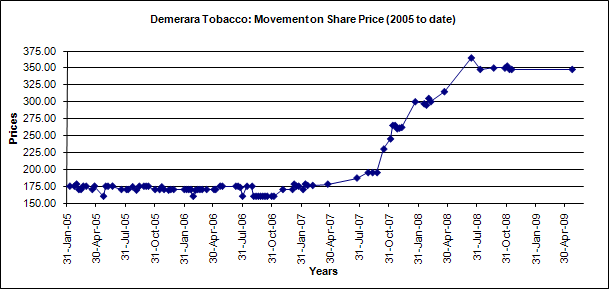
After an increase in the share price in the first half of 2008 the price actually reflected a small drop, but has been steady since August 2008. Despite this persons who see in the company’s performance only dollars and not the severe health risks would consider that they have done very well indeed.

20090621_table2

Source: The Guyana Association of Securities Companies and Intermediaries Inc., weekly trading reports

The government too would have been pleased with the amount of taxes collected with duty and excise taxes paid increasing from $1,608 million to $1,716 million or 6%, and corporation and property taxes of $960 million. The person who said that sin does not pay could clearly not have been referring to cigarettes and alcohol.

Weaknesses in the self-regulation of the accounting industry have been demonstrated

The acceptance by Mr Chandradat Chintamani, FCCA of a place on the board of Demerara Distillers Limited on the last day of 2008 has highlighted the role of individual accountants and the regulator in ensuring that ethical standards in the accounting profession are maintained.

Mr Chintamani is a member of the Council of the Institute of Chartered Accountants of Guyana (ICAG) and the Secretary and point man of its Investigations Committee. That committee took close to five years (April 22, 2004 to December 30, 2008) to adjudicate on a professional complaint against two senior directors of DDL and the company’s auditors over a loan-buy back from troubled Hamilton Bank. The evidence is that the company gained from the transaction US$1.1M or more than G$200M at the then exchange rate of the US to the Guyana dollar. The gist of the complaint was that DDL had failed to account for the gain in its financial statements on which the auditors gave a clean opinion.

As the complainant I provided Mr Chintamani directly with particulars of the buy-back which were not reflected in the company’s financial statements.

What increased the concern over the transaction were the conflicting statements made by two senior officials of the company and their inconsistency with the information provided to Mr Chintamani.

In a letter dated December 1, 2003 the company’s Chairman had stated that “the loan was treated as a creditor and included in current liabilities since it is a line of credit.” For good measure the Chairman added that the net effect of the settlement resulted in no gain or loss to the company.

Two weeks later on December 14, 2003 a different story emerged from an article in the Stabroek News in which then Finance Controller and now General Manager of the company Mr Loris Nathoo reported that “since the transaction happened within the financial year and the loans were short-term the company did not see it necessary to report the matter in its statement” (sic). He was also reported as saying that the 25% discount of US$1.1M reflected “interest and other charges.”

After some considerable silence on the part of the Investigations Committee I received a letter dated December 30, 2008 advising me that “based on documentation examined, the Council [of the ICAG] is convinced that the settlement of the loan with Hamilton Bank Limited was properly accounted for in the financial statements of DDL for the year ended December 31, 2002.” I was therefore confronted with a number of questions:

If according to the company’s Chairman the loan was treated as a creditor (as opposed to loans payable or separate treatment as it is an interest bearing liability) how could the Investigations Committee find that it was properly accounted for?

If the later statement by the Finance Controller is correct and there was no need to report the matter in its financial statements were the Finance Controller and the ICAG referring to two different sets of statements?

Assuming that the ICAG is correct, why did interest payable only increase by $72M from 2002 to 2003 if in fact a gain was set against interest payable in 2002?

Should there not have been a disclosure of a loan transaction involving US$4.673M including the credit being specifically disclosed in note 4 to the financial statements?

Since under the ICAG’s bye-laws the Institute can initiate an investigation without a complaint, what is the burden and standard of proof applied by the Investigations Committee and its own obligations to pursue evidence in relation to any enquiry it carries out?

To resolve these questions I wrote the Secretary of the ICAG on January 19, 2009 asking for a copy of the report done by the Investigations Committee. I have not had a response to my request but learnt unofficially that the report may have been oral which raises some serious questions indeed.

The role of the ICAG as regulator is not only to advance the interest of its members generally but also to ensure the maintenance of high standards of practice and professional conduct by all its members. Vernon Soare, ICAEW Executive Director of Professional Standards on the occasion of the decision of that body to open up its tribunals to the press and the public in 2007 put it this way: “A modern professional body must demonstrate that its processes are objective and in the public interest.”

The conduct of the Investigations Committee and the ICAG in the matter of the complaint against DDL and its auditors clearly did not meet that test but rather demonstrated the serious weaknesses in self-regulation and the failure of the accounting profession in its duty to the public. The reputation of the country is no less determined by the conduct of its politicians than by the integrity of the accounting profession.

From the sequence of events Mr Chintamani must have been engaged in discussions about a seat on DDL’s board even while he bore a duty to participate in an independent investigation into a complaint against leading members of that Board. At a minimum, Mr Chintamani should have disclosed to the Council of the ICAG his impending appointment and the Board of DDL ought to have considered the ethical issue involved in offering a place to Mr Chintamani. The approach to him was improper and distasteful and does a disservice to the entire Board of DDL but in the final analysis it was Mr Chintamani’s duty to refuse. His failure to do so, undermined the investigation and discredits the profession.

Mr Chintamani needs to reconsider his decision and lapse of judgment and do what is necessary to restore some measure of confidence in the profession. The Council of the ICAG must also consider whether in the light of these developments the findings of the Investigations Committee can and should stand. A profession that many see, perhaps unfairly, as part of the tax evasion industry cannot afford to feed any negative perceptions about its leading members and itself.

On the Line: Demerara Distillers Limited Annual Report 2008

Introduction
In what Dr Yesu Persaud, Chairman of the beverage giant described as one of its most difficult and challenging years the group has experienced in recent times, the Demerara Distillers Limited (DDL) group reports a decline in pre-tax profit of 8.8% over 2007. For the parent company itself, the decline in pre-tax profit was 8.98% and is a measure of how significant its alcohol and soft drinks operations are to the group. In addition to the parent, the group comprises a mix of operating companies in Guyana, the Caribbean, Europe and India. It also has a 30% stake in BEV Enterprises Limited, 33.33% in National Rums of Jamaica Limited and 19.5% in Diamond Fire and General Insurance Company Limited. The parent company accounted for 73% of the group sales but 87% of profit after tax. Correspondingly, the subsidiaries accounted for 27% of revenue and together with the applicable share of profits of associated companies accounted for 13% of after tax profits.

The Chairman attributed the performance of the company and group to the problems facing the global economy and the impact on consumers “burdened by the Value-Added Tax introduced in 2007.” The directors of the company are however confident about the future and in June last year announced a $4.5Bn expansion programme extending into the first quarter of 2010, which has already caused a significant increase in the long-term debt of the company. In fact with the total debt for the company increasing during the year from $4.2Bn to $7.3Bn, its debt to equity ratio, a measure of a company’s ability to borrow and repay money, has jumped from 0.48:1 to 0.82:1. Capital expenditure in 2008 was $1.8Bn and much of the increased borrowings by the company went into financing a 17% build-up in inventory and a 75% increase in receivables. Such borrowings have come at a cost, and finance cost increased during the year from $490Mn to $561Mn. This equates to one out of every three dollars earned before interest and tax being used to pay interest. A further $56Mn of interest paid was not charged to the income statement but was capitalised as a cost of the related asset.

Falling returns
The further expansion in plant and machinery will of course lead to additional interest cost which has increased since 2002 when the Chairman announced a financial restructuring including a share issue to minimise financing cost. That has not materialized, and financing cost has continued to rise. In fact interest cover which measures the number of times interest is covered by profit before interest and tax is now 3, when at the time of the announced financial restructuring it was 5.6 times.

While the gross assets employed by the group have more than trebled in the past ten years, the return on those assets has fallen from 29.1% in 1999 to 9.4% in 2008 – the lowest it has ever been. Despite the decline in after-tax profits by 10.9% the directors are proposing to maintain a dividend of $0.40 per share, jarringly referred to as cents per share, which of course went out of existence in 1998. The total dividend payout for the year is approximately 39%.

‘What if’ reporting
An interesting and innovative inclusion in the Chairman’s report was what may be described as a ‘what if’ statement, in which the company suggested that had it not been for some global factors affecting fuel, net exchange loss movement and increase in provision for impairments the company’s profits would have been $903Mn higher, and that profit before tax would have been an implausible $2,585Mn, an increase of 14% on decreased sales of 10.38%. These are however real costs, and reflect the challenges which directors are expected to confront and mitigate.

The composition of the net exchange loss reflected in note 6 to the financial statements is itself interesting, as it is made up of Exchange losses of $488Mn and Exchange gain of $296Mn. This emphasises the inevitable risk of dealing in international currencies such as the euro and the pound sterling, which often move one way and then the other, the negative impact of which may be avoided by what is referred to as hedging.

Liquidity strains
The company and the group have also seen a substantial reduction in cash with the company’s cash resources reduced to $79Mn from $235Mn at the beginning of the year, and for the group from $298Mn to $107Mn. Current liabilities on the other hand, skyrocketed from $3.7Bn in 2007 to $6.7Bn in 2008, partly due to two major short-term loans taken as bridging finance for the capital expenditure in 2008. The position will abate in 2009 with the conversion of those loans into long-term facilities, but will continue to remain high with trade payables and bank overdraft exceeding $6Bn. Included also in Trade and other payables for the company is a huge amount of $2.242Bn, bringing total interest bearing borrowings to $8.354Bn. If this trend continues without compensating returns on investments, they will become a real drag on the company’s development.

One continuing concern about this company is the high level of its inventory and receivables. The company’s sales for the year declined by 11%, but its level of inventory which includes finished goods, raw materials and spares increased by 17%. And for the group the position was only slightly better. Revenue increased by 2.3%, but its inventory increased by 20%. Expressed another way, the company and the group have in stock at their written down value the equivalent of sales value of 14 months and 20 months respectively! Intuitively one would expect the company to have had a high level of inventory because of the aging of alcohol, but these numbers lead one to wonder seriously about the quality of the inventory held by the subsidiaries.

Sales too have come with hidden financing cost. While sales for the company show a decline of 10.4%, trade receivables went up by 46%, and for the subsidiaries the increase in sales of 67% was accompanied by an increase in their trade receivables by 34%. This latter position appears better than it really is because a major subsidiary – Distribution Services Limited – operates on a cash and carry basis.

Subsidiaries
The performance of the subsidiaries and associates was mixed, with Tropical Orchards Products Company Limited reporting after tax losses increasing from $6Mn to $50Mn. When the group announced a $500Mn investment in TOPCO in 2004 Business Page pointed out that based on a standard measure of investment appraisal such a level could not be justified. Regrettably that fear is being more than vindicated and since then TOPCO has returned a net loss to the group.

Another concern is the investment in India which continues to show losses, and it takes a certain level of faith to persist with this investment in the face of annual losses having to be carried by the rest of the group. China and South America with which the company flirted for a couple of years appear to have gone off the radar and already the company is learning what a difficult environment Jamaica is with its share of pre-tax profits in the Jamaican company declining from $56Mn in 2007 to less than $4Mn in 2008. On the other hand, bright spots are Demerara Shipping and Distribution Services locally, and the European, St Kitts and US operations.

Belatedly, the directors appear to have accepted that the purchase by the company of the controlling shares in Solutions 2000 was not a good investment after all. The company has lost its entire investment in annual losses and given the performance and outlook for Solutions, the company must consider itself lucky that it did not suffer a bigger capital loss. Interestingly it is only in the year of disposal that the company discloses that the controlling interest in the company was acquired from DDL directors Messrs Komal Samaroo and David Spence in 2000. The identity of the purchaser has not been disclosed.

Governance
One difficulty I have with some of the numbers presented for the subsidiaries is that all the subsidiaries are private companies subject to minimal statutory and governance obligations. In fact some of them operate in jurisdictions which do not require an audit and even locally the subsidiaries do not comply with the law requiring them to file annual returns and financial statements. It is unlawful and unacceptable that the local subsidiaries have not been filing their annual returns and financial statements, and the only financial statements seen in any of the files at the Deeds Registry are the annual reports of the group.

In preparing for the column I sent a note to fellow accountant Mr Loris Nathoo, General Manager, asking for the turnover and the names of the auditors of the subsidiaries. Since it relates to the subsidiaries of a public company this information should not be a matter of secrecy. However, the reply took the form of a letter from the company’s in-house attorney that did not respond to my request, but boasted of the “Company’s 2008 Report [being] incomparable to any other published accounts in Guyana and, indeed, in the region.” One has to wonder whether the writer is familiar with the annual reports of Neal and Massy or RBTT of Trinidad and Tobago or Grace Kennedy of Jamaica.

One might have expected awareness on the part of the directors that their note 22 on Segment reporting is not in compliance with paragraph 69 (a) of IAS 14, which requires that where a company chooses business segments as its primary reporting format it must disclose revenue by geographical location of the customers. That is where the risk lies and that is what segment reporting is designed to highlight.

One change in the financial statements is the inclusion of the insurance arm Diamond Fire and General Insurance Inc as an associated company in the results of the company. Dr Persaud claims that this change was based on the advice of the auditors and the Institute of Chartered Accountants of Guyana. Of course that does not reflect the fact that it was a ruling resulting from a formal complaint lodged by this columnist.

New Director
A related issue is that on the last day of 2008 the board appointed Mr Chandradat Chintamani, Chartered Accountant, as a director of the company. This appointment is considered coincidentally unfortunate since a committee of the ICAG headed by Mr Chintamani had very shortly before exonerated certain directors and the company’s auditors from my formal complaint that they had failed to account for a US$1.1Mn discount on a loan buyback from Hamilton Bank, which had gone into liquidation.

Conclusion
Apart from the announcement about the new investment the Chairman’s report is largely retrospective, and nothing is said about the outlook for the company and the group for the current year and beyond. Like with all the companies whose shares are traded on the local stock exchange, the company’s share price has remained steady, and with the recession in the developed economies appearing to have slowed, the group must be hopeful that it will return to growth in 2009.

The IMF Consultation on the Guyana economy in 2008

Introduction
Using its stock-in-trade jargon the Executive Board of the International Monetary Fund in a Public Information Notice issued on May 19, 2009 gave a very favourable report on the performance of the Guyana economy for 2008. The IMF attributed the maintenance of macroeconomic stability in 2008, despite what it referred to as external shocks and undefined “social pressures,” to the implementation of prudent fiscal and monetary policies by the Guyanese authorities. This assessment came in what is referred to as an Article IV Consultation in which the IMF holds bilateral discussions with member countries, usually every year. For the consultation an IMF staff team visits the country, collects economic and financial information, and discusses with officials the country’s economic developments and policies.

The website Countryrisk.com/guide/ archives/000309.html considers such consultations to be as “fine a piece of research as you’re likely to find produced by the public sector.” It claims that “the IMF staff economists harangue each country about its weak points on a periodic basis; these reports record this tongue-lashing.” Roles have reversed and it is the tongue-lasher who is in the effusive role immediately juxtaposing a criticism with an overwhelming corresponding achievement. The website also opined that with the recent fashion for good governance the consultation covers not just economic policy but also political institutions. That certainly did not happen with the Guyana 2008 Consultation. To complete the songs of praise of such reports, Countryrisk.com notes that they contain an excellent data section at the end including detailed budget numbers and IMF forecasts. Not even the IMF Public Relations Department could have done a better job.

Insensitive IMF
Today’s column looks at the May 19 statement which has generated practically no comment in the media. The consultation took place just days after the presentation of the 2009 Budget by the Minister of Finance and it is in many ways a restatement of the points made in the speech by the minister, except perhaps for its level of generalisation. If the matters contained in the report are almost identical, so too are the omissions. Nothing, for example, about job creation and unemployment levels, which must be the major poverty issues facing the country, the pervasive underground/parallel/narco-economy which has such a distorting effect on the official economy, and widespread tax evasion which is as much an equity issue as it is a contributor to poverty with the poor paying the taxes for the rich. In fact the reference to taxation said nothing of the punitive tax burden borne by those who have the misfortune to be honest or employed while the report lauds the introduction of VAT as “significant progress in the area of fiscal reform.” That is as insulting as it is insensitive.

In fact if the unnamed official who visited Guyana had taken the time to read the IMF’s own recommendations on tax reform s/he would have noted that many of the recommendations are yet to be implemented. Some of these are: the recommendation for the reduction of the corporation income tax rate for commercial companies from 45% to 40% in 2003 and to 35% in 2004; disallowing the carry forward of minimum tax in excess of corporation income tax; extending the minimum tax to noncommercial companies and the abolition of the threshold; limiting the deduction of interest paid for corporation tax purposes and imposing a withholding tax on payments to local government contractors.

And those locals more familiar with the tax laws and their operations could add several more, including constraints in the tax laws (income, corporation, property and VAT) which inhibit businesses; clarifying ambiguities in the tax laws; modernising the provisions relating to capital allowances in respect of the service and IT industries; thin capitalisation rules; trans-border and operational issues such as set-offs, interest, refunds, etc.

Resuscitating the PRSP
The report describes the attention to poverty alleviation as a medium term issue and notes that the directors “welcomed the upcoming finalisation of the Poverty Reduction Strategy Paper,” which, however, did not get a mention in the 2009 Budget speech. Other than references to earlier documents, the past three budget speeches paid no attention to the PRSP, leading many to wonder whether the PRSP had been subsumed or abandoned. And the Minister of Finance in his 2009 Budget speech linked poverty reduction and economic development to the mobilisation of external and domestic debt. Not only can debt cause impoverishment, but what about the seventy billion dollars or so paid in VAT and other indirect taxes and PAYE which make many into working poor? It seems that the PRSP is no more than another marketing document to take to donors and the lending community.

Macroeconomic stability holds a special place on the IMF altar of economic performance and rectitude. If that is preserved then for the IMF all is well. But then we seem to have shifting sands when it comes to what the IMF in fact means by macroeconomic stability. Has the meaning changed from the early days when the IMF itself defined its objectives to include a) achievement of an average rate of GDP growth of 4%; b) a viable balance of payments situation in the medium term; and c) the re-incorporation of the parallel economy into the official economy? The economy is of course a long way from these, so the meaning not only changes but when growth decelerates the IMF considers it sufficient compensation that there is a decline in inflation. And after a sharp shortfall in 2008, sugar is expected to contribute to higher growth for 2009 to offset a slowdown in the other sectors of the economy.

Statistics
The IMF seems to accept all statistics at face value. It repeats the official growth in the 2008 economy of “about 3%,” described as a deceleration attributed to the performance of sugar. Even if it is assumed that at the time of its official’s visit in February, the statistics were unavailable, more complete data were available by the time of the report’s publication. The data disclosed by the Minister of Finance show that in 2008 sugar as well as forestry declined over 2007 by 15%, diamond by 37%, bauxite by 7% and manufacturing by 2%. Despite all of this the economy grew by 3.1% – a questionable proposition indeed.

There was not a single comment on the unrestrained excessive domestic spending, but in relation to external transactions the IMF noted that the country’s external current account had widened to close to 21%. The current account is the sum of the balance of trade (exports minus imports of goods and services), net factor income (such as interest and dividends) and net transfer payments (such as foreign aid). Almost as if to soften the impact of the deterioration the report not only seeks to attribute that deterioration to sugar but immediately adds “but was fully financed by concesssional loans, grants, and FDI.” As if one justifies the other.

No mention either of the alarming growth of the domestic debt which has quadrupled since 1992. As debt – domestic or foreign – rises so too does debt-servicing. The interest cost of servicing the domestic debt in 2008 was $2.98Bn while the interest of the external debt was $1.7Bn. Total debt service inclusive of interest cost is 14.4% of the total non-interest expenditure compared with 11.7% in 2007. Instead of seeking to address poverty reduction through incurring further debts policy-makers should be concentrating on job-creation to save our citizens from the indignities, cruel treatment and even death as they seek jobs in neighbouring countries.

Job creation
Even with all the limitations of our national statistics the evidence is overwhelming – we are not creating an adequate number of jobs to serve the population. That is the essence of the problems our citizens face. To blame Barbados for enforcing their immigration laws is counter-productive. Every government is sworn to uphold its laws even where there is a common economic space, and one only has to think of the illegal Mexicans who are routinely held by the US and returned to their country. To use Obama’s word it is “ignorant” to threaten to pull out of Caricom when we are certainly a major beneficiary. Or to hark back to the days when Bajans were welcome into our country, as if the traffic was all one-way.

For all the constant criticism about the economy inherited from the PNC and the boast about growth in the economy, since then the active number of employed persons in 2008 is less than it was in 1990, 1991 and 1992. NIS is a poverty issue and the failure by the scheme to insure persons is a failure of poverty management. It means that those persons would have no NIS pension when they turn 60.

Conclusion
Guyana is by far the largest country in Caricom and has one of the lowest population densities. We need our citizens – artisans and professionals – to stay and help build the country by exploiting the country’s vast potential, also the greatest in the region. We need imaginative economic and social policies; we need local and foreign investors who create jobs and make a net contribution to the country, and who do not just reap benefits and leave; we need a society that is as favourable to the poor as it is about the rich. We need a tax system that is fair and equitable.

At best the IMF sees poverty as a subscript to their macro-economic fundamentals. They seem neutral whether it is the parallel or the formal economy that makes the economy stable or how many persons are put on the breadline to achieve that stability. We need to make the elimination of poverty as much part of the equation as macro-economic stability. It is time to reject trickle-down economics.