The Integrity Commission is not a subject for spinning

Perhaps it is because in cricketing terms both Dr Prem Misir and Mr Kwame McKoy would be considered spinners of the pedigree of Ramadhin and Valentine; perhaps it is because they work at the same place, or that they write and think alike; or perhaps it is their knack for assigning a political party because they do not understand or practise independence, political or otherwise, but whatever it is, Dr Misir’s missive in the Stabroek News (February 3), repeated I believe in all the dailies, wishing me luck in my campaign in the 2011 elections surely extends their line about my political goals and plans. Dr Misir was even generous enough to wish me well, but then undermines his sincerity with the words, “I really mean it.” Or perhaps Dr Misir understands the need for such an attestation clause to add to his credibility. Whatever it is, I now make this public promise: If ever I decide to participate in the 2011 or the 2021 elections, which would be my preference, I will inform Dr Misir and Kwame first. After all they will, for their own purpose, publicise the news quickly and widely. And I really mean it!

In responding to the Business Page article on the Integrity Commission, Dr Misir made bold to say that the Integrity Commission exists with a functioning secretariat. What he did not tell us is how well it is functioning. Nor does he say that the secretariat as presently constituted cannot carry out its mandate under the Integrity Act, 1997. He does not say too that the commission, including the secretariat, has failed in routine administrative functions and that the commission and the commissioners have been derelict in their statutory duties. And that the commission has only an accounts clerk.

I can only wonder how Dr Misir can be so badly informed that he seems unaware of the rather uncomplimentary report done by external consultants Bradford and Associates, and that for over two years the accountable and self-appointed Minister, President Jagdeo, has been unable or unwilling to address the commission’s identified structural, organisational and operational deficiencies and the report’s recommendations, which this administration gave a commitment to the World Bank that it would implement. I am never sure whether the World Bank and the IMF are hopelessly spineless or dangerously gullible.

Dr Misir praises the President for sounding the alarm bell, which is the doctor’s euphemism for threatening a targeted group with prosecution. He does not say that the alarm came long into the still-born state of the commission and speculates on the President’s reasons for the timing of the chiming. Why he has to speculate given that he is the President’s spokesperson-in-chief is a bit of a mystery, every bit as surprising as penning his letter − apparently in his personal capacity. Perhaps it is because he described the episode started by the President as the “integrity thing.” But it is more than that; it is about possible criminal conduct, the rule of law, accountability and transparency. It is about how some politicians and “public servants” have come to acquire significant wealth on a bare state salary. It is about the kind of society and white collar criminality we as a society are prepared to tolerate. This is not something for spinning.

Some years ago when President Jagdeo appointed the wife of someone subsequently discredited to be a member of the Integrity Commission I wrote publicly that the commission itself needed a dose of integrity. I am now more convinced than then. As commissioners they need to be more virtuous than Caesar’s wife, ensuring that they comply with all the laws of the country and are scrupulously forthright about their compliance with all the country’s laws, including those relating to taxes.

But we need to fix more than the commission, which was part of the “integrity thing.” Imagine the President has not notified the commission of the resignation of Chairman George! Is this for real? We need to get the Office of the Ombudsman, the Procurement Commission and a proper Money Laundering Unit functioning. We need to free the Guyana Revenue Authority from political influence that may inhibit their zeal in going after the big-time tax evaders. We need proper campaign financing rules to free political parties from their secret and secretive donors.

We need an Office of the DPP which enjoys the total confidence of the public. And let us not forget, we need an Audit Office where the wife of a Minister does not hold a senior post.

It is time that we begin the serious and considerable work to be done; it is not a time to spin.

But back to Dr Misir’s letter. The letter jumps from me to the PNC, and then remembering what he had set out to do, ie respond to Business Page, he jumps right back to me in his closing paragraph. Perhaps Dr Misir was being too clever by half: accuse by association.

Finally, if Dr Misir wants to find out how a real Integrity Commission works I recommend that he consider what is happening with the Integrity Commission in Trinidad and Tobago.

If he does he will see that their Integrity Commission is enshrined in their constitution rather than a mere law; he will see the quality, qualification and background of its commissioners and the clout the commission has exercised in that country. In fact, just this past Thursday the entire commission comprising Chartered Accountant John C Martin, Chairman; retired Supreme Court Judge and former Chief Parliamentary Counsel Monica Barnes; Finance Consultant Peter Clarke and Chartered Accountant Vindar-Dean Mohammed, a full-time Member of the Tax Appeal Board resigned en bloc having been criticized by a judge. Their resignations took effect on submission to President Ellis.

Since I believe we have a duty to our fellow Guyanese to share knowledge and information, I am sending a copy of today’s (Friday) Trinidadian Guardian to Dr Misir. I hope he shares it with Kwame. And I really mean it!

Addressing the CLICO Issue

Introduction
Rumours that the region’s largest conglomerate CL Financial Limited (CL) was experiencing difficulties were confirmed at a dramatic press conference in Trinidad two Fridays ago, hosted by the Governor of the Central Bank and including CL’s chairman Lawrence Duprey and Finance Minister Karen Nunez-Tesheira. At the press conference it was announced that the group, better known by its founding acronym CLICO, had approached the Government of Trinidad and Tobago for a line of credit to meet some unusually large demands for withdrawals from CLICO Investment Bank (CIB), a subsidiary of CL.

The initial deal seemed clean, clinical and simple enough. The government and the central bank would take control of CLICO Investment Bank (CIB) while the assets and liabilities of CIB and another subsidiary, Caribbean Money Market Brokers (CMMB) would be transferred to state bank First Citizens. At the same time the Minister of Finance announced that the government and the central bank would guarantee the assets of depositors and policy holders at CLICO, CLICO Investment Bank (CIB), CMMB and British American Insurance by the injection of cash. In return CL was expected to give up vast swathes of its empire including its 55 per cent stake in Republic Bank Ltd (worth billions of dollars), its interest in Methanol Holdings Trinidad Ltd, which owns and operates the world’s largest methanol plant, and share its equity interest in CLICO and British American Insurance.

Jitters and praise
The government and the central bank were praised by the TT business community for their prompt and mature response and jitters appeared calmed. But things turned a bit sour when the government sought to pass necessary legislation to provide it with the remaining powers needed to extend supervision over insurance companies and to facilitate the transaction. The country’s Opposition Leader accused the government of having engaged in a hostile takeover; the press revealed that both the central bank Governor and the Minister of Finance had been connected with cashing out of deposits with CIB; Mr Duprey brought in UK Senior Counsel to advise him on the transaction while the government brought in financial specialists to assist in the valuation of the assets and in the restructuring of the companies. It was also reported that the Memorandum of Understanding among the central bank, the government and the Group was still being “clarified.” The government did however get the legislation that it wanted.

Guyana
The guarantees of policies and deposits by the Government of Trinidad related only to third parties and only in respect of the companies with which the memorandum was to be signed. They did not extend to other subsidiaries of CL Financial including the Guyana subsidiaries and those which are indebted to CLICO Guyana. Of particular interest to Guyana therefore is the impact on policies including annuities and deposits with CLICO Guyana, and deposits with Republic Bank (Guyana) Limited (RBGL), a subsidiary of the Trinidadian parent whose majority shareholders are those entities being taken over.

Let us look at the last first. Chairman of the local RBL and Managing Director of RBL Trinidad Mr David Dulal-Whiteway announced that government’s gain of Republic Bank’s shares from CL Financial is only an interim measure to secure financial support from the state and will not involve operational control of the bank. The Guyana Association of Bankers (GAB) gave full support to RBGL in a late-night statement issued on January 30 in which it welcomed the decision of the Trinidad Central Bank to intervene to support CL Financial Limited. It noted that commercial banks locally “held excess liquid assets of $29.6B or 71.6% above the statutorily required level,” and that “depositors can feel very confident and assured that the stability and integrity of the local financial system is guaranteed.”

CLICO Guyana, in which two of the three directors are Trinidadian, issued its own statement through its CEO Ms Geeta Singh-Knight in which she announced that the statutory fund (required by the Insurance Act 1998) of the company which is a separate entity within the CL Financial Group was “in good standing”; none of its assets are intertwined with CLlCO [TRINIDAD] or CLlCO Investment Bank”; and that developments involving its parent CL Financial Limited have no financial impact.

Meeting
On the day the news broke in Trinidad, Minister of Finance, Dr Ashni Singh summoned a meeting with CEO Singh-Knight and Commissioner of Insurance Maria van Beek. He wanted to ascertain the extent of exposure, if any, of CLICO Guyana to the events in Port-of-Spain and requested the company to supply to the Commissioner of Insurance by last Monday further “information on the financial status of the Group, details of the transaction agreed with the authorities in Trinidad and Tobago, and of the implications of these developments for the operations of the Group as a whole and the Guyana company in particular.”

Nothing further has been said publicly by the Minister who appears to have committed a procedural error of judgment since the better thing to do would have been to meet with the two parties consecutively. The public has not been told whether all the information requested has been provided and analysed and the Commissioner of Insurance has been silent.

Like Trinidad, CLICO Guyana takes money on deposit from the public but because of the Bank of Guyana’s interpretation of the law the company does not require a licence from the Bank of Guyana to do so. As a result the responsibility for supervising CLICO’s financial operations falls entirely under the Commissioner of Insurance and the office should have been far more proactive than it has been in this matter. There is a lot at stake, including insurance policies, annuities and pensions, and huge sums invested in the company by the NIS.

Monitoring
President Jagdeo announced that his government was watching the situation closely, and trying to put into context the scale of any potential problem the company may encounter, noting that CLICO (Guyana) makes up just three per cent of the country’s total financial assets. The President who has appointed the company’s CEO to the GuySuCo board added that the only problem he could envisage in the short term was a mismatch between liabilities and assets.

Then late on Friday Deputy Governor of the Bank of Guyana, Dr Gobind Ganga said that the central bank is “very much concerned” at the financial crisis within the CL Financial Group and confirmed that the bank is tracking every bit of information being provided on the issue as it develops – hardly a clear statement in these circumstances.

Such statements may sound good but what is needed is critical analysis of factual information, particularly given the attention span of politicians. The discussions between the government and the company seem to emphasise “investments or dealings with sister companies CIB or CLICO (Trinidad),” which can cause dealings with other related entities to be overlooked.

So far no one seems to be dissecting the 2007 financial statements, or requesting a copy of the Memorandum of Understanding and asking that the relevant transactions for 2008 be made public. It cannot be too hard to determine the liquidity situation of the company or the exposure to related parties – the issues that sparked the crisis in Trinidad. CL’s financial statements for 2008 are not yet out but the regulators in Trinidad have obviously requested and received them.

A limited financial perspective
The audit of the Guyana company’s books for 2008 is in progress and only the 2007 statements audited by Deloitte and Touche are available. I therefore sought some updated information from Ms Singh-Knight who was most forthcoming and extremely helpful.

The 2007 financial statements, which regrettably are not that reader-friendly and could benefit from significant enhancements, state that the company is a wholly-owned subsidiary of CL Financial Limited. At December 2007 it owed CLICO Trinidad $1.2 billion (representing 10% of its total assets) and reduced this balance in 2008 to $800 million. This amount is interest free but repayable on demand. Does the Memorandum of Understanding permit the deferral of the debt in the interest of the Guyana company or not?

The net assets of the company at December 31, 2007 amounted to $11.7 billion of which $1.2 billion was classified as current assets but which included accrued investment income of $500 million, largely from related parties. In the bank at that date was $127 million. Its current liabilities or payables are stated at $1.7 billion including the $1.2 billion owed to CLICO Trinidad. The company treats all policy holders’ funds as equity and these include $8.030 billion in Ordinary life policies, including annuities. The holders of these annuities can surrender their policies and expect to receive payment within one week.

The company’s primary investments are in Caribbean Resources Limited (CRL) and CLICO (Bahamas) Limited. At December 31, 2007, investments in these entities totalled $1.5B and $6.0B or 13% and 51% of total assets respectively. Investments in the Berbice Bridge Company Inc (BBCI) total $1.8B, or 16% of total assets bringing total investments in three related entities to 80% of total assets.
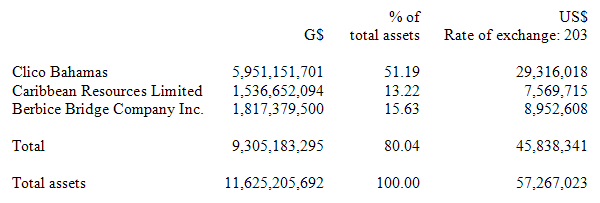
20090208_table
Source: CLICO Guyana Annual Report 2007

The last annual return filed by CRL was for 2001 and therefore updated information was not available for our review. The investment in CLICO (Bahamas) Limited, an insurance subsidiary of CL whose 2007 financial statements are available on the internet, represents approximately 30% of that company’s assets.

The Guyana company’s financial statements describe the investments in the Bahamas company as Fixed Deposits, which is misleading since that suggests a banking type deposit. In fact, despite the auditors of the two entities bearing the same international name, the Bahamas company in its corresponding account includes the amount not in Equity but as Annuities under the broad heading Future Policy Benefit Reserves.

It is apposite to note that as the 2007 financial statements indicate, the company is in breach of section 55 of the Insurance Act 1998 which requires that 85% of the statutory fund be held in Guyana. One now has to wonder whether the company has taken steps to remedy this situation.

Bahamas company
The CRL investment is guaranteed by the troubled CL Financial group while the investment in the BBCI would clearly not be liquid. The Bahamas company too has its own problems with the auditor’s report containing an Emphasis of Matter noting that 59% of the company’s assets were invested in a related company, CLICO Enterprises Limited. The audited financial statements did not show an amount due to the Guyana company at December 31, 2007 in its related party notes, but annuities total 70.0M Bahamian dollars, of which Guyana would hold 42%.

On August 21, 2008, AM Best Company Inc, a financial services credit rating organisation, downgraded CLICO (Bahamas) Limited’s financial strength rating to B (Fair) from B+ (Good) and issuer credit rating to “bb” from “bbb-”. The outlook for both ratings is stated as “negative.” The ratings for Colonial Life Insurance Company (Trinidad) Limited were similarly downgraded on February 2, 2009 as news broke of its troubles and both companies were placed “under review.”

Conclusion
I was informed by the company’s CEO that it has met all demands for funds since the news broke. The last thing the company needs is an unusual demand from its policy holders. What is now very important is for the Minister of Finance, the government and the Office of the Commissioner of Insurance to ask the right questions and to get hard information from the company. Now that everyone has been before the cameras and has had their photo opportunities, the hard work must begin.

It is not enough to downplay the impact of any potential difficulties and we should not forget that the NIS up to December 31, 2005 (the last date for which financial statements have been released) was heavily invested (to the tune of $7.7B) in the company. Unfortunately Ms Linda Gossai, a member of the scheme’s investment committee would not disclose to me the extent of its current investment, claiming that she does not “keep those figures in her head.” Instead of simply tracking information on the issue as it develops, the Bank of Guyana needs to start thinking whether, like Trinidad, there are regulatory issues which need to be addressed with respect to what amounts to deposit taking by some insurance companies.

The Bank of Guyana should have long contacted its counterpart on a confidential basis for a copy of the Memorandum of Understanding and to have an informed basis to deal with its concern. Too many people just seem to be waiting and that is not good enough at any time, let alone now. It is also clear that the Office of the Commissioner of Insurance simply does not have the resources, the authority or apparently the will to deal with issues like these. The local authorities should act quickly by first obtaining and analysing the relevant information and having further discussions and agreement with the company, and then following this by a visit to Trinidad and The Bahamas to meet with the relevant persons. Delay only drags the situation out, which is not good for either the company or the economy.

Integrity Commission on shaky ground – conclusion

Re-cap
Last week we ended the column with the offices listed in Schedule I to the Act, the holders of which must automatically file with the Integrity Commission, declarations of their income, assets and liabilities of themselves, their spouses and minor unmarried children by June 30 of the following year. Formidable as the list may appear, it leaves out some very vulnerable positions. For example, it does not include members of tender boards responsible for the award of contracts; members of Go-Invest which is responsible for recommendations on concessions to investors by the government; head of the prevention of money laundering unit; police and special prosecutors; members of the Securities Council; members of tax appeal boards and possibly some statutory bodies as well. Nor does the list go deep enough. For example it includes only four positions in the GRA/Customs and would have excluded those persons allegedly associated with the Fidelity scam. The offices of Chancellor and Chief Justice are not included but would have to file as members of the Judicial Service Commission.

Complaint required
Section 42 of the Act does however make provision for the following categories of persons not listed in Schedule I. Submission of declarations by them is not automatic and requires a complaint to the Commission, an investigation and findings while any resulting declarations will be in respect of specified years only. The categories are: public officers; officers of Regional Democratic Councils; officers of the Bank of Guyana; officers of state-owned and controlled banks; officers of public corporations and other bodies corporate and agencies (including companies and bodies established by or under any statute) owned by the state or in which the controlling interest is vested in the state or any agency on behalf of the state; members of tender boards.

The Act does not define “officers” but looking at section 42 alongside Schedule I, mandatory annual submission applies only to the top echelons. In any case, any appearance of overlap should cause no problem since once the position is listed in Schedule I, submission is mandatory. The problem faced by a person seeking to utilise this provision is that s/he has to have good grounds while section 28 (3) has the effect of discouraging complaints by providing sanctions for complaints that are considered frivolous, mischievous or spiteful.

Investigation into the assets of those GRA officers allegedly involved in the Fidelity scam would therefore require a complaint by any person which would include the President. Public posturing does not constitute a complaint which in any case has to be made to the Commission and not to the Audit Office.

Code of Conduct
The Code of Conduct set out in Schedule II to the Act applies to all persons in public life, but experience has shown how hard it is for breaches of the code by both scheduled and non-scheduled persons to be uncovered and penalised. Many of the provisions of the code aim to establish proper conduct by public officers but this will require a complaint or self-disclosure, hardly a reasonable expectation. It expects, quite unrealistically in our environment, that a person who has received a gift in excess of $10,000 or who has misused his/her public office for private gains will report those facts to the Commission.

Powers of the President
The Act is also very clear on the independence of the Commission and provides that “in the exercise and discharge of its functions, the Commission shall not be subject to the direction or control of any other person or authority.”

Perhaps it is timely to correct a view held not only by the President but also by the press, that is, the President’s role in relation to receipt of statements and publication of a list of defaulters. Section 13 is clear: the statements by persons other than members of the Commission go to the Commission. Only statements by members of the Commission are submitted to the President. The right to examine statements, make enquiries, request statements or publish names as set out in sections 17 to 19 is circumscribed by the use of the words “the Commission or the President, as the case may be” (emphasis mine). The President simply does not have the powers he claims and those who seek to speak on his behalf think he has.

Accountability
The Commission is required within three months after the end of the year to submit to the President a report containing an account of the activities of the Commission including any difficulties experienced by the Commission in the performance of its functions. Surely non-submission by relevant persons and not only MPs constitutes difficulties. The Commissioners have failed to discharge this particular responsibility for each year of the Commission’s existence, which constitutes a dereliction of their duty.

The nation is owed a full and proper explanation by the Commission’s acting Chairman, Mr Ferouz. Both as President and the self-appointed minister responsible for the operation of the Act, Mr Jagdeo owes the nation an explanation for his failure to have reports laid in the National Assembly within the prescribed time.

With the Commissioners’ continuing failures – I understand that they are now trying to work on their past reports − there are sufficient grounds for their removal under section 5 of the Act which include breach of any of the provisions of the Act, absence from meetings for two consecutive months or for three months during a period of twelve, and failure to carry out any of the functions and duties of the Commission. On these grounds, there can no longer be a basis for the pretence regarding Bishop George or the continued membership by Mr Fazeel Ferouz of the Central Islamic Organisation of Guyana (CIOG), Mr Nigel Hinds of the Guyana Council of Churches and Pandit Rabindranauth, Director of the National Commission of the Family. Interestingly, while the Leader of the Opposition has to be consulted on appointments it seems that removal is a matter exclusively for the President.

Legal action
During this past week head of GINA, Dr Prem Misir, and Minister of Health Dr Leslie Ramsammy, both persons required to file declarations under the Act, wrote letters to the press on the question of the submission of declarations by persons concerned. Dr Ramsammy’s letter was refreshing and persuasive and could have easily been intended for all declarants, including his political colleagues. Dr Misir’s, on the other hand, was more concerned about opposition MP’s non-filing. Another letter signed by Mr Learie Barclay actually and dangerously sought to justify an improper “dictating” by the President, incredibly, on moral grounds.

Leader of the Opposition Mr Robert Corbin, an attorney-at-law argues that since his party has challenged the appointment of the Commissioners on the grounds that the President had failed to consult with him as required by the Act, their MPs do not have to comply with the Act. The press has given few details of the action brought and the relief sought by the PNC but as far as I am aware the party did not ask for any interim relief and accordingly Dr Misir has a point that compliance is required until the court rules otherwise. The PNC could have asked, for example, either that the court grant an order staying any requirement for the submission of declarations or that declarations be submitted but sealed so that the Commissioners whose appointment is subject to the court challenge are prevented from accessing them.

The opposition should also have considered how a court would interpret and apply section 9 of the Act which allows for acts of the Commission to retain their validity even if there is any defect in the appointment or qualification of “any person purporting to be a member.” Taken literally, even if the court finds a defect in the appointment or qualifications of all the members of the Commission, they may still rule the actions of the Commissioners as valid, despite the breach of the important consultation provision of the Act. In this connection and to avoid any embarrassment, the Chief Justice needs to ensure that the judge assigned to adjudicate in the matter has been submitting the annual declaration required by the Act.

The view of some legal minds outside of Guyana with whom I discussed the matter is that the legal action against the appointment does not constitute a stay but another person took a different view − there should be no second hurdle – the first (consultations with the leader of the opposition) was not crossed so no need to consider the second (compliance). For good measure he said that only in Guyana could such things take place.

Conclusion
The Act was intended, as stated in its long title, to secure the integrity of persons in public life and creates a new offence at law – Possession of Unaccounted Property or Pecuniary Resource. That is most desirable and can go a long way in cleaning the Augean stables so far as persons in public life are concerned. It can also help to raise revenue and curb tax evasion. I can see a Commissioner General ringing his hand in glee knowing that he can demand from relevant persons further statutory evidence against which to check the accuracy and completeness of information by an important class of taxpayers. And let us be clear – that includes all those persons whose official emoluments are exempted from taxation, such as the President, the Chancellor, the Chief Justice and persons in receipt of foreign-funded salaries.

The President has retreated from his misplaced two-week ultimatum for naming those MPs who fail to submit declarations. The PNC has already stated that its MPs will not submit, rendering the threat inconsequential. The President now says he is resuscitating the Commission, an admission that he has misunderstood and sought to misapply the provisions of the Act, not dissimilar to his pronouncements on tax holidays. The result is that the Act’s noble purposes have been delayed if not defeated. We can only hope that the President and the Leader of the Opposition can agree on five persons to serve as Commissioners. Will they also address the other shortcomings of the Act such as the list of persons required to file declarations? We have to hope as well that the court has been listening and reading about the consequences of its lethargy. Something tells me that we will have a long time to wait before this issue is resolved.

Finally, public officers may feel badly done by, being subject to more stringent ethical obligations than their private sector counterparts. Perhaps it is time to repeat a call made earlier by Business Page for a Code of Conduct for persons serving in a representative capacity in private sector organisations to prevent them abusing that role for their personal and specific business interest.

Israel’s intrusion into Gaza is a war crime

The final sentence in Roger Williams’ letter to SN (‘Israel’s action in Gaza is not a war crime,’ January 19) exemplifies the central theme of his quarrel with those of us who described Israel’s intrusion into Gaza as a war crime, the glorification of the Israeli war machine.  Are there some other dimensions, or hidden ideological agenda, to Mr Williams’ support for Israel’s cruel and inhuman attack on Gaza?

While ranting on a few issues in our letter Williams is strangely silent on other matters we raised, above all the overwhelming condemnation of the assault on Gaza by thousands upon thousands of Jews inside and outside of Israel. We limit ourselves to just two.

The first, a letter in the Irish Times signed by eight women and men describing themselves as “people in Ireland who are Jewish or of Jewish descent” made the following denunciation of the action by Israel and appeal for support for Jewish people opposing it:

“We are appalled by Israel ’s slaughter in Gaza. We have seen people justifying this on the basis of Israel’s ‘security concerns’ and attacking supporters of peace for being anti-Jewish. In this climate we feel it important to assert that it is not anti-Semitic or anti-Jewish to oppose Israel’s action. Nor, however, can it be part of any progressive political vision to conflate what the Israeli state has done and is doing in Gaza as being supported by Jews worldwide. Throughout the world, Jews have opposed the invasion of Gaza. In Israel itself, tens of thousands protested this war; they have been attacked by police and right-wing mobs and many Israelis, predominantly non-Jewish but also Jewish, have been imprisoned. We ask people to support these Israelis.

As for Israel’s security concerns, two points need to be made. Firstly nothing, but nothing, justifies the massacre of innocent people. Secondly, peace will only come about through justice for the Palestinian people and through negotiations between Israel and elected Palestinian representatives. One does not need to be Jewish to know this. We ask people not to claim to speak for us when justifying Israel’s barbarity.”

The second, a statement by British parliamentarian Sir Gerald Kaufman, made a connection at once deeply personal and political:

“My parents came to Britain as refugees from Poland. Most of their families were subsequently murdered by the Nazis in the holocaust. My grandmother was ill in bed when the Nazis came to her home town of Staszow. A German soldier shot her dead in her bed.

“My grandmother did not die to provide cover for Israeli soldiers murdering Palestinian grandmothers in Gaza. The current Israeli Government ruthlessly and cynically exploit the continuing guilt among gentiles over the slaughter of Jews in the holocaust as justification for their murder of Palestinians. The implication is that Jewish lives are precious, but the lives of Palestinians do not count.”

We would urge Mr Williams to go outside the narrow corridors of Israeli propaganda and learn the real truth about the historical and contemporary relationship of the Israeli state to the people of Palestine. Israel forcibly expelled the Palestinians in 1948 and this ethnic cleansing has continued past several United Nations resolutions all the way to last week in Gaza.

The omission of a human rights dimension in Mr Williams’ response is particularly striking and at odds not just with the letter writers he critiques but with the United Nations and Amnesty International as well as the Jewish women and men, a few of whom we quote above, and the hundreds of thousands who have been demonstrating all over North America and Europe. His view that Hamas is hiding among women and children is a pathetically weak defence of the slaughter of women and children in Gaza. The majority of reports strongly indicate that the Israeli army committed crimes against surrendering citizens whose homes were free of Hamas fighters. We now learn that on the basis of international opinion and public pressure, the state is investigating “five cases” of atrocities committed by the army and the dropping of phosphorus on civilians, including the United Nations headquarters.  A BBC report stated:

“The move follows numerous allegations by rights groups and in media reports that the army fired phosphorus shells where they could harm civilians. The UN said its headquarters were hit by three such shells causing a fire destroying much of its aid supplies. White phosphorus is legal for making smokescreens on a battlefield. The Israeli army says all its weapons in the Gaza offensive were entirely legal, but until now has refused to specify which weapons it used.  White phosphorus sticks to human skin and will burn right through to the bone, causing death or leaving survivors with painful wounds which are slow to heal. Its ingestion or inhalation can also be fatal.”

If Mr Williams consider these voices as external and for that reason unhelpful, what does he say about Israel’s own Supreme Court’s interpretation that the intentional targeting of civilians such as cadets graduating from a Gazan police academy, is in conflict with current international law?

Israel cannot continue to defy world opinion on the basis of protection by big interests and a media blanket at least in the United States. The international outpouring of condemnation and the facts on the ground fully justify our claims that the Israeli army has committed war crimes in Gaza.

Yours faithfully,
Andaiye, David Hinds, Rupert Roopnaraine, Karen de Souza, Wazir Mohamed, Denis Canterbury, Alissa Trotz, Nigel Westmaas, Eusi Kwayana, Chris Ram, Abbyssinian Carto, Moses Bhagwan

Integrity Commission on shaky ground

Introduction
There has been unprecedented focus this past week on the Integrity Commission established under the Integrity Commission Act 1997. On Monday, President Jagdeo announced that he would be meeting the Commissioners two days later to tell them that he expected they would publish within two weeks the list of MPs who were failing to comply with the Act. Simultaneously, he announced that steps would be taken to have defaulters charged. On Tuesday it was reported that in a high profile family proceedings matter a declaration made under the Act was tendered in negotiations outside of the court to support a settlement offer. On Wednesday the promised meeting did not take place even as the two main opposition parties were reported as criticising the statements by the President. On Thursday the government claimed in an advertisement that the President’s call for sanctions was consistent with the law and that the criticisms by the opposition warranted “the most profound explanation” and on Friday the PNCR leader rebuffed the President’s call.

The Act was intended to promote transparency and integrity among public officials and sets out penal sanctions for non-compliance. Unfortunately the Act met with a court challenge in 2005 by the PNCR that the appointment of the Commissioners breached the consultation requirement set out in the Act. Despite the Act’s obvious significance, the court has not yet found time to deal with the case and in the view of the PNCR, the Act is effectively in abeyance. While Parliament has continued to allocate sums of money for the Commission’s secretariat, reports are that the Commission has not been functioning for want of a quorum and questions concerning the Commission are referred to chief government spokesman, Dr Prem Misir. Meanwhile the Commission has itself not been complying with the Act, suggesting that they too consider the Act as being held in abeyance.

All the President’s Men
Desirable as it is, the President’s apparent impulsive call made without due consideration of all the provisions in the Act may have the very opposite of the objectives he intends. What the President needs to do at this stage is take legal counsel and ensure that his action does not undermine achieving transparency and corruption. He should realise that he may get as much resistance from his own people as from the opposition. Specified declarants include all the presidential advisors and many from the party who hold top positions, and disclosure may place them in the uncomfortable position of having to explain any sudden wealth.

Calling it George
The Act provides for a Commission made up of a chairman and not less than two or more than four other members, to be appointed by the President after consultation with the Minority Leader. The persons who have been appointed by the President are Anglican Bishop Randolph George as Chairman, Fazeel Ferouz of the Central Islamic Organisation of Guyana (CIOG), Nigel Hinds of the Guyana Council of Churches and Pandit Rabindranauth, Director of the National Commission of the Family.

Usually such legislation comes under a particular minister and while the Act refers to “the Minister” it does not identify which one, while the bill setting up the Commission was piloted by the then Attorney General, Mr Bernard De Santos. It seems, however, that the President has assumed ministerial responsibility for the Act, though this is certainly not clear.

Bishop George resigned as Chairman close to three years ago, but according to the Commission, which does not speak on the record, since his resignation has not been accepted by the President, the Bishop remains the Chairman. In fact there is nothing requiring such acceptance as section 5 (2) of the Act provides that “The chairman or any other member may resign by letter addressed to the President.”

More confusion
The announcement that the Commission has not been meeting because of a lack of a quorum seems equally misinformed since section 9 (4) provides that three persons constitute a quorum and that in the absence of the chairman the persons present can appoint a chairman. Perhaps the framers of the Act knew what they were doing by requiring the chairman to be a judge of the High Court or any other fit and proper person, and the other members to have “experience in law, administration of justice, public administration, social service, finance or accountancy, or any other discipline.” The appointments based solely on religion appear to have put in overall charge of the Commission persons whose knowledge and experience seem limited indeed, defeating the one of the objectives of the Act.

Appointments are for specified terms subject to reappointment with the terms of appointment, remuneration, etc, being determined by the President after consultation with the Leader of the Opposition.

The principal requirement of the Act is that designated persons set out in Schedule I of the Act must submit annually by June 30, a statement of the income, assets and liabilities for the preceding calendar year of themselves, their spouse and unmarried children under the age of eighteen. Assets and liabilities include those held in Guyana as well as those held abroad. The statements by persons other than Commissioners are to be submitted to the Commission while members of the Commission are required to submit their statement to the President. Persons who are not designated in the Act but who are in public life may also be required to submit a similar statement if a complaint has been lodged with the Commission. Section 28 (3) has the effect of discouraging certain kinds of complaints and provides for penalties for complaints that are frivolous, mischievous or spiteful.

Persons who must file statements
The President of Guyana; The Speaker of the National Assembly; Ministers including Ministers of State; Secretary to the Cabinet; Parliamentary Secretaries; Members of the National Assembly; Members of the National Congress of Local Democratic Organs; Members of the Regional Democratic Councils; Clerk of the National Assembly; Attorney-General (if not a Member of the Cabinet); Head of the Presidential Secretariat; Director of Protocol, Office of the President; Chief of Protocol, Ministry of Foreign Affairs; Permanent Secretaries and Deputy Permanent Secretaries; Ombudsman; Director of Public Prosecutions; Deputy Director of Public Prosecutions; Solicitor-General; Deputy Solicitor-General; Chief Parliamentary Counsel; Deputy Chief Parliamentary Counsel; Auditor General; Deputy Auditor General; Secretary to the Treasury; Deputy Secretary to the Treasury; Commissioner of Police; Deputy Commissioner of Police; Chief of Staff, Guyana Defence Force; Director General, Guyana National Service; Commandant, Guyana People’s Militia; Members, Elections Commission; Members, Judicial Service Commission; Members, Public Service Commission; Members, Police Service Commission; Members, Teaching Service Commission; Members, Public Service Appellate Tribunal; Police Complaints Authority; Heads of Diplomatic Missions of Guyana accredited to any other country or any international organization; Governor, Deputy Governor and Heads of Division of the Bank of Guyana; Managing Directors and Managers of State owned or controlled banks; Heads of all Government Departments; Commissioner of Lands and Surveys; Deputy Commissioner of Lands and Surveys; Commissioner of Geology and Mines; Deputy Commissioner of Geology and Mines; Commissioner of Forests; Deputy Commissioner of Forests; Commissioner of Inland Revenue; Deputy Commissioner of Inland Revenue; Comptroller of Customs and Excise; Deputy Comptroller of Customs and Excise; Judges of the Supreme Court; Presidential Advisors; Magistrates; Commissioner of Title; Registrar of the Supreme Court; Registrar of Deeds; State Solicitor, Official Receiver and Public Trustee; Chief Planning Officer; Chief Executive Officer, Deputy Chief Executive Officer and Heads of Departments, Public Corporations Secretariat; Chairmen, Managing Directors, Chief Executive Officers, General Managers and Heads of Departments of all public corporations, and other bodies corporate and agencies (including companies and bodies established by or under any statute) owned by the State or in which the controlling interest is vested in the State or in any agency on behalf of the State; Vice-Chancellor, Registrar, and Deans of Faculties of the University of Guyana; Registrar General; Chief Elections Officer and Commissioner of Registration; Mayors and Deputy Mayors and Town Clerks of the City of Georgetown, Town of New Amsterdam and other towns; Members of the Integrity Commission; Regional Executive Officer and Heads of Departments of Regional Democratic Councils.