
Guyana must comply with CCJ’s ruling on the “environmental” tax

Introduction
On May 8, the Caribbean Court of Justice handed down a decision in a case against Guyana brought by a Surinamese manufacturing company Rudisa Beverages & Juices N.V. and its Guyana subsidiary Caribbean International Distributors Inc. In essence the two companies were claiming a refund of what is called under the Guyana’s Customs Act an environmental tax of $10 on the importation of non-returnable beverage containers. The two companies asked the regional court which is the protector of the Revised Treaty of Chagauramas (RTC) among other things, to order Guyana to refund to them the sum of US$6,047,244.47 paid by them to the GRA up to 24th October 2013 and any further amounts paid since that date.

After submissions and arguments which began in June last year, the Court:

A) Declared that the collection of the environmental tax in relation to goods of CARICOM origin is incompatible with the RTC; and

B) Ordered Guyana to:

i) Immediately cease the collection of environmental tax on imported non-returnable beverage containers;

ii) Pay to CIDI the sum of US$6,047,244.47 together with such further sums paid by them from 25th October 2013 to the date of this judgement;

iii) Pay interest on the sums payable by this judgement at the rate of 4% per annum from the date of the judgement; and

iv) Pay the costs of these proceedings to be taxed if not agreed.
Continue reading “Guyana must comply with CCJ’s ruling on the “environmental” tax”
Appointing Senior Counsel – wrong priority, wrong approach

Introduction
Depending on the background and interest of who one asks, their responses to identify the principal challenges facing the legal system could include the length of time cases take to conclude; the non-pursuit of cases because the victims don’t want to proceed; the unscrupulousness of some lawyers, especially when dealing with “vulnerable” clients; for groups who deal with women and child victims of violence, the willingness of many lawyers to defend their client by subjecting the victim to a second abuse; and access to justice.

Those with a greater familiarity with the legal system may identify the thousands of cases still to be scheduled for hearing by the courts (a case of justice delayed being justice denied); the non-functioning of the Judicial Service Commission, charged by the Constitution with responsibility to make recommendations on the appointment of judges and for the appointment, discipline and removal of the majority of senior judicial officers; the inordinate delay by some judges in providing written decisions despite the passage of legislation to remedy this mischief; the quality of submissions by attorneys and the resulting quality of the decisions by the courts; and misconduct by attorneys at law – senior and junior – including the egregious violations of the code of practice for attorneys prescribed by law.
Continue reading “Appointing Senior Counsel – wrong priority, wrong approach”

Stats Bureau should be doing far more to explain questionable GDP numbers

It was refreshing to see the letter by Chief Statistician Mr. Lennox Benjamin `Challenge of country’s growth estimate was undertaken without single reference to the economy’s sectoral sources of expansion’ (Stabroek News, May 4, 2014). Mr. Benjamin was responding to a letter in the Stabroek News of April 26, 2014 “challeng[ing] the Minister to illustrate to the nation how he arrived at the 5 per cent GDP growth rate reported in his 2014 Budget Speech”. In support of their conclusion “that the 5 per cent growth rate was an act of economic illusion”, the writers of the first letter drew attention to an overall balance of payments deficit of US$119.5 million compared to a surplus of US$32.9 million in 2012.

In his response Mr. Benjamin states that if the writers have doubts on the figures, they must say what the numbers should be. Mr. Benjamin is confusing the duty of the Stats Bureau to produce accurate and timely information with the right of the public to question the information and to ask for explanations. For example, the Stats Bureau reported an inflation rate of 0.9% in 2013, which as Mr. Benjamin knows is not a national inflation rate but an Urban Consumer Price Index for Georgetown only. The so-called inflation rate of 0.9% for 2013 not only defies all logic but is inconsistent with and unsupported by the several different specific and complementary measures and indicators to which Mr. Benjamin himself refers.
Continue reading “Stats Bureau should be doing far more to explain questionable GDP numbers”

Doubts about Government respecting the budget non-approvals

Introduction
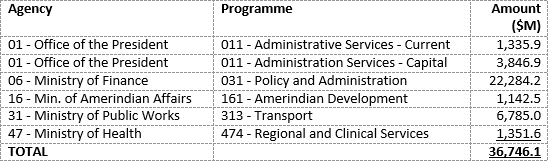
The mixture of surprise and relief when Dr. Ashni Singh, Minister of Finance announced in the National Assembly that he would be amending the 2014 Appropriation Bill to reflect the non-approval by the Committee of Supply of several items in the 2014 National Budget has given way to skepticism, suspicion and speculation. Of the six Programmes not approved, two are under the Office of the President, one under the capital budget and the other the current budget. The full list is:

Among the projects or entities affected by non-approval were the usual suspects, the Government Information Agency (GINA), (previously referred to in the Estimates as Guyana Information Agency), National Communications Network (NCN), the Specialty Hospital and the Information Technology Project funded by the Chinese and way, way behind schedule. Mildly surprising were the Chinese-funded Airport Project and the Amaila Falls Hydropower Project, both of which in earlier appropriations by the National Assembly had received some support of the parliamentary opposition, albeit under some rather interesting circumstances.
Continue reading “Doubts about Government respecting the budget non-approvals”

It is the President’s duty alone to appoint three members of the Judicial Service Commission

Mr Anil Nandlall, Attorney General and Minister of Legal Affairs needs to take his own advice to the media to “exercise care in what is published” (‘President consulting on appointments to JSC, other commissions –AG,’ SN, March 18). In seeking to divert blame from himself for failing to advise the President on his duty to appoint the Judicial Service Commission, Mr Nandlall blamed the National Assembly for failing to initiate the process for nominating members with respect to the commission.

There is at least one of three explanations for the almost continuous stream of statements earning Mr Nandlall some unfavourable attention: he is careless about details, as he was in relation to the Council of Legal Education necessitating a correction by the Vice-Chancellor of the University of the West Indies; he is cavalier about the constitution and the law, as in his statement that he has to issue an Assent Certificate to Bills passed by the National Assembly; or he is mischievous and obfuscatory, as in this case.
Continue reading “It is the President’s duty alone to appoint three members of the Judicial Service Commission”