On The Line – Banks DIH Limited 2012

Introduction
I have always been perplexed why companies in Guyana consistently ignore one of the most important considerations among their shareholders. This column has lamented, year after year and company after company, the absence of comments by companies‘ CEOs and directors in otherwise often very wordy annual reports on the performance of their companies’ shares on the stock market. Banks DIH Limited, the beverage giant has many things to be proud about with respect to its 2011-2012 performance and annual report – historic levels of profits, a strong balance sheet, good industrial relations, a stable management team and growth in share price of 37.5%.

We will get back to this shortly but let us consider first the financial statements.

Banks DIH is a company with two major institutional shareholders – Banks Holdings Limited of Barbados (20%) and Demerara Life Group of Companies (10.8%) – and one that is described as a substantial shareholder under the Securities Industry Act, Trust Company Guyana Limited (6.2%). Banks DIH is also the parent company of Citizens Bank Guyana Inc in which it has a 51% interest. Only two directors of Banks DIH (Messrs Clifford Reis and Errol Cheong) have any shareholding in Citizens Bank. The directors of the company presented their annual report and its audited financial statements last Saturday at a usually well-attended but usually uneventful meeting of its shareholders.

Performance
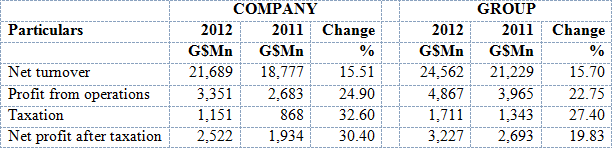
2013.01.27_Table1

Source: 2012 Annual Report

The company recorded an increase in turnover (sales) of 15.5%, the best increase in turnover over the past five years. However revenue for export sales remains minimal, 1.49% in 2012 and 1.24% in 2011. No doubt the directors of the Guyana company would reflect that one of the intents expressed in the Memorandum of Understanding of 2005 under which Banks DIH and Banks Holdings Limited did some cross-investing in each other was to market and distribute each other’s products in their respective home markets. Guyana’s domestic market will remain small for years to come and the company must sooner rather than later focus on the export market. Where the directors have reason to be very satisfied is in terms of the profits earned: a 25% increase over 2011 and a 30.4% increase in profit after taxation.

Strong balance sheet
As we look at the balance sheet we see a company that by standard analytical tools is strong. Current assets have increased by 21% while the smaller figure of current liabilities increased by 13%. As a result of the combination of these two variables the net current assets position has increased by 26%.

As the company continues its capital renewal and expansion programme, the directors have opted for an increase in long-term borrowings of $750 million which are expected to increase in the current year due to planned capital expenditure of some $5,124 million on several key operating assets including equipment for the soft drink, beer, water and CO2 plants and ice cream facilities and the renewal of its distribution fleet.
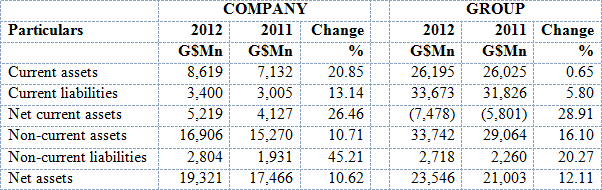
2013.01.27_Table2

Source: 2012 Annual Report

Helped by a sale of capital assets that brought in some $461 million and borrowings of $750 million, neither of which is addressed in the CEO’s or the directors’ report, net cash inflow for the year was $101 million, compared with an outflow of $728 million in 2011. The directors would no doubt be keeping an eye on the cash and bank balances even as they recognise that the “company’s continued success will depend on its ability to respond to the needs of a rapidly emerging middle class.”

Shares and their returns
Now let us return to the matter raised in the introduction to this column. Here is why I believe that for the more discerning shareholder, a commentary on share price and performance is important. Five years ago the group had after-tax profits of $898.1 million and paid dividends amounting to $400 million. Analysts use these numbers to arrive at a pay-out ratio with a low ratio indicating a policy of retaining its earnings rather than paying out dividends. In 2012, profits had risen to $2,776 million but the directors recommended and effectively limited dividends to $560 million. The pay-out ratio for the two years is 44.5% and 20.2%. This apparent change in policy is hardly likely to operate in favour of the aging and retired shareholder who depends on dividends, bank interest and modest pensions for their life’s income.

The graph below shows three variables for the group: net profit after minority interest (ie profit available for distribution), dividends paid and dividend plus growth in shareholder value. Dividends remain low, despite significant increase in after-tax profits.
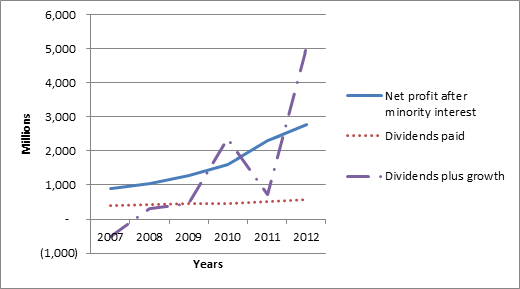
2013.01.27_Chart1

Source: Annual Reports and Guyana Stock Exchange

2012 provided a windfall for shareholders in terms of the movement in the share price. When examined over the period 2007 to 2012, however, a different picture emerges. Net profit after minority interest over this period was $9,902 million of which $2,810 million was paid as dividends.

The amount of available profits retained by the group was therefore $7,092,213,000 and which should be reflected in the market value of the company’s shares. This has however only grown by $5,600,000,000, a shortfall of $1,492 million. If measured against the growth in shareholders’ equity, the shortfall is $286 million.

It is to the credit of the directors of Banks DIH, with one major exception who is no longer with the company, that they have avoided any acquisitive tendency for shares in the company, either for themselves or their associates. Directors Errol Cheong, Christopher J Fernandes, Richard B Fields, George G McDonald and Michael H Pereira all still own the same number of shares they did in 2005. CEO Clifford Reis has 187,500 fewer shares now while Andrew Carto has acquired 71,312 shares since then.

It would be interesting to see whether those companies, the year-end of which is December 31 will comment on their market price performance when they issue their 2012 annual reports and financial statements over the next few months.

Barbados investment
It seems like history since in reaction to a suspected take-over bid by the Trinidadian company Ansa McAl, Banks DIH entered into a mutual investment agreement under which Barbados Holdings Limited (BHL) took a 20% shareholding in the Guyana company in exchange for Banks DIH taking a 6.7% interest in the Barbados company. BHL has two nominees on the Banks board while the Guyana company has one director on the board of BHL from which dividends received in 2012 were $39.4 million while dividends paid to Banks Holdings Ltd, Barbados were $112.1 million.

Despite what may appear to be financial returns that favour the Barbados company, consensus among observers is that the arrangement has helped Banks DIH in more than just putting the takeover threat to rest. The turnover of the company increased by approximately 75% since the investment agreement and the company continues to express satisfaction in its “dedicat[ion] to the Principles of Good Corporate Governance.”

Governance
This column can be accused of a crusade in so far as advocating better demographic representation on boards of public companies in Guyana is concerned. A look at pages 4-9 of the company’s annual report shows the youthful vitality and the gender, age and ethnic diversity which make up Guyana. The personalities in the very attractive advertisements are nine women to seven men; in higher and tertiary education women outnumber men as they do (marginally) in the population as a whole. And no doubt women also make up a large part of the company’s employees and customers, yet as shareholders turn the pages, they enter a different world, where the average age of the population is north of 50, from which women are excluded and none of whom is an Indian, even among a band of eleven. The last time this company had a woman director was in 2006 when the wife of the founder of the company died. In fact the 2005 Annual Report lists twelve directors, including Mrs D’Aguiar, so it seems possible that the company can address this limitation without the need to amend its articles or retire any director.

Conclusion
The Board of Directors Report is well laid out and contains the basic information required by law except with respect to section 168 (g) of the Companies Act which requires the directors to state the directors’ proposals as to the application of the company’s profits, including its revenue reserves. This common omission of companies in Guyana is perhaps because directors consider that it is implied.

While neither the Chairman/CEO nor the directors have much to say about the future, an expenditure of over $10 billion over a three year period is testimony to their confidence in the future of the company.

The tragedy of NICIL – Act 2

Introduction
Today I return to the article on NICIL (National Industrial & Commercial Investment Ltd) which I started two weeks ago but which I interrupted to conclude my 20th anniversary piece on the banking system. In what was referred to as Act 1, the directors were identified and financial summaries set out. It became apparent that the preparation of financial statements was a matter of political convenience and provided no information that could be considered useful to understand how and for whom NICIL operates. Events since January 6 have convinced me that the Institute of Chartered Accountants of Guyana has no serious interest in addressing the complaints against the Chairman of NICIL and his spouse and even worse that some members of the institute actually advise the executive of NICIL.

We recall that NICIL was incorporated as a company under the Companies Act Chapter 89:01 on July 18, 1990, but began functioning in 1991. NICIL enjoyed an incestuous relationship with what was called the Privatisation Unit of the Ministry of Finance which had been set up to carry out the Government’s privatisation programme. Moneys earned from the privatisations, including the shares in GBTI were paid into the Consolidated Fund.

But then someone had the bright idea that NICIL could function in capacities other than an incestuous relationship; it could actually raid the Consolidated Fund by the mechanism of vesting. So, convoluting and contaminating the relationship further, the same parties, the Ministry of Finance, Cabinet, the Privatisation Unit and the directors of NICIL, all of whom were appointed by Cabinet, signed in 2002 a Management Co-operation Agreement appointing the Privatization Unit, described as a semi-autonomous organ, as exclusive manager of NICIL. Under the agreement all privatization expenses would be funded by NIICIL, even though, let it be remembered, director Luncheon said NICIL was a private company. But demonstrating its unique brand of integrity, NICIL agreed that any privatization of NICIL’s assets would be in accordance with Privatization Policy Framework Paper (PPFP) of 1993.

What does NICIL do?
When NICIL was incorporated it had to include in its constituent documents the objects of the company and its financial statements disclose that “the primary objectives of the Company ‘NICIL’ is that of subscribing for, taking or otherwise acquiring and holding the Government shares, stocks, debentures or other securities of any company, co- operatives societies or body corporate.”

Now how NICIL moved into diverting sewerage, building roads in the hinterland on behalf of the Guyana Geology and Mines Commission, setting up a company to build a hotel and paying NCN to move its transmitting facilities, is not clear. But this was not the only perverse matter disclosed or not disclosed in successive annual reports of NICIL. Its financial statements disclose that properties vested or transferred by the Government to the company are brought into the books at a nominal value, in accordance with IAS 20 (para 23). A closer read of IAS 20 (para 23) tells us differently.

IAS 20
IAS 20 says that a government grant can take the form of a transfer of a non-monetary asset, such as land or other resources, for the use of the entity (my emphasis), and that it is usual to assess the fair value of the non-monetary asset and to account for both grant and asset at that fair value. Fair value is closer to market value and is clearly different from nominal value. The paragraph goes on to state that an alternative course that is sometimes followed is to record both asset and grant at a nominal amount, but this alternative treatment must surely be justified by circumstances. Since many of the properties are vested with a view to sales negotiated even before vesting, nominal value is clearly an inappropriate policy.

Some accountants might even argue that IAS 20 does not apply to NICIL because IAS 20 deals with government grants which it defines as “assistance by government in the form of transfers of resources to an entity in return for past or future compliance with certain conditions relating to the operating activities of the company.”

The transfer of these assets has nothing to do with the operating activities of NICIL which by its own admission is not an operating company but at its most honourable, serves to facilitate the disposal of state assets in an orderly manner.

The law
It seems to me that from a legal standpoint the so-called vesting takes place in a principal-agency relationship with NICIL acting as the agent of the Government whose assets they are. The perverse convolution is simply to use NICIL as the vehicle to circumvent Articles 216 and 217 of the Constitution which set out clear rules for accounting for government revenues and incurring government expenditure.

Let us assume that neither the CEO nor his deputy understand some of these technicalities or practices. But surely Ms Nadir-Sharma, who was expounding on the Companies Act 1991 and its application to NICIL only a few months ago, must be aware that the Act specifies the contents of the directors’ annual reports. These must include the following:

1. the affairs of the company, each of its subsidiaries and their principal activities;
2. changes in fixed assets of the company and each subsidiary;
3. a statement by the directors on their proposals as to the application of the profits of the company and of its subsidiaries.

To ensure that these matters are not excluded the Companies Act requires very specifically that where “the directors’ annual report does not contain a statement required by [the] section to be included in it or contains a statement which is false, deceptive, misleading or incomplete, the auditors of the company shall, so far as they are reasonably able to do so, include in their report on the accounts of the company … a statement or correction giving the information required by this section.”

There is a high probability that Mr Deodat Sharma, the Auditor General has no knowledge of this requirement and consequently is unable to fill in the information. Mr Sharma serves not as an independent auditor but chooses not to contract out NICIL’s audit. He does the same with NCN, another rogue company when it comes to compliance, good governance and accountability.

It is really painful that we tolerate such ineptitude from the government’s principal operating company. This brings to mind a question posed by a reader who enquired whether the annual reports tabled by various agencies of the state are subject to any review or scrutiny of the Public Accounts Committee. Sadly, the answer is that this has never happened and the practice is merely to place the document on public record; nothing more.

Some other comments
The paucity of information and disclosures frustrates any serious attempt at commentary on NICIL’s financial statements. Indeed, the paucity extends to disregard for entire accounting standards including IAS 10 Events after the Reporting Period. However the report for the year 2009 is interesting if only for one reason. In that year NICIL put some $166,241,000 in NCN about which nothing was ever said by the Minister of Finance who is NICIL’s Chairman and who in 2009 had allocated to NICIL in the National Estimates the sum of $54 million.

In other words, NICIL, whose Chairman is the Minister of Finance, gave to NCN three times as much as he gave to NCN as Minister of Finance. These advances coincide with the move of NCN’s transmission facilities to facilitate the construction of Pradoville 2, where Mr Jagdeo and some of his ministers have appropriated unto themselves valuable state property at below market value, or to use NICIL’s words, nominal value.

Surprisingly NICIL which from time to time holds billions of dollars in the bank discloses in its financial statements only modest sums for “Interest and other income.” It is public knowledge that NICIL also receives several millions of dollars annually in rental but without a note showing the separate amounts of interest, rentals, etc, it is difficult to determine whether all the income is properly accounted for.

Conclusion
The National Assembly has passed a motion for an investigation of NICIL. I believe that this investigation of NICIL’s operations would have to be very far reaching and include an examination of the assets of those who may have benefited. I have lost all faith in the Institute of Chartered Accountants of Guyana and it is public knowledge that certainly in respect of NICIL, the Audit Office is either inept or compromised. It is unfortunate that the Public Accounts Committee does not insist in reviewing the annual reports and financial statements of NICIL. Their rushed preparation, inept audit and simultaneous laying of NICIL’s reports for several years have nothing to do with good governance, respect for the law or accountability. It is meant to silence critics.

The real tragedy of NICIL is that it has simply got worse.

Ramson’s opinion as AG was solicited on a private lottery not a government lottery

Unusually for Guyana, Mr Charles Ramson SC uses the honorific ‘Justice’ to subscribe his letter ‘Solicited opinion that the government share of the Lotto funds does not have to be placed in the Consolidated Fund has now been given the blessing of a High Court judge’ (SN, January 15).

Despite having occupied such an exalted position, Mr Ramson still seems unable to accept certain basic facts as well as the relevant constitutional and statutory provisions in the entire Lotto funds issue, including the case to which he refers. Let me try to clarify some salient points for him.

In 1996, some time around which Mr Ramson had his first stint as Attorney General, the Government of Guyana and Canadian Bank Note Ltd signed an agreement under which the company’s wholly-owned subsidiary, the Guyana Lottery Company Inc, was granted permission to operate a lottery in Guyana. Under the terms of the agreement, the company pays to the Government of Guyana a licence fee of 24% of gross revenues, decreased by the amounts of any additional fees and taxes.

The question which the court was asked by Mr Desmond Trotman to address in the Lotto case is whether the 24% is subject to Article 216 of the Constitution of Guyana. That article requires that:

“All revenues or other moneys raised or received by Guyana (not being revenues or other moneys that are payable, by or under an Act of Parliament, into some other fund established for any specific purpose or that may, by or under such an Act, be retained by the authority that received them for the purpose of defraying the expenses of that authority) shall be paid into and form one Consolidated Fund.”

In what he keeps repeating is a “solicited opinion” given by him on May 19, 2010, Mr Ramson as Attorney General advised that the funds received from the Guyana Lottery Company were not required to be deposited into the Consolidated Fund.

It is more than surprising that Mr Ramson who holds such a high opinion of himself and which he thinks is shared by others would make the elementary mistake of not properly and adequately checking the Government Lotteries Act Cap. 80:07. This Act, which permits and regulates Government lotteries provides the following unambiguous definition of “Government lottery”:

“Government lottery” means a lottery organised and conducted by the Government Lotteries Control Committee under the provisions of section 3 of this Act“ (emphasis added).

But instead of staying faithfully with that definition, Mr Ramson refers in his opinion to the Auditor General the following definition in the agreement:

“A lottery organized and conducted under the provisions of Chapter 80:07 Laws of Guyana.”

No clumsy, procrustean or perverse attempts to circumvent the Guyana Lotteries Act could succeed since only a lottery “organised and conducted by the Government Lotteries Control Committee” comes within the definition of the Act. The lottery on which Mr Ramson’s opinion was solicited is one organised and managed by the Guyana Lottery Company Limited, a private company. It could not therefore be a government lottery, even by Mr Ramson’s strained definition.

But this was not Mr Ramson’s only error. In referring to a Development Fund of Guyana to buttress his flawed opinion, he does the opposite and actually weakens his case. Had he done basic research he would have realised that there is no such fund in Guyana, nor has any been in existence since 1966 when an earlier Development Fund set up for the colony of British Guiana was abolished.

With a modicum of diligence, Mr Ramson would have discovered that there is no Development Fund of Guyana whether under the Constitution, the Financial Administration and Audit Act Cap. 73:04 or the successor provisions in the Fiscal Management and Accountability Act No 20 of 2003. The latter makes it pellucid and mandatory that all public moneys raised or received by the government must be credited fully and promptly to the Consolidated Fund. The only exceptions, none of which applies to the 24% received from a private company, are:

(a) moneys credited to an extra-budgetary fund set up under enabling legislation establishing such a fund;

(b) moneys credited to a deposit fund established by the Minister into which public moneys are paid pending repayment or payment for the purpose for which the moneys were deposited; and

(c) any fund established for any specific purpose by or under an Act to be retained by the authority receiving the money to be used for the purpose of defraying the expenses of that authority.

But Mr Ramson’s most egregious error was his failure to recognise that the Constitution is the supreme law of Guyana and its provisions, including Article 216, cannot be swept aside by the terms of any agreement however clearly or ineptly drafted.

Unfortunately for Mr Ramson, he did not stay silent even with the embarrassment of such elementary errors. Without the benefit of a written decision of the judge or his presence in the court when Justice Diane Insanally gave her ruling on a preliminary point, Mr Ramson claims that his opinion “has been given the blessing of a High Court judge.”

If Mr Ramson would exit the fantasy land in which he “sedulously sought refuge” he would realise that the learned judge did no such thing: she simply ruled on a procedural point only; and he would also learn that that ruling has been challenged. Incidentally one of the grounds of appeal is the judge’s reliance on what is considered a flawed point handed down by Mr Ramson himself while he sat on the Court of Appeal.

Unhelpfully for his legacy that was the closing case Mr Ramson included in his book In Pursuit of Justice – A Collectanea which he thinks secured his expertise as a legal mind.

Twenty years later – part 3

Introduction
Today I return to and conclude the topic started on December 16, 2012 to mark the 20 year anniversary of Business Page. I chose the banking sector to mark the occasion because that sector was in the inaugural column, and I thought it would be useful to see how the sector had performed over the two decades. Twenty years ago the Government played a big role in the banking and financial sectors in Guyana. It owned and operated the Guyana National Co-operative Bank (GNCB) and also had major interests in the National Bank of Industry and Commerce (NBIC) and the Guyana Bank for Trade and Industry (GBTI). The only other commercial banks operating in Guyana twenty years ago were the Bank of Baroda Ltd, an Indian-owned multinational, and a branch of the Canadian-owned Bank of Nova Scotia. Other players in the financial sector were the Guyana Co-operative Agricultural Development Bank (GAIBANK) and the Guyana Co-operative Mortgage Finance Bank (GCFS), both wholly-owned Government entities, and the New Building Society Limited.

Twenty years later the government is completely out of commercial banking, GNCB and GAIBANK are no more in existence or operational while two new domestic banks are closing in on their own twenty years of operation. In other words, there is only one additional operator in the commercial banking sector and no new international bank in the twenty years since 1992. The ownership structure is one of concentration and control with one of the international banks (Scotiabank) still operating as a branch and the other (Baroda) a wholly owned subsidiary. RBL, GBTI and Citizens Bank are all subsidiaries with a majority shareholder, while DBL’s ownership structure is somewhat more complex, with its annual report disclosing that there is no shareholder whose interest exceeds 5% but whose annual general meeting, among the commercial banks, is probably attended by the least number of members.

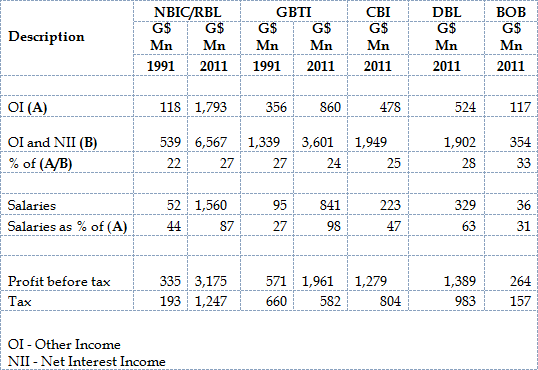
In the tables in today’s column we see that those banks have all done extremely well, surpassing the growth in the economy many times over. Let us take profits before tax. From nothing the Demerara Bank Limited and Citizens Bank Inc. recorded pre-tax profits in 2011 of $1,279 million and $1,389 million respectively; the National Bank of Industry and Commerce which was renamed the Republic Bank (Guyana) Limited and acquired the operations, liabilities and certain assets of the GNCB has seen its pre-tax profits increase from $335 million in 1991 to $3,175 million in 2011, an increase of 847% while the GBTI which reported pre-tax profits of $571 million in 1991 saw those profits rising to $1,961 million in 2011, an increase of 243%. The performance of the Bank of Nova Scotia was no doubt equally impressive although under then prevailing laws that branch was not required to report on the performance of its domestic operations.

While the growth of the economy, inflation and the scale of their services would have contributed to the increased profitability of the banks, they would inevitably have benefited from the barriers to entry in the sector with the government very reluctant to grant further banking licences. There is no study of which I am aware into the operations of the sector to examine the effects on the economy, beyond some fierce competition for market share, which the concentration of ownership can facilitate.

This kind of research which goes well beyond a newspaper column, is what one should expect from the Bank of Guyana and the University of Guyana, and it would be helpful for a better understanding of the sector and the formulation of policy initiatives if such a study, or indeed studies were undertaken.

What is clear, however, is that while in the years immediately following 1992, it was almost obligatory for the Minister of Finance to comment critically on the high spread between the rates of interest charged on loans and advances and those paid on deposits, that no longer happens. Moreover with a number of the banks taking up membership of the Private Sector Commission the question of spreads seems completely off the table.

The following two tables show some indicators in the landscape in which the commercial banks have operated. Inflation has declined dramatically; the banks’ prime lending rate has been halved while the rate of interest paid on savings accounts has fallen much more steeply. Meanwhile and counter-intuitively the exchange rate of the Guyana dollar to the United States dollar has fallen from $122.75 to $203.75.

Table 1

2013.01.13_Table1

Source: Bank of Guyana publications

Some aggregate numbers
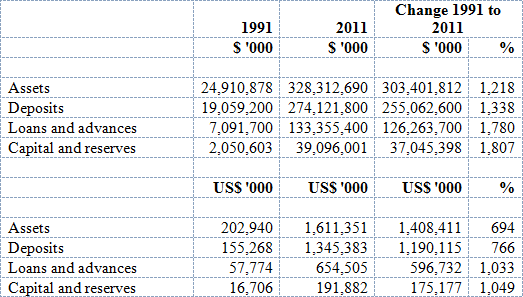
The banks have become bigger, much bigger. Measured in Guyana dollars, their assets have increased by 1,218%; deposits by an even larger 1,338%, loans and advances by 1,780%. The comparable US dollar percentages are 694%, 766% and 1,033%. As noted above and shown in Table 4, growth has translated to handsome profits.

Commercial Banks

Table 2

2013.01.13_Table2

Source: Bank of Guyana publications

Market share
While concerns may be expressed about the conduct of the commercial banks in a wider sense, there is no doubt in my mind that there is intense competition for loans and advances to customers.

There appears to be far too restrictive policy on making loans to non-resident companies which almost invariably have to bring money into the country on the mistaken ground of crowding out rather than borrowing from the local banking sector. At December 31, 2011 loans and advances by the commercial banks were less than 50% of their deposits which many consider are not growing as fast as they can because of interest rates that deter rather than encourage savings.

The banks however face some countervailing challenges when it comes to the economy. Some of the main players in some of the fastest growing sectors such as gold, construction, the narco-sector (which has earned special mention), the still huge underground economy and the Chinese and Brazilians, seem more interested in shipping money out of Guyana rather than borrowing from the commercial banks.

As a result of the restrictive lending rules and the nature of key sectors of the economy, market share in the banking sector, and more especially in their hugely profitable lending operations, is vital to profitability. This is how the banks stood in (2011), the last date at which figures are available. These numbers are more than just instructive.

Table 3

2013.01.13_Table3

Other Income & Salary Ratios

Table 4: 1991 and 2011 comparatives for NBIC/RBL & GBTI and 2011 for Citizens Bank (Guyana) Inc. (CBI), Demerara Bank Limited (DBL) & Bank of Baroda (BOB).

2013.01.13_Table4

One area of concern about the banks are the charges they impose on what might appear to be their miscellaneous services such as foreign exchange operations, letters of credit, returned cheques, copies of statements, etc. Interestingly, while in the case of NBIC/RBL, the percentage which such other income bears to its other income and net interest income has increased from 22% in 1991 to 27% in 2011, in the case of GBTI that percentage has fallen from 27% to 24%. Comparable percentages for the other banks are Citizens Bank 25%, Demerara Bank 28% and Bank of Baroda 33%.

Another interesting statistic is that in every bank, the salary and related costs are more than covered by other income alone, maybe strengthening the argument for more favourable interest rates, subject to the usual rules applying to risk levels.

The future
The picture for the banking sector looks rosy.

The sector will continue to be driven by technology and the banking licence – which has no carrying value on the balance sheet – will continue to be the most valuable asset, a licence to make money. While some entities will pursue the bricks and mortar strategy at least one other will see that as not the smartest approach to banking in an increasingly technologically driven environment.

Technology will play an even greater role in the sector as mobile money takes root and measures to strengthen controls and prevent increasingly clever and daring frauds continue.

But then the future is never certain. While money laundering will continue to play a significant role in the economy, with the non-bank cambios prominent, the commercial banks’ risk will not be helped by the tepid supervision of money laundering. This is likely to increase as the distributive trade continues its evolution.

There is no new legislation on the horizon and the principal regulator of the sector will continue to pursue conservative, non-interventionist policies.

Without some kind of revolutionary thinking and approaches neither the consumer nor the labour movement will exert any influence on the sector.

The tragedy of NICIL – Act 1

Introduction
If NICIL – the National Industrial & Commercial Investments Limited – was a play, it would be one that challenges Othello and King Lear for the dubious distinction of saddest tragedy ever written. And this is how the dramatis personae would be introduced:

Chairman of the Board: Dr Ashni Singh has the distinction of reporting to himself; credit for the undermining of the last vestiges of confidence in public accounting; lead authority on the use and mostly abuse of the Consolidated Fund and its offspring the Contingencies Fund; and credit for the largest financial sector failure under his watch;

Director: Dr Roger Luncheon, who thinks running a government and country is an opportunity to display verbosity and jest; who has merrily led the country’s National Insurance Scheme to the brink of the cliff and then casually denies reality; and who cannot distinguish a government company from a private company;

Executive director: Winston Brassington, who has been the architect or centre of almost every concoction or government initiative in the past fifteen years – the Queens Atlantic Investment Inc and its illegal tax holidays (later accepting the assignment to teach a private sector icon about the country’s tax laws); railroading the most costly financial package in setting up the Berbice River Bridge Company Inc and inducing and bribing investors with generous tax incentives; and the longest transitioning from the public sector to the private sector in Guyana’s history;

Auditor General: the benign Deodat Sharma, who moves from the stream of auditing (or not auditing) government transactions to the ocean of auditing where statutes on taxation and governance rule; where familiarity with deferred taxation and ever-changing IFRSs challenge the most seasoned accountants; who audits some of the country’s largest (government) companies in accordance with the Companies Act 1991 which does not recognise him as qualified to do such audits;

Regulators: such as the Registrar of Companies who was frightened off from demanding annual returns from the company for close to twenty years; the Commissioner General of the Guyana Revenue Authority who has not been able, for more than twenty years to collect a penny of Corporation Tax from Dr Luncheon’s “private company” despite several billion dollars of profit before taxation; or Property Tax despite the company owning at various times some of the most valuable state assets; or Capital Gains Tax despite the company acquiring premium assets at nil value and disposing of them at market value (except in the case of some friendly sales); and the national accounting regulator who has sat on two complaints for the equivalent of one year, unable or unwilling, maybe because the financial interest of its members, to pronounce on alleged egregious breaches of ethical and accounting rules and the Companies Act.

Making hay of delay
Apparently the Institute, applying a logic best understood by them only, decided to treat with the two complaints sequentially. From follow-up enquiries on these complaints, there appears some equivocation or evasion on whether or not this approach was reversed following stalling tactics employed by counsel retained by Ms Gitanjali Singh to deal with the complaint against her on the fundamental question of conflict of interest. After all, more than Ms Singh’s conduct is at stake here and it was no surprise that she resorted to Senior Counsel.

Minor players whose names or faces are supposed to lend credibility to NICIL: These include former Chairman and Minister of Finance Mr Saisnarine Kowlessar who would hardly have suspected how the company would come to define and represent some of the very values he represents; Mr Geoff DaSilva, Head of Go-invest, Ms Sonya Roopnauth, Budget Director and Ms Marcia Nadir-Sharma, NICIL’s Company Secretary, ever ready to sign corporate documents and defend the most offensive of corporate practices.

Ms Nadir-Sharma we recall was on television in September 2012 on the NCN’s outstandingly ironic debate on corruption, vociferously denying that NICIL had been in violation of the Companies Act and then rushing just over one year later to sign off on the statutorily mandated directors’ report for nine years – 2002 to 2010 inclusive – bearing no date but only the month: November 2012. Consequently, what NICIL and its directors could not and did not do in years could suddenly be done in just two months, a demonstration of political expediency trumping the law and governance. It is probably more than idle speculation that NICIL might have been taking advantage of the craven slothfulness of the Institute of Chartered Accountants which has delayed any consideration of a number of issues on the financial statements of the company and the conflicts of interest between the company and the Audit Office.

The plot
More important to the players however is the plot to take an entity established by the PNC government of Desmond Hoyte to oversee the privatisation process and make it in an instrument of circumventing the Constitution and other laws of Guyana. More specifically, it ensures the ignoring of Article 216 of the Constitution that requires all government revenue to be placed in the Consolidated Fund and bypass Article 217 which requires parliamentary approval for all public expenditure. The plot is devilish in its simplicity: vest state assets in the company which it then sells and uses as its own money to do as it pleases, whether to develop Pradoville 2, divert sewerage or mismanage road contracts or build a hotel.

Sitting in the pit of the theatre of the absurd are the politicians, including the main opposition party APNU, demonstrating a failure to understand or appreciate the deviousness with which their concerns over NICIL and other financial issues have been circumvented, and announcing in late 2012 that the government had become “more accountable”; the professional class more concerned about their economic well-being or about being victimised for their courage rather than standing up and speaking out for the financial well-being and fiscal rectitude of the country; and the public bewildered and bemused that the kind of maladministration for which NICIL has become a poster child continues to this day.

Financial summaries
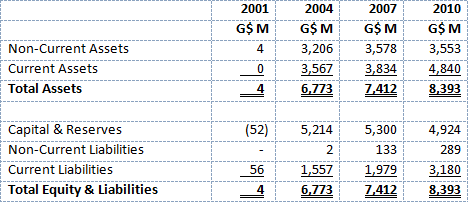
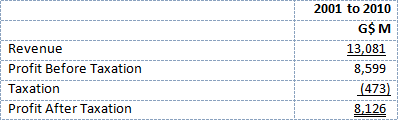
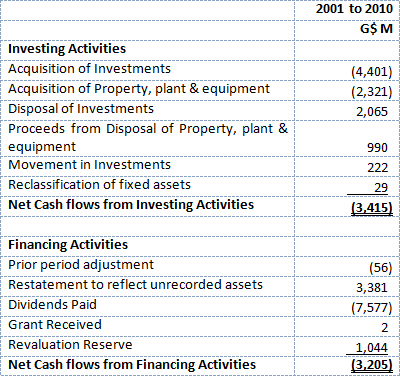
Against this background Business Page commences a review of the financial statements and directors’ reports of NICIL for the years 2002 to 2010, the last year for which annual reports have been tabled in the National Assembly by Dr Ashni Singh. To carry out this function Dr Singh seamlessly changed hats from being the Chairman of NICIL to that of Minister of Finance. Here is a summary of the financial statements of the company – not the consolidated accounts of the group – for the ten years 2001 to 2010 as disclosed by the audited financial statements.

Statement of financial position

2012.01.06_Table1

Statement of the Comprehensive Income

2012.01.06_Table2

Statement of Cash Flows

2012.01.06_Table3

However, before addressing and analysing these I will use next week’s column to conclude the twenty year review of the banking sector in Guyana which I started last month. I do apologise for the untidiness of not completing that review before beginning the examination of NICIL’s financials, but my own efforts at data collection and research were less efficient than I had anticipated.