Auditor General’s report 2011: sanitizing or whitewash

Introduction
The 2011 Auditor General’s report is the earliest since 1993. It is also among the poorest in terms of quality and content. Those journalists who look forward to going to town on the report will be disappointed by the shortened and sanitized work produced by the national Audit Office. Indeed two days after the report was published it had ceased to attract media attention. The word “abuse” that described the management of the Contingencies Fund by the Minister of Finance has been replaced with more acceptable language “continued to be used without meeting the requisite criteria” – “urgent, unavoidable and unforeseen.” It is more than mind-boggling that Mr Sharma could think that expenditure related to the elections of November 28, 2011 could have been “unforeseen,” particularly since in a special report on advances to the police for the elections, Mr Sharma acknowledged that such advances were also a problem in 2001 and 2006.

Here are some other issues which have been highlighted in past audit reports which have been relegated to verbiage in the report itself, if they appeared at all: Procurement of drugs for the Ministry of Health and the Georgetown Public Hospital Corporation amounting to three billion dollars from New GPC; procurement of pirated textbooks by the Ministry of Education; fraudulent payment of pensions and gratuities; stale-dated cheques; lottery abuse; etc. And things that appear to have escaped attention were monies spent on Pradoville 2, contract employees, the severe weaknesses at NCN and failure to account for NICIL.

Once again the Audit Office fails to look into the annual sum of $100 million allocated to the Ministry of Culture, Youth and Sport for arts and sports development. Had it not been for the fact that this issue has been publicly raised on several occasions, I would have suggested that, bad as it is, the Audit Office is unaware of the existence of the Fund. That they must have been aware of it points to a more serious matter: that they are not keen in helping taxpayers’ knowledge of how the $100 million per year is spent, reportedly under the direction and control of no more than two individuals.

Not understanding the implications
Some time ago, in reviewing a special report of the payments of social security, I suggested quite strongly that the Auditor General does not seem to appreciate the implications of some of his own findings – or could not really care. Let us take as an example paragraph 11 of the report which states that, “The Ministry of Health failed to adhere to the provisions of Section 43 of the Fiscal Management and Accountability Act (FMAA), which requires any unexpended balance of public moneys issued out of the Consolidated Fund to be returned and surrendered to the Consolidated Fund at the end of each fiscal year.”

Now compare this with paragraph 65 of the report which tells taxpayers that “the Guyana Office for Investment (GO-INVEST), Environmental Protection Agency (EPA) and Institute of Applied Science and Technology (IAST) failed to make timely refunds of unspent balances as at 31 December 2011, which respectively, amounted to $20.598M, $223,730 and $1.794M. Since these refunds were paid to the Office of the President during the year 2012…”

At a time when the National Assembly had voted to reduce the allocation of that Office, a clear breach of the FMAA that puts money into the Office of the President rather than into the Consolidated Fund raises legitimate questions. Not only does the report leave it to the reader to wonder whether or not the money was paid back into the Fund, but there is nothing in the National Estimates to indicate how the money was eventually disposed of.

Contingencies Fund
Let us return to the Contingencies Fund, the sole responsibility for which lies with the Minister of Finance. We learn that he authorised eighty withdrawals from the Fund over a period of nine months, or an average of nine withdrawals per month. What the Audit Report does not acknowledge is that the Minister of Finance must report to the next sitting (emphasis mine) of the National Assembly on all advances made out of the Contingencies Fund, specifying (a) the amounts advanced; (b) to whom the amounts were paid; and (c) the purpose of the advances.

The Minister must also come by way of a supplementary appropriation act and for the replenishment of the Contingencies Fund. But so that the National Assembly is aware of the consequences of its decision, the FMAA imposes another requirement on the Minister: he has to state the reasons for the proposed variations and provide a supplementary document describing the impact that the variations, if approved, will have on the financial plan outlined in the annual budget.

The requirement for a supplementary document applies to all financial papers, whether for the replenishment of contingencies or for a variation of the budget. Yet, Dr Singh has never once produced a supplementary document to the National Assembly for any of more than fifteen supplementary appropriation bills or so that he has presented to the National Assembly. Regrettably the members of the National Assembly have failed to request of the Minister that he comply with the Act as a condition for granting him any money.

I have written the Speaker of the National Assembly and he has promised to address the omission with the Minister.

Poor Ramnarine
We can now turn to the special report into the $90.649 million paid from the Contingencies Fund for feeding the Police, which was released by the Ministry of Home Affairs prior to the circulation of the wider 2011 Auditor General report. The Audit Office appears to have exonerated Mr David Ramnarine Divisional Commander, but not before his career path was seriously obstructed at the instance of the Minister of Home Affairs.

Again, in a half-baked way, the special report fails to question or explain how public funds could find their way into the bank account of the Police Welfare Fund which is not a public fund, and therefore a breach of the FMAA. Nor does the report explain why the unspent balance of several millions was only refunded into the Consolidated Fund in March 2012. There is a strong and widely held suspicion that the refund would not have happened had the opposition not brought the matter to the attention to the public. The Audit report could therefore be seen to be something of an escape route – if not a cover-up – for wider and higher-up impropriety in the Police Force. The real issue was not Ramnarine – he was the scapegoat. The issue was about the arrangement that but for the intervention of the opposition, would have left taxpayers’ money with the Police Welfare Fund.

There is one final danger point about the Contingencies Fund which I have pointed out before, and which was borne out in this case. The Audit Office not only consistently fails to report on important non-compliance by the Minister with the requirements of the FMAA, but also fails to pursue the actual spending of the sums from the Contingencies Fund. Short of appointing a professionally qualified accountant to the position of Auditor General I see little prospect for better control and oversight of the Contingencies Fund.

A solution
The National Assembly needs to act in this matter. They can do so in two ways. The first is to reduce the amount of the Contingencies Fund which the PPP/C administration raised from $500,000 to what amounts to more than $3.5 billion. If the Minister must come to the next sitting of the National Assembly for reporting and replenishment then $3.5 billion is an extraordinary sum. Reducing the amount – which requires a small legislative change – will introduce some level of accountability and oversight and rein in the Minister of Finance who seems impatient to bring supplementary appropriation bills to the National Assembly prior to spending. The second is to remove the amendment to the Constitution (Prescribed Matters) Act and return to the age limit of 55 years. Now that all our MPs are trained in legislative drafting that should be a simple task.

The fact is that Mr Sharma cannot do a proper job, given his dependence on the Government for his continuance in that position.

Value for [whose] money and drugs
And while we have not moved off from special reports it may be convenient to refer to two Value for Money audits which Mr Sharma has been working on for three years and which according to the 2009 Audit Report were “expected to be completed before December 2010.” In 2012 we are assured that the Audit Office is in the “process of finalizing” these. What makes the inordinate delay in the completion of these of considerable concern is the importance and relevance of the subject-matters of the exercise: “A Review of the Operations of the National Board and National Procurement and Tender Administration” and “An Assessment of the Management and Control of Drugs and Medical Supplies at the Ministry of Health.”

The 2011 Audit Report advertises these “projects” as demonstrative of the Office’s “commitment in ensuring the provision of reports which will facilitate improvements in the operations of our clients.” The public would recall that the exercise was first announced three years ago and would be aware that since then expenditure on goods and services has increased from around $75 billion to $125 billion and that on capital projects has almost doubled, moving from $45 billion to $75 billion. To compound the matter, the procurement laws apply to state-owned entities and other statutory bodies which would add another several billions of dollars per annum in places like GuySuCo and GPL.

And what about the purchase of drugs? For the Georgetown Public Hospital Corporation, expenditure on drugs and medical supplies in 2011 was $1.620 billion, while for the Ministry of Health the expenditure was over $2.6 billion. Not surprisingly, the lion’s share of the expenditure went to the New GPC which is known to have strong government ties and which is usually advanced the money to finance the procurement and supply of the drugs.

With the Audit Office having such fancy names as a Value for Money Unit, a Forensic Unit and a Quality Assurance Unit, taxpayers would like it to move expeditiously on a thorough examination using business principles and practice of this generous arrangement which involves reported markups on the supplies that many would consider price-gouging. And as for procurement, there can hardly be any financial and corruption issue that deserves a higher priority.

Conclusion
There is one final point to note in today’s column, and that is in relation to the 2000 Series Bank Accounts held with the Bank of Guyana. Dr Goolsarran and I have drawn attention to the drawing down of some of these accounts without complying with the law and any proper accounting for some $30 billion. Not only does the 2011 Audit Report ignore responsible and reasonable calls for explanations, but the 2011 table of the balances in Static and Active accounts is either amateurishly prepared or deliberately set up to mislead the readers and the National Assembly. In a table that is designed to show movement over time one does not exclude balances in an earlier year because the balance no longer exists. In the column for the respective year the amount ought to be shown. So that in the 2007 and 2008 columns, the amounts of $4,410.3 million and $4,690.6 million should have read $7,591.3 million and $7,868.4 million respectively.

It is troubling when an audit report itself becomes suspect.

To be continued
An abomination for an Auditor General report

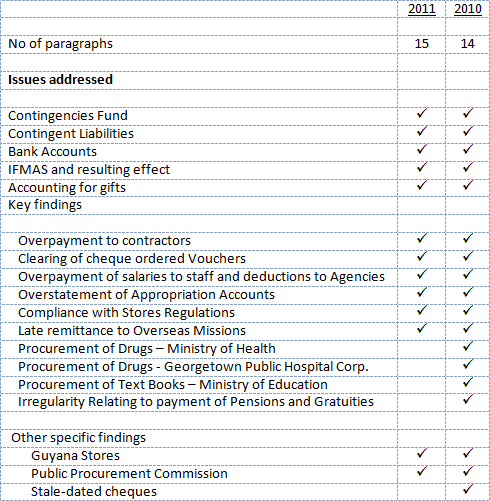
The report of the Auditor General on the public accounts of Guyana was tabled in the National Assembly on Monday. In a country with weak accounting and accountability, an Access to Freedom Act that has not been brought into force, an Integrity Commission without Commissioners, no Public Procurement Commission, no anti-corruption or whistleblowers legislation, the report by the Auditor General – if its Executive Summary is an indication of its contents – is striking for its sterility.

A comparison of the 2011 Executive Summary is an almost identical reproduction of the 2010 report.

Note that 2011 was a less effective audit than 2010 which in any case was itself not a good audit: it ignored the armies of contract employees, the off-constitution spending by that abomination called NICIL, slush funds across ministries and including the dormant accounts, the loan recovery unit, the National Frequency Management Unit.

The problem we face is an unqualified acting Auditor General who plays to his master’s voice in order to retain one of the most lucrative employment contracts in Guyana. If we need any proof of this we need go no further than the clandestine attempt to lay a path for confirmation.

If that happens, if we think the 2011 audit is poor, we have not seen anything yet.

Obituary – Naeem Nasir – January 8, 1960 – October 9, 2012

Introduction
The 1986 lifting of the four and a half years ban on the importation into Guyana of wheaten flour was of national significance in our economic history. But it was historic too for an individual who not too long after the resumption visited our office with his wife Annetta for a conversation. Nothing was more striking about the young man Naeem Nasir than his modesty, quiet confidence, conviction and focus. Later in a relationship that extended beyond business, other qualities which I came to associate with Mr. Nasir were his unerring flair to identify business opportunities, his ability to lead with inspiration rather than command, his commitment to his faith, his generosity and compassion, his energy and dynamism.

Mr. Nasir’s business acumen and success have been recounted ever since his death on October 9 at the age of fifty-two. But anyone who knew him recognised his life as one of unending generosity and dedication to any and all Guyanese, supporting countless individuals, families, organisations and Muslim communities in Guyana and Orlando. From my limited vantage point, but knowing how he sought to promote the knowledge and practice of Islam I believe that when the modern history of Islam in Guyana is written Naeem and his family will be recognised as pivotal forces behind the increasing confidence in that religion.

But Mr. Nasir was more than an astute businessman or staunch follower of Islam. His prep school colleague remembers his kindness while his workmates from National Bank of Industry and Commerce remember how he would offer to drop them home after balancing the books at 2 AM.

More recently he set a standard of philanthropy unknown in Guyana and a model for others – with bigger organisations and purses – to emulate. But what is perhaps less known is his management style and his relationship with those who worked for him and who showed their appreciation and their loss by some of the strongest expressions of emotions at his funeral service. His lieutenant Rajin Ganga praises him for his style of decision-making and leadership – a readiness to listen to others challenging his views, comfortable with delegating authority but taking full responsibility when anything goes amiss.

Entrepreneur extraordinary
As one of the softest touches of businesspersons in town, he was accessible while not craving publicity, raising and giving money for any person, cause or interest. Until the day he was admitted to the Dr. Balwant Singh Hospital complaining of head pains, Mr. Nasir was engaged in several projects including the Soup Kitchen, the construction of the Queenstown Jama Masjid, Church Street, the GPO food outlet and the recently established Doobay Medical Centre at Annandale. One of his associates explained that he managed to do all of these things while supervising a round-the-clock business because for him schedules and routines were sacred.

I never had the impression that it was due to the fact that he was the only of the Nasir siblings to be born at the North Road Georgetown Building that led him to start his business right there.

Seems to me more a matter that his job at the National Bank of Industry and Commerce and in Barbados where he had worked for a short while, did not allow him enough savings to rent any place to start his business. Whatever it was, it was a remarkable coincidence that the bakery empire he launched was only a few doors away from the home of the then President Hugh Desmond Hoyte, the man who courageously lifted the ban on wheaten flour imposed earlier by Forbes Burnham.

In a fiercely competitive industry to which the barriers to entry were not too high or too formidable, in a country where success depends less on integrity and competence than on connections and favours, and in a line of product where reputation can be destroyed by a single production run, Naeem decided that he was up to the challenge.

Background and giving back
Yet, nothing in his background had prepared him for or suggested that this was the direction his life would take. In his primary school education at Baird’s Primary School (a private school) in Robb Street and Central Primary School, his interest was in the numerate subjects – arithmetic, algebra and geometry – and in problem solving. His performance at Central earned him a place at Queen’s College where another great influence on his life came to the fore.

The son of attorney-at-law S. M. A. Nasir, OBE, CCH, a founder and first President of the Central Islamic Organisation of Guyana and Fazeela Nasir, a Trinidadian, Naeem had Islam in his blood and its promotion on his mind from a very young age. He himself was a founder member of the Islamic Society at QC doing Islamic studies in the afternoons at the Queenstown Mosque and at the age of 8 was able to recite the Quran.

More than a bookish student, he never regretted forgoing the opportunity to attend university in Canada. He was an affable, outgoing regular person. At school he played cricket and table tennis, two games he loved with a passion and over the past few years took up tennis and developed into a good doubles player.

In fact he was a founding member of the Le Ressouvenir Tennis Club and in an unprecedented gesture, personally financed the construction of a tennis court at the President’s College.

But while we in the Tennis Association could claim a part of him, he was just as generous with football, cricket and other sports with popular appeal. For him, opportunities to deprived communities to participate in sports took youths off the street corners and on to the playing field where they could enhance their talent and constructively use their energies.

As a kid, like most youngest sons of better-off Indian families, Naeem spent very little time in the kitchen although on visits to Guyana from Barbados where he was employed in the hospitality business, he would drop by his brother-in-law who carried on a small bakery operation.

It would be a great irony indeed if his most lasting public legacy turns out to be the soup kitchen on which he was partnering with the Government spearheaded by then Minister of Human Services Ms. Priya Manickchand.

When operational, the project will serve to the poor and the needy some 2,500 meals per day, three hundred and sixty-five days per year.

Partnership
Surprised but supportive of his son’s new-found interest and experiment with bread, his father suggested that he could utilise the area with fruit trees in the back of the yard on the southern side of the house to start his own bakery.

His wife Annetta gave up her salon business to join him in one of the most successful husband/wife partnerships since Alston and Lyla Kissoon started their furniture empire in the sixties.

He and his wife would work day and night to push the business – adding both volume and range to the products on offer. It was a measure of his success that eponym worked in reverse with him, many persons referring to him as Mr. Bakewell. His experiences and exposure in Orlando, Florida where Bakewell products were sought after by non-Guyanese as well, led him to set and maintain standards that were first world.

Whenever he and I were in Orlando at the same time we always went to dinner but never at the same place. For him dining was a discovery and an experience to be shared and he always strove to offer Guyanese whatever was available elsewhere.

On any day, at the various food outlets he operated, there are over two hundred products from which the consumer or connoisseur can choose.

There are not many places you can travel in the Caribbean and find a shop or chain that offers all of the following: roti and curry, Danish pastries, Swiss Rolls, fried or curried chicken, English Muffins, chowmein and fried rice, French toast, Jamaican patties, channa, Haagen Dazs Ice Cream and Starbucks type American coffee.

As an entrepreneur Mr. Nasir shunned red tape and bureaucracy and believed in the flat organisation model in which there are few layers of decision-making. He anchored his business in a clear vision, worker empowerment and a simple but uncompromising guide with people as its centre.

For him contributing to social causes was not about promoting one’s products or about photo opportunities but about giving back to society, helping the needy. More informed than many, he stayed clear of politicians.

Yet he was always willing to work with those whose contribution he felt served the public interest: former President Desmond Hoyte was as prominent as acting President Samuel Hinds at the commissioning of the company’s Triumph factory operations.

Challenge
But life for Nasir was not without its challenges. Throughout his teenage years, he used to complain about tummy aches, and was taken to every doctor his parents could think about. At 18 however, the pain was unbearable, and he soon discovered after a kidney test that one of his kidneys was already gone and the other one needed repairs. He went to Canada at age 20 and removed the failed kidney and had the other one repaired.

At age 40 the repaired one failed, so he had a transplant from his elder brother. Its efficacy started to diminish early in 2011 and many of his close friends offered a transplant. As a result of the medication used to prevent rejection of the transplanted kidney, he gained weight and his mobility was restricted. But Naeem never allowed this to slow him down as he moved from one idea to another, one project to another. For him, complaining was not an option and he continued to live a life of service, optimism and an example of the possible.

Naeem is survived by his wife Annetta, children Anisa, 15 and Ahmad, 7 and his four siblings including his sister Aleema.

The danger of ignoring dangers – the NIS debacle

Introduction
The Luncheonese in the heading is deliberate. Business Page of May 10 2009 wrote that the NIS faced real and disastrous consequences from Cabinet’s failure to act on the recommendations contained in the 2001 and 2006 Actuarial Reviews of the NIS.

In one of the columns in that 2009 series on the annual report on the Scheme, I wrote that the 2006 Actuarial Report had projected that total expenditure would, in 2014, exceed total income for the first time in the scheme’s forty years and unless contribution rates are increased, the scheme’s reserves would be exhausted by 2022. I wrote then that with the likely loss of billions in capital and income in Clico and the inaction of the government and the board, including PPP/C fixtures like trade unionist Komal Chand and Chitraykha Dass, Chartered Accountant Maurice Solomon and business executive Paul Cheong, it was possible that the actuary’s fears about expenditure exceeding income could happen sooner rather than later.

Last week, on the 43rd. anniversary of the Scheme the Chairman and the General Manager made separate statements in which the word “pride” was used by both of them. But the full-page advertisement caused consternation and led to more concern than might have been warranted. Indeed another section of the media mistakenly reported that the Scheme would have a deficit for 2012 of $1.399B. The cause of the confusion was the reporting of all expenditure the Scheme would incur in 2012 but only the contribution income it would receive. Of course the NIS has two principal sources of income – contributions and investment income. In 2010 investment income amounted to $1,348 million which if continued into 2012, would cover the deficit of payments over contributions received.

Late reporting
We wait on the audited report for 2011 which Dr. Ashni Singh, as the subject-minister, is already late in presenting. But if the audit confirms the General Manager’s numbers then the actuaries are spot on with respect to their doomsday scenario – if the unlikely urgent and drastic preventive action is not taken. Indeed, since the last actuarial report predated the Clico debacle, the actuaries would have assumed that the NIS would be receiving a stream of income from Clico with no risk to its investment of nearly seven billion.

The audited financial statements of the Scheme at December 31, 2010 included accrued investment income from Clico of $90 million, and no provision for a loss on the investment. That is at best aggressive accounting – and as noted before in this column – is based on a misunderstanding of a statement by Dr. Luncheon as Head of the Presidential Secretariat to the NIS of which he has been Chairman since 1992.

But casual and irresponsible as Dr. Luncheon has been, he is not solely to be blamed for the almost irreparable financial damage to the NIS over the past ten years. At the policy level I would have to name President Jagdeo and the two Finance Ministers of the PPP/C since 2001 – Mr. Saisnarine Kowlessar and Dr. Ashni Singh.

Sharing the responsibility
Dr. Singh in particular has to take a lot of the blame because the acceleration of the deterioration was the collapse of Clico for which as Finance Minister he bears statutory responsibility, and tolerated and later excused. And he has not been contrite, modest or courteous about his serial failures in relation to the NIS. To check on the propriety of NIS investing in Clico, I wrote Minister of Finance Dr Ashni Singh a letter on February 24, 2009 pointing out that the NIS Act only allows the NIS to invest in securities approved of by the Co-operative Finance Administration (COFA) established under the Co-operative Financial Institutions. I pointed out in my letter that Dr. Singh as Finance Minister is not only the Chairman of COFA but as Minister, he also appoints its Board. The Minister of course also appoints the Board of the NIS. I asked him the following questions:

1. The names of the persons he appointed to COFA currently serving as members of the administration, and the commencement and termination dates of their appointments.

2. The securities which COFA approved for purposes of investment.

3. Whether the NIS had sought and received approval for any investments other than those determined by the administration and if so, the securities which have been so approved.

4. Whether the administration during his tenure as Minister has ever taken the opportunity under section 4 of the act for its Chairman or Secretary to attend any meeting of the National Insurance Board, and in particular the meeting at which any decision was made by the board for any special investments.

More than three years later, I am still awaiting a response.

The nature of the Scheme
The NIS is an actuarial scheme that seeks to balance out, in the long-run, its obligations against its resources. The NIS Act requires that every five years, external independent actuaries must review all the data on active and past contributors, project future income and expenses – of which pension benefits are always the more significant item – and then make recommendations to maintain/restore the actuarial balance of the Scheme.

The responsibility of the Government and the Board is to consider and act on the actuaries’ recommendations. However, for more than a decade, the Government has consistently allowed political considerations to undermine the proper management of the Scheme, ignoring the recommendations contained in the reports of the actuaries for the 2001 and 2006 reviews.

Between 2004 and 2007, every annual report of the NIS stated that the Board of Directors “is in the process of reviewing and implementing the recommendations”. But then in 2008, the Scheme’s annual report dropped the word “implementing”. Clearly, they gave up on their own plans to implement.Not surprisingly, and apparently frustrated by the failure to implement their recommendations, the actuaries in their Executive Summary of the 2006 Actuarial Review, categorically expressed a decision to limit their recommendations “given the outlook of the Fund and the concerns regarding some benefit provisions”.

We give up
They added that if the limited recommendations were implemented, “then other changes may be considered later.” In other words, ‘we give up’. When you get serious, we will too. This huge warning signal was missed by the entire Board of the NIS and the Cabinet of the country.

The result of this stubborn and irresponsible failure by the Government is that the NIS is now under serious stress from which no amount of spinning or flippancy will rescue it or detract from. In the most unbelievable statement to come out of the NIS, its Chairman Dr. Roger Luncheon, the 2009 announcement of whose removal from the Board was welcomed in many quarters, could find it possible to say that his government considers any decision on the Scheme in the same manner as it considers same-sex marriage or the decision on the death penalty!!

Source: National Insurance Scheme Annual Reports, 2004 to 2010

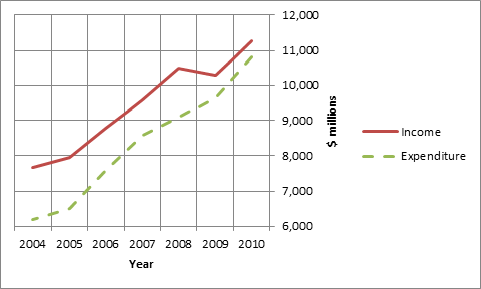
Under the immediate past stewardship of Drs. Luncheon and Singh, the failure to act on the recommendations of the actuaries, compounded by the collapse of its investment in Clico has left a $5 billion hole in the Scheme’s balance sheet, and no income from more than 20% of its investment. Significantly, the benefits most under threat are pensions for which the reserves to payments ratio has fallen from 4.95 times in 2002 to 1.82 times in 2010, the last year for which the annual reports of the NIS are available.

Ram & McRae in their 2012 Budget Focus repeated the fear that “the possibility cannot be ruled out that perhaps no later than in 2012, expenditure will exceed income with the situation worsening every year thereafter.” The accountants warned in their document that the resolution of the Scheme’s problems which began in earnest in 2004 cannot await the completion of the 2011 Actuarial review now in its preparatory stage. Immediate and decisive action is necessary, otherwise disaster looms.

Darkening clouds
The outlook for the NIS is grim and once again the smiling, avuncular doctor is trying to assure the public that things are not that bad. In his anniversary message he assures the country that the findings of the 8th. actuarial review would soon be presented to stakeholders who he “[expects] to contribute constructively to the resolution of the challenges facing the Scheme.”

Those confident enough to believe Dr. Luncheon are assured that the Board and the Management commits to spearhead this entire exercise with the intention of ensuring that the expectations of the stakeholders are solicited and recommended in any new disposition adopted by the Government of Guyana.”

This column is not optimistic.

Contrary to Singh, Nandlall and Luncheon’s statements Chief Justice’s decision was not final in the Budget cuts case

The Attorney General, the Minister of Finance and the Head of the Presidential Secretariat have been busy distorting the decision in the Budget cuts case to mislead the public. They appear to use their flawed interpretation as the basis for continuing payments to party comrades like Mr Reepu Daman Persaud, Ms Gail Teixeira and Mr Kwame McCoy, in violation of a vote by the National Assembly.

On the day Mr Ian Chang, Chief Justice (ag) delivered, to use his own words, “his views,” the Attorney General Mr Anil Nandlall went from the court, via the Office of the President, to NCN to shout victory.

And in the 2012 mid-year report Finance Minister Dr Ashni Singh presented recently, he said that “The [National] Assembly was later deemed by the Courts of Guyana to have acted outside its constitutional remit in inflicting those cuts to the budget.”
Not to be left out, Dr Luncheon was quoted in the press on September 7, 2012 as saying that “the $1 that was approved by the opposition for the various agencies was totally inconsistent with the constitutional provision as ruled by the Chief Justice.”

Let us turn to the Chief Justice’s decision. He rejected the application of the Attorney General and denied the Minister of Finance the “liberty” to make advances/ withdrawals from the Consolidated Fund to restore the $21 billion 2012 budget cuts, except for the sum of $99,000,000 for the ERC. The reason for restoring the amount for the ERC, according to the Chief Justice, is that it is a constitutional body subject to a direct charge on the Consolidated Fund. Accordingly, its budget allocation was not subject to a vote of the National Assembly.

And let us be reminded that the Chief Justice concluded his decision with the words that the matter brought by Mr Nandlall is in its “preliminary stage” and that “the views expressed at this juncture are not final.” The misinterpretation suggests that the three do not have any regard for the truth, respect for the court, or deference for the National Assembly, the only body with the power over the spending of public funds. We may be tempted to discount Mr Nandlall and Dr Luncheon as ineffective political spinners. Not so Dr Singh. He controls the public purse of Guyana and the records show that he has not been unwilling to play around with the Contingencies Fund and the dormant bank accounts to the tune of billions of dollars.

So when Dr Luncheon announces in last month that “no one lost their jobs” and that “Contingency funds were approved and funds made available belatedly but still available to meet the wages and salaries of the contract workers [at OP].” it is time to get worried. Because, if that is so, the Minister of Finance is in violation of not one but two Acts – his own amended 2012 Budget Act and the Fiscal Management and Account-ability Act, under the pretext of a misrepresentation of the court’s decision.

The question now is whether, after a prolonged break, the political opposition can muster the capacity and the courage to confront with all the powers at their disposal, the continuing lawless manner in which the country’s public funds have been mismanaged and misspent by Dr Singh, assured of a pliant and ineffective Audit Office.