
Mid-Year 2012 Report shows mixed performance

Introduction
In the introduction to last week’s Business Page I pointed out that it was refreshing that the mid-year report was not only prepared within the statutory deadline but that the report was actually made public even before it was laid in the National Assembly which is presided over by the Speaker. That was certainly one step forward. Just one week later the Auditor General presented to the Speaker of the National Assembly the audit report for 2011within the statutory deadline. This was the first time that this was done under Mr Deodat Sharma as the Head of the Audit Office. And guess what the Speaker does? He not only drew comparison with what last took place twenty-one years ago, but then goes on to confuse his specially assembled audience over the timing of the submission of reports since that date. And to add vinegar, he announced that the report will be locked away until the National Assembly resumes from its prolonged recess. That certainly is not a forward step.

Last week as we reviewed the sectoral performance of the economy we saw the up-and-down performance of its major sectors even as it recorded overall growth. We also looked at the values of imports and imports and the change in the consumer price index which is popularly referred to as the inflation rate. Today we turn attention to other segments of the report and begin with revenues.

Revenues
Central government revenue for the first half of 2012 amounted to $64.9 billion. While representing only 44% of the budgeted revenue for the year, the collections represented a 5.5 % increase over first half 2011, primarily as a result of improved performance across several tax revenue categories. Tax revenue collections for the period amounted to $58.6 billion representing 90.4% of total current revenue collections or 2.9% over 2011.

Internal revenue collections for the half-year amounted to $25.9 billion compared to $26.5 billion in 2011, a decline of 2.3%, as a result of contractions of $582.2 million and $146.6 million in private and public sector corporation taxes respectively. The Minister attributed this decline to lower company tax rates, a bit of a stretch since tax rates were reduced not in 2012 but in 2011, and tax payments to June 30, 2011 would have taken the reduced rates into account last year.

A more realistic explanation lay in withholding tax collections which decreased by $624.8 million compared to first half 2011 due to arrears in dividend payments made in 2011 by a local company to its overseas parent company.

Customs and trade tax collections totalled $5.7 billion for the first half, representing a 19.6% or $930.9 million increase over 2011 half-year collections. The minister attributed this to a $900.6 million increase from import duties due to higher level of imports of most categories of goods particularly intermediate goods. Excise tax collections for the period amounted to $11 billion, a slight fall from 2011. Excise tax collections from motor vehicles amounted to $5.2 billion, an increase of $1.5 billion reflecting higher levels of vehicle imports.

Collections of value added tax (VAT) for the half-year amounted to $16.1 billion, an increase of $1.4 billion. VAT on imports of goods and services accounting for $611.7 million of the increase while VAT on domestic supplies increased by $831.1 million. Value-added tax for the full year was budgeted at $33.968 billion.

Tax evasion
Taxes collected from the self-employed amounted to a mere $1.8 billion to the revenues, compared to $1.5 billion for same period in 2011. As a percentage of tax revenues the self-employed – who dominate the professions, agriculture, fishing, car dealers, goldsmiths, artisans, contractors and most of the main shopping areas in all three counties – contribute less than 2.6% of the tax revenues of the country.

We have heard nothing recently of the so-called tax review committee announced by President Ramotar almost ten months ago, a delay that perpetuates a lop-sided, regressive tax-system in which the self-employed continue to treat taxation as a voluntary matter rather than be treated as the criminals that they are.

No Minister of Finance since 1992 has treated tax evasion seriously but all, including Dr Ashni Singh and his appointed Board of the Guyana Revenue Authority, continue to ignore the glaring statistics that show how serious and damaging the situation has become. Imports by the self-employed continue to rise by double digits, with bank deposits and import taxes not far behind. Yet the taxes the self employed merchants including our newest friends and the rest of the self-employed sector pay, move up only imperceptibly.

With all the inherent problems the GRA faces, it is quite remarkable that the taxes collected by it continue to rise. Whatever we may think of the nature of the tax system and the systemic corruption in some segments of the GRA, those of us who have to deal with the Authority on a day-to-day basis cannot help but admire – and feel a bit sorry for – the many hardworking staff who have to deal with a taxation public made up of so many groups of prominent tax evaders and money launderers.

Missing GRIF and other monies
In paragraph 3.34 of the mid-year report the Minister states that “based on developments in the first half of the year, total current revenue collections (net of GRIF inflows) are now estimated at $128.7 billion for the full year.” A review of Appendix E1 shows that while the sum of $18.4 billion was budgeted to be received, that amount has now been revised downwards to $1.975 billion. Since the Norwegian funds accounted for 15% of budgeted revenue for this year and since many of the LCDS projects were framed around the Norway funds, it was reasonable to expect that the Minister would say something of substance about the status of those funds.

Absent from revenue projections too are monies from the Lottery and the proceeds from the disposal of state assets by NICIL for sundry purposes.

Current expenditure
On the expenditure side total non-interest current expenditure to June 2012 amounted to $43.8 billion, an increase of 14.3% over the same period in 2011. This sum represents 41% of the budgeted expenditure for 2012.

The several types of expenditure where there were increases in 2012 over 2011 included statutory pensions and gratuities which had a 38% increase (no explanation offered); total other charges which increased by 11%; and subsidies and contributions to local organisations – mainly Guyana Power and Light Inc – which increased from $5.8 billion in half-year 2011 to $10.3 billion (77.6%) in the corresponding period in 2012. Old Age Pensions and Social Assistance payments in 2012 amounted to $2.4 billion compared with $1.98 billion in the corresponding half year in 2011.

While the late presentation and passing of the 2012 budget may have been responsible for a number of categories of expenditure to be lower than those for 2011, their greater significance lay in the percentages which the half-year 2012 expenditure bear to the full-year budget. Not unusually, the entire amount of $$3.7 billion for revision of wages and salaries remains unspent.

If we look further at the item Other Charges, which includes several categories of expenditure, we note that only $26.3 billion was spent up to June 30, representing 37% of what is projected for the full year. Principal among the items which had disproportionate spending in the first half of 2012 are expenditure on Materials and Supplies which represents 34% of full year projections; Rental and Maintenance of buildings18.7%; Maintenance of Infrastructure 14.5%; Transport, Travel and postage 34.3%; Utility charges 32.8%; Other Goods and Services 33.9%; Other Operational Expenses 30.1%; Education Subvention and Training 38.8%; Rates and Taxes and Subventions to Local Authorities 3.9%; and Pensions 42.5%.

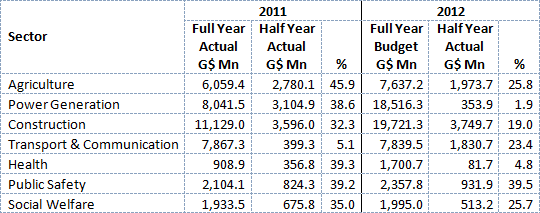
The situation is no different with the capital expenditure side of the accounts.

Sectoral Capital Expenditure
What we may see and need to fear is that there will be a mad rush to spend in the second half of the year with continued negative consequences for quality and value for money as well as controls over public expenditure.
Source: Mid-Year Report 2012

Deficit and debt
The overall deficit before grants is projected at $43.5 billion, almost certainly the largest budget deficit in the country’s history, measured by absolute amount as well as a percentage of revenue. Even after projected grants of $16.8 billion, the country will need financing of $26.6 billion which will have to come from borrowings. By June 2012, the external debt had increased to US$1.3 billion, 7.6% more than the amounts owing at December 31, 2011. During the first half of 2012, external debt service totalled US$20.4 million, an increase of 10.8% compared to the same period in 2011.By December 31, 2012 the combined external and domestic debt stock will exceed the psychological US$2 billion threshold.

Conclusion
It is evident that the economy’s growth rate in 2012 was lower than in 2011. But perhaps because the Minister had projected for lower real growth in full year 2012, he concluded his report with some reassurance, if not confidence, that the performance of the first half of the year “augurs well for the remainder of the year.”

But acknowledging the events in Linden, his final words were directed not at his colleagues in his government or his ministry to implore them to exercise greater and better management, but at all national stakeholders to “ensure the preservation of the environment that is so critical for a continuation of this favourable performance, not just for the remainder of the year but into the medium term.”
In the final NCN debate on institutional corruption Ashni Singh committed the same error of which he accused Nagamootoo

In the final NCN debate on institutional corruption broadcast recently, Senior Minister of Finance Dr Ashni Singh accused Mr Moses Nagamootoo of the AFC of “pretence,” “misrepresentation,” “opportunism” and “making false charges of corruption” against the PPP/C.

In an attempt to show how far the government has gone to remove the opportunities and possibilities for corruption, the Minister said on the programme that in the case of the tax laws, his government has “removed opportunities for discretion, imposed rigid rules-based system over all aspects of the corporations, rules have been framed for the granting of incentives …” The facts show otherwise.

What makes the Minister’s accusations so contrived is that he could not have forgotten the infamous case of the Ramroop group in which he and Mr Jagdeo rushed to grant illegal tax concessions to the group. And when confronted with the embarrassment of the illegality – which Dr Singh missed not once but thrice – he spearheaded a change in the law to legalise the concessions to the government’s friend. That cannot constitute a rules-based system.

What was ironic about the accusation is that by his false boast of removal of discretions, the Minister committed the same error of which he seeks to accuse Mr Nagamootoo. A tax holiday under the Income Tax (In Aid of Industry) Act is easily the most valuable tax concession available, and its award is substantially discretionary. This is how the relevant section of the Act begins:

“Notwithstanding anything to the contrary contained in the Income Tax Act or the Corporation Tax Act, it is hereby provided that the Minister may grant an exemption from corporation tax…” (emphasis added).

Readers might be aware that by law once an entity is exempt from Corporation Tax, it is also exempt from Property Tax (section 6) and Capital Gains Tax (section 5). These combined concessions can run to ten years and cost the country billions of dollars in lost revenues. Spin it how much one wants, the language and the power are clearly discretionary.

A less known but certainly not inexpensive concession is contained in the Value-Added Tax Act. By regulations made by the same Minister, any supply of goods and services under an investment agreement entered into on behalf of the government is zero-rated. This means that while the entity does not have to charge VAT on its supply of goods and services, it can recover any VAT it pays on its inputs. The Minister responsible for that Act (Dr Singh) has not indicated the criteria, if any, which a company must meet to qualify for an investment agreement or, that it is he who has the final say on whether or not a person qualifies.

And to go back to the tax holidays, the Minister of Finance who confidently makes such statements that “it is a matter of public record” and that this or that person “ought to know,” must himself know that the Investment Act requires him to publish information regarding tax holidays incentives under the Income Tax (In Aid of Industry) Act. Would the Minister say how transparent and compliant the government has been?

To compound the institutional silence and dereliction, the Act also requires the Audit Office to carry out annually a process audit of the concessions and to make a report to the National Assembly “within six months of the end of each of the financial year.” June 2005, 2006, 2007, 2008, 2009, 2010, 2011 and 2012 have come and gone since the Investment Act became law. Would the Minister say for which year any such a report was made to the National Assembly?

Teixeira’s position was absurd and disgraceful

I was invited to make a keynote address to the UG Students for Social Change on the topic ‘Legislating as a means of Effecting Policy Changes.’ It is not important that the invitation to me did not indicate that there would be four panellists comprising the Government, the PPP/C, the APNU and the AFC. Nor that ‘certain politicians’ had insisted that they would only participate if they were given the same time to speak as I was given.

What is important for the purposes of this letter is that in the course of the question-and-answer session following the presentations, Ms Gail Teixeira, Presidential Advisor on Governance was categorical that her government did not wish to be distracted by copyright laws and was only interested in reducing the cost of school books. Displaying an enormous insensitivity to Guyana’s obligations under the rules of the World Trade Organisation/WIPO; and under the Economic Partnership Agreement with the EU and the Revised Treaty of Chaguaramas, she dismissed authors’ rights as property and questioned why copyright had to last more than a few years.

Even if the governance czar does not know that the rule of law is the first requirement of governance, I had hoped she would understand that her economic and political case could be met by the government contracting for the writing of the required textbooks. The government could then be free to grant the right to any and everyone to copy as they please.

The issue of respect for the intellectual property of writers was strongly supported by Mr Khemraj Ramjattan of the AFC. But I was extremely disappointed that Dr Rupert Roopnaraine, who like Ms Teixeira is a member of the Council of the University of Guyana, did not offer a comment on Ms Teixeira’s absurd and disgraceful position.

Mid-year report 2012 shows mixed performance

Introduction
For years, this column has made some sharp comments about the Finance Minister over his presentation of the economy’s mid-year report required under the Fiscal Management and Accountability Act. That cannot be said for this year. I am not only sure that its presentation to the media at a hastily convened press conference on September 1, 2012 had no publicity intentions, but I accept that it was as good as meeting the statutory deadline of sixty days after the end of the half-year. Even more, I give the Minister credit for presenting the report to the public even before its laying in the National Assembly, which is what the Act requires. With this kind of precedent and epiphany, Guyanese might now hope that all other reports for which the Minister has responsibility will be tabled in the National Assembly and made available to the public within their respective statutory deadlines.

Before looking at the 2012 mid-year report it seems necessary to make a point that appears to have been excluded from the report itself and the reporting on it which followed publication. It appears that the method used to describe the growth figures is not only unclear but may actually mislead. The figures compare a period to its corresponding period – as in this case, Jan-June 2012 against Jan-June 2011. There is logic for this: it removes the skew that would be due to seasonality. It would not be a fair representation to compare growth in the first half of 2012 with a period in 2011 that included the second half of 2011, if there were seasonal factors unique to the second half.

So what this means is that when the Minister reports a 2.8% half-year growth, he is comparing half-year 2011 with half-year 2012. Worse, had the Minister given any comparison with the corresponding measures in 2011, Guyanese would have learnt that half-year growth in 2012 is less than half the real economic growth of 5.9% recorded in 2011. That is quite a dramatic slowdown which if it continues will translate into substantially slower growth in 2012 than the 4.1% expected at the time of the presentation of the 2012 budget. We recall that that 4.1% was actually lower than the 5.4% for the full year 2011.

Let us now look at the disaggregated numbers under two groups – those that have done better in half-year 2012 than they did in the same period in 2011 and those which have done worse.

The stars
Rice improved over the corresponding period in 2011 by 1.4% but this was well down on the 23.3 % increase in 2011 over the corresponding period in 2010. Despite the modest improvement in the first half of 2012, the full year growth is projected to remain at 2.6%.

The fisheries industry recorded an estimated growth of 13.8% compared with a contraction of 2.2% during the corresponding period in 2011. On this basis, the annual growth projection has been revised from 5% to 9.7%. Since the fisheries industry is not a significant sub-sector in the economy, the revision is not expected to affect the overall growth for the economy in full-year 2012.

The mining and quarrying industry continued to record strong growth (16.4%) in the first half, mainly supported by bauxite and gold. By comparison, however, the growth is modest when placed against the increase of 38.6 % in 2011 over the same period in 2010. The Minister cautiously noted that as a result of more recent domestic developments in Linden along with possible volatility in the external fortunes of the two industries, the overall growth rate for the sector for the year would be revised to 1.4 %, down from 1.8% in the budget.

The transportation and storage industry at the time of budget was projected to grow by 9.5% in 2012. In fact, the Minister reported that “indicators” for the first half of 2012 showed growth of 20.2% when compared to the corresponding period in 2011. Quite what he meant by “indicators” is neither clear nor helpful since it raises questions about just every other sector for which performance is reported.

Financial and insurance services grew by 5 % in the first half of 2012, with all of the key indicators of the sector showing positive signs of growth. By comparison, in 2011 the industry had recorded a half-year growth rate of 16 % over 2010.

The Wholesale and retail trade, comprising the distribution both of imported consumer, intermediate and capital goods, and domestic products, reported growth of 11.6% in the first half of 2012 compared with a growth of 21.7% for the same period in 2011. The sector’s projected growth for the year of 6.5% is maintained.

Education which now includes increasing private participation also recorded slower growth (1.2%) compared with 3.0% in 2011, but here too the projected growth of 1.8% for the full year is maintained. The story for Health and Social Services is similar with growth of 2.4% in 2012 compared with 3.4% in 2011 while the projected growth rate of 5.7% for the full year is maintained.

The dogs
For the period January-June 2012, sugar production was 71,147 tonnes, down 33.4 per cent from the 106,871 tonnes for the corresponding period in 2011. The performance of the sugar industry must be quite exasperating to the Minister who in 2011 was encouraged enough to remark that the sugar industry’s path to recovery had commenced. The Minister displays that exasperation by blaming industrial relations disruptions and inclement weather – the two usual whipping boys of the industry. Despite this setback, the industry is projected to grow for the full year by 1.5%.

Like sugar, the other crops sector on which so much of the country’s diversification strategy had been pinned saw its performance decline from a growth of 5.7% in 2011 to an estimated mid-year growth of 2 per cent. The sector is projected to grow by 4% for the full year.

The forestry sector recorded a decline of 10.3% with the production of logs declining by 19 % and sawn wood increasing by 8.6 per cent. Full year decline for the sector is projected at 10.3%.

As a result of activity in the sugar sector, manufacturing contracted by 2.2% compared with a growth of 10.6% at the half year 2011. The growth projection for the full year is revised to 3.2%, down from the 3.9% in the 2012 budget.

Postal services declined by an estimated 11.5% for the period from January to June of 2012 compared to the same period in 2011. On this, the Minister went into some detail, explaining that the despatch of both in and outbound mail and parcels, has continued to decline and that the continued trend underscores the well-known shift to digital forms of communication. One might have expected the decline to have been replaced by telecommunications which are at least as costly, and by courier services which are vastly more expensive.

The construction industry contracted by 8.8% in the first half 2012, compared with a 4.0% in 2011. Despite this contraction, the end of year projection of 6.3% has been maintained in the expectation that recovery will take place.

Faced with these performances and what he referred to as the updated outlook for the various sectors, the Minister projected the economy would grow by 3.8% for full-year 2012, down from the 4.1% projected in the Budget.

While these developments are not without interest – as is the omission of any reference to oil exploration – it seems too early to say that the economy is slowing, particularly given the possibility of the government undertaking those big ticket items like Amaila and the Marriot over which concerns continue to circulate.

Other developments
At the end of the first half of 2012, the balance of payments had recorded a deficit of US$50.5 million, compared to a deficit of US$19.6 million in the corresponding period in 2011. Export earnings grew in 2012 by 9.2% to US$582.1 million, compared with the US$533.2 million registered in half-year to June 2011.The Minister did not indicate whether or how he expected the worse than expected deficit in the first half of 2012 to affect the budgeted overall balance of payments surplus of US$136.3 million for the year.

Whereas the value of sugar and rice exports expanded in 2011 by 32.4% and 35.1% respectively, in 2012 the earnings on sugar declined by 14.1% while the earnings from rice declined by 8.7%. On the other hand, the export value of gold grew by 16.8% in 2012 compared with a 54.6% increase in 2011.

Merchandise imports for the period increased by 10.2% to US$949.4 million primarily attributed to a 12.7% increase in capital goods to US$221.7 million associated with the expansion in the mining sector, while consumption goods increased by 8.1% to US$209.4 million.

The capital account recorded a surplus of US$174.9 million compared to US$162.4 million owing to higher capital transfers and foreign direct investment, which were concentrated mainly in the mining, energy and telecommunication sectors.

During the first half of the year, private sector deposits increased by 7.8%, with business deposits expanding by 13.3% to $43.3 billion, while deposits of individual customers grew by 6.6% to $181.4 billion.

The commercial banks weighted average lending rate declined by 22 basis points to 11.46% per annum, while the small savings rate declined by 23 basis points to 1.75% per annum. The annualised rate on 91-day Treasury bills declined by 53 basis points to 1.82%.

The domestic consumer price index (the inflation rate) moved by a moderate 1.8% in the first half of 2012 compared with a 3.0% increase in 2011. This rate measures the rate of growth over the period since December 31, 2011.

To be continued.

Clico Liquidator lodges first liquidation statement – Part 3

Introduction
Today completes a series on the liquidation process of the insurance giant that collapsed spectacularly in early 2009 after news came out of Trinidad and Tobago that the company’s parent had been taken over by that country’s central bank following a dramatic run on the company mainly by policyholders. As we looked with amazement at the manoeuverings of those involved including President Jagdeo, Drs Ashni Singh and Roger Luncheon and Ms Maria Van Beek and Ms Geeta Singh-Knight we learnt that the Guyana subsidiary was resting on a foundation of sand, that the company had been managed recklessly, and that the regulator had failed to do its job. Then we saw what the Insurance Act and the Companies Act had intended, namely, to regulate the orderly liquidation of a failed business, turn into a series of legal and professional infractions.

This series of three parts began following the lodging of a Liquidator’s Statement of Receipts and Payments more than one year beyond the statutory deadline. If readers thought the elementary errors in the preparation of the statement by the liquidator and his team were bad, they must now confront worse. If the high priced professionals knew what they were doing, it is not reflected in their work. Their carelessness, shoddiness and poor standard of work have done nothing to minimise, let alone reverse the massive losses to Clico’s creditors, the NIS and the country.

Today’s Business Page concludes its short series with the regret that when the government prefers loyalty to competence, all we end up with are avoidable losses and lessons from which we do not learn.

Source: Statement lodged with the Registrar of Companies

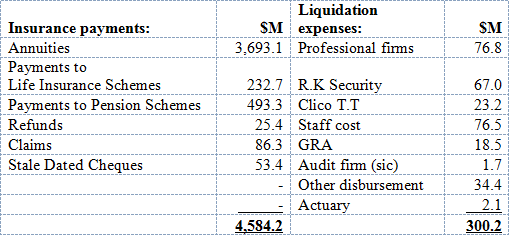
Earlier, I had reproduced the Liquidator’s Statement of Account in which Mr Williams misleadingly described total receipts as ‘Realisations‘ and separately, disclosed those payments in relation to Insurance transactions and those he described as Liquidation Expenses. For the purpose of this instalment, I think readers might find the information in the table set out above of some assistance in understanding how the liquidator has conducted the financial transactions for the period for which he has made a report.

Insurance payments
But before turning to those payments, a general comment on the $4,584.2 million in insurance payments. The information lodged with the Registrar shows only the classes of the payees. There are no supporting schedules or particulars. As a result there can be little commentary on those payments and whether for example the NIS, by far the company’s major annuitant, has so far received any cash from the liquidator. But the NIS is not the only creditor which has been made to sweat, despite the key role being played in the liquidation by their long-serving director Mr Maurice Solomon, a member of Williams’s triumvirate.

NIS massive losses
Whatever duty Mr Solomon may consider he owes the NIS, he appears to have done very little to protect or speak up for the tens of thousands of pensioners and other beneficiaries who are staring at the loss of billions of dollars of NIS investments in Clico. Worse, the famous assurances by Drs Jagdeo and Luncheon that the NIS would get back all its money have so far proved to be no more than the idle words of insincere politicians. On his part, Mr Solomon has annually approved financial statements of the NIS which make no provision for the losses which the NIS is already incurring, as it looks helplessly at its financial statements and sees over $5,000 million of investments in Clico producing no income and on a balance of likelihood, having to be written off sooner rather than later.

This is not scaremongering. The information provided in the June 2012 statement, the first filed by the liquidator since his appointment nearly two years ago, is hopelessly deficient to allow for proper analysis; well outside of the statutory deadline; uninformative about the current financial status of the company; and useless when it comes to assessing the prospects for the remaining creditors. What I know based on professionally prepared information collected in 2009 is that the total liabilities of Clico at the date of the appointment of the liquidator amounted to close to $15 billion. At June 30, 2012, just under $5 billion had been paid towards those liabilities leaving around $10 billion to be paid towards the capital sums outstanding, since interest is out of the question.

Already it seems that some $600 million will be paid to the NIS by way of an effective exchange of property in part settlement for its debt. That will leave little else for them or for the other creditors. In other words, as things stand the NIS is likely to lose over $5 billion, and other creditors, whose names are known by the liquidator but who have not been listed, will lose around $4 billion.

Liquidator’s expenses
Now let us turn to an amount of $301 million referred to by Mr Williams and his team as ‘Liquidator’s expenses.’ Because of the amateurishness in the preparation of the statements, a review or comment has to make certain assumptions or consider certain possibilities. For example, it is hard to believe that the payment to RK’s Security of $67.0 million could possibly be for the period since the liquidation, and one wonders what it would have taken for the liquidator to state the period to which the payment applied.

This is not simply amateur accounting. It has legal implications. When an entity goes into liquidation, the law provides a scheme for the payment of debts, starting with preferential creditors. Charges by RK’s Security prior to the liquidation are not priority debts and it must be assumed therefore that the $67 million was paid for services received after Williams’ appointment. Surely these must be justified by way of proper disclosure.

Another interesting item is that relating to taxation. The sale of properties gives rise to potential capital gains tax while payments made to non-residents may be subject to withholding tax. My experience is that a number of accountants, in carrying out receiverships and liquidations, routinely overlook their obligations under the tax laws. So before Mr Williams undertakes another transaction with tax implications, he should invite the GRA to examine his stewardship’s compliance with the tax laws.

The unnamed professional firms
Returning to the statement, the most startling item is the sum of $76.8 million paid to “professional firms,” a term, which obviously rules out both Mr Williams, and Ms Gibson, a member of his supporting cast. So how does Mr Williams explain the $76.8 million paid to “professional firms,” which perhaps not surprisingly, he does not identify? He gives not a least hint. What we do know is that this sum cannot include any payment to the actuary since that is separately itemised with its own amount ($2,123,815). It cannot be audit since that too is separately itemised with its own amount ($1,740,000). It cannot be for valuation services since that is also separately identified with its own amount ($3,110,215). Mr Williams the liquidator, Ms Gibson, the actuary, the valuer and the auditor having been eliminated, one is left only with the providers of legal and accounting services.

The accountants and the lawyers
Based on the public records, legal services, including conveyancing and litigation work, were provided mainly by the law firm of Mr Ashton Chase SC. In accounting, Nizam Ali and Co prepared for then Commissioner of Insurance Maria van Beek, a statement of net assets at February 28, 2009 and Mr Maurice Solomon provides to the liquidator, services such as cheque-signing. Since Clico retained the services of CEO and Chartered Accountant Geeta Singh-Knight as well as key accounting personnel of the failed company, all of whose emoluments are accounted as staff cost, the $76.8 million paid to “professional firms” seems hardly justifiable.

Adding insult to injury, the liquidator, possibly on the advice of Ms Geeta Singh-Knight paid some $23.2 million to a company that is part of the group which cheated Guyana of some $7 billion.

Conclusion
Ever since the matter of Clico surfaced in Guyana following the collapse of its parent in Trinidad and Tobago, Guyanese have been subject to misinformation, distortions and silence. Guyanese reacted favourably to the false assurances and actually praised President Jagdeo for helping out with money he negotiated from the Petroleum Fund and from raiding the Forestry Commission of moneys that should have been paid into the Consolidated Fund.

Informed opinion thought otherwise. That group wanted an investigation and prosecution of the directors of Clico as contemplated by the Insurance Act and the criminal laws. The Commissioner of Insurance had the power to appoint a Special Prosecutor to pursue any wrongdoing. But her failure to do so, her rush to liquidation and her appointment of Ms Geeta Singh-Knight to continue in the management of the company were as mysterious as her subsequent shooting in downtown Georgetown.

Some of us felt that the move to have a liquidator appointed premature; they were convinced that certain of Clico’s business not only could, but also should have been saved in the public interest. They were not only ignored but also ridiculed.
We are the only country that made no attempt to save the salvageable parts of the company. Indeed Trinidad, which was the worst hit, is now being rewarded with a Clico that is reporting improved performance and a significant rise in its assets value. As the financial press in that country reports earlier this month, Clico’s portfolio of listed investments is now worth T&T$6.3 billion. We ought to have been in a position to make a case against the Trinidad and Tobago parent. Jagdeo’s rushed deal to extract money from the Caricom Petroleum Fund probably ruled that out.

While the company may have some time to go before it is finally dissolved, the chances of any inquiry are not high since neither the government nor the opposition seems to have any interest in the fate of the company. Given the consequences for the NIS – a potential loss of more than $5,000 million – their lack of interest is a shame. They must insist on a full inquiry. Compare our situation with Trinidad where their central bank Governor on Thursday September 6 admitted to public perceptions that the Bank faltered in relation to its supervision of Clico; that there is likely to be psychological damage from the Clico failures; that the Bank would be subject to the first Commission of Inquiry in its 48 year history; and that the Bank would be transparent in accounting for its regulatory and supervisory actions in respect of the Clico companies.

The bunglers who are administering the Guyana Clico have allowed Caribbean Resources Limited to be dissolved without pursuing the $1.5 billion which CRL owed to Clico. Mr Lawrence Williams has double the obligation of his Trinidad counterpart. The Guyana central bank messed up big time when it failed to challenge Clico’s marketing of deposits masquerading as insurance. Now as liquidator, its Governor and its head of the Insurance Supervision Department are botching the company’s liquidation.