
Clico Liquidator lodges first liquidation statement – Part 2

Introduction

Here is a cheque drawn on the account of Clico – in Liquidation.
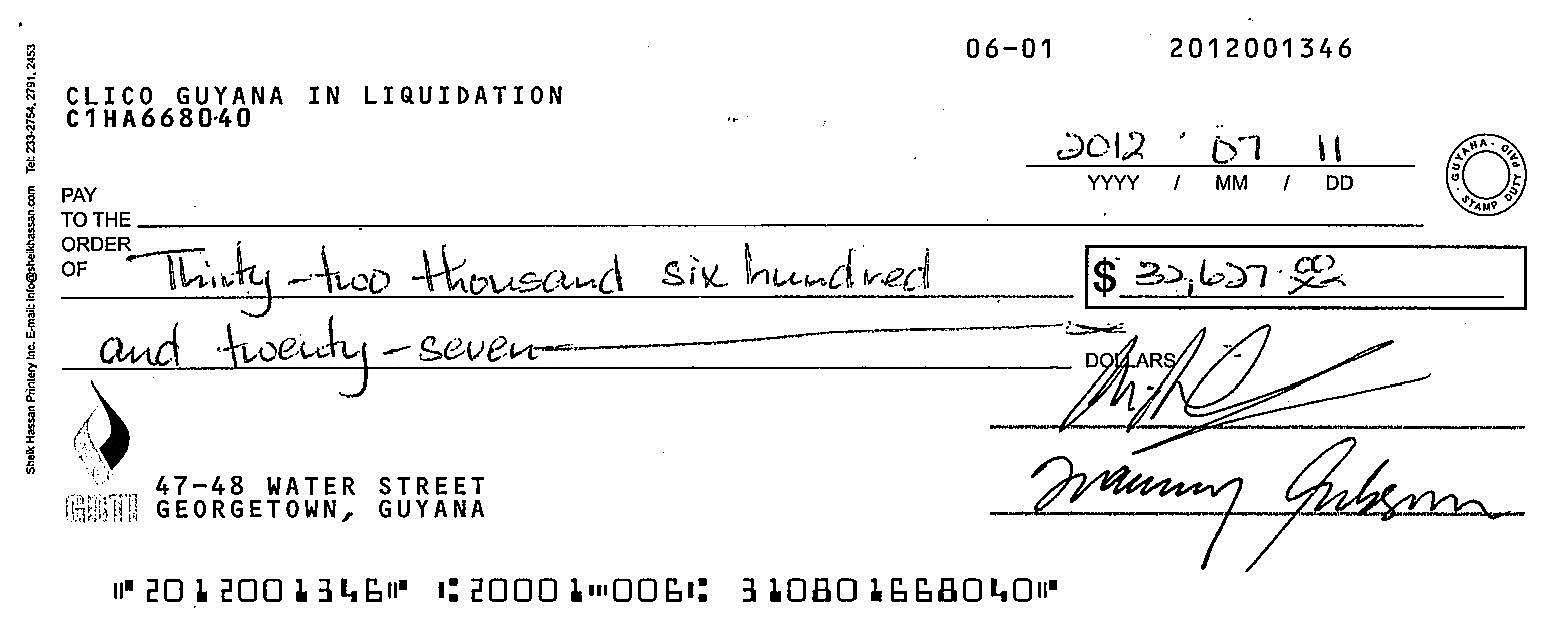
The court-appointed liquidator of Clico is Mr Lawrence Williams whose substantive office is Governor of the Bank of Guyana. If you were familiar with Mr Williams’ signature you will notice that he is not a signatory on this cheque. The reason is that Mr Williams has single-handedly converted a personal appointment as liquidator with strict fiduciary responsibilities and obligations into what I referred to last week as a triumvirate operating it seems in the most outside-of-the-law process.

On that occasion I named as one of the triumvirate Ms Geeta Singh-Knight who played a lead and illegal role in the collapse of Clico. But you will note that Ms Singh-Knight is not a signatory either. She has carefully stayed out of the limelight while the other two members of the triumvirate, Ms Tracy Gibson who had taken over from Ms Maria Van Beek as Commissioner of Insurance, and Mr Maurice Solomon, Chartered Accountant and a favourite of the government, are in the forefront. They are the ones who signed the cheque, the identity of the payee being redacted.

A diversion into legislative confusion
Let me divert a bit and look at the law establishing the Commissioner of Insurance. After Ms Van Beek migrated, the Insurance Act was amended to transfer to the Bank of Guyana the responsibility for the general administration of the Insurance Act subject to directions by the Minister of Finance. Unfortunately the amendment did not indicate what functions, if any, the Commissioner of Insurance now exercises. Surely the insurance industry is too important to be left in such a messy state of uncertainty.

Jagdeo’s legacy
Now I return to Clico. Clico was racked by illegalities before it went into liquidation. Just prior to its avoidable demise, former President Bharrat Jagdeo showed that he, and not the court, the Commissioner of Insurance or the Liquidator was really in charge. The stamp of Mr Jagdeo has been worse than the albatross around the neck of the Ancient Mariner for those with any interest in the law, in corporate governance or who believe that crime should not pay. Unfortunately none of the professionals who followed the politician seems to have made any effort to repair the damage or restore any respect for legality, sense of competence or interest in professional discipline.

From day one into the liquidation, I questioned the decision by Mr Jagdeo to ignore the principle of pari passu under which returns to creditors and contributories in a liquidation are made proportionately. And when disposal of assets began, I had cause to question the sale of properties and the granting of (fraudulent) preference to one of the creditors of the company.

The triumvirate
Nothing has changed, as evidence of the roles being played by Ms Singh-Knight, Ms Gibson and Mr Solomon challenge all the norms of decency or professional ethics imaginable. Ms Singh-Knight breached the Insurance Act and ignored the request of the then Commissioner of Insurance to comply with the law. Incredibly, after being appointed Judicial Manager under the very Insurance Act, the then Commissioner of Insurance turned around and rewarded her with an appointment as Assistant Manager of Clico, with even less oversight!

And what about Ms Gibson and Mr Solomon? It may be argued that the former is now acting not in her regulatory capacity but as an agent of the liquidator. She signs as Assistant Director, Insurance Supervision Department, Bank of Guyana. Her substantive responsibilities must surely be to oversee compliance with the Insurance Act in which capacity she should be overseeing the Insurance Act and overseeing the liquidation of the insurance company. By accepting an executive function in the liquidation, she has effectively abdicated her regulatory responsibilities.

Mr Maurice Solomon is a director of the National Insurance Scheme, by far Clico’s largest creditor. As a director of the NIS, Mr Solomon has a first obligation to the Scheme and should owe no loyalty to any other entity which would place him in a conflict of interest position. The liquidation process has brought all of those into question.

Fees, fees and more fees
As will be seen in the concluding instalment next week, the Liquidator’s Receipt and Payments Statement reveals payments for professional services amounting to $76 million between October 2010 and June 2012. By a process of elimination, this huge sum could only have been paid mainly to any or all of Mr Williams, Ms Gibson and Mr Solomon and Mr Ashton Chase, SC. Except for a block figure, the statement is amateurishly unhelpful. This is the first Liquidator’s Receipt and Payments Statement I have seen where such vital information is not disclosed.

The public and policy-holders have a legitimate interest in knowing whether all professionals engaged in this liquidation were paid, and if so, how much.

The statement has been lodged with the Registrar of Companies who as this column noted last week must cause an audit to be carried out. She has had the statement more than a fortnight and should have taken steps to comply with the law.

Misleading description
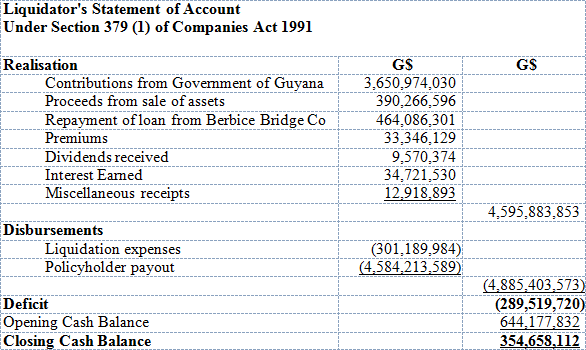
Let us return to the Receipts and Payments Statement of the Liquidator at June 30, 2012 (sic) which appeared last week. That statement discloses what is described as Realisation and Disbursements. The statement would have us believe that some $3,650.9 million of the $4,595.9 million was in fact Realisation. It is not. In fact, that sum is made up of approximately $3,000 million which came from the Caricom Petroleum Fund in exchange for the $7,000 million which the T&T owned Clico cost this country. Under the unexplained, lop-sided deal negotiated with Trinidad and Tobago by President Jagdeo our country effectively lost any right to bring legal action against Clico or the Central Bank of Trinidad and Tobago which took over the assets of Clico’s T&T parent company, the parent company of the Bahamas Clico. That is the company in which Geeta Singh-Knight and Lawrence Duprey had “invested” over $7.1 billion of Guyana policyholders’ funds. The other major receipt was $650 million hijacked from the Guyana Forestry Commission which the Commission received from the Indian Coffee maker Vaitarna. This sum should have been paid into the GFC from which, subject to the Act, surpluses could be paid into the Consolidated Fund.

Lucky bridge company
The next highest receipt is some $464.1 million being repayment of a loan made by Gita Singh-Knight’s Clico to Geeta Singh-Knight’s Berbice Bridge Company Inc (BBCI). Interest received from the Berbice Bridge Company amounted to $22.4 million, bringing the total received from that company to $486.5 million. The indebtedness of the Berbice Bridge Company to Clico at the last report date was $605.9 million, and how the difference of close to $125 million will be accounted for is a matter for speculation, since neither the de jure liquidator nor the de facto triumvirate (Geeta Singh-Knight, Maurice Solomon or Tracy Gibson) have shown themselves duty bound to offer any explanation. I am sure we did not even notice and by now have forgotten that NICIL unlawfully waived almost half a billion dollars to the Berbice Bridge Company Limited; now it seems that a company in liquidation – Clico – may be unlawfully waiving close to $125 million.

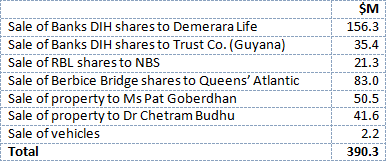
The only other receipt over $50 million was the sum of $390.3 million being proceeds from sale of assets. This is how this sum was made up:
Next week I will turn to the payments.
Clico Liquidator lodges first liquidation statement – Part 1

Introduction
This column is about Clico Life and General Insurance Company (South American) Limited (Clico), a regional insurance giant whose Guyana subsidiary collapsed spectacularly when Mr. Ian Chang, Chief Justice appointed Mr. Lawrence Williams, Governor of the Bank of Guyana to liquidate the company. Since 2010 when Clico began to implode I have written forty-nine pages on the company – all of which are posted on my website chrisram.net. In those many pages I questioned the role of then President Jagdeo’s compulsive, misguided and irresponsible direction of the judicial management and subsequent liquidation of Clico.

I noted that his action exacerbated the colossal and unlawful serial acts of Clico’s CEO Ms. Gita Singh-Knight who shifted billions of dollars belonging to Guyanese policy holders in breach of the Insurance Act 1998 and in defiance of the then Commissioner of Insurance Ms. Maria van Beek. Unfortunately for Guyana, Ms. van Beek hardly distinguished herself with her indecision and failure to act against Ms. Singh-Knight whose immunity from prosecution under Jagdeo appears to have continued under his successor.

Brief recap
But let us go back a bit to what might seem to be the genesis of the collapse of the Guyana company. On January 30, 2009 the authorities in Trinidad and Tobago announced that they were taking over certain assets of CL Financial Limited including Colonial Life Insurance Company Limited, the parent company of the Guyana company Clico Life and General Insurance Company (S.A.) Limited. Further references to Clico and the company are to the Guyana company unless otherwise stated.

Prior to February 25, 2009 the company was unable to raise additional funds or liquidity from its parent or recoup US$34 million invested by its management in its Bahamian fellow-subsidiary which itself had been placed in judicial management. The company was facing a run and needed help. On an application by Ms. Maria van Beek she was appointed Judicial Manager by an order entered on February 26, 2009. Surprisingly, rather than insisting on an enquiry into Ms. Singh-Knight’s conduct, Ms. Van Beek appointed her as Assistant Manager challenging the old adage that wrong does not pay.

After technical arguments between Senior Counsel Mr. Ashton Chase for the Judicial Manager and Attorney-at-Law Mr. Roysdale Forde the Chief Justice appointed Mr. Lawrence Williams, the Governor of the Bank of Guyana as liquidator. In one earlier column I argued that had Mr. Williams in his capacity as the banking regulator moved against the company for taking deposits packaged as insurance, Guyana might have been saved billions.

The Liquidator
I have enjoyed a cordial relationship with Mr. Lawrence Williams who I sincerely believe is doing a very good job at the Bank of Guyana. But no matter how charitable one wishes to be, it is hard not to rate his stewardship as liquidator of Clico with almost the same grades as one rates Jagdeo in relation to the company. He has acted unlawfully, delegated his powers and duties without any logic or justification, and overseen spending on a scale that may bear comparison with Ms. Singh-Knight’s reckless management of the company.

Incredibly Mr. Williams who as court appointed Liquidator has enormous but not unlimited powers has had Ms. Singh-Knight as one of his top lieutenants in the liquidation process. Ms. Singh-Knight may not be prominent in front of the camera but her influence has none the less been crucial. The word is that she has been paid a seven figure salary as part of a triumvirate to do the work that the Court empowered and ordered Mr. Williams to do. That is not only recklessness; it is madness; it is lawlessness.

And while all of that was going on the Chairman of the National Insurance Scheme who is also the Head of the Presidential Secretariat has misled the public into believing that the investments of NIS in CLICO would be recovered. I said then that had the Board not included long-serving and experienced directors like Maurice Solomon FCCA and Paul Cheong, a top director of the Beharry Group, I would have said that it was a case of Luncheon taking the workers of Guyana for a $5.8 billion dollar ride. That he managed to take others along with him is a feat that only a Luncheon would contrive and succeed with.

Liquidator’s failure
Last Friday, after months of checking for the financial statement every liquidator is required to file with the Registrar of Companies, I finally came up with one such report which I am not suggesting that the report was prompted by my persistent enquiries. But before I go into the contents let us look at some of the statutory requirements and how the liquidator dealt with these.

The report itself states the Statement of Receipts and Payments was being submitted under section 379 (1) of the Companies Act. But let me quote that same section 379 (1). It says: “Every liquidator of a company which is being wound up by the court shall, at such times as may be prescribed but not less than twice in each year (emphasis mine) during this tenure of office, send to the Registrar an account of his receipts and payments as liquidator.”

The liquidator was appointed on September 10, 2010 and twice yearly reports should have been submitted for six months to March 2011, September 2011 and March 2012 with the next due at the end of this month. Let us assume that Mr. Williams does not know or is too busy to be informed about the requirements of the sections of the Act that affect his role as liquidator. Is it reasonable to believe that none of the triumvirate and their high-priced legal advisor was aware that the liquidator had been guilty of a continuing offence under the Act for more than five hundred days?

Registrar’s audit
The triumvirate could not have missed that section 379 (2) requires the statement to be in duplicate and verified by an affidavit or a statutory declaration. Nothing in the records at the Registrar of Companies suggests that these requirements have been met. Nor does it end there. The Registrar must now cause the accounts to be audited, for which purpose the liquidator is required to furnish the Registrar with such vouchers and other information which the Registrar requires. When the accounts have been audited, the Registrar is required to keep one copy and to deliver one to the court for filing. Both copies are available for inspection by any creditor or interested person. We wait to see whether the Registrar, who was recently installed by the Attorney General and whose own appointment has not passed without raising some eyebrows, will do what the law and the public interest require.

The Registrar is also confronted with section 380 of the Companies Act which requires her to take such action she may think expedient if a liquidator does not faithfully perform his duties and duly observe all the requirements imposed on him by statute, rules, or otherwise with respect to the performance of his duties. A failure of more than five hundred days can hardly be considered faithful and is probably the first public test whether the Registrar will act as she is required to under the Companies Act.

The Statement
Now let us turn to the contents of the statement which I saw for the first time two days ago. One would have expected that with Mr. Maurice Solomon as the financial and accounting agent to the liquidator, a highly professional prepared statement with such elementary omissions as proper heading, cross-referencing and some notes.

Source: Office of the Registrar of Companies: August 31, 2012

Next week I will undertake a detailed commentary on this statement and introduce an interesting document.

The economics of Linden and electricity rates – conclusion

Introduction
As this column evolved over the past month its focus moved beyond Linden and electricity to the whole of Region 10 of which Linden can be considered the capital. The column which concludes today was in response to developments in that region in which the drastic hike in electricity rates led to protests, deaths and what will soon come to be known as the Region 10 Agreement. That agreement, signed by the Chairman of Region 10, Sharma Solomon, and Prime Minister Samuel Hinds on behalf of the Government of Guyana provides for a Technical Team specifically to look at the question of electricity; an Economic Committee to address the economic conditions in the region, a Commission of Inquiry to look into the events of July 18 in which three persons were killed; the establishment of a Region 10 Land Selection Committee to look at investments and land development in Linden and Region 10; and for the transfer to the regional administration of the television dish and transmitter and the granting of a television licence to the region.

The agreement provides for the naming of the Economic Committee by Tuesday of this coming week and for it to submit its final report “within ninety days.” While the members of the Technical Committee have been named as proposed by the region and the government, this column has learnt that the designated persons are awaiting formal notification of their appointment which makes the ninety days to report even more challenging.

Unfortunately ‘normal’ in executing agreements in Guyana is often synonymous with procrastination and more like a long-distance hurdle, with President Ramotar’s Tax Review Committee only one recent example. At this stage all the details of the Commission of Inquiry have not been made public and it is unclear when the commission will be assembled to begin its work.

Time for action
This column calls on the parties to the agreement to accelerate the rate of activity.

In this concluding part which seeks to look at the prospects for economic development in the region, the unsatisfactory state of available and reliable baseline data is an immediate problem. Indeed one of the terms of reference of the Economic Committee is to “examine the employment situation of Linden in particular and Region 10 in general…” That is not only an enormous task but also an enormously important one with direct relevance for affordability, one of the matters into which the Technical Team is required to enquire. As time would have it, that task is made more challenging by the fact that the committee might not be able to call on the services of the Bureau of Statistics which is now engaged in the national ten yearly census.

Accordingly, the members of the Economics Committee will have to be resourceful in how they approach the gathering of information and explore places like GECOM, the ministries and other agencies which would have collected some economic and social data for their respective purposes.

Economic plans
One of the other terms of reference of the Economic Committee requires it to “examine all studies, all plans, all sectors and their resources in use, new resources and human resources and develop a sustainable plan for Linden and Region 10.” There have indeed been a number of plans which the committee will find most useful and which with some updating could constitute a useful starting document. But I fear that the ninety days deadline for completing the work will require economists of herculean ability. Both Dr Clive Thomas who is generally regarded as the country’s best economist and Mr Haslyn Parris who is very familiar with the economics of the region are on the Technical Team looking into the electricity issue, which has the same deadline.

But let us leave the committees to do their work and get on with our own and look at the economic and development prospects for Region 10. Despite its not so positive image of bauxite, the region is rich in other natural resources.

Giving away the store
Region 10 is one of those regions for which tax holidays are provided for under the Income Tax (In Aid of Industry) Act. To qualify, the economic activity must be new, of a developmental and risk-bearing nature and demonstrably create new employment. The power to grant tax holidays rests with the Minister of Finance who also has wide powers to enter into investment agreements which could give businesses additional and valuable wide-ranging concessions. To give an idea of the width of the discretion and the possibilities for abuse and misuse of the law, one only has to look at Bosai and Rusal, neither of which undertook new economic activity nor demonstrably created new employment. Indeed they slashed employment in an existing activity but were yet given tax holidays.

Unfortunately because of the politicisation of the tax system none of the ten administrative regions has any power to attract or direct businesses to their regions. Tax incentives and concessions provided for under the laws including tax holidays as well as the powers to enter into investment agreements, are entirely controlled by the central government. Some participation and control were clearly contemplated by Article 76 of the Constitution which anticipates Parliament making laws enabling “regional democratic councils to raise their own revenues and to dispose of them for the benefit and welfare of their areas.”

Contrarily, the government has been improperly giving away tax revenues which the law requires them to impose and then turns around and tells the regions it has no more money to spend on them. Similarly the Constitution at Article 77 A requires the Parliament to make laws providing “for the formulation and implementation of objective criteria … for the allocating of resources to, and the garnering of resources by local democratic organs,” again emphasising the right of regions to raise revenues.

The importance of good governance
Still on the governance issue the constitution sets out as a fundamental right the participation of persons through various kinds of organisations in the management and decision-making processes of the state. And then there is article 78 A which requires the Parliament to establish a Local Government Commission which together with the other provisions will ensure better governance and democracy at the regional level.

Unfortunately all the regions of the country have had to contend with years of shocking failure by their representatives in the National Assembly to bring the necessary laws to ensure that the constitutional provisions are effected. Our parliamentarians must be the only people not to recognise how fundamental these are to the development of Region 10, as indeed to the rest of Guyana.

I have always believed that good governance is a necessary prerequisite for social and economic development, and that good economics always turns out to be good politics. Maybe the Region 10 Chairman should meet with his counterparts to persuade them to press their parties to do what the constitution has provided in the interest of the people of the regions. If they do not wish to play ball in their own interest, then region 10 will once again have to show the way.

Regional Development Strategy
Assuming these governance issues are addressed, the question for the Economic Committee is how to achieve their objectives in 90 days, a challenge which even Jules Verne would find daunting. Fortunately there is a document called the Regional Development Strategy for Region 10 which was prepared not too long ago with input from LEAP (referred to in an earlier part of this column), the government, the EU and the UNDP.

And as I mention the LEAP, I should update readers with a conversation I had with a high-ranking government official who suggested to me that the reason for the runaround I had to get a copy of the LEAP Completion report is that that report never got beyond the draft stage. While I consider my source just short of impeccable, I am astounded that the European Union would have spent €12.5 million without a completion report on the project!

On the other hand, the Regional Development Strategy is a document which could form the basis of the work of the Economic Committee. That report identified as the vision for the economy five engines of growth: agriculture, forestry and wood value- added manufacturing and other skill-based industries absorbing the increased technical output of our schools and technical institutions, tourism and transportation.

The strategy recognises that bauxite mining will continue in Linden and at Aroaima. It asserts that a study to determine the feasibility of constructing an aluminum smelter in Linden has confirmed its viability while kaolin and laterite are developed within the bauxite industry to complement the traditional metal, chemical and refractory grade bauxite.

The strategy also includes a vision for environmental stewardship, the social sectors and governance and institutional capacity, but did not appear to have addressed the constitutional issues. Paragraph 2.4 of the strategy identifies “Region 10 [as] crucial to the development of Guyana. Its geo-strategical position as a gateway to Brazil, its central location in the heart of the country bordering six other regions, its span over the three major rivers, and its weight in the national economy (particularly bauxite mining) make it an outstanding region compared to others.”

Conclusion
But the document goes further claiming with justification that the elaboration of a Region 10 Development Strategy as a pilot project in Guyana and a harbinger for similar strategies in other regions gains critical importance in the national context. While some of the methods the leadership of Region 10 has pursued have not won universal approval, the community itself has demonstrated to the rest of the country that central government habits die hard and sometimes have to be pushed out of the way to make room for development.

The next ninety days and how the government responds to the reports of the Technical Team looking into electricity and the Economic Committee with a broader mandate, will signal the direction in which the country will go. Favourable and it could be a model for success. Failure to act will cause failure all around. The government remains key but not exclusive.

The economics of Linden and electricity rates – part 3

As with the first, the second installment of this column last week attracted a full length response from the Prime Minister Samuel Hinds which as far as I could understand pleaded with me “to help soothe anxiety about removing a historical subsidy.” I have no objection to doing so if Mr Hinds would share with me a copy of the Bosai Power Purchase Agreement and detailed information on the generation and distribution of electricity in Region 10.

Mr Hinds in his letter also cited ultra-conservative, anti-labour Margaret Thatcher’s handling of the coal industry in the seventies as a model against which to compare our 21st century Linden. As if to establish the firmness of his belief, his government then appoints two Bosai directors, Messrs Winston Brassington and Norman McLean, to investigate the Bosai-supplied electricity in Region 10, the genesis of the current unrest in that region.

Mr Hinds also reacted to my reference to the LEAP Completion Report and even sought to advise how I should “proceed to critique it.” After two weeks and despite assurances by the Minister of Finance that the report would be provided to me, I am yet to receive a copy.

Introduction
In last week’s column I reproduced a map of Guyana showing the administrative regions of the country. Region 10 is not a particularly large region and has been described as the only landlocked region in the country. But that understates its importance. Not only is it the country’s sole bauxite region but in terms of natural resources it also is a significant forestry region which LEAP had projected would witness increased annual production of about 5% per annum from 2004 onwards. The incomplete draft Completion Report spoke confidently of the number of activities taking place in the agriculture sector, allowing farmers to target specific high yield crops for the Guyanese and export market. It referred to a draft agriculture strategy having been tabled for discussion by LEAP and the Regional Agricultural Team, which when finalised, would guide regional agricultural development in the medium to long term.

Historically the fortunes of the region have been closely linked with that of the bauxite industry. But employment reduction at Linmine and Bermine and their successors has been significant over the years. Given that the sector now employs less than 10% of the 12,000 persons employed by the industry at its peak, the largely forgotten National Development Strategy (NDS), and Poverty Reduction Strategy (PRS) both articulated the need for significant expansion and diversification of economic activities. Not surprisingly then, the draft LEAP Completion Report identified a rapid transition to a diversified economic base as of particular importance in Region 10.

Importance of Linden
Linden’s location is strategic. It has the potential to become the hub for goods from northern Brazil and a key point in the Lethem to Georgetown corridor. But its importance within Guyana has been underlined during the current impasse in which road contacts and movement of goods and people between Regions 7, 8 and 9 and Regions 4, 5 and 6 have been brought to a virtual standstill.

Ocean-going vessels navigate their way to Linden with practically no problem, while the region also has various kinds of clay to spawn a major industry. With no threat from rising sea levels and a largely concentrated population many of whom are skilled artisans, the region has the capacity to provide its current population of approximately 45,000 with a standard of living that compares favourably with the rest of Guyana.

Transformational leap
LEAP was supposed to have provided that springboard with €12.5M provided by the European Union. The project had the kind of structure so loved by those overpaid international consultants who often have a first call on project funds. Overall responsibility for the project rested with the National Authorising Officer of the Ministry of Finance, while executive responsibility lay with the Project Steering Committee. This committee was responsible for approving the annual work programme and receiving regular technical and financial reports.

The government was expected to play the major role in supporting the transition from a bauxite town to a diversified community with the key five agencies being GO-Invest, National Industrial and Commercial Investment Limited (NICIL), the Forestry Commission, the Ministry of Agriculture and the Linden Economic Advancement Programme (LEAP).

The core component of the LEAP was the Business Development Services (BDS) oriented to providing “hand-holding” assistance to new businesses and SMEs as well as to help entrepreneurs to modernise and improve management skills. Whereas in the short to medium term BDS was expected to become a one-stop-shop in Linden to streamline queries and business solutions for existing and new entrepreneurs, the ultimate purpose was to turn it into an example of a driving force for business and economic development of Region 10.

Government stalled
The results of the LEAP are disputed. Ms Kathy Whalen, LEAP International Programme Manager was confident that LEAP achieved most of its set indicators and that new jobs were created and investors were attracted to the community. Many disagreed then, and now question those glowing reports against the background of the current state of the community. The absence of the Completion Report makes any assessment of LEAP a step in the dark while there is almost a blanket of silence over the successor Linden Economic Advancement Fund which the government brought their friends in to manage.

The government appears not to have acted on some of the suggestions made in the draft Completion Report including the need for an institutional arrangement for investment promotion and micro-credit activity. The draft recommended a jointly public-private financed and operated entity with the Government of Guyana continuing to make a credit line available.

The government dilly-dallied and as a result, arguably the richest region in the country was left to become a depressed community where residents are unable to meet the economic cost of basic necessities. Sadly, it took the events of July 18 to cause the government to establish two teams to look at electricity specifically and the wider economic state of the region. While those teams will have their work cut out, there are several options they would no doubt consider. Here are my brief comments on some matters they may wish to consider.

Electricity
1. Historically low tariffs have militated against any attempt not only at conservation but common sense. It appears that most consumers use electricity rather than gas for cooking and many of them keep on lights 24/7. At least one government representative agreed with a suggestion I made to him that the government buy a bulk supply of gas stoves which it can distribute to residents of the community, at a modest cost. This would have an immediate and significant impact on consumption and therefore the subsidy. Similarly the government can distribute energy-savings bulbs with the same effect.

2. The entire arrangement whereby the government supplies duty-free fuel to Bosai Services and pays the company to generate and supply electricity to the region has to be carefully scrutinized. The members of the team include GPL Chairman Mr Winston Brassington and its CEO Mr Bharrat Dindyal. GPL is of course a high cost supplier of electricity and by their presence on the team may also benefit from the kind of professional examination of electricity costs which will take place. No doubt too, there will be a thorough examination of the Power Purchase Agreement and the allocation of costs between various groups of users/consumers.

3. The team should also consider a more sustainable, lower cost alternative strategy for the medium term (3-5 years). Energy is critical to economic development and I understand from a document which was provided to me, that a regional energy plan, including the use of the region’s natural resources is being considered. This must be accelerated.

4. The region must not be forced into the national grid. This is as much an economic as a political matter. If the region can provide electricity at a lower cost, then it must be free to do so.

Economic issues and democracy
The potential of the region, like the rest of the country, has been stymied by lack of local democracy. For all the talk about budgets, the regions are at the mercy or fancy of the Minister of Finance while the Minister of Local Government appoints the Regional Executive Officers. The regions have no control over taxes and are required to deal with all kinds of garbage including plastic containers for which the central government collects more than one billion dollars annually. If ever there was one set of revenues that should be shared among the regions, the Environmental Tax is that one.

And it is not that revenue-raising is any new concept. As Article 76 of the Constitution states, “Parliament may provide for regional democratic councils to raise their own revenues and to dispose of them for the benefit and welfare of their areas.”

If this was in place, the region could raise revenues by way of tolls, charging for certain services, etc.

And while that would be at the regional level, the regions themselves will have a fair share of national revenues if the slothful parliament would do as Article 77A of the Constitution requires and make “law [to] provide for the formulation and implementation of objective criteria for the purpose of the allocation of resources to, and the garnering of resources by local democratic organs.”

Finally on this score, is the abomination of annual postponement of local government elections which some claim is unconstitutional. In depriving the people of their democratic, constitutional rights, the Parliament is proving to be the most undemocratic body in Guyana.

Next week I will conclude with some recommendations on the economic revival of Linden.

Finance Minister ignored the requirement of the law in relation to a supplementary appropriation bill

In a letter published on May 17, 2012 (‘In accordance with the law?’ SN)I drew attention to an exchange in the National Assembly between the Speaker and the Minister of Finance following a question raised by Mr Khemraj Ramjattan during the debate on what soon entered into the public psyche simply as Paper 7. That paper was part of Supplementary Appropriation (No 3 of 2011) Bill 2011.

The exchange centred around a requirement of section 24 of the Fiscal Management and Accountability Act (FMAA) that on the presentation of a supplementary appropriation Bill, the Minister, in addition to providing the reasons for the proposed variations must also provide “a supplementary document describing the impact that the variations, if approved will have on the financial plan in the annual budget.”

At the time of that debate, the supplementary document had not been provided. For ease of reference here again is that exchange as recorded in the official parliamentary record:

Speaker: Hon Minister of Finance, will you be in a position to give an undertaking that you will accord and abide by the conditions of the Act?

Dr Singh: Mr Speaker, as has always been the case, the relevant submission will be made in accordance with the law.

I pointed out then that Dr Singh had misled the National Assembly, not ever having presented in close to fifteen supplementary appropriations bills introduced by him since 2006, any supplementary document required by section 24 of the FMAA.

Dr Singh again came to the National Assembly on August 9, 2012 with Supplementary Appropriation (No 1 of 2012) Bill for $13,739,733,521. Without having met the obligation and undertaking given by him in respect of Paper 7, Dr Singh again ignored the requirement of the law.

Disappointingly, neither the parliamentary opposition nor the Speaker sought to remind Dr Singh about the requirement of the Fiscal Management and Accountability Act. They granted him authority to spend a further $11.9 billion without any information or understanding of the impact of their vote on the country’s 2012 finances, leaving everyone with the question whether they might have voted differently had they known the consequences of their decision. In the process the Assembly reinforced Dr Singh’s demonstrated disdain for the national body, the country’s laws and indeed all Guyanese.

I am copying this letter to the Speaker of the National Assembly with the hope that future supplementary provisions are dealt with strictly in accordance with all statutory requirements. The country deserves better.