
The economics of Linden and electricity rates – part 2

Introduction
It is now more than three weeks since what was intended as a five-day protest against the electricity hikes in the region took a dramatic turn for the worse on the very first day with the deaths of three protesters. By contrast, the talks between the government and the regional administrators to address the region’s problems have moved at a pedestrian pace, despite the political social and economic implications for Region 10 and other regions and sectors which have come to rely on the Linden passage, and of the danger of a deteriorating situation the longer the standoff continues.

Part 1 of this column which appeared two Sundays ago had as its central theme the arrangements for the supply of electricity in Region 10 and that the increases in tariff scheduled for July 1 of a minimum of 300% for consumption in excess of 75 kWh per month were hardly consistent with the progressive realignment of rates announced by the Minister of Finance only a couple of months earlier. The column was met by a response from Prime Minister Samuel Hinds who has ministerial responsibility for energy and who is also a Region 10 representative of the government in the National Assembly.

Instead of offering some pointers to addressing the economic and social conditions facing the community in one of the country’s richest regions, Mr Hinds resorted to the usual everyday currency of ad hominem pettiness and political banality to the level at which he as Prime Minister finds it necessary to point out that the percentage increases were not in a circular about the new electricity tariffs! But it is not necessary to respond to an explanation as to why the regional supply of electricity is exempted from regulation by the Public Utilities Commission.

What I found unbelievable was his justification for the supplier – Bosai – making a profit partly out of the national subsidy, a profit he linked to the company’s cash flows. The two are as related as apples are to mangoes! Surely a more logical link would be royalties and taxes paid to gross revenues – or even to the cash flows of the region’s two international bauxite operations. It is troubling that Mr Hinds can be so insensitive to the relevance or impact of the rate of the tariff increases, in many cases exceeding 300%.

It is an indictment for his government to ignore its duty to enforce the law including the Bauxite (Production Levy) Act, and that the Finance Minister would be willing to consider waiving royalty for any non-renewable resource, particularly for a company that is hugely profitable. Any country serious about managing its resources within a framework of an acceptable climate for foreign investors would pursue a fairly negotiated Double Taxation Treaty with that country. Separate, secret negotiations with strict confidentiality clauses may be useful between private companies but have no place in a transparent democratic environment in which one of the parties is the state.

From dream to LEAP
Linden, once the dream community of Guyana, now has an unemployment rate that ranks with the worst pockets in the country, with some saying – implausibly – that it is 70% while a leading government spokesperson conceded that it was somewhere around 25%. How it got here through a series of failed policies and market circumstances is beyond the scope of this particular column, but suffice it to acknowledge that within a short few years Linden came to be singled out by the European Union and the government for special treatment.

Under the Linden Economic Advancement Programme (LEAP), the EU provided €12.5M over a nine year period which ended on December 31 2010. Yet – incredibly – neither the Office of the European Union nor the Ministry of Finance was willing to provide me with a copy of the Completion Report on that project. Acting on the unlikely suggestion that I seek out an unofficial copy, I was provided with a draft, incomplete report with many key data missing.

According to that draft, the objective of the project was the creation/strengthening of viable and competitive enterprises and the generation of new long-term jobs contributing to improving the living conditions of the community in Linden and Region 10 and to reduction of social tensions. But the same draft identified as the purpose of the project was “the development of the local market for business advisory services and financial services in order to attract new national and foreign investment and increase employment opportunities.”

And if that was not enough of a mouthful, here is how the draft defined the key results of the project as:

● improved local capacity for economic planning, project design and implementation within the private and public sectors;

● improve business and finance sector;

● viable and competitive companies created;

● direct permanent jobs created by enterprises benefiting from loans and support services;

● laid off miners or unemployed youth receive training in employable skills;

● public officials trained in economic and regional development planning, project preparation, management and proposal writing;

● basic infrastructure upgrade.

A harsh assessment based on existing conditions in the region would suggest that the project was a huge failure. That would be unfair; the funds provided were clearly inadequate for the project’s ambitious objectives. My efforts to source relevant information from the Bureau of Statistics were even less successful and I was directed to the last census a decade ago. While that is surely disappointing, what is worse is the reluctance of key parties to make the Completion Report available since that robs the national conversation of useful information about the extent of the problem and strategies to deal with the economic malaise which the region shares with so many depressed communities in the country.

Failure of governance
Linden is a failure of governance, the laws and the constitution. This is what Article 77 A of the Constitution states: 77A. Parliament shall by law provide for the formulation and implementation of objective criteria for the purpose of the allocation of resources to, and the garnering of resources by local democratic organs. Nearly twelve years after that Article was inserted in the constitution, the inept National Assembly is yet to pass any such law.

But the governing party has simply made matters worse. The principal local democratic organ to which Article 77 A refers is of course the Regional Administration whose executive operations are headed by a Regional Executive Officer appointed by and accountable to a central government minister and whose funds are provided by another central government minister, the Minister of Finance.

It would be instructive to learn whether either of these ministers has had any extended conversation with the Chairman of Region 10 since the November 28 elections, let alone July 18.

Region 10 is an interesting region. It is not among the larger regions by size or population. The last census showed that it had a population of 42,000 persons or 5.5% of the total population and with a size of 19,387 km2, accounts for some 9% of the country’s 214,999 km2. Those statistics do not however reflect the region’s economic significance.

Administrative map of Guyana

Region 10 is the bauxite capital of Guyana with RUSAL living up to its international corporate reputation in exploiting the bauxite reserves at Aroaima while Bosai controls the Linden operations. Both entities have slashed the number of persons employed in bauxite, to about one-tenth of the numbers in the peak days. So while there is justification in the statement that Linden is no longer a company town, it still provides both companies with a pool of employees eager and willing to work even as they bear the cost of the illness-related externalities. For the three years 2009 to 2011, bauxite exports (tonnes) were: 1,406,908 in 2009, 1,135,817 in 2010 and 1,816,548 in 2011, bringing in export revenues of US$79.5M in 2009, US$114.2M in 2010 and US$133.3M in 2011.

Next week I will continue examining the region’s economic resources as I make the point that it contributes far more to the national treasury than it draws out.
Remarks at Service for Linden Martyrs

As the community and country mark the burial ceremony of three of our fellow citizens, let us remember and share the personal grief of those who are left to mourn the deaths of Shemroy Bouyea, Alan Lewis and Ron Sommerset. To their loved ones I extend sincere condolences. We remember too those who were injured on that fateful day – July 18, 2012 – as they protested for better living conditions – the right of every citizen of this country. We pray for their full and speedy recovery.

I speak today as a Guyanese of Indian descent to remind my Indian sisters and brothers of the grief and suffering they and others in Guyana still remember and commemorate at the killing in 1948 of five Indo-Guyanese protesting their working and social conditions. Where is the progress I ask, in this richly endowed country, that sixty-four years later, three African Guyanese are killed protesting high unemployment, economic stagnation and prohibitive increases in the cost of electricity?

Whether as Africans, Indians, Amerindians, Chinese, Portuguese or mixed race, what must matter to us is not the ethnicity – but the identity – of those who gave the orders and who pulled the trigger. We debase ourselves by our silence if we do not condemn unequivocally the killing of Shemroy Bouyea, Alan Lewis and Ron Sommerset not as African Guyanese or Indian Guyanese, as Amerindian Guyanese, or as Guyanese of Chinese descent – but as Guyanese. Let us ensure that whoever the perpetrators are, that they are brought to justice.

Particularly to my fellow Indians, I say Guyana has no place to go if the words “we” and “our” are seen through ethnic lens. Our country and communities are too diverse and interdependent, the national fabric too interwoven, families now too mixed, for any form of ethnic purity. We must all feel and share a national sense of disappointment, poverty and insecurity that any one community, any one region or any one village is deprived, impoverished and without hope.

Today marks Emancipation Day, the declaration of freedom from that abomination called slavery, a day that defined us as a people and a nation. Let us see today as another defining day in which we finally begin to do as our Constitution requires us to do and that is to “Forge a system of governance that promotes concerted efforts and broad-based participation in national decision-making in order to develop a viable economy and a harmonious community based on democratic values, social justice, fundamental human rights, and the rule of law.”

When tomorrow comes – and by the grace of God it will – let us resolve to respond to the anguished cries of the Linden community for justice to prevail for our brothers who lost their lives, for those who were injured and who bear the scars of that day, for those who day in and day out struggle to make ends meet, to send their children to school, to pay the light bills and to stand up for fair and equal treatment guaranteed by our national sacred document called the Constitution.

Let us hope for a speedy and satisfactory resolution of the concerns of Lindeners – Justice, Fairness, and Economic Reconstruction, including the basic needs of all human beings. As we strive on this Emancipation Day to honour the heroes of our glorious revolutions, let us determine that henceforth we will create heroes, not martyrs. Let us shed our prejudices, not blood. Let us build Linden, Wismar, the coastal villages and the hinterland communities, not monuments to insensitivity and extravagance. And let the government, our leaders and us the people do so for a Guyana of seven, not one or two ethnic or influential voting groups.

Let us today resolve to honour Shemroy Bouyea, Alan Lewis and Ron Sommerset by doing all we can to bring about the community and country they no doubt wanted for themselves and for us all to live in. We, and I mean all Guyanese, owe them nothing less.

Dangerous fabrication

Please allow me to use your column to highlight a dangerous piece of mischief circulated this past Sunday on the internet (Facebook) by someone using the name Tamara Deokumarie.

The person claims that I made a cheque payment of one hundred and twenty thousand ($120,000) to the Mark Benschop Foundation three days before the Linden protest. The person also claims that I was overheard talking about “things going well at Linden” on the cell-phone.

Of course I knew that no such payment was made or that any such conversation took place. Yet to satisfy myself I reviewed not only cheque but cash payments as well for the entire month of July. It confirms that no payment was made to the Mark Benschop Foundation for any amount.

Whoever, Tamara Deokumarie is, s/he is nothing but a dangerous fabricator and mischief-maker. Her/ his claim about the cell-phone conversation is as imaginary as a cheque payment to the Mark Benschop Foundation.

The economics of Linden and electricity rates – part 1

Region Ten is not a burden on, but rather a contributor to the state

Introduction
In the 2012 Budget Speech, Dr Ashni Singh, Minister of Finance said: “Currently, in Linden, electricity costs between $5 and $15 per kWh, while on the GPL [Guyana Power and Light] grid customers pay an average of $64 perkWh. The total cost of this electricity subsidy was $2.9 billion last year, the equivalent of 10 per cent of GPL’s total revenues. Starting from 2012, reforms will be initiated to the tariff subsidy with the aim of giving effect to a progressive alignment of the subsidised rates with the national rates that are applicable on the GPL grid.”[Emphasis added].

There are a couple of small things wrong with that statement. Linking the subsidy to the total recorded revenue of GPL is tenuous at best, and misleading under any circumstances. Linden is not on the GPL grid; it is provided with electricity produced by Bosai Mineral Services for sale to Bosai Minerals Group and to the community through Linden Electricity Company and the Electricity Cooperative Society. Third, a random survey of the electricity bills for the most recent period of five GPL consumers, all staff of Ram & McRae, showed an average of $55 per kWh, high but 14% lower than the charge stated by the Minister.

Nothing progressive
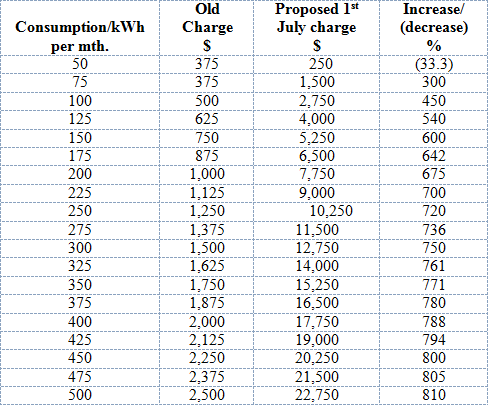
But what is patently misleading is that part of the Minister’s statement that speaks of a progressive alignment starting from 2012. Here are the increases which customers were being asked to pay before the tragic deaths which led to the rates being put on hold.

Source: Linden Electricity Company Inc circular

Anyone consuming 75 kWh or more of electricity will face an increase in their bill of at least 300%. In my group of five, the average consumption is 157 kWh. The increase applicable to them would be over 600% making it hard to find any word but deception to describe the Minister’s clever use of words.

This government which has a good sense of history has had twenty years to address the subsidised tariffs in Linden. Assuming a $5 per kWh in 1992, it would have required a semi-annual increase of roughly 6% to bring the tariff up to the same level as GPL. With fatal consequences, the government has attempted to do in one year what it did not do in 20 years.

Profiting from the subsidy
But the Minister is not the only person producing misleading information. Bosai Minerals Services Inc released recently a document described as an “Audited Operation report” showing that the company made a profit of US$233,000 in 2010. The public records however show that the company made a profit (before tax) of G$76,342,000, the US Dollar equivalent of $380,000. Since the company’s business is the operation of a power plant to provide electricity to its (group) bauxite operations and the community, it must explain this difference and whether it is permitted under the agreement with the Government of Guyana to make a profit from the subsidy.

There are other concerns about the electricity operations. The information the electricity company has provided on fuel costs needs explanation. Invoices for diesel imported by its parent company (Bosai Minerals) from the State Oil Company of Suriname show a lower cost of fuel than that reflected in the company’s income statement. Since its financial statements do not suggest that the company buys diesel from the parent company, the question is why does it not pay the same price from the same supplier as its parent.

A second concern has to do with the agreement signed with the government for the supply of electricity, a regulated service which would otherwise come under the Public Utilities Commission. The government has excluded Bosai from any regulatory obligation hence its freedom to charge rates that should have been fixed on a cost recovery basis. It seems incontrovertible that that would be the more appropriate basis since the supply serves the group and in some cases its service is specific to the group. For example, any plant capacity for the operation of the dust collector cannot be shared with the community charge while on the remaining plant, the pricing policy should be based on the marginal cost of providing electricity to the community.

Paranoia
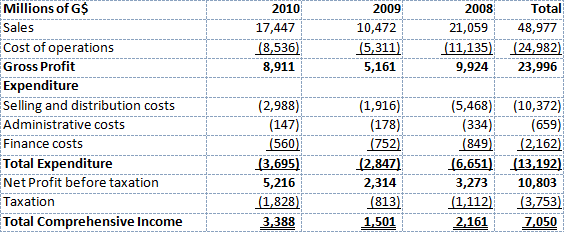
A third concern I have touches on the government’s paranoia that if it applies the country’s laws to Bosai, the company will pull out. Perhaps that is the message – or threat – the company communicates to the government in private. We should not fall for that. Bosai and China are here not to develop Guyana but to guarantee access to raw materials. They need Guyana as much as Guyana needs foreign investment. Our failure to recognise that allows investors and Bosai in particular to exploit the country. Let us look at Bosai’s Income Statement for the years 2008-2010.

Source: Audited financial statements

Under the agreement with the government the company was exempted from the payment of property tax and royalty for the five years to December 8, 2009. The notes to the 2010 financial statements state that the company has sought a five year extension, but went on to state that no royalty was payable on sales during the period December 9, 2009 to December 31, 2010 and that no property tax provision to December 31, 2010 had been made.

Order 8 of 2005 indicates that the company is subject to royalty at the rate of 1.5% but to a zero rate for the first five years. I searched the Laws of Guyana but could only find statutory authority for a 3% rate and first saw a reference to 1.5% in a 1997 Mining Policy and Fiscal Regime by Prime Minister Samuel Hinds. Mr Hinds’ paper did not even mention the Bauxite (Production Levy) Act 1974 which was introduced to ensure that the country gets a fair share of the revenues from its natural non-renewable resources.

Mrs Da Silva and Mr Hinds
The Hansard of the debate on the Production Levy Act in the National Assembly of September 25, 1974 records then leading member of the United Force as saying: “These big multi-national corporations seem to think that because they are huge multi-million concerns, that because they are big and we are small and we need the revenue from our bauxite so badly for the economy of our country, that they should have the upper hand and be allowed to dictate [to us]. That time has passed.” If you can hear me, Mrs Da Silva, that time has returned.

Those whom her party now supports in the National Assembly are prepared to waive royalties and to ignore the Bauxite (Production Levy) Act for a hugely profitable company which was on target to recover its original investment in less than five years. Prime Minister Sam Hinds, failing to appreciate the difference between royalties and corporation tax, has ensured that under Order 8 of 1995, the company will pay only the greater of royalty and corporation tax. In other words, if the corporation tax payable exceeds the amount payable as royalty, no royalty will be payable.

Let us put that into context. In the three years 2008 to 2010, the bauxite companies exported some 4,659,317 tonnes of bauxite with an exchange value of US$325.2 M. For this, the country received no royalties.

And if 2010 was a good year, 2011 was a great one. Bauxite production shot up in 2011 by 68%, from 1,082,512 tonnes to 1,818,399 tonnes. If there was no technical or economic case for a royalty waiver in 2005, there can be no financial case for an extension of that waiver in 2011.

And there is one other point which may have escaped the Government of Guyana. Without a Double Taxation Treaty between Guyana and China the income earned in Guyana would under normal tax rules, be subject to tax in China. In other words, income we do not tax is effectively contributing to the Treasury of China. If only we are courageous enough to negotiate a fair deal with Bosai, and apply Guyana’s tax laws including the anti-transfer pricing provisions as necessary, the country will be better off.

Conclusion
And let us end today’s column on this note. Guyana is a 30% shareholder in Bosai. So that when Bosai paid one billion dollars in dividends in 2010, Guyana received $440 million of that in revenues, $300 million in dividends paid to NICIL and $140 million paid to the Guyana Revenue Authority as withholding tax. And that is on top of the $708 million received from corporate taxation! If only we did not waive all those other taxes!

Clearly Region Ten is not a burden on, but rather a contributor to the state.

Next week I will identify some specific solutions to the tariff question.

No such thing as a free chow mein – Conclusion

Introduction
Today’s column concludes my review of the strengthening of economic relations between Guyana and China. Or more accurately between China and Guyana since for China the relationship seems all part of their global strategy aimed at accessing raw materials for its unlimited needs and appetite to sustain its rapidly growing domestic and export markets. China clearly understands the link between a country’s domestic economic policy imperatives and its foreign policy. It recently played host in Beijing to several political leaders and officials from countries across Africa at a China-Africa Co-operation Forum, pampering them with attention and banquets and dangling before them preferential loans.

Just briefly, Guyana’s failure to connect the dots contrasts sharply with China’s, and explains why Minister Robeson Benn can justify a US$138 million expansion at the Cheddi Jagan International Airport built financed by the Chinese, who according to Benn came by with the money which Guyana duly grabbed. Apparently no one bothered to consider whether the project fitted in with our debt profile, our investment strategies, our economic priorities and our foreign policies. A couple of years ago we were excited with Libya and Kuwait. Yet the PPP/C’s 2011 Elections Manifesto had not a single reference to Libya, Kuwait or China, or indeed to foreign policy.

Regardless of whether or not there is a Guyana policy, as a country China is rapidly becoming the dominant player in Guyana. The Indians, no saints themselves, who have long had a stronghold in Regent Street, are now complaining about the practices of the Chinese traders. If Guyana has a China policy it seems to run along these lines: whosoever will, may come, no questions asked, no visas required and no tax or NIS registration compliance.

Trade trends
A recent study shows China as one of the leading exporters to Guyana of car parts, tyres, fertilizer, pesticide, weedicide and fungicide. Its domestic appliances now dominate in the hire-purchase outlets. And of course the Chinese restaurant is found at almost every street corner in Guyana. But Chinese durables are also reality, notwithstanding the many jokes about the standards of their products.

But apart from these, China has also been a major supplier of capital projects. They supplied the Moco-Moco Hydroelectricity plant which has been defunct for several years and the rehabilitation for which the country was forced to consider seeking assistance from the Brazillians, and the Skeldon Sugar Plant which cost the country billions and like Moco-Moco, the rehabilitation for which GuySuCo had to turn to the South Africans and the Indians. The most recent fiasco import from China are the two roll-on, roll-off ferries for which more than rehabilitation will be required with questions being asked as to whether the vessels will ever be able to meet the needs for which they were acquired. We seem to have such infinite faith in the Chinese that we not only buy a pig in a poke from them, but one that says if the pig turns out to be a dud, tough luck, let the buyer beware.

Softly, softly
Less visibly until now, the Chinese are making significant moves into gold mining, and the local media recently revealed their anti-environmental practices at Imbaimadai and raised complaints that the Chinese enjoy more privileges than local miners. One particular cause of concern is that many of the Chinese found on these concessions may have entered Guyana illegally and in many cases only the lowest level job is given to Guyanese, if at all. Interestingly, the Guyana Geology and Mines Commission came quickly to the defence of the Chinese who it said were employed as skilled equipment operators. The statement did not offer any explanation for several of the foreigners working without the relevant documentation. But then there is more to the explanation than the GGMC was prepared to admit to.

The Imbamadai issue simply highlighted Guyana’s confused policy on Chinese immigration which first surfaced in in December 2010 when President Jagdeo pledged Guyana citizenship to Chinese nationals who were living here legally for seven years, and three-year work permits. The Guyana Citizenship Act sets five years as the benchmark for citizenship applications once persons are of good character and intend to continue living here, while work permits are usually available for one year only.

BOSAI and China Harbour
A Chinese controlled company – BOSAI – was caught in the Linden electricity storm when it was revealed that the subsidy in the national budget now proposed to be cut was paid by the government to the company to enable it to sell electricity to the community at a reduced price. When this was revealed in the media one of the companies in the BOSAI group then published a one page document that inclusive of the subsidy, the company was actually making a profit. The statement was completely inadequate for any analysis of the appropriate accounting in the company and how it accounts for cost. In other words, BOSAI could in fact be making much, much more out of the subsidy. Persons close to the company tell me that almost all the positions of any importance in the company are held by Chinese who are always either reluctant to provide information or would often and suddenly not be able to understand questions posed to them.

When BOSAI was granted permission to take over the Linden operations, it announced that it would be investing in an alumina plant here. Later we were told a subsequent feasibility study done by the company had shown this to be unprofitable. The original agreement, which has not been made widely available, was signed by Prime Minister Samuel Hinds who is supposed to be knowledgeable about the sector. But if the Government-BOSAI deal is a case of an agreement with an investor over the use of the resources not being made public, it cannot be as bad as the contract with the discredited Chinese company for the expansion of our major international airport that will cost us some US$140 million.

What is baffling about that contract with China Harbour Engineering Company (CHEC) Limited is that the man who engineered it in secrecy, former President Bharrat Jagdeo, is now calling for its review. That call was made after the disclosure by Jamaica’s Office of the Contractor General (OCG) that CHEC’s parent company, China Communications Construction Company (CCCC) and, by extension, CHEC have been blacklisted, since January 2009 by the World Bank, under the Bank’s ‘Fraud and Corruption Sanctioning Policy.’ Inexplicably, President Ramotar seems to have ignored Mr Jagdeo’s advice.

In Guyana’s interest
Any investment that allows for the profitable use of Guyana’s natural resources should of course be welcome, but only if it benefits both the investor and Guyana. Bauxite production in 2011 of 1,818,399 tonnes was almost double that of 2010 but Guyana gets very little out of it. On Friday I passed by a mined-out pond at the back of Amelia’s Ward and was astonished at the environmental legacy of the bauxite companies. On the other hand, the revenue that accrues to the country for all of this is next to nothing. This crazy policy has to be reviewed and it cannot be that whoever passes through waving bundles of US dollars should drive our investment profile.

On Friday I was in Linden. Yesterday I took someone to the airport. Surely any rational person would consider priorities in how to borrow and spend. Like so many communities around the country Linden needs development funds more than the country needs a state-of-the-art airport. By all means we should do something about improving safety and passenger convenience at CJIA, but can we afford to spend US$140 million just a few years after what we were told was a modernization of the same airport when whole communities need development and jobs?

We must not forget that the External Loans Act only allows external borrowings up to approximately two billion United States dollars. We are getting very close to that ceiling, some of which has been used to finance questionable projects, including those financed and involving the Chinese. In fact I would argue that we have already exceeded the ceiling if we include the Chinese loans appearing on the books of GuySuCo which the government will have to repay, since GuySuCo cannot. Indirectly too, the government will be committing to the payment on behalf of GPL to hundreds of millions in connection with power purchase by GPL from the Amaila hydroelectricity project.

Favouring Guyana
The first thing is that we need to understand the link between foreign investors, foreign policy and the domestic economy. Rather than go for a career diplomat to represent us in China, Guyana chose writer and academic Dr David Dabydeen as its ambassador, under the direction of Ms Carolyn Rodrigues, herself a newcomer to diplomacy. We need to have persons in these positions who would question why China has chosen Guyana for treatment that is even more special than that country extends to Africa.

At the China-Africa Co-operation Forum referred to earlier, President Hu Jintao of China pledged US$20B in credit for Africa over the next three years. There are roughly fifty countries on the African continent. Over a three-year period the US$20B amounts to approximately $133 million per year – in credit. China is not paying an awful lot of money for the economic opportunities and benefits it receives from Africa in the “form of crude oil, minerals, steel and agricultural products which have played an active role in lifting the Chinese people’s livelihood. Meanwhile, the continent also serves as an indispensable market with great potential for Chinese products…” according to the People’s Daily, the Communist Party’s main mouthpiece.

The new coloniser
China resents any suggestion that it is the 21st century new coloniser, preferring to use the label ‘strategic partnership.’ China’s economic offensive is matched by a media barrage that has so far not been able to dispel concerns that like the CHEC airport contract, investment deals involving China are opaque and open to corruption; that like BOSAI and the Imbamadai gold operations Chinese projects often import Chinese labour rather than develop local skills; and that as the workers in the Chinese stores in Georgetown can attest, Chinese firms exploit local workers.

There is no question that China has moved away from being just a manufacturer of cheap products. Other countries in South East Asia pay even lower wages. But China, supported by a huge military and internal police and with good infrastructure, is able to offer a stable location for business that has no equal at this time. Some may chafe at China’s human rights practices; its attitude to religion and its treatment of the Buddhists; its one child per family policy; how it puts down dissent or cleared communities to showcase itself for the 2008 Olympics. But none can deny its success as an economic powerhouse. It can and should be a partner, but not on its terms alone.

Conclusion
What we in Guyana must recognise when the Chinese come bearing gifts is that China’s foreign policy is driven by economic considerations which put Chinese interests at the centre. As its veto of UN sanctions against Syria has shown, China has little interest other than its own, regardless of how many lives are involved. It could not care too whether it riles the rest of the world with its strategy of building its own economy at the expense of other countries through an undervalued currency, trade barriers and state subsidies to its exporters. Even China’s friends like Kenya’s Prime Minister Raila Odinga grumble that his country imports a lot of manufactured equipment like tractors, ploughs and harvesters, and that it is time that Kenya should have its own tractor manufacturing plant.

In Guyana we need to learn two things – that there is no such thing as a free chow mein and to say ‘不’ or ‘bu’, the Chinese for ‘no.’