The Attorney General completely disregarded the principles and authorities on bias in the matter of Mrs Singh’s position

Attorney General Anil Nandlall’s letter SN ‘The squabble over conflict of interest in the Audit Office is much ado about nothing’ July 13, 2012 refers. Mr. Nandlall accuses those who have taken a position on what he dubs as a “concocted” and “politically inspired” matter involving Dr. Ashni Singh as Minister of Finance and his wife Mrs. Gitanjali Singh of the Audit Office of not subjecting the relevant facts and surrounding circumstances to mature analysis.

I respond to make the following points not because I think Mr. Nandlall’s letter has any validity or merit but because of the position he holds as leader of the Bar of Guyana, and to counteract the mischief his letter created.

1. I wonder if the Attorney General considered the propriety of his public intervention in the matter, citing some weak and discarded legal authorities, while the Institute of Chartered Accountants of Guyana is considering formal complaints over the same issues.

2. If Mr. Nandlall had apprised himself of the relevant facts he would not have misled the country about Mrs. Singh’s service at the Audit Office. She could not and did not commence her career at the Auditor General’s Office in 1992 and worked continuously since then in that office. Mr. Nandlall and his colleagues might wish to believe that everything began in 1992 but the fact is that in 2001/2, Mrs. Singh was Director, Internal Audit at the Georgetown Public Hospital Corporation.

3. And for Mr. Nandlall’s further information, Mrs. Singh left that position because a conflict of interest question arose.

4. For someone who prides himself on accurate and precise language, not once in his several references to Mr. Deodat Sharma did Mr. Nandlall acknowledge that the current Auditor General is an acting appointee – no trivial matter. As the country’s Attorney General tasked with advising the President and the Government, Mr. Nandlall may wish to confirm whether the holder of that important constitutional office was appointed to the acting position in accordance with the provisions of the Constitution which require the advice of the Public Service Commission.

5. Completely disregarding the principles and authorities on bias, Mr. Nandlall asserts that there is no scintilla of evidence of an actuality of conflict. May I respectfully refer Mr. Nandlall to the Pinochet extradition case in which a decision of the House of Lords was overturned after it emerged that Lord Hoffmann was a director of Amnesty International, a party to the case. A second strong House of Lords court, without Hoffmann, came to the same decision during which time the senior law lord, Lord Browne-Wilkinson, and four other law lords criticised Lord Hoffmann for flouting the basic principle that “justice must not only be done but must be seen to be done”.

6. And as for Mr. Nandlall’s “actuality of bias”, may I refer him to the case of Guyana Telephone and Telegraph Company Limited No. 13-M/1999, in which Justice Carl Singh as he then was, said “whenever a test is required to be applied for the determination of allegations of bias, the test [is] whether a fair minded observer might reasonably suspect the existence of bias”. I assume Mr. Nandlall knows about Justice Singh’s ruling but I prefer not to speculate about his reason for disregarding it.

7. Amazingly and with no legal foundation to support him, Mr. Nandlall seeks to apply the practice of one profession by analogy with the written Code of another, a sin of commission that is beyond legal heresy. As an accountant and attorney-at-law I submit that Mr. Nandlall’s analogy between the legal and accounting professions is misinformed, misconceived, misleading and unworthy of the learned Attorney General. Practitioners of the two professions are subject to entirely different Codes of Ethics. Lawyers describe the circumstances under the rubric “bias”: for accountants, it is an independence issue.

In penning his letter, Mr. Nandlall must have recognised that it would be seen as self-serving and opportunistic. With that burden, he could at least have taken the time to better inform himself of all the relevant rules and apply them to the factual circumstances, as he erroneously and misleadingly accused others of not doing.

No such thing as a free chow mein

Introduction
No free chow mein. That was my first thought as I tried to interpret the words of Minister of Public Works and Communications Robeson Benn in relation to the airport expansion project that “we [meaning the government] had to enter into an agreement because we had a very narrow window in September where a Chinese Vice Premier came to the Caribbean with several billion dollars to fund projects and it was the only opportunity we had then to fund this undertaking.” Call it boldness, recklessness or madness, Mr Benn was honest in telling Guyanese how the country arrived at the decision to bind the people of the country with a debt of more than thirty billion dollars, in secrecy and without any feasibility study. While the government’s methodology might frighten some and shock others, many would not be even mildly surprised at the clear insight into the government’s thinking.

Hitch the wagon to the Yuan
It should be no irony that Guyana – with no foreign policy compass, philosophy or ideology – should have chosen to hitch its wagon to the Chinese star, or rather their bulging treasury. After more than fifteen years under the thumb of the IMF, Guyana had exhausted and benefited from all the opportunities associated with being a low income country. With an extended downturn in the West which was, as far as Guyana was concerned, too picky about transparency and accountability, China fitted well with the mendicancy economics admitted to by Robeson Benn. Even so, Mr Benn, better known for heavy action, sledgehammers and bulldozers than for thoughtfulness, could have cited hundreds of reasons for electing to go down the Chinese road.

The Economist, one of the most influential publications in the world, this year launched a weekly section devoted to China, the first time in seventy years that it singled out a country for detailed coverage. The accolade has nothing to do with the virtues of the country. It is still a Communist state regulated by internal police, does not take criticisms lightly, is largely anti-religion and its one child per family policy is sometimes executed in the most cruel and callous way. In one recent case, local state officials forced a young mother to abort her child seven months into the pregnancy due to China’s one-child limit law. The birth of the child would have violated the one child per family policy. While child stealing is not official policy, with a country as vast as China, state officials are reported to confiscate “illegal children” and ship them off to orphanages from where they are sold.

In the face of the rise of China to its status of might, Hillary Clinton and the USA suddenly decided that the wall of human rights could not withstand the might of the Chinese economic juggernaut. In so doing, the US left serious questions about China to be raised by other groups and individuals.

Miracle
Whatever anyone might think of China, its economic story is a miracle. The miracle, the story goes, began in 1985 with a steamship conference of ten foreign economists, including one Nobel prize-winner and about two dozen Chinese, swapping ideas on how to lead and manage a vast country with a population approaching a billion. In 2010 China displaced Japan as the second largest economy in the world. And some time in this current decade, it is expected to overtake America. That is a feat without a historical parallel.

What makes the rise and rise of China so fascinating is that it has happened in less than a generation. Only 20 years ago, China was a long way from being a global superpower. After the student protests in Tiananmen Square in 1989, China faced isolation abroad and doubts and threats at home from the old stalwarts. In what turned out to be a masterstroke, in 1992 Deng Xiaoping set out on a “southern tour” to sell his reforms and its benefits, arguing that that was the only way to save the Communist Party. Seemingly oblivious to what has happened around it and across the world, the Chinese dragon has moved relentlessly to establish itself as a superpower in its own right.

China then applied all the Western theories about export led growth, promoting itself as a low cost location with hundreds of millions of its hardworking people willing to provide their labour at rates well below those in the West, with modern infrastructure and a stable economic system. It certainly helped too that as China was heading in this new direction, the US and the rest were pushing globalisation and the removal of all barriers to trade. That could not have come at a better time for the Chinese. China became manufacturers to the world with shelves upon shelves of America’s stores stacked with Chinese goods. Indeed I just read that the US Olympic Team uniforms are made in China! What an honour! And what indignity!

The good
China has now overtaken the US in steel consumption, mobile phones, exports, fixed investment, energy consumption and car sales. Its education system and research and development capability have made huge strides. And using the overarching measure of them all, China’s economy is projected to overtake that of the USA by 2018, if not earlier. It is hard to imagine that in 2000, its economy was only one-eighth that of the USA.

To do that China needs all the raw materials it can puts its hands on – steel, bauxite, timber, zinc, copper, gold, silver, etc – and has targeted the third world and particularly Africa. As counterpoints to the colonial powers and the gunboat diplomacy of the US, and with an eye for corrupt politicians, the Chinese were received with a mix of hope and fear, fascination and suspicion, and gratitude and disappointment by most of Africa’s fifty or more countries.

The records show that China has boosted employment in Africa and made all kinds of basic goods, clothing, footwear, toys, shoes, watches and radios more affordable. Trade has expanded while China’s loans to poor countries have surpassed the World Bank’s. Much of those have gone to Africa.

The bad
But the fears and suspicions were not without sound basis. The story is all too familiar of conmen operating in mainland China and ripping off their own people. The opening up of China to both foreign and local media, access to the internet and a few high profile human rights advocates have exposed some of the worst excesses of shoddy construction, fake milk, counterfeit products bearing brand names and expired, useless and dangerous drugs. The practitioners however did not disappear and soon formed part of the exports from China to Africa. They break immigration, customs and tax laws routinely and have no qualms about bribing local officials.

An article appearing in The Economist last year would find resonance with Guyana. It spoke about slapdash Chinese construction work and of serious defects to buildings and roads constructed by them. Local employees of Chinese businesses are almost invariably stuck in low level positions while even the middle level positions and all the senior positions are held by Chinese. These are not anecdotal and are easily cross-checked by what happens wherever the Chinese go.

The Chinese have a long and proud history and seldom do anything without the most serious study. Their strategy is to exploit other countries’ resources while conserving their own, a policy they may have copied from the West and most particularly America. But they are also selective. While Africa has only 10% of the world’s oil reserves, China now receives an estimated one-third of its oil imports from Africa. A closer look at the countries with which it does most of its business indicates that China likes to deal with very poor countries and to invest in assets for their own benefit and financed by their loans. If the road leads to a copper mine or a seaport, the Chinese are excited to build it – with Chinese management, labour, equipment and capital.

The ugly
There is a fear that China has become too successful. With millionaires galore, there is huge expectation among the masses and the workers, many of whom are becoming restive. Social unrest has been common and while the internal police have been condign in clamping down on them, the lid could just pop. One thing China has is a pathological fear of religion. It has been particularly intolerant of the Moslems and Buddhists whose spiritual leader the Dalai Lama they see as a mortal enemy and for which they make the Tibetans collectively pay.

The power has spawned arrogance and their disdain of other world leaders including President Obama has been evident. They suffered for a long time over British domination of Hong Kong. They bristle over Taiwan. Their annual spending growth on defence and security is always in double digits. They can afford it with reserves in excess of three trillion dollars, that is, three and twelve noughts.

In addition to a party that believes it has to control everything, Guyana also shares with China the conspicuous princelings, the offspring of the party dynasty who receive the best education the state can afford and are then offered assets and opportunities to share in the largesse of the country. The PPP/C government believes in private capitalism while in China it is state capitalism. In China they shut down internet sites. In Guyana, the government starts up its own to attack others.

It believes in prestige projects on a gigantic scale and sells the idea to third world politicians who will grab at any passing dollar. Corruption is taken quite seriously in China and can lead to public ridicule and in extreme cases to execution. It ranks 75th. on the Transparency International Corruption list but could not care about Guyana’s 134th place. For the Chinese that matters not. What matters to them is that there is a government willing to enter into agreements which allow them to lend some of their nation’s huge reserves while gaining access to Guyana’s resources. Hopefully, the Chinese must think, they will charm the rest with all forms of blandishments.

Conclusion
That Robeson Benn could get away with what he said is an indictment to all Guyanese. But not surprising. After all, look no further than the Chinese supply and construction of the clearly defective Skeldon Plant without any meaningful guarantee and then being awarded further contracts. Next week I will look at some of their investments including the ferries, the Mocha-Mocha mini-hydro plant, BOSAI and the airport deal which dealmaker Mr Bharrat Jagdeo has indicated should be revisited.

W(h)ither the accounting profession?

Introduction
At that age where reminiscing is one of life’s remaining pleasures it is with fondness that early memories of the accounting profession come to mind. It may be that it was unwarranted hero-worshipping, but many newcomers to the profession held those referred to in that bygone era who were respectfully described as “qualified” accountants in the highest esteem. Undoubtedly young and impressionable, we held onto those images that we had created for dear life and it drove new entrants to the profession to try to achieve great things so as to gain the approval of their heroes and be admitted into their realm. We aspired to be like them; we worked hard, studied hard and played hard, because that is what accountants did in those days behind the boring, stodgy facade. The seniors and partners at Pannell Fitzpatrick, (the largest accounting firm in Guyana at the time and grandfather of the current TSD Lal & Co) along with Willie Stoll, Victor Gangadin, Yesu Persaud, Alan Luck, John Barcellos, Ossie Baptiste and Sugrim Mohan, the pre-eminent accountants of the era, were men of mystery who every young accountant knew were the big men on campus and hoped someday to be like.Sadly today not too many in the profession possess that aura.

Those days have long gone, but still it was jarringly noticeable that in his speech calling for an assault on corruption the outgoing chairman of the Private Sector Commission (PSC) Mr Ramesh Dookhoo mentioned the accounting profession not once but twice. This reference could be interpreted in two ways: either the gentleman feels that the accounting profession has a role to play in attempting to curtail corruption or cynically, that it is already playing a role, but as an accessory. It was not an inopportune time, coming in the midst of a furore in which the highest ranking accountant in the country is embroiled in a controversy in which anyone, save those directly involved and those in the Guyana Government, can see an obvious and blatant conflict of interest. Such is the egregious nature of the situation that it moved no less a person than the Vice-President of the domestic accounting regulator, the Institute of Chartered Accountants, Mr Chandradat Chintamani – no stranger to conflicts of interest himself – to pronounce “…my position is that it is deemed as a conflict of interest.”

Mr Dookhoo of course speaks with some knowledge and experience of the shenanigans of the accounting profession and their sometimes inappropriate liaison with corporate management. He would know of instances in which management has been less than cooperative with the internal auditors – the frontline warriors against poor accounting and controls and the kinds of internal dealings engaged in by management. As a long-standing director of the Private Sector Commission he would have been privy to both anecdotal and empirical information and indicia on corruption and tax evasion. The PSC has often made noises about tax reform, even though when it comes to walking the talk it has failed spectacularly. So I have some empathy with the negative views of the profession expressed by Mr Dookhoo, even though I do not think it was a collective mea culpa.

Where I differ from Mr Dookhoo – and without holding any brief for the local profession which deserves even stronger criticisms than it currently receives – is that he fails to see or acknowledge the unholy alliance between corporate Guyana and their auditors, not unlike the complaint against the police or customs officer who is castigated and sometimes prosecuted for receiving a bribe while the perpetrator goes unpunished.

Mr Dookhoo will be familiar with the improper transactions in which many company directors engage with their companies; unrecorded sales and related parties transactions; under-the-table payments by them, the source of which is never pursued and their destination never accounted for; and the tax free payments made to staff as “non-taxable” allowances to facilitate a reasonable take-home pay. As an accountant I can say that the avenues of tax evasion are varied and many, but like the rest of the private sector, the Private Sector Commission has never ventured to categorise tax evasion as corruption; rather it is euphemistically called tax minimization. Nor did Mr Dookhoo unambiguously question the role in all of this played by significant segments of corporate Guyana which are then prepared to reward their accountants commensurately. He was lucky that the President was in a charitable mood and did not respond to his call for him to address corruption at high government levels by pointing out that the public sector does not have a monopoly on corruption and that the private sector plays a not insignificant role in the scheme of things.

If the Private Sector Commission wants to achieve more than mere positioning itself on the right side of the corruption debate, then its officers must do more than just make farewell speeches. Mr Dookhoo’s statement about the profession would have had even more credence and weight if he had called on the President to ensure that the Public Procurement Commission is established without delay, associated the PSC with Transparency Institute’s call for anti-corruption legislation; pledged its support for the national efforts to stamp out tax evasion; and had reminded the President that the Tax Review Committee needs to be reconceived to replace the one that was stillborn. Hopefully his successor would take a stronger stand in the national interest.

Noble profession?
Members of the profession should not be surprised if the latter of the two interpretations of the remarks by Mr Dookhoo is embraced by anyone. In fact the statement offers an opening and a challenge to those still committed to practise professional values while offering leadership to those aspiring young accountants who have hitherto seen accounting as a noble profession. Why should they and the rest of society not be cynical about the declarations concerning integrity, high ethical standards and professionalism, when they see them being trampled upon and violated by members of the profession? The question we must answer is how did the profession arrive at this place where worldwide it is on the verge of becoming synonymous with greed and financial scandal?

Sounding the alarm
As far back as 1985, long before the much publicized demise of Arthur Andersen resulting from the Enron scandal, the American Institute of Certified Public Accountants was beginning to press the panic button. A report by its Special Committee on Standards of Professional Conduct had this depressing but prescient observation:

“There has been an erosion of self-restraint, conservatism, and adherence to basic professional values at a pace and to an extent that is unprecedented in [the] profession’s history… we believe the profession is on the brink of a crisis of confidence in its ability to serve the public interest” (Special Committee 1985 3-4).

The most damning portion of this statement is the last, that warns of a crisis of confidence in the ability of the profession to serve the public interest. The warning was vindicated with the spate of accounting scandals bearing the name Enron. Users of financial statements over time have relied on accountants to use their professional, training, skill and judgment to give objective assessments of financial information. The profession – until the relatively recent past and the repeated black eyes it has received as a consequence of aggressive practices, greed, and disregard for ethical standards – has been by and large self-regulating in many countries, and this is still the case in Guyana.

The view of the professions, and accounting was no different, was that their members possessed the requisite skill and would exercise due care in the execution of their duties. They were perceived as being special and therefore they were allowed to set their standards, establish their own rules and were given the authority to discipline their members. This works well if their membership maintains those standards which over time establish and reinforce the credibility and integrity with which to serve the public interest.

Without this a profession is of no consequence and many countries recognizing the failings of the accounting profession have increasingly introduced regulations to compensate for its shortcomings. It is time that the fig leaf of self-regulation be revisited in Guyana – but then what do we do about the incompetent, incapacitated Audit Office? We are in a real dilemma.

Impeccable record?
The Institute of Chartered Accountants of Guyana (ICAG) has been noticeably absent from the public discourse on any issue, even if it has direct implications for its members or relates to matters on which it has a responsibility to educate the public. In Guyana, the impeccable record of the profession has never, as far as this writer can recall, been tarnished by any disciplinary action against any of its members; an amazing accomplishment perhaps worthy of recognition by the good folk at the Guinness Book of Records. Based on recent events, however, it appears that there is a blot on that record on the horizon because surely the Institute of Chartered Accountants of Guyana must now deal with the twin issue of the Minister of Finance and his wife who are both professionally qualified accountants and subject to the strictures of the local body. It is hoped that the usually indolent body will now move expeditiously in a manner that restores Mr Dookhoo and the public’s faith in the ability of the accounting profession to regulate its members.

Hard choices
There has been enough adverse publicity for the profession almost on a daily basis, so there is no point dwelling on the litany of scandals with which it has been confronted worldwide. The focus should be on whether the members of the profession are prepared to engage in the introspection necessary to redeem their reputation. The deafening silence in the face of both public and private sector abuses must no longer be the cloak behind which the protection of fees takes precedence over the discharge of statutory and professional obligations. While the profession throughout the world has issues, my concern is with what is happening in Guyana, and the worn out cliché that there are problems everywhere does not cut it. The ICAG has a duty to take principled positions when necessary even if they are unpopular and have a financial cost, because it is the only way to carry out its mandate of serving the public interest. It also must not shy away from exercising its authority to institute disciplinary measures against any of its members, high or low, whenever necessary if it wants to restore its credibility in the eyes of the public.

Conclusion
Accountants who want to be respected as professionals must walk the walk or they do grave disservice to the profession, the public and all those many young people who are just getting into or are thinking of embarking on careers as accountants.

The almighty dollar must not be the shrine at which pseudo professionals are prepared to sacrifice their principles and ethics.

Perhaps there is a message in Mr Dookhoo’s statement perhaps not; only he knows that. What everyone does know is that the reputation of the accounting profession, though not quite in tatters, is not a long way away from achieving that status. It may be that an unintended consequence of the fallout from this latest exhibition of arrogance on display from the Finance Minister and his colleagues is the long awaited awakening of the ICAG from its long, deep slumber. Its Vice-President has left the door ajar; maybe other members will have the courage to kick it open. One can only hope.

On a final note, Mr Dookhoo also appended the legal profession to his charge. It is not certain whether that profession is any better than the accountants. But since it is known for its prolixity, the legal profession might wish to say something to help restore its own image and the reputation of its practitioners.

Canadian auditor’s suggestion that Sharma be appointed Auditor General was tantamount to improper interference in Guyana’s affairs

Mr Deodat Sharma may not be a proper Auditor General but he surely knows how to play the political game. Last week, the Audit Office which he heads hosted a team of two from the Audit Office of Newfoundland and Labrador (AONL) with which the Guyana Audit Office claims a “twinning partnership.” The website of the AONL indicates no such partnership.

I understand from persons who attended a workshop conducted by the two visitors from Canada that one of them actually sought to advance the case for the confirmation of Mr Sharma who for seven years could not be substantively appointed because of lack of qualifications.

Mr Sharma’s lack of qualifications would likely prevent him from being appointed Audit Manager, much less Audit Principal or Auditor General, in the Newfoundland Audit Office.

In my view, the attempt by the Canadian gentleman was insulting, inappropriate and tantamount to improper interference in the operations of Guyana’s national financial watchdog which no Canadian Audit Office would accept and tolerate for itself.

Here are some interesting statistics. The Auditor General of Newfoundland and Labrador is appointed for a 10 year non-renewable term by the Lieutenant-Governor in Council and confirmed by a resolution of the House of Assembly. (Term limit for Auditors General is a common feature in other countries as well, but not in Guyana.) The Newfoundland Office has less than a quarter of the staff of the Guyana Audit Office – 36 compared with 150 – but while 28 of their staff hold professional accounting designations (78%) only 2 or 3 persons (1.33% or 2%) in the Guyana Audit Office are similarly qualified.

In its work, the Office of the Auditor General of Newfoundland and Labrador complies with the professional and ethical standards established by the Canadian Institute of Chartered Accountants. And according to that Audit Office, they adhere to professional codes of ethics and independence standards; exhibit independence in fact and in appearance; and avoid perceived and real conflicts of interest. In Guyana we aspire to and apply low or no standards.

I do not for one moment however believe that it is only because of lack of qualifications throughout the Guyana Audit Office that it has failed so miserably in unearthing the kind of frauds which the reporters from Kaieteur News and to a lesser extent, the Stabroek News, have been uncovering.

Rather, it is because some of those who hold senior positions cannot afford to jeopardise their position or embarrass the Minister of Finance and the government.

It is 0.01%, not 1% – Part 2

Introduction
The events of the past week have been significant and distracting. It started with the sole AFC representative on the Public Accounts Committee not attending one of the most critical sessions of the PAC – ever. In the process and against all the rules of professional ethics, the wife of the Minister of Finance has been elevated to being the key intellect and influence in the Audit Office. That failure by the AFC for which it never even bothered to express regret, let alone an apology and sanction, was followed by the announcement of the renewal of the appointment of Professor Compton Bourne for another three years. Within three days he renounced the extension, leaving the university in continuing shambles. Then came two resignations: one from the CEO of NCN Mr Mohammed Sattaur and the CEO of telecommunications giant Guyana Telephone and Telegraph Company Mr Yog Mahadeo who only hours earlier had been elected Chairman of the Private Sector Commission. And as the Minister of Education proudly announced the results of the Grade 6 examinations, the contract of a top education official was summarily brought to an end, for what the Minister described as “different” reasons. For a small country of barely three-quarters of a million, our capacity for spicy news seems to be boundless.

But let us return to the topic begun last week in which I made the point that the disparity or gap between the rich and the poor – or as Jagan used to describe them, the haves and have-nots – is reaching alarming proportions. I advanced the proposition that nought-point-nought one per cent (0.01%) of the Guyana population owns between 70 and 80 per cent of the private wealth of the country. On the one hand most of these people keep a very low profile: at least in Guyana. One of my seventy-eight held the wedding of his son at Disney in Orlando. Another preferred to take many of his guests to his daughter’s wedding in New York rather than have it in Guyana. The members of this privileged group are seldom seen in the newspapers – not even giving to charity. With helpful attorneys and accountants in their corner they generally feel less insecure giving to the party than the state in the form of taxes.

Trickle down
On the other hand, with no control over or accountability of election funding, the 0.01% know they control the politicians. Part of this country’s unfortunate problem is that none of the political parties or leading politicians has ever expressed any real interest in any but a market-based, trickle-down economic agenda, if at all. If we need any evidence of how the legislators treat the working poor in the country consider the following: for four years, the regulated wage was $100 per hour for several thousands. Thanks to Labour Minister Dr Nanda Gopaul, that was raised to $140 per hour, which is still not enough, but yet the 0.01% grumbled.

President Ramotar had promised and in fact appointed a committee to review the tax laws. That committee never met, never had any terms of reference or any time-table. To the embarrassment of the members, the committee is as good as dead. It is no surprise that the tenure of Mr Ramesh Dookhoo as chairman of the Private Sector Commission has come to an end without anything to show for it in terms of tax reform.

Not theory
As a country we remit or forgive as much in taxes (tax expenditure) as we collect. The Audit Office has quietly dispensed with reporting on these. But they alone are not to be blamed. Think of those MPs for whom the first order of business – and last as the Parliament comes to an end – is their duty-free vehicle. Like the businessmen among the 0.01%, MPs seem not to care about tax reform once they themselves benefit. The most egregious example of course is Mr Jagdeo who signed into law an act that allows him to enjoy for life every known duty concession and complete exemption from any taxes from any source. The man can go into business in newspapers, hotel, airline, tourism or anything else, and will pay no taxes. Not ever.

The obscene income disparity is not a theoretical construct. It is as real as people’s lives. It helps to explain but does not justify or condone the level of crime in our society, the reasons why most women stay in a hostile abusive relationship, migration, low worker morale, poor educational standards and the other ills of society. Our tragedy is that for most, this is the natural order and success is measured entirely in economic terms. Notice how the Education Ministry did not even remark on the absence of hinterland or riverain schoolchildren in the list of those who did well in the recent Grade 6 examinations. The irony is that there are three Amerindian ministers in the government and one former minister administering to the Amerindian votes rather than their needs.

Of the 1%, by the 1% and for the 1%
According to a Vanity Fair article titled ‘Of the 1%, by the 1% and for the 1%,‘ many people look at income inequality and then look away. Like Mr Jagdeo, Dr Ashni Singh would like us not to consider how the pie is divided but the size of the pie. Vanity Fair considers that argument fundamentally wrong because any economy in which most citizens are doing worse year after year cannot succeed over the long haul. Two points made by Vanity Fair seem particularly relevant to Guyana.

First, growing inequality is the flip side of something else: shrinking opportunity. Whenever there is a diminution of opportunity for all, the most valuable assets – people – are not used in the most productive way possible. The second is that many of the distortions that lead to inequality, such as those associated with monopoly power and preferential tax treatment for special interests, undermine the efficiency of the economy. This new inequality goes on to create new distortions, undermining efficiency even further until the system collapses. That surely was the experience and lesson from the Arab Spring, a lesson we are willing to ignore.

It is manifest in our tax system which has all the elements for the creation and sustenance of widening disparity: no taxes on dividends, lower rates on capital gains, massive tax exemptions and widespread tax evasion well beyond the capacity of the GRA and the inclination of the courts.

Progressive (differential) taxation
More than any other tool, the means by which government finances and depletes its treasury by way of tax giveaways affects the societal distribution of wealth. Quoting John Rawls in a Theory of Justice in an article making the case for progressive taxation, Jim Chen of the University of Louisville Law School has argued that differential taxation and targeted spending are the most significant and most effective means by which government can “gradually and continually… correct the distribution of wealth to prevent concentrations of power detrimental to the fair value of political liberty and fair equality of opportunity.”

So that while economists and social planners are convinced that progressive taxation is the most economically efficient means for redistributing wealth, every administration beginning with Hoyte has entrenched a system of taxation that offers opportunities for some at the expense of others.

For sixty years, Guyana had a system of progressive taxation which imposed higher rates as the level of income rose. So for example, the first $25,000 of taxable income was subject to a tax rate of 10% while the next and the next would be taxed at 15%, 20% etc. Progressive taxation was also evident – and still exists – in relation to expenditure taxes with the goods and services used by the poor subject to much lower tax rates than luxury items. That we still have such a structure under the Customs and Excise Tax Acts ought to be a convincing response to those who complain about the administrative difficulties of a progressive system in taxation.

It is perhaps the nature of our society that income inequality and the return of progressive direct taxes are not ever discussed, even among economists. In just about every other country, progressive taxation has endured as the primary engine of redistribution in terms of taxation. Economic policy has been driven by wealth creation for the 0.01% and safety net for the remainder. With all the power and influence residing in the handful, change will not come from them.

Private sector
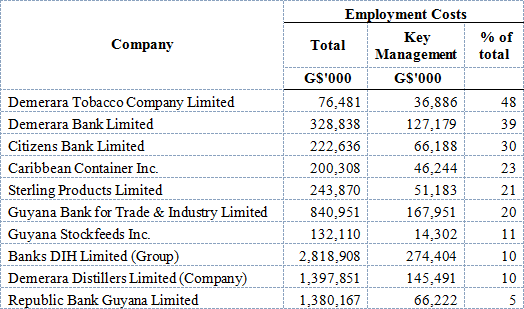
Is the private sector any different? Only the optimist and the charitable will say yes. We have few enlightened employers among us, and even those who try to top up their employees’ remuneration do so at the expense of the treasury by way of under-the-table payments not subject to tax. Contrast that with the following table that shows the share of the total compensation earned by key management personnel – the decision-makers – as a percentage of the total compensation of our major entities.

Source: Annual Reports 2011

And let me say that these do not tell the whole story. The cost of all the perks enjoyed by the few persons falling within this exalted group is by definition not included in their compensation. And let us be fair to Demtoco – it hardly carries on any business in Guyana so has just a few strategic staff. The percentage is also influenced by how the definition of key management personnel is applied with accounting rules becoming increasingly permissive; no longer are companies required to disclose the number of their employees while enjoying much latitude in how they define compensation.

Conclusion
In these past two articles, I explored the inequality of opportunities and income among Guyanese. The best hope for a fairer economic system had rested with President Ramotar who before becoming President had often lamented its injustice. Seven months into his presidency, he has shown no interest in what is now the status quo. For the 99.99%, the unequal distribution of income has deprived them of opportunities. Their hopes lie in a hustle – or migration.