Annual reports 2011: Guyana Bank of Trade and Industry and Sterling Products Limited

Introduction
Business Page today continues its review of the annual reports of companies for the year 2011 by covering two of the public companies in the Beharry Group – the Guyana Bank for Trade and Industry and Sterling Products Limited. GBTI held its 24th Annual General Meeting on April 3, while Sterling held its AGM on April 18. Secure International Finance Company Incorporated (Secure) owns 61% of the outstanding shares in the Bank and 58.1% of the shares in Sterling. In turn, Secure is 100% owned by Edward B. Beharry & Company Limited, a private company. The reports show that the Bank recorded a 15% increase in profits after tax while Sterling’s profits after tax increased by 20%.

GBTI Highlights
The Bank has nine branches including one at Lethem, making it the first and only banking service outside of the cities and towns of Guyana. Over the past five years, GBTI has witnessed truly impressive growth winning the favours of the government in a number of foreign and locally financed lending schemes, some of which come with tax breaks. In 2006 it was awarded a contract “to carry out the implementation of a Financial Facility to improve the competitiveness of the Rice Sector in Guyana,” and in 2011 it entered into a contract with the Ministry of Finance in respect of “loans to non-traditional agricultural exports, aquaculture, fruits and vegetables and livestock.” Financing for this comes from the IDB and the interest on the loans is exempt from corporation tax. Taking advantage of a number of tax shelters the Bank’s effective tax rate is less than 30%, compared with the nominal rate of 40% on the profits earned by commercial banks.

Asset structure
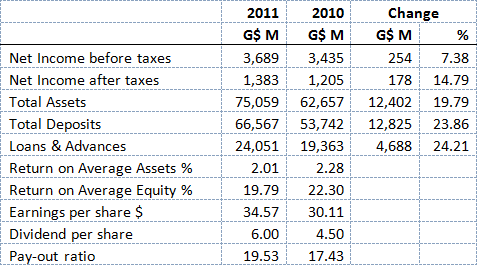
The Bank’s total assets at the end of 2010 were $75B, reflecting a growth of $12.4B (20%) over 2010 and accounting for 23% of Total Commercial Bank Assets in Guyana. The Bank’s assets as a percentage of commercial bank assets grew by 2 percentage points over 2010. Of the Bank’s assets, some $8.3 billion, or more than 10% was held overseas “so as to benefit from more attractive returns from yet safe instruments.”

At December 31, 2011 loans and advances amounted to $24,051 million, a 24% increase over 2010. The report states that loans to all sectors of the economy increased in 2011and that lending to individual customers increased by $3.1 billion while lending to business enterprises increased by $13.6 billion, which in total exceeds the $4.7 billion increase in total loans and advances. There is a similar discrepancy in the information on loans in the Agriculture Sector which in one case is shown as increasing by $2.8 billion and in another by $1.1 billion. In yet another table, loans and advances to the Agriculture Sector are shown as $2.342 billion while in a narrative they are stated as $9.7 billion.

Income statement
Neither the Chairman nor the CEO discusses lending and deposit rates in the absence of which only very rough calculations can be computed. These show that the average rate paid on savings accounts was 2.03% and on term deposits 1.91%. Taking all deposits into account the average interest paid by the Bank is about 1.5%, compared with the average rate on lending of close to 12%.

GBTI has always earned significant commissions and foreign exchange gains and in 2011 the amounts earned exceeded the Bank’s entire salaries bill. As a consequence of the operating performance, earnings per share (EPS) rose by 5.3% to $34.59, encouraging the directors to increase dividends per share from $4.50 to $6.00 giving a payout ratio of 19.53%.

GBTI continues to be one of the country’s strongest banks and has several committees designed to enhance better governance and better results. Its high quality annual report is upbeat and positive, justified by the results it has been delivering. There are however some technical areas for improvement in meeting IFRS and other regulatory requirements.

Sterling – Highlights

Statement of Income
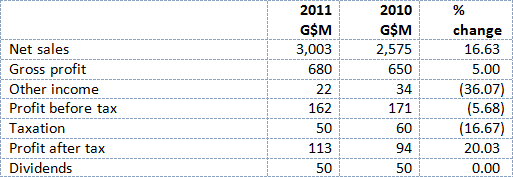
For the first time in the company’s history, turnover topped the G$3.0 billion mark, although this has come with a reduction of G$9.7 million in after-tax profit, down 5.6% to $162.1 million from $171.9 million in 2010. Chairman Dr Leslie Chin attempts to explain this as “due to sales and marketing expenditure directly associated with enhancing distribution of our products. With additional spending in the area of marketing and distribution the company saw the relative return on investment as a total business expanded,” which must have confused the shareholders in attendance.

The Chairman also reports that export sales grew by 5.5% or by G$9.9M over year 2010 sales without stating the level of export sales, which too is not shown in the financial statements. From note 22 dealing with credit exposure it is apparent that the company does business with Grenada and Trinidad and Tobago, with two of the top balances being with customers from those countries.

He does however report that the company has seen “growth in some Caribbean Countries, whilst others present problems with respect to competitiveness.” Sterling is potentially one of Guyana’s manufacturing exporters and for years it has sought to “explore ways and means to have our products on the shelves of businesses in the Caribbean.”

Gross margin has declined from 25.3% to 22.6% while other income has also fallen, from $34.9 million to $22.3 million even as distributing and marketing expenses have increased by $25 million. Once again the company incurs finance costs from an overdraft, even as it holds more than two hundred million dollars in fixed deposits.

With the reduction in the tax rate from 35% to 30% the company’s tax charge has declined by $29 million, of which a significant portion is due to the tax effect of depreciation. Basic earnings per share increased from $6.18 to $7.42 while dividend per share has increased from $3.30 to $3.50. The increase is not reflected in the table above as dividends are only recognised in the financial statements when paid.

The balance sheet of this company is strong with both adequate working capital and healthy liquidity. One of the commendable features of this company is that it has maintained its defined benefit schemes for its employees while so many others are switching from defined benefit to defined contribution scheme. Hopefully, it keeps it that way.
Contrary to what Luncheon claims NICIL is a government company

I find the earlier pronouncements of Drs Roger Luncheon and Ashni Singh and now Mr Winston Brassington that National Industrial and Commercial Investments Limited (NICIL) is a private company with the legal right to withhold public moneys annoying, self-serving, misinformed and mischievous. It is sad, and even dangerous, that individuals with the power to make major decisions over the resources of the country and the lives of its people can be so deficient in their knowledge and reckless in their actions.

Dr Luncheon wrongly informed the media that there are “20-something articles that underpin the creation of NICIL and none of them says that money from NICIL has to be put in the Consolidated Fund.” Mr Brassington adds his share of vacuity with his pronouncement that “proper accounting requirements dictate that money from the sale of government assets should first be placed in the company account, provided it can adequately discharge all of its liabilities.” In my 42 years as a professional, I have never heard anything so absurd and facile.

In fact, the Articles of Continuance of NICIL comprise nine articles (see attached) and it operates under, and is classified by the Companies Act 1991 as a “Government Company.” The Act imposes on NICIL the following obligations over and above those imposed on companies generally:

1. that sections 48 and 49 of the Public Corporations Act dealing with accounts and audits apply;

2. NICIL is required to submit to the Minister of Finance an account of its transactions and audited financial statements no later than June 30 of the following year; and

3. the Minister of Finance is required to lay in the National Assembly the statement of transactions and the audited financial statements no later than September 30, ie, within 90 days of receiving them.

The public is reminded that the Chairman of NICIL is Dr Ashni Singh and the Minister to whom he must submit the report and accounts is the same Dr Ashni Singh. If it was only these breaches of which he is derelict, it would still be a serious matter. But there are more, and worse. The Government of Guyana “vests” lands and other properties in NICIL – on whose Board also sit Drs Luncheon and other Cabinet members – which then sells the assets and pockets the money. The government also uses NICIL to collect dividends from Guyoil, GT&T and other investments which are also retained by NICIL.

This scheme, which assumed scandalous proportion under the Jagdeo-Ashni Singh duo, has become a ruse to get around Article 216 of the Constitution which requires “All revenues raised or received by Guyana to be paid into and form one Consolidated Fund.” By their own boasts, NICIL has collected tens of billions of dollars and not paid these into the Consolidated Fund.

To any ordinary person, so far as the land transactions are concerned, NICIL is merely an agent for the government. Therefore, the moneys it collects should be paid over to the Ministry of Finance to be deposited into the Consolidated Fund. Instead, in an arrangement which in neighbouring Trinidad would be considered criminal, NICIL’s board uses the funds as a second budget to do the things which the Finance Minister would not be comfortable in bringing to the National Assembly, like the Marriott Hotel, like getting involved in Pradoville 2 and for miscellaneous purposes including secret overseas trips, etc. Article 217 of the Constitution dealing with spending public moneys does not allow any of these.

Now, to go back to the absurdity about state companies being subject only to the company laws, I refer the financial doctors to the following two documents: 1) the Report of the Working Party on the Harmonization of Company Law in the Caribbean Community, and 2) the Report of the Review Committee on the Companies Act of Guyana.

This is what the Working Party Report under the heading Public Accountability has to say in paragraphs 19.142 [in part] and 143:

“Whether the company is a mixed enterprise or wholly State owned, public funds are employed for the capital of the company. In the view of the Working Party, this introduces an important dimension with which existing company law does not deal….”

“With respect to companies with capital drawn from public funds, however, the State shareholder is in theory the party which should ensure that proper use of those funds is taking place. In practice, this cannot provide a system of accountability to the public for the effective use of public funds. It by no means follows that the assessment of the State as shareholder with respect to the running of the company will stand up to scrutiny when viewed as a public investment. Increasingly, arguments are made in this context for some additional mechanism whereby the performance of the company in relation to the investment of public monies is subject to accountability beyond the company itself.” And the Guyana Review Committee appointed by the Hoyte administration to consider the report of the Caricom Working Party proposed the adoption of its recommendation that “wholly-owned government companies should be constituted under the Public Corporations Act.

Presciently, the authors of the Working Party Report, including our own Bryn Pollard, were saying thirty years ago, that there could be no accountability under the NICIL-type model, even if it did not have the degree of egregiousness practised by Drs Singh and Luncheon and Mr Brassington.

And finally, with respect to the chorus that it is for the directors to decide if and when NICIL would pay any dividends to the government, let us recall that in 2009, the government, a mere 20% shareholder in GT&T, caused that company to pay more than $6 billion in dividends. And guess who the Finance Minister was and who was the government director on the Board of GT&T when that “persuasion” took place? Dr Ashni Singh and Mr Brassington respectively.

Now the same Messrs Luncheon, Singh and Brassington are bold enough, in respect of a 100% government company in which public property is routinely vested, and which has a 100% Cabinet Board, to plead impotence in calling for a dividend which the country badly needs to help the working and the non-working poor.

To show how reckless and ridiculous it has become, only a couple of years ago the government forced the Geology and Mines Commission to pay $1.8 billion to NICIL to build/repair roads in the hinterland communities, all done by way of a Cabinet directive signed by Dr Luncheon.

For too long constitutional violations, financial improprieties, mis/malfeasance in public office and breaches of fiduciary duties have been tolerated by this bleeding country. It is time for the talking to stop and for the courts in Guyana, and if necessary the Caribbean Court of Justice, to be invited to address these matters. Sooner rather than later some Guyanese will decide that enough is enough.

The $18.3B which was cut from the LCDS needed to be covered by a conditional appropriation

I prefer to impute no motives to Government spokespersons or self-appointed, self-interested critics of the Budget “cuts”, including Drs. Ashni Singh, Roger Luncheon and Leslie Ramsammy, Mr. Juan Edghill and Carvil Duncan, Martin Goolsarran and Fuzzy Sattaur and Ms. Gita Raghubir and Alexei Ramotar for misrepresenting the “cuts”, including the removal of the LCDS money from the Appropriation Bill for the 2012 Budget. Shepherded by Mr. Martin Goolsarran into NCN to cry “heartless and unpatriotic”, none of them it seems, including Ms. Raghubir, an attorney-at-law, bothered to check the Budget “law”, the Fiscal Management and Accountability Act.

They would have learnt that the appropriation of expenditure of $18,394,650,000 had to be brought by way of a Conditional Appropriation Bill under section 21 of the FMAA, and not by way of an Appropriation Bill. But before I refer directly to section 21, I draw attention to both the Explanatory Memorandum to the Bill as well as the statement made by then Finance Minister Mr. Saisnarine Kowlessar in the parliamentary debate on the Bill on December 15, 2003.

The Explanatory Memorandum states that the bill “establishes the concept of conditional appropriation, whereby an agency may be appropriated sums that are conditional on the said agency achieving specified levels of revenue in accordance with an agreement entered into with the Minister.” In other words, the National Assembly authorises the expenditure but only if (or conditional upon) the money comes in.

For his part, Mr. Kowlessar in introducing the Bill said “… In addition, the Bill describes the concept of a conditional appropriation, as well as details the terms and conditions under which such appropriation may be made and accounted for.”

It is nonsensical for Dr. Singh to compare the expected LCDS sums with VAT and say that since VAT has not yet come in, maybe a Conditional Appropriation Bill will be required for VAT as well! Does he believe that in relation to him Guyanese are that stupid and cannot understand the difference between a tax (VAT) and moneys that come under an MOU with preconditions attached? Someone should have pointed out to Dr. Singh there and then that it was his Government that passed the Fiscal Management and Accountability Act because US$30 million of donor money depended on its passage. Details then did not matter. And if the PPP/C can ignore the Constitution, ignoring a mere law is no big deal.

The logic of linking the expenditure to income by way of a conditional appropriation is evident from the following example. For the year 2012, expenditure of $18.394 billion represents more than 12% of the non-LCDS budgeted Current and Capital Revenues. If that sum is spent but the money does not come in, the government’s expenditure will have exceeded its income not only by the $30.524 billion shown in the Budget but by an additional $18.394 billion, bringing the 2012 budget deficit to $48.918 billion, or close to quarter billion United States Dollars. No amount of juggling of figures or playing with the 2000 Series Bank Accounts can mask that reality.

To see how inconsistent Dr. Singh has been in relation to budget preparation for future revenue flows, one needs to look no further than the 2011 budget treatment of the Chinese vessels in which only the local expenditure of $366 million was included at the time of the budget presentation. It was not until one year later, when the resources had actually arrived in the country that Dr. Singh went to the National Assembly for supplementary appropriation of $2.588 billion. At the time, former Finance Minister Carl Greenidge drew Dr. Singh’s attention to section 21 of the Act, pointing out how it should have been treated in the first place. But so convinced was Dr. Singh that he could never be wrong, that he ignored Mr. Greenidge.

Much was made of the fact that the $18.394 billion that was removed from Budget 2012 included an unspecified amount for land titling for Amerindians. In fact, the issue of land titling for Amerindians (so far as necessary) fits neatly into the provision of the Act by allowing a “conditional appropriation” to consist of both a) an authority to spend a specified amount of money; and b) an additional authority to spend a specified amount of money, conditional (emphasis mine) upon budget agency receipts earned by that budget agency and being credited to the Consolidated Fund.

I say ‘so far as necessary’ because land titling is a constitutional requirement which since 1993 has been funded each year out of annual appropriations and need not be tied in with LCDS money. It would be a sad day indeed if our first people have to wait on foreign moneys to right the historical wrongs inflicted upon them centuries ago. But I suspect that the Singh/Luncheon formulation of including it was as bait to the international community with its soft spot for indigenous peoples across the world.

On the Line: Caribbean Container Incorporated and Guyana Stockfeeds Incorporated

Introduction
Today we continue our review of the annual reports of two more of the country’s public companies – Caribbean Container Incorporated (CCI) which held its annual general meeting last Friday and the Guyana Stockfeeds Incorporated (Stockfeeds) whose annual general meeting is scheduled for tomorrow. Both these companies are on the Secondary List of the Guyana Association of Securities Companies Incorporated (GASCI), popularly referred to as the Guyana Stock Exchange.

As a result of a challenge in the High Court of Guyana by the government company National Industrial and Commercial Investment Limited (NICIL), a shareholder of the company, the company is not permitted to issue any new shares until the outcome of this matter is fully settled. The regulator, GASCI has suspended trading of the company’s shares until the matter is settled. The shares of neither company, both of which have a dominant shareholder, are actively traded on GASCI with the last trade in the shares of CCI taking place on January 9 of this year while for Stockfeeds there has been no trade since October 27, 2008.

In the case of CCI, the dominant shareholder is a non-public company which goes by the name of Demerara Holdings Inc, which has some 129 million of the 152 million of the issued shares of the company, while in the case of Stockfeeds, Chairman and CEO Robert Badal owns some 35 million while an associate of his owns 25 million of the issued shares. Except for DDL and Banks DIH, the majority interest in all our public companies are held by a single shareholder with the minority shareholders playing a passive role. This raises the issue of the prospects of the survival of our public companies as they are supposed to operate.

CCI
CCI has had a checkered history with ownership changing hands from government to Ansa McAl to Rand Whitney and now Demerara Holdings Inc, which it is believed is in turn owned by CCI’s Executive Chairman Ronald Webster, who has been with the company for decades. In an era when recycling is becoming the buzzword, it is good to see CCI making some strides to sustainability. Its non-executive directors include Dr Elisabeth Ramlal and Mr Frank DeAbreu, one of Guyana’s younger breed of entrepreneurs.

Shares transactions
Shareholders were called upon to ratify the passing of two resolutions which had already received the blessing of the majority shareholder: one dealing with the cancellation of shares and the other with the issue of bonus shares. The first is to cancel 1,500,000 ordinary shares standing in the company’s name resulting from the reacquisition of the said shares. In 1992, these shares were allotted under an Employee Share Purchase Plan and were fully paid for on behalf of the employees via a loan from a financial institution. However, at the time of winding up the said plan, none of the shares allotted were taken up by the intended employees, nor had they settled the outstanding repayments in relation to those shares.

In keeping with the requirements of the Companies Act the directors of the company have decided to cancel these shares and treat them as part of the authorised but unissued shares. According to the company, the transaction should have no effect on the company’s equity but where I have some difficulty is the statement that the Revenue Reserve Account is credited and I doubt that shareholders would have been clearer.

The second resolution is to authorise the issue of 1 bonus share for every 50 shares owned. Bonus shares are not paid for and at one time were very popular in Guyana, particularly with Banks DIH. They have fallen into disuse because they are a kind of artificial transaction with a mere book entry between equity accounts without any increase in the company’s asset value or earnings prospects. Accordingly, if there is one bonus share for every one share in issue, the price per share is halved. However, when the capital market was even less developed than now, the share price never moved, and the ‘bonus” turned out to be a real bonus. Maybe with a bonus issue of one share for every fifty held, there is not going to be much change in the market price.

Financial Summary

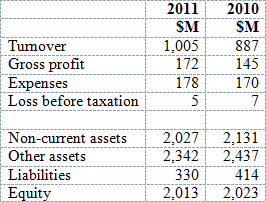
Source: Audited financial statements 2011

In 2011, turnover increased by 13.4% from $887 million to just over one billion dollars and earnings before depreciation (EBDA) by 3.3% from $115 million to $119 million. Gross profit at $172 million was up by 19% over 2010’s GP of $145 million. The loss before tax was reduced by 25% from $7 million to $5 million. Without any real discussion, the Chairman attributed the year’s improved performance to good sales and production efficiencies. Gross profit on sales remained constant at 30% and while finance charges fell by $7 million, administrative expenses rose by $14 million, mainly in staff costs.

The company has some $66 million in retained earnings out of which dividends could be paid and may have caused one shareholder to complain to me that as a group they have been receiving nothing by way of dividends from the company. The company also has $43 million in the bank and there must be some reason for the ultra-conservative decision not to pay any dividend. Maybe there is a belief that a bonus of one share for every fifty held will appease the shareholders.

Guyana Stockfeeds Incorporated
The company manufactures and distributes livestock feeds and related products including day-old broiler chicks to both the local and export markets. It also produces parboiled rice for the export market under its “Angel” brand. In the domestic market feed sales grew by 30% while baby chick sales grew by 5% but in the face of competition from Brazilian suppliers of parboiled rice, rice export sales declined by 16%.

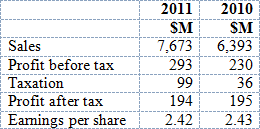
Highlights are set out in the table below:

The annual report is not heavy on discussion. As a result the reader is left to scour note 4, Taxation to the financial statements, to determine why a $63 million increase in profit before tax should carry a corresponding $63 million increase in taxes with the result that the after-tax profit in 2011 is marginally less than in 2010. The explanation lies in a higher deferred taxation which in 2010 benefited from a lowering of the applicable tax rate.

The company pays a significant portion of its expenses through a related party ($852 million in 2011) and also pays the related party $30 million as a “reimbursement for costs incurred.” This was the same amount paid in 2010.

Expenditure on property, plant and equipment was $76 million and the overall decrease in cash was a substantial $240 million with the result that liquid balances declined from $304 million to $60 million. Faced with this situation the directors of the company are not recommending a dividend for the year 2011.
Minority shareholders in neither of these companies will be particularly happy.

On the Line – Demerara Distillers Limited Annual Report 2011

Introduction
Demerara Distillers Limited, a conglomerate group comprising several local and overseas companies with manufacturing, trading, banking and trust relationships in Guyana, the region, North America and Europe as well as a joint venture in India and associated companies in Guyana and Jamaica, will be holding its annual general meeting this coming Friday, April 27. When the shareholders meet at the company’s Diamond Complex on the East Bank of Demerara, they will consider, among other routine items, an impressive if not entirely informative annual report containing the financial statements of the parent as well as its subsidiaries.

Measured by growth in turnover, it was not such a good year either for the parent (2.2% compared with 11.3% in 2010), or for the group as a whole (a more respectable 6.7% but less than 10.6% in 2010). Sales to subsidiaries represented 75% of total turnover of the company compared to 77% in the prior year.

In terms of after-tax profits, on the face of it the company and the group have done very well; the profits of the company increased by 68.7% while those of the group increased by a still substantial but smaller 35.7%.

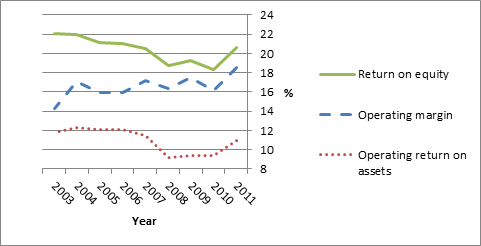
Performance over the past nine years is illustrated by the following graph:

Source: Annual reports

No doubt encouraged by these results, the directors of the company are recommending an increase in the dividend per share from $0.45 to $0.48 – it would be good if the company could appreciate, like everyone else, that “cents” are no longer part of the currency of this country –which will cost the company some $23 million more than the $346 million paid out in 2010. Yet, for all of these, the Chairman in his report was less optimistic than usual, for reasons that only became apparent as the reader perused the financial statements and in particular their accompanying notes. Let us turn to some of those numbers.

According to the Chairman, there was an unspecified shortfall in bulk sales which carry a significantly lesser margin for which the higher value, higher margin-branded products should have more than compensated. An outsider looking in would think the company should welcome any situation whereby the higher margin products grow at a faster rate than the lower margin products. The emphasis on the sale of bulk products over branded products evident in year 2010 during which bulk sales increased by 45% while total sales increased by 10% seems quite counter-intuitive, if not illogical.

Domestic operations
While two of the four domestic operations made losses, those that were profitable produced some good results on a considerably smaller asset base. The standout failure is TOPCO, the juice company in which, despite the injection of hundreds of millions of dollars in capital expenditure, has managed to make losses in more years than it has operated profitably. One cannot help but notice too for TOPCO the almost identical language in 2010 being repeated in 2011, suggesting an inadequate level of attention in a competitive business environment. On the other hand, Distribution Services Limited, with a much smaller asset base, is reported to have enjoyed a10% growth in income and a 43% growth in after-tax profits.

Revenue from Guyana customers represents 65.4% of total group turnover compared to 62.5%, possibly reflecting the pressures faced in the international markets.

International operations
Not unlike the domestic operations, the inconsistently presented information for the overseas operations indicates that the international members of the group also had mixed fortunes. Total overseas sales fell by 1.6% despite growth in branded products of 10% reported by the Chairman.

In problem plagued Europe, turnover was down 6% and after-tax profits by 32%. In that region, a single customer generated 44.6% of total turnover from Europe compared to 50.0% in the prior year.

In DDL USA, no sales information is offered but after tax profit is reported to have grown from G$21 million in 2010 to $31.5 million in 2011. The shareholders of the parent company will recall that Demerara Rum Company of Canada was bought two years ago for $76.9 million. The company’s shareholders would certainly have liked to have had some particulars of that transaction as well as the parties behind the acquired company which handled bulk sales in Canada and must have had the confidence of the directors back home.

Interestingly enough, while the Canadian company was able to record an after-tax profit of $23.4 million in ten months, in 2010 it made only $8.9 million in 2011. It would certainly be interesting to learn how this was possible in the home of the company’s VP for International marketing, Mr Komal Samaroo. The company’s joint venture in Jamaica saw profits halved in 2011, but it was the Indian joint venture which ought to have caused the most concern among the company’s directors.

It seems certain that the existing joint venture in Demerara Distillers (Hyderabad) is heading the way of a number of other subsidiaries which the parent acquired and subsequently found unprofitable. Anyone following this column in the early nineties would remember the adventures of the first Indian operation which suddenly and without any explanation or information disappeared in 1993. Well, the directors having promised shareholders in the 2010 annual report that management would “make appropriate decisions to ensure an adequate return on [India] investments in 2011” now say, after another year of losses, that a “decision will be made in 2012 on the way forward.”

BEV Processors Inc
What does all of this mean? Except for an interesting transaction in which the company divested its BEV Processors Inc, the results of the company and the group would have been unimpressive. The profits reported include a non-recurring $288 million in dividends received prior to the sale of the investment, a reminder of a missed and costly lesson for Guyana’s taxpayers on whose behalf privatisation czar Winston Brassington sold the government’s 20% holding in GT&T without getting any of the year’s dividends, let alone accumulated profits.

The BEV transaction was particularly interesting in that the sale took place in early March 2011, but the dividend was not recorded in DDL’s books until the second half of 2011. Moreover, the 2010 annual report referred to the BEV shares sale in March 2011 without any mention of the substantial dividends the company received.

The June 2011 half year report published under the Securities Industry Act was used to help explain the revenue flow over the year. Turnover in the second half of the year represented 53% of the turnover for the entire year but produced exactly 50% of the gross profit and 60% of the profit before tax as a result of other income earned, representing 79% of the year‘s total. For the second half of 2011, finance cost was 52% and profit before and after tax 63% and 66% respectively, of the full year amounts.

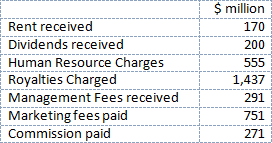
But the income statements are interesting for other reasons too. Note 26 Related Parties discloses several transactions with group companies, only some of which I have been able to follow in the financial statements. Here are the major ones:

One might expect these to show up somewhere in the Income Statement; it is unclear where some of these items have been accounted for. In the interest of transparency, the company and its auditors TSD Lal & Co should be asked by some shareholder to explain these substantial transactions, before the GRA does. They should also be asked to provide information on which of the subsidiaries are audited and by whom, and which are not. It does not help shareholders and market confidence to have such uncertainties flowing from the financial statements of a public company, particularly one that is totally controlled by executive management.

Balance Sheet
Ever since this column began reviewing the company’s annual reports about two decades ago, two areas have stood out: inventories and loans. Because of the stable of products offered by the company, it is expected that inventories in the maturing process will be fairly significant while bearing in mind that inventories for accounting purposes must always be valued at the lower cost and market value, regardless of the accretion of the market value. The company had sales of $9.5 billion in 2011, the cost of which was $5.9 billion. In other words, the company has some 327 days of finished inventory on hand compared with 234 days in 2007.

Included in inventories as well is an amount of $1.165 billion of “spares, containers, goods-in-transit and miscellaneous stocks,” a category that always seemed to have been overstocked and out of balance with the finished stocks. It is good to see that that category seems to be falling significantly, both in absolute and relative terms. In 2007 the value of the inventories in that category was $1.8B or approximately 30% of total inventories.

The debt/equity ratio is a healthy 0.87:1 but the share of income before interest and taxes which goes to interest is around 25% and lenders to the company consistently receive a bigger share of the company’s earnings than its shareholders. In 2011 interest paid was $618 million ($371 million after tax assuming the lender is subject to a 40% tax rate) compared with dividends paid of $346 million with lenders investing less than half of shareholders’ equity.

Human resources
DDL has always prided itself as a good corporate citizen and is a major donor to the community through sports and education. In fact, two years ago the company established the DDL Foundation to “make a difference in the lives of deserving young people.” Internally too, the company has supported its employees with training, including the degree programmes at the University of Guyana. As the Chairman said, however, employee retention is a problem, a fact borne out by the turnover at management level in the company.

Of the nine members of the management team identified in the 2006 annual report, only two are still with the company, one of whom has moved up to the main board. Indeed, even at the board level there have been changes – some unavoidable – with only four of the nine directors in 2006 still on the company’s board of directors. Of the eight current directors, four are accountants including three serving in a non-independent executive capacity. The remaining one is a recent addition to the Board and serves as the Chairman of the Audit Committee.

Conclusion
This column has for years commented on the quality of the information provided in the Annual Report including an indication of those subsidiaries which have been audited and by whom. It is also not in keeping with modern trends to have only a Chairman’s report and not a CEO’s report, or a Management Discussion and Analysis which does not depend on the existence of the CEO.

Despite the improved earnings and earnings per share, the company’s share price is trading lower now ($10.7) than it did at the end of the half year ($11.0).