
The GT&T share sale (Conclusion) and the New Building Society

Introduction
In today’s Business Page I conclude the discussion started last week on the announcement by Dr Roger Luncheon that the government has sold the country’s 20% shareholding in the telecommunication company Guyana Telephone and Telegraph Company Limited (GT&T) to an unknown Chinese entity. The announcement came a few days after the 2012 Budget Speech which contained no mention of the sale negotiated by NICIL of which the Finance Minister is the Chairman.

Well we now know that the Chinese company is Datang, less known for its connection with the Chinese Liberation Army than for its development, production and sale of electronic information systems and equipment. Incredibly the company appears to have not had a formal meeting with the 80% shareholder, Atlantic Tele-Network of the USA and it will certainly be interesting to learn how the usually sceptical US Government will view a partnership of their company with the Chinese who do not have a good record as a respecter of intellectual property or confidentiality of information.

Under the Companies Act 1991, the ownership of the shares in the company will pass to Datang on the delivery to them of the transfer form and the share certificate. At that point, except that the government is the government, it would cease to have any interest in GT&T. Interestingly, at that point, the Government of Guyana’s rights under the 1991 agreement with ATN in relation to any share-ownership right shall cease. Datang will no doubt soon present itself to the GT&T management with the share certificate and transfer form in their hand for what will no doubt be a very useful exchange.

Last week we were told that the government is selling its interest for US$30 million of which US$25 million is to be paid immediately and the balance paid later. Meanwhile in a couple of weeks Datang will participate in an AGM at which dividends will be on the agenda. Unfortunately Mr Winston Brassington seems to have negotiated an agreement under which dividends that ought to come to the government will go to Datang! How eerily does history have a way of repeating itself! A not too dissimilar situation arose when the PNC administration sold Guyana Telecommunications Corporation with a bundle of cash in the bank. I wonder what those who then accused the PNC of being either careless or stupid would think of the Privatisation Board and the Cabinet for giving away US$2 million.

But that is not the only give-away. At US$30 million, the price for the shares is a significant markdown on what the shares are worth. GT&T is not a public company and its shares are not traded anywhere for their value to be determined. There are then two options. The first is to take all relevant factors into account, project the income of the company into the future and discount these into present day value. The alternative is to take a price earnings ratio (a vital tool used by investors) of the shares in a similar entity and, making adjustment for specific factors, apply a P/E ratio to the earnings of the company. Using that method I have arrived at a price of approximately US$40 million.

So we – or rather Drs Luncheon and Singh and other ministers along with Brassington have given away some US$12 million of the taxpayers’ money. They did the same when they waived some G$400 million of interest and preference dividend in the Berbice Bridge Company Inc so that the private sector entities could receive theirs.

The question why these gentlemen would have acted so recklessly and secretively probably has to do with the diversion of public funds from the Consolidated Fund to the illegally operating NICIL, all the directors on the Board of which are Cabinet members. That is unheard of anywhere in any self-respecting country, but is easily explainable as the creation of an illegal fund from which Cabinet can do as it pleases: pay over price for goods and services, divert, build white elephants, etc – all in complete violation of Articles 216 and 217 of the constitution. And to add some veneer of legality and acceptability to the saga, Dr Singh the Finance Minister, had the decision passed through the Privatisation Board of which Dr Singh is the Chairman!

These bright gentlemen have decided to bypass the constitution and do through the backdoor what they are not allowed to do through the front door.

On the Line: 2011 Annual Report of New Building Society
The editor reminded me that it is that time of the year when annual reports for companies and entities with a December 31 year end become available. Starting today with the 2011 Annual Report of the New Building Society (NBS) Business Page will review those reports well aware that other national economic issues will not wait. The page will try to offer a balance between the two.

The annual general meeting (AGM) of the NBS is slated for Saturday April 28 and will be held in the Society’s new head office in North Road, to which the Society moved a few weeks ago. It is to the credit of the institution that the move appears to have gone off quite smoothly, at least so far as the customers were concerned.

Readers will recall that the Society was brought under the Financial Institutions Act in August 2010 and the results for 2011 would have been the first full year since the new status. Surprisingly, however, there was only a passing reference to the impact of this is in the Chairman’s report: “It is also to be noted that notwithstanding the Society is currently governed under the New Building Society’s Act, Chapter 36:21, the Supervision by the Bank of Guyana, must be seen as a positive sign.” I am sure members would have liked to know the full impact, if any, the FIA has had on the Society in the absence of which the directors should have indicated whether they intend to take the full four years to come into full compliance with the provisions of the Financial Institutions Act.

Highlights
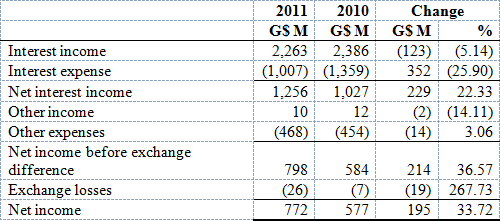
Source: 2011 audited financial statements

As the table above shows interest income from mortgages and other assets fell by 5% but interest paid on deposits declined by a dramatic 26% with the result that the net interest income increased by $229 million. Loss on exchange has again raised its ugly head after the directors resiled from a members’ decision to repatriate the moneys held in the UK and as a consequence the Society lost some $26 million following a $7 million loss in 2010.

Dr Nanda Gopaul, who has signalled his intent not to continue as Chairman of the Society following his appointment as a minister of the government, in his report announced a “record profit of $772M being made, an increase of 34% over the previous year.” According to Dr Gopaul this “was achieved despite reducing our mortgage rates for lower, middle and higher income mortgagors at the beginning of the year from 4.75%, 6.95% and 7.95% to 4.25%, 6.25% and 7.45% respectively.” That was only half the truth since the reduction in interest income was only $123 million. The real reason is obvious from the graph below that shows that while the returns on loans have declined from 7.3% in 2009 to 6.7% in 2011, the average interest paid to depositors declined dramatically from 4% to 2.7%!

It would have been helpful if either the Chairman or the CEO gave an explanation for the significant reduction in the Society’s deposit rates rather than have members speculate on whether the Society is carried away by the misnomer “profits” rather than surplus, or is seeking to discourage persons putting money into the Society which it is then unable to on-lend.

Returns on Loans, investments and deposits
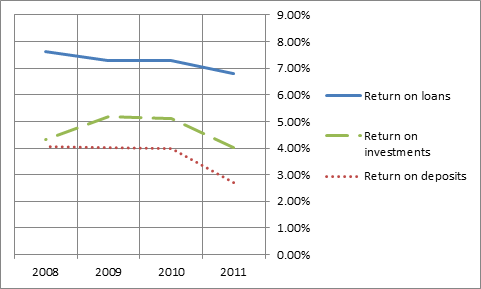
Source: 2008 to 2011 audited financial statements

Assets and their returns
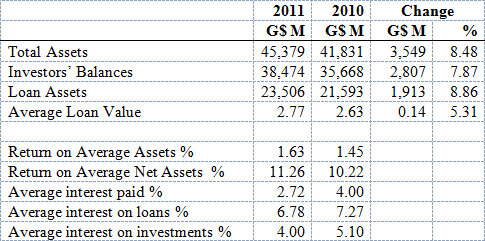
Source: 2010 and 2011 audited financial statements

The Society has increased its loan limit to $15 million subject to ministerial approval, which it says the Society is working towards making a reality, so that its financial resources can be more beneficially utilised to the advantage of members and customers.

In 2011, there was a net increase in the number of mortgage accounts of 276 while the Society disbursed mortgage advances for the year totalling $4.2B, another record, which was 43% higher than the previous year. At year end, the mortgage portfolio was 52% of Assets or 61% of Total Investors’ balances.

The Society continues to record its satisfaction in its investment in the Berbice Bridge Company Inc, which earned the Society a healthy return during the year and some 32% cumulatively. The Berbice Bridge commuters’ pain is the NBS’s members gain. While the financial logic of the decision to make the investment cannot be faulted, the amendment to the Act permitting the investment and the financial structure of the bridge transaction by the Jagdeo-Brassington team is one costly venture for the country’s taxpayers who have had to finance substantial tax concessions benefiting the bridge investors.

Statutory breach
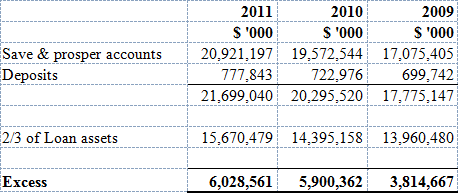
Source: 2009 to 2011 audited financial statements

Two years ago, Business Page highlighted the breach of the proviso to section 7 (d) of the New Building Society Act. Despite this, the situation has deteriorated and the shortfall in mortgage assets has increased by 58%.

Next week, I will review the annual report of Demerara Distillers Limited, whose annual general meeting will be held on April 27, 2012.

The GT&T share sale

Introduction
Even before the debate on the 2012 Budget begins, it is overtaken by an event not outside the control of the government, but well within it, an event that has been in the pipeline for years. Drs Jagdeo and Ashni Singh and their loyal servant Mr Winston Brassington had been speaking about, offering and negotiating to sell the government’s 20% shareholding in the telecommunication company Guyana Telephone and Telegraph Company Limited (GT&T) for at least three years. Yet the Finance Minister could not find a place in his 87 page speech to alert the plebians that an investment that brought in around US$2 million per year was in the final stages of disposal.

Guyanese must thank Cabinet Secretary Dr Roger Luncheon for the timeliness of the announcement at a press conference just one day after the decision by Cabinet to sell the pearl of the cacique crown for US$30M ($6B) to a “Chinese company” whose name, incredibly, Dr Luncheon could not remember. Guyanese would find it difficult to accept that Dr Luncheon, who also sits on the Board of NICIL under the chairmanship of Dr Ashni Singh and which is legally the owner of the shares, does not know the identity of the buyer!

NICIL
For close to two decades NICIL has acted like it does not know that it is subject to an Act called the Companies Act with which it ought to, but does not comply. As a result, NICIL has practically zero experience in complying with the law and may need to be reminded that the certificate representing the 20% shareholding in GT&T is in fact held by NICIL which must also sign the transfer form to pass ownership to the Chinese company.

The CEO of NICIL is Mr Winston Brassington who has been at the centre of all the major sales/disposals of state assets and who has impressed the Guyanese public with his ability to carve up transactions in which the Guyanese taxpayers are often the biggest losers. Except that in the case of the Berbice Bridge Company, Mr Brassington’s iconic show of private-public sector partnership, the big losers are both taxpayers and commuters. The taxpayers suffer as a result of the excessively generous concessions which have been given to the investors in the Bridge Company, and the commuters, as a result of some of the most exorbitant rates for a river crossing anywhere in the world. Just by way of reminder, NICIL recently waived hundreds of millions of dollars of interest (payable to NICIL) so that the private investors could be paid theirs!

Apparently intending to impress the media, Dr Luncheon whose performance as Chairman of the National Insurance Scheme has been exceptional for all the wrong reasons, volunteered to the media that the Chinese company had “conducted its due diligence and decided to purchase the shares.” What the public needs to know is not what the Chinese did but what the government did in arriving at a fair price for the 4,125 shares which it has owned for more than twenty years. Under a 1991 agreement between the Hoyte administration and ATN of the US Virgin Islands, the government received a 20% stake in the new company that took over the assets and liabilities of the Guyana Telecommunications Corporation in a process that itself raised eyebrows. To put the latest transaction into perspective, what the people need to know is how NICIL/Cabinet arrived at the sale price, not how the buyer arrived at the purchase price.

The changing profile of the international investor
The experience in many countries is that the Chinese – and one assumes that this is neither a phantom nor a pseudonym – are more likely to sell, rather than buy, a pig in a poke. They will have looked after their interest and we ought to have looked after ours. The question is, did we?

Unless Guyana is becoming the playground for Chinese investors, the nationality of the investor is surely intriguing, since we now have a picture of one set of Chinese investing in GT&T and another investing in the competing LTE GoG network. There must be something that the Chinese know about Guyana that the ordinary Guyanese does not, but hopefully it is not too late to learn. It is well known that the Government of China invests abroad, ostensibly through private individuals and companies. With their unimaginable reserves, a managed exchange rate and a colonizing mentality, China has been throwing its power around the Third World including Guyana.

They seem willing to get involved in sugar, bauxite, hydro-electricity, airport expansion, Guyana Power and Light, ferries and bauxite, many of which have benefited the Chinese disproportionately.

Led by Mr Jagdeo, there has been a fundamental shift in the profile of investors in Guyana. The implications for Guyana in the medium term can be fundamental, although this is not to suggest that the GT&T share sale is part of some bigger picture.

The strange silence of the Minister of Finance
GT&T is regulated under the Public Utilities Act, and one wonders whether the government had notified the PUC of the proposed sale of its holding in the company and whether, in view of the nature of the company, the identity of the buyer ought to have been similarly communicated.

Unfortunately, there are too many persons of influence and power who think that the law is an ass, and need not be observed or obeyed. Hence, it may be wrong to assume that the buyer has taken advice that as a substantial shareholder under the Companies Act 1991 (10%) it must give written notice to the company within fourteen days of becoming a shareholder.

Given this scenario it is not beyond the realm of possibility that in doing its “due diligence,” the Chinese may not have met with GT&T and might have relied on assurances from the same Mr Winston Brassington, the second-in-command negotiator-in-chief for the government.

What is more disturbing is that the share sale agreement was concluded on Wednesday April 4, less than one week after the Minister of Finance presented the 2012 National Budget to the National Assembly. By then, the discussions with the Chinese – in which the Minister would have played a major part – must have already arrived at the framework of an agreement including the price to be paid to the government.

But the Minister of Finance chose to remain silent on this major development and the budget he presented did not include any income from the sale of these shares.

NICIL again
The frightening possibility is that this money will be put into NICIL’s hands, later to be paid into the Consolidated Fund only if and when the Board of NICIL – which is chaired by the Minister of Finance and which includes Cabinet ministers and as said above, Dr Luncheon – decides to pay a dividend. The law does allow for the payment of interim dividends by all companies, but if NICIL’s directors choose not to pay any dividends, there is little recourse available short of court action.

Meanwhile, NICIL will be free to spend the $5 billion dollars it receives from the Chinese as it pleases, including on the Marriot Hotel which NICIL is bent on financing whatever the perceived risks associated with the industry and the project. It is clear that NICIL has now abandoned any pretence of being the Privatisation Unit of the Ministry of Finance which ensured that proceeds of privatisation transactions went direct to the Consolidated Fund.

By interposing NICIL in the mix, that direct relationship no longer exists, and Dr Singh as Minister of Finance must wait until Dr Singh as Chairman of NICIL’s board of directors decides to pay a dividend before he could bring any money into the public coffers. That just does not sound kosher.

There is some hope from a precedent from a couple of years ago when dividends payable by GT&T to NICIL went into the Consolidated Fund, bypassing NICIL. Parliamentarians, the public, the University of Guyana and the country’s pensioners await with interest the course of the Budget deliberation and whether the Minister of Finance will follow that course and amend the revenue numbers in the Estimates to include the $5 billion.

If he does not, we know then that the fears that the Minister administers at least two budgets – one for the Consolidated Fund and the other for NICIL – are in fact justified.

The agreement
Now back to the agreement. It was always incongruous for the government to be a player (shareholder) in a sector as well as the regulator (PUC), a principle that applies as much to telephones as it does to the media, or any other business.

On that basis, the sale is welcome, although there are disturbing signs that the previous administration has been paving the way, at taxpayers’ expense, for its associates to enter the sector and enjoy major benefits.

In the disposal of shares, a sensible negotiator would contract a price that is cum div or ex div, meaning whether or not outstanding dividends go to the buyer or the seller. GT&T would be concluding its 2011 financial statements in time for April 30 filing deadline. It will probably have its AGM shortly thereafter at which the question of dividends for 2011 will be considered. Since the government-Chinese agreement is made in 2012 the government as the seller could have done one of two things about the 2011 dividends: agree for the buyer to receive the dividend but paying for this in the purchase price, or selling the shares while retaining the right to the dividend.

Dr Luncheon did not mention whether this was considered, nor, unfortunately, did any of the media ask him the question.

We will look at this in the concluding part next week.

Mr. Brummell’s purported appointment as acting Commissioner is unconstitutional

From the press, the public has learnt the Mr. Leroy Brummell DSM has been appointed as acting Commissioner of Police. It seems, once again, that the country is being treated with casual if not reckless disregard with respect to constitutional positions.

Article 211 of the Constitution provides for the Commissioner and Deputy Commissioner of Police to be appointed by the President after meaningful consultation with the Leader of the Opposition and the chairperson of the Police Service Commission. Specifically, Article 211(2) makes the appointment of an acting Commissioner subject to the same constitutional requirements as the Commissioner.

I am advised that there has been no consultation on the “appointment” of Mr. Brummell. It is therefore my opinion that Mr. Brummell’s purported appointment is unconstitutional, null and void.

For good measure Mr. Henry Greene who is the substantive Commissioner was required, under Article 211 (3) to vacate office when he attained age fifty five (55). He did not do so because according to Dr. Luncheon the government has entered into an agreement with him to continue until age 60. That agreement too is unconstitutional.

So we are in the unique position where both the substantive Commissioner (Greene) and the acting Commissioner (Brummell) exist in a constitutional illegality. What a country!

Mr Ramnarine was exercising a right and duty under Article 32 of the Constitution

There has been a call from high-up for the disciplining of senior police officer David Ramnarine for exposing certain practices in the Guyana Police Force, and for claiming that his constitutional rights trump the Force Orders. The practice he identified was in connection with the payment of $90 million from Contingencies Fund to feed the Police over the November 28 elections period. On the question of the constitution, Mr. Ramnarine was in fact not only exercising a right but rather carrying out a duty which Article 32 of the Constitution imposes on every citizen. And as just about everyone by now knows, the Constitution is the supreme law of Guyana and not even the Parliament can make a law that is in conflict with it.

I cannot see then how some Force Order purporting to restrict a right could abridge a duty imposed by the Constitution. I would therefore like to receive from the Minister of Home Affairs an informed opinion on which instrument – the Constitution or the Force Orders, or which interest – secrecy of the Police Welfare Fund or the protection of public property – his Government considers paramount.

For, as Article 32 states: “It is the joint duty of the State, the society and every citizen (emphasis mine) to combat and prevent crime and other violations of the law and to take care of and protect public property.”

The country is fortunate and grateful that circumstances forced the lone Mr. Ramnarine to exercise his constitutional duty under Article 32. It is frightening to reflect on the several others in the Police Force, some more and others less senior to him, the GDF, the ministries and departments, and the hundreds of thousands of Guyanese who daily fail in their Article 32 duty.

Whether by accident or intent, Article 32 is a Whistleblowers protection in the public service. I would like to see some enabling legislation aimed at giving effect to Article 32, and to wrong-doings in the private sector as well.

I draw attention also to a further development from the same issue. In the process of his revelation, Mr. Ramnarine implicitly exposed a weakness in the State audits to which I have been drawing public attention: that a bare statement in the Audit Report that drawings from the Contingencies Fund did not meet the criteria set out under the Fiscal Management and Accountability Act was not enough. The Audit Office needs to go further and by a scientific sample, audit Contingencies Fund transactions for accuracy, authority, authenticity and completeness from what auditors call cradle to grave: in this case from the issue of the drawing right by the Minister of Finance to his timely request to the National Assembly for replenishment. The Minister of Finance has only up to the next sitting of the Assembly to seek approval.

I have noticed that the Auditor General (ag.), against a background of public concerns, has announced a special investigation into the $90 million fiasco. I should remind him that Dr. Ashni Singh’s Supplementary Appropriation for expenditure during the parliamentary break involved $5.7 Billion, of which $2.4 Billion was judgmental. I doubt that the public and the parliamentary opposition will be satisfied with another limited scope, incomplete and therefore inadequate exercise.

Time to consider new accounting rules

Introduction
The brouhaha over Financial Papers 7 and 8 in the National Assembly has served to expose the state of the public financial management in Guyana. The issue is a natural consequence of the new configuration in the Assembly which compels the Minister of Finance to demonstrate some accountability to the country. In that sense November 28, 2011 is potentially a blessing as prior to that date and that event, a request to the National Assembly for approval of Supplementary Appropriation of any number of millions would have been a non-event and automatic confirmation.

This column had written ad nauseam about the several breaches of the Fiscal Management and Accountability Act which was intended to address all matters concerning the preparation and execution of the annual budget; the receipt, control and disbursement of public money; the accounting for public money; and all other matters to bring transparency and efficient management of the finances of Guyana. While the Act requires some amendments, it was an improvement over what it replaced and should have brought greater accountability to the country. It did not, and it has become progressively worse as state and party lines become blurred.

But Guyana is not alone in this situation. A recent article in the World Economic Journal said that government accounting makes Enron look good. According to the article, accounting practices employed by many governments around the world are not only deficient but “sometimes fraudulent”. The rest of this column is based on that article.

Remembering Enron
The informed observer will recall the spate of corporate failures just over a decade ago. While the major problems were in the USA in which Enron was the worst face, in Europe a company called Parmalat was able to get a clean audit report even though there was huge $3 billion hole in its balance sheet. As is so often the case, governments reacted swiftly with legislation to remedy identified shortcomings in the financial reporting and assurance of publicly listed companies. The most significant legislation was the Sarbanes-Oxley Act (SOX) in the United States, which – in the context of already robust reporting requirements – imposed detailed requirements for the assessment of internal controls over financial reporting.

SOX also imposed stricter independence requirements on auditors, who became subject to closer scrutiny and inspection by government regulators. Perhaps because the Act had a number of extra-territorial effects, modified elements of it became a template for government action in many jurisdictions around the world.

Both in the USA and elsewhere, these measures were aimed at restoring confidence in capital markets, which had been dealt severe blows by the misreporting of corporations and the associated audit failures.

Not for governments
But there are some double standards when it comes to making rules by governments and their own practices. The seriousness of the situation was brought home very strongly in the instance of the Greece basket case in which self-interested politicians and public servants were keen to ensure that an accurate picture of the country’s finances was not made available. While changing reporting arrangements and processes will not of itself ensure that fraudulent reporting is eliminated, implementing a system that is based on a structured, robust framework permits reported information to be audited – that is, it allows independent assurance about the reliability of the information presented, and whether it is free from material misstatement.

Of course, one of the reasons is that politicians and public servants do not always act in the public interest – hence the explanation why governments do not want transparency, why they do not want anyone else setting their financial reporting standards, and why ministries of finance generally do not advocate for better accounting. Indeed, we have seen in Guyana a strong reaction against the calls for better accountability to the point where no less a person than the President, less than four months following one of the most expensive elections anywhere, wants to go back to the polls for a majority that would stifle calls for greater accountability. Of course the President tells the taxpayers that those calling for greater accountability are anti-development!

The countries of Europe and more directly Portugal, Ireland, Italy, Greece and Spain (PIIGS) have made it abundantly clear that not only in the Third World but in northern countries as well, government debt cannot be considered ‘risk free’. Private-sector organisations must provide detailed, audited financial reporting and disclosures to banks and credit providers so appropriate risk premiums and the price of borrowing can be determined. Once the ‘risk-free’ assumption can no longer be made, investors in public debt require similar detailed information from governments, and for the same reasons.

The cons
Arguments against enhanced public-sector financial reporting, disclosure and financial management typically involve arguments that superior methods are either not available, or that they come at a prohibitive cost. The former is patently untrue for governments that continue to use traditional, cash-based methods of accounting; while the latter can be countered – perhaps with a little more effort – through careful examination of the costs of making, and of not making, such improvements.

The unexpected costs of poor decision-making and fraudulent reporting are currently being felt in not-so-uncertain terms.

Citizens and investors deserve more reliable and complete financial information, and greater transparency and accountability, from governments. The costs of not doing so are just too high.

The Chairman of the International Accounting Standards Board noted recently that “without transparency, neither can there be trust or accountability”. Governments that employ traditional cash-based public-sector accounting cannot be transparent; their reporting necessarily presents only part of the total picture. Traditional methods of government accounting – cash-based accounting are simply insufficient to allow governments to discharge accountability to the public, or to permit investors and potential investors to make fully informed decisions. Better accounting practices are required.

Cash-based versus accrual accounting
The cash-based accounting which Guyana and most other countries practice, reports cash inflows (eg from taxation receipts, interest earned on investments, and proceeds from sale of assets) and cash outflows (eg spending on government programmes, interest on borrowing, lending, asset purchases, public-sector salaries and wages).

A major weakness in that system is its failure to distinguish between the economic characteristics of different types of transactions since it treats the sale of public property in the same manner as cash raised through taxation. Likewise, government lending – a cash outflow – is treated the same as the payment of public-sector salaries.

Not that cash-based accounting does not have its use. It clearly does – both in the private as well as the public sector. Any entity, whether an NGO, government or a commercial entity needs to know its cash position, inflows and outflows, borrowing requirements, and liquidity position. But cash is not all and in fact cash-based accounting can be significantly misleading, if not plain creative accounting.

A government faced with the difficult decision of balancing its budget may find it expedient to dispose of the crown jewels rather than cutting expenditure or raising taxes. But what happens when there are no further assets to sell? In other words, cash-based accounting allows politicians to delay and defer the tough decisions to subsequent years and generations of taxpayers.

Conclusion
As the Minister of Finance prepares his 2012 Budget, he may just spare a thought about the manner in which the government accounts are kept and whether the existing cash-based system serves the long-term interest of the country. Both the United Nations System of National Accounts (SNA) and IMF Government Finance Statistics (GFS) – promote the use of accrual-based reporting.

As an accountant himself, the Minister of Finance may find it a relatively straightforward exercise to remedy the reporting deficiencies of government accounts: introduce a robust accrual-based financial reporting framework.

There is already a framework called IPSAS (International Public Sector Accounting Standards) developed and issued by the International Public Sector Accounting Standards Board. To do so requires two important things: (i) the existence of such a framework; and (ii) the will by politicians to make the decision to improve government transparency and accountability, and therefore enable greater scrutiny of their decision-making. While the former exists – in the form of IPSASs – the incentives provided to politicians in most countries mean that the latter is very difficult to achieve.

And that is why I do not hold out much hope for change any time soon.