Provisions of two financial Acts are vastly different

One of the attributes of someone engaged in teaching, as I have been at various times, is the constant and necessary effort to put things over in a manner that facilitates comprehension by students. While that does not apply to Mr Ralph Ramkarran, his response of March 1 to my letter of February 29 on the two financial papers currently before the National Assembly, suggests that he missed several points which I thought would be quite obvious, particularly since he presided over the parliamentary debate on the Fiscal Management and Accountability Act 2003 which is again being hotly contested in the National Assembly. Mr Ramkarran either does not understand, or is unwilling to accept, that the Financial Administration and Audit Act Cap. 73:01 is as different from the 2003 Act as chalk is from milk.

In order to make the differences between the relevant Contingencies Fund provisions of the two Acts excruciatingly clear – borrowing the words of our energetic new Attorney General – I thought it would be helpful to set those features out in tabular form. Visually, the following ought to be obvious: that the provisions are vastly different; the reasons for their being different (the sums involved, ever evolving standards of accountability and transparency); what the legislators set out to do to manage the risks associated with the huge sums involved (detailed reporting, a statement showing the impact on the annual budget); and statutory sanctions against the Minister.

Financial Administration and Audit Act Cap. 73:01 (1961)  

Fiscal Management and Accountability  Act 2003

1. Purpose:
To meet unforeseen and urgent expenditure.

1. Purpose:
To meet urgent, unavoidable and unforeseen expenditure.
2. Circumstances:
Expenditure cannot be postponed without injury to the public, and no other provision exists to meet the expenditure.

2. Circumstances:
Expenditure cannot be deferred without injury to the public interest and there have been no or insufficient appropriated sums for which no reallocation is possible.

3. Mechanism
An advance
3. Mechanism
Issuance of a drawing right

4. Maximum Spending:
$500,000

4. Maximum Spending:
2% of expenditure approved by the national assembly of the preceding year. Currently equivalent to $2.5 Billion.

5. Report to National Assembly
NONE
5. Report to National Assembly
Report by minister specifying:
I. The amounts advanced;
II. To whom paid;
III. Purpose of advances; and
IV. A supplementary document describing the impact that the variations, if approved, will have on the financial plan outlined in the annual budget.

6. Time for taking to National Assembly
As soon as possible
 
6. Time for taking to National Assembly
Next sitting of the Assembly
 
7. Procedures:
a) Preparation of supplementary estimates.
b) Approval by National Assembly.
7. Procedures:
a) The Submission of supplementary appropriation bill.
b) Approval by National Assembly.
8. Sanctions against the Minister of Finance
NONE  
8. Sanctions against the Minister of Finance
Minister personally liable for any loss which he caused or to which he contributed.

It may have escaped the attention, not only of the learned Senior Counsel Mr Ramkarran but also the entire National Assembly, that the limit remained at a modest dollar sum for thirty-seven years because the circumstances – even at the lower pre-2003 standards – so extreme that it would have been unimaginable that any person would be given discretion to spend such huge sums without parliamentary approval when the convening of the National Assembly is a telephone call away! Section 41 should be amended immediately to restore some discipline to the demonstrated tendency of Dr Ashni Singh to abuse his powers and to act recklessly. I recommend a figure of no more than $50 million, which is one hundred times the pre-2003 limit.

Finally, as demonstrated by letters in the press, Mr Ramkarran is not the only person who appears to have difficulties with the nature and implications of the 2003 vis-à-vis the 1961 Act. He shares company with Mr Philip Bynoe and pollster Vishnu Bisram, who can only see an “Indian hospital.” Not too long ago, Mr Bisram saw a landslide; it was a mirage.

To my disappointment, Mr Ramkarran, stung by my letter, allowed himself in his March 1 letter to degenerate into the public ‘cuss-down’ which up to recently he had opposed from his nemesis Mr Jagdeo. I would suggest that he moderate any intemperate response to this letter, since he himself is not without vulnerabilities.

Ramkarran has disregarded essential facts in his comments on the 1961 and 2003 finance Acts

In his column in last Sunday’s Weekend Mirror defending the government’s $5.7 billion Supplementary Appropriation Bill No. 1 of 2012, Mr Ralph Ramkarran SC may have been guilty of some of the very charges – political opportunism, a disregard for essential facts and, over one significant issue, the taint of racially inspired motives – which he makes against Mr Carl Greenidge, the APNU shadow Finance Minister.

Even politicians, who often find truth and history inconvenient, do their best to avoid some of the errors made by Mr Ramkarran in his column. It is more than semantics that Mr Ramkarran describes the Bill as Estimates rather than what it was – an appropriation for 2011 transactions for which parliamentary approval is being sought in 2012. Mr Ramkarran’s statement that the Fiscal Management and Accountability Act 2003 Act, which he mis-identified, had “only one material amendment” to a 1961 Act is way off mark. In fact, the 2003 Act repealed twenty-eight of the forty sections of the 1961 Act, including two of its three substantive parts. The remaining substantive part and one general part were removed one year later.

I find those lapses most amazing since Mr Ramkarran, as Speaker of the National Assembly, was in the chair when the 2003 Act was debated and passed on December 16, 2003, assented to the same day, and gazetted one day later. I can overlook, as an inconsequential error, Mr Ramkarran’s miscalculation about the duration of the combined operation of section 24 of the FAA Act (it really is section 25) and section 41 of the FMA Act – it is fifty and not forty years as he states. What I am hesitant in allowing to pass is his suggestion of similarity between “the methodology and format … of approaching the National Assembly to approve the expenditure of funds by way of supplementary estimates” under the 1961 and 2003 Acts. The contrast between the two Acts is fundamental, touching on provisions of the Constitution of Guyana and involving the difference between substantial sums – half-a-million dollars under the old Act and billions of dollars currently.

I will take a short walk down memory lane with Mr Ramkarran and point to the fact that Guyana was a colony when the Financial Administration and Audit Act was passed in 1961. Five years later in 1966 we had our Independence Constitution, and fourteen years thereafter, the present day 1980 Constitution. In 2003 came what on paper was the path-breaking Fiscal Management and Accountability Act designed to give effect to the provisions of the constitution requiring strict financial discipline over the moneys received by the government and the procedures for approving and accounting for expenditure.

Mr Ramkarran is therefore being more than a little disingenuous in speaking of “only one material amendment”; that ‘section 41 added “unavoidable” as a qualification to “unforeseen and urgent.” The real and substantial differences between the two Acts lie not only in whether or not the Minister of Finance has discretion but in several major areas:

1. The amount in the Contingencies Fund is now 2% of the previous year‘s budget which in 2011 would have translated to approximately $2.5 billion compared with $500,000 prior to the passing of the 2003 Act.

2. The Minister is required to report to the National Assembly all withdrawals from the Consolidated Fund, providing specific information on the payments made.

3. Specific allocation of responsibilities, the creation of offences and imposition of penalties, including on the Minister;

4. the concept of conditional appropriations;

5. mid-year reporting;

6. government guarantee levy, etc.

Mr Ramkarran seems to find it inconvenient to acknowledge the vastly different sums involved in “Contingencies” spending between 1961 and now, or that the concept of transparency and accountability is a defining feature of modern public sector management. As a defender of a Bill and financial papers not brought to the National Assembly in accordance with the Act, Mr Ramkarran and the Finance Minister Dr Singh should be happy that the parliamentary opposition allowed almost all of Financial Paper # 7 to pass, not mock them with references to the “Indian” hospital.

Let me put this scenario to Mr Ramkarran as the CEO of the country’s oldest law practice. His chief finance officer comes to him saying that he has spent, without any evidence whatsoever, not only the $150 million the management had approved for “preparatory studies and designs on a specialty hospital,” but also another $29.1 million on “mobilization payment” for which he now seeks approval. I cannot see Mr Ramkarran approving the additional payment – as he is now asking not only the opposition, but the entire National Assembly – without some serious and penetrating questions and demands for documentary evidence. I know Mr Ramkarran quite well and I am certain that, couched in some good Guyanese language, he would demand, under threat of sacking, a copy of the study to examine its recommendations before any further expenditure is incurred. It troubles me therefore that in what amounts to a similar response by the Opposition, Mr Ramkarran can see some racially inspired undertones.

If Mr Ramkarran had understood the significance of the legislative changes in the 2003 Act, he would not have filled the remainder of the column with a learned but irrelevant discussion on the exercise of ministerial judgment. The space would have been better utilised reminding Dr Singh that as Speaker he had cause to caution the Minister with the message that arrogance and disrespect ought to have no place in Guyanese society, let alone the National Assembly.

Auditor General Report 2010

Introduction
I do not share the excitement of the media and the public about the revelations in the Auditor General’s 2010 report supplying further evidence of the excesses, mismanagement and improprieties which have become routine under Dr Ashni Singh’s stewardship of the Ministry of Finance. For persons who pay taxes and advise others to do likewise this is more than a titillating news story. Accordingly, I cannot be enthused to read that the Contingencies Fund continues to be abused several years after it was first pointed out. I am not at all pleased that this Auditor General cannot see the forest for the trees, and that he is more concerned about some overpayment of $1,167 than about hundreds of millions of dollars in special funds not being audited; or that he focuses on vehicle log books not maintained while scores of government vehicles cannot be accounted for or are misused.

If our financial architecture is designed to be dysfunctional, which by any measure it is, then no amount of post-transaction audit would remedy the defects. There must be concern about the placing of square pegs in round holes, persons holding positions across the arms of the state without the requisite expertise and qualifications.

Internal audit
One of the most effective tools of financial oversight is a well-resourced internal audit mechanism headed by at least one qualified accountant. Our Fiscal Management and Accountability Act bears some resemblance to the Australian Act, but with notable exceptions. That Act which goes back to 1997, six years before the Guyana Act, provides for fraud control plans and audit committees in each agency, and applies the criminal code of that country to the misapplication, improper disposal or improper use of public money. Unlike our Act, the Minister is not exempted from such sanctions.

Under the Australian Act any borrowing of money not authorized by an Act of the National Assembly is invalid. Our relevant legislation seems far more permissive and even that is being abused with several loans and other financial agreements entered into not tabled in the National Assembly. Their Parliament must be notified of any involvement in a company by the state or a prescribed body. In Guyana, Dr Singh’s NICIL (he is the Chairman of the Board with Dr Luncheon and other Cabinet members) can form companies and use them to siphon off state resources or enter into questionable transactions. Even if, as seems probable, that had been done at Mr Jagdeo’s behest, it would not exonerate the Minister nor the Auditor General from investigating these.

A financial infrastructure
No properly managed structure would allow the Audit Office to decide that it would no longer report on concessions given by the administration, in clear violation of statute. Or to accept a self-serving opinion from a cabinet member that public moneys do not have to be put in the Consolidated Fund. The least a self-respecting audit office would do is seek an independent opinion.

Nor would a proper financial infrastructure allow the offices of Accountant General and Auditor General to be held over several years by acting appointees, or require the latter to report to the executive, contrary to the constitution. I am concerned that the Public Accounts Committee has not asserted itself, content to make less than consequential statements than address the fundamental problems facing the financial administration of the country. Concerned too that the Audit Report reflects no work on the transactions of the Office of the President except to refer approvingly to the Lethem to Providence E-Government Project, one of the immediate beneficiaries. Some $846.451M was expended on that project in 2010 which is only partly completed.

Disgrace
It seems to me a national disgrace that the government can decide that it will so frustrate the establishment of the Public Procurement Commission in order for cabinet to control all significant tenders. Or use the Fiscal Management and Accountability Act as cover to bring constitutionally independent persons under the Ministry of Finance. With all the excesses, I am not aware that any public official has ever been brought before the court for breaches of the Act.

In the days of Anand Goolsarran, before we had the Act and before we had several years of training in forensic and Value For Money audits, we could rely on the Audit Office to tell us about the stone scam, the milk scam and poor public infrastructural works. Now the Audit Report is more noted for what it leaves out than what it includes. The media – both print and electronic – constantly depress the nation with stories and pictures of shoddy multi-million works that have gone bad. The Audit Office looks at the Palms but not at NICIL, Pradoville 2, or those projects that have robbed the nation of billions. For all the controversy with the Amaila road awarded by NICIL, or the many concessions valued at billions of dollars, the Audit Office has been noticeably silent.

We must not forget that whatever the 2010 Report’s significant defects, the report was delivered within the statutory deadline for the first time since the current holder has occupied the office. But to ensure that the abuses played no part in the elections, the report was not released until four months later.

PAC
What makes for a more depressing picture is that the Opposition in the National Assembly chairs the Public Accounts Committee but is overwhelmed by the executive and people like the Financial Secretary, who is the Head of Budget Agency with responsibility for compliance with the Fiscal Management and Accountability Act and the protection of public moneys and property.

The PAC too, has constitutional responsibility to nominate the members of the Public Procurement Commission, but for ten years has failed to do so. For whatever reason, the commission has not been appointed and its constitutional functions are shared between the cabinet and the National Procurement and Tender Administration. The members of the administration are appointed by the Minister of Finance who determines the salary and allowances they receive and to whom they report.

Disdain
Past reports show the continued disdain this Minister has for the Audit Office which he once served under Goolsarran. Every year we are told that the Ministry of Finance (the Minister and the Finance Secretary) did not include explanations of any significant differences between the annual estimates of revenues and out-turn of the revenues. And that the ministry did not provide explanations for the impact of (a) movements in the underlying economic assumptions and parameters used in the preparation of the annual budget proposals; (b) changes to revenue policies during the year; and (c) slippages, if any, in the delivery of the budget measures. Because of the stubbornness of the ministry we can never be certain of the completeness, accuracy and validity of the amounts shown in the Statement of End of Year Budget Outcome and Reconciliation Report (Revenue) required under Section 68(1) of the Fiscal Management and Accountability Act 2003.

Singular contempt for the Audit Office and by extension the Public Accounts Committee and the country is demonstrated with the reaction and response to the reports of abuse of the Contingencies Fund. Responsibility for this fund lies solely with the Minister of Finance and in the past five years the amounts which the National Assembly was called upon to reimburse the fund because of expenditure under the Ashni Singh Ministry of Finance was a whopping $14 billion. Yet, as Dr Singh has shown by his behaviour over Bill # 1 of 2012, both he and the Financial Secretary Mr Nirmal Rekha appear to be in a state of denial, or arrogance. Their response to the comment by the Audit Office in 2007 about the Contingencies Fund advances not meeting the criteria provided by law, was that since Parliament subsequently passed the supplementary appropriation to cover the advances, the advances could not be contrary to the Act!

Here are a couple of other cases of bad financial management.

Two loan liabilities of $51M in 2004 were allowed to grow to $211M because of the failure of Ministry of Finance to act on them. The increase is all as a result of interest on the loans.

No deposit fund account has been established as required by section 42 of the FMA Act which requires the Minister to “establish one or more Deposit Funds into which public monies shall be paid pending repayment or payment for the purpose for which the monies were deposited.” Deposits received during year 2010 were paid directly into the Consolidated Fund (Account № 407), and related payments made therefrom.

I will close this week with a reference to the state of the country’s principal bank accounts. As at December 31, 2010, there were balances of $4.4B in static and inactive accounts and other accounts that should have been transferred to the Consolidated Fund. Indications are that these are now being transferred to plug the deficits brought on by the non-arrival of the Norway funds and excessive spending by the government.

There has been no reconciliation of amounts of maybe $46 billion held in the old Consolidated Fund which the Audit Office has been recommending be closed, but only after the impossible task of completing proper bank reconciliation – the mathematical equivalent of trying to square the circle. Meanwhile the report does not make clear whether the new account for the Consolidated Fund which was opened to bring some order to the government’s bank balances has gone the same way. It certainly seems to be in overdraft.

Continued: http://www.chrisram.net/?p=859

The Supplementary debate and the Audit Office

Introduction
In last week’s Business Page I indicated that I would be addressing the 2010 Auditor General’s report this week. It will be remembered that the report was handed over to the Speaker of the National Assembly around the time of the dissolution of the Assembly, its release delayed because of the dissolution. Before I consider the report, however, it is useful to comment on last Thursday’s sitting of the National Assembly when Bill No 1 of 2012 containing a request by Dr Ashni Singh, Minister of Finance for $5.7 billion.

Supporting the Bill were two financial papers, one for $2,240 million to replenish the Contingencies Fund and the other $3,471 million for supplementary approval under four headings. From all appearances, it was quite a contentious session during which acting Speaker Ms Deborah Backer had to offer some maternal advice to the Finance Minister who, clearly uncomfortable with the uncharted waters, appeared several times to have lost his cool. The arguments raged to such an extent that the Bill was not fully addressed in the session and the House was adjourned for another month!

From reports, it appears that save for some transactions for about two hundred million dollars, Paper 7 was approved in principle based on explanations offered by the Minister and his junior, Bishop Edghill. I learnt from one parliamentarian that the expectation is that Paper 8 would be more contentious, having a few transactions for substantial sums. There seems a fundamental misunderstanding of the two papers and how they ought to be treated under the Financial Management and Accountability Act which sets the rules for the receipts and payments of “public moneys,” a term that is much wider than actual cash.

The Fiscal Management and Accountability Act
It does not seem to me that the genesis and provisions of this Act are understood by many of the members of the National Assembly. To start with, then Minister of Finance Saisnarine Kowlessar and Prime Minister Sam Hinds resisted the pleas of Winston Murray and James McAllister for the Bill to be referred to a Select Committee because delay could cause the government to lose US$30 million. The urgency was evident in that the Act was assented to and gazetted one day later.

Our MPs on checking the Hansard of the debate on the Bill would have seen too the arguments by Murray on what constitutes qualifying expenditure from the Consolidated Fund and how he succeeded in getting the National Assembly to insert the word “urgent” before “unavoidable and unforeseen.” Many of the items in Paper 7, even if the details were submitted in accordance with the FMA Act, would not meet the strict test for payment out of the Fund. It has to be seen therefore as an act of some considerable compromise for the opposition not only to accept oral explanations in place of the written details required by the Act but also a relaxation of the criteria which the PNCR had insisted on when the Act was passed in 2003.

I can only hope that when the Bill comes up for voting, the opposition makes it clear to Dr Singh that taxpayers‘ money is not there to be dispensed at the whim of any politician.

Enhanced obligations
While the ordinary person expects all legislators to understand the law, that obligation is greater on those who have been in the National Assembly for some time, or who have served on the Public Accounts Committee, and greatest on the Minister of Finance. It seems to me that Paper 8 reflects a lack of awareness, by all these persons, of section 21 of the Act and the concept of conditional appropriation to which Mr Murray drew attention in the parliamentary debate.

Such an appropriation would have allowed for the spending of specified sums of money, conditional upon budget agency receipts being credited to the Consolidated Fund. By definition, such a case requires prior and not subsequent approval, as Dr Singh is now seeking. There is room to speculate whether his reason for not doing the right thing at that time is because he did not wish to reflect an even larger deficit, or did want to have to answer too many questions about some of the transactions.

When it comes to budgeting – an essential element of financial management – this Minister has either been ineffective or rather cavalier. He brought eight financial papers to the National Assembly for supplementary funds for 2011. The amount he sought was over $18 billion on budget heads of less than $30 billion. He came to the National Assembly twice in September 2011 and yet he did not know that GPL was bleeding, even as it was bleeding the consumers. Any responsible Minister of Finance would have sought supplementary funds at that stage rather than wait until after the end of the year. But let us not complain: the country is the beneficiary of the miscalculation by Dr Singh in thinking he would be able to get the National Assembly to vote money for him however and whenever he wishes.

The country must now wait another month – Parliament seems to work at most, only on Thursdays – to see how Paper 8 is debated and how the vote on the Bill will go. Some MPs are hoping that when the National Assembly resumes, the Minister will add some flesh to the bare details offered in Paper 8 and that such details will be explosive.

Audit report 2010 and the Audit Office
Over the past four years Business Page has had about seven columns examining the annual reports of the Audit Office on the accounts of the ministries, departments and regions of Guyana. I have noted the standard response by the press and the public to revelations of Contingencies Fund abuse, unreconciled bank accounts; single sourcing of drugs from the New Guyana Pharmaceutical Corporation; vehicle log books not maintained and improperly kept stock records. I have written that Mr Deodat Sharma who has been acting in the position as Auditor General since 2004 often turns a Nelson’s Eye to many of the serious financial improprieties and mismanagement in some of the budget agencies, including the Office of the President.

I have said on numerous occasions that NICIL seems to have audit immunity from the Registrar of Companies as well as the Audit Office. I have suggested to the Public Accounts Committee to get a professionally qualified accountant to head the Audit Office so that staff progression is not stymied and the quality of their audits brought to an acceptable standard. Along with others, I have wondered about Article 216 of the constitution in relation to the lottery funds and how then President Jagdeo ignored the basic elements of financial management to dispose of the funds as he thought fit.

The Audit Office has been reminded of the many funds around that are not being audited and its attention drawn to the continuing failure of the majority of ministers to table the annual reports and audited financial statements of the entities for which they bear ministerial responsibilities. It has regularly been reminding him that Flood 2005 money, Carifesta and World Cup remain unaudited and that there is no evidence that it carries out the audit of “tax concessions” under the Investment Act.

No change
Despite these, nothing seems to change. That the report of the Audit Office hardly offers any new insights is evident in the number of paragraphs under each budget agency that has far more “prior year matters which have not been resolved” than current year matters. In the case of the Operations of the National Procurement and Tender Administration there are only prior year issues, as is the case with the Ministry of Foreign Affairs.

But that applies to the report of the Audit Office itself. It keeps moving the goalpost on when it will have its full complement of staff, or when it will issue its next Value For Money audit. Amidst the verbiage of the developments on VFM audits, we learn that only two such audits were concluded in 3½ years, while two were promised, first in 2009 and the same two were promised by end of 2010. It is now 2012.

We should surely be expecting more from our Audit Office that includes “six officers of the unit including the Auditor General who spent 9 month in training in Canada,” and another fifty-nine who were trained locally. We learn too that the Audit Office has a Forensic Audit Office which was established in 2008 and which has “continued to be an integral part of the Office.” Let us hope they start producing some results.

To close this first part of the review of the report it may be useful to note that for several years now the post of Accountant General has been filled with acting appointees. In the last five years, the occupants of the office were Mr H Autar – 2 years; Mr G Abrams – 2 years; and Col J Persaud. Several positions below the Accountant General are also filled by acting appointees, a situation that mirrors the Audit Office where almost the entire top brass are themselves acting. That cannot make for a healthy control environment.

To be continued

Managing the country’s finances

Introduction
“The Contingencies Fund continued to be abused with amounts totaling $550.025 M drawn from the Fund and utilized to meet expenditure that did not meet the eligibility criteria as defined in the Act.”

Even allowing for the imprecise language, these words appearing in paragraph 3 of the Executive Summary of the Report of the Auditor General 2010 must be very discomfitting to Dr Ashni Singh, Minister of Finance. Not that the sentiment is new; words to that effect have appeared in every single report since Dr Singh was appointed a senior technocratic minister in 2006. But what makes the words perilous for him is that the report, which for four months has been kept secret from MPs and public alike, was tabled in the National Assembly on the same day as were two financial papers – Nos 7 and 8 – for $5.7 billion.

In each case of reported abuse in the past, the ministry gave one stock, banal response to the finding by the Audit Office: “that the Ministry of Finance continues to ensure that there is full compliance with the requirements of the Fiscal Management and Accountability Act.” No one can accuse Dr Singh of not understanding the Act and its requirements.

But perhaps he felt, like Steve Jobs, that he could bend reality at his command, or he underestimated the commonsense of Guyanese, or he did not care, assured of the unquestioned support and vote of his parliamentary colleagues and the cover of his former authoritarian boss, President Jagdeo.

Post November 28, that attitude can be fatal. Mr Jagdeo has gone, bequeathing a diminished PPP/C government, taking with him his immunity, and seemingly inured to any embarrassment. To President Ramotar, on the day he delivered his maiden presidential speech to the National Assembly, his Finance Minister tabled two financial papers that have his opponents excited and his own supporters confused. It is the Jagdeo legacy, so faithfully carried out by his protégé and appointee Dr Singh who, faced with criticism, demonstrates misplaced bravado and accuses me of “blatant distortions and misrepresentations.”

Over the next couple of weeks this column will review the report of the Auditor General but given the topicality of the two financial papers, these are addressed in this column.

The two papers
The two papers are respectively for $2.240 B of which $2.161B is for recurrent expenditure and $79.3 M on capital expenditure; and $3.471B, classified entirely as capital expenditure, although there seems to be some element of recurrent expenditure in at least one of the headings. It is probably worth repeating the elements of an occasion that would permit the issue of a warrant by the Minister for expenditure from the Contingencies Fund. Indeed, paragraph 29 of the 2009 and 2010 Auditor General’s reports reminds the Minister that the criteria require him [the Minister] to be satisfied that “an urgent, unavoidable and unforeseen need for the expenditure has arisen (a) for which no moneys have been appropriated or for which the sum appropriated is insufficient; (b) for which moneys cannot be reallocated as provided for under this Act; or (c) which cannot be deferred without injury to the public interest…”

The report adds that “where any advance is made, a supplementary estimate must be laid before the National Assembly as soon as is practicable for the purpose of properly authorising the replacement of the amount advanced.” What the report does not state is that the Minister, when seeking the replacement of funds, must provide to the National Assembly specifics of (a) the amounts advanced; (b) to whom the amounts were paid; and (c) the purpose of the advances. It is safe to say that this Minister has never provided the required information to the National Assembly. And equally significantly, the benign Audit Office never addresses the expenditure under the respective agency programme. Surely advancing the money to the expenditure agency is not the end of the transaction; the money has to be paid out.

Let us take a couple of examples. More than $200 million was spent by way of contingencies advances on Amerindian projects in 2010. There is not a single comment on the expenditure under the ministry. Similarly, $75.5 million was spent out of the Contingencies Fund on completing the swimming pool. Again, no mention under the report’s audit findings at that ministry.

And finally, $300 million was paid out of the Contingencies Fund under Agriculture for expenses described as “to assist farmers in regions 8 and 9 affected by prolonged rainfall.“ That would normally warrant some audit attention; none is suggested in the 2010 Audit report.

Let us now turn to the 2011 advances that have generated such excitement, starting with the Contingencies Fund. Some of the main headings are as follows:
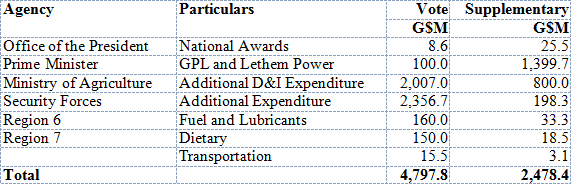
Source: Financial Papers

It is incredible that the budget for national awards should be understated by 300%. The Office of the President has so often and so long operated outside of the already lax financial system that that is now part of its culture. Maybe the October awards were an afterthought of Mr Jagdeo with elections in mind. But Dr Singh, it must be remembered, presented a mid-year report in August and went to the National Assembly for money twice in September. He ought to have known then that GPL and Lethem Power would need substantial additional funds. The same applies to the security forces and their need for supplementary funds to cover additional security duties for the elections. And predictably, the Ministry of Agriculture gets supplementary funds for Black Bush and for Mannarabisi, while two Amerindian dormitories get $18 million in food and $3 million to get the children home for Christmas. Whether it was just poor budgeting or politicking is a matter for speculation.

The second paper
Paper 8 is for $3.471 billion and is made up of four items. These are:

1. Ferries from China
The paper seeks another $2,588 million for the two ferries from China for which Budget 2011 had an initial provision of $366M. There was no comment on this by the Minister in his 2011 mid year report but the capital project profile presented at the time of the Budget had a total cost for the ferries of $3,849 million, all of it to be financed by “foreign loans/grants.” The profile shows the project ending in 2011 and the entire amount should have been taken up at the time of the Budget.

2. Education delivery
The paper seeks approval for $160 million on this $8,943 million project for institutional strengthening of hinterland schools, school facilities, textbooks and child-friendly classrooms. $800M was approved in the 2011 Budget and with pre-2011 spending of $4,063 million, the accumulated sum drawn down at end of 2011 would have been $5,023 million, leaving a large sum undrawn. The project is shown as being financed by foreign loan/grants and comes to an end in 2011.

3. East Bank Demerara Highway Improvement Project
The project profile for this IDB-funded, five year (2011-2015) lane extension from Providence to Diamond shows a total cost of $4,510 million of which $450M was approved in the 2011 budget. The paper seeks another $261 million.

4. Electrification programme
This is listed in the capital profile as a two-year project ending December 31, 2012. It consists of:

● the expansion of the transmission and distribution systems;

● seven new sub stations;

● expansion and upgrading of two sub-stations; and

● installation of a Supervisory Control and Data Acquisition (SCADA) system.

The total project cost is $8,157M of which $1,395 M was spent before 2011 and $2,791M was approved in the 2011 budget. It would seem then that there will be some $1,000 million to be spent to the end of the project in 2012.

Conclusion
There is something fundamentally wrong with the manner of budgeting at the central government level. For example, “foreign loans/grants” is a term of confusion, not clarification. The information in the capital project profiles is unhelpful, and even unusual. It seems strange that the Budget would have had only a small part of the cost of the ferry when it was known that their delivery was scheduled in 2011. The reason it seems is a calculated strategy to mask the deficit at the time of budgeting. There is no reason to budget for part of the vessel – you either take the whole cost or none.

The Minister, as usual, was less than forthcoming in his mid-year report disclosures and projections. He then had another chance when he went to the National Assembly – not once but twice in September 2011. If he knew that there would be some matters of financial significance between the dissolution of the National Assembly and the end of the year, he should have sought to have provisions for those.

A senior minister can hardly admit that he was unaware about some of the party’s elections spending plans, although with Mr Jagdeo no one can be certain. Whatever it is, this Minister’s capacity for good budgeting and responsible financial management is being increasingly questioned.

And on the issue of the Contingencies Fund, his financial papers do not meet the requirements of the Act. Not only, in the words of the Auditor General, is the Minister a serial abuser of the Fund, but he shows some disdain for the National Assembly by his failure to provide it with the details required by section 41 of the Fiscal Management and Accountability Act.

At the wider level, the Jagdeo administration had engaged in a spending extravaganza, financed by borrowings.

So while the National Assembly persuades Dr Singh to bring financial papers in accordance with the law, and to stop the abuse of the Contingencies Fund, it also needs to bring under parliamentary control, our ballooning domestic and external debts.
