
NIS buys Clico building for $600 million

Introduction
At a time when the National Insurance Scheme is experiencing the results of more than two decades of bad governance it has just dished out some $600 million to buy the CLICO building on Camp Street. That building was the single most valuable asset of the failed giant insurance company which was placed first under judicial management and later ordered by Chief Justice (ag) Ian Chang after he found that information available to him in 2010 pointed “unerringly” in the direction of its insolvency. The Chief Justice appointed Bank of Guyana Governor Mr Lawrence Williams as liquidator of the company but in keeping with the law Mr Williams was appointed in his personal capacity.

The acquisition is an interesting transaction. On the one hand the building is one of the largest buildings in Georgetown and the transaction is the single largest real estate transaction ever entered into by the Scheme. Yet but not surprisingly, the board of the NIS headed by Dr Roger Luncheon has not made any statement on the matter. With one old but historic church site sold in Regent Street for $500 million dollars the NIS might have thought it was getting a fancy building at a steal.

Shortly after the danger signs appeared in February 2009, a report on the net assets of the company showed the building as CLICO’s single most valuable asset. According to the report done by a local accountancy firm the building had a going concern value of $1.5 billion and a liquidation value on a best case scenario of $1.112 billion and under a worst case, $750 million. So $600 million must be a good price for any buyer.

Bigger building
Hopefully the Liquidator can explain this and whether he sought out the widest possible prospects to ensure that he obtained the best possible price as his fiduciary obligations would require. The price at which the Liquidator sold the property ought to be of some concern to the creditors of CLICO since it is out of the pool of proceeds that they are paid. Fortunately for the Liquidator and despite several possible causes, no challenge has been raised in relation to the liquidation of CLICO.

The building which dominates Camp Street seems to have been built without any serious consideration for cost, and indications are that it would be extremely expensive to maintain. Perhaps in making the acquisition decision the directors might have felt that the existing head office built decades ago is no longer adequate to house the staff and records and cater for the persons who visit there daily.

Or perhaps it wants to consolidate its Georgetown operations which are now housed in three locations, hopefully leading to greater efficiency and economy. In that case, our pensioners and persons attending the NIS office for medical and other reasons will have to accustom themselves to use elevators!

Bigger issue
If the NIS moves offices it will then have to consider what it would do with the existing buildings and whether there is a market for them. If that turns out not to be the case, the NIS would regret its $600 million dollar decision in addition to other costly decisions and transactions it has had with CLICO. For example, as at December 31, 2009 the NIS had more than $5.8 billion invested in CLICO which it seemed most unlikely to recover, not withstanding the bravado of Mr Jagdeo that the “NIS would not lose a cent.”

And in his own peculiar style Dr Luncheon had assured the auditors during the course of the 2009 audit that “the Board of the National Insurance Scheme wishes to advise that it has noted the undertakings made by the President concerning the recovery of NIS investments in CLICO.

The Board is also mindful of the unanimous Parliamentary Resolution guaranteeing state support for recovery by NIS of its investments in CLICO. As such, the Board has the utmost confidence that the undertaking would be honoured and the investments of NIS in CLICO will be recovered.”

With recent parliamentary developments I do not think the matter will be that simple. The end of the Jagdeo presidency allows for all the questions that have gone unanswered for nearly two years to be answered fully and truthfully. It would be sad indeed that the NIS should be one of the first casualties of the newly configured National Assembly.

Clearly, Jagdeo’s undertaking is not worth a cent and the opposition controlled Assembly will no doubt demand a quid pro quo: an investigation into the collapse of CLICO including the unlawful transfer of money abroad, the relationship between Jagdeo and CLICO and its CEO and whether there was impropriety in the use of $1.5 billion the company received from the New Building Society to which it sold the bulk of its investments in the Berbice Bridge Company bonds.

More of CLICO and the NIS
Now let us return briefly to the liquidation. CLICO’s principal asset is now well and truly sold for $150 million less than the worst case fire-sale price. So that those larger investors who were hoping to get some more out of CLICO might just have experienced that sinking sensation which we have all felt at some time. Their situation is at least $150 million worse but even that to the NIS as a creditor of CLICO is chicken feed.

For several years, the NIS has been engaged in some quite interlocking, if not incestuous relationships with CLICO. It had lent CLICO and Hand-in-Hand Insurance Company tons of money at modest interest rates which they then invested in the Berbice Bridge Company at quite attractive rates of interest. Indeed CLICO was such a big investor that its CEO and Director Ms Gita Singh-Knight was hand-picked as the Chairperson of the Berbice Bridge Company Inc.

But there may be a bit of good news. As at the date of the net assets report referred to above CLICO is shown as an investor in the Bridge Company to the tune of $605 million made up of $400 million in Subordinated Loan Stock, unpaid interest of $89 million and short-term loans of $116 million.

There is no indication whether Mr Williams the Liquidator has sought to liquidate those funds or call in the unpaid interest. If not that is a good small piece and some consolation.

Conclusion
Finally, I saw a newspaper article refer to the payment of the building to be by way of a set-off. In my view this is not permissible under the law but then the liquidation of CLICO has had improper interference from then President Bharrat Jagdeo which was hardly consistent with the law.

The reason for set-off not being available is that it would amount to a preference to the detriment of the 39 policyholders who at the date of cessation of business had balances in excess of $30 million but who were paid up to a maximum of $30 million only.

I am sympathetic to the new members of the National Assembly whose task is almost as huge as the cleaning of the Augean stables.
Berbice River tolls can be substantially reduced

Introduction
The Demerara Harbour Bridge is vested in and operated by a public corporation, while the Berbice Bridge was built and is operated by the Berbice Bridge Company Inc, a private company under a Build, Operate and Transfer Agreement. The Demerara Bridge was constructed under the Burnham administration in 1978 and vested in a public corporation in 2003. The toll for a motor car to cross the Berbice River is $2,200. The toll to cross the Demerara River is $100. There does seems something quite inequitable in such an arrangement and one wonders why a government that draws so much of its support from Regions 5 and 6 would subject its residents to the kind of high fares that the private company charges.

By now, everyone is aware that the country has long come out of an IMF arrangement and even if the bridge was constructed when Guyana was under such an arrangement, the Jagdeo administration was still willing to defy the IMF and World Bank to build the ill-fated Skeldon Sugar Factory, and the stadium. And we have been willing to invest in a $3 billion fibre-optic cable, a specialty tourism hospital and a hotel.

Ghost town
Since the bridge opening in late 2008, business in New Amsterdam has fallen off dramatically. Understandably, if not entirely justifiably then, the local business community is attributing many of the problems facing them first to the location of the bridge and second, to the high tolls charged by the Bridge Company. When I met last Thursday with members of the Berbice business community they complained about the refusal of Chairperson of the Bridge Company Ms Geeta Singh-Knight and her directors to give them an audience and to discuss the effect of the company’s high tolls on their businesses. Indeed, they pointed out the irony that businesspersons from Georgetown are now doing better and brisk business in Berbice, to the detriment of the Berbice businesses. According to the persons I met, the effect of siting the bridge at D’Edward has made New Amsterdam into a ghost town at night.

But notwithstanding their arrogance and insensitivity to Berbicians, the directors – all of whom are Georgetown-based – can do nothing about the location of the bridge. That, according to both government critics and observers, was loaded with political considerations. If the bridge was placed further upriver, traffic would have had to pass through unfriendly villages and the town of New Amsterdam which has never had a warm relationship with the PPP/C. And this was before President Jagdeo described its Mayor in language most inappropriate for Business Page.

The government on the other hand argues that politics had nothing to do with it. That it was about cost. That if the bridge was built further upriver, the capital cost on new roads and the likely logjam in New Amsterdam would have been intolerable. In any case those arguments are moot now: the bridge is where it is and there is nothing the directors or anyone else can do about it.

Addressing the high tolls
Ever since October 16, when in the Business Page column I reviewed the Bridge Company’s annual return and the 2010 financial statements, I have been studying how the second issue – the high tolls – can be addressed. I am more than ever convinced that the legal structure, nature of ownership and the financing model are the cause of the high tolls. The 2010 audited financial statements show that the company had assets of $8.9 billion of which only $400 million was put up by equity shareholders with the remaining $8.5 billion coming from high cost, interest bearing debts, namely, 950 million Preference Shares with a return rate of 11% and redeemable at increasing percentages after year fifteen; Subordinated Loan Stock – $1,250,000,000, repayable 2026; Bonds Tranche 1 – $3,050 million at 9% maturing 2013; Bonds Tranche 2 – $2,525 million at 10% maturing 2017 and Loans – $450 million.

The result is that the company has to pay over $800 million annually in interest alone. Because of the business model and financial structure of the Demerara Harbour Bridge Corporation, that corporation has no debt financing and therefore no interest cost. A similar model for the Berbice Bridge would therefore save upward of $800 million which can then be applied to lowering the tolls.

Savings
My recommendation is for the government to buy over the debts paying by way of Treasury Bills at lower rates of interest to reflect the lower risk of government paper compared with private sector loans to a company whose projections had shown it would be a high risk investment. To the question of why the government should assume the debt, the answer is why should Berbicians be subjected to a model that is different and more costly than that in Demerara?

Some even argue that road users pay no toll and it is unfair for those who live in an important region of the country to have to bear costs which others do not have. The government pays for the roads often with borrowed funds so there is nothing unusual or burdensome about the government carrying the cost via the public accounts.

Readers of this column would also be aware that the investors in the company enjoy the widest range of tax concessions paying no corporation tax, income tax and withholding tax while the company enjoys additional exemptions from customs duty, VAT, etc. In public finance, tax concessions are treated as a cost so the government has a saving, albeit a non-cash one.

Legal structure
The other problem lies in the legal structure and the nature of ownership of the Berbice Bridge Company. It is a private limited company incorporated under the Companies Act 1991 and operating under a Concession Agreement for twenty-one years. This means that all the company’s investment in the bridge has to be recovered within that period, for which the clock is already running. In other words, since the right to operate the bridge ends in twenty-one years, the investment must be written off over that period. That gives an amortization charge of roughly $500 million. Again, if we look for a comparison with the Demerara Harbour Bridge we note that in the 2003 Act creating the corporation, the bridge was vested at a nil value. Apparently the Demerara Harbour Bridge Corporation does not file its annual report and accounts in the National Assembly and I am therefore unable to say whether, subsequent to vesting, it revalued the bridge and has been taking depreciation on it.

My recommendation is that after paying the investors, the government should vest the bridge in a new entity, at nil or at a value lower than the cost. This would allow for a substantially reduced depreciation or indeed none at all, with the savings going to the users of the bridge. An alternative suggested by my partner is vesting at full cost but for the government to make an annual grant to the entity equivalent of the depreciation charge. That seems eminently sensible, since commercial entities like the Chronicle and NCN are given annual subventions with much less justification.

Putting aside money
The other point of considerable significance arises out of what I referred to earlier: the duration of the Concession Agreement which incidentally has not been tabled in the National Assembly or ever released to the public. It means that apart from the annual interest, the Berbice Bridge Company would have to repay all borrowings and preference shareholders at agreed times but no later than at the end of the concession period.

What the Bridge Company requires is to set up a sinking fund account into which it places sufficient cash to ensure that it can meet its obligations as the repayment of the borrowings becomes due. For example, in another two years, the company has to find $3,050 billion to pay the investors in the Tranche 1 Bonds, on pain of penalty. The company clearly will not be able to do so (it had practically no cash balance at December 31, 2010), and will have to roll over the debts. Four years later, Tranche 2 of $2,525 million becomes due and it will also not be able to meet those obligations.

As the end of the concession period approaches, the company will find increasing difficulty in persuading anyone to lend it any money, let alone billions of dollars. From the October 16 Business Page, readers would have noted that the government was forced to waive hundreds of millions of dollars on its preference shares, just so that the company could pretend that it was meeting its other obligations. In fact it was only able to do so by the very dubious and possibly illegal waiver by the government.

Would the government have to waive that more than one hundred million due to it every year and would it also waive the redemption of the preference shares which become due in three years after the second tranche bonds? The Berbice Bridge Company seems to be a walking insolvent company and shielding it from that embarrassment is not only financially sensible but will allow any successor operator to charge considerably lower tolls and yet be solvent.

Looming clouds
In its present form the company requires about $1550 million annually to meet its annual operating costs, the interest and dividends payable to investors, and future loan obligations. In 2010, its total income was $1,115 million, a shortfall of $435 million. The company’s only hope for survival is that traffic would increase by an improbable 50%, or that it can increase tolls by that amount. That would surely be unacceptable, even for Berbicians.

Ramon Gaskin had predicted this situation more than five years ago when Winston Brassington was trying to twist the arm of the New Building Society directors to invest $2 billion in the bridge. The directors agreed with his assessment and it was only when Dr Nanda Gopaul became Chairman that the NBS bought over some $1.5 billion dollars in bonds held by the sinking Clico. I do not believe that we have heard the last of that investment.

Conclusion
Despite substantial subsidies, the bridge is uneconomic for the body of investors as a whole, and most especially the government in the form of exempted taxes running into further hundreds of millions of dollars and in waivers of Preference Shares Dividends. The high cost necessitates an unbearable burden on the users of the bridge in the form of tolls.

Even at, or because of the high tolls, the company will continue to have significant shortfalls to cover annual expenditure and current and future debt obligations. In the medium to long term the company would only be able to repay loans by further borrowings and would be insolvent, ie unable to pay its debts at the time of its contractual handover. The cost of the bridge to users and especially Berbicians is both economic and social.

My recommendation for reducing the high debt cost of the Bridge Company is stated above. Additionally, instead of paying NICIL (or one of its satellites) for the $950 million in redeemable shares it holds, these can be converted to ordinary shares which will attract dividends.

Organisationally, I also recommend the establishment of a national Bridges Authority out of the separate entities. This single entity will own and operate all publicly owned bridges in Guyana enjoying the benefits of shared expertise and management.

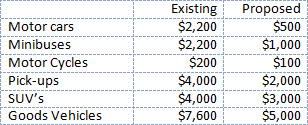
Finally, I recommended in my presentation to the Berbice businesspersons the following toll charges:

My numbers indicate that the new entity will make in one year a surplus of $79 million at the proposed tolls, if the government, having bought out the investors, vests the bridge in the new entity at 50% of its cost. If it is vested at an even lower value the tolls can be reduced even further.

Whatever the result of the elections they will not have been fair

Parliament was prorogued in late September, meaning that we now have no parliament and the passage of new laws including those for incurring of new debts must await the next parliament. However, to ensure that the wheels of government do not grind to a halt, the constitution provides for the executive, including the president and the cabinet, to remain in office until a new government is installed. The government meanwhile assumes a holding mode, sometimes loosely described as a lame duck government.

Our constitution does not specify, or indeed restrict, the powers of the government during this holding period. That does not mean the government can do as it pleases. Indeed what it should do is to follow convention and good practice and limit its actions, decisions and expenditure to what the National Assembly approved before prorogation. Accordingly, the decisions they should make and action taken should be restricted to routine, operational matters.

It would not be appropriate for example for the government to enter into a new international treaty or to make a decision on matters that would require parliamentary approval, whether in the form of authorisation or the provision of finance. I understand that the constitutions of some countries limit the actions such holding governments can take, thus making it unconstitutional for them to do the kinds of things that have become routine under the increasingly lawless PPP/C.

The thinly disguised Cabinet Outreach, outboard engines and fertilizer of 2006 are modest compared with the multibillion agreements we have been hearing about since the announcement of elections. A few days ago we learnt from Jamaica that Jagdeo has signed a secret deal with the Chinese for an investment of $27 billion on the Timehri Airport, and from the local press that he is borrowing $4 billion from India for a specialty hospital, and is committing several billion dollars for an overpriced Marriott Hotel.

We have become so accustomed to this lawlessness that we simply dismiss Mr Jagdeo’s actions as further cases of his routine violations of the constitution, some of which concern the protection afforded by the constitution. These include the appointment of an Ombudsman, the Public Procurement Commission and the integrity of the Consolidated Fund and the Contingencies Fund.

There are two important consequences to these actions: whether it is proper for the Jagdeo administration to tie the hands of the successor government; and the impact of such actions on the elections. The first touches on the constitutional issue of whether a successor government (PPP/C, APNU or AFC) should consider itself bound by these reckless decisions. Unfortunately Mr Donald Ramotar appears to be a party to most of the recent excesses and would seem to be allowing himself little or no room to revisit any of them. It would seem from their pronouncements that the other major parties are committed to revisiting and quite probably rescinding a number of the recent deals, with the Amaila Project heading the list. That could put Guyana on a collision course with investors and tarnish the country’s reputation as an investment destination.

On the issue of the fairness of the elections, I think it would be hard for anyone to conclude that house lots to communities, subventions for Veterans Homes, salary increases to public servants and the disciplined services, the signing of new contracts with major tax concessions and or state borrowings, the payment of discretionary sums from the ruling party office and the opening of miscellaneous facilities by the President and his ministers are not intended to and will not influence the vote. That means the elections – whatever the result – will not be free and fair and one hopes that the Elections Observer Missions are taking note.

Over the last fourteen years I have tried to convince GECOM and the political parties to have some form of campaign finance rules. Mrs Sheila Holder actually tabled a motion in the National Assembly on this. The PPP/C simply stalled. As a result we have neither campaign rules nor restrictions on the use of state resources for party political purposes.

It is a gift for a president who has no sense of constitutional convention or propriety, has no respect for the rule of law, and indulges himself with the belief that he is all powerful.

Issues to which Ramotar should make a commitment

PPP/C presidential candidate Donald Ramotar announced at a political rally on Sunday evening that he would be ready to listen to the views and ideas of national interest from persons, groups or organisations.

Indeed he was specific enough to say, “As long as they think they have ideas I would be ready to listen to them, I would be ready to discuss with them, I would be ready to debate with them and I would be ready to work with them in the interest of Guyana.”

Unfortunately, over the past nineteen years Mr Ramotar and his party have rejected every single proposal made by the parliamentary opposition during the annual budget debate. He and his party have been silent even as the party’s President and government have rejected hundreds of calls, suggestions and ideas made by Guyanese on issues ranging from murders of citizens, abuse of state power, financial management and good governance.

But Guyanese are a forgiving people and do not hold him personally responsible for all the violations that have taken place under his party’s watch. I am sure they are prepared to turn a new leaf with him. The question is: is he himself prepared to turn a new leaf? Here are twelve issues that citizens would like him to make a commitment to:

1. If elected President, ensuring that the constitutional bodies such as the Ombudsman, the Public Procurement Commission and the Local Government Commission are set up within thirty days of, or other specified period after his election;

2. Within sixty or other specified number of days but not exceeding four months of his election, working with Parliament to appoint a broad-based Constitutional Reform Commission to examine the constitution with a view to removing its dictatorial features and making it more democratic and consistent with republican status and the rule of law;

3. Appointing a Commission of Enquiry to look into all aspects of the crime spree that led to the deaths of hundreds of Guyanese including his party’s Minister, Mr Sash Sawh;

4. Ensuring that all public funds including money from the sale of government properties and the proceeds of the Lottery are placed in the Consolidated Fund;

5. Implementing the recommendations of the Chang and the Symonds Reports to strengthen the Guyana Police Force;

6. Removing party control of the state media and the restriction on the citizens of Region 10 to access to television of their choice;

7. Removing the state monopoly on radio;

8. Reviewing the Amaila Falls Hydro Electricity Project with a view to ensuring transparency and economy in the project and lower tariffs to the consumers;

9. The establishment of a full enquiry into the CLICO collapse and action to deal with wrongdoers;

10. Appointing qualified independent persons to the Audit Office and removing those who have a conflict of interest;

11. Repealing the Former Presidents (Other Benefits and Facilities) Act; and

12. The passing of modern anti-corruption legislation.

Mr Ramotar will note that the issues raised will either save money or lead to better governance. They do not involve any expenditure or loss of revenue such as the reduction of VAT and other taxes on which he may wish to take the lead.

Because I wanted to limit the list to a round dozen, and to make them as uncontroversial as possible, I have not asked about the Marriot Hotel, the Intelligence Agency in the Castellani House Compound, the Airport Expansion Project or the giveaway of state property to party leaders, comrades and friends. He is of course free to address these. Nor have I raised any matter that could cause him any embarrassment like his role as a Director of Omai and GuySuCo or how his daughter obtained state property in Pradoville 2.

These are not new matters or fresh ideas. They have been around and expressed by many “persons, groups [and] organizations.”

He would have no doubt addressed his mind to them. Each is capable of a yes or no answer. As a citizen, I am appealing to him to answer them promptly for the benefit of the electorate whose vote he now seeks.

Country heading for massive budget deficit

Introduction
As campaign 2011 moves into top gear, no one it seems has the least interest in the financial and economic consequences of the explosion in what appears to be uncontrolled expenditure by the government. The simple rule of financial management is that new expenditure must either come from increasing revenues, or from utilizing accumulated reserves or from new borrowings. That is as true of an individual as it is of a company or government. But the very simplicity of the rule may help to disguise the stark consequences of the option of overspending financed by borrowings.

Take Budget 2011 as a case in point. That budget presented in January this year showed significant increases in government spending over 2010. Current non-interest expenditure was projected to increase by $9B from $78.5B to $88B and capital expenditure from $47B to $62B. Not that these increases were justified by the funds available or by new or additional revenues. No. The Minister, recklessly in my view, proposed to the National Assembly a budget deficit of $34B financed by external borrowings of $32B and from domestic sources by $2B. Over all the protestations of the opposition, the government passed the Budget without a single modification.

Warning
At that time, Ram & McRae immediately sounded the warning bell pointing in its January 18 review of the Budget that:

– External debt service in 2011 would be US$28.8 million and domestic debt service $4.979 billion, an increase of 15.1% over the preceding year;

– The percentage of budgeted current revenue used to service debt had increased from 7.9% in 2007 to 13.3% in 2010; and

– The impact of the unrestrained expenditure would be an increase in the overall balance on the financial operations from a negative $20.5 billion in 2010 to a negative $33.9 billion in 2011, or 65%, and double that of 2009.

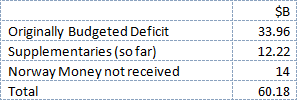
From all appearances, the situation is turning out to be much worse. Between January and September, the Minister of Finance presented to the National Assembly six financial papers for supplementary funds totalling $12.2 billion. A breakdown of the financial papers shows $5.449 billion coming out of the Contingencies Fund and $6.77 billion for proposed spending. Unless these are financed from new sources or increases in revenue the deficit would climb to $46B. But not only are these not coming from new sources or increases in revenue but President Jagdeo has now conceded that some $14B budgeted in 2011 as revenue flowing from the Guyana-Norway LCDS initiative is now certain not to be coming in this year.

No lame duck
If we add this all together this is what we find:

In this table, I am conservatively and unrealistically assuming that there will be no further supplementary appropriations for 2011. Of course there will be. The problem is that no one knows the extent of the unbudgeted spending that has been going on since the last financial paper was submitted to the National Assembly before it expired in late September. It did not help that the parliamentary opposition had withdrawn from the National Assembly although it might have made no difference since the government is not known for its willingness to listen to any criticism of its actions, whether on money or otherwise.

What it did was to allow the distinctly un-lame duck President Jagdeo and the openly politicized Finance Minister to do as they wished, to spend as they wanted and to ignore the consequences. Even now, or rather moreso now, the President goes around handing out millions to all and sundry which the post-November 28 administration will have to add up and then approach the National Assembly to approve what he has been spending, as if it were coming out of his presidential pension package.

Out-turn
Let us return to the out-turn for the year. And let us assume that the government manages to shave as much as ten billion dollars of expenditure from the budget for the year. Here are two immediate consequences:

The resulting deficit will be approximately $50 billion or US$250M – more than the entire sum receivable from Norway over a five year period.

The total debt of the country – external and internal – expressed in US dollars, will exceed US$1.8 billion, just a little below the debt the PPP/C inherited in 1992.

Because of the depreciation of the Guyana dollar since 1992 from $125 to $204 to the US dollar, the per capita debt, which is the amount of debt divided by the number of Guyanese, would be higher in 2011 than it was in 1992.

The consequences of this will be severe on the taxpayer. In 2010, the interest cost of servicing the domestic debt in 2010 was $3.9B while the interest on the external debt was $2B. Total debt service inclusive of interest cost is 13.28% of current revenue. While servicing of the external debt in 2011 is projected to increase by 27.6%, the internal debt service is projected to fall in 2011 because of a substantial projected decrease in domestic debt repayment. That is an apparently painless way to say that the government never intended to pay down on the domestic debt in 2011.

Mid-year hope
I was hoping that the Mid-Year report prepared by the Minister of Finance would have offered some comfort. Unfortunately, while the National Estimates include a table giving an accounting classification of the Central Government Financial Operations, the Mid-Year report does not. The narrative in the later report indicates that full-year 2011 revenues are projected to exceed 2010 by about $7 billion while for the first half of 2011 non-interest current expenditure amounted to $38.3 billion, an increase of 16.2 per cent over the same period last year. Similarly capital expenditure for the first half of 2011 amounted to $17 billion compared to $13.7 billion in the corresponding period in 2010.

One other possibility is that the new expenditure will come from one of the many slush funds or padded line items such as the provisions for wage increases dealt with in Business Page last week. The economy cannot bear the kind of debt burden which reckless spending involves.

New money
Earlier in this column reference was made to the financial papers for additional money for the government. The principal agencies for which monies were voted were:

The vote for GPL was a single amount for the acquisition of a 15.2 MW power plant at Kingston. The allocation for Ministry of Finance was to buy fuel for the LINMINE Community Power Plant, flood victims in regions 6 (?), 9 and 10 and $1.2 billion for additional electricity charges. One expects the Ministry of Finance to be best at budgeting costs and to have its allocation for the payment of electricity charges is a poor reflection of its ability to manage and control costs.

Public Works had much to do with road expansion on the East Bank and East Coast Demerara, preparation of the Supenaam and Parika Stellings for Chinese vessels and cost for replacement of ferry spares. Health was mainly for the purchase of drugs while Agriculture was for D&I and other projects, some of which are related to the Grow More Food Campaign which the government is trying hard to justify against the huge sums spent so far.

Conclusion
For now, ‘boat gone ah falls.’ The Jagdeo administration will soon expire and hopefully a government with some commitment to financial discipline will see the need to cap borrowings to levels that are sustainable. It is what the economy and the country will need to cushion any challenges which inevitably happen even to the best managed economy.