The tax exemption of the president’s pension package is an abomination

The defenders of the Former Presidents (Benefits and Other Facilities) Act 2009 including Prime Minister Sam Hinds, Dr. Roger Luncheon, Mr. Robert Persaud and now Dr. Nanda Gopaul are having a hard time trying to convince the Guyanese taxpayer that President Bharrat Jagdeo was less than greedy in initiating and approving legislation providing for benefits that are patently overgenerous.

The best that Mr. Persaud could do was question the timing of the questions, seemingly unaware that as far back as May 2009 Prime Minister Sam Hinds was vainly defending the Act with misrepresentations.

Mr. Hinds incorrectly wrote that all Mr. Jagdeo and his spouse would have is a single vehicle owned and maintained by the State. In fact Mr. Jagdeo is entitled to an unspecified number of such vehicles with drivers. In addition, Mr. Jagdeo is also entitled to duty-free concessions for motor vehicles and every other item he chooses to import. Mr. Hinds would also wish us to believe that free medical expenses are limited to the former president and his spouse. In fact taxpayers would have to pay for the medical costs for him and the dependent members of his family, for the rest of his life. And if Mr. Jagdeo or any one of them opts for treatment abroad, no big deal – the Act places no restriction.

Dr. Luncheon and others have been saying that all the Act did was to put into law payments made to former presidents, completely forgetting that neither Burnham nor Jagan lived to become former presidents.

With a slight twist Dr. Gopaul then tries to confuse the issue by listing eight types of expenses that former presidents were entitled to but fails to state what they actually received which is the real concern over the Act. What Dr. Gopaul seems to miss is what the parliamentary opposition and civil society have been saying all along, i.e. that there are no caps to any of the facilities; no conditions for receipt of benefits and no consideration of cost.

A former president working abroad is still entitled to tax-free pensions and most if not all the benefits and facilities permitted under the Act. And even if resident, s/he is entitled to clerical and technical staff even for private consultancy work, and can run up the most outrageous utilities bill for electricity, telephone and water to be paid for by the state. As drafted, the legislation would seem to impose on the state all the costs where the former president decides to have two or more residences. And we know from the advertisements, our soon-to-be former President is actually constructing on the sprawling state-owned land he awarded himself two houses and a distinctly un-low carbon hot and cold swimming pool for which the monthly electricity bill will easily run to $600,000. We will pay for all of that.

Even while visiting friends that individual likes to travel with an entourage often consisting of five vehicles and several staff providing security. If he is unwilling or unable to give up such show of power and influence, we the taxpayers will pay for them too, including overtime late into the night.

We may take some comfort in the two services that seem to be limited in number – the gardener, though even that could be circumvented by retaining a landscaping service, and an attendant. And if the soon-to-be former president joins one of his buddies in business or enters in business in name, either on his own account or for their benefit, all the income will be tax-free. This abomination has no parallel or precedent anywhere in the world and is deserving of its own Champion of the World Award.

The menu of benefits and facilities hardly seems what the Constitution intended as payments to former presidents when it states that “A person who has held the office of President shall receive such pension or, upon the expiration of his term of office, such gratuity as may be prescribed by Parliament. Any such pension or gratuity shall be a charge on the Consolidated Fund.”

One is forced to wonder whether the attempts by Hinds, Luncheon and others to confuse the public about the contents and consequences of the Act really show their inability to defend its inherent obscenity. What one does not have to wonder about is the frightening disregard for rules and cost on the one hand, and the interest of self on the other, which are symptomatic of how the PPP/C has been managing the financial resources of the country.

Over-budgeting or underpayment of public sector wage and pension increases

Introduction
In his presentation to the National Assembly of the 2011 Budget on January 17, Dr Ashni Singh announced that public assistance was then being paid at a rate of $4,900 per month to approximately 9,000 beneficiaries. He went on to announce a 12% increase to $5,500 per month from February 1. And in the same speech, he announced that “in like manner,” old age pensions then being paid at a rate of $6,600 per month to approximately 42,000 pensioners would be increased to a rate of $7,500 per month, a 14% increase. Even allowing for the word “approximately,” the information was specific enough to allow for a reasonable calculation of the total cost – inclusive of the announced increases – of $4,330 million, made up of Public Assistance of $590 million and Old Age Pension of $3,740 million.

But the 2011 Estimates themselves tell a very confusing story which could easily mislead readers. What is clear however is that a one-line item from page 21, Table 9 of the 2011 National Estimates accounts for the entire year’s pensions cost – without the need for any further increase. Yet, there is a provision for increased pensions of $2,106 billion or 31% of the year’s pensions cost, exclusive of the increase. To emphasise, the increases are already built into the non-statutory pension cost and there ought to be no further provision, unless of course tens of thousands of persons suddenly become eligible for pensions! I would unhesitatingly dismiss any suggestion that the provision relates to persons in receipt of statutory pensions and gratuities since that would amount to an increase of nearly 100%!

Moreover, there was no indication in the announcement by GINA that those in receipt of statutory pensions would also receive the 14% increase, usually intended for persons classified as vulnerable. But even if one charitably assumes that they too will share in the 14% previously announced, the increase is still only $325 million, leaving a huge amount to be accounted for.

Padding
The situation is no different in 2010 or indeed 2009. Unlike wages and salaries, OAP and Social Security are not subject to any negotiations, and any proposed increases should be included in the year’s budget, or explained somewhere in the budget. Indeed any uncertainty would be removed if Dr Singh would comply with the requirement of the Fiscal Management and Accountability Act that the assumptions underlying the budget should be stated. Without subscribing to any conspiratorial fear, for the Minister to do this might expose the budget to some of the padding that takes place, allowing for “authorised” slush funds, many of which are controlled by the Minister of Finance and his President.

This is more than a procedural or presentational point. It is about serious and substantial over-budgeting while somehow the government still manages to utilise the full amounts budgeted. If this is indeed a case of utilising over-budgeted funds, it would compound questions asked about Ms Manickchand’s pensioners‘ register, which has been the subject of adverse comments in a report by opposition parliamentarian Sheila Holder, and me in the letter columns.

According to Mrs Holder that register may contain as many as 17,640 phantom persons, with an annual loss to the state of over $1.3 billion. My estimate was higher because I applied the law strictly which would eliminate those returning Guyanese who have not been here for the minimum period specified by law and those persons who on account of assets and income would not qualify for the receipt of pension.

Wages
Let us now turn to similar provisions for wage increases. It took the Guyana Information Agency rather than the Accountant General or the Secretary to the Treasury to report the President’s announcement of his pre-elections wage increase for public servants. According to GINA, the “8 percent increase is payable to all public servants and members of the disciplined services, while teachers will get a 3 percent across the board hike with effect from 1st January 2011 on top of the 5 percent increase previously paid by Government with effect from the same date in accordance with the multiyear agreement concluded between Government and the Guyana Teachers Union.”

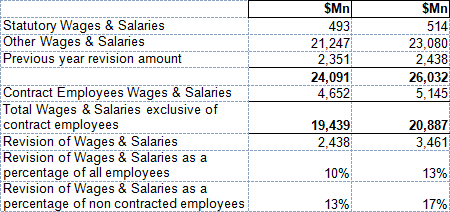
Here is a summary of the estimates raising similarly disturbing questions as they do in relation to wages and salaries.

WAGES AND SALARIES EXTRACTS 2011

Source: 2011 National Estimates

Affordability
What seems clear is that the government can afford to pay much more than the 8% that it has announced. Forget for a moment that as the employer and tax collector the government gets back 33.33% of any wages and salaries it pays to taxable persons. And forget too that the so-called contract employees like Ms Teixeira, Reepu Daman Persaud and Odinga Lumumba have fixed remuneration contracts and would therefore not be entitled to the 8%. The allocation in the Estimates for revision of wages and salaries in the 2011 Budget allows the government to pay a minimum of 13% to all public sector employees, or 17% if the contract employees are excluded. And since the government gets back 33.33% of what it pays out as remuneration, it can afford to pay as much as 20% to 25%, depending on whether it excludes or includes the contract employees.

Readers will recall that the increase announced in 2010 was 5% when the National Assembly had approved increases equivalent to anywhere between 10% and 13%. No one knows how the substantial difference of about $1.2 billion was spent. The only certainty is that it was spent.

Similarly, in 2011, a payment of 8% will leave the government with a hefty surplus or slush fund of about $1.5 billion.

Poor oversight
While the unearthing of some of the missing information requires some kind of detailed investigation, the public sector unions and especially the Public Service Union have been in the business long enough to alert themselves to the fact that the government might be shortchanging them. They ought to be aware that given the attitude of the government to its own employees, public servants deserve strong leadership from their unions.

The teachers too, have perhaps as weak a leadership as ever and one recalls their President Mr Colin Bynoe describing a 5% annual increase over the next five years as a “giant step.” One wonders whether he thinks President Jagdeo has made a giant leap of benevolence or has convinced him of what many felt when he accepted the five year, five per cent annual increase for his members. While he might have been overwhelmed, what is unforgivable is that his union might not have been aware of the budgetary allocation for public sector employees, including teachers.

But let us not blame the unions alone. What about the parliamentarians, including those sitting on the Public Accounts Committee which is chaired by an opposition member? They should be challenging rather than following the tepid report of the Auditor General who seems to see no evil even in the most glaring impropriety. That the Estimates are so unfriendly to readers and incomprehensible to most persons should suggest to them that they should ask probing questions, seek independent advice and ensure that they are capable of doing the job the taxpayers of this country pay them to do.

Hopefully, the next parliament will do a better job.

Region 9 flood relief was distributed through PPP/C party office

‘Business Page’ in this past Sunday Stabroek noted how the government has undermined the regional administrations and the local democratic organs across the country. For more than ten years, it has failed to pass the necessary laws and to establish the Local Government Commission required by the Constitution of Guyana to allow for operational and financial autonomy of those bodies. In that column I reminded readers that Article 12 of the Constitution states that “Local government by freely elected representatives of the people is an integral part of the democratic organisation of the State.” Instead of democracy, the PPP/C has restored party paramountcy in its vilest form.

One day after the column appeared I learn through the online news medium Demerara Waves that during the PPP/C’s electioneering campaign in Region 9 this weekend, that party’s regional headquarters was the location from which hundreds of persons were paid $20,000 in cash. The ostensible purpose of the payment was “flood relief.”

It is entirely irrelevant whether the recipients were told that the money came from the public Treasury and not the PPP/C. Each of the ten administrative regions has its own office, staff and transportation facilities. It is wrong, and egregiously so, that public funds are disbursed from any party office. I would like to think – though with this dishonest government and its political arm the equally dishonest PPP/C, no one can be sure – that following the flood, a proper, auditable system was used to identify eligible persons for “flood relief.”

Yet, this government, which for years had robbed the Amerindians of their entitlements under the Amerindian Act 2006, heartlessly made the flood victims wait for five months until the PPP/C elections entourage rolled into town to make the “flood relief” payment at their party’s office. I would not be surprised if the payment was deceptively an inducement to the poor Amerindians to attend the PPP/C rally and had little to do with “flood relief.” It is after all, how the party has commoditised the Amerindians of this country, particularly since 1992. It is about paramountcy of the party which Guyanese had deluded themselves had died in 1992. In fact paramountcy has matured into a semi-criminal enterprise.

This is just the latest case of the government using the prorogation of the National Assembly as a cover to continue misusing, mismanaging and misappropriating public moneys in a crude and shameless vote-buying national exercise. Even as the non-government parties campaign to unseat the PPP/C, they should remain alert to and oppose all the abuses which are coming to light.

As a member of civil society and of the Committee for Human Rights and Free and Fair Elections, I hope that Gecom, the Electoral Assistance Bureau and all those who will pronounce on the November 28 national and regional elections are taking note of these malpractices. The stage is being set for massively unfair elections.

Local government financing and democracy

Introduction
The reader should not wonder why in the caption of this column ‘democracy’ does not precede ‘financing.’ Obviously it should but the reader will also appreciate the procrustean attempt to fit what is at first blush a political and local governance issue into a business column. Still, it is clear that our Constitution in fact acknowledges the importance of financing to local government and specifically addresses financing in three Articles under Chapter 7 of the Constitution dealing with local democracy.

It is often said, and by no less a person than the President of the country, that Guyana has one of the best constitutions in the world. That is of course true if one is prepared to overlook the fatal flaws that permit an elected dictator who is more equal than the rest of the citizens, an emasculated Cabinet and National Assembly unable or unwilling to carry out their constitutional responsibilities and a political class that would cynically ignore those sections of the Constitution that they find inconvenient.

The constitution
– in theory

Notwithstanding these serious limitations, one area in which the Constitution is on paper very strong relates to local government. The problem is that our Parliament which comprises the National Assembly and the president has failed to carry out their constitutional duties. Article 12 states that “Local government by freely elected representatives of the people is an integral part of the democratic organisation of the State” which Article 71 (1) recognises as “a vital aspect of democracy” and requires that it “be organised so as to involve as many people as possible in the task of managing and developing the communities in which they live.”

The Constitution does not leave it there and imposes on Parliament the obligation “to provide for the institution of a country-wide system of local government through the establishment of organs of local democratic power as an integral part of the political organisation of the State.” Such local democratic organs are constitutionally autonomous and the decisions they make are binding upon the communities and citizens of their areas.

Helpfully the Constitution also provides that for the purposes of local government administration the country should be divided into regions, sub-regions and other subdivisions as Parliament deems fit. The relevant considerations in such a determination include population, the physical size, the geographical characteristics, the economic resources and the existing and planned infrastructure of each area, all with a view to ensuring that the area is or has the potential for becoming economically viable.

Article 74 (1) lays down as “the primary duty of local democratic organs” the efficient management and development of their areas and to provide leadership by example. Article 74 (3) imposes on local democratic organs the duty to maintain and protect public property, improve working and living conditions, promote the social and cultural life of the people, raise the level of civic consciousness, preserve law and order, consolidate the rule of law and safeguard the rights of citizens.”

The practice is different
Local government elections not having been held since 1994, this “integral part of the democratic organisation” has been in abeyance for nearly fifteen years, something that everyone seems to accept as the norm of this new democratic era.

The Constitution recognizes that the discharge of the obligations of the local government bodies requires financing; Article 76 empowers Parliament to permit the regional democratic councils to raise their own revenues and to use such resources for the benefit and welfare of their areas. The Constitution does not specify the bases on which these bodies may raise such funds but Article 77 A requires Parliament to make a law for the “the formulation and implementation of objective criteria for the purpose of the allocation of resources to, and the garnering of resources by local democratic organs,” being the regions, sub-regions and other sub-divisions into which Parliament divides Guyana.

There is some amount of confusion arising out of Article 77 (of the Constitution) which requires the development programme of each region to be integrated into the national development plans, and for the government to allocate funds to each region to enable it to implement its development programme. The Constitution framers might have thought that the meaning of the word ‘development’ is so self-evident that no definition is necessary, but I fail to understand how a “development programme” can mean the annual office cost in the operational budget of any region.

Parliamentary failure
What is disappointing – if not shocking – is that we have had two full-term parliaments since these changes were made to the Constitution but the parliamentarians have done nothing to give effect to those changes. Still, it does not seem particularly shocking that a National Assembly that could cynically pass laws to postpone local government elections on several occasions would have any difficulty in otherwise undermining the autonomy of local government bodies, including the means and necessity to raise money to enable those bodies to carry out their mandate. Consequently there is no effective local government and the paradox we are faced with is of a central government minister exercising operational control over regions and local democratic organs.

To realise how extreme the situation is one only has to look at the National Estimates to recognise that the country’s ten administrative regions are dependent entirely on the central government for their revenues, a situation that has few if any parallels around the world. By way of example, I refer to a review by me of the new constitution of Kenya published in the Stabroek News of November 30, 2010. Under that constitution, only the national government has the power to impose income taxes; value added taxes; excise taxes as well as customs and other duties on the import and export of goods.

No silver bullet
The governance problems in Guyana are so endemic that there is unlikely to be any silver bullet solution and while we heard first of devolution and later power-sharing, in my view the issue of local government financing has received far too little attention. This centralization of power and control of the national purse on the one hand and the restrictions on regional and local government bodies to garner their own resources are counterproductive to good governance and democracy as envisaged in Guyana’s Constitution.

The failure of the Ninth Parliament and more specifically the PPP/C and the PNCR to agree on the establishment of the Local Government Commission required under Article 78 A was a major hurdle to local government elections. There was little talk if any of the reform of local government financing. That is a pity.

And it is not as if there is any major hurdle in accessing good examples. We do not have to go as far as Kenya – just look at the Amerindian Act of 2006. Guyana has witnessed and suffered from the excesses of central controls. For all the powerful arguments for power-sharing, they will come to naught without improved local democracy and efficiencies.

Studies show that the revision of funding sources is a key part of the reform of local government and that “local government finance is the litmus test for central government’s commitment to local government.” That is not to say that there is such a thing as an optimal level for local government, and without exception, the size and structure of local government varies often in relation to the functions imposed on them. What we have in Guyana is a situation in which the functions of local government bodies are defined but the resources to carry out those functions are controlled by others.

Conclusion
Given the long absence of meaningful local government it might be useful to restate what are regarded as the main reasons underlying the system of local government, as a manifestation of local democracy and a provider of local services. Locally elected politicians make decisions on behalf of local communities and serve as a safeguard against central government domination, while the strengths of local government as a democratic instrument are its closeness to the population, its elected status, its accessibility and the opportunity it provides for public participation in the democratic process.

Even for those countries with an established tradition of local government there is the continuing effort to determine the right size to ensure local democracy and economic efficiency in the delivery of local public services. Various models have been developed to meet these two, often contradictory, demands but we need not worry too much about these. Here in Guyana, if we ignore for the moment the system of village councils we had up to the sixties, we really are starting from scratch and have numerous examples on which to draw.

The 2011 Manifesto of the PPP/C did not see local government financing as an issue which they thought needed addressing. Whether the other parties will share that perspective we will soon know.

Half-yearly reports show increased turnover

Introduction
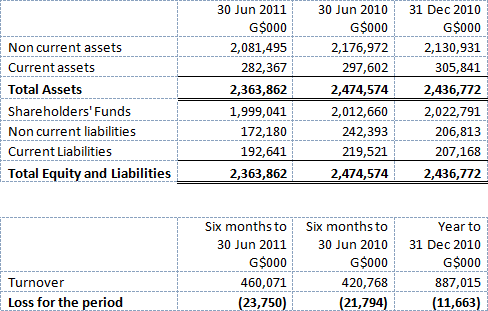
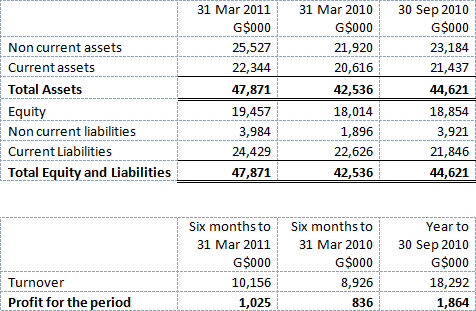
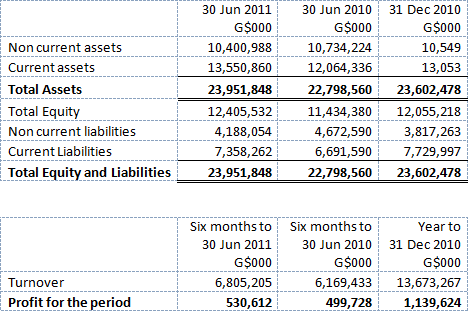
Caribbean Containers Inc, a public company in the paper recycling business has reported turnover for the first half of 2011 increasing by 9.3% over the same period last year. This follows a 10.3% reported turnover increase by the DDL Group of Companies and a 13.8% increase in the Banks DIH Group, the only one of the three with a September 30 year-end while CCI and DDL have a December 31 year end. The increases in turnover are of course considerably higher than the rates of inflation in the economy. Banks DIH in explaining its improved performance cited higher dollar sales, a term usually used in contradistinction from volume sales.

Caribbean Containers Inc.

CCI reported a gross profit increase over 2010 of 14.3% but its losses before tax increased from $21.8 million to $23.8 million. The report shows Earnings before depreciation as having declined in the first half of the year by 31.3% and that margins were severely affected by the rapid escalation in global fuel prices which resulted in the company’s fuel bill going up by some 40%.

The company’s performance in the third quarter ended September 30, 2011 improved strongly with an 18.3% growth in Earnings before depreciation compared with third quarter 2010. The result was a modest profit before tax of $2.7 million compared with a loss of $10.2 million for the third quarter of 2010. The overall result was a sharp decline in loss before tax for the nine months from $32 million in 2010 to $21million in 2011. The report explained that over the last four years, sales in the second half of the year averaged 13% more than in the first half.

CCI has had its fair share of financial problems over the years with a number of ownership changes and substantial debt restructuring. As at June 30, the company had liabilities of $365 million including trade and other payables of $116 million and loans repayable within a year amounting to $69 million. Cash resources amounted to $37 million but this had gone down to $25 million three months later.

In what can be described as Guyana’s principal LCDS private sector company, survival is still the challenge as the company’s aging technology has high running and maintenance cost, placing cash management at the centre of management focus.

Yet the company deserved commendation for being the only private sector company other than Republic Bank (Guyana) Limited to publish quarterly financial reports. The Bank of Guyana had published and recently withdrew Guideline # 10 requiring all banks to publish quarterly statements.

Banks DIH Limited

The half-yearly report is a consolidated report of the food and beverage giant and its subsidiary Citizens Bank Guyana Inc. Given the disparate nature of the operations and business of the two entities such a consolidated report does not allow any easy informed analysis of the two businesses.

The company had unaudited profit after tax in the half-year of $689.5 million compared to $594.1 million in 2010, an increase of $95.4 million or 16%. Chairman and Chief Executive of the group explained in the report that the improved results came mainly from increased dollar sales, efficiencies derived from Plant and Machinery upgrades and the benefits obtained from the installation of Capital Equipment.

The subsidiary Citizens Bank achieved an unaudited profit after taxation of $364.6 million compared to $261.0 million in 2010.

Total group profit after taxation for the half year was $1,025 million compared with $836 million, an increase of some 22% and a resulting increase in Earnings per Share from $0.71 per share to $0.85 per share.

A meaningful cash flow commentary is not possible as the cash and bank resources of the company cannot be distinguished from those of the banking subsidiary. Inventories, the bulk of which would be for the company stood at $4,367 million, increasing from $4,069 million one year earlier. For the type and nature of the operations this seems reasonable, particularly when compared with DDL to which we now turn attention.

Demerara Distillers Limited

This group comprises several local and overseas companies in the region, North America and Europe as well as a joint venture in India and associated companies in Guyana and Jamaica. In his Chairman’s Statement Dr. Yesu Persaud reported that the group’s pre-tax profit for the half-year of $769 million had increased by 6.4% over 2011, attributed to the performances of the European subsidiary, Demerara Shipping Company Limited and Distribution Services Limited.

When account is taken of increases in the fair value of investments and exchange differences on consolidation, the total comprehensive income for the year – a measure of the sum total of all operating and financial events that have changed the value of an owner’s interest in a business – is $627 million compared with $437 million in 2010. The group may have a challenge however in exceeding the full year reported profits for 2010 of $1,139 million. The profits for that year were augmented by a $151 million “share of profit of associated company.” In the first six months of 2011 this profit was only $8.4 million compared with $3.4 million in 2010 half-year, suggesting some major development in the second half of that year.

Earnings per share (EPS) have increased from $0.65 in half-year 2010 to $0.69 in 2011.

The balance sheet continues to be fair with current assets exceeding current liabilities by a ratio of nearly 2:1. The problem lies however in the composition of the two balance sheet components. Trade payables have climbed to $4 billion, bank overdraft is $2.8 billion and loans repayable in the next twelve months is close to half a billion dollars.

Share prices
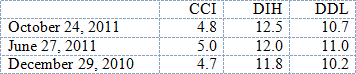
None of the reports bother to speak of one of the most important issues for shareholders and that is the performance of the companies’ shares on the Stock Exchange. A comparison of recent prices is shown below: