
Amaila: ‘Deals within a deal’

Introduction
Mr Hinds’s intervention on the Amaila issue came one day after the press carried a report that hydro-electric “pioneer” Mr Fip Motilall had received approval for the transfer of a licence to Sithe Global, which some time in 2002 he had been awarded under the Hydro-Electricity Act Cap 56:03 to develop a hydroelectric plant at Amaila Falls.

Letting the cat out of the bag
It is important to nail the myth that Mr Motilall pioneered the Amaila Falls project. The studies on that Falls’ potential were done in the 1970s, and Mr Motilall was given access to them by this administration. If the Prime Minister would care to read from his own website, he would notice that the feasibility study done by Kaehne Consulting Ltd for the government in 2002 described Synergy/Harza as “developers.”

It was the senior Vice-President of Sithe, Mr Jim McGowan who on Thursday last at the Hotel Tower, let the cat out of the bag when, in answer to a question from the press at what was supposed to be a road show, said that his company had “acquired Synergy’s interest in the licence.” Neither he nor Mr Philip Mooney, the consultant to the project appeared to know that the law provides first for an interim licence and then a final licence, or the difference between the two. Indeed, Sithe is acting as if it has a final licence and one wonders whether the pattern of non-compliance with the law will continue despite the increasing scrutiny.

In a series of five columns I did in May-June 2010 I pointed out the amazing level of unfamiliarity with key provisions of the Hydro-Electricity Act demonstrated by no lesser persons than President Jagdeo and the Head of the Presidential Secretariat Dr Roger Luncheon, and the confusion they have sown with throwing around figures and relating one story to another. Mr Hinds now completes the triumvirate when he asserts, in clear contravention of the law, that he had authorized the transfer of the licence from Synergy to Sithe, something which only the President is authorized to do.

PM’s understanding
There is nothing about the project that Mr Hinds says now or has said before to suggest that he knows anything about the law relating to hydro-electric power or the facts pertaining to Synergy/Sithe. The law provides for the payment of rent and royalties under an interim licence; the publication by the Chief Works and Hydraulics Officer in the Gazette of any application for a licence; the posting of a bond as security for performance; that “a licensee shall at all times have an office in Georgetown”; that the licence must state “the date of each permit and extension thereof which may have been issued in favour of the interim licensee; and a statement whether the requirements thereof and of the Regulations [published under the Act] have been fully complied with by such interim licensee.”

Exactly one month ago, on Friday April 15, 2011, in the face of mounting confusion sowed by Luncheon and Jagdeo on the one side and Synergy and Sithe on the other, I publicly asked Dr. Luncheon to use his influence to have publicised “the licence(s), extensions, agreements including that of May 2006, and the terms and conditions for cash and other inputs by the government towards the Amaila Hydro-electric project.” This has not been done.

The triumvirate could not make available what the law requires but suddenly the Prime Minister shares the details of the agreement which Mr Motilall had concluded with Sithe, including the US$5 million dollars in “cash and unpaid time since 1997 in helping to develop the Amaila Falls Project.” Does Mr Hinds not know that “pioneers” also make side deals and that the costs he claims Mr Motilall expended are not reflected in the financial statements of Motilall’s company?

Pioneer’s profits
In matters relating to Amaila Mr Hinds has shown a remarkable tendency to mis-remember and mis-speak, and anyone who takes his words seriously risks being misled. What is very clear is how poorly the Prime Minister is informed about the project and how little he appears to care about its consequences for the consumers and taxpayers of this country. He did give an indication of how much Mr Motilall will benefit from his pioneering efforts by volunteering that “depending upon the profitability of the project the pioneer would receive multiple of his investment in cash and time.” A multiple of two means twice US$5 million, a multiple of three means three times, etc. With Sithe being the most expensive hydro-electric developers in the world, there are several multiples accruing to Mr Motilall. That licence should have been cancelled, but it was not. Did I hear someone say Simon and Shock International Logging Inc and Vaitarna?

China Railway
At what was described as a forum to consult with the public, Sithe billed China Railway as the contractors for the construction of the hydro-electric plant, although under questioning its senior officers admitted that there was as yet no contract between Sithe and China Railway. What is particularly interesting is that the China Railway Group lists on its website its core business as railway construction and including “infrastructure construction, survey, design and consulting services, engineering equipment and components manufacturing, as well as property development.” Despite extensive search on the group’s and its subsidiaries’ websites, I could find no trace of the Chinese company being engaged in hydro-electric plant construction. It is difficult therefore to comment on the confidence which Sithe is placing in the China Railway Group as their preferred contractor.

Guyana and GuySuCo are reeling from lack of demonstrated expertise by Chinese contractors for the Skeldon Sugar plant which cost the country nearly two hundred million United States dollars. We as a country would want to avoid a similar experience and should do our own due diligence on the Chinese Railway. We have been far too gullible in the past, at great cost to the country.

Sithe’s contribution
At the consultation at Tower Hotel, we were told that the total project cost was US$675 million and that Sithe’s principal – the Blackstone Group – was putting in US$200 million in cash, a proposition not borne out by other information. President Jagdeo not too long ago had announced that the final cost for the hydro will be US$306 million, the transmission line US$145 million through a public tender and US$150 million is there for contingency and interest cost.” That leaves US$75 million of the US$675 million to be accounted for.

It is unusual for a fixed price contract to have a contingency but even a 10% contingency would amount to only US$45 million, so that the interest cost during construction will be $105 million. If as Sithe’s representatives said, Blackstone is putting in US$200 million and we know the government plans to put in US$70 million of Norwegian funds, then the balance needed is US$181 million, to finance expenditure progressively over the 3-4 years construction phase. If the interest is a minimum of $105 million during construction, one is looking at an interest rate of in excess of 30%!

But there is more. Blackstone is an investment and advisory firm that specialises in putting deals together, not financing other people’s projects. As its website states their “alternative asset management businesses include the management of private equity funds, real estate funds, [hedge fund solutions], credit oriented funds [and] publicly-traded closed-end mutual funds .. and various financial advisory services.”

Sithe’s role therefore appears to be a higher form of deal-making than Motilall’s, putting no money into the company but walking away with tons of money as the project’s developer. Needless to say, it is the country’s consumers and taxpayers who will pay.

Electricity cost
The interest cost referred to by President Jagdeo only goes up to the point of completion. If at that stage the project would have cost US$675 million, interest for the duration of the licence will cost hundreds of millions again. The management of the Guyana Power and Light Inc and the Public Utilities Commission need to get involved.

But at this stage they, the taxpayers and consumers are either in the dark or totally quiet, with no clue as to the price consumers will pay for electricity when the hydro-electric power starts to flow. The information I have is that any savings on fuel costs will be used to pay interest costs so that while the country will save on the fuel bill, the consumers will not be better off, at least for a couple of decades. That probably sums up the Amaila deal and sub-deals.
On the Line – Annual Reports of the NIS 2008 and 2009

Introduction
As it enters its forty-second year as the workers’ retirement and short-term insurance fund, the National Insurance Scheme is facing one of its most serious crises ever. For several years during the Burnham Administration which set up the Scheme in 1969, its surplus funds were treated it as a source of cheap borrowings by the Government. I recall first looking at the finances of the Scheme with trade unionists Lincoln Lewis and Nanda Gopaul in the mid-to-late eighties and our shock at seeing all the investments in long-term, low-interest (5%) government paper when the inflation rate was considerably higher. Now, with seemingly more investment freedom, the Scheme is actually doing worse, partly a measure of the absence of quality investment opportunities in the economy.

In the context of its current travails, it is more than ironic that its 2009 annual report tabled belatedly in the National Assembly along with its 2008 report, has a creative cover design with the words “Embracing the Future….. Reaching New Heights!” As part of its near-term challenges, the Scheme’s directors must ponder about the safety of more than $5.8 billion the NIS has tied up in the collapsed insurance giant CLICO Life and General Insurance Company (SA) Inc. Readers will recall that the Guyana courts last year ordered the company to be liquidated after its parent in Trinidad and Tobago had over-extended itself and sought the protection of the Central Bank in that country. Within months, all the CLICO subsidiaries, from The Bahamas in the north to Guyana in the south, fell like pins at the bowling alley.

The CLICO fiasco
For several years, the NIS had over-exposed itself to CLICO, with its investment in that company – according to Finance Minister Dr. Ashni Singh – at one time running at about 40% of the Scheme’s assets. President Jagdeo too had described the investment as “bad” but they were defended by Dr. Roger Luncheon, the Board’s chairman since 1992, on grounds of “comparative analysis …. with other simultaneous investments”.

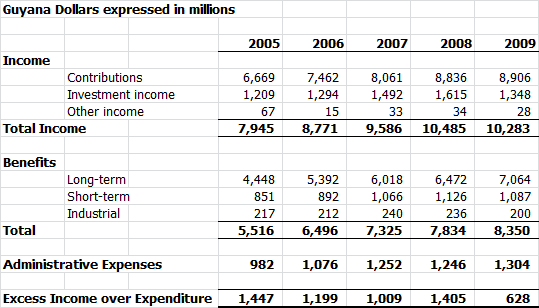
The Scheme derives its income from contributions and investments. Mature Schemes expect that as contributors retire, investment income from the accumulated savings would account for an increasing share towards the heavy cost of long-term pensions. That did not happen in 2009 when long-term benefits increased by 9.2% while investment income fell by 16.5%, from $1,615 million to $1,348 million. Total expenditure, mainly on benefits and administration costs increased from $7,835 million to $8,351 million, or 6.6%. This does not mean the Scheme is in immediate danger of collapse. It is not. On an annual basis benefit payments are still covered by contributions and the Scheme has liquidity cushion in the form of billions in fixed deposits in the commercial banks.

What is happening though is that partly as a result of CLICO, net income is falling at a rate that even the actuaries could not anticipate when they did their last review in 2006. Moreover, the viability of a Scheme is measured not by traditional cash flow models but by long-term considerations since a worker pays today to receive pensions well into the future. And if the Minister of Health is right about life expectancy increasing, the amount the contributor will receive in long-term benefits also increases. To deal with that danger, consideration has been given to increasing the NIS pensionable age but that is unlikely to go down well with the public.

Five-year summary

Source: NIS Audited Financial Statements

Section 37 of the National Insurance Act requires an actuarial review at least every five years, although the better view is for triennial reviews. Ever since the 2006 review, the financial statements consistently note that the Board is “reviewing and implementing the above actuaries’ recommendations.” That slothfulness is a luxury the Board cannot afford given that the actuaries had warned that using an intermediate scenario projection the Scheme’s expenditure would exceed its income in 2015. It now seems that even before taking any loss on the CLICO investment, the critical point will arrive long before 2015, and possibly in this very year.

The President and Vaitarna
One hopes that the directors will wake from their slumber and that there is a reversal of fortune. But for the government to make good on President Jagdeo’s pledge that the “NIS has not lost a cent because …they will be paid back”, taxpayers will be carrying the can for all those individuals and entities who got taken in by CLICO’S Ponzi-like interest policy to attract money to finance its parent’s Bahamas operations. The President, willingly or unwittingly, for reasons which we can only speculate, is prepared to compensate risk-takers in CLICO at the expense of the pensioners, workers and the NIS, one of the country’s most important and enduring institutions.

The President at the National Cultural Centre fifteen months later backpedaled and committed his government only to very specific sums for the CLICO recovery efforts – $3 billion from the Petroleum Fund and another $600 million from a source he did not then identify. It now seems that that money has been unlawfully diverted from the Guyana Forestry Commission in a transaction with Vaitarna Holdings Private Inc. which took over a Timber Sales Agreement previously held by Caribbean Resources Limited, a CLICO subsidiary. On that occasion, the President spelt out how the money was going to be used – to pay CLICO’S 4,366 holders of Executive Flexible Premium Annuities and 39 policyholders with balances in excess of $30 million who he said would receive the remaining $900 million, “up a maximum of $30 million each, with priority being given to non-institutional policyholders.”

Chicken feed
Not only did this exclude the NIS as an institutional policyholder, but $30 million is chicken feed to the $5.8 billion it has in CLICO. And there was worse coming from the President when he indicated that for purposes of the payout, “the balances outstanding would be those as of the time that the judicial management commenced, that is, February 2009.” Taken literally, that means that there will be no interest after February 2009 when CLICO went bust. If that is the case, then the NIS will have to write-off all the income it has taken up in its books from that date.

For some inexplicable reason the auditors of the Scheme appear to have misinterpreted a letter from Dr. Roger Luncheon as a guarantee on the basis of which they gave an unqualified opinion on the Scheme’s financial statements. If they were aware of all that was taking place around CLICO, they would have insisted on no income from the investment in CLICO being recognised and for the investment to be marked down. If the directors refused to do that, the auditors should have qualified their opinion rather than take the soft option of an emphasis of matter.

There are two favourable possibilities. Although the President’s remaining term can now be counted in months, if his Party is re-elected it is likely to feel compelled to pay the NIS the full principal and interest it has outstanding in CLICO. In this quasi-legal liquidation, there are only a few pension funds to challenge for parity of treatment. Second, with those pension funds paid off, the NIS will be the only entity entitled to the proceeds from disposal of CLICO’s remaining assets. For the NIS, the CLICO’s investment could be a major stumbling block in the 2011 actuarial review unless it is resolved by that time. I repeat however: any sums paid out of the Treasury constitute a cost to the taxpayers, plain and simple. Yet those very taxpayers and their representatives are completely in the dark about the various ways that the government will bail CLICO and its directors out of the illegal mess that they have created.

Valuable statistics
The NIS maintains some excellent statistics on its contributors and beneficiaries and I believe that it has been making real effort to address the weaknesses in its contribution records, some of which may never be resolved as employers have gone out of existence. Some of the statistics seem counter-intuitive or hard to explain. For example, is it credible that in 2010 there is less than half the number of self-employed contributors as there were in 1997 or that the number of active employed contributors is less than it was 20 years ago? I think not.

The future
The next actuarial study will be most instructive and will give an indication of what the future holds. Failure to act on the 2006 recommendations will make the 2011 recommendations that much stronger. The future calls for fresh ideas, boldness at the Cabinet level and new blood in the Board. Several of the directors – who are very much part of the problem – have been there since 1992 and most of the new appointees are due to ex officio changes, so for example Ms. Doreen Nelson replaced Mr. Patrick Martinborough on his retirement as the Scheme’s General Manager and Ms. Linda Gossai replaced Mr. Edward Layne on the Board after she succeeded him as Accountant General. The Board may even need individuals with paranormal qualities to exorcise the ghost of CLICO. Only then can they start thinking of a future.

NIS annual report does not provide any evidence of a guarantee of the $5.7B CLICO investment

Dr. Ashni Singh, Senior Minister of Finance last week tabled in the National Assembly the annual reports and accounts of the National Insurance Scheme for the years 2008 and 2009, late to extremely late under the law but quite normal for this Minister.

Business Page in this coming Sunday Stabroek will place these reports under the microscope but for now there is one egregious matter which I think deserves the widest exposure and that is risk to the Scheme of losing $5.8 billion invested by the NIS in the failed CLICO Life and General Insurance Co (S.A.) Limited. At December 31, 2009 the NIS had invested in CLICO’s so-called annuities the sum of $5.748 billion, in addition to $90 million of income earned but not yet received from CLICO. The reality is that because of this reckless and possibly unlawful investment by the board in a Jagdeo-favoured company, 20% or $1 of every $5 of the accumulated fund of workers’ contributions in NIS is now at grave risk, earning nothing in income. The board and its auditors TSD Lal & Co. do not seem particularly concerned.

Perhaps the board and the auditors, which by an unfortunate coincidence are/were also the auditors of CLICO, did not consider the investment bad or doubtful. TSD Lal & Co refers unambiguously in their audit report to a guarantee by the government of the NIS’s investment in CLICO and directs the reader to Note 22 in which the directors too, refer to a guarantee, but in looser language but which appears to have escaped notice by the auditors. The further information provided in note 22 does not by a long stretch provide any evidence of a guarantee but rather proof of a clear conflict of interest between Roger Luncheon, M.D. Chairman of the NIS Board and his position as Head of the Presidential Secretariat, a conflict that would put any careful auditor to great care and, in the circumstances of CLICO to extreme notice. Instead, the auditors and the Board were so impressed and reassured by a mix of quasi-legal/accounting “Luncheonese” that they accepted the following as constituting a guarantee.

“The Chairman of the National Insurance Scheme who is also the Head of the Presidential Secretariat at the Office of the President made the following representation in a letter dated 10th. August 2009:

“The Board of the National Insurance Scheme wishes to advise that it has noted the undertakings made by the President concerning the recovery of NIS investments in CLICO. The Board is also mindful of the unanimous Parliamentary Resolution guaranteeing state support for recovery (emphasis mine) by NIS of its investments in CLICO. As such, the Board has the utmost confidence that the undertaking would be honoured and the investments of NIS in CLICO will be recovered.”

Had the Board not included long-serving and experienced directors like Maurice Solomon FCCA and Paul Cheong, a top director of the Beharry Group, I would have said that it was a case of Luncheon taking the workers of Guyana for a $5.8 billion dollar ride. That he managed to take others along with him is a feat that only a Luncheon would contrive and succeed with.

Other than in note 22 – not Catch 22 – the directors did not even bother to refer to its CLICO exposure in their annual report. A serious Minister of Finance should have referred the report and its undated transmittal letter back to the Board for major revision. Dr. Singh accepted it.

If the investment is not recovered in the very near future, it will be drastically discounted (reduced) by the actuaries in the periodic evaluation on the viability of the Scheme due later this year, with the workers as contributors, bearing the cost. And if it is “recovered” from the public purse, the workers will still bear the cost, this time as taxpayers. In either case, that would leave President Jagdeo, Ms. Gita Singh-Knight of CLICO, Drs. Luncheon and Singh, the entire board of the NIS and its auditors, with varying quantities of red ink indelibly oozing from their hands, without having to bear any other responsibility for the consequences.

Hopefully, Minister Anthony will now answer the unresolved questions about taxpayers money

The most recent letter signed by Mr. Neil Kumar `When was the last time the GLTA submitted an audited financial report to the National Sports Commission? SN April 30, 2011) convinces me that but for the political route, people like he, Mr. Kellawan Lall and Mr. Kwame McKoy do not deserve and could not have achieved public office in this country. Mr. Kumar, Director of Sports and CEO of the defunct National Sports Commission signed a letter, ostensibly in response to a Business Page article on the considerable resources inefficiently and improperly managed by the Ministry of Culture, Youth and Sport.

Because of our experience with the vindictiveness of the Ministry, I do not wish to draw the GLTA into this matter but since integrity and truth are being compromised publicly, I have no choice but to deal with the misrepresentations and distortions of substance raised by Mr. Kumar. This exchange provides the Minister with the ideal opportunity to rise above the petty vindictiveness of which so many sporting and arts bodies have been victims.

Specifically the column challenged, among other things, the Minister’s failure to account for World Cup money since 2007 and to account to the National Assembly and to taxpayers for hundreds of millions of dollars allocated to the Arts and Sports Development Fund which is operated secretly like a slush fund, away from the knowledge of the intended beneficiaries. Rather than the Minister responding to what is a serious allegation touching on public accountability and impropriety, Mr. Kumar exposed his little understanding of the issues and embarrassed himself by putting his name to letters he cannot defend, quoting secondhand information he cannot support and referring to secondary legislation that does not exist.

Common sense should have cautioned him to check whether there is such a thing as “National Sports Commission (NSC) … regulations” before asking the question under the caption referred to above. Had Mr. Kumar any idea or appreciation of the generally coercive nature of legislation he would have known that no sports organisation, including the GLTA, would have any obligation, as a matter of routine, to submit audited financial statements to the NSC.

On the other hand because the NSC is a statutory body (in receipt of hundreds of millions of public funds), its governing legislation requires it to have its report of activities together with a copy of the statement of its accounts audited and laid before the National Assembly not later than the thirtieth day of September in each year (emphasis supplied). Since Mr. Kumar did not understand the question I asked in my letter of April 24, I am now putting it to his Minister to tell the public the last year for which the report and audited financial statements of the NSC were laid before the National Assembly. Just parenthetically, the audited 2010 financial statements of the GLTA were approved unanimously by its membership in March 2011. Out of courtesy to the Minister and Mr. Kumar, I will ask the GLTA’s Treasurer Ms. Anita Rampersaud-Sawh FCCA to send them copies immediately.

On the issue of what the GLTA demanded from the Minister of Culture, Youth and Sport, since Mr. Kumar was not at the meeting with the Minister I am proposing to make public my entire notes of that meeting. But the Minister must do likewise and not rely on others coming to his defence with amateurly written letters as we have seen recently. Those notes will clarify two other matters which Mr. Kumar misrepresented in his most recent missive: one, the person who undertook to arrange a meeting of the Ministers of Education and Sports and the President of the GLTA in connection with a Schools tennis co-ordinator, and second, that by early 2010, the life of the NSC had expired more than two years earlier. To save Mr. Kumar from another factual misrepresentation and embarrassing exposure, I caution him that any appointment/re-appointment requires publication in the Official Gazette.

There is no useful purpose to be served in any further engagement with Mr. Kumar who is advised to write the Secretary of the Guyana Tennis Association for any information or clarification he may require in connection with the Association. The issues first raised in Business Page and in this letter involving billions of dollars of public money as well as the governance of the Ministry of Culture, Youth and Sport are addressed to the Minister under whose portfolio they fall, not Mr. Kumar. Hopefully the Minister will now address them with the same speed with which he pursued correspondence with the CEO of the West Indies Cricket Board concerning its team selection policy.

The plight of the labour movement, through the prism of the teachers deal

Introduction
Even as mainly organized labour assemble at their various points today to march in silent resignation, listen to flat speeches from their leaders, numb their plight and pain with music, food and liquor produced by their colleagues for the profits of the investing class, the evidence so overwhelmingly confronting their membership on this Labour Day points to a movement that is in complete crisis, their numbers in decline, their leadership in disarray, their unity in tatters, and their very survival in question. Almost every issue that has faced workers recently, be it RUSAL’s attempt at union-busting; the teachers’ union imaginary giant leap; government’s withdrawal of Critchlow Labour College subvention; the de facto abolition of collective bargaining in the public sector; the CLICO-induced six billion dollar hole in the NIS financial statements, or politicking by some of the movement’s leaders, would make an excellent case study for any thesis on the Collapse of the Labour Movement in Guyana.

Yet, a country whose first two modern-day leaders came out of the bowels of the labour movement cannot find a single person with the interest and inclination to engage in such an exercise or produce a leader with the capacity to heal the rift, stem the tide, deliver hope or start the debate. Indeed even an intellectually curious economist, touting past working class credentials and harbouring future presidential ambitions confesses to an ignorance of the number of unemployed, while more truthfully demonstrating insensitivity to the plight of that class. The state of the workers is probably mirrored in the paucity of statistics compiled by the movement, academia, and the national institution with the duty to produce such data. We are after all in a market-based, low-wage economy in which the users of labour care only about the maximization of profit, whether at the expense of the state, the consumer or labour.

Physical and psychological blow
The Economic Recovery Programme introduced by Mr. Desmond Hoyte and his team dealt a physical blow to the public sector. The PPP/C has added the psychological coup de grace, crudely using the carrot and stick to compromise and destroy the leadership, not caring about putting even their own supporters on the breadline. In the not too distant past, the interest of the worker and the leader coincided to such an extent that leadership in the movement was merely a function, as they collectively and individually faced the same struggles and felt the same hardships. Now, the only thing they share is as occupants of George Orwell’s Animal Farm, the interests not only having diverged but sections of the leadership having become the instruments of the exploiters, sorry I meant employers. What hope is there for those destined to remain workers or to be part of that pool of the unemployed or near unemployed – the unwaged housewife and single mother, the Amerindian made to depend on handouts from the coast, the rural poor on the goodwill of the “plantation” owners, the petty trader from meagre sales, and even the employed on remittances from abroad.

With such challenges facing the country, what prospects are there for the transformation of the economy into one that is competitive by regional and international standards, where businesses benefit from an expansion in aggregate demand, the economy from new investments, workers from new opportunities and the state from additional taxes? How do we escape the trap of having proudly marketed ourselves as a low wage economy characterized by low demand and low investments into a new and dynamic one, capable of delivering the standard of living compatible with basic human needs? How do we re-invent our educational system to make it serve their own advancements and the needs of industry and commerce, and yes, where would the resources come from? And how do we stem the migration of our brightest and even those not so bright?

Every issue or challenge that faces the worker or the member of the working class – whether employed, unemployed or under-employed – has direct and immediate implications for the employer, the economy and the country. A worker who is underpaid or undernourished is hardly likely to be a productive worker; the single parent earning no or low pay cannot provide for a learning child; the unemployed cannot contribute to enhancing aggregate demand. It is such a huge challenge that no one seems willing to admit, let alone confront it. Failure to recognise or confront it is more likely to lead to migration than solution and while with each person migrating the number of unemployed will fall by at least one unit, so too will demand for goods and services. It is the classic case of Catch 22.

The effects of the ERP, the money-driven privatization process that threw workers to the wolves, the introduction of a market-based economy in which social benefits are assigned no value, where the private sector is permitted not only to exploit labour but to corrupt and bribe public officials and the state, to evade taxes with impunity and to ignore laws and rules at their leisure, have combined to inflict a stifling effect on the economy.

The teachers union did not learn
As we approach elections 2011, the evidence is that the votes of the working class can either be bought or taken for granted. Economics or workers’ own personal circumstances it seems do not alter the voting dynamics, perhaps the only thing about labour that the political leaders seem to understand and then exploit. The teachers “settlement” is a classic case on this Labour Day. Let us look at it. In 2006, the government and the teachers union signed their first five-year pact (2006-2010) that included an annual 5% plus a one percent performance-based incentive, some non-cash benefits such as scholarships to 100 teachers each year, clothing allowance and duty-free allowance for one-off duty-free concessions for vehicles for 100 head teachers per year. It also included a housing revolving fund of $40M.

What was not given any prominence was that the Union was paid some money, the sort of sum given to GAWU last year as part of a “dispute settlement” resolution. President Jagdeo, who had been driving the negotiations for the government, found this was a small price for the government to pay for the union’s weakness and capitulation. It is not known how many head teachers benefitted from the duty-free concessions or teachers from the scholarships but what is certain is that the revolving fund was never set up.

For those teachers who were below the threshold for the payment of income tax at thirty-three and one third percent, the settlement will keep them in poverty. For those above, the net increase – assuming they all received the 1% incentive – was 4%, i.e. two-thirds of six percent. Over the five years, inflation averaged 6.5 %. In other words, the teachers at the end of the 2006-2010 deal were worse off than they were before, notwithstanding a gift made to them by Jagdeo in 2007. You would think that teachers would learn but clearly not their leaders.

Giant step – backward
Having been taken along in a game described by the union’s leadership as “tough negotiations” in which Jagdeo again played the leading role for the employers, the union which had sought a 15% increase, accepted a new five-year agreement providing for an annual five percent pay hike. On this occasion the goodies were a renewed agreement for the non-cash benefits that the government had failed to pay under the previous five year deal. Mr. Colin Bynoe, the union’s president in a clear slip of the tongue described the deal as a “giant step”. He left out the word “backwards”.

As Mr. Earl John, a human resources specialist pointed out in a letter in Friday’s Stabroek News, no negotiations were needed to get five per cent. That has become the standard gift from Jagdeo, confirmed by him at a press conference in October 2007 when he said of negotiations then taking place with the public servants: “If they are not concluded [soon] we are going to have to do like what we did in other years and make a payout to the public servants.”

With Mr. Bynoe’s giant step, 100 teachers will get house lots each year so that in one hundred and thirty years all teachers will have earned a house lot. And with the $40 million housing revolving fund, at even an average loan of $2 million per house, twenty of those teachers will be able to access the fund. Every other Guyanese it seems, their brother and their friend, is entitled to a house lot. For the teachers they have to agree to what in real terms is a five year wage freeze.

The result is that for the next five years, Guyana will continue to have the lowest paid teachers in the region; will invest hundreds of millions each year preparing Guyanese teachers for migration; both teachers and students will continue their high rates of absenteeism from the classroom; students will pass through the classroom rather than pass their examination; and the leadership of the teachers union can take a five-year sabbatical until just before the current agreement runs out.

Better leadership
Our teachers deserve better leadership and a more enlightened attitude from their employers than the kind of success Minister of Education Shaik Baksh could crow about. But the same can be said of many other unions, in the public as well as private sector. Ask any public servant of any achievement of their union in the past five years and they would be at a loss for a charitable answer. Ask the workers in the low paying shops, factories and farms what the labour movement has done for them and the instinctive answer will be nothing.

Ask the bauxite workers and you will be told that the government and the Minister of Labour Manzoor Nadir have colluded with RUSAL in union-busting. Ask other workers seeking union representation and they will tell you of impediments rather than empathy from the Trade Union Recognition Board. Ask the United Minibus Owners and they will tell you how the government brazenly engages in blacklegging operations. Ask the lecturers at the University of Guyana and they will tell you that like the rest of the public service, they too accept imposed salaries and conditions rather than defend their rights to bargain for adequate compensation for their services. For the workers, there are only questions and hardships. It is a short-term gain from an unfortunately near-sighted strategy by the government. In the end, the whole country loses, excepting the ruling class and the exploiters for whom the strategy seems designed.

The past decade has not been a good one for the workers. Today’s Labour Day will not change anything.