
Finance Ministry’s budget relies on Norwegian funds

Introduction
Today’s column resumes the review of the 2011 budgetary allocations to the principal ministries of government. Two of the ministries covered so far were the Ministry of Education on February 27 and the Ministry of Education on March 6. Today we turn our attention to the Ministry of Finance which in 2011 was allocated $18.3 B on the recurrent budget and $17.4 B on the capital budget, making a total of $35.7 B.

A summary of the expenditure as contained in the 2011 Estimates is as follows.
As a percentage of the national budget, the Ministry of Finance accounts for 18.4% of the recurrent budget and 28.0% of the capital budget. This makes it the single largest spending ministry in the government, and it is perhaps surprising that its capital budget is bigger than that of the Ministry of Public Works and Communication.

What is also significant is the increase over 2010 – a massive 64.3% increase with the bulk of it on the capital side. This is largely due to the proposed spending on LCDS projects including equity spending on the Amaila Falls Hydro-electricity project.

The Ministry
Like the Ministry of Health, this ministry has two ministers, with the junior minister Ms Jennifer Webster playing a more low-key, back-room role while the senior minister Dr Ashni Singh, brought in after the 2006 general elections as a technocrat is increasingly copying the style and language of his mentor, President Bharrat Jagdeo. That style has not endeared him to the diplomatic and multilateral financial community, and many observers think that that may be responsible for the closing of the development agencies DFID and USAID as well as the relocation of the office of the head of the World Bank mission in Guyana.

The World Bank office came in for a scathing attack by Dr Singh who accused the bank’s staff here of having “one of the largest appetites for publicity and self-promotion” and seeking to increase their “creature comforts” by relocating to “a grand former colonial residence opposite one of the city’s most fashionable cafés.” Coming in for his tongue-lashing was the Economic Intelligence Unit which had dared to question the final outturn for 2009 after the economy had performed poorly in the first three quarters. It was a case of how dare they question him.

His shutting out of critical views by draconian legislation on the New Building Society, his refusal to approve proposals by micro-projects for EU funding and his refusal to canvass views prior to his annual budgets all demonstrate an intolerance for opposing views that is inconsistent with a true technocrat.

Staffing
This is another of those ministries where the percentage which the number of contract employees bears to the total number of employees exceeds 40%. It is in fact 43.4% but it accounts for 72% of the total wages and salaries of that ministry. If one excludes the junior staff who according to Labour Minister Manzoor Nadir, were recently shifted to the category of contract employees, the share of the wages budget that is paid to contract employees is huge, very huge.

In the current budget of the Ministry’s Administration, three line items account for 94.06 % of the total as follows:
$B
Revision of wages and salaries 3.5
Electricity charges 2.5
Subsidies and contributions to local organisations 6.3
12.3

In the Government Accounting Administration two line items – statutory pensions and gratuities ($2.2B) and Pension Increase ($2.1B) – account for 82.4% of this programme’s activity.

Subsidies and contributions
The entities in receipt of the largest contributions were the Guyana Revenue Authority ($3.1B) and LINMINE for community power ($2.2B). It is of some interest that notwithstanding a decision of the court, the GRA is treated for the purposes of its expenditure as a separate entity while its entire income goes into the Consolidated Fund.

Other significant subsidies and contributions were made to organizations, some of which are of doubtful legal status, while that of their audits is even less clear. The principal ones are:

$M
Customs Anti-Narcotics Unit 99.2
Ethnic Relations Commission 89.1
Kwakwani Utilities Inc. 253.5
State Planning Secretariat 130.1
Statistical Bureau 172.0
Total 743.9

Capital programme
Under the capital programme are such hazy projects as:

$M
Road Support Project 150
Basic Needs Trust Fund 650
LCDS Projects 14,350
Student Loan 450
Poverty 717
GuySuCo 440
Total 16,607

The projects earmarked for funding under the LCDS programme are “Amaila Falls equity” which can surely mean anything and everything, Amerindian Development Fund and Land Titling, and Fibre Optic Cable.

Conclusion
But for the interventionist style of the President, this would easily be the most important ministry in the government. In addition to his several functions and duties under the Fiscal Management and Accountability Act 2003 which he sometimes conveniently ignores, Dr Singh is also the subject minister responsible for the Bank of Guyana, the Guyana Revenue Authority, the Bureau of Statistics, the National Insurance Scheme (NIS) and the Office of the Commissioner of Insurance. Under the Bureau of Statistics Act, 1991 unless he appoints a chairman of the bureau he is automatically the chairman, making him the scorekeeper of his own performance. And as subject minister, he seemed blissfully uninformed about the failure of the Office of the Commissioner of Insurance which allowed Clico Guyana to conduct its affairs in the most reckless manner and caused the NIS to have a yet-to-be filled hole of $6 billion.

Even though the major bungling and the public pronouncements on the tax concessions to the Ramroop group by Mr Jagdeo took the spotlight off Dr Singh, he was in fact at the centre of the fiasco, having had to look at it from three different perspectives. To his further discredit, Dr Singh also chairs the board of NICIL, the state-owned company that simply refuses to conduct its affairs in accordance with the law.

The Minister regularly publishes the mid-year report with misleading dates. He was cited by an opposition MP in the $4B transaction with GuySuCo in which his colleague in the Ministry of Housing was found to have a prima facie case made against him for misleading the National Assembly. There can be no doubt that Dr Singh would have known and went along with the transaction. But if there is a single issue for which this Minister will always be remembered is that while he served as Senior Minister of Finance, his spouse was effectively the Auditor General. That is an extremely convenient arrangement, but one over which few would be prepared to risk their reputations, and which will overshadow Dr Singh’s tenure as Minister during which he reported growth in each year.

Next week I will review the annual report of the Guyana Bank for Trade and Industry Limited which has published a notice of its AGM.
The President hides under the apron of the constitution’s immunity clause

The commemoration ceremony for the late President, Dr Cheddi Jagan, at the cremation site at Babu John in Berbice has a strange and profound effect on President Jagdeo. It is as if some weird spirit causes his newly minted doctorate in literature to desert him in favour of palpable fabrication; his natural immaturity to descend into inexplicable recklessness and the stature of his presidency into miasmic freefall.

A couple of years ago the spirit caused him to tell his dumbfounded Babu John audience that if the PNCR was returned to power, the same people who were stealing guns would be given them. This year it is about blood and its target is that party’s presidential candidate, retired Brigadier David Granger against whom the accusations were so beyond the pale that even Jagdeo’s preference as presidential successor Mr Donald Ramotar sought to rephrase the accusation describing it euphemistically as “a bit harsh.”

Once again, the President abuses the country’s constitution to make defamatory statements about others while hiding under the apron of immunity article in the constitution. He knows – or rather thinks – that he has such absolute and unqualified immunity under the constitution that he cannot be prosecuted for anything. I doubt whether the framers of the constitution would have intended the constitution to be interpreted in such literal and absurd sense. Yet, his confidence – or recklessness – seems to lead him to believe that he can, with impunity, accuse others of being incompetent, habitués of rum shops, man kisser, etc.

When Mr Freddie Kissoon, whom Mr Jagdeo regularly abuses and defames, uses a term which the head of state regards as offensive to describe his presidency, Mr Jagdeo runs to the court for financial compensation for loss of reputation. In the process he also sought and obtained a silencing order (injunction) against Mr Kissoon, an order that has been challenged but not heard by the court. One hopes that when the court calls, Mr Jagdeo will be courageous enough to take the stand and answer questions about his presidency and his conduct over the past several years.

Meanwhile, I believe that in Mr Granger, Mr Jagdeo has more than met his match. Now that Mr Granger has stood up to him, we wait to see what he will do.

The spending on health

Introduction
An appendix to the budget speech includes some very useful indications about the health of the nation. Here are some of those statistics:

These data tell a mixed story with some interesting variations. For example while the number of deaths per 1,000 of the population for infants (under 1 year) has declined significantly since 2006, the same measure for the under fives has remained almost constant. The percentage of the population that is severely malnourished has halved over the same period indicating a fall in the number from 3,043 persons to 1,556 persons. At the same time the number of persons who are moderately malnourished has fallen from 44,881 to 42,785, although it increased in 2010 when the economy reported favourable growth.

On the positive side too is the rapid growth in the number of doctors from 373 to 537. On the other hand the number of nurses in absolute terms has declined from 822 to 786, suggesting that the doctors now have fewer support staff with whom to work. Now that the government has taken a decision to import skills it is not unlikely that it may move to fill the many vacancies at this level in the health system.

Details of expenditure
Agency Details

It is important to note that there is other expenditure to fill in the wider picture. The Georgetown Public Hospital Corporation is a separate agency in the budget and for 2011 has an allocation of $4.14 billion, or 71% of the budget for the substantive ministry. Expressed another way, the GHPC is allocated 42% of the total allocation of these two budget agencies. It is also uncertain whether there is proper accounting for the considerable sums received from various donors for different projects and programmes, with the major one being the HIV and AIDS programmes.

Over the years Guyana has been a major beneficiary of donor funds for our HIV/AIDS programmes which sought to project us as one of the region’s most infected populations. We received hundreds of millions from several sources and particularly from the US. It is unclear whether these have been accounted for in accordance with the Fiscal Management and Accountability Act which would deem the grants public money to be accounted for through the Consolidated Fund.

Capital budget
The ministry’s capital expenditure for the year is projected at $845 million with the lion’s share being $523 million under Regional and Clinical Services. Of this one hundred and fifty million dollars ($150 million) has been allocated for the “provisions [sic] for preparatory studies and designs for a Specialty Hospital”! Is this for real and was this hospital not supposed to be a free deal arising out of the President’s recent doctoral visit to India? Just improving the doctor’s quarters at Skeldon is budgeted to cost $10 million while filing cabinets, a projector, a refrigerator and chairs will cost $3.5 million. Seems that at Health, the mandate is to go for the highest bidder.

This ministry is one of the most politicised ministries with two ministers and a permanent secretary as political appointees. It is also the ministry in which more than half the employees (683 out of 1233) are contract employees with implications for their independence and right to membership of a trade union which in the main would be the Public Service Union that has had a stormy relationship with successive PPP administrations.

Lack of accountability
Now even by the standards of the Audit Office, the ministry and to a lesser extent the GHPC have had serious accounting issues over the years. In 2009 a fire of unknown origin destroyed the main building and with it financial and other records. What the fire revealed was a pattern of non-compliance with requirements to circulate copies of contracts, Tender Board minutes and basic matters like pay changes.

The matter of financing the GHPC is clearly not consistent with the requirements of the Fiscal Management and Accountability Act in that the corporation has been receiving an appropriation rather than a subvention. The explanation given for the whole question of inadequate accounting and improper financing is far from clear, but we are told that the matter has been submitted to Cabinet for consideration. What is clear is that Cabinet has shown no urgency in complying with the statutory requirements.

Similarly, the GHPC, despite annual adverse comments by the Audit Office continues to spend moneys that should properly have gone to the Consolidated Fund, because the Board approved the expenditure.

Both the GHPC and the Ministry of Health continue to buy billions of dollars of drugs with scant regard for proper tender procedures, sometimes advancing hundreds of millions of dollars to the New Pharmaceutical Corporation for drugs received several months later. It is unclear why this lop-sided relationship has been allowed to continue when the transactions with the company cannot even be verified, and again the disrespect or sheer stupidity of the excuses is hard to understand. These transactions are reminiscent of the unlawful tax concessions given to the group of which this company is a key component.

But these are not all. The ministry fails to adhere to the FMAA in relation to unspent balances causing the national accounts to be overstated, and was unable to provide satisfactory evidence to support the purchase of some $20 million of fixed assets.

Conclusion
There seems more than mere financial lawlessness at this ministry of which one of the ministers had once famously said he would not hesitate to break the law in some circumstances. Earlier this week the Minister of Finance made a real show of calling in the police and the Audit Office at his ministry. Seems that the Ministry of Health can do with some real forensic auditing and those responsible be subjected to serious questioning.

Correction
In the Business Page last week, I mistakenly noted that Education’s share of the National Budget has declined from 10.6% in 2007 to 9.4% in 2010. In fact these percentages should have read 17.1% to 15.3%. I sincerely apologize for the error and the inconvenience caused.

The spending on education

Introduction
The Budget debate is over and the spending is now in full flow. Contracts are being hastily awarded and colourable initiatives taken with significant budgetary implications. The President’s misnamed One Laptop per Family has begun, and despite the seriousness of the questions and the strength and logic of the criticisms, the project is proceeding as the President wants. All, it seems, oblivious to the sad state of education in the country, the many plans accumulating dust on the shelves, and the increasing disparity of performance of the poor child forced to attend the public schools and those of the powerful and privileged attending the private schools.

Just before sitting down to write – or rather type – this column I was reading the judgment delivered in fluent and beautiful language by former Chancellor Keith Massiah in the case Attorney General v Mohammed Ally delivered in 1987 in the Guyana Court of Appeal. On the question of the justiciability of the then Article 11 which has been adapted into Article 13 of the current constitution as well as enshrined in the fundamental rights article (149c), the Chancellor said: “[The question] is therefore in Guyana at large for debate and decision. Now that it has arisen, the court cannot retreat into a state of intellectual agoraphobia, refusing to venture forth and to express an opinion one way or another.” Responding to the question the Chancellor said: “I see no reason to think that the articles in Chapter II of the Constitution have no juridical relevance and are merely idealistic references with cosmetic value only. So to think would be to seek to debase the Constitution.” Unfortunately those concerned with the formulation and promulgation of our national budget have their own contrary ideas of what consultation means. By way of footnote the current Attorney General was a member of the team whose argument found favour with the Court of Appeal.

Process, not an event
This column sees financial management as a continuous process rather than an event and supports the call by Professor Clive Thomas for an independent Budget Office. With so much milk in the public purse, some competent, independent body needs to exercise greater oversight over the proliferating and omnipresent cats. There seems a view – not entirely without merit – that the absence of accountability stops with the President. In fact we only have to look across the ministries and the regions to find ministers, regional representatives and other politicos who emulate the President when it comes to careless and improper spending and accounting. In other words, such behaviour does not stop with the President but in fact starts with him. The nation therefore has to be on its guard and the fourth estate ever alert to the opportunities for improper use of the public purse.

Starting today Business Page will address with greater attention some of the spending approvals by some of the ministries and departments and intends to ask whether the National Assembly fully understands what is taking place with the finances of the country. I wonder if there is one per cent of the population which knows who the Accountant General or who the finance officer in the Office of the President is. One clue: it is not the President, despite how often and how flamboyantly he speaks and acts as if he controls the public purse or carries it in his back pocket.

‘Mis-maths’
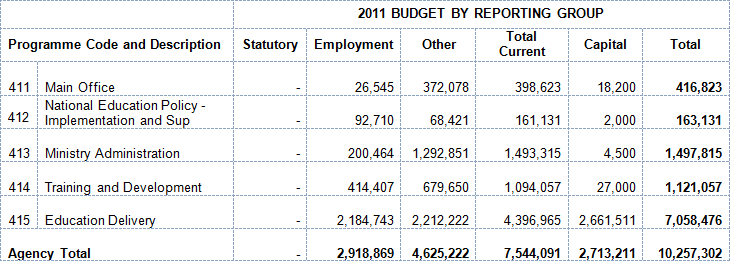
I have chosen for the first of these ministry reviews the Ministry of Education partly because of the topicality and controversy over the One Laptop Per Family project on which more than $5.4 billion will be spent. There is some uncertainty and confusion over the total cost of the programme. The junior Minister of Finance Jennifer Webster announced the cost as US$295 per computer or whatever it is, while for 2010 the total expenditure is projected at $3.6 billion, of which half is from the national budget and the other half is expected from the Chinese. If we take the number of 90,000 households, times a unit cost of US$295 and convert that at G$204 to US$1, the figure is $5.416 billion, some 50% more. I would start then by pointing out that this project is more than half of the budget for the Ministry of Education which is $10.3 billion of which the recurrent budget is $7.544 billion and the capital budget is $2.661 billion. We should bear in mind however that the regions also have budgetary allocations for education, additional to those of the ministry.

A summary of the ministry’s budget follows:

Under-funding at UG
The Berbice Campus of the university, with approximately 550 students, receives $132.6 million or approximately $241,091 per student. By contrast the Turkeyen Campus with approximately 5,500 students receives $575.2 million or $104,581 per student, a significant disparity perhaps explained by the level of fixed cost. Similarly, the capital budget for the Turkeyen Campus is $35 million while that for Berbice is $20 million.

The treatment of the university by the government might come as a shock to Vice-Chancellor Professor Carrington and his team who invested considerable resources in preparing a 2009-2012 Strategic Plan that identified under-financing as the major problem facing the university. The numbers show that the President will be spending on his Laptop programme more than seven times the 2011 expenditure on the University of Guyana.

At a meeting with the private sector last year Prof Carrington reported on an encouraging meeting that his team had had with the President and the Cabinet. He is learning faster than he might have wished about the official policy towards education in Guyana and towards higher education in particular. If it is any consolation to the university, public education as a percentage of the national budget has actually declined from 10.6% in 2007 to 9.4% in 2010.

Information versus education
In its wider Strategic Plan 2008-2013 the Ministry of Education emphasised the critical role which the University of Guyana must play in ensuring quality education throughout the education system. The Laptop programme was not even conceived when that plan was developed and agreed by Cabinet. With such ‘ad hoc-ism’ in planning, it can be no surprise that the 2003-2007 Strategic Plan failed to meet the target of “50% for students meeting the defined standards of literacy and numeracy.”

On teacher training, compare Cyril Potter which gets $87.5 million in 2011 while GINA gets $111.5 million, suggesting that for this government imparting controlled information is more deserving of public funding than teacher training. Or NCN, ostensibly a commercial entity, gets $70 million.

Interestingly enough, employment costs account for 30% of the ministry’s budget for education delivery, while in Region 4 it is 73%, in Region 5 it is 72%, and in Region 6 it is 70%. The 30% in the ministry is partly because the subventions for UG come out of its budget. An interesting comparison too would be the distribution of persons engaged in education delivery across the country. There is a wide disparity across the regions between the ratio of persons engaged in education delivery with Region 6 having the largest number in relation to population of the regions and Region 4 the lowest. Whether this has anything to do with the Ministry of Education being responsible for some schools in Region 4 is not obvious, but it is clear that this would not be true of all the schools.

No contracts
In what is described as the Main Office, eight out of the ten employees are contract employees; under the National Education Policy 21 out of 42, up from 9 out of 28 in 2010; in Ministry Administration 56 out of 194; and Education Delivery 25 out of 2,220 employees. This suggests that the pattern of contract employees does not apply to the teachers, who are among the lowest paid public employees with pay scales range from $38,554 per month to $189,006 for what is called a special scale. Again we only have to compare what happens with the so-called consultants and politicians and other connected persons, who have been placed in the Office of the President at taxpayers’ expense.

One intriguing piece of information is the item ‘Dietary’ under Ministry Administration which is $600 million, a whopping 50% increase in 2010 accounting for 40.2% of that unit’s budget for 2011. This programme appears to have escaped the attention of the Auditor General in recent years. On the other hand it might support the notion that we do in fact have 90,000 poor households in Guyana and they are in receipt of some school feeding or similar programme.

Conclusion
The state of our education system is understandable from the poor, uncoordinated or non-existent policies towards education, the failure to identify and address the problems and the misdirection of budgetary allocation by the government. More than forty years after its birth, UG is treated like an unwanted stepchild, with inadequate support and an uncertain future. Sitting at the apex of our education system, in many ways, UG epitomizes the country’s education woes which it will take more than one laptop to solve.

Next week we will look at another of the ministries.

Mr Khan’s letter ignores Section 13 of the Income Tax Act exempting only the President’s official emoluments from income tax

Of all the serious questions raised about President Jagdeo’s “acquisition” of acres of land at Pradoville 2, Attorney-at-law Mr Jerome Khan (‘President Jagdeo is not liable to pay capital gains tax after selling his house in Pradoville 1’ Stabroek News, February 15) has chosen to join issue on whether or not the President is liable to pay income tax under any circumstances.

Mr Khan’s entry in the minefield of revenue law with some constitutional implications is welcome and his reminder to readers about section 66 of the Tax Act Cap 80:01 is useful. However, his bold attempt to defend Mr Jagdeo in the absence of any attack and his description of excessive and possibly unlawful benefits as “protection of the law” may be excused as convenient and self-serving, even opportunistic to the point where Mr Khan ignores the basic distinction between what lawyers refer to as a sword and a shield. The constitution’s principal shield for the President is provided under the immunities article (Article 182) and with respect to income, only that it cannot be reduced to the holder’s disadvantage (Article 222 (3)).

Mr Khan’s reliance solely on section 66 of the Tax Act and his certainty about how the courts of Guyana and the Caribbean Court of Justice would rule in a matter that at best involves the thorny issue of a conflict of laws presumes too much and would hardly come from an experienced attorney-at-law. His letter completely ignores Section 13 of the Income Tax Act which exempts from income tax only “the official emoluments [emphasis mine] received by the President both when in and when absent from Guyana.”

In his forays into revenue law, Mr Khan should know that the Tax Act in its many incarnations preceded the Income Tax Act, which was first introduced in this country in 1929. Why would a court ignore the argument that the provision was in respect of known taxes at the time, particularly since under each subsequent Tax Act – Income, Capital Gains and Property – the law specifically addressed presidential exemption. Mr Khan may also note that the long title of the Tax Act is ‘An Act to consolidate the enactments relating to the imposition of taxes for the public use in Guyana.’ He would know too that there have been twenty-one amendments to Section 13 of the Income Tax Act and not a single one sought to exempt from income tax, income other than the official emoluments of the office holder.

Is Mr Khan suggesting that the parliamentary draftsmen, the attorneys general, the ministers of finance, the National Assembly and the president who assents to all acts including amending acts, did not know about the qualification in Section 13? And is Mr Khan aware that the President pays VAT on his purchases of standard rated items in the absence of a specific exemption in the Value-Added Tax Act?

Tax exemption for the head of state has a particular history and context. It derives from our colonial days when the governor’s ‘official emoluments’ paid by the British government had to be specifically exempted for two reasons. The first was that since the office or employment was exercised in British Guiana the income would be taxable here, regardless of where paid. Second, since the emoluments accrued to a person who was considered resident and domiciled in the UK, under their laws it was taxable there. In other words, the income was taxed but not in Guyana.

Ethically minded individuals assuming high political office usually place their personal assets in what is referred to as a blind trust, and studiously abstain from business deals while in office. Lawmakers make certain assumptions about the character of the holders of high office and would hardly contemplate a president being willing to stretch the laws.

But let us for a moment assume that Mr Khan is right: to exploit a loophole in the tax laws for one’s benefit is to engage in tax avoidance – something that Mr Khan as an attorney seems to be advising gratuitously but which Mr Jagdeo as President should resist. And as for Mr Khan’s pronouncements about motive and intent in the Pradoville 1 transaction, Mr Khan may wish to refer to what are called in tax laws the ‘badges of trade’; to the inferences from which motives can be drawn; and to the whole body of relevant case law which I think would be outside the scope of a letter to the editor.

I hope Mr Khan appreciates that this is not some technical issue about conflicts of laws but one of a political culture where a person operates outside and above of the law. It is about the rule of law and the equality of persons before the law. I would borrow his own words and state that I have no doubt that as taxpayer, former politician and now practising attorney-at-law, Mr Khan would agree with me on these and on the improprieties surrounding Mr Jagdeo’s property transactions. In fact the judges of the CCJ would find interesting a ‘lawless’ and unique set of laws while Mr Khan may find his confidence that that court would give him unqualified support completely misplaced.