
Doing Business in Guyana – World Bank/IFC Report

Introduction
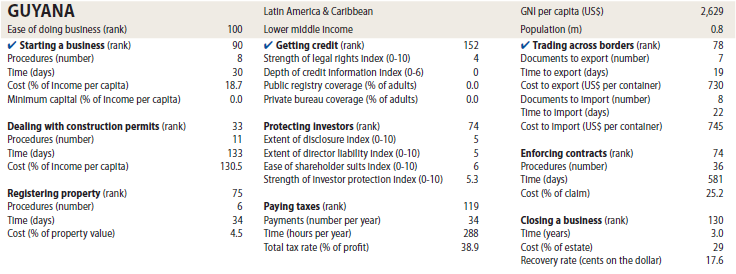
Guyana has improved marginally in the World Bank/ International Finance Corporation publication called Doing Business 2011 publication. Of 183 countries included in the report Guyana ranks at 100, compared with 101 in the 2010 survey. Of significance too is the fact that Guyana is listed as having three reform measures in 2010, which is better than most of the countries covered. The report also shows Guyana as one of the 85% of economies that made it easier to do business in the past five years.

Among the persons listed as local partners who would have provided information to the two international bodies are Geoff DaSilva of GO-Invest, Registrar of Companies Ms Carolyn Paul, the Public Utilities Commission, Attorneys Ms Josephine Whitehead, Ashton Chase, R N Poonai and Kashir Khan, business persons Desmond Correia, Lucia Desir, Gidel Thomside of GNSC, and accountants from PKF, Barcellos Narine & Co and Ram & McRae.

The 2011 publication is the eighth in the series that began in 2004 and investigates and reports annually on the regulations that enhance business activity and those that constrain it. Eleven areas of life of a business are covered but one which Guyanese may consider very important is not: electricity, which continues like an albatross around the necks of businesses.

Quibbles and questions
Source: Doing Business 2011

No doubt there will be quibbles over specific rankings and questions about some of the placements. For example Guyana and Canada have similar companies’ legislation with an essentially one-page Articles of Incorporation. Yet for Guyana the time to start a business is shown as 30 days while for Canada it is stated as five days. At 5.3 the index of investor protection for Guyana seems generous and indeed helps to improve its overall position.

Where we do badly is in terms of getting credit (152 out of 183), paying taxes (119 out of 183) and closing a business (130 out 183). Seventy-four for “enforcing contracts” also seems a bit generous with inadequate arrangements for enforcing judgments made in non-Commonwealth countries. As the Table shows under ‘Getting Credit,’ it is a hat trick of zeros and one hopes that the Minister of Finance will follow through on the commitment to get a credit bureau going. The mess-up made by the Attorney General over the Deeds Registry (see Business Page December 5, 2010) was fortunately not an issue at the time the survey was done.

Foreign exchange issues
In addition to the concerns in Doing Business, one issue among investors is worthy of some consideration. It has to do with exchange controls which we are told have all been abolished. But that is not quite true. Yes, the bank and non-bank cambios easily facilitate the conversion and payment of foreign currency. There are some simple, non-intrusive provisions that require declaration and these pose no difficulty for the business persons. But there are others less popular, such as the requirement in the Bank of Guyana Act that all monetary obligations or transactions in Guyana (whether imposed or authorised by a law or otherwise) be expressed and recorded, and shall be settled in Guyana dollars unless otherwise provided for by law or agreed between the parties. But such an agreement requires the permission of the Bank of Guyana after consultation with the Minister.

And under the Foreign Exchange (Miscellaneous Provisions) Act 1996, the permission of the Minister of Finance is required for any of the following:

1. The lending to or borrowing from any person in Guyana, other than an authorised dealer of any gold or foreign currency.

2. The act of any person resident in Guyana which involves, is in association with, or is preparatory to borrowing any gold or foreign currency from, or lending any gold or foreign currency to any person outside Guyana.

3. The operation of a foreign currency account. The concern among foreign investors is the time it takes to open such an account and the conditions applicable to such account.

4. The lending by a person in Guyana of money or securities to a company resident in Guyana but controlled by a person resident outside Guyana.

Guyana a long time ago repealed its Alien Landholding Act but section 333 of the Companies Act still requires a licence issued by the President for the holding of land in Guyana.

Conclusion
Often the concerns about doing business expressed by foreign investors are always ventilated and addressed more easily that those facing domestic businesspersons. That should stop and we need to treat with all constraints to doing business, whether local or foreign investors.

One of the fundamental problems and contradictions in the business infrastructure is that economic activities require rules and laws to establish and clarify rights and obligations. At the same time as we witness the increase in drug-trafficking, terrorism, other crimes including money-laundering, there will be stricter rules that will necessarily impede business. The challenge is to get the balance right.

Making the Stock Exchange work – Part 2

Introduction
Today I continue the discussion on the Guyana Stock Exchange and what we might do to make it work. I believe that a vibrant stock exchange is an important vehicle to promote growth in the economy and to enable the small investor to share in the national economic pie.

This discussion on making our stock exchange work is more than some abstract financial concept, and relates to some useful initiatives in Jamaica which has one of the oldest exchanges in the region but which up to a couple of years ago had seen trading slowed to a crawl.

If we look at the banking statistics we realise how difficult it is for small and medium-sized enterprises (SME) to raise capital through commercial loans, both because they lack the necessary security to support their loan applications and because they have to pay rates of interest that are often beyond their reach.

The most recent Bank of Guyana report shows the prime lending rate by the commercial banks of 15.06% although a number of borrowers have been negotiating for much lower rates under the threat of taking their business elsewhere.

On the other hand the majority of savings deposit account holders receive interest of less than 3% per annum which is lower than the rate of inflation, even if we ignore the withholding tax of 20%. Part of this dichotomy lies in an examination of some other banking statistics. Table 2.14 of the Banking Statistics at December 31, 2010 shows under ‘Commercial Banks: Liquid Assets’ treasury bills of $64,401.1M, even though this conflicts with Table 2.17 which shows ‘Commercial Banks Holdings of Treasury Bills’ of $65,514.2M.

Add to that the sums of money held by the commercial banks with the Bank of Guyana as “Commercial Banks: Minimum Reserve Requirements”. This stands at $45,101.9Mn compared to a required level of $29,335.0Mn at December 31, 2010, an excess of $15,766.9M. So at the end of 2010 the commercial banks had invested in the government through Treasury Bills and reserve requirements close to $110 billion out of total deposits with them of $248 billion.

It is as if the banks are raising money for the government rather than intermediating funds within the private and business sector to which loans and advances at December 31, 2010 amounted to $76 billion.

In other words, of the deposits received by the commercial banks, the government holds Treasury Bills attracting interest of between 2.67% and 3.78% per annum while the Bank of Guyana holds funds from the banks as reserve requirements another $45 billion which attract no interest at all. On the other hand households and the business sector are loaned $75 billion with a prime rate of 15%! Of course there is small business and low cost housing lending which are at lower rates subsidised by the general tax laws.

I mentioned last week the mindless and costly policy of the government when it comes to managing the financial sector, and am again reminded that the commercial banks are caught between Scylla and Charybdis – the BoG has imposed such onerous lending and provisioning requirements and restrictions on the commercial banks as to discourage lending. These statistics require a separate study outside the scope of a newspaper column.

A viable option
The point is that if we could have an active stock exchange not only would bank depositors have an alternative and possibly better vehicle for their savings, but businesses would be able to access funds at a much lower cost of capital, a term that is common in financial management.

Of course, not all companies and particularly the start-ups are ready for the big time on the stock exchange, and they would not be able to compete with the bigger players. And that is the point about the junior stock exchange that has been working so successfully in Jamaica.

Down Jamaica way
But even the Jamaicans will tell you that they did not initiate the concept, and in their own preparations noted the success of the London Stock Exchange junior market – the Alternative Investment Market (AIM) and the Toronto Stock Exchange junior market – Venture X.

These junior markets allow investors to put capital into legitimate small and medium-sized companies that are listed. Experience from those exchanges has shown how the fundraising and development activities of the listed investment securities have been able to grow the local economy by creating established and transparent businesses, jobs and ultimately, economic confidence.

The Jamaican experience followed the same pattern. Within two years there were some nine companies listed on the junior market in Jamaica across the manufacturing, retail, tourism and finance sectors, and there are reportedly ten other companies preparing to enter the market.

For them the major attraction was lowering their cost of funds.

After only a couple of years Jamaica now has an active junior stock exchange with clear rules of entry and engagement, which despite a 92-page document are nothing too onerous.

In order to be admitted to the exchange a company must issue voting shares by way of an initial public offering, subject to a prospectus seeking a minimum subscription of new shares (or allotment of existing shares) of not less than J$50 million and not more than J$500 million only.

The exchange rate of the US dollar to the Jamaican dollar is approximately 85:1. If a company exceeds its maximum market capitalization of J$500 million, it will be required to list on the main JSE Board.

For the purpose of transparency, annual statutory audit, quarterly and annual reports are required in keeping with the submission requirements of the main exchange. The company must appoint to its board a mentor who is approved as ‘Fit & Proper’ by the Financial Services Commission, the equivalent of our Securities Council.

Companies which are not allowed to list on the junior exchange include a company which is wholly or partially a subsidiary of a registered entity on a recognized stock exchange and one which had been listed on the main board of the exchange.

Attracting SMEs to the exchange
It was recognised that SMEs would be attracted to the Junior Market based on the level of support which will be provided to them. Not all of the assistance was financial or fiscal. They could benefit from the Private Sector Development Programme, a technical assistance programme implemented jointly by the European Union and the Government of Jamaica.

Fiscal incentives included a tax incentive for a period not exceeding ten years from the date of listing on the JSE Junior Market as follows:

i. a full income tax holiday for five years after listing and a half income tax holiday for the remaining years;

ii. exemption from tax on dividends or other distributions by Junior Markets;

iii. exemption from transfer tax and stamp duty on transfers of shares in JSE Junior Market companies.

If the company de-lists within 15 years of being listed on the combined exchanges, it will be required to repay to the government the tax benefits enjoyed during this period.

An SME will enjoy the benefits of any approved tax incentive while on the Junior Market during the allowed incentive period. At the end of the allowed incentive period, the SME will be obligated to move to the main board of the JSE. If the SME decides after the period in which the tax holiday was granted not to list on the main board or to delist without compelling reasons, the SME must reimburse the government for the tax incentive provided.

Conclusion
The big challenge in Guyana to get private companies to bring in outside shareholders has to do with transparency, accountability, governance and tax issues. We have already noted that the lion’s share of corporation tax is paid by a handful of companies.

The names of several of our hardware suppliers, contractors and the politically connected or protected simply do not appear anywhere close.

They are busy gobbling up state assets and are oozing with liquidity.

They seem always bent on ensuring that everything is kept in the family. Governance for them applies only to the government and most of them do not bother with annual general meetings or filing annual returns, and they know that the GRA has only limited capacity to do a good audit.

Still a few of them willing to be pioneers and offering say 25% of their shares to the public could be enough to get a junior exchange started.

All the features of the Jamaican model may not be appropriate to us in Guyana. However they offer a template that could be modified to suit our peculiar needs and to attract entrants.

To continue to do nothing is hardly an option. It is time the government shows some interest in our Stock Exchange.

President Jagdeo’s land dealings not above board

President Jagdeo has finally confirmed that he has acquired land in Pradoville 2. He described the price as $5 million per acre without stating how many acres he bought. The word is that it was 2.5 acres of land, which if true is arguably the largest single plot of land by any individual in any residential area in Guyana.

Mr Jagdeo had been among the favoured comrades and strategic individuals to receive an allocation of land in Pradoville 1. He did not build until several years later, rented the house no doubt for a decent rent, and later sold it for a substantial gain. Soon after, in negotiations in which he was influential as both buyer and seller, he acquired land in Pradoville 2 at a concessionary price.

The President enjoys the following exemptions from taxes under the law:

1. on his official emoluments under the Income Tax Act;
2. from all customs duties under the Customs Act;
3. from all obligations under the Property Tax Act;
4. from all obligations under the Capital Gains Tax Act.

Under the Former Presidents (Benefits and other Facilities) Act 2009 in which he was not in an insignificant conflict, Mr Jagdeo will enjoy those exemptions plus a substantial pension and other benefits until death, or until the earlier repeal of the act.

Let us look first at tax issues facing Mr Jagdeo. Since rental is not official emoluments, the net rental income from the Pradoville 1 house is taxable. But Mr Jagdeo’s tax exposure does not end there. He never lived in that house, used it as a commercial venture and then made a substantial profit on its sale. After further consideration and research, I have revised my earlier suggestion (Business Page October 31, 2010) that the gain would be subject to Capital Gains Tax except for the exemption stated at 4 above. It is now my considered view that on a proper interpretation and application of the tax laws, the gain is taxable as income under the Income Tax Act despite the fact that it arose from what would be described as an isolated transaction.

Now to Mr Jagdeo’s land dealings. The standard clauses in transports for the purchase of land in government schemes include:

a) The purchaser must build within twelve months of the passing of transport. Any person failing to do so is bound to re-convey the property to the Central Housing and Planning Authority, subject to be reimbursed with a reasonable sum for any development works undertaken during such period.

b) The purchaser cannot sell, lease, transfer or otherwise dispose of the said property within ten years from the date of transport, without the written consent of the Minister responsible for Housing. If the person wants to do so, the Central Housing and Planning Authority must be given the first option to buy.

c) Anyone who owns real property is not entitled to purchase a lot. If it is found out that the person had owned real property within the past three years he is liable to pay to the Government of Guyana or Central Housing and Planning Authority the current market value of the lot or at its option, the Government of Guyana will be entitled to repossess the said lot upon the repayment of the purchase money less expenses incurred for repossession.

That Mr Jagdeo did not build within twelve months; that he earned rentals; and that he made a gain of approximately $100 million on the sale of the Pradoville property are hardly matters of dispute. He is therefore in breach of the condition under the Pradoville 1 transport and has tax obligations in connection with the property he owned and sold there.

Mr Jagdeo’s attorney may want to make the slick argument that Pradoville 2 is not subject to the rules that apply to government lands. But no one can dispute the arithmetic that 2.5 acres of land in the Eccles housing area (Block A) and comparable land at Diamond would fetch $10 million per acre. It is clear then that $12.5 million for 2.5 acres of ocean front land in the far more exclusive Pradoville 2 cannot be justified and Mr Jagdeo of all people must know this.

When around 1970 then Minister of Works Hydraulics and Supply Hamilton Green acquired government-owned metal sheets to paal off his private property, the PPP, the Catholic Church, the TUC, professionals and all decent-minded Guyanese were outraged. At the instance of Eusi Kwayana, the Ombudsman investigated the matter and exonerated Green. Contrast that with Mr Jagdeo’s shocking and secretive acquisition, contempt for the dignity of the highest office in the land, disdain for the opinion of the people, making a joke of the Norwegians and the United Nations Champion of the Earth award, and the threat and fear of rising sea levels that Jagdeo’s land deals epitomise. It is doubtful that even Burnham knew the possibilities for misuse that his 1980 constitution offered. Hoyte and the two Jagans obviously did not contemplate it. It has taken thirty years and a Bharrat Jagdeo for those possibilities to be exploited to this degree. And we have not seen the end. As a result of his Former Presidents Benefits Act, taxpayers will have to meet for the rest of his life the cost of the maids, gardeners, water, electricity and telephones for a property that under any standards of decency would be considered with more than mere suspicion.

Making the Stock Exchange work

Introduction
We have not heard much from or about it recently. Passing its offices at High and Robb Streets it is hard to believe that this is the institution that was set up with much hype, expectations and hope that it will make access to capital easier and cheaper, widen shareholder ownership and raise the bar of corporate governance. The Guyana Stock Exchange, or to use its more formal name the Guyana Association of Securities Companies and Intermediaries Inc, was incorporated on June 4, 2001 after several studies with the principal aim of encouraging companies to “go public,” a term generally used to mean companies offering their shares to the public. To encourage such companies the government offered them favourable tax treatment including waiver of duties payable on the transfer of shares in quoted companies and exemption from Capital Gains Tax on gains made on the disposal of shares in public companies.

The Stock Exchange has had only limited success, being largely ignored by the government and failing to attract any attention from this Finance Minister. With a private sector body that seems to have a view only if prompted by the government, its chief spokespersons in the Private Sector Commission have been similarly silent. In fact I find it hard to believe from any of their utterances that they even remember that the exchange exists.

Access to capital
This column has constantly proclaimed the importance and possibilities of a vibrant and functioning stock exchange to a market economy. Real interest rates, ie, the rate charged over the rate of inflation is still extremely high and actually discourages borrowings by the business community since the cost of funds make many investments unattractive ab initio. Then we have the government’s endless policy of mopping up liquidity that costs the taxpayers billions of dollars in interest payments. This policy encourages the financial intermediaries to make their money by charging high rates of interest on one class of lending – its borrowings group – thereby making it financially justifiable to invest the rest in government securities at rates that are less than the rate of inflation. But since the government does not see this, the private sector is automatically handicapped.

This in no ways suggests that the commercial banks should open their vaults to all and sundry or indeed that it is sensible to do so. Financed mainly by customers’ deposits, banks and other deposit taking financial institutions operate like trustees, and it takes only a couple of their larger loans to go bad to create havoc with their financial results and balance sheets. More recently the Anti-Money Laundering and Countering the Financing of Terrorism Act 2009 has added to the challenges and risks facing such entities, since the act requires lenders to have the most intimate detail about their customers.

‘Well done, Mr Minister’
Dr Ashni Singh wrapped up the debate on the 2011 budget by sweeping and disparaging remarks about the parliamentary opposition’s poor contribution during the debate. Yet, his budget speeches are themselves devoid of any real underlying vision or philosophy, more rhetoric than substance, and even in budget measures there was clearly a failure to apply any intellect or effort at analysis. It is disrespectful and arrogant of Dr Singh to believe that he alone has the capacity to speak or think through a proper national budget. In fact had it not been for the annual stealing of VAT from the people of this country, the ineptitude of the President and his successive Finance Ministers would have been on national display.

In none of his four budget speeches has Dr Singh shown any understanding of the role of a stock exchange or concern about its failure to take off, or to explore and exploit the opportunities and possibilities which a stock exchange can bring. Has the PSC not seen this or the National Competitiveness Council or the Chamber of Commerce or anyone else? Would Dr Singh include them as part of that group that makes no constructive contribution to the budget, or is their endorsement, “Well done Mr Minister,” what he considers constructive criticism?

If only we were more imaginative and innovative, if only we understand that there is trading in government paper all year round, if only we really believed that the private sector is the engine of growth and a functioning capital market its fuel, GPS and steering system, we will still be able to bring the stock exchange back to life.

As the stock exchange enters its eighth year of operation, policy holders may wish to look at the steps taken by Jamaica, where its exchange too had slowed almost to a crawl. Jamaica’s answer was the creation of a Junior Stock Exchange that within a couple of years has seen eight companies entering the market with another ten lined up for listing in 2011.

A brief history
The Exchange began trading on July 8, 2003 at which time the market value of the shares of companies to be traded was approximately $17.7 billion. At December 31, 2010, this had increased to $69.4 billion. Trading on the Exchange has been slow not only because the concept of public ownership of shares is still not strongly promoted or embraced, but also because many of the country’s public companies are controlled companies and the number of shares available for trading is therefore limited. Yet, the total value of trades on the Exchange since its inception has exceeded two billion dollars with four companies accounting for 83% – Banks DIH, (50%); DEMTOCO (13.2%), DDL (10.8%); and GBTI (10.7%).

That is confirmed by the following chart which shows the number of shares traded by year (the acronyms are expanded in the table following).

DIH – Banks DIH Limited
CCI – Caribbean Container Inc.
CBI – Citizens Bank Guyana Inc.
DBL – Demerara Bank Limited
DDL – Demerara Distillers Limited
DTC – Demerara Tobacco Company Limited
BTI – Guyana Bank for Trade and Industry Limited
PHI – Property Holdings Inc.
GSI – Guyana Stockfeeds Inc.
RBL – Republic Bank (Guyana) Limited
SPL – Sterling Products Limited

Source: Guyana Stock Exchange

Another expectation was that the Stock Exchange would have a positive impact on share prices. In the first couple of years the results exceeded expectations with substantial increases on the prices of almost every company with gains ranging from 29% to 500% in one extreme case. The market made adjustments for the shares in Demerara Tobacco Limited, the Guyana Bank for Trade and Industry and Republic Bank Limited, while a significant movement in the shares of Banks DIH Limited accompanied the interest in the take-over of that company by the Trinidad company Ansa McAl.

To be continued

There is a gap of between 15,000 and 19,000 who are paid the Old Age Pension but are not entitled under the law

Minister of Human Services Ms Priya Manickchand behaved with apoplectic rage in response to a conclusion in a report by her parliamentary colleague Mrs Sheila Holder that the number of persons to whom the Old Age Pension (OAP) is paid is inflated by 17,640 (phantom persons, according to Mrs Holder) with a loss to the state of over $1.3 billion.

Ms Manickchand reacted badly too to a cartoon in the Stabroek News of January 27 depicting her unflatteringly, prompting a letter by her which appeared with another by Mr Ivelaw Henry, her Chief Statistical Officer, both on the same day in the Stabroek News (Saturday, Jan 29) challenging Mrs Holder’s numbers. They both cited in support of the numbers being challenged projections done in November 2006 by a Mr Sonkarley T Beaie, who is described as a UN demographics expert and the holder of an MPhil, perhaps with a view to impress us.

To understand the conflicting positions, it is convenient to address three separate but related issues – statistics, the legal framework for the payment of OAP, and the arrangements in place for the payment of Old Age Pensions.

The most recent census done in 2002 shows the following data in relation to persons 65 years and over:

Between censuses, the country’s mid-year population is tracked by the Bureau of Statistics from data on births, deaths and migration, and is reported on in an appendix to the annual Budget Speech by the Minister of Finance. This is what the Bureau of Statistics reports for the years following the 2002 census: 2003 – 752,500; 2004 – 755,100; 2005 – 757,600; 2006 – 760,200; 2007 – 763,200; 2008 – 766,200, 2009 – 769,600, 2010 – 777,900.

One must always be cautious about population data and even more careful about making assumptions from them. I therefore wonder why instead of taking the actual population figure Mr Henry and his Minister chose to rely on Mr Beaie’s increasingly incorrect projections which for total population in 2010 were “wrong” by 10,000. It is fair to say that any major change in the characteristics of a population – other than through migration, a plague or a baby boom – takes place very slowly. From 1980 to 1991 the shift in the over 65 age group was a 0.16 percentage point and from 1991 to 2002 it was a 0.12 percentage point as shown in the table above. Even if we generously assume that the percentage of that group as a percentage of the current population has climbed to 4.5%, the maximum number of persons eligible for OAP would be approximately 35,000, or 7,000 less than the “around 42,000” the Minister of Finance referred to on more than one occasion in his Budget Speech.

That is not the end of the story, since not every person 65 and over is entitled to OAP. The Old Age Pensions Act sets as the conditions for eligibility for OAP that the person must have: (a) attained the age of sixty-five years; (b) been a citizen for ten years; (c) been ordinarily resident in Guyana during the last twenty years; and (d) passed a means test based on income and assets. Therefore any returnee to Guyana before 1991 is not entitled to a pension because of condition (c) and many if not most of the senior citizens living in Courida Park, Queenstown, Pradoville, Oleander Gardens, Republic Park, former senior public servants, professionals including doctors and lawyers, etc, are not entitled under condition (d).

We all have and know of countless others of our friends and relatives and their parents who do not claim Old Age Pensions. These would include persons 65 and over in the population not entitled to on account of their income and/or assets, plus those who are entitled to but do not claim because they do not know they qualify, plus those not entitled because they returned to Guyana less than twenty years ago. Those probably number between 8,000 and 12,000. To get to the number who meet all the tests, we need to deduct these from the maximum, theoretical 35,000, leaving between 23,000 and 27,000 persons who are entitled. This means that there is a gap of between 15,000 and 19,000 who are paid, but who are not entitled to the pension under the law.

At the current rate of $7,500, between $1.4 billion and $1.7 billion is being paid out unlawfully each year.

A recent Value-For-Money audit done by the Audit Office identifies a host of accounting and audit issues that could have given rise to the wide gap.

While the Audit Office must be commended for undertaking the exercise, it is regrettable that it did not attempt to put in dollar terms the range of values involved in its findings, and that it did not look at the related public assistance programme that is subject to even fewer rules and is more politicised and corrupted.

Let us put the calculation into perspective. If Old Age Pensions were paid only to persons legally entitled, then each pensioner could easily receive another $4,000 to $6,000 per month out of the money allocated in the 2011 Budget.

Ms Manickchand should now be willing to make her list publicly available for scrutiny.