
Tax rates hardly matter

Introduction
As promised, this week’s column looks at the importance of tax rates in the overall scheme of tax policy in any country. I start by saying that lower rates of tax do matter – they allow the taxpayer to retain a higher level of the income earned which they can use for re-investment or higher dividend payments to shareholders. They can also make a country more competitive since prospective investors pay some attention to countries’ nominal tax rates in their investment equation. Hence, the decision to reduce the corporate tax rates by five percentage points would be welcomed both by companies and individuals, as evidenced by the swift response of the Private Sector Commission (PSC) to the announcement by the Minister of Finance.

In making his announcement the Minister said companies benefiting from this measure would be in a position to retain and invest a significantly higher share of their profits. While some may suggest that the reduction in the tax rate had an unmistakable eye on the upcoming general elections, they cannot argue with the effect advanced by the Minister since by definition a reduced tax charge leaves more after-tax profits which are available for investments, higher dividend payments and related party loans. But seemingly too quick to please the political directorate, it was the private sector representatives who stated that the reduction would make Guyana competitive in terms of tax rates.

The private sector leaders travel around and must know that the corporate rate in two of our major Caricom trading partners (Trinidad and Tobago and Barbados) is 25% while our reduced rates are 30% for non-commercial companies, 40% for commercial companies and 45% for telephone companies. Non-regional investors on the other hand would be familiar with much lower tax rates in their own countries, so that our 30%/40% would still sound to them extremely high.

Government failure
The biggest but unacknowledged problem for the private sector is the failure by this government to address tax policy and tax reform which it has been promising for eighteen years. For example, tax policy would address how we treat one sector over another, whether a single person should receive the same personal allowance as the single parent with a number of children, whether there should be differentials in tax rates, the balance between direct and indirect taxes, extending the use of the withholding tax to domestic contractors, etc. Unfortunately what passes for tax policy is the demand for tax revenues to finance a bloated, politicised and inefficient bureaucracy and a government that seems to have an insatiable appetite to spend, spend and spend.

I strongly believe that the flat, across-the-board reduction of five percentage points is both intellectually lazy and politically cowardly. If the officials of the Ministry of Finance were to read the report of the Bank of Guyana (latest mid-year 2010) or indeed the statistics in their own National Estimates, they would see that the business community is increasingly investment-averse despite all the tax and contracts goodies thrown their way. As the following table shows, growth in the economy is being driven by the public sector.

[table to be inserted]

Source: National Estimates 2011

Goodies
The tax laws are now replete with all forms of incentives, some of which are general and others specific, some found in legislation and others in agreements signed by the political arm of the government. Some are intended to encourage exports (the export allowance), investments (the Income Tax in Aid of Industry) which also provides tax holidays for investments in the hinterland, low cost housing and exemption from VAT.

More than a decade after its introduction and generous exemptions for public companies investments, the Stock Exchange remains extremely inactive with no new issuers, i.e., companies going public, or existing companies offering new issues. In the absence of rules on thin capitalisation and the differential tax treatment of loans versus dividends, even our larger public companies find it cheaper to borrow than to raise new capital. There was a time when Banks DIH and DDL could be relied upon to make rights issue or bonus shares which allowed for some greater liquidity in the market. They have not needed to do so.

The commercial banks hold deposits of more than $230 billion dollars of which loans and advances, inclusive of the public sector loans, amounted to $68.9 billion. For several years the government has been critical of the commercial banks and Minister Manzoor Nadir, the self-appointed chief spokesperson of the 2011 Budget is on record as stating that “the commercial banks have been penalizing our people for too long.” He is also on record for cautioning against differential tax rates to protect the locally manufactured products since they “protect local inefficiencies.” That Mr Nadir now supports the things he had earlier railed against shows how politicised the tax system is, how it is influenced by the changing tides of political opportunitism and why we have a tax system that is, by any measure other than revenue collection, so dysfunctional.

Drivers
Tax policy has to be driven by a vision and relevant information. This column has called for more relevant information to be disclosed in public documents. Principal among these would be the annual report of the Guyana Revenue Authority which the Minister of Finance has failed to table in the National Assembly for some time now. Let us see how much the construction sector, the bauxite sector, the forestry sector, the agriculture sector including rice, sugar and other crops sectors contribute to the national coffers, and how much remissions, rebates and holidays they receive which may amount to billions each year. And yes, we should be able to see how much each region contributes and compare this with their receipts from the central government.

The Minister has access to data that would tell him that the bulk of the corporate taxes collected by the GRA is paid literally by a handful of companies. These are the commercial banks, Banks DIH and DDL, GT&T and Digicel and the oil distribution companies. The majority of companies could not care about tax rate – they decide how much tax they will pay and have their accounts prepared accordingly. This of course is also true of the self-employed, for which Regent Street is a metonym and to which political protest is as applicable as tax evasion is. There is a strong suspicion that setting a payment level for any period is also true of VAT, and as I have written before in this column, that some politicians have given pledges to the business community for tax support in exchange for votes.

Conclusion
Tax policy and tax reform will clearly have to wait for some years. The Jagdeo-Singh duo is comfortable with the status quo under which urban workers and consumers are the biggest contributors. They are equally comfortable with some sectors and segments making no contribution to the national coffers while demanding so much. The parliamentary debate on the 2011 Budget will close without any discussion on either tax policy or tax reform. In that sense, we are all losers.
Mr Nadir here are some of the state entities with poor audit records

Mr. Manzoor Nadir’s letter on the 2011 budget (Stabroek News, January 23, 2011: Dr. Ashni Singh’s credentials are impeccable) was the kind of “honesty” that Guyanese have come to expect from this itinerant political leader. Mr. Nadir accuses me of being envious of Dr. Ashni Singh’s brilliance and credentials; invites me to join the leadership of the PNC/R and then goes on to praise the 2011 Budget. The second is the most convenient to dispatch first: Mr. Nadir must know that I declined an invitation to be nominated for the presidential candidacy of the PNCR and I also refused his invitation to go on the TUF slate for every election since 1997. I now address the other issues.

I last had a cordial discussion with Mr. Nadir this Tuesday, January 19, the day after the 2011 Budget. He acknowledged my correction of a misleading claim he made last year on the performance of the economy and that he had begun to repeat this year. He also indicated that he relies on the Ministry of Finance for some of his numbers. This gentleman is the leader of the country’s only declared anti-communist party who gave himself completely to the country’s only declared Marxist party, one that has distinguished itself by the single word corruption! Maybe he is honestly trying to correct the historical wrong of his party’s joining with the PNC to cause the PPP to lose office.

His accuracy or honesty, or both, come again into question in trying to attribute to me personally an official publication of Ram & McRae, of which I am one of three partners. The analysis did not question Dr. Ashni Singh’s credentials and I would have hoped that Mr. Nadir would recognise the analysis – done by a team of the firm’s dedicated and professional staff working through Budget night – was about the Budget and not about either Dr. Singh or me. In fact I now say that Dr. Singh’s credentials stand in marked contrast to the increasingly intellectual bankruptcy of his and the PPP/C’s annual budgets.

I would avoid Mr. Nadir’s personal attacks and forays into my mind and motives and address only the essential points in issue. As the Ram & McRae analysis pointed out, and which Mr. Nadir could not dispute, the personal allowance of $40,000 now is in real terms less than the value of the $35,000 when it was set at that level three years ago. Nor can he dispute that the Minister did not indicate the cost of the tax proposals in the budget speech, a cost that just might show that businesses are expected to receive more from the 2011 Budget than the workers, pensioners and indigents.

On the issue of contract employees, Mr. Nadir correctly quoted from the firm’s analysis but then goes off into an excursion into diversion by explaining that “in 2010 we (government) moved all the cleaners, handypersons, drivers and lower level skills to contracted positions.” Mr. Nadir, like his political boss, must think this is a country of fools to believe that “cleaners, handypersons, drivers and lower level skills” can account for a 40% increase in that group. For the record I draw his attention to Table 9 of Volume 1 of the National Estimates, account code # 6115 Semi-Skilled Operatives and Unskilled, which shows an increased, not a reduced allocation, even after the low level “move”. The same applies to Temporary Employees and Clerical and Office Support!

Mr. Nadir must also know that his group of lower level skills is commingled with political appointees such as Reepu Daman Persaud, Feroze Mohammed, Harry Persaud Nokta, Shyam Nokta, Odinga Lumumba, Dr. Randy Persaud, Dr. Prem Persaud, Gail Teixeira and Kwame McKoy and hundreds of others at the Office of the President, the Ministry of Finance and indeed throughout the public service. Mr. Nadir should tell us which one of these contract persons earns less than $500,000 per month, not argue over the minimum wage about which “his” government has a questionable record. And he might wish to tell us whether the decision to treat the lower level persons as part of the group of contractors was done to disguise the average pay of this group after I had exposed it two years ago.

Stating that I used a broadside to describe the state of audits of public entities, he dared me to name any of those entities. Does he need any more than NICIL, the entity of which the Finance Minister is Chairman and through which state assets are diverted for unlawful purposes, and which disdainfully refuses to have an audit or to file an annual return? Just in case he needs more, here we go: Go-Invest, Guyana Energy Agency, Institute of Applied Science and Technology, Integrity Commission, GINA. Need some more? What about National Sports Commission, Guyana National Bureau of Standards, Environmental Protection Agency, etc.

Only someone who has not read the Public Corporations Act or the Guyana Revenue Authority Act would make such an uninformed and incorrect statement that it is the Auditor General who is responsible to report to Parliament on entities falling under those Acts. In fact, the Acts require the entities to submit, within six months of the end of the year, their audited financial statements and directors’ report to the Minister of Finance or other relevant Minister. It is the Minister who has responsibility for tabling them in the National Assembly. It gives me no pleasure to correct Mr. Nadir twice in one week.

Mr. Nadir does not help his Minister by his reference to the Audit Office, which provides evidence of a relationship between the Minister and that Office which constitutes a uniquely bad case of professional independence. Or by his questions about statistics which we know emanate from the Stats Bureau and the Bank of Guyana over which the Minister of Finance exerts both official and improper influence.

Two points in closing: one, it is the sycophancy of people like Minister Nadir that encourages the excesses, improprieties and illegalities of the Jagdeo Administration; and two, I hereby publicly invite Mr. Nadir and the Finance Minister to appear on Plain Talk to discuss the 2011 Budget. If Dr. Singh is unwilling, I invite Mr. Nadir to bring along one of his TUF colleagues. That is, if he can find one.

Putting the encomiums into some perspective – 2011 Budget

Introduction
Before going into a couple of matters arising out of the 2011 Budget let us clear up a few points. In prefatory remarks during his budget speech, the Minister of Finance said “today, the Guyanese economy is larger than ever before with gross domestic product (GDP) now measured at $453 billion, and more resilient than ever before…” He did not say that this number increased dramatically last year by the simple exercise of rebasing the national accounts. As Ram & McRae pointed out in their response to the 2010 Budget, the re-basing caused an immediate increase in the GDP by 63%. Magically, that also made each of us much better off, in national economic terms, than we were before the rebasing.

What the Minister avoided as well was any reference to, or mention of, the extent to which the economy is driven by the underground, illegal and criminal economies. It is correct to say that the proceeds of these activities are not reported to the tax authorities and therefore escape taxation. But it is not correct to say that they do not form part of the GDP figure. The reason why they do get counted is because of the two ways used to measure GDP – by the income method under which such transactions are by definition excluded, and under the expenditure method under which it is captured.

Here is a simple example: drug man A ‘earns’ say one million US dollars during the year as his commission for moving the goods from Colombia to the US via Guyana. Clearly he will not report this to the tax authorities and is careful how and how much he washes through the cambio and street foreign exchange markets. But when he uses that money to set up a business, buy a vehicle or establish a housing scheme, the transaction enters into the GDP figures. So it does contribute to the ‘growth’ in the economy and to its ‘resilience.’

International reserves
Dr Singh also drew attention to the country’s external reserves but failed to mention the part played by Petro-Caribe and IMF funds in this equation. Nor was he prepared to relate the reserves to the country’s import bill which is spiralling almost out of control. As the few live off the fat of the poor, the country is now spending increasing amounts on luxury goods which cause our import bill to climb. In 2010, merchandise imports are projected to grow by 20% to US$1,477 million with the result that for 2011, the overall balance of payments (the account that measures international trade) is projected at a surplus of US$24.4M compared with US$90.1M in 2010 and US$234 million in 2009.

That places the country’s international reserves and its exchange rate at risk which, but for remittances, would have been significant if not disastrous. A sound tax system would see that the economy does not bear a disproportionate share of this burden. As we saw in Suriname a couple of days ago, the government seeks to address these goods by what are called “sin taxes.” Our sin tax for a very different reason is the VAT.

Over-exuberance
While the Finance Minister engaged in spinning the numbers, Mr Manzoor Nadir, a sometimes over-enthusiastic TUF member of the government takes it further by actually making false claims about the country’s economic performance. During this past week in a very cordial telephone conversation with him, I had to remind him of his wrong claim last year that four successive years of growth is a joint record in Guyana. I noted that he is now magnifying the myth on his current television rounds by extrapolating from his 2010 mis-claim that with Dr Singh’s reported 2010 growth, the five years continuous growth “represents the longest period of sustained growth in Guyana.” That is not correct and it was unfortunate that none of his fellow panelists or interviewers seemed to have been better informed or willing to correct him. As I pointed out to Mr Nadir, the period 1991-1997 saw seven years of significant growth that started to fall once Mr Jagdeo had taken over from Asgar Ally as Finance Minister in the mid-nineties.

Tax rates and allowances
The reduction in the tax rates for the corporate sector – with the discriminatory exception of the two telephone companies – has brought the Private Sector Commission alive, giving them something to crow about. The Georgetown Chamber of Commerce, a leading member of the PSC, was more measured in its response – it saw the increase in the threshold and the reduction in the tax rate as a good start. Neither of them bothered to reflect that the increase in the threshold does not restore the allowance to the value it had three years ago. In other words, adjusted for inflation, the $40,000 announced for 2011 is less that the $35,000 it replaced.

To have meant something the threshold should be the $50,000 called for by the unions. However, because this group pays such a significant portion of the taxes on income collected by the state, the government can be neither bold nor honest in addressing the level of the threshold. A proper tax threshold should be an indexed number that allows automatic increase in line with inflation. Under the un-indexed system, the individual is forced to bear the cost of inflation. It is for the same reason that the government will not reduce the rate of VAT – it is a cash cow and brings in huge revenues so that a couple of percentage points reduction would mean a lot.

The private sector has bought into a strategy that compresses the threshold for several years, releasing it only in an election year. It has too, bought into the myth of the relevance of the corporate tax rate. For the waged employee the personal income tax rate is meaningful since barring a small travel allowance here and a meal allowance there, after the personal allowance, his entire income is taxed.

What do tax rates mean?
With very few exceptions, for the self-employed and the corporate sector, tax rates mean little. They decide how much tax they are prepared to pay and have their friendly accountant – and here I include some professionally qualified accountants – do the rest. It embarrasses me that a profession to which I belong engages in this or any level of tax evasion. What is worse is that all of this is known to the authorities who seem unwilling to do anything about it.

Next week I hope to have comprehensive data establishing that for the self-employed and for segments of the corporate sector, tax rates matter little. Many of them live off the taxes paid by employed persons and the consumers. The estimates for 2011 show projected income from income tax under the PAYE as $16 billion and VAT and Excise Taxes of $50 billion, together accounting for roughly two-thirds of the total taxes to be collected by the GRA this year.

And this is one of the reasons why I do not think this government wants to undertake any tax reform. For them the threshold and the tax rate offer an easy, low cost option. It also throws the private sector off their call for tax reform that looks at all issues of taxation, including sectoral and geographical contribution. The private sector has failed to ask even the most basic question and the reasons for the delayed tabling of the annual report of the GRA by the Minister of Finance. None of them seems impressed that the basic rate of personal tax is now higher than the corporate tax rate, a situation unprecedented in this country. And this has happened while dividend income is tax free, as are capital gains on shares in public companies.

The expenditure side of the budget
The private sector too does not appear concerned about the expenditure side of the budget. Expenditure keeps defying the laws of gravity, increasing over the period 2006 to 2011 (projected) by 60%. Over the same period the capital budget is projected to increase by 48%, from $42 billion (2006) to $62 billion. Employment costs over the period will have risen from $14 billion to $22 billion or 57% but not for the traditional public servant whose income has increased by the PPP/C’s standard 5% annually. It has come from that creation called ‘contract employees’ the number of which keeps increasing annually.

In 2010, wages and salaries for contract employees increased by a whopping 40% while the total wage bill increased by 0.24%! Not only are funds being diverted though NICIL but employees are also being diverted, this time via the Office of the President, the Ministry of Health, etc. Worse, my information is that some of these ‘contractors’ are treated as self-employed and are responsible for paying their own taxes. In other words, the government encourages the tax evasion.

The overall deficit of the government finances is projected to increase from $20.6B to $34.0B. And that is after $14 billion of Norwegian money. If that does not come in, any government that comes in after the 2011 elections will have a real job on their hands.

If only the private sector could be convinced that these matters are as important as the tax rate, we would in fact have a good debate going.

The private sector and development objective

Introduction
2010 has turned out as a bumper year for some of Guyana’s leading businesses. With several public companies having a September 30 year end, the results are welcome for the shareholders of Banks DIH Limited and its banking subsidiary Citizens Bank Guyana Limited, the DDL associated banking business Demerara Bank Limited and Republic Bank Guyana Limited.

Republic Bank, a subsidiary of the Trinidad and Tobago giant of the same name, and always the first of Guyana’s public companies to hold its annual general meeting, reported to its members profit after tax of $1.982 billion for the year ended September 30, 2010. This 8.8 % increase over 2009 turned out to be modest when compared with the results of some of the other businesses.

Citizens Bank had a whopping increase of 37% in net profit while the Demerara Bank Limited reported a more modest increase in net profit over 2009 of 4.2%. Banks DIH Limited, the beverage giant showed increases in before-and-after-tax profits of 21% over the corresponding period one year, inclusive of dividends from its banking subsidiary.

Contributing to these impressive results of the commercial banks is an 11.6% increase in credit to the private sector. Categorising the credits by economic activities, the September 30 report of the Bank of Guyana shows a 77.9 per cent increase to the mining sector, 36.5 per cent to agriculture, 22.1 per cent to manufacturing and 16.9 per cent to real estate (mortgage loans). Credit to the distribution and personal sectors reflected growth of 11.7 per cent and 4.1 per cent while the rice milling sector recorded a marginal growth of 0.3 per cent. Conversely, the other services sector reflected a decline of 8.9 per cent.

Taxes and corporate Guyana
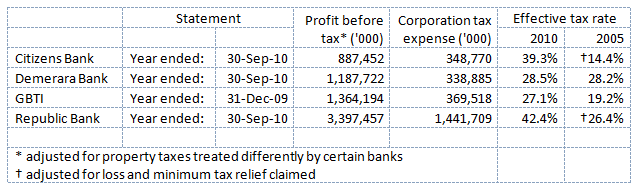
It is interesting to see the effective tax rates paid by these businesses as the government continues to ignore tax reforms in which the private sector under its current leadership show little interest. For this purpose I include the other major domestic commercial bank – Guyana Bank for Trade and Industry whose year end is December 31 and for which the 2010 financial results will not be available for some time.

Tax Table

Source: Annual Reports of companies

Why the PSC is not taking any real interest in tax reform – an integral element in any developing economy – is really hard to understand, unless its priority is to avoid the public castigation one of its leaders received from Mr Jagdeo for daring to ask for a reduction in the corporate rates of taxes. As the table shows the effective tax rates have climbed quite significantly in some cases, with one bank almost up to the nominal rate of 45%. The Chairman of the PSC has said that tax reform has now been placed on the agenda of the National Competitiveness Council (NCC), of which he is the Vice-Chairman. This is an entity on which huge sums have been expended but it takes some effort to see if there have been any returns on those investments.

In fact even as the Chairman was disclosing to Stabroek Business the new responsibility on the NCC for tax reform, he was reported as giving no indication of the state of play regarding the tax reform discourses, alluding instead to what he said was a partnership between the government and the private sector to engage a consultant “to review the tax study that had been commissioned by government and to recommend appropriate changes to the country’s tax structure with the objective of formatting a new tax structure that would be friendlier to the business community and the average employee without compromising government’s tax collection.” This is quite a mouthful that really means very little.

Share prices and the Stock Exchange
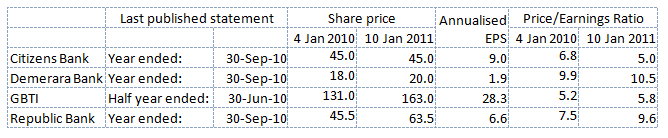
The annual reports have one other limitation running through them. None of them even mentions the movement in their company’s share prices as reported by the local Stock Exchange. Whether this is because they do not take the Stock Exchange seriously or do not consider share prices relevant to their members is a matter for speculation. This is clearly wrong since people buy shares not only for dividends but also for capital appreciation as reflected in the price for shares.

What is also interesting is how the ‘market’ seems to ignore the companies’ reported results. As the following table shows the increases in earnings are not reflected in the share prices, an indicator of an inefficient market which can be due to a range of factors including as an extreme but unlikely cause, market manipulation.

Share price analysis

Source: Annual Reports of companies

The disappointment with our still fledgling Stock Exchange must be tempered by the fact that the regional exchanges are also facing difficult times with some companies choosing to de-list rather than face scrutiny and bear the cost of listing. There is no indication that the situation in Guyana will improve any time soon and the public’s lack of interest in the shares of Trinidad Cement Limited (TCL), the only regional company to list on our exchange will almost certainly discourage other regional companies for fear of repeating TCL’s experience. That would be unfortunate.

Mr Lall and his gov’t cannot escape responsibility for the state of the dump site

Some of the many things that immediately come to mind about this government are the combination of its ignoring or ignorance of basic laws, its neutralising or neutering of the opposition and its tendency to pass the buck at every opportunity. Mr. Kellawan Lall, Minister of Local Government who stands out as a ministerial recipient of police tolerance – or their hesitation to prosecute crimes involving special persons – single-handedly demonstrated these failings in his statement in the National Assembly in relation to the Le Repentir garbage disposal site “I want to debunk the idea that this [site] has to do with the central government.” (S/N Friday December 31, 2010).

The minister’s expertise in dump site management was not known until that moment when he informed the National Assembly that “over the years, he had advised the Solid Waste Department of the M&CC how to manage the site but it failed to heed advice.” Here is a man who has acted autocratically on less important issues when the M&CC (sic) failed to take his “advice” but who, when the well-being of tens of thousands of the citizens of Georgetown is at stake, stands back for years, doing nothing and coming close to wishing a city-wide health pandemic to prove a political point.

Such a statement denying government responsibility and documented for posterity in the official parliamentary records should have been immediately challenged for its glaring and dangerous inaccuracy. Article 149 J (1) of the constitution sets out as a fundamental right of every citizen “the right to an environment that is not harmful to his or her health or well-being.” And Article 149 J (2) imposes on the State (emphasis mine) a duty “to protect the environment for the benefit of present and future generations through reasonable legislative and other measures designed to – (a) prevent pollution and ecological degradation…… “.

Mr. Lall at the very least ought to know as well that the Guyana constitution gives to every citizen a right to life. Courts in more normal countries have interpreted this right liberally and widely to include in addition to physical existence, quality of life, access to roads, the means to support life and living with dignity. Unfortunately, with the threshold for ministerial appointment in Guyana being exceptionally low, one does not expect Mr. Lall to be informed about these or about South Africa’s and more recently Kenya’s admirable constitutional safeguards of economic, cultural and social rights. But one does expect that the government’s legal advisors would attempt to educate ministers on general and specific matters pertaining to their work. The evidence so far is that this is not being done or that any effort is not succeeding.

More direct to the environment, my recent readings about citizens’ action in countries in Africa and in India provide ideal examples and support for Guyanese to take action against the government, the Environmental Protection Agency and the City Council for damage to the environment and the endangering of lives.

One example will suffice. As far back as 1996 the Kenya court ordered the shutting down of a school’s toilets because their odiferous gases interfered with and diminished a single individual’s ordinary use and enjoyment of his home. Here in Georgetown we have tens of thousands who are affected by the dump site, some more directly than others, no longer able to enjoy fresh air, to take an afternoon stroll, or to send their children out to play. And to add a desecrating touch, even the dead are again buried, this time by stinking, rotting, toxic garbage. Yet it seems that not one of the living, not any of their political leaders, not a single presidential aspirant, is concerned enough to raise their voice in protest, aggrieved enough to take action in defiance or interested enough to approach the courts for relief.

No surprise then that we have such uninformed, bungling and callous persons as ministers. That Mr. Lall is by no means unique makes it all the more troubling.