
The Amaila Falls Road Project – whose synergy? – part 3

Introduction
Last week I addressed the process by which Synergy was awarded the contract with a price tag of US$15.4 million for road and transmission line construction in connection with the Amaila Falls Hydro Electricity Project (AFHEP). The process was led by the government-owned private company NICIL, identified as the agency responsible for coordinating the project. The Request for Proposals was in the name of the Government of Guyana through NICIL. Now it must be remembered that in 2003 the National Assembly passed a Procurement Act which requires the government to comply with the provisions of the act in relation to all procurements. With a contract price of over G$3 billion, the contract comes easily under the National Tender Board. It seems, however, that the government was unwilling to take the legally mandatory route, choosing instead NICIL, seen as a pliant and useful vehicle by which the Procurement Act could be bypassed, without anyone noticing or complaining, and with complete impunity.

Of the seventeen firms originally registering an interest in the project, only the following four submitted tenders which, given the scope and challenges inherent in the work to be done, should have excited some concern at the governmental level. An obvious problem was the short time frame for putting together a proposal requiring considerable details which because of its involvement in the project over several years, gave Synergy a distinct edge.

1. Synergy Holdings Inc – USD15,400,000

2. A consortium comprising, B&J Civil Works, Ivor Allen & Dynamic Engineering Co Ltd – USD16,650,000

3. BK International Inc – USD21,037,500

4. Mr. Roopan Ramotar – USD26,000,000.

No right to complain
By virtue of their submission, only those four – or rather three, since the successful bidder is not expected to complain – enjoyed a right to challenge any perceived wrongdoing in the tender process. The law allows complaints only from a supplier or contractor who claims to have suffered, or who may suffer loss or damage due to a breach of a duty imposed on a procuring entity by the act and its subsidiary legislation. It also gives them the right to ask for information relating to the qualification, or lack thereof, of suppliers or contractors that submitted tenders.

Taxpayers who bear all costs, including the cost of corruption and inefficiencies should these occur, are not the suppliers or contractors and so they have to stand on the sidelines as passive victims, unable to challenge any substantive or procedural legal improprieties, however egregious or unlawful.

The law provides that where a contract has already been awarded, a complaint can be made to the Bid Protest Committee required under the act, but this is yet to be appointed. Not surprisingly the Finance Ministry does not seem to be aware of the rules governing the establishment of this committee, or maybe it suspects that no one would dare protest.

Despite the misgivings about the project award, none of the bidders is willing to challenge the propriety of the process or to ask for information presumably because they all benefit from other government contracts and would fear jeopardising their chances with other contracts. In their own way, the contractors contribute to the lawlessness and boldness that underlie this bid process and award.

Synergy’s qualifications
The Procurement Act sets out the criteria which a contractor must meet to qualify for a particular contract. These are essentially but not identically set out on page 8 of the RFP issued by NICIL. Information is widely available that Synergy did not meet any of these tests, but owing to sloppy background checks or self-delusion, the Ministry of Finance (MoF), NICIL and the government seem to think otherwise. For example, the MoF claims that Synergy has expertise and experience in building roads through forests, a claim that even Synergy does not make, and which is not supported by readily available information.

Synergy is a company in which Mr Fip Motilall is the sole director and secretary. Its total authorised capital is US$25,000 but because it has never filed an annual return it is not possible to know whether it has issued any shares or whether it has ever had its books audited. In other words, for all we know Synergy may be a paper company with no shareholders, no money, no audit and no other statutory compliance. Clearly, compliance with basic law is not seen as an impediment for the award of a government contract worth US$15.4 million. Co-incidentally, Synergy shares this disregard for the law with NICIL, the project co-ordinator.

Fact, fiction and fantasy
Synergy’s greatest strength seems to lie in its luck and the salesmanship of Mr Motilall, a Guyanese who migrated to the US several years ago. He successfully persuaded the US government to provide him with funds to do a study of the Amaila Falls hydro-project, and the Guyana government to enter into an agreement for his company to develop that project into an operational entity.

On its website, Synergy describes itself as the developer to design, build, own and operate a hydroelectric plant in Guyana. One immediately notes the absence of any obligation to transfer the plant to the government and wonders whether this is another attempt to mislead potential investors. The company claims that in 1997, it identified a dire need for electrical power generation in Guyana and sought to fill this need by harnessing the hydro potential of the country. In 1998, it joint-ventured with Harza Engineering Company to fund and perform a detailed feasibility study and Environmental Impact Assessment (EIA) for which it wrongly claims that it took a loan from the US Trade Development Agency (US TDA). In fact it was a grant.

The dissimulation continued with the assertion that the project had attracted equity investors and multi-lateral banks to finance the construction. Synergy is now looking for financing, even as Sithe describes itself as the project sponsor. What is true is that the company has been granted a licence to undertake the AFHEP although the particulars of that licence are not a matter of public information. Under the 2003 Jagdeo-Corbin agreement such matters are required to be tabled in the National Assembly.

Broken promises
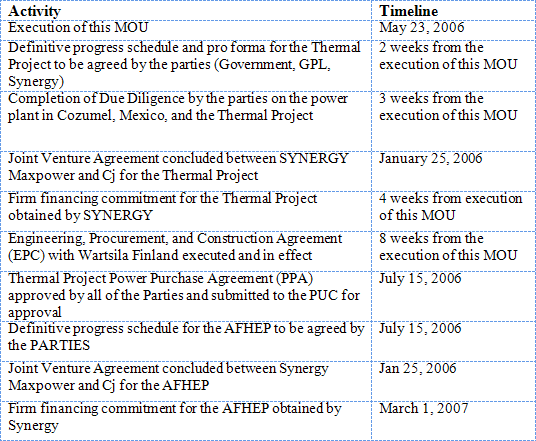
On May 23, 2006, an MOU was signed between the developers and government and Guyana Power and Light Inc (GPL) for the development of the project. Here is a schedule of commitments and dates contained in Section 3 of the Schedule to the May 2006 MOU. Notice that Synergy has breached every one of its obligations under the MOU, most of which should have led to the immediate termination of licence, MOU and dealings.
Hydro by Christmas 2010
Emboldened by the brazen complicity of the government, Mr Motilall seems completely unmoved by his otherwise embarrassing incapacity to meet his obligations even within an unreasonable time. In fact, despite his failure his company’s website continues to tell the world that “the schedule that was agreed upon has the start of construction of AFHEP in August 2007 with commercial operation on the last quarter 2010. In the interim, Synergy and its partners agreed to supply a thermal power plant of 25 MW (to be operational in March 2007) as a way to meet GPL’s demand for power until the hydro-power plant can be built.

The hydro project will assimilate the thermal plant upon its commissioning and the 25 MW thermal power plant will most likely operate in a back-up capacity after 2010.” As my twelve year old would say, “Yeah, right.”

Next week we will look at the financial provisions of the several disparate documents and statements made on the project.

Wall Street Journal not Economist

In early January this year, Stabroek News reported on a Wall Street Journal/Heritage Foundation 2009 Index of Economic Freedom. That sparked the usual outrage from the government led by President Jagdeo, and supported by the usual letter writers including Ms Marissa Lowden, whose contributions have dried up since her departure from Dr Prem Misir’s office. For some reason, the Kaieteur News only recently carried a report on the same index.

The government reacted as it knows best – instinct over common sense and power over brain, again led by the champion driver, this time supported by the three doctors Ashni Singh, Prem Misir and Randy Persaud, and Marissa’s ghost. The fact that none of them recognised that the later report had no originality was bad enough. If they had, they would have had the upper hand and precious state resources could have been better used elsewhere. But lead letter writer Dr Randy Persaud in the Stabroek News of May 8 (‘Organizations like the Heritage Foundation and the Economist are attempting to usurp the authority of the multilateral institutions’) combined a pedantic and political approach, concluding with a professorial pronouncement on the report’s perceived authors as well as its imagined “basic mistakes” which he claimed even a sixth grader would have recognised, even though he himself seemed unable to identify any. This cleverness backfired with several serious errors in his letter.

Here are some of those errors with elaborations inserted for Dr Persaud’s enlightenment.

1. The report was an international index, not a country report as suggested by Dr Persaud.

2. For this particular index, Heritage partners with the Wall Street Journal of the USA, not the Economist of the UK.

3. The index is available free online, with methodology and all. Therefore, it is inaccurate to state that there is no transparency in the index’s publication and that the index is a commercial venture.

4. The Economist might be an institution but it is not an organisation, nor does it publish a country report. The Economist is a weekly news magazine. Also, the Economist Intelligence Unit, a leading research and advisory firm, in addition to consulting, publishes quarterly Country Reports for subscribers.

5. The IMF and the World Bank, among other multilaterals, are endowed with authority to provide reliable economic data and analyses. In fact these institutions rely almost entirely on the “official” statistics published by governments, including Guyana’s. Perhaps Dr Persaud could be encouraged to tell Guyanese who endowed them with proprietary authority that others can usurp. Or why his President rejected the World Bank’s “authoritative” index and analysis in their 2009 ‘Doing Business’ series, which was less than complimentary about Guyana’s business climate.

6. The rankings, Dr Persaud claims, are not based on actual performances, but biased towards narrow ideological criteria. Again, if Dr Persaud would break ranks and tell the nation about the government’s actual performance on corruption, it then could be able to test how ideological or biased is the index’s Guyana’s percentage rating of 26.5 in ‘Freedom from Corruption.’ The cynic might argue that that score reflects a pro-government bias!

7. The organisations he identified (Heritage and Economist) have their roots in the Cold War era. The reality is that the Economist first appeared one hundred and three years before the Cold War began in 1946 and that it is the IMF and the World Bank which are rooted in the Cold War, formed in the US by the West, as their tools of economic colonization and control. (See Cheddi Jagan’s West on Trial.)

I once wrote in a response to another letter that I had never seen so many errors in a single letter. I now need to review that assessment. Other than the above, I share with Dr Persaud an ideological dislike for the conservative, pro-capitalist Heritage Foundation.

The Amaila Falls Road Project – whose synergy? – part 2

Introduction
Very little would be known about Synergy Holdings Inc but for a remarkable display of journalistic persistence that deserves an award for champion investigative reporting, not derisive and unpresidential talk about the fabulous five unnamed “bitter old people.” The only “official” information available on the whole saga, other than the heady and often misleading pronouncements from the President and the Head of the Presidential Secretariat are:

1. the Request for Proposal issued by the Government of Guyana/National Industrial and Commercial Investments Limited (NICIL); and

2. a press release issued by the Ministry of Finance dated April 15, 2010 seeking to justify the award of the road contract to Synergy.

The successful bidder has been largely invisible, incommunicado and silent, apparently out looking for equipment and setting up an office it can call its own. From there it will direct and oversee the upgrading of 85 km of roadway, construction of 110 km of virgin roadway through forests and pontoon crossings at the Essequibo and Kuribrong rivers, and clearing a pathway along the roadways to allow for the installation of 65 km of transmission lines. No easy task.

Cake-shop, rum shop or talk shop
The roads and bridges have to meet certain standards that would allow for the passage of heavy vehicles under all conditions, including the torrential and sustained rainfall which takes place during several months of each year, often making even well-constructed roads impassable. The roads are not only for the purpose of transporting machinery, plant, personnel and supplies to the site located on the Kuribrong River which is a tributary of the Potaro River. They will need, over decades, to be in a constant state of repair to allow for regular traffic in some of this country’s most difficult terrain.

That the nearest current access point is the airstrip at Kaieteur Falls gives an idea where the hydro-project site is located, and what would be involved. Mr Motilall and his company are in diverse businesses with a range of skills, but road-building capacity and experience are not among them. How he managed to convince President Jagdeo and Winston Brassington’s NICIL that he could also build roads is a mystery. To actually build roads in such harsh and demanding conditions within the timeframe would require a miracle.

But for Guyanese this is not a matter of words in the cake shop, rum shop or talk shop, among the young, or any group of grumpy and bitter old people. If the road works do go wrong – and it will not need Murphy’s Law for that to happen – the entire hydro-project will be at risk and the centrepiece of the country’s LCDS in trouble. If we are to avoid that, we have to get it right every step of the way, every metre of it. Like the people of Uganda where Synergy’s connections are labouring over the construction of the Bujagali hydro-power facility, we will be left with a white elephant and a massive debt. The economy is already carrying the cost of the GuySuCo’s investment debts. Another mistake of that magnitude will be crippling. As the largest investment this country has even undertaken, this project cannot absorb further incompetence or corruption.

The bond and the insurance company
The construction has to take place within eight months, an ambitious and possibly unrealistic deadline set by no less a person than the President himself. To demonstrate the government’s seriousness, the RFP specifies that time is of the essence for the completion of the contract. If the contract is not substantially completed within that time the government of Guyana/NICIL can call in the bond issued by the Hand-in-Hand Insurance Company for the performance of the contract. But there is where things get murky and messy.

Part of the package to be submitted by the bidder is a bank bond (emphasis mine). Such a bond was not submitted by Synergy. It is possible that Mr Fip Motilall’s attempt to secure a bank bond did not succeed for the simple and practical reason that the country’s several banks did not consider Synergy a good risk for the project. Since the bank bond is a required content of the proposal submitted for consideration, failure to submit one should have led to an immediate rejection of Synergy’s bid.

Synergy could not get a bank bond so it presented to the Government/NICIL an insurance bond instead. No one knows what went on behind the closed doors of NICIL and whether there were any consultations among Synergy, NICIL and the Hand-in-Hand Insurance Company Limited (HIH) that led to an agreement that a bond issued by an insurance company would be accepted by NICIL as a substitute. This has never been publicly addressed by any of the parties and all we have is an unidentified source in the insurance company saying that it is relying on the commitment of the government/NICIL to the project as its security for the issue of the bond. None of the parties has sought to deny this. What happens if things go wrong and the government seeks to enforce the bond?

The Bank of Guyana’s role
The implications go beyond non-compliance with the RFP. It exposes policy holders of the insurance company to a potential loss of three hundred million dollars which would imperil its capital base and its operational capacity. It is as though Hand-in-Hand has learnt nothing from the experience of its subsidiary the Hand-in-Hand Trust (HIHT) which lost several hundreds of millions of dollars in Stanford and would have to consider itself lucky that the Bank of Guyana, as the financial sector regulator, did not step in and enforce the law regarding the impairment of capital.

Since that hit to HIHT’s financial statements, the Bank of Guyana has been assigned the role of regulator for the insurance sector and it ought to have considered whether the bond places the insurance company under any significant risk. The BoG should be concerned about the poor track record of the insurance company to carry out proper due diligence as so damningly demonstrated by Professor Clive Thomas in an exchange with Hand-in-Hand CEO Keith Evelyn.

Act 2 Scene 1 NICIL
But such considerations only matter to the few who are concerned whether the bid process was serious and legitimate. The steps towards, and the circumstances surrounding the award of the contract, invite the question as to whether or not the winner of the bid was decided in advance.

Enter NICIL, a state-owned company increasingly at the centre of much of government action that is wrong, illegal and unconstitutional and for which it has become a vehicle of convenience.

NICIL was never formed to do what it is now doing. It is a company operating under the Companies Act and the Public Corporations Act set up with its first purpose being to subscribe for, take or otherwise acquire and hold shares, stocks, debentures or other securities of any company, co-operative society or body corporate. To divert sewerage pipes, to hijack and hold public monies, to build roads and administer funds of the Guyana Geology and Mines Commission are simply out of its remit.

Here is a company that cannot keep its own books but was retained to keep the accounts of the Berbice Bridge Company Inc. In umpteen years it has not filed an annual return in accordance with the law but its CEO can find the time to perform corporate secretarial services to another company. As recently as March 2010, it continued to display its commingling role in state assets by shuffling property between Property Holdings Limited, NICIL and the Privatisation Unit, all of which are headed by Winston Brassington.

Its very role in the Synergy contract makes the whole transaction malodorous.

The Procurement Act
I now turn to an examination of that role. The Procurement Act 2003 regulates the procurement of all goods and services by a procuring entity. “Procurement” under the act means acquisition by any means, including purchase, rental, lease or hire-purchase, of goods, or services, or of construction services. A “procuring entity” is any ministry, department, organ or other unit, or any subdivision thereof, of the government that engages in procurement.

The Procurement Act allows for various types of tender boards while the Procurement Regulations 2004 sets out the value threshold that determines the type of board under which a particular tender would fall. With a value of $3 billion, the Amaila Falls Road Contract brings it squarely under the jurisdiction of the National Tenders Board.

NICIL is not the procuring entity but according to the RFP is the vehicle through which the Government of Guyana has acted to advertise for tenders and select the successful bidder. It is not known whether the government obtained advice on the matter from the Attorney General, its principal legal adviser, or whether NICIL acted on the advice of its in-house attorney Ms Marcia Nadir-Sharma, or whether the matter was considered by anyone.

What is known is that there is no provision in the Procurement Act for the National Tenders Board, or the government, or indeed any other tender board to delegate any of its powers and obligations under the act. I have seen correspondence issued by NICIL in respect of the Amaila contract and in none of it does NICIL indicate that it is acting as an agent for the government or any ministry.

To be continued

The Amaila Falls Road Project – whose synergy? – part 1

Introduction
The US$15 million contract to Synergy Holdings Inc. for the first phase of the Amaila Falls Hydro-electric Power Project (AFHEP) has drawn intense scrutiny from the two independent dailies. It is difficult to say which element of the award of the contract is – to borrow a word from Dr Roger Luncheon – more ‘sinister,’ the method and the vehicle used by the government first to direct and then defend the contract to the awardee, or the attempt by the awardee to mask its incredible incapacity to perform such a contract. There is big money involved, if not from this phase of the project, then later from the real prize, the construction of the hydro-power plant with a price tag of several hundreds of millions of US dollars.

The characters in this extravagant saga make an interesting cast with the lead role being played by the versatile and ubiquitous National Industrial and Commercial Investments Ltd (NICIL), a company that has been at the centre of almost every questionable big ticket transaction undertaken by the government. NICIL is described as the government’s shareholding arm, but it has an unholy alliance with the government’s privatisation arm called the Privatisation Unit, with which it shares a common CEO, Mr Winston Brassington. Behind or – depending on the way one looks at it – in front of NICIL is a politically studded board of ministers and government insiders headed by the Minister of Finance Dr Ashni Singh. NICIL’s corporate secretary is attorney-at-law Ms Marcia Nadir-Sharma. And on the other side is a man whose incredible talent for self-promotion deserves its own Oscar and whose major assets are his political connections and his determination.

Silence not synergy
The storyline is one of intrigue on a Machiavellian scale. The two lead actors both play more than one role. One President appears literally out of the Caribbean Airlines sky to tell us that hydro will allow us within the next three years to use only renewable energy in the production of electricity. The other president assures us that Guyanese will soon be paying for electricity half of what we now pay to the Guyana Power and Light Inc and later, our electricity rates will be the cheapest in the world, a claim which even a professional propagandist might not feel comfortable making.

There is a fair cast of naysayers, their warnings muffled by the intense propaganda, while several members of the Low Carbon Development Strategy (LCDS) cast have taken time-out. With hydro-electricity being the centrepiece of the LCDS, one might expect them to be more vocal, to consult and to convince. Yet, not a single voice has been heard from this amorphous group that plays its part in the chorus line. Silence is not synergy.

The many-headed hydra
Every time Guyana believes that it is closing in on one set of improprieties another raises its head – or the impropriety is legalised. The Synergy deal – in the most common sense of the word – shows that impropriety has more heads than a hydra, more tentacles than the octopus. For years, accounting for and spending of the Lotto funds has been an obsession of the Audit Office. A few years ago there was the infamous Queens Atlantic Investment Inc privatisation and concessions, followed by the single sourcing of drugs from the President’s friends.

Then last year it was Clico from which some benefited despite incompetence, improper conduct and possible illegalities. In the case of Synergy, as in its purchase of hundreds of millions worth of drugs from India, the government uses a middleman, a friend of the President. Except that in the case of Synergy, there was a supposedly independent tender process.

Not only was the Amaila contract process flawed, it was in breach of the Procurement Act, subliminally confirmed by Head of the Presidential Secretariat Dr Roger Luncheon who said that the contract was awarded via a competitive bidding process within the specified guidelines.

And guess who specified those guidelines? Dr Luncheon’s famous circumlocution is often regarded as no more than a cause for humour but it always masks some serious truths. He did not tell the nation that the contract was awarded under the Procurement Act; he said that the award of the contract to Synergy Holdings was made via a public tender done within the provisions of the Act. What he does not say is that the administration of a government tender has specific rules that would not allow a private company like NICIL to be engaged in the tender process.

The absent opposition
That raises questions about another no-show in the whole saga: the political opposition, the whole lot of them. Belatedly, the PNCR has announced that it is calling on the government to submit all proposals connected with the project to the National Assembly to ensure proper accountability and transparency. That party must enjoy being insulted and embarrassed for it must know that a mere call on the Jagdeo government is insufficient to bring about any results. A call is the easiest thing to make – all words, little effort and no action.

Such calls should be left to individual citizens with no other practical options. It is more than three weeks since I called on the parliamentary opposition and the people of Guyana to demand an enquiry into the award of the contract to Synergy, and for it to be stopped.

It has been left to individuals and the press – described by President Jagdeo as the new opposition – to do the investigations and the hard work of exposing the illegalities and improprieties, which may or may not add up to corruption.

The AFC and GAP-Roar seem to have been incapacitated into silence, learning nothing from Mr Motilall, that incapacity in Guyana is not an impediment.

Civil society, including the professionals and their bodies, has been paralysed by fear of their own shadow and apprehension about the response.

We have been reassured about Synergy’s credibility not due to its President and CEO, but the role of Sithe Global Power LLC which is described in the Request for Proposal as the Project Manager and in a joint press statement issued on April 5, 2010 by the Ministry of Finance as the project sponsor, which I assume is something like a godfather. Not only can both descriptions not be right but there are significant legal, operational and financial implications between them that need clarification.

‘Bigging up’ Sithe
That false description perhaps stems from what may be an attempt to ‘big up’ Sithe Global Power, LLC to compensate for Synergy’s demonstrated incapacity to execute any but the most insignificant contract. It is convenient, but misleading to tout Sithe as the project sponsor of Uganda’s Bujagali Hydro-power project when in fact the sponsors are Industrial Promotion Services (Kenya) Limited and SG Bujagali Holdings Ltd, an affiliate of Sithe. This information is readily available to our professional associations which could have at least checked on Sithe and the Bujagali project which has run into all kinds of technical, financial, environmental problems.

Through the pivotal role of Uganda’s National Association of Professional Environmentalists, within months of the World Bank’s January 2008 announcement of financial closure, an Inspection Panel appointed by the Bank concluded, following a 17-month investigation, that the benefits of the Bujagali project had been overstated and its risks understated.

That could easily be the case of Amaila where the decider-in-chief President Jagdeo displays an amazing naiveté on technical issues and appears to be misled by the most simplistic numbers on complex issues. He accepted McKinsey’s calculation that our forests are worth US$580 million per year and has so far not challenged Synergy’s numbers on the price at which it would sell power to the Guyana Power and Light.

The Public Utilities Commission
And here is where another interest comes in – the Public Utilities Commission (PUC). Is it aware of a long term Power Purchase Agreement under which GPL will take all of the energy generated by Amaila, or of an ‘Assignment of Receivables Agreement,’ which ensures the payment via pass-through payment from end use customers? Electricity tariffs come within the purview of the PUC and it would therefore have been incumbent on that body to satisfy itself that Winston Brassington, Chairman of GPL was not a party to or exerted any influence on the negotiations leading to those agreements, that they were properly made and that all the implications for rate-setting have been addressed.

Like Bujagali, failure to rigorously evaluate the Amaila project can spell a major financial disaster which the citizens of the country will have to bear long after Motilall and the politicians have departed Guyana.

It is not something that we can address only after it has happened. It will be Guyana’s mess, obligations and burden. It cannot wait.

To be continued

Questions have made many in government uncomfortable

This letter was submitted to the Guyana Chronicle as a response to an extensive article captioned, ‘Finance Ministry slams Christopher Ram’s latest journey of speculation and misleading statements.’ Seven days after it was sent in, it still has not appeared.

The only reason I can think of for the three-page April 20 response by the Ministry of Finance (which appeared in GC on April 21) to my letter appearing in the Sunday Stabroek and the Kaieteur News of April 18 is that my exposure of the corrosive effect of first and second generation corruption, conflicting actions within Low Carbon Development Strategy (LCDS) policies, the questionable award of the Amaila Falls Road Project contract to Synergy, a mini-company owned by a political friend, Mr Fip Moitlall, the dubious role of the politically-directed National Industrial and Commercial Investments Limited (NICIL) and the repeated, costly and embarrassing mistakes by Finance Minister Dr Ashni Singh, has made many personally uncomfortable, to the extent that a rancorous public rebuttal became necessary. I refuse to reciprocate by descending to that level. Instead, out of respect for the Guyanese public’s right to the truth, I will rebut, point by point the April 20 diatribe by the Ministry of Finance.

The ministry challenges me on the LCDS implications of the NICIL-awarded road contract given to a friend of the political family, so reminiscent of another such case involving the Ramroops, friends of the President. In that case, tens, and possibly hundreds of millions of dollars of tax concessions, rent reduction and other benefits were engineered for the Ramroops by NICIL whose board is chaired by Dr Singh.

In a famous misunderstanding of the law, the concessions were subsequently approved by Cabinet and granted under the hands of the same Dr Singh.

When Mr Yesu Persaud asked for such concessions to be made widely available, President Jagdeo publicly abused him, directing NICIL’s CEO Winston Brassington to lecture Mr Persaud about the tax laws. Two days after Jagdeo’s abuse, in Business Page I examined for readers the relevant concessions legislation and pointed out that it was the President, Drs Luncheon and Ashni Singh, Messrs Winston Brassington, Geoff DaSilva and the entire Cabinet and Board of NICIL that needed some tax education. No one should harbour more embarrassment from that exposure than Dr Singh who, wearing three different hats, should have been aware of the provisions of the legislation and of the extent of his powers to grant such concessions. Synergy seems to be a case of history repeating itself.

Neither of the two drafts of the LCDS contains any calculation of the carbon emissions from the construction or operation of any of the development schemes outlined in the second draft.

Under the Guyana-Norway Agreement, there are two penalties which could apply – one for increasing deforestation, and the other for the timber cleared for the access road to the dam site. How I arrived at the USD 14.2 million for a road-associated potential penalty is technical and takes up valuable editorial space.

I have posted the details on my website chrisram.net (see box below), but I doubt that the Ministry of Finance is concerned about facts and figures.

Note on Penalty calculation
In the two drafts of the LCDS there is no calculation of the carbon emissions from the construction or operation of any of the development schemes outlined on pages 25-36 of the second draft, December 2009. It is not possible to derive the Ministry’s statement today from the single paragraph on Amaila Falls on page 25 of the LCDS document.

Under the Agreement, there are two penalties which Norway could levy. One penalty is for increasing deforestation, and one penalty is for the timber taken off the upgraded 85 km and new 110 km of all-weather access road to the dam site. The 110 km of new road would generate 0.19 MtC (million tonnes of forest carbon). The MoU values the forest carbon at USD 18.35/tC, and the penalty rate is four times the value, so the road-associated penalty is USD 14.2 million. This penalty is due if the deforestation from the roadworks pushes our total for 2009-2010 above the generous Norwegian allowance of 0.45 per cent of total forest area. As the draft LCDS does not discuss the deforestations associated with the development projects listed on pages 25-36, and the President’s Office of Climate Change has issued no calculations, we should be prudent in pointing out this hazard.

Whether or not the road does cause that excess deforestation, the second penalty may apply. Under the MoU, the total timber extraction should not exceed the mean national total for years 2003-2008 (total extracted volume, in table 2 on Enabling Indicators of the Norway-Guyana MoU and Joint Concept Note). That mean total is 481,226 m3 and includes raw logs, roundwood (poles and posts), and chainsaw lumber converted to its roundwood equivalent with the conversion factor of 0.4 used by the Guyana Forestry Commission. If the logs from the roadworks do not lead to log production rising beyond that agreed limit, then is log production elsewhere in Guyana being limited to make space under the limit for the Amaila Falls road logs? No agency in the government, nor the Forest Products Association, has indicated an intention of localised restrictions on log production. Page 39 of the LCDS indicates presidential assurance that large-scale loggers can continue their business-as-usual.

If they were, they would also take note of Janette Bulkan’s letter published by Kaieteur News on March 29, in which she pointed out that the Environment Impact Assessment (EIA) of 2002 on the Amaila Falls project available on the website of the Environment Protection Agency was for a much smaller project.

The document acknowledges that an expansion of capacity would require a fresh EIA, but that would get in someone’s way.

Further, the ministry’s attempt to confuse my stated concern about the Synergy road contract with hydro is artful, and even dishonest. The two are clearly separate but have come to represent the modus vivendi of this ministry in particular, and the government in general.

As a private company, NICIL is not subject to the stringent rules of the Procurement Act and the Fiscal Management and Accountability Act (FMAA). It is subject to lower standards of accountability under a political board that includes Drs Luncheon and Singh and Messrs Robert Persaud, Geoff DaSilva and Winston Brassington. To divert attention from “NICIL/ Government,” the Ministry of Finance in its April 20 statement conveniently introduces the Ministry of Works, which was not once mentioned in the Amaila Project Request for Proposal issued by NICIL.

That unholy combination is not unlike the Privatisation Unit/NICIL hybrid, which allows it, chameleon-like, to be and act like a government department when it is convenient, as in this case, and like a private company when it does not want the constitution, the FMAA and the rules of accountability to apply.

Let me correct some of the other issues which the Ministry of Finance chose to distort.

Queens Atlantic
I had objected to the illegal concessions granted to that company. To the extent that a person fails to honour his/her investment commitment, the concessions should be revoked. The only investment of substance by QA has been the newspaper which was not even included in its investment proposal seeking the hundreds of millions of concessions. But if the Lord gives, who else dares take back?

The Berbice River Bridge
My objections were all of a financial nature. They were:

(1) Winston Brassington’s attempts to have me withhold a Business Page article for one week. It turned out that he needed that week to get the Roger Luncheon-led NIS to invest in the bridge.

(2) The massive tax concessions given to everyone involved, even tangentially, in the bridge.

(3) The fact that despite these concessions, a Berbician car owner pays twenty times as much to use the Jagdeo Bridge as his Demerarian counterpart pays to use the Burnham Bridge. I did not realise at the time that unlike the Burnham Bridge, cyclists and pedestrians in Berbice could not cross their bridge.

RUSAL
In negotiations led by the President and Mr Brassington, we have given away our bauxite to a company owned by a Russian oligarch Oleg Deripaska, a man with a reputation for strong tactics and for lavishly entertaining foreign officials, and who like some of our own top people, has had his own visa problems. (See London Guardian, October 31, 2008.) RUSAL is now actively engaged in union-busting in Guyana and yet earns the tacit admiration and undisguised support of this administration.

Arising out of its secret negotiations with President Jagdeo and Mr Brassington, RUSAL has been granted exemptions from just about everything, including the bauxite levy.

But to divert attention, the Ministry of Finance chooses to speak of jobs. As if Mr Deripaska came to Guyana to provide employment, rather than obtain free bauxite for his Russian plants, acquired under circumstances that can still excite!

Finally, let me remind the Finance Minister that I have challenged his knowledge of the sinister history of the VAT rate, conflicts of interest involving his ministry and the Audit Office, and his veracity in the National Assembly over a $4 billion payment to GuySuCo. No space was found in his ministry’s three page production to enlighten citizens on where he stands on any of the issues raised, or, on where any of the issues raised stand.