Guysuco needs drastic surgery to ensure survival – conclusion

Introduction
Today’s column is my conclusion of GuySuCo’s Strategic Blueprint prepared by a special taskforce appointed by the President following the disastrous performance of the state-owned entity in 2008, recording its lowest sugar production since 1992 and the highest financial losses ever. Following the presentation of the blueprint, the government terminated its contract with Booker Tate but then recruited its top Caribbean executive and one of Booker Tate’s nominees to the board as its CEO – a decision that baffles observers and insiders alike.

To recap, parts one and two which appeared on March 14 and March 21, dealt mainly with a review of the 2008 audited financial statements, drew attention to the huge loans which were soon to mature but which would require significant help from the government for the corporation to repay. In part three, I sought to reduce to reality the economic contribution of sugar to the country which had for years been placed in the high teens. In fact, measured in terms of constant prices, in 2008 sugar contributed 5.9% of GDP, placing it seventh in ranking, while in terms of export earnings it earned the country considerably less than the earnings from gold. In 2009, sugar’s contribution to GDP was unchanged, but in terms of export earnings, sugar earned less than half that of gold. Even in rural Guyana, sugar is an old and ailing king, gradually giving way to commerce, other economic activities, or simply waiting on Western Union.

With respect to taxes, sugar makes a negative contribution, receiving from the treasury a host of subsidies, exemptions and concessions. In 2010 direct cash injections to the corporation are likely to exceed $10 billion on top of the $4 billion paid to GuySuCo to help it meet its debts. Ostensibly the $4 billion was to purchase a yet to be determined area of land, for a yet to be determined price per acre, and fully under cultivation. Part four dealt with issues of corporate governance as well as the corporate governors many of whom were brought in, like Horace’s dei ex machina, and given the task of turning around the corporation under the chairmanship of sugar unionist turned politician turned public servant, Dr Nanda Gopaul. In part five we began a review of the plan itself, and in this final part we look at some of the most important elements of that plan.

The production target
The plan revolves around a production target of 400,000 tonnes of sugar by 2013, including 110,000 tonnes from Skeldon. Optimistically the architects of the plan indicated that “initiatives were in place to bring this forward.” They also expect direct consumption sales from 10,000 tonnes of sugar in 2009 to 60,000 tonnes in 2013 with the major increase.

I say optimistically because even under the new direction, the corporation has found it almost impossible to achieve its targets, despite being in possession of constant data about the acreage under standing cane. For example, in May 2009, production for 2009 was projected at 250,000 tonnes, still short of the 290,000 January latest estimate, but described as secure. Production for the year turned out at 233,000 tonnes. 2010 production in the plan was stated at 321,000 tonnes, but a few months later the Minister of Finance announced a target for the year at 280,000 tonnes. For their optimism the Minister will sink close to G$10 billion in 2010, in addition to the G$4 billion in the land deal referred to above. It is hard to avoid the conclusion that targets are the result of circular guesswork than of any serious cooperative efforts by the field managers and the army of accountants now in control of the corporation.

Hercules or Don Quixote
Indeed it seems that the turnaround artists were themselves confused because Table 17 of both the April and May versions of the plan project production to rise to 439,000 tonnes in 2014. This will require not merely a Herculean effort but a miracle on the scale of the Second Coming.

Equally optimistically, the plan assumes no problem in disposing of all the sugar produced, whether in domestic, value-added, refined or bulk form. Caricom sales are expected to increase between 2009 and 2015 from 5,700 tonnes to 200,000 tonnes. Of this refined sugar sales are projected at 120,000 tonnes by 2016. This will have to be achieved even as the corporation lost its marketing director in a bizarre incident in which she was allegedly excluded from a meeting for being no more than a couple of minutes late. If that action was intended to teach the incumbent a lesson, it backfired damagingly for the corporation is now without this most important resource.

One further comment on the refined sugar sales: the plan assumes the invoking of the CET at the rate of 20% and the continuation of the sugar refinery in Trinidad for the duration of the plan period. Basic research would have alerted the plan’s architects that the Trinidad refinery was coming to the end of its extended life. That refinery was shut down completely at the end of April 2010. With this information, perhaps we will see another version of the plan and worse for taxpayers, a request for still more billions of taxpayers’ dollars.

The place of the people
Human resource is as important to production as marketing capability is to sales. The plan seeks to reduce departmental labour cost as a percentage of total departmental costs from 54.4% to 41.0%. It is expected that this will be achieved as a result of increased mechanisation, the restriction of costs of cultivation of one hectare from approximately $640,000 to $490,000, and an accompanying decline in labour numbers from 18,541 in 2009 to 15,660 in 2010, falling eventually to a precise 12,599 in 2015. While the plan recognises the corporation’s labour force as critical to its objectives, it seems particularly weak on human resource management. There is little or no understanding, as is evident in the document, of people being the most important resource in the industry. This is probably because there is no relevant human resource interest or competence to be found amongst the authors. While production and its related activities are only possible through people, only grudging references to employer/union relations have been made and interestingly enough, the management and supervisory ranks are not identified as stakeholders.

Such a perception can hardly motivate these groups of employees to buy into a plan hinged on production, rather than productivity and people. There is a deafening silence about the rate of voluntary departures of critically skilled personnel, while incidental reference is made to training – not necessarily based on any needs analysis or identified in a normal training and development plan.

The intention to off-load health centres and community centres respectively to the government and the Sugar Industry Labour Welfare Fund (of all places – an indication that not many of the plan’s authors know what the fund does), is clearly symptomatic of the corporation’s apathy towards the communities amongst whom it operates and who supplies its workers and its managers.

The trees from the forest
At times the plan seems to think that operational decisions of a routine nature are a substitute for real strategy. How else does upgrading the curricula at the Port Mourant Training Centre, revising training programmes for management trainees, and filling the position of Drainage and Irrigation Engineer get elevated from routine management activity to strategy?

The plan makes some strange decisions about the authority of the HR and IR functions which is now to be concentrated at the head office. This, according to the authors, is to allow estate managers to concentrate on yields and field and factory production. As if labour takes a back seat in all of this. One can only assume there is a superior collective intellect for the high-flight decision to remove HR from under estate managers, and for placing in a grey area the accountability for the state of industrial relations on the respective estates.

Political choices and moral hazard
The plan restructures the eight estates into two regions and Skeldon. The regions are headed by a regional director who reports to the deputy CEO, Mr Rajendra Singh, a hurried appointment in 2009 of someone with no experience or expertise in sugar or high-level management, other than having been a non-executive director of the corporation earlier. Given his resumé, Mr Singh is unlikely to display the skills indicative of a capability of moving up, and the government may find itself in the uncomfortable and reluctant position that it will have to prolong the services of Mr Hanoman. When the story of GuySuCo is told, the cost of political decisions will rank far higher than the cost of labour.

Underlying the thinking behind the plan is the assurance that the government will be there providing the financial brace and shielding the authors from any scrutiny of their quixotic assumptions and follies. The authors could confidently assume that the government will convert more than G$27 billion into equity, funded by the workers of the country to whom the government refuse to give more than US$175 per month as a tax-free allowance to cover their mortgage interest relief, children, dependents and educational allowances, and of course their cost-of-living basket.

That assumption comes from the assurance by Agriculture Minister Robert Persaud that Guysuco is too big to fail. I take a very different view: Guysuco is too big to save. As long as Guysuco retains its existing configuration, it will continue to remain in intensive political and financial care – courtesy of mind-boggling ineptitude indecision by the President who had ignored the readings of the tea leaves by Booker Tate, and the irresistible and pathological tendency of the political administration to interfere in everything.

Conclusion
This is not the first turnaround plan done within the past few years. Many of the same recommendations had been made by Booker Tate over the past couple of years, but the difference is that the new and not improved one comes with a demand and an expectation of such huge billions to keep afloat some estates and activities that should have been terminated years ago. The plan is an act of cowardice – no bold independent decisions but strictly following political instructions to the letter. With this high-powered board, one would have expected something with more courage, substance and vision. None of these is present. No wonder that GuySuCo would not share the plan with stakeholders or subject it to any independent scrutiny.

The 2010 first crop will soon come to an end and it is likely that production will again be off-target. We should prepare ourselves for the excuses, to be followed by another turnaround plan. And possibly more taxpayers’ money.
New Building Society in breach of its own Act

Introduction
The annual general meeting (AGM) of the New Building Society (NBS) returned to Georgetown after a two-year sojourn in Berbice. Unfortunately neither the press nor the directors of the Society made any report on the meeting which had its own moments of interest. Today’s column will try to fill that void. Once again the NBS Concerned Members were present, vocal and prominent. There were from the Office of the President big fishes, including letter writer Dr Randy Persaud, and small fishes. There were also some prominent figures who, like Dr Persaud, perform political functions and work in the public service. But it soon became apparent that while it is always good to have adequate members’ attendance, quality matters more than numbers, except when a vote is called and proxies can be pulled out.

Business Page two weeks ago had reviewed the 2009 financial performance and the balance sheet. While the financial statements were a major item on the agenda of the meeting, it is not necessary to discuss them here again.

Comical
Shortly after the meeting was called to order, Mr Cyril Walker, Secretary of the Concerned Members group questioned why the Society had not responded to a request from long-serving member for a copy of the minutes of the last AGM. Chairman Eileen Gopaul ruled him out of order, and that was that. This was not the first time that the indefatigable Ms Cox has suffered the indignity of her request for a copy of the minutes of a members’ meeting being ignored.

The meeting then moved to the report of the auditors. Apparently it did not strike the board and its Finance Committee headed by former Commissioner of Police Mr Floyd McDonald that the firm presenting the audit report – Maurice Solomon and Company – was not the same firm – Solomon and Parmesar – that the members had appointed on the board’s recommendation after the previous auditors had declined re-appointment after decades as the Society’s auditors. It would be hard to imagine a more comical situation in a regulated financial business controlling close to $40 billion in public funds.

Challenged on the matter, Chairman Gopaul spoke for about three minutes without making any logical, let alone, sense. As I write, I now realise how unmemorable that response was. The issue was more than a technical change of name as Dr Gopaul seemed to think. During 2009, the appointed firm had split down the middle with the departure of partner Harry Parmesar, FCCA, taking with him several key staff members. What the Audit Committee should have done was carry out a due diligence to satisfy itself that the firm had retained sufficient expertise and experience to undertake such a major audit. With no financial expertise among the directors, maybe they never thought about it. As Ramon Gaskin pointed out, there should have been some note to this effect in the report of the directors.

Corporate arrogance
The directors had proudly boasted that the results were the best ever for the Society, describing these as a 97% increase over 2008. While the Concerned Members suggested that the comparison was misleading, and the line for line increase was 9.6%, they did not dispute the actual profit in 2009. Instead, they proposed a rebate to specified classes of borrowers and adjustment to the borrowing rates, a common practice some years ago. The Society is a mutual organisation so the profits in practice belong to the members and like any corporate entity, the members are paid a dividend. The Chairman did not allow for this to be put to the members but promised that the directors would “look at it.”

Contributing to the profit comparison was a gain on exchange losses on UK investment in 2009 compared with a $200 million loss in 2008. Called to explain why a 2009 decision of the members that the UK investments be repatriated, Dr Gopaul asserted that it was not a decision but “a discussion.” He is possibly the only person whose recollection would have led him to that interpretation, but again members are powerless in the face of this corporate arrogance. So it seems the investments stand, waiting for the usual swings that have characterised the pound sterling for the better part of the last decade.

No estoppel in tax evasion
Two other corporate governance issues attracted much attention. Concerned Members argued that whatever may have been the practice in the past, there should be no pension scheme for directors, to which the Chairman asked, apparently rhetorically, whether directors were not workers. The only problem is that workers are subject to contracts of employment and their employment is subject to an age limit. The directors may also note that there is no contractual relationship and that the same body – the members – that voted pensions can also vote to end the scheme. This is a governance issue, not a dubious claim of worker rights.

The second was in relation to remuneration. The practice of the NBS has been to split the remuneration between fees and travelling – the one being taxable and the other presumed non-taxable. Dr Gopaul’s first response was that directors use their own vehicles to do NBS business and the second was that that the practice came from the days of “Ram” which prompted Gaskin to reply that there is no estoppel in tax evasion.

Statutory breach
There was a sustained exchange between this columnist and the Chairman and the Society’s CEO that exposed how little the bosses understand the New Building Society Act under which the Society operates. I asked Dr Gopaul for the statutory reference and further explanation for his statement in the annual report that the Society was “racing near to the lending limit.” I pleaded with him that the Society had already exceeded that limit and offered to move a motion for an amendment that would have begun the regularization process. Dr Gopaul would have none of it, pointing out that his own board, its auditors and the Bank of Guyana were all convinced that they were right and I was wrong.

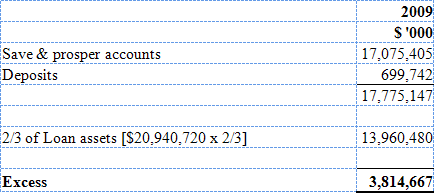
I have since confirmed my interpretation with a source in the Bank of Guyana and am more convinced than ever, that the NBS at December 31, 2009 had breached the lending limit prescribed by section 7 of the NBS Act by $3.8 billion, as follows:

Application of the proviso to section 7 (d) of the New Building Society Act to the financial statements for the year ended 31 December 2009:

Despite being described in the annual report as an “uninformed little group of mischief makers and pseudo intellectuals,” Concerned Members take no pleasure in being proved right when the NBS is found to be in breach of its own Act. We believe however that the tardiness of the Minister of Finance in introducing legislation to bring the NBS under the regulatory oversight of the Bank of Guyana would have saved the NBS from this embarrassment.

Expel the…
If lack of understanding of its own Act by the board was not bad enough, their support for an amendment to the rules that would permit the NBS to expel a member at any time shows how mischievous or misinformed the board members are when it comes to serious issues. Originally, rule 13 only allowed the NBS to decline “to admit or continue a member” within one month of the payment of the entrance fee. That time restriction was removed on a motion under Any Other Business, fourteen days notice having been given.

Immediately after the motion was read by the new member, the Chairman sought to put it to a vote, which was objected to by the Concerned Members who asked for a discussion. The motion was supported by all the directors, and overwhelmingly by the floor. The member who moved the motion is an attorney-at-law working at the Office of the President and is a daughter of a PPP/C member of parliament. Afterwards, I met and spoke with her outside of the meeting, in the presence of another top PPP person. She did not even understand what she had done. What was worse was that the board on which sits a Senior Counsel, did not know either.

Guysuco needs drastic surgery to ensure survival – part 5

Introduction
In today’s column I will begin a review of GuySuCo’s Strategic Blueprint announced by President Jagdeo on January 8, 2009, following the installation of an interim board he appointed to steer the local sugar industry out of its field of inefficiencies, tonnes of red ink, and punt-loads of government subsidies. Dubbed by President Jagdeo a “turnaround plan,” and by the plan itself as a blueprint for success, the plan and the interim board were a reaction to the low-point of production by the corporation in almost two decades, and to the danger that the corporation was staring down the barrel of insolvency. Unlike previous studies on the corporation and the industry, the strategic plan is a hidden document, accorded the utmost secrecy, not available to economists and analysts, politicians or taxpayers who, by virtue of having to pump billions of dollars to keep the corporation afloat, must be considered the corporation’s current major stakeholders.

There are several versions of the Strategic Blueprint, but the one on which this column is based is dated May 2009. The first point to note is that the architects of this multi-billion dollar blueprint acted partly on oral instructions for the terms of reference for their work. They proudly refer readers to the website of the Office of the President which sets out the mandate given to them by President Jagdeo, and also make reference to a press report quoting Minister of Agriculture Robert Persaud. They promptly complied with instructions from Minister Persaud, who directed them that it was “an appropriate time to make changes to the organisational structure of the corporation, starting at the management level.” No thought about starting at the activity level, such as separating agricultural, factory and value-added activities, since presumably that was not the instruction.

Strategic deficiencies
The product is an unfortunately limited document that did not seek first to ascertain why and how GuySuCo got there, where the politicians wanted to take it, and most importantly whether what the politicians wanted made any business sense. The government presented to the team a political, if unwritten plan. At the most acquiescent level, a professional team would have developed a business plan, which this document is clearly not. It considers only those matters on which instructions, or more accurately directives, were given. The team is a mainly public sector group, the members of which with the notable exception of Ms Geeta Singh of Clico, have very little commercial experience. Not surprisingly then, excluded from the plan is any reference to consideration of such sensible possibilities as estate closure, and more daringly, private sector participation in the corporation, by sale or joint venture. They were unprepared to confront the reality of an inevitable failure of the corporation if it retained all 8 estates, factories and 20,000 workers.

It was clear too that they could not deal with the poorly considered idea by President Jagdeo to invest hundreds of millions in the Skeldon Sugar Modernisation Project, compounded by the calamitous decision by him, against the better advice and judgment of the experts, to bring in inexperienced Chinese as the contractors.

Chinese power
The President ignored the reality that the factory was in a mess, and rejected advice that the contract be cancelled. The money outstanding could then be paid to a competent contractor to finish the job. But politically, it was easier to persist with the Chinese while blaming Booker Tate. The trouble is that that course has had serious financial costs, including thousands of tonnes of sugar lost, and a similar number of hours of senior GuySuCo time spent on increasingly difficult negotiations with the contractors. A meeting locally with a Chinese government representative and visits to China proved equally difficult, if not unproductive. It was a display of Chinese power versus Guyanese amateurism, experiences which could be useful as we negotiate an even bigger contract for the construction of the Amaila Falls hydropower project. The indications are that we are about to repeat that political adventurism, only this time on a bigger scale.

The writing had long appeared on the wall that the selection of CNTIC as the preferred contractor was heading for disaster. They could not get their team together, their project management capability was less than what the project required and as early as 2005, the project itself was already behind schedule.

The plan did not examine the fundamental problems of the industry, and similarly, glossed over in one page what it called the state of the industry, incredibly under three headings: current cash position, production history and projected 2009 production. It could not bring itself to admit that the Skeldon Project contract price had escalated, demanding a disproportionate amount of time, draining the cash resources of GuySuCo of billions, and starving the other estates of critical capital and operating expenditure. What little was left had to be spread among all the estates, good and bad alike.

The President had always signalled his unwillingness to accept these unpalatable facts and that the corporation was unlikely to show any profits for several years to come. He and the board concealed such vital information behind a mask of financial and political propaganda, saved temporarily by the weakening of the US$ against the euro, and the increase in complementary quantity that gave the corporation some breathing space until 2008.

Like the President, the interim board seemed equally unwilling to accept the fact that the corporation would not survive if it retained Uitvlugt, Wales and LBI, and if it did not reduce its workforce by several thousands. Like the President, the politically-minded interim board could not understand that good-paying jobs do not come from bailouts, but rather from new and dynamic businesses. Robert Litan, who directs research at the US Kauffman Foundation which specialises in promoting innovation in America reports that between 1980 and 2005, virtually all net new jobs created in the US were created by firms that were 5 years old or less. GAWU might lose some members, and the ineptitude of many of the politicians would be exposed, but I am not sure that would be such a bad thing. Sugar workers are hard-working and resourceful and will not sit idly by. They will go out there and find better jobs, jobs which are less demanding and offer greater security.

An industry, not a company
The other fundamental flaw of the plan is its total concentration on the corporation – again because that is what the team was told to do – rather than addressing the problems of the industry. GuySuCo is not an island, but is at the centre of an industry. Its success depends on the success of the industry, and if the industry does not have a future, neither does GuySuCo. Because it was told to come up with a plan in the “shortest possible time,” the team never did any analysis of the industry, including the private cane farmers, or of the dwindling labour and talent pool from which it would be required to draw exceptionally committed employees if the plan is to half-succeed.

The Skeldon project anticipates the participation of private operators, yet no attention is paid to this group with which the corporation would have to compete for labour. Unlike the corporation which can count on state subsidies and which the Minister of Agriculture says is too big to fail, these private operators will make hard decisions on economic and financial grounds. GuySuCo has guaranteed hundreds of millions of dollars of bank loans to those operators. The private operators will be concerned about having to share the costs of the inefficiencies of the Skeldon Factory, the uncertainty of the market and the unpredictability of the weather.

Irrationalities
Absent too is any indication that the turnaround team did any work on a market analysis so necessary in the light of the new trading arrangements in the once highly subsidised and profitable EU markets, and the developments within this region. One of the first rules in business planning is that you start with the market and build around that. Instead this plan starts with an obsessive commitment to production of 400,000 tonnes annually from 2013, with 110,000 tonnes from Skeldon. One has to wonder too, whether the team knows that the corporation is almost always too optimistic in its projections and production. In its secret deal with the government, the corporation is disposing of choice land currently under cultivation at Diamond, accounting for 18,000 tonnes of sugar annually,which it claims will be made up by ‘recommended’ strategic measures at Blairmont. It must be a sign of extreme desperation that a professionally prepared plan would sell land under cultivation just when it seeks to expand production and then incur additional heavy capital expenditure of G$3 billion on which it admits that returns will not be very large in the early years. The only thing that I can think of as more ridiculous than the sale is the purchase of the land by the government, which will now have to convert agricultural land to housing development.

But it is easy for the plan to engage in such irrationalities. Its authors do not state what they consider a reasonable return on capital or acceptable measure of profitability and success. Most of the corporation’s land is held on peppercorn lease rental from the government – $1,000 per acre per year – and it would add to the absurdities for the corporation to pretend to sell land it does not own and for the government to buy its own land. The plan is premised on continued subsidies of all sorts, most of which are not, however, disclosed. The industry’s contribution to GDP is now about 7% and it is the major beneficiary of government subsidies, of which the land sale is just another example.

False economies, accounting
The plan is also based on some false economies such as the imposition of a fixed average cost for cultivation of $490,000 per hectare. If this is an arbitrary determination by the accountants who predominate in decision-making in the corporation, then the impact will be felt in production and productivity, negating the gains so excitedly touted to the Economic Services Committee of the National Assembly.

I will close by noting two points about costs and their behaviour which the plan does not address. It does not appear that sufficient or any attention was paid to the question of costing and management accounting. It is wrong for the corporation to make decisions only on the basis of the field cost per tonne. To return a profit requires the entity to sell at a price that covers total cost. On that basis, cost per pound was approximately US forty cents in 2008, and not much less in 2009.

The second is that in any project analysis, if the marginal cost exceeds the marginal revenue, each additional unit produced increases the entity’s losses. It does not appear that this point was considered in the plan. I should add that it does not matter whether the sugar produced is then used for value-added, such as the Packaging Plant. For what that means is that that plant will be using over-priced raw material. Better to buy from third parties and do the packaging – assuming that it would make sense to do so.

Next week, I will wrap up this series and move on to deal with other fast-moving developments taking place.

The economics of the Amaila project do not add up

Last Thursday, Dr Roger Luncheon, Head of the Presidential Secretariat was asked for further details about the award of the multi-billion contract to Synergy Holdings for the construction of a road to the Amaila Falls. Dr Luncheon who placed the contract “within the provisions of the Procurement Act,” said that the persons who were raising doubts about Synergy and its ability to implement the project, were by extension raising doubts about the procurement process, and accused them of being part of a sinister agenda. It was also said that the award was based on the fact that Synergy had submitted the lowest tender.

The facts show that it is Dr Luncheon who is being sinister – and less than forthcoming – in attempting to mislead the public, which is asked to pay more than G$3 billion to build a road by a company that has zero experience in such a project. Dr Luncheon must know that National Industrial and Commercial Investments Limited (NICIL) is a state-owned private company that does not fall under the Procurement Act; that Synergy did not meet any of the pre-qualification criteria for the contract and its tender should therefore have failed at the first hurdle; and that the project’s Request for Proposal states unambiguously that there was no obligation to accept the lowest proposal. Yet, Synergy is now foisted on the nation as the only road to shining light, compliments of NICIL, chaired by Finance Minister Dr Ashni Singh, with a supporting cast of other ministers and political appointees of the President.

As a private company, NICIL is a vehicle of convenience to award the road-building contract as a precursor to giving a preferred company an even more lucrative contract – the construction of a hydropower plant valued at hundreds of millions of US dollars. Dr Luncheon’s government pretends to be blissfully unaware that the economics of the Amaila project do not add up, and may end up like the decision to spend more than US$200 million on the Skeldon Sugar Modernisation Plant, financed by loans on which GuySuCo has defaulted, requiring a government bailout.

Moreover, Dr Luncheon did not tell the nation about the source of this initial US$15 million. The 2010 Budget anticipated a G$6 billion from the Norwegians under the MOU. That money has not arrived, and indeed many key conditions of the MOU for its receipt are yet to be met by Guyana. Ironically, the four million square metres of tree-clearing operation required under the Synergy contract is likely to cost some US$14 million of penalty under the very MOU, reducing by approximately 48% the G$6 billion budgeted to be received from Norway this year.

The budget already has a $28.6 billion deficit which will increase as more money is put into GuySuCo to keep it afloat, and political spending accelerates in preparation for the 2011 elections. Of course, it is the hapless Guyanese taxpayer who is saddled ultimately with the related implications of, and responsibilities for, deficits brought about by government’s caprice.

Taking a different tack, there is also the possibility that this project is being financed from the NICIL fund created out of moneys diverted from privatisation proceeds and huge sums from various public entities. By these unlawful and unconstitutional means Parliament and the Consolidated Fund are bypassed in favour of NICIL, a company which for several years has not been filing its annual tax returns, or having its accounts prepared and audited in accordance with the law.

All in all, the choice of NICIL to do this piece of midwifery is not surprising. It has been at the centre of many highly questionable transactions involving this government, including: 1) the RUSAL bauxite give-away; 2) spending for the phantom hotel; 3) the NIS investment in the Berbice Bridge Company; and 4) facilitating, most egregiously, the Ramroop’s Queens Atlantic Investment Inc deal which included unlawful tax concessions.

This Synergy deal continues a pattern, and the parliamentary opposition and the people of Guyana should demand an enquiry into this outrage, potentially the largest single financial transaction ever undertaken in Guyana. This must be stopped.

On the Line: 2009 Annual Reports of the Guyana Bank for Trade and Industry and the New Building Society

Introduction
Business Page today interrupts its series on the state-owned Guyana Sugar Corporation to present an overview of the annual reports and accounts of two of the country’s financial institutions which will soon be holding their annual members’ general meetings at which the presentation of the annual reports is a major agenda item. One of these is the commercial bank, the Guyana Bank of Trade and Industry which is a licensed financial institution regulated by the Bank of Guyana under the Financial Institutions Act. The other is the New Building Society Limited, which carries on a financial business but which the Bank of Guyana claims does not fall within the act and which, despite several commitments by the Bank of Guyana and the government, remains unregulated. As a result, the bank is subject to the Single Borrowers Limit and other “strong financial regulations,” as described by no less than the Minster of Finance himself, while the NBS is not.

This is not the only note of contrast. One has to look no further than the Chairman’s reports by Mr Robin Stoby SC and Dr Nanda Gopaul of the two institutions respectively to see how they reflect the backgrounds, styles and personalities of the individuals. Both of them had good reason to be satisfied about the results of their entities. But while Mr Stoby was professional and measured, even enthusiastic at times, Dr Gopaul showed how difficult it is for him to adjust his political style to dealing with the commercial world.

He had no qualms about castigating members of the NBS as an “uninformed little group of mischief makers and pseudo intellectuals”; or about praising Housing Minister Irfaan Alli who now risks sanction by the Privileges Committee of the National Assembly for misleading the National Assembly; or making claims about the economy that are at best questionable. While Dr Gopaul claims that the Guyana currency has appreciated during the year, the GBTI Annual Report – and you would expect the bank to know – reported that the Guyana dollar market exchange rate was $202.75 compared with $201.75 during 2008. He also said that the fiscal deficit was at its lowest in 10 years. Perhaps he has been wrongly advised by his Finance Committee comprising former Commissioner of Police Mr Floyd McDonald and trade unionist Mr Kenneth Joseph.

It also goes beyond the two chairmen. The directors of GBTI are all experienced, private sector persons, while those of the NBS with one exception are all connected, directly or indirectly with the ruling party. This necessarily flows through to the quality of governance which has been a major and continuing issue at the NBS, particularly in relation to proxy voting, pensions for directors, and a modern code of corporate governance.

GBTI
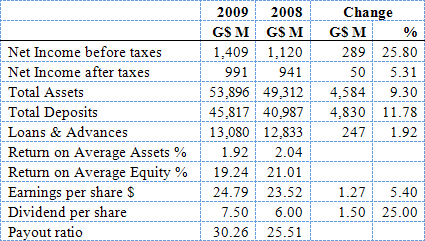
The annual report of the GBTI which will be holding its meeting on Monday, April 19, 2010 shows the bank continuing a remarkable run in which since 2006, net income before taxes has increased by 25.8% in 2009, 14.8% in 2008 and 23.9% in 2007, making for a cumulative increase since 2006 of 78.8%. Because of the tax effect, after-tax profits have increased cumulatively over the same period by 95.9%.

The Beharry family holds a 61% controlling interest with the remainder of the shares spread among hundreds of members, but the actual number and any other significant concentrations are not disclosed in the annual report.

Earnings per share for the year were 24.8% in 2009, marginally up from the 23.5% in 2008. With the company’s shares trading at $140, the P/E ratio, a popular investment measure, has improved slightly, to 5.6, making the security one of the most attractive in the domestic market. One area of significance is the increase in the effective rate of taxation which for 2009 is 29.7%, compared with an effective rate of 16.0% in 2008. The corporation tax charge for the year is 26.2%, compared with 13.6% in 2008. Readers are aware that the nominal rate of corporation tax on banks, commercial and telecommunication companies is 45%. As a result of the higher effective rate of tax, the Return on Average Assets and Average Equity have both declined, albeit marginally.

The interest earned on the average of net loan balances declined from 13.4% to 13.1% while the average interest paid on deposits was 2.2%, compared with 2.6% in 2008. This apparently low interest rate is in some significant measure due to the high level of non-interest bearing demand deposits which averaged more than $10 billion during the year. The bank continues to earn significant amounts from foreign exchange transactions with Exchange Trading Gains increasing from $664M or 18.4% of total income in 2008 to $733 million or 19.1% in 2009. As this column noted last year, the gains on foreign exchange alone cover the total staff costs of $612.6 million, which is a decrease from the previous year.

The continuing good run allows Chairman Robin Stoby to announce for yet another year, “the highest dividend payout in absolute terms in the bank’s long history.” At $7.5 per share, total dividends in 2009 will represent 30.3% of the year’s distributable profits, compared with 25.5% in 2008 and 25.1% in 2007. By comparison, the dividend payout ratio of Republic Bank Guyana Limited for 2009 was 41.2%.

Highlights

The bank’s deposits increased in line with the growth in deposits of the financial sector, thus allowing it to retain a 21% market share of deposits. Its market share of loans however declined from 22% to 20.3%. The bank’s financial condition remains very strong and shareholders’ funds have increased from $4.7 billion to $5.7 billion.

Mainly due to what is described as capital work-in-progress of $4.1 billion, the value of property, plant and equipment has increased from $3.8 billion to $5.6 billion. In addition to the new head office, the bank is also building a new branch at Diamond on the East Bank of Demerara. At the sod-turning in 2008 the bank had announced the cost of the new head office building at $2.6 billion. Unless there are some other capital developments that have not been announced, it seems that there has been a significant cost overrun on the head office. The financial statements also reveal that the bank had actually exceeded the Single Borrower Limit by its investment in Government of Trinidad and Tobago Sovereign Bonds, although it fails to disclose the amount of the excess.

As they receive the report of the continued successful performance of the bank, shareholders are likely to overlook these matters, as well as the sudden departure of the bank’s CEO in October 2009. The meeting should be quite a quiet affair.

The New Building Society
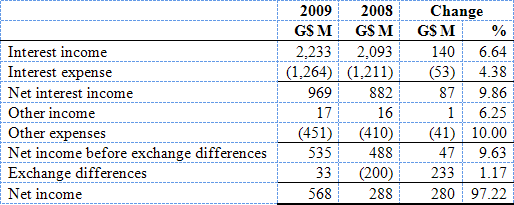
After a break of two years when the directors took the annual meeting to Berbice, the annual general meeting of the NBS will return to the Pegasus Hotel next Saturday at 1.30 pm. The directors will report a profit of $588 million, describing it as an increase of 97% following a write-off in 2008 of a $200 million exchange loss on its sterling investment. According to the audited Statement of Income the profit for the preceding year was $487 million, so that the increase in profit for the current year is 9.6%.

Highlights

As is evident, the increase in net income before exchange difference was 9.63% but after taking account of an exchange gain in 2009 compared with an exchange loss in 2008, the change in net income is 97.2%. Just for the benefit of the financially minded, the accounting treatment of the gain is not in accordance with the rules of accounting.

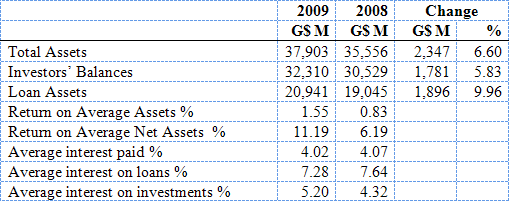
Total assets of the NBS increased by 6.6% compared with 9.3% of the GBTI while its investors’ balances – largely equivalent to depositors’ balances – increased by 5.8%, compared with GBTI 11.9%. Despite this, and due to its tax exempt status, no reserve requirement and more discretionary provisioning rules, the NBS pays higher rates of interest on deposits and yet charges lower rates on its loans.

There is no doubt that the investments in the Berbice Bridge Company Inc are attractive, even for a tax-exempt entity. The issue has been concentration. Having acquired $1,520,000 of such investments from CLICO in 2009, the total of $1,870,000 represents 34.9% of the reserves at the end of the year. As a prudential rule, the Financial Institutions Act limits any single investment by financial institutions to 25% of their capital base.

The Society’s pension fund recorded unfunded obligations of $21.8M compared to a surplus of $21.5M, a significant turnaround of over 200%. No mention is made of the cause of this decline. Accounting rules have allowed a significant larger obligation to be presented in the financial statements.

The last time the NBS had a meeting at the Pegasus, there was quite a furore. It is unlikely that history will repeat itself.