Banks DIH decision on shares a clear case of illegality

Dear Editor,

Pension Funds, Institutional and even small shareholders  in Banks DIH Limited have been thrown into turmoil as a result of the arrogance and inexcusable insensivity of the directors of the company, the legacy of Guyana’s pioneering entrepreneur Peter D’Aguiar. For months, those shareholders and the public were confused by the decision of the directors to make the food and beverage giant into a private company, away from public scrutiny. To achieve this Machiavellian objective, shareholders of the company were expected to exchange their shares in the company for an equivalent number of shares in a newly established holding company, Banks DIH Holdings Inc.

Then followed a lawsuit brought by the two companies against the Guyana Securities Council – the Regulator  of public companies – for its failure or refusal to delist the old operating company and list the new company as the public company. The Court rejected the application and ordered the companies to provide the Council with the information it required within a specified timeline and a deadline for a decision by the Council to respond to the companies.

Earlier reports in the press indicated that the Court ruled that the Securities Council was in its right to demand information on the transaction to enable the Council to make a proper decision. The date set out in the Court’s decision was 8 September 2024. There is no public information that the Council has given the companies its approval.

Yet, in surprise announcements in the national newspapers on Thursday and Friday of this week, the companies published two advertisements: one to shareholders and the other to “To whom it may concern” respectively. While the notices are confusing in their details, what is clear is that the directors have deemed the shares held by every holder of shares in the beverage company to be invalid, i.e., until a shareholder exchanges her/his current shares for new ones, those shares have no value. In other words, shareholders are deprived of their property which they thought the Guyana Constitution protects.

It is true that the views of the minority cannot prevail over a decision by the majority, but Company Law has made gigantic strides in the protection of minority shareholders, including a buyout of dissident shareholders. But I do find it hard to believe that the directors of both companies are so simple-minded to think that an exchange of an equal quantity of shares between companies carries an equivalent value. Think of it: even countries which engage in barter use value as the medium of exchange.

To confirm that frightening situation, the Guyana Stock Exchange, in a publication in the press of August 3 has suspended trading in Banks DIH shares with grave implications for all shareholders. I think it most unfortunate that the Guyana Securities did not respond publicly to the initial advertisement by the company which not only sought to preempt the decision of the Council but also seems to be in contempt of the Court’s ruling in the Council’s favour.

The decision by the two companies is irrational, abhorrent, unlawful, contemptuous and unconstitutional. Our country is replete with instances where persons refuse to act even when their interest is threatened. This is evidently such a case, and shareholders cannot let this pass.

In the more general to whom it may concern notice, emphasis seems to be placed on. She held interest or shares held on lean by institutions, requiring such institutions to return the share certificates to facilitate the issuance of the new shares.

It might have escaped attention that that was effectively backdating a deprivation of property guaranteed by the constitution of Guyana.

To add to the confusion, this Saturday’s edition of the Stabroek news, in addition to the republication of the general notification by the Company concerning shares held in in trust and on lien the Guyana Stock exchange Announced that in the circumstances of Banks DIH holdings Inc. issuing a newspaper notices to the effect that banks GIS Limited shares will no longer be valid effective July 19, 2024, stock exchange has suspended trading in BIH shares. It probably comes as no surprise to everyone, but to the directors and officers of BANKS DIH Limited, that the confusion brought about by the irrational decision whereby the beverage and hospitality giant is converted into private company whose shareholdings are transferred to a new hauling company.
Business and Economic Commentary by Christopher Ram Part 8

July 12, 2024

Court woes for Banks DIH Limited

Court setback

Banks DIH Limited and its newly minted holding company Banks DIH Holdings Inc. (BDIHHI) had a setback of some significance in the courts in an action brought against the Guyana Securities Council. (See Stabroek News of Wednesday 9 July). Dissatisfied with the failure by the Securities Council to give speedy blessing to their efforts to restructure Banks business, the two companies, through a strong legal team, approached the court for judicial review. It was over the Council’s delay in endorsing a plan which would see the iconic company ceasing to be a public company and now to be owned by a newly created holding company. That plan involves shareholders in the long-established company exchanging their shares for the uncertainty of a newly minted, ill-defined holding company.

The decision by the court must have come as a total surprise to the companies which enjoyed a rather easy ride, obtaining a stage one approval without even notifying, let alone engaging, the Council. It was even easier at the level of the shareholders who offered overwhelming support for a scantily defined and hardly understood and communicated plan. A booklet circulated to shareholders selling the idea offered information that was at best unclear and imprecise, and worse, inadequate and troubling. As I think about it now, that document was as important as a prospectus but was subject to none of the stringent conditions of a prospectus.

The essence of the assurance to shareholders was that the move was part of a broader strategy to streamline the company’s corporate structure and meet evolving financial regulations. To achieve this objective, the directors of Banks DIH Limited would make the company into a private company, shielding its tons of retained earnings from shareholders. To do this, the directors needed the approval of the Securities Council to deregister the much-loved company. And that is when the problem started.

Ruling on favour of the regulator

The GSC’s position it seems was “not so fast”, asking the company for more information. It seems that this displeased the directors who approached the courts, arguing that the GSC’s actions were unreasonable, an abuse of power, and contrary to law. The court ruled that the Securities Council was indeed subject to judicial review, a process which involves an examination of the legality of the decision-making process, but not the merits of the decision itself.  Except for that small mercy, the court rejected the arguments of the companies and refused to grant the several orders sought. Accordingly, the court found that the GSC’s request for additional documentary evidence was both lawful and necessary, and found no evidence that the GSC failed to consider the applications or acted in bad faith.

The companies are now required to provide the Council with the information it needs within seven days after which the Council has a further fourteen days to decide on the application. I have deep concerns about the adventurous move by the directors and hope that the company will reconsider its decision. This is a poorly conceived plan and there is no doubt that quite a few shareholders are hoping that the directors are courageous enough to walk away from this extravagant idea.

Running out of ideas

Readers will recall that the very Council which the directors have vigorously challenged in court, was recently requested by the same directors to investigate the poor performance of the company’s shares on the Stock Exchange. Maybe the price fall is less about manipulation or small shareholders and more about matters which cause more than a little concern among shareholders. Maybe there is a link between the share price and the serious questions about the composition of the company’s board of directors – many of whom are not independent of the Chairman -, the routing of transactions with Europe via Florida at great cost to the company, the expensive, inflated share buyback in 2016, and the appearance that the company has run out of ideas.

With respect to the great plan, it would be useful for the directors to share their understanding and impact of the following provisions of the Companies Act dealing with dividends and retained earnings. .  

52 (5) “Where a particular company becomes the subsidiary of another company, any dividend paid to the other company out of profits of the particular company, acquired before it became a subsidiary of the other company, shall be treated as capital, and not as profits of the other company.”

53 “Where a company acquires all or enough of the shares of another company to control all of the other company’s activities, the pre-acquisition profits of the acquired company shall be treated as capital of the acquiring company.”   

Conclusion

Banks DIH Limited, once respected for its civility and decent conversation, seems no longer interested in open and respectful exchanges. Indeed, the decision by the Court included what it referred to as a postscript in which the tone of the exchanges, particularly by the company, was harshly criticised. But hubris is no substitute for good corporate practices. Banks as a company needs some serious reflection and retreats (pun intended). It needs a more enlightened and informed approach to management in the third decade of the twenty-first century. The structure has served the company well. If it ain’t broke, don’t fix it. Business is far more about business than it is about structures.

This project will have far more unintended consequences than the directors can imagine. This is no time for such risks.

Every Man, Woman and Child in Guyana Must Become Oil-Minded – Column 132 – June 28, 2024

Oil companies have earned five times more from oil than Guyana.

Modest investment, gargantuan returns

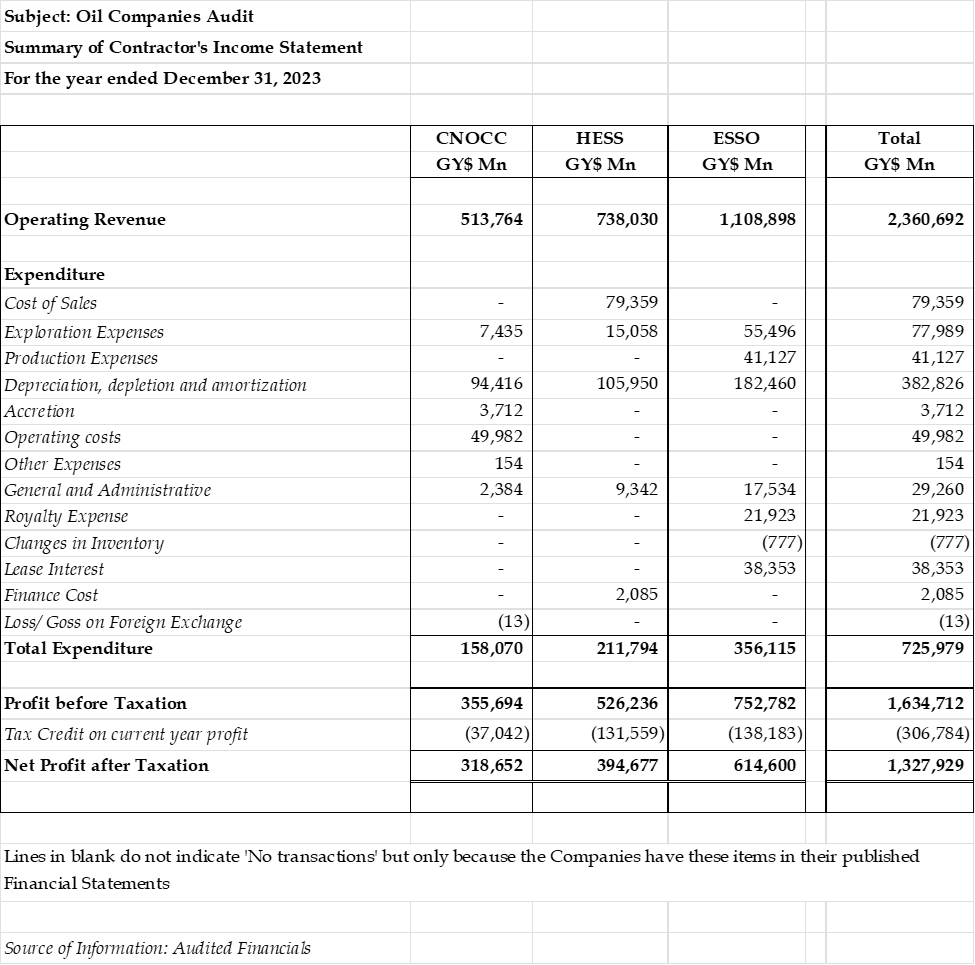
Last week’s column completed the review of the published financial statements of the three companies which signed the 2016 Agreement for the Stabroek Block. Table 1 is a summary of the Income Statements (Profit and Loss Accounts) of the three companies which operate as branches of external companies rather than as incorporated entities with their own share capital and directors. We were fortunate to have been able to access the balance sheet of the CNOOC intermediate parent showing that the Company has only US$200,000 in permanent capital invested in Guyana. But CNOOC, which has a 25% stake in the Block, is no outlier among the three.

That is a discredited narrative and myth. CNOOC is no outlier. Hess which owns a 30% interest, has permanent capital of US$50,000 or the equivalent of $10 Mn while ExxonMobil, the Operator and 45% holder, has permanent capital of US$500,000 and preferential capital of US$10 Mn. It is clear that those who have sought to justify the incredible, untouchable and sacrosanct tax concessions protected for forty years. Not only do they all operate in low or no tax jurisdictions, but the money that they themselves invest is negligible.

Back to the numbers

These are derived from the audited financial statements of the three companies for 2023. The total profit before the mythical tax for the three companies amounted to G$1,624,712 of which Exxon’s share is shown at 46%, Hess at G$526,236 Mn. or 32% and CNOOC of 21.8%. Readers can turn to Columns 129 to 131 for a review and commentary on the 2023 financial statements of each of the three oil companies, including both their income statement and balance sheet. I have commented in the past years about the lack of comparability of the financial statements and am amazed that the auditors appointed by the Government at considerable cost and amid big fanfare, never seem to have recognised this self-evident fact. But the leadership seems no less clueless.

Table 1.

Financing capital projects

I draw your attention to the line-item Depreciation, depletion and amortisation of $382,826 Mn. charged as an expense in the Income Statement, representing 53% of the total expenditure for the year. That is what is referred to as a non-cash expense and for the technically minded, that amount is a source of funds in the Cash Flow statement. But guess what? Guyana bears fifty percent of that cost, even as the funds are available to be used by the oil companies for further investment. Even after 25 years, Vice President Bharrat Jagdeo who was a key adviser to then President Janet Jagan when she signed the 1999 Agreement, does not seem to understand how that Agreement which has been “bridged” to the 2016 Agreement works. In fact, Mr. Jagdeo compounds that sad state of affairs by refusing to set any ringfencing conditions to any Production Licence. In that regard, he is in good company: Mr. Aubrey Norton, the Leader of the Opposition, is similarly in the dark.

What is clear too is that these companies have recovered their investments many times over while Guyana has to borrow billions to build roads and infrastructure, provide security, grant huge tax concessions, all because we love the foreign investors.

Taxation

As the Table shows, Guyana will be paying out of our oil fund $306,784 Mn. as taxes for the trio, plus giving the oil companies tax receipts so that they can double-dip. Another grand idea from Mrs. Jagan and Mr. Jagdeo and taken up by David Granger and Raphael Trotman in 2016. We seem to have created our own oil curse!

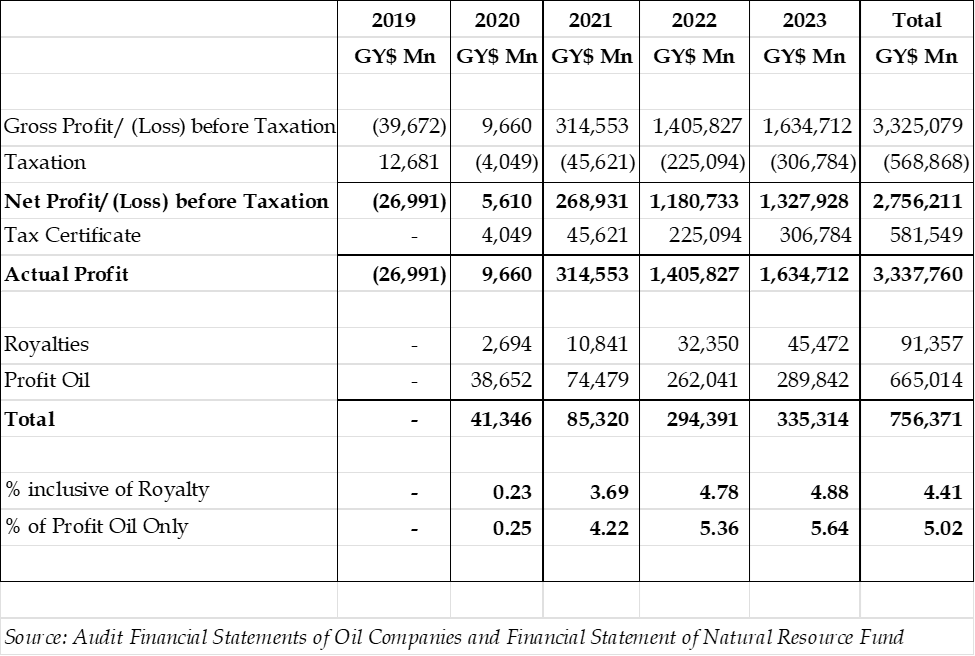
Table 2: Five Year revenue compilation 2019 – 2023

Five to One is highway robbery 

The above Table shows how lopsided the 2016 Agreement in money terms is. Over the years since production began, the oil companies have walked away with the staggering sum of $3,337,760 Mn, inclusive of the tax certificate to which they are entitled. The taxes nominally payable by the oil companies, are paid by the government of Guyana but the receipt is written in the name of the respective oil company so that they can then present them to get tax credits in their own country. What a farce, what a fraud?

But that is only part of the story. The line Royalties represent the compensation to Guyana for the petroleum extracted and sold. Even the quarries, the sand pits, the loggers and the gold miners are envious of a 2% royalty when some of them pay as much as 8%! A 2% royalty is one of the lowest in the world, but the Government claims without any serious understanding of contract law, that there is sanctity. Mr. Nandlall would tell them that such a principle is not absolute and that there are several grounds for setting aside a contract. That will be the subject for another column.

So let me point out that the oil companies have earned five times more than the Government under a 50/50 profit share Agreement. It is clear that the oil companies are engaging in lopsided front-end loading to grab as much as possible, as fast as possible. While draining the natural resources of Guyana, they are squeezing every ounce of flesh and drop of blood from the body of Guyana. The government likes to boast that in 2027 and beyond we will be producing substantially more oil than we do now. That is indeed true but all the evidence from all the experts is that oil prices will begin to fall in another couple of years.

Conclusion

President Ali has disowned responsibility and instead of a professional, competent Petroleum Commission he has Is delegated responsibility for the sector to Mr. Jagdeo. To say that this is a grievous mistake is an understatement, and grievously are we paying for it.

No amount of military spending can replace diplomatic support of countries in the controversy with Venezuela

Dear Editor,

At the request of the Ukrainian President, the Swiss government organised a Peace Summit last weekend. The Summit, attended by around 100 countries and multilateral organisations from around the world, had as its purpose, finding a path to peace in Ukraine which for over two years has been battling to repel the Russian invasion of its territory.

Attendees included leading countries of the world such as Brazil, Canada, France, France, Germany, India, Saudi Arabia, South Africa, the UK and the USA, as well as organisations such as the EU, OAS and the United Nations. Russia which had opposed the idea of such a Summit was not invited and there is no indication that its enablers China, Iran and North Korea were invited. For completeness, it is noted that several of these named  countries did not sign the Summit’s closing statement. That however is not entirely relevant to the purpose of this letter.

Guyana was not among the countries attending the Summit, meaning that it was a missed opportunity by the Government to engage in bilateral discussions with other countries on the Venezuelan threat to Guyana. Guyana must recognise that no amount of military spending will allow the country to repel any invasion by that country. In as much that we were impressed by the US fighter jets flying across Guyana as a show of strength and support, Guyana’s best guarantee in its controversy with Venezuela is to canvas and garner diplomatic support of countries that matter. Guyana shares with Ukraine and Taiwan the danger of being overrun by a neighbouring bully.

The country has not one but two foreign ministers and has recently made two diplomatic appointments to Europe. The failure must therefore be seen not as unavailability of personnel but of policy and intent. Indeed, having delegated to his Vice President the task of managing the fallout from the US announcement of sanctions against its former friends and members, President Ali should have been free to represent Guyana at the Summit.  

In my view, Guyana should be seeking membership of the Inter-American Treaty of Reciprocal Assistance (the Rio Treaty) signed in 1947. The essential features of this Treaty are similar to those of the NATO Agreement signed in 1949, both providing for mutual defence, collective security and the peaceful resolution of disputes. Venezuela is a member of the Treaty having reactivated its membership in 2019 after a withdrawal in 2012. It may object to Guyana’s application, but we must at least try.

Christopher Ram

Business and Economic Commentary by Christopher Ram Part 7

June 22, 2024

Banks DIH’s call for a suspension in trading in its shares

Introduction

Banks DIH Limited, a blue-chip company on the domestic scene, has asked the Securities Council of Guyana to suspend the trading of its shares on the Guyana Stock Exchange. While I am not aware of any precedent for such a request in Guyana, the request is often justified where there are concerns about unfair trading or market manipulation. In a circular to its thousands of members, the company’s Board of Directors expressed concern that there is a continuing pattern of an unusual reduction in the price of BDIH shares involving very small trading. It notes that for the period 2019 to 2023, revenue increased by 48.8 % and profit after taxation increased by 79.7 % but yet the Company’s share price declined from $300 per share in March 2022 and to $115 per share in May 2024. The Circular added that “such a comparison of the price of shares going down at the same time that profits are going up defies any logical explanation” and raises fundamental questions as to the integrity of the Stock Market. Even more strongly, the Circular added that “[A]ny reasonable person would consider that the Stock Market in Guyana cannot be taken seriously!”, with an exclamation mark.

An accusation of market manipulation is a serious one indeed, particularly coming from one of the country’s best-known public companies. What is worse is that the company appears to have formed its conclusions, even before calling on the Security Council to undertake an investigation of the reasons for the price movement and to “rectify the present state of affairs.” To put the small shareholders at some ease, the fall does not affect them and others who do not intend to sell their shares, but only traders, brokers, pension schemes and similar entities which are forced to recognise the loss in value.

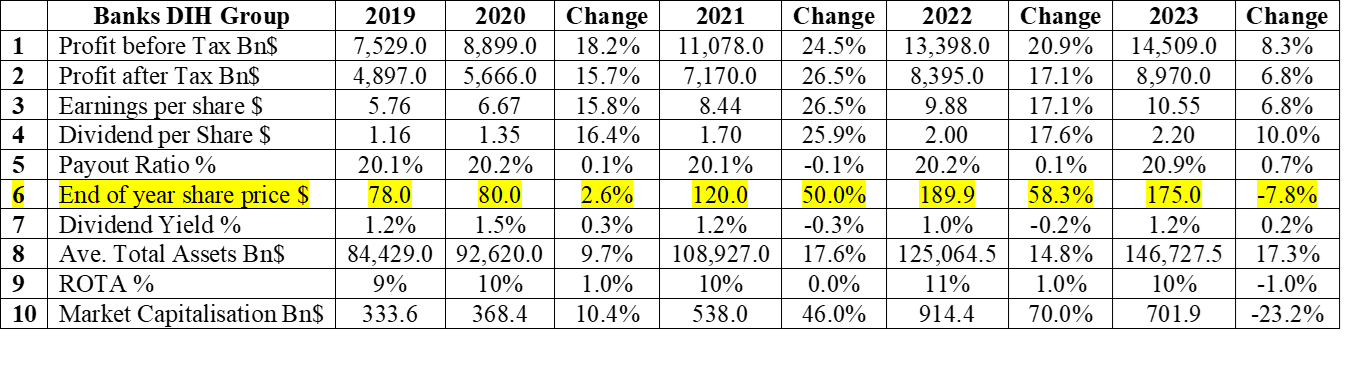
There is another side to the question of the share price of the company which this columnist has raised before. The significant increase in the share price over the period 2019 to 2023 was correspondingly much greater than its increases in profits, as reflected in the Table below, previously published by me as a letter to the Editor. (S/N 02 -02- 2024). Seeing their results as much as a public relations issue as a statement on their performance, companies take credit when their share prices increase but seek to avoid responsibility when they fall.

Source: Annual Reports of Banks DIH and GASCI website

The company should also address the historical, low dividend yield arising from the ownership of its shares and to offer an explanation and justification for the company’s policy of hoarding cash at the expense of shareholders. A small holding in the company is hardly worth the transaction cost for the modest dividends paid to its multitude of small shareholders, in three separate tranches. At the time of writing, I have on my desk three Banks DIH share certificates, one for 135 shares, one for 90 shares and the other for 910 shares, all issued by the company which the owner is offering for sale. Shareholders obviously have a right to sell their shares and if the company wants to stop small trades, then it needs to amend its by-laws and/or carry-out a large scale buy back of such small holdings.

Share price performance also reflects other variables. For example, the directors recently persuaded its shareholders to support the adventurous idea of converting itself into a holding company while making this iconic company into a private company. To borrow from the Circular, that step “defies any logical explanation,” but despite grave questions being raised, there is no indication that this move will not take place.

Observers are aware too that this company has been lukewarm at best on an effective Code of Corporate Governance and not only holds to a single person being the Chairman and the CEO, no succession plan and a majority of directors who are employees of the company and the Group. No wonder then that in relation to the ordering of goods from Europe through a company in Miami, the directors have opened themselves to charges of a breach of fiduciary duty to protect the best interest of the company. While one cannot be sure where this gross breach is on a scale with the accusation which the company is making against anonymous persons, to ignore such concerns only compounds the absence of responsible and proper governance in the company. For the company to be taken seriously, it must be willing to urgently review the governance and procurement practices of the entire group and to discontinue wasteful practices.

One final thought. While the company calls for the suspension of trading in its shares, it advises shareholders that their shares can be transferred at the Banks DIH Shares Registry, which would seem to be an avenue of share trading which is no more transparent than the issue being complained about.

Conclusion

It is true that the company has increased turnover and profits substantially over the years but its inconsequential revenue from exports shows the absence of any serious strategies and policies over those very years, or for the future. Investors in Guyana long for investment opportunities and look to the existing as well as new companies to offer fresh ideas and possibilities. Hopefully, the company will cooperate fully with any investigations by the Securities Council and the Stock Exchange. It must be prepared to share information on share activities by its own Share Registry and to actively support the efforts of the Securities Council to put in place a modern Code of Corporate Governance and Social Responsibility.