Every Man, Woman and Child in Guyana Must Become Oil-Minded – Part 118 – December 29, 2023

Natural Resource Fund overstated by $274,765 Mn., should be addressed as a matter of urgency.

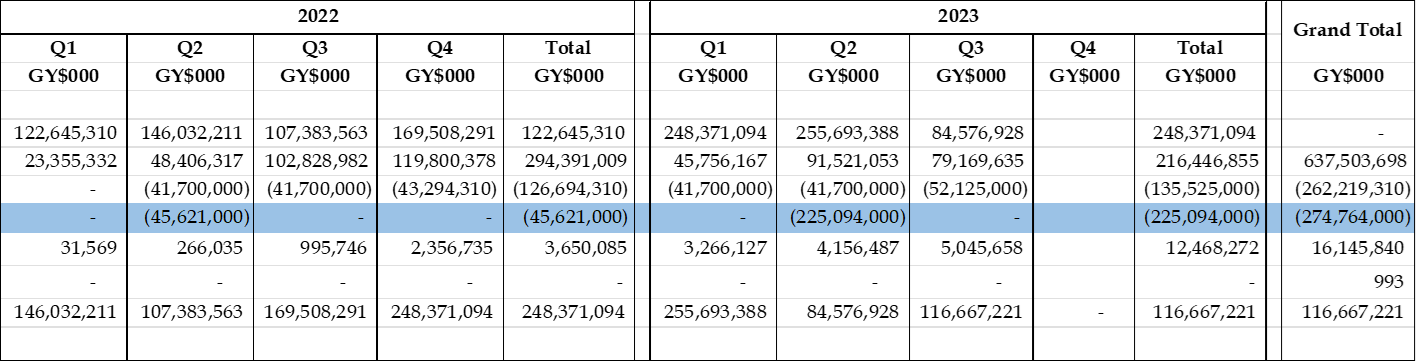
Among the several challenges facing the Natural Resource Fund (NRF) – also known internationally as a Sovereign Wealth Fund – identified in column 117 published on 22 December, was one which I described simply as “accounting”. Readers will recall that in the concluding sentence I opined that the balance in the NRF is overstated by “tens of billions of Guyana dollars”. To my horror, my research discovered that the overstatement at 30. June 2023 after the payment of 2022 corporation taxes for the oil companies, was $274.8 Bn. ($274,765 Mn.), representing 76% of the Fund balance at that date. The magnitude and significance of the error is evident from the 2022 financial statements of the Fund, which received a clean, unqualified opinion by the Audit Office of Guyana, showing the value of the Fund at that date of G$298 Bn. With taxes payable amounting to $49.7 Bn for the years 2020 and 2021 to be financed out of Guyana’s share of profit oil, the correct value of the Fund at 31st. December 2022 should have been G$248.4 Bn, the difference representing an overstatement of 20%. A similar overstatement for 2023 alone, amounted to a further G$225.1 Bn., hence the cumulative overstatement of $274.8 Bn.

Natural Resource Fund – Summary of Quarterly Reports
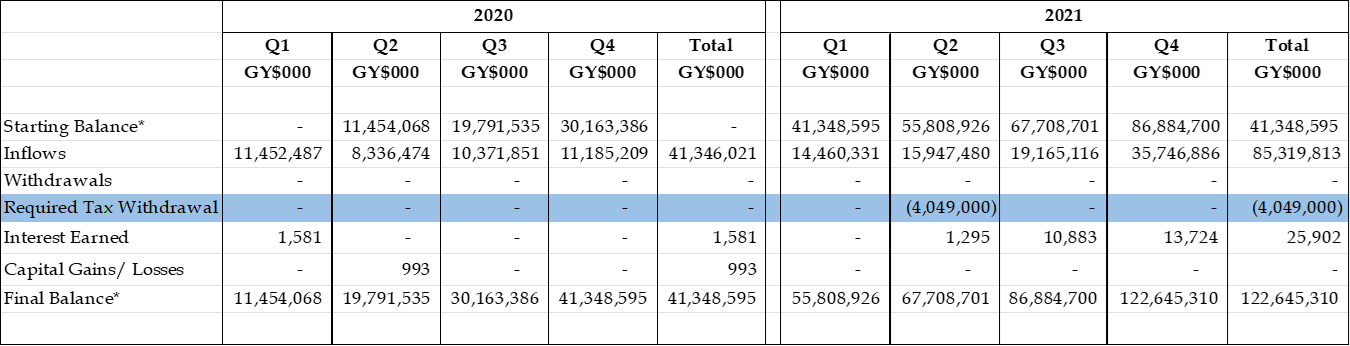
Source of Information: Bank of Guyana Quarterly Reports, *described as market value. Highlighted information from companies audited financial statements.

Summary of Contractor’s Income Statement (Exxon, Hess, CNOOC)

Source of Information: Audited Financials

As astonishing as it sounds, if just one of several persons or agencies involved – the Office of the President, the Ministry of Finance, including the Budget Office, the Ministry of Natural Resources, the Bank of Guyana, the Guyana Revenue Authority (GRA), the NRF Board and, I must say, the National Assembly and the Attorney General’s Chambers – had been paying attention to and discharging their respective responsibilities, this fiasco would have not arisen in the first place. What is worse, this situation has existed since at least 2021.

Relationship between NRF and the 2016 Petroleum Agreement

Let us look briefly at the operations of the NRF and its relationship to the 2016 Petroleum Agreement. The NRF receives three sources of income: royalty of 2% of all petroleum produced and sold (less cost of fuel used in production and transportation), the proceeds from the sale of the government’s share of profit oil and any interest received on investments, mainly cash balances held by the Fund. In accounting parlance, these are credits to the Fund account. Debits would represent withdrawals from the Fund, principally for two purposes. The first being transfers to the Consolidated Fund in accordance with sections 16, 19 and 20 of the NRF Act and second, money requested by the Minister of Natural Resources to pay to the Guyana Revenue Authority the taxes payable shown on the Company’s corporation tax returns for which the GRA issues certificates of taxes paid.

NRF Balances

Produced hereunder is a summary extract from the Audited financial statements of the three contracting oil companies for the years 2020 to 2022, highlighting the amount of taxes payable by them for each of those years. Those amount in total to a staggering G$274,765 Mn. If the transactions were accounted for in accordance with the Agreement, Corporation Tax receipts for the three years should have included $4,049 Mn. for 2020, $45,621 Mn. for 2021 and $225,094 Mn. for 2022, with corresponding reductions from the Natural Resource Fund for those years.

I am not asking cynics to believe me. They just need to look at Note 7 of the audited 2022 audited financial statements of Esso Exploration and Production Guyana Limited which states as follows:

“Under Article 15.2 of the petroleum agreement, the Company is subject to the income tax laws of Guyana with respect to filing returns, assessment of tax and keeping of records. (Emphasis mine). Under article 15.4 of the Petroleum Agreement, the sum equivalent to the tax assessed on [the] Company will be paid by the Minister responsible for petroleum to the Commissioner General, Guyana Revenue Authority and is reported as non-customer revenue.”

The observant reader will note the obligations of the three companies do not include the payment of taxes, which is done on their behalf by the Government. The reference to “non-customer revenue” is to comply with Article 15.4 (a) of the Agreement. For the answer to the question of the proper source of the money to pay the Commissioner General, one has to turn to Article 15.4 (b) of the Agreement. This agreement requires the tax to be paid out of the Government’s share of profit oil, the proceeds of which, under the NRF Act, are deposited into the Natural Resource Fund.

Screaming questions

The first question to arise is whether Minister Vickram Bharrat or Vice President Bharrat Jagdeo has ever read the financial statements of the company, which interprets for them the relevant provision of the Petroleum Agreement. Steve Coll’s masterpiece Private Empire ExxonMobil and American Power shows the oil giant at its ruthless and diabolical best when dealing with host countries whose governments are clueless, incompetent, malleable and spineless. They have found both the APNU+AFC and the PPP/C governments ticking all these boxes.

Like the majority of thinking Guyanese, I have always been offended by Article 15 of the Petroleum Agreement which the Granger/Trotman duo has locked us into until 2057, give or take a couple of years. And like the majority of thinking Guyanese, I feel painfully betrayed by the Ali/Jagdeo duo who now defend as sacred and inviolable an Agreement which they committed to “review and renegotiate” as part of their 2020 elections promises.

The next question is whether any, and if so what amount, of any actual tax payments made by Minister Vickram Bharrat to the Guyana Revenue Authority on behalf of the oil companies. That is a question which calls for an investigation in the absence of proper disclosure.

What I can state with a high level of confidence is that nothing emanating from several governmental agencies suggests that the Minister of Natural Resources has paid any actual cash to the Guyana Revenue Authority for which Certificates of Taxes Paid must be issued. These agencies include: the Office of the President, which has constitutional responsibility for the natural resources sector, the Ministry of Natural Resources whose Minister is responsible for the general oversight of petroleum and the mining sector, the Ministry of Finance which has responsibility for the Budget Office and for the annual Budgets, the Bank of Guyana which operationally manages the Natural Resource Fund, the Guyana Revenue Authority which is responsible for the collection of taxes and the Natural Resource Fund Board,

It is sad but not surprising that Minister Bharrat has once again failed in a major duty in his portfolio of responsibilities for which there will be no sanction, or consequence – not even the infamous two weeks salary deduction! If the Minister was familiar with the 2016 Agreement or has been following all the concerns in the press, he would not have been guilty of this grave act of omission. The oil companies of course, would know their entitlement and the procedures to access those entitlement. In other words, they would have had their tax advisers prepare their tax returns and deliver these returns to the Guyana Revenue Authority in accordance with Article 15.5 of the Agreement. The Article is carefully crafted with language like “properly prepare the receipts” and “proper tax certificates … evidencing the payment” by the Guyana Revenue Authority.

Conclusion

It is unquestionable that tax certificates evidencing receipt should have been issued. It is clear that no payment was made from NRF, nor was any such money accounted for in the Estimates of Receipts and Payments and paid into the Consolidated Fund. This omission reflects poorly on the Budget Office. The irrefutable but uncomfortable conclusion is that no money was paid to or received by the Guyana Revenue Authority. This is obviously a matter for the statutory auditors (the Auditor General) and the relevant government agencies, including the Natural Resource Fund Board. This Board needs a better understanding of the funds at its disposal to assure citizens that it is capable of defending and protecting the legitimacy, accuracy and integrity of the Fund.

Finally, having disparaged its predecessor’s Natural Resource Fund Act # 12 of 2019, both before and during the rushed parliamentary debate on its own NRF, the Government MP’s must be hugely embarrassed that not one of them understood the implication of the 2016 Petroleum Agreement on the Natural Resource Act. As a consequence, there is a clear disconnect between the Act and the Petroleum Agreement in that section 16 of the Act dealing with withdrawals does not include the taxes paid on behalf of the oil companies. That Act must therefore be amended urgently, to preserve the so-called sanctity of the 2016 “contract”. In doing so, the draftspersons would also have to address the overstatement of the Natural Resource Fund either by way of a belated cumulative transfer, or by some other legal device. While the parliamentary opposition had walked out the debate in protest about the allocation of speaking time, it appears that it too did not recognise the omission.

The overstatement of the balance in the Natural Resource Fund at the amount and in the current improper form must be addressed and corrected. This is not a “massa cow, massa bull matter”. They fall under separate legislation and the NRF is too important an inter-generational mechanism to this country to allow it to remain tainted.

Next week’s column will expose the myth of the 50/50 Profit Share.

What comes to an end in June 2027 is the Petroleum Prospecting Licence

Dear Editor,

I have to confess to some impatience at having to correct, once again, some of the disinformation being peddled by Mr. Joel Bhagwandin. Instead of taking stock of how he embarrasses himself, he continues to show reckless indifference, as if it was a badge of honour.

Two months ago, he demonstrated his inability to differentiate between the date of the 2016 Petroleum Agreement and its execution date but persisted, despite being corrected. In yesterday’s Stabroek News (12/20/23), in his feeble attempt to respond to my letter in Stabroek News and Kaieteur News one day earlier, he confidently claims that the 2016 Petroleum Agreement “has an expiration date … and that expiration date is in October 2027”. That is dangerously misinformed and totally wrong.

What comes to an end in June 2027 – not October 2027 – is the Petroleum Prospecting Licence issued to Exxon, Hess and CNOOC. The Petroleum Agreement with those companies under which Prospecting and Production Licences are issued expire in year 2057, inclusive of the one-year COVID 19 force majeure approved by this Administration.

I suggest to the young man that he heed the cautionary advice offered by my friend Robin Singh in his letter appearing in the Stabroek News yesterday, alongside Mr. Bhagwandin’s. What Mr. Bhagwandin wrote would please Maduro who would then think, well, all I have to do is wait four years!

I sincerely hope that Guyanese do not fall for the continuous stream of disinformation emanating from Mr. Bhagwandin.

Christopher Ram

AG needs to be reminded that the singular wish of all commentators is getting the best possible deal for the country and its people

Dear Editor,


Following the Kaieteur News article featuring comments made by Mr Anil Nandlall, S.C. Attorney General and Minister of Legal Affairs on the use by Venezuelan President Nicolas Maduro of “critical commentaries about Exxon in Guyana”, I messaged Mr. Nandlall and spoke with him about his comments and the not unreasonable inference that that statement could be interpreted as a threat of aiding and abetting the enemy. He offered his unequivocal assurance that no such interpretation was intended, and that as a lawyer, he would never suggest that commentators should feel themselves less than free to write.
Yesterday, following an interview with the usually accessible Mr. Nandlall, Stabroek News ran an editorial on the same issue. While that news outlet noted that he was more specific in the interview than in his earlier statement, the editorial did not mention any assurance about commentators’ right and duty to write.


I do not think that Mr. Nandlall needs to be reminded that the singular wish of all commentators is to get the best possible deal for the country and its people from our exhaustible petroleum resources. We do not criticise for its own sake, but to highlight the multitude of weaknesses in, and the egregiously poor oversight of the 2016 Petroleum Agreement. After years of tone deafness, commentators and the silent Guyanese are frustrated by the Government’s unwillingness to address any of the glaring deficiencies which result in serious loss of revenue to Guyana, each and every day.


More than just not wanting to muzzle commentaries, Mr. Nandlall should share their concerns, and let his superiors know that their ineffectiveness in the administration of the petroleum sector is the biggest part of the problem. More than mere bystanders, the Government operates as accomplices of Exxon which has a deservedly bad record of illegal and improper conduct – both internationally and locally.


As Attorney General, parliamentarian and a lawyer who has been involved in multiple constitutional cases, Mr. Nandlall should be more concerned than the average commentator that Guyana has ceded legislative sovereignty to Exxon for close to sixty years, or two generations of Guyanese. And that the Granger/Trotman gave to Exxon a second petroleum agreement which the law does not seem to permit.


As Minister of Legal Affairs, Mr. Nandlall should be concerned that that Exxon has siphoned off vast sums money received from investors, including Shell; that it blatantly padded pre-contract costs over and above what its audited financial statements of Exxon and those of its partners showed; that it unlawfully and improperly engaged a public official to write off the disallowance of a claim of US$211 million; and that while those financial statements are inconsistent and misleading, his colleague Minister of Natural Resources annually calls on the GRA to issue receipts for taxes which they do not pay.


As a citizen and leader, Mr. Nandlall should join the call for a Commission of Inquiry into the award of the 2016 Petroleum Agreement for which the Clyde & Co report provides compelling evidence. He should be offended that a top official of Exxon wrote the Cabinet Paper which led to that infamous Agreement. As a lawyer, he should use all his talent and the resources at his disposal to make the case for re-negotiation of the 2016 Agreement. And as a citizen, he should join his fellow citizens to make that happen.


I take this opportunity to advise Mr. Nandlall that if the government addresses the issues identified above, as well as others raised by commentators, he can be assured of compliments and commendations in place of criticisms and complaints. And finally, that no commentator or media house that I know would think of helping Maduro’s unlawful and baseless claim to two-thirds of Guyana.


Yours truly,
Christopher Ram

The President must not cede diplomatic support to Venezuela or show weakness in the St. Vincent meetings

Dear editor,

The announcement that President Ally will be travelling to St. Vincent and the Grenadines for a meeting with President Maduro of Venezuela, appears to have surprised many Guyanese. News of the meeting began circulating by way of a leaked copy of a letter by the Vincentian Prime Minister Mr. Ralph Gonsalves to the Presidents of Guyana and Venezuela.

President Ally has consistently asserted that the border controversy between Guyana and Venezuela is before the International Court of Justice, and confidently predicted that the International Court of Justice (ICJ), to which the controversy has been referred, would rule in Guyana’s favour. He advocates that everyone should await the ruling, while insisting that Guyana’s development cannot be put on pause, and that the rule of law must prevail. The ICJ has already made two preliminary rulings on the matter. It rejected Venezuela’s claim that the ICJ has no jurisdiction and in the second, on the matter of the 3rd December Referendum in Venezuela, it called on Venezuela to “refrain from taking any action which would modify the situation that currently prevails”.

It was disappointing that the ICJ used what appears to have been excessively neutral language to describe Essequibo, speaking of “dispute” rather than “controversy”, and “administration and control” – a term more descriptive of a holding situation in a protectorate, rather than sovereignty and territorial integrity of countries. As Anil Nandlall, the Attorney General said at a recent Bar Association forum, the Court was probably bending over to display its impartiality and to avoid any accusation of bias. Overall, the Court delivers sound judgments, a bit too slowly in my view, but while it can pronounce, it cannot enforce. There is an example some years ago of the USA’s refusal to abide by a ruling of the Court, while more recently, judges of Russian and Chinese nationalities dissented in an otherwise unanimous ruling against Russia.

Commendably, Guyana has received support, if only lukewarm, from regional, hemispheric and international communities. CARICOM, of which Guyana is a founding member, and the Community of States of Latin America, (CELAC) of which both Venezuela and Guyana are members, have led the initiative for Thursday’s meeting. Based on a statement by Gonsalves to the Vincentian media, he had a visit from a top Venezuelan official prior to the meeting which suggests that that country would have had some role in getting support for the meeting. Yet, it would have been difficult for President Ally to decline the invitation.

Perhaps in response to some disquiet expressed by sections of the Guyanese population following the announcement, President Ally has against assured the nation that the border controversy is not on the agenda. What he did not say however, is what is on the agenda, or what his own proposals are. Such meetings should have clear ground rules and desired outcomes, lest they end in disaster.

It is unclear what advice President Ally has taken, and who will comprise the Guyana team to meet with the Venezuelan delegation. In a letter in yesterday’s Sunday Stabroek, commentator Ravi Dev wrote that VP Jagdeo appears to favour a military base in Guyana “to protect our national interest”, clearly a reference to the USA. I seriously doubt that that will go down well with Gonsalves, President Lula or with Maduro.

A long time ago, Guyana could boast of one of the best teams of diplomats in the Foreign Affairs Ministry among world countries, and under President Burnham, Guyana hosted a meeting of the leaders of the Non-Aligned countries of the world. Regrettably, the role and strength of foreign affairs have been downgraded since then, depriving President Ally of the quality of support the situation demands, and which cannot be provided by either the Foreign Secretary, or the Foreign Minister. If diplomacy is to compensate for any other weakness in our relations with Venezuela, it needs to be handled capably, competently and delicately.

Guyanese of all political stripes have come out totally in defence of the country’s sovereignty and the integrity of its territory. To his credit, President Ali has engaged Guyanese populace, but mainly in speaking to, rather than with them. He is yet to consult with the National Assembly, and on the issue of the St. Vincent meeting, he notified the Leader of the Opposition, rather than consulted with him. Our semi-dormant National Assembly is meeting today, and there was no reason or urgency why President Ally had to respond to the invitation with such urgency, and without consulting with the people’s representatives.

It is a fine line to distinguish between the border controversy, while discussing the tensions caused by Venezuela arising out of that controversy. Guyanese will be hoping that nothing the President does in St. Vincent will yield a single concession to Venezuela or contribute to an escalation of tensions between our countries, or cause Guyana the loss of any diplomatic support. He cannot and must not.

Christopher Ram

Mr. Joseph is deserving of recognition for his phenomenal work on the border controversy

Dear Editor,

In yesterday’s Oil and Gas column I made a reference to former Ambassador Cedric Joseph and his book “Anglo-American Diplomacy and the Reopening of the Guyana -Venezuela Boundary Controversy 1961-1966”. Soon thereafter, I received the following message from a former colleague of Mr. Joseph which I have permission to share with your viewers. I do so because in my view Joseph’s contribution is one of the most significant pieces of research touching on our country’s very existence and sovereignty.

“Dear Chris

I was really interested in what you had to say about Cedric Joseph and his book on the Border Controversy in your article for today’s Stabroek News.

I have said on several occasions that had Joseph belonged to a different kind of society he would have been honoured for completing a work on Issue of critical importance to his country; one indeed which must be the best of its kind in the English Language. And what makes this accomplishment all the more remarkable is that Joseph did the research for his book mostly after he had retired and at his own expense. This undertaking was largely done in the UK.

The background to the making the making of book “Anglo-American Diplomacy and the Reopening of the Guyana -Venezuela Boundary Controversy 1961-1966” is also very interesting. Cedric Joseph wrote an article on this subject when he was a young Professor at the University of the West Indies which is generally regarded as the best introduction to the Border Controversy. This article was published by the University of Puerto Rico and by the Foreign Service Institute of the Ministry of Foreign Affairs under the title “The Search for Justice.”

After the publication of the article in question, Joseph wrote a booklet which carried the same title as his book, and which was an expanded precursor to the larger publication. I am telling you he dedicated his professional life to this issue.

I tried to get Cedric Joseph recognized for his remarkable achievement during the tenure of the last administration, but my recommendation fell on deaf ears. Among other things, myself and others proposed that there should be a Prize in Joseph’s name for the best thesis on Border Controversy which could have been placed under the aegis of the History Department of the University of Guyana. But you know our society destroys outstanding intellects. It does not encourage or succor talent and outstanding gifts. Yet we are surprised that we fail, as a nation, at so many important things.

Yours
Ronald Austin”

The University of Guyana will soon be conferring on Guyanese honorary Doctor of Philosophy on outstanding Guyanese for their contribution. While everyone of them is completely worthy of such an accolade, at this time when the very integrity and sovereignty of our country is at stake, none can be more deserving than Mr. Cedric Joseph. He is an academic and an incomparable authority on the Guyana-Venezuela controversy, even as he is excluded from any role in Guyana’s case against Venezuela at the ICJ. We just should not let him be another case of a prophet without honour in his own country.

Christopher Ram