Bridging Deed sells both patrimony and soul (2nd. Instalment)

This was Published on February 04, 2021

This Column regards the Bridging Deed conceived by some artful legal mind as going to the heart of the 2016 Petroleum Agreement – one of the first major economic acts of the Granger Administration. The handmaiden for the transaction was Mr. Raphael Trotman in his capacity as Minister of Natural Resources while its custodian or guarantor was Sir Shridath Ramphal. In an article in the Kaieteur News of February 1, 2018 seeking to justify the Administration’s refusal to make the Deed public, Trotman claimed that he needed to consult Sir Shridath Ramphal on the release of the document. He volunteered that there was nothing sinister about the Deed (with a capital “D”) and that Sir Shridath was selected as its guardian because the Government and Esso had confidence in him as a good person. In the subsequent two years, Trotman has been eloquently silent.
Column # 83 published last Friday revealed things about the Deed that challenge Trotman’s language. Because of my assessment of the Deed’s fundamental importance to the country, I sought and obtained the agreement of the senior editorial management of the Stabroek News to carry three columns this week – Tuesday, Thursday and the concluding piece on the usual Friday. This first part is
descriptive not judgmental, objective rather than subjective, narrative rather than critical. That was also the approach I took when in the earlier segments of this series of columns I dealt with the Agreement proper. Here are some of the key elements of the Deed. It was made on 29th. June 2016 and had four parties: the Government of Guyana and three oil companies – Esso Exploration and Production Guyana Limited (Esso), Hess Guyana Exploration Limited and CNOOC Nexen Petroleum Guyana Limited. They listed as their countries of incorporation The Bahamas (Esso), the Cayman Islands (Hess) and Barbados (CNOOC Nexen) and their registered office 62 Hadfield and Cross Streets, Georgetown, Guyana.

The Deed appoints as Escrow Agent Sir Shridath Ramphal of a Barbados address. It refers to an Escrow Letter dated the same date as the Deed sent from the Escrow Agent to the four Parties. The letter sets out the terms of the Escrow Arrangement whereby the Escrow Agent holds the Documents on behalf of the parties “subject to the satisfaction of certain conditions”. The terms “documents” and “Escrow Conditions” are defined only as having the meaning set out in the Escrow Letter.
The Deed is signed by Minister Raphael Trotman for the Government while the same persons who signed the 2016 Petroleum Agreement signed the Deed for the oil companies. There were two witnesses to each signature to the Deed while a single and
different person signed as witnessing the execution of the Petroleum Agreement. The Agreement was made on the 27th of June 2016 and the Deed was made on the 29th of June 2016.
In terms of contents, there is the Deed proper which runs to twelve pages. The Deed has the following attachments: Schedule 1 – Form of Notice of Intent to Relinquish; Schedule 2 – Form of Relinquishment Notice; Schedule 3 – Form of Regulation 28 Application; Schedule 4 – Section 51 (1) Modification (by Minister of Finance); Schedule 5 – Form of New Licence Application; Attachment “A” –Application for Petroleum Licence concerning the expired Stabroek Licence Area; and Part B – Form of section 14 (2) (a) Notice acceptance of conditions for the grant of a licence. Action/Decisions required under the Deed A – On the signing of the Deed Parties to procure that the Escrow Agent sign Escrow Letter and Parties to countersign the Escrow Letter. Parties to sign and deliver six copies of New Petroleum Agreement to the Escrow Agent for Registration at Deeds Registry. Minister was required to retain one of the Originals, a copy of which was to be provided to the National Assembly as part of the section 51 of the Petroleum Act with respect to taxation.
Oil companies to sign but leave undated two originals to the Relinquishment Notice and New Licence Application and deliver the signed originals to the Escrow Agent.
The Minister to sign and deliver to the Escrow Agent two undated originals of the section 14 (2) (a) Notice. Section 14 (1) deals with the notification of the granting of a licence while 14 (2) (a) deals with the acceptance of that licence; and within five business days from the date of the Deed Oil Companies to sign and deliver to the Minister a Notice of Intent to Relinquish with intended Relinquishment conditional on the following: The receipt of dispensation from Minister pursuant to Regulation 28 application. This regulation deals with modification of requirements in relation to the keeping of records, the surrender of records, and the maintenance of accounts.
The National Assembly to approve an Order under s51 (1) of the Petroleum Exploration and Production Act, modifying certain specified tax laws to the Oil Companies, and the gazetting of the Order. Esso on behalf of the Contractor Parties as well as the Minister to deliver Confirmation Notices pursuant to clause 4.2 of the Escrow Letter before the Escrow Termination Date. In the absence of the Escrow Letter it is not possible to ascertain other than by speculation what clause 4.2 is all about.
Following which the Minister to deliver to them, within thirty Business days, a confirmation note that Regulation 26 will be dispensed.
Before delivering the Confirmation Notice to the Escrow Agent, the Minister to give Oil Companies no less than five Business Days’ notice of his intention to do so.
Parties to coordinate with Escrow Agent to arrange a suitable Completion Date following satisfaction of the Escrow Conditions. The Deed defines the Completion Date to have the meaning given in the Escrow Letter. Column 85 to be published this coming Thursday will discuss some of the contents of the Deed.
Every Man, Woman and Child in Guyana Must Become Oil-Minded

This was Publish on June 21, 2021

Introduction

This column which last appeared on April 17, 2020, is returning for a short series. It will feature the 2020 financial performance of the three companies which signed a petroleum agreement with the Government of Guyana for the Stabroek Block. The three companies are Esso, Hess and CNOOC which hold 45%, 30% and 25% respectively of the Block which has so far been hugely successful with a twentieth discovery – Longtail-3 – announced earlier this week. Each of the columns over the next three weeks will feature one of the companies, followed by a wrap-up synthesis of the three.

The Petroleum Agreement is largely silent on accounting rules except in relation to the documentation to be submitted to the Government in relation to the petroleum operations. Expanding only slightly, the Agreement requires the companies to keep accounts, operating records, reports and statements relating to the operations in accordance with the Agreement and the Accounting Procedure set out in Annex C to the Agreement. The substantial part of the Annex deals with the various categories of costs and whether certain specified costs are recoverable without any approval by the Minister, recoverable with the consent of the Minister, not recoverable, and finally, costs not otherwise specified. These would require the approval of the Minister.

In the absence of and prescribed rules, it is left to the Institute of Chartered Accountants of Guyana to set the accounting rules for petroleum operations. This the Institute has done by way of the adoption of Inter-national Financial Reporting Standards, generally referred to by the abbreviation IFRS. Given the nature of the operations involved, the rules are extremely complex and their application open to interpretation. This is just another area in which the country suffers as a result of the failure by the Government to have a Petroleum Commission by whatever name to regulate the sector. This Column will address some of these issues after a review of the financial statements of the individual companies. 

CNOOC

This company has changed its name from CNOOC/ Nexen which was originally a Canadian/Chinese jointly held company but the Canadians are no longer involved. Note 2 to the financial statements states that certain of the Branch’s activities are conducted through joint arrangements, raising the question whether it has other activities which it carries on independently.

The Company appears to be a shell within a shell. CNOOC operates as an offshore company in Barbados which up to now has provided a haven for sheltering taxes. So instead of the Board having directors from the parent company, three of the four directors of the company are Bajans! It is therefore not ironic that the note to the financial statements carry a long statement on the regulatory changes in Barbados but nothing about the regulatory petroleum environment in Guyana which is the only country in which CNOOC Petroleum Guyana carries out its only operation. 

In its first full year of production, the Company has reported a profit of $9,298 million on income of $41,419 million, a net margin of 22.4%. The financial statements also fail to disclose how it accounts for pre-contract costs recovered in the current year and what is left to be recovered.

Of the expenditure of $32,121 million, Depreciation, depletion and amortization accounts for $14,782 million and refers the reader to Note 3 but that number is not evident in the Note. Operating costs amount to $16,875 million, but that number does not even carry a note or any other information to support the figure. 

Taxation

The most interesting bit on the income statement is the element of taxation. Nowhere in the financial statements or in the extensive, copious notes is there any indication that the branch pays no taxes in Guyana. Indeed, it is surely guilty of a half truth when in Note 8 it states that the Branch is subject to the Guyana Income Tax Act and the terms and conditions of the 2016 Petroleum Agreement. At first glance, this appears to suggest a cumulative impact when the reality is the direct opposite.

The financial statements make good use of what is called deferred tax and so the financial statements have a charge of $2,324 million for deferred tax, one that is paid to no one but rather to recover losses claimed to have been made in past years. 

The Company sells all its share of oil production to an affiliate in Singapore which on sells on a cargo-by-cargo basis. Despite this arrangement the Company owes its related parties more than $400,000 million, the terms and conditions of which, including interest, are not stated.   

Note 5 states that the company has a $2.5 billion credit facility provided by CNOOC International Limited and one wonders whether this is a USD facility, or unlikely, a G$ facility. The note also states that the Company has received a letter of support from BVI (sic) to sustain the business at its current level of activity. The financial statements show that the company is already making commitments for the Liza Phase 2 and the Payara Projects to the tune of $297,000 million. 

A final matter of note is the Decommissioning and restoration provisions at $39,365 million as funds to reclaim and abandon wells and facilities.

Next week’s column will feature the financial statements of Hess. 

COVID-19: An Overview and Lessons for Guyana

Dear Editor,

Guyana’s electoral fiasco may have overshadowed the other major crisis which it faces, the COVID – 19 pandemic. As of Saturday April 11, Guyana had carried out 193 COVID – 19 tests, of which 45 were positive, with six deaths. A review of the COVID – 19 data[1] for forty-five countries from across the world shows the USA, the wealthiest country in the world, having the highest number of deaths (21,409), with the fear that the peak may not yet have been reached. The USA also tops the chart for the greatest number of tests carried out by any single country.


USA/Europe

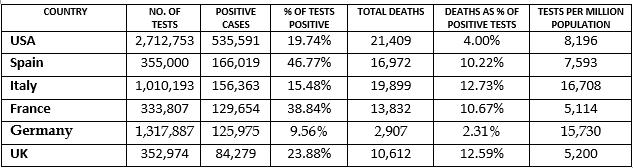
The next four countries in terms of deaths are Italy, Spain, France and the United Kingdom. In terms of tests carried out relative to population, Italy which has the second highest death rate has carried out the highest number of tests measured in relation to population, followed by Germany at 15,730 tests per million of population. Spain had the highest percentage of positive cases (46.77%) of number of tests carried out. Counterintuitively, Italy had the lowest percentage of positive cases to tests, confirming the widely held observation that the Italian cases were concentrated in particular areas. Italy and the UK had the highest percentage of deaths to tests carried out. The success story is arguably Germany which has about the same number of cases as France but did three times as many tests and suffered only one-fifth of the fatalities.

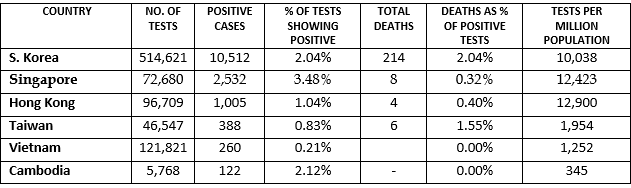
Here is what the Table shows for six countries in these geographical areas:   


South East Asia

Perhaps because of their proximity to China, the countries of South East Asia responded early and aggressively. Singapore, South Korea, Cambodia, Taiwan, Vietnam and Hong Kong appear to have managed the pandemic far better that the countries of Europe and the USA. South Korea is widely held up to be the gold standard for management of the virus with the highest number of tests overall. However, that number translates to 10,038 per million of population which is lower than Singapore and Hong Kong, both of which recorded less than half percent of deaths to number of positive cases. In fact, only South Korea had a relatively significant number of deaths (214) with Singapore, Hong Kong and Taiwan having 8, 6 and 4 deaths respectively with Vietnam and Cambodia reporting not a single death from the disease. Both these countries had considerably lower incidence of tests than the first category selected above with Cambodia being particularly low at 345 tests per million of population.  


Commentators from western countries were quick to point out that China where the virus started was able to manage the virus using measures that the west would find unacceptable. Of course, Singapore, South Korea, Hong Kong and Taiwan provide an instant rebuttal.


Africa

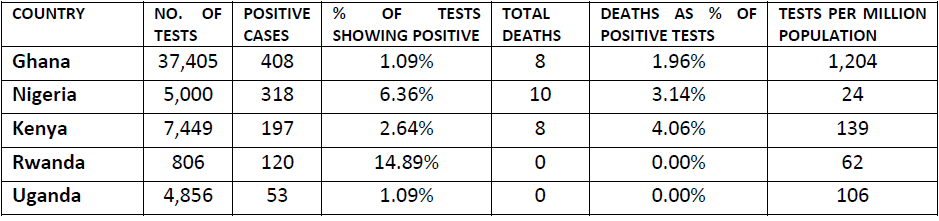
The countries of Africa have also performed well with very few deaths as the following table shows. Nigeria is a huge country with close to 200 million people spread over nearly one million km2. Ghana was the leader in number of tests, almost double the number done by Nigeria, Kenya, Rwanda and Uganda, the latter two recording no COVID – 19 death. Despite having one of the lowest test rates in the world – 24 out of every million – the percentage of those tested proving positive was in single digit at 6.36%.

Nigeria’s strong epidemic response infrastructure is in large part responsible for their relative success. The Nigerian Centre of Disease Control has been investigating pandemic preparedness for the last three years. At the time of the incident case, they had already established Public Health Emergency Operations Centres (PHEOCs) in 23 out of the 36 states in Nigeria for the purpose of detecting, preventing, monitoring, preventing epidemics. The country’s experience with Ebola also bolstered its response. The incidence case was detected within 48 hours of the person arriving in Nigeria.

Readers will recall that the region was ravaged in 2014 – 2016 by the dreaded Ebola virus disease (EVD) which like the corona virus traced its origin to wild animals. The fatality rate of the EVD reached 60%. The African countries took strong and effective public health measures in the aftermath of the EVD and the benefits may be paying off. Rwanda’s rate of positive test was 14.89% which is more consistent with the rate experienced in the European countries.     


South America

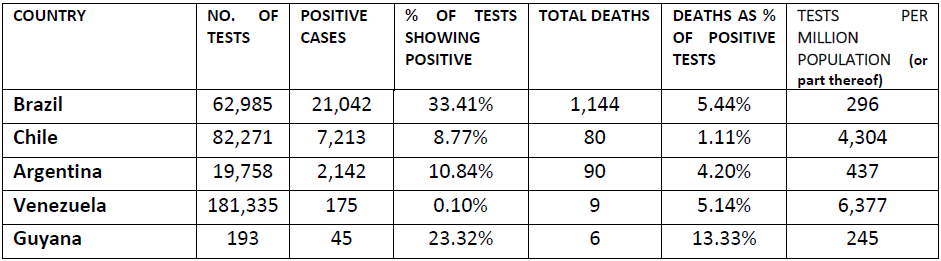
Brazil’s ultra-right wing President Bolsonaro is among the handful of world leaders still scoffing at the threat of coronavirus to public health. It is no surprise then that relative to population, Chile has tested fourteen times the number tested in Brazil. Troublingly for the people of the South American giant is that one in three persons tested came out positive and more than 5% resulted in death. Chile’s tests are also coming back with a fairly high positive rate and a 1.1% death rate.

The real exceptional case in South America is Venezuela which only last month was predicted in the western media, to become an epicentre of the virus. In fact, Venezuela has carried out one of the highest test rates per million of population (6,377), among South American and Caribbean countries. Only Chile (4,304) and Barbados (2,599) come anywhere close. For convenience I have placed Guyana among the South American countries as it shares land borders with Brazil and Venezuela.

Of the forty-five tests carried out by Guyana, 23.3% were positive and resulted in six deaths. Guyana has its own special problems having alienated itself with electoral shenanigans meaning that there is no legitimate Government, the President is in hibernation and the Minister of Public Health seeming to be out of her depth. Meanwhile, the outgoing Government’s application for modest assistance from the World Bank has been stuck in the system.    


The Caribbean

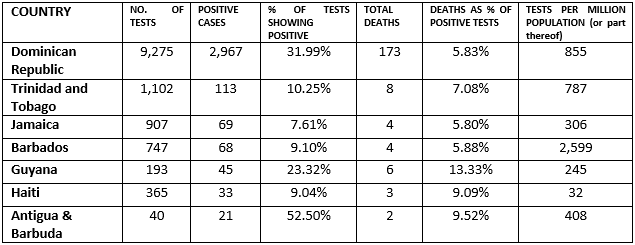
Comprising mainly island states, the six countries which include Guyana, are in lock down and are already facing serious fiscal and economic challenges, which are getting worse by the day. Tourism plays a significant role in the economies of all the OECS countries including Antigua and Barbuda, Barbados and to a lesser extent Jamaica, all countries included in the Table. Haiti, another such country, has suffered from one calamity after another over several years. COVID-19 could therefore only exacerbate an economy under severe stress.

Except for Barbados, significant testing does not appear to be part of the strategy of these countries of the Caribbean. Although it is possible that this is simply because of the unavailability of these tests either because of funding or the mentality that COVID – 19 was a “Chinese thing” that would not come to these shores. Deaths in all the countries remain in single digits with some of them resulting from imported cases, as is the case of Guyana where Patient Zero was a visiting American Guyanese.

Antigua & Barbuda stands out as the only country in the world that has had positive test result in excess of 50%. For its part, Guyana ranks highly in this metric at 23.32% and it is unclear why neither Antigua & Barbuda nor Guyana is not extending their test. This apparent reluctance only fuels speculation, especially in Guyana where statistics have been controlled by a very partisan politician.    


Lessons for Guyana

The statistics do not offer any clear direction for Guyana. South Korea is considered a gold standard in testing because it began widespread testing very early. Guyana did not do so and is now well past that stage. It is not clear how many test kits Guyana has and why these have not been used. The entire process is being controlled by a Minister better known for her partisanship than for her competence.

For all the conflicting directions in which the statistics point, there are a few ways in which COVID – 19 can be defeated. Social distancing, the wearing of masks, personal hygiene, including the proper washing of hands, contact tracing, the wide availability of tests and early results. Additionally, a challenge of this magnitude requires strong and informed leadership, teamwork, trust and resources. At the national level, Guyana has failed in almost every single matrix.

No one knows what resources are available, the national leadership is exclusive rather than inclusive, the President seems himself to be in lockdown, the Government is paralysed by its own making, there is no Parliament to make laws and most of the initiatives come from a disparate number of political and other groups. All of this in a country that is considered among the least prepared to deal with the virus.  

Meanwhile, major sections of the country are in lockdown or underperforming as a result of the combined effects of the unwillingness of the loser of the March 2 elections to concede defeat and a weak response to COVID – 19.

Except for non-essential services, the country’s economy is on lockdown until May 4th. Many businesses have sent home workers but with no assurance of payment. Some businesses will find it difficult to resume. In the country’s first year as an oil producing country, Government projected revenue will take a substantial hit, partly as a result of the sharp decline in oil price. There is no consensus of the elements of the decision to reopen the country’s border and its economy.  

When the lockdown is over, the electoral and constitutional mess will continue. 2020 will go down as one of the most difficult years in the history of the country.    

13 April 2020


[1] Source: https://www.worldometers.info/coronavirus

Outrageous and blatant abuse of state resources by the gov’t

Dear Editor,

It is a measure of how low the APNU+AFC Coalition Government has sunk that its Prime Ministerial Candidate and leader of the AFC Mr. Khemraj Ramjattan defends the use of state resources by  David  Granger and his ministers to campaign for the March 2 General and Regional elections. And how dysfunctional the Granger Administration has become that Mr. Joseph Harmon, Co-Chair of the Campaign to reelect the Granger-led Coalition, can dismiss concerns about the abuse of state resources as “a ridiculous assertion” even as the Coalition’s manifesto launch was live streamed from public resources. Ramjattan was defending Granger’s use of aircraft from the Guyana Defence Force while politicking on the day of voting by members of the Disciplined Forces.

According to Mr. Harmon, the APNU+AFC campaign is being “financed by of persons who [see in] the programmes which we [the APNU+AFC] are embracing a future for Guyana and want to invest in that future.” Even assuming that that were true, Harmon is showing an incredible lack of familiarity with facts and with the law. One major contractor appears to have been appointed to approach the private sector soliciting funds for the Coalition. Two such members of the private sector sought my advice on the legitimacy of such payment. Just as an aside, for their massive contribution to the future which the APNU+AFC has embraced, no doubt including further increases in taxation, not a single senior member of the private sector has made it to the President’s National Awards.

Harmon is reported to have told the media that “a decision on the release of campaign financing information would be made at the end of the campaign.” That is not a choice Mr. Harmon, it is a requirement of the law. An Election expenses return and declarations has to be submitted to the Chief Election Officer within thirty-five days after the declaration of results.

Now back to Ramjattan’s preposterous statement. Like Harmon, Ramjattan shows a remarkable level of ignorance about matters on which he pronounces. I shall identify two such statements made by Ramjattan. The first is that US President Donald Trump in his current re-election bid, utilises state resources, including the presidential aircraft, Air Force One.  It is not whether he does or does not. It is whether the use is free. It is not. The rule is that whenever the president is travelling for political purposes, the Party or his Campaign must pay the federal government for the cost of the trip. Where there is a dual purpose, the cost is allocated but is never free.

The second one is frankly dishonest. He argued that the use of state resources “is the norm of every other democracy I know.” Let me remind Mr. Ramjattan of the work I did for the AFC through Sheila Holder and him in obtaining information on how to address campaign finance. I am sure if he makes a reasonable search he would recover the Model Code of Conduct for elections (MCC) in India.

Meanwhile, here are some relevant extracts from that document:

Ministers must not combine official visits with election work or use official machinery for the same.  APNU+AFC compliance: Violated.

The party must avoid advertising at the cost of the public exchequer or using official mass media for publicity on achievements to improve chances of victory in the elections. APNU+AFC compliance: Violated.

Ministers and other authorities must not announce any financial grants, or promise any construction of roads, provision of drinking water, etc. APNU+AFC Compliance: Violated.

Other parties must be allowed to use public spaces and rest houses and these must not be monopolised by the party in power. APNU+AFC Compliance: Violated.

And just let me remind Harmon and Ramjattan that these are the rules for elections coming after the normal end of a Parliament. The APNU+AFC Government ended on a Motion of No Confidence which Granger and his Government improperly and unconstitutionally violated.

And finally, it would be good to hear from Ramjattan who has responsibility for the Guyana Police Force whether he was informed and authorised Minister Annette Ferguson addressing members of the Police Force promising them house lots one day before they cast their votes in these elections, and whether that is also the norm with which he is familiar.

The conduct and pronouncements of three named Ministers in this letter show how low Guyana has sunk intellectually and morally under David Granger and how far we are from the campaign financing rules for which Sheila Holder and Khemraj Ramjattan advocated while in opposition.

Yours faithfully,

Christopher Ram

Every Man, Woman and Child in Guyana Must Become Oil-Minded – Part 86 – February 7, 2020: Bridging Deed sells both patrimony and soul (4th. Instalment).

Introduction

It has been a week of fast-moving events. This past Monday (February 3), the London-based NGO Global Witness released a report Signed Away in which it made the claim that had Guyana properly negotiated the 2016 Petroleum Agreement with Esso/Hess/CNOOC Nexen, it would have received some US$55 billion more than what it would receive under the contract it now has. By a strange coincidence, a Government sponsored report by Clyde & Co, a law firm out of the UK, appeared in the electronic media despite having as its first words Strictly Private and Confidential.

The Government of Guyana went into overdrive, describing the Global Witness Report as “baseless”, “sensationalist, agenda-driven and extra-ordinarily speculative.” Criticisms came not only from the Government but from Forbes Magazine of the USA and Rystad Energy a research company from abroad and high profile local individuals such as Ms. Melinda Janki and Mr. Wesley Kirton. The comments from Forbes were logically understandable as it saw the report as an attack piece aimed at some of the biggest players in the oil and gas sector. Forbes saw it necessary to defend its friends in that sector.

Understanding numbers and projections

Rystad argued that its 2% royalty and 50% share of profit will give the Government 60% of the profit from Esso’s various projects. For her part, Melinda Janki in a letter in the Stabroek News accused Global Witness of putting out “Lala-land estimates”. I doubt that Ms. Janki was aware that accompanying Global Witness report was the extensive worksheets and report by Open Oil setting out the assumptions used in the projections – including from Rystad and the United States Government. While Rystad did not mention Global Witness in the press release it issued, it sought to counter pose Global Witness’ recommended 69% with its own strange math of 60%. If Rystad wants to be taken seriously and not another majority-of-65-is-35 type, it should make its methodology and assumptions public.  

For his part, Kirton seemed to see the expressed concerns of GW as analogous to a marriage, and of course as arrogance and disrespect for us Guyanese. I wonder what he thinks of an ExxonMobil man Mr. Brook Harris writing the draft Cabinet paper justifying the give-away of the century to a foreign oil company on the 50th. Anniversary of Guyana’s Independence Day!

The Government had the upper hand: Exxon had the Government 

I have read the Global Witness Report and the projections and long-term estimates by Open Oil. If I have any concern, it is that the estimate of US$55 billion is conservative and understated. It did not take any account of the abundance of gas and it used a median range of oil contracts for oil production which were negotiated before oil was found. Also omitted is that the Government has to pay the oil companies taxes for at least the next forty years from its share of oil profits. And significantly, by the time the 2016 Agreement was signed, there were two major world class finds and Exxon by its own admission was operating under an expired contract. The Government clearly had the upper hand. But Exxon had the Government. That was all that mattered.  

Who paid Clyde?

Now for the Clyde & Company report paid for by taxpayers. Like the Escrow Letter under the Bridging Deed, there are a multitude of annexes which are missing, including the Engagement Letter setting out the terms of reference and fees payable to the legal firm. But the Clyde and Co report seems to have had as a principal objective clearing the name of Trotman who stands accused of the most costly act of incompetence ever perpetrated on the people of this country. Let us recall that by the time this report was commissioned in late 2019, oil and gas had been removed from Trotman’s portfolio. How he came to drive this Clyde process is quite a mystery.  

Yet, Trotman was allowed to select the law firm and to decide who they could meet: only two ministers – himself and Greenidge. He also decided which documents he would share with the law firm. As the Report states at paragraph 1.6.2 the Report was prepared on the basis of information provided by Trotman’s Ministry and the GGMC over which he has portfolio responsibility. One of Greenidge’s signal contribution was to give to the oil companies the assurance that US$15 million of the Signature Bonus would only be used to fund the proceedings with Venezuela in the International Court of Justice. In other words, at a minimum, to protect Exxon’s assets. 

While Trotman’s list of interviewees did not include the oil companies, their presence pervades the report. We learnt that they “appeared” to put a lot of pressure on the Government to secure the 2016 Agreement in a short time scale, with different reasons being offered by the oil companies. None of the reasons seemed to have convinced Clyde. It thought the real reason was because Exxon’s subsidiary was driving to have a new agreement before the Liza-2 well results became fully known.

“Arrogance and disrespect for us Guyanese”

The most important bit of information in the Report was the revelation that on the 25th. May 2016, exactly fifty years to the day since Independence, while we were celebrating 50, Brooke Harris of ExxonMobil “provided by email a first draft of the Cabinet Memorandum to Mrs. Homer (Mr. Trotman’s Legal Adviser)”. It did not stop there: Clyde states in its report that the Cabinet Memorandum was prepared along the lines of the Independence Day email and that draft versions were exchanged between Mrs. Homer and Mr. Harris right up to the 31st. May. It was submitted to Cabinet on June 3, the very next business day.    

If ever Guyanese should be offended at – to borrow Wesley Kirton’s words – the arrogance and disrespect for us Guyanese, it is being told this by Clyde. Clyde also tells us that Trotman and Homer told their team that visited Guyana, that they received daily phone calls from the Contractor’s Consortium. And in the same Independence email, Harris told Mrs. Homer that Esso had strong operational need to have the section 51 Order (tax variation) confirmed.   

Conclusion

This is the first time in two years in which more than one Column is published. It took a lot of effort to do three columns and I hope that Guyanese have a better understanding of the path down which the APNU+AFC has taken Guyana. One has to wonder why the Government did and continues to do so many things in secret. We must remember that these things were not expected to come to light – the signing bonus, the Agreement, the Bridging Deed, the Escrow Letter and now the Clyde Report. It is the height or depth of stupidity for the Government to have considered the Clyde Report as exculpatory. For the excerpts cited above, it is damning. Laziness, absence of patriotism and a frightening complex for foreigners, prevented the Government – including Granger – from doing basic reading.

The Government’s response to the Global Witness Report, its pattern of deceit and dissembling of facts, its obsequiousness to Esso in particular suggest that if by whatever means it remains in power, there is no hope of Guyana recovering from the infamous Contract, the product of a Cabinet Memorandum written by ExxonMobil. My hope is that the anger which the Bridging Deed revelation has aroused will be constructively managed and that Exxon will have been sufficiently exposed and embarrassed that it would voluntarily return to the bargaining table. I hope that I am not hoping in vain.