
Every Man, Woman and Child in Guyana Must Become Oil-Minded – Part 72 – August 2, 2019: Esso’s, Hess’ and CNOOC/Nexen’s Recoverable Costs amount – Continued

Introduction

Column 71 published last week included a summary table of the Statements of Financial Position (the Balance Sheet) of the three oil companies which will lead Guyana to First Oil projected to take place during the first quarter of 2020. Noting that the financial statements audited by the same firm reflect significant differences in their content and presentation, Column 71 pointed to the value of expenditure incurred by the companies – more than G$500 billion – as at December 31, 2018, more than one full year before First Oil. As is now well known, the Petroleum Agreement provides for the recovery of costs before sharing Profit Oil equally between the oil companies and Guyana, subject only to a 75% of revenue limitation. In US Dollar terms, at December 31 the expenditure was approximately US$2.5 billion.

This expenditure falls into the category of pre-production costs which also includes pre-contract costs, including the amount of US$460 million stated in the Petroleum Agreement as having been expended to December 31, 2015. For completeness it is worth noting that this Column disputes this amount as being overstated by a not insubstantial amount when measured against the financial statements of the three companies. Of course, recoverable contract costs also include annual operating costs once production begins, usually measured by reference to a barrel of oil. The oil companies have not given any indication of what that cost is likely to be and one wonders at the basis of projections used by the Ministry of Finance and the Guyana Revenue Authority.

In all the Oil and Gas Columns so far, I have used a per barrel cost of production figure of US$35, inclusive of capital costs. However, in a recent presentation at Moray House, Dr. Tulsi Singh, a Texan-Guyanese who has been involved in the sector for decades, has used a figure of US$35 plus US$7 for capital expenditure. One would have expected that by now, some light would be shed on this important number and inevitably, one wonders whether the Energy Department itself has any idea of the likely number and how it has been derived.

Balance Sheet

The Summary table published last week did not disclose the Balance Sheet items by companies, an omission which I will now touch on briefly for two of the more significant items – Inventory and Property, Plant and Equipment. The December 31, 2018 total inventory of $14 billion is made up entirely of inventory held by Esso ($10.9 billion) and Hess ($3.1 billion). It is more than passing strange that CNOOC reports no inventory at that date and raises the question of a real time supply chain one hundred and twenty miles offshore, either directly or through its co-contractors which would more than likely be Esso. CNOOC has in fact not reported any Inventory over the past three years and Hess has only done so in 2018. 

As expected Property, Plant and Equipment (PPE) is by far the most significant item in each of the three Balance Sheets. The financials of Hess and CNOOC have two classes of PPE – Exploration and Evaluation Assets and Development Assets – while Esso has three classes – Buildings and Vehicles, Wells, and Plant and Equipment (Work in Progress). Combined PPE at year end 2018 mounted in total to G$490 billion in 2018, up from G$247 billion in 2017 with the highest growth being Esso (108.9%), CNOOC (93.9%) and Hess (89%).

Income Statement

I now turn to the summarised Statement of Profit and Loss and Other Comprehensive Income extracted from the separate financial statements of the three companies.
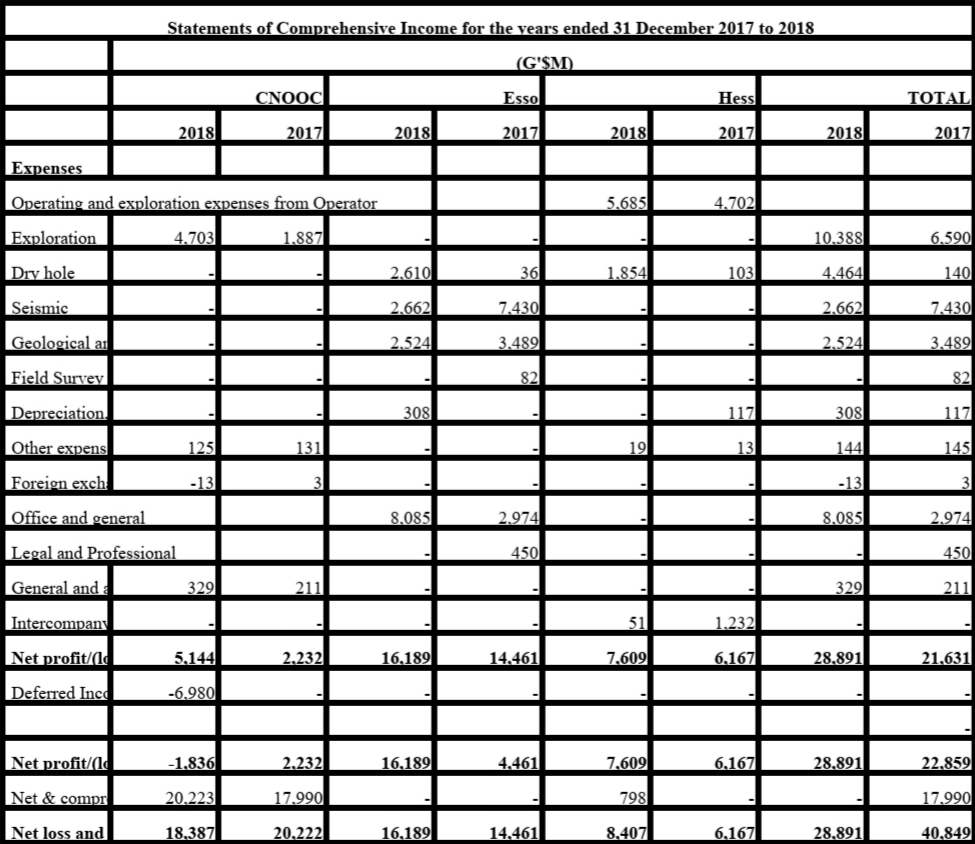
Source: Compiled from audited financial statements.

There are three lines to which special attention needs to be paid and these are highlighted: Net Profit/loss before income taxes, Net profit/(loss) for the year and the Net Loss and Comprehensive Income, end of the year. I noted last week that both content of and disclosure in the financial statements are inconsistent but there is another matter that raises a different question altogether which appears in Hess’ books. In this latter case, Hess reports a charge of G$5,685 Million for Operating and exploration expenses from Esso but there is no similar item in CNOOC’s financial statements. This raises a few questions:

  1. Does this mean then that Esso’s operating relationship with Hess is different from that with CNOOC?
  2. Is CNOOC doing its own exploration while Hess merely bears part of Esso’s exploration cost?
  3. Has the Minister or the person delegated by him to carry out his functions aware of and given express or implied approval of this arrangement?
  4. If Hess’ financial statements reflect costs assigned by Esso, why is there no corresponding transaction in Esso’s books showing it has recovered that sum and reduced its own expenditure?

And no surprise that Esso’s accounting and disclosure are different from that of CNOOC as the Table shows with Esso reporting items like Dry Hole, Seismic and Geological and Geophysical while CNOOC has a single block figure for Exploration.

Standing out in Esso’s Income Statement however, is an $8,085 million charge for Office and General Expenses which compares with $339 Million by CNOOC. Hess’ statement does not have such a line item but its administrative expenses could possibly be found in line Item Other Expenses ($19 Million), or in Intercompany charges ($51 Million).  Esso’s 2018 financials also show Legal and Professional expenses incurred in 2017 of $450 million but none in 2018. 

Esso’s $8,085 million charge for Office and General Expenses in 2018 and $450 million in Legal and Professional expenses in 2017 are not insignificant sums and these will probably all have to be borne by the Guyana taxpayer, one way or another.

Conclusion

Not too long ago everyone seems to have been auditing the financial statements of the oil companies for purposes of the Petroleum Agreement but months later, nothing is being heard. Oversight is not an episodic matter but one of sustained vigilance.

There is nothing that the Granger Administration has done in relation to the Stabroek Block that suggests anything but the greatest deceit and incompetence that continues to this day. It seems fair to say that the oil companies having been handed a lifetime gift in the form of the 2016 post-discovery contract is being fortified by a dangerously weak oversight. Let us pray.

Next week’s column will consider Petroleum Czar’s plans to uplift Guyana’s share of oil every ten days. 

Every Man, Woman and Child in Guyana Must Become Oil-Minded – Part 71 – July 26, 2019: Esso’s, Hess’ and CNOOC/Nexen’s Recoverable Costs mount.

Introduction  
Today’s column summarises some of the principal information extracted from the audited financial statements of the three Contractors to the Petroleum Agreement signed on June 27, 2016. The financial statements are filed with the Commercial Registry and are public records available to any person on the payment of a small fee.   Before looking at the figures themselves it is probably worth pointing out that while the financial statements are audited by the same local auditing firm, there are significant differences in their content and presentation. One standout difference is that while the currency of the financial statements of Esso and Hess, both with American roots, is the Guyana Dollar, the currency used in CNOOC/Nexen’s financial statements is the US$.   The summary below is stated in millions of Guyana Dollars.   

Combined Statement of Financial Position of Esso/CNOOC and Hess for the Years ended 31 December 2015 to 2018
(G’$M)  

Source: Companies Audited Financial Statements

Another major difference is how the three companies account for the most significant item in their financial statements – exploration cost. Let us see how each of these companies, all enjoying the status of Contractors account for and describe those critical costs.

Esso

Esso which has a 45% interest in the Agreement, is the only company that uses the label “intangible assets and wells” in the notes to its financial statements, although confusingly, the exact term does not appear on the face of the financial statements. It notes that the Branch uses the “successful efforts” method to account for its exploration and production activities and goes on to state that the Branch carries as asset explorations well cost when the well has found a sufficient quantity to justify its completion as a producing well and where the Branch is making sufficient progress assessing the reserves and the economic and operating viability of the project. Exploratory well cost not meeting these criteria are charged to expenses. Other Exploratory expenditures, including geophysical cost and annual lease rental, are expensed as incurred.

And under the heading Deferred Expenditure, the note states that “Expenditures incurred during the exploration stage and pre-full funding expenditures are written off in the year they are incurred.”

CNOOC

The financial statements of CNOOC on the other hand disclose that it carries exploratory well costs as an asset when the well has found a sufficient quantity of reserves to justify its completion as a producing well and where the branch is making sufficient progress assessing the reserves and the economic and operating viability of the project. Exploratory well costs not meeting these criteria are charged to expenses. Exploratory wells that potentially economic reserves in areas where major capital expenditure will be required before production would begin and when the major capital expenditure depends upon the successful completion of further exploratory work remain capitalized and are reviewed periodically for impairment.

This 30% interest holder discloses that Oil exploration and evaluation expenditures are accounted for using the ‘successful efforts’ method of accounting. Costs of acquiring rights to explore, develop and produce oil and gas (leasehold costs) are capitalized. Geological and geophysical costs are expensed as incurred. The cost of exploratory wells that find oil and gas reserves are capitalised pending determination of whether proved reserves have been found.

The extract from Hess seems to lend support to the widely-held view that it paid Esso for the opportunity to get in on the deal of the century and my own contention that Esso’s pre-contract cost should have been reduced by whatever payment it received from Hess and CNOON/Nexen.

Other differences

Another difference of some significance is that of the three companies only CNOOC/Nexen actually recognises Deferred Taxation as a credit in its Income Statement and a Receivable in its Balance Sheet. Hess has taken a more conservative approach, preferring to recognise a deferred tax asset only to the extent that future profits will be available to utilise any temporary differences can be utilised. 

CNOOC is also the only one of the three companies which has provided for Decommissioning and Restoration Provision. Such figures are not likely to be insignificant with CNOOC already providing some $7,567 million.

Conclusion

It is at the minimum mystifying that three companies which have joined to sign a single agreement, operate in the same Contract Area and which no doubt share some common reporting responsibility can have financial statements with such differences. I believe that there will be more that a fair share of confusion when the time comes for computing cost oil and profit oil. In next week’s column I will review and comment on the combined balance sheets of the three companies which show total assets of G$516,111 million dollars at December 31, 2018. Converted to US$, that amounts to roughly US$2,500 million or US$2.5 billion. This means that it will be a few years before such costs are fully recovered. Effectively therefore, for those years, Guyana will have to be content with receiving a mere 14.25% of gross petroleum revenue.

Every Man, Woman and Child in Guyana Must Become Oil-Minded – Part 70 – July 19, 2019: Landlordism in the Oil and Gas sector (Continued).

Introduction

Following up on last week’s column we have set out below a Table summarizing the Profit and Loss Statement of Mid-Atlantic for each of the years 2013 (part-year) to 2018 extracted from the company’s audited financial statements lodged with the Commercial Registry, a statutory obligation under the Companies Act. The Company was incorporated since 2013 but did not sign a Petroleum Agreement until 2015, the kind of information anyone would expect to see in financial statements but which is noticeably missing.

The Table shows that the Company has incurred expenditure over the first five years and a bit of over $270 million Guyana dollars of which 80% was spent on Administrative Expenses with the bulk of that expenditure going on Employee Benefits and Consultancy Fees. A perusal of the 2018 financial statements show that 90% of the $75 million in expenses reported in the Statement of Profit and Loss was incurred on Administrative Expenses.

The Balance Sheet is not any more informative or impressive and this may be because the Company, with Ministerial approval has become no more than a shell. That process, in which French oil giant Total and its American counterpart ExxonMobil now control the lion’s share of the blocks awarded to Mid-Atlantic. The significant amounts in the Balance Sheet are Cash and Bank Balances of $227 million, a negative balance on Reserves representing losses incurred, borrowings of $216 million and nearly $300 million in amounts payable to Related Parties and what is stated only as Other Payables. 

No expenditure, no exploration

Article 10 of the Petroleum Agreement requires an Annual Rental Charge of US$90,000 but it is not apparent whether this payment has been made or how it is accounted for. Yes, the Company has farmed out most of its blocks but the financial statements ought to provide more information to readers for a better understanding of how contractual revenues to the State are accounted for.

Clearly no exploration has been undertaken by this Company nor does it seem as though the Company has any such intention. It is expected that Total and ExxonMobil’s local company Esso Exploration and Production Guyana Limited (EEPGL) will account for any prospecting expenditure in their own books. Before looking into where EEPGL and how EEGPL has accounted for its expenditure (see Column # 69), it is interesting to inquire where Mid-Atlantic has accounted the proceeds of the two farm-outs to other oil giants.

Esso’s accounts

I have expressed similar concerns about Esso’s sharing its gigantic blocks with Hess and CNOOC-Nexen and its failure to account for the revenues therefrom. What has compounded the situation with EEPGL is that that Company seems to be claiming its gross pre-contract and pre-production costs before any operating costs are deducted to arrive at profit oil. It is incredible and shameful that this Company has not been called out by the Government “to clear the air”.

So this brings us now the EEPGL’s statement for 2018. As Column #69 narrated, EEPGL is working part of the Canje Block originally granted to Mid-Atlantic but there is no way of knowing whether any of those costs are accounted for in EEPGL’s books to be claimed as pre-production cost once the oil starts to flow. Exxon’s man was yesterday featured in a Stabroek News exclusive interview telling Guyanese how great his company is and how the absence of ring-fencing is good for Guyana! Please Mr. Henson, we Guyanese are not all stupid to have our intelligence insulted. 

Conclusion

It seems clear that some oil companies, big and small, are making rings around those who ought to protect our interest and national patrimony. The result has been that for the country, it has been one disaster after another. Raphael Trotman, the first APNU+AFC oil Minister was not only knew nothing but was less than truthful to the country. When the portfolio was removed from him and retained by David Granger, it was hoped that the impact would at least be mitigated. Those hopes have been dashed and Granger’s assessment that Dr. Mark Bynoe did not know about petroleum but would know people who know has turned out to be only half-true.  

Next week, Column # 71 will look at Esso’s 2018 financial statements and Exxon man’s exclusive interview. 

Every Man, Woman and Child in Guyana Must Become Oil-Minded – Part 69 – July 15, 2019: Landlordism in the Oil and Gas sector.

Introduction

The Public and Government Affairs Advisor of ExxonMobil Ms. Janelle Persaud has disclosed to the press that its subsidiary, Esso Exploration and Production Guyana Limited (EEPGL), has applied for its Petroleum Prospecting Licence for the Canje Block to be renewed. The Block was awarded to Mid-Atlantic Oil and Gas Inc. but it seems that not content with the 26,806 sq. km. awarded to it by Raphael Trotman, Exxon has decided to expand even further, showing it is, to use an old Guyanese word, “scraven”.    

The PGA Advisor seems to lament that the Government has failed to act on the application four months after it was lodged on March 4, 2019. The Advisor must no doubt be aware that Ministerial responsibility for the petroleum now vests in the President in the absence of that portfolio being assigned to anyone else. If the law is being followed, Dr. Mark Bynoe has no statutory role or power in the extension of the Prospecting Licence and the relinquishment of blocks.

Mid-Atlantic is owned by a single shareholder Dr. Edris Dookie who holds 5,000 shares in the company with a value of $1,000 per share. The Agreement signed in March 2015 stated that the Company would have or would acquire the financial resources, technical and industrial competence and the experience to carry out Petroleum Operations and would provide an affiliate company guarantee satisfactory to the Minister for the performance and the observance by the company of the conditions of the licence. There is nothing in the public documents to suggest that this condition was met.

Taxes

Readers are aware by now that SARA, whose very legality has been the subject of a Court challenge, through the highly conflicted Eric Phillips, of the same SARA, has been conducting an adverse investigation into the origin and circumstances of the Mid-Atlantic Agreement for over a year now. Even if Phillips could find anything, he would have to encounter the complicit conduct of the APNU+AFC Administration and the Minister of Finance who less than one year ago passed an Order through the National Assembly ratifying substantial tax concessions to the Company. Taxes specifically referred to in the Order are the Income Tax Act, the Corporation Tax Act, the Income Tax (In Aid of Industry) Act and the Property Tax Act.

Notably, the Finance Minister has no power under the Petroleum Act to give special concessions on VAT or directly, the Capital Gains Tax Act. However, exemption from Capital Gains arising from an extension of the Property Tax Act applies in two cases – where a person is exempted from the Property Tax Act by resolution of the National Assembly, and second to companies granted exemption under the Income Tax (In Aid of Industry) Act for tax holidays.

Relinquishment

But let us get back to Ms. Persaud and her pronouncement about relinquishment. I fail to see how Exxon can apply for a renewal of a Prospecting Licence to which it is not a party, but more like a usurper. We have no idea how it came into the Agreement in the first place and whether it is the ubiquitous Raphael Trotman who would have approved any assignment of the Agreement. Trotman and Granger have certainly given a new meaning to Production Sharing Contracts! In fact, Mid-Atlantic is now reported to have a negligible 15% remaining in the Canje Block with the French oil company Total also sharing in the spoils.               

Let us look at what the law states in relation to relinquishment under a Petroleum Prospecting Licence and first note that the term means the giving up of blocks by the Contractor under the Agreement. Section 24 of the Act dealing with the application for a renewal of a prospecting licence allows for such a licence to be renewed twice with the effect that such a licence may extend up to ten years plus a probationary period of six months. This ten year period is divided into four years in the first instance and two three-year extensions.

Section 24 provides that the number of blocks for which renewal is sought must not be more than half of the number of blocks for which the licence was granted in the first place. But there is a catch – this limitation is “subject to any Agreement”. So what does the Agreement state? It allows for a minimum relinquishment of 20% which is the percentage quoted by Ms. Persaud.

There is clearly conflict between the generosity of the Agreement and the logic of the Act with the Act seeking the front-end loading of relinquishment with 50% after four years. The Agreement on the other hand seeks to put the restrictions towards the backend. But why would the Government allow only a 20% relinquishment of there is little work and negligible expenditure during the initial period which appears to be the case here. That sound to me suspiciously like hoarding.

Next week: The Column will look at the financial statements of the company Mid-Atlantic for the year 2018 to see what expenditure, if any ExxonMobil or Mid-Atlantic has made under this Petroleum Agreement to justify such hoarding.   

Every Man, Woman and Child in Guyana Must Become Oil-Minded – Part 68 – July 5, 2019: Why Ring-fencing matters and why it does not?

Introduction

This column has had an extensive rest – more than half the year while more and more of the defects and inadequacies of the infamous “ExxonMobil” Petroleum Agreement have been exposed. Paradoxically, it seems that it is the Government which has been the one to make the admission by way of its engagement with the IMF while Minister of Natural Resources Mr. Raphael Trotman has blamed the Guyana Geology and Mines Commission for the Agreement which he claims he signed “on the advice and direction of the GGMC.” It must be only in Guyana can a senior Minister sign an Agreement mortgaging the future of this country without sanction or consequence.

The admission came in the wake of an IMF country report critical of the absence of ring-fencing in the in Petroleum Agreement, a point made by several commentators on the PA but ignored by the same Minister and his Government. Indeed Column # 67 referred to non-ring-fenced cost but not a word was uttered by Trotman or the Agreement’s defenders. I therefore think this is a good point for the reappearance of the Column which it is hoped will run for the rest of the year.

Ring-fencing

This Column begins by a definition and description of the term and proceeds to consider, in the circumstances of the Agreement as a whole, whether ring-fencing really matters. I hope to show that it does and does not matter, paying particular attention to the experiences of Ghana which started oil production only in the last decade. Ring-fencing is neither a legal nor a technical term and different bodies have sought to define it in their own way. The Natural Resource Governance Institute describes it broadly to mean a “limitation on consolidation of income and deductions for tax purposes across different activities, or different projects, undertaken by the same taxpayer.”

In practice it means that in computing the profits of an enterprise, in this case one oil activity, only the expenses directly referable to that enterprise or oil activity can be deducted from the income earned from that field. Where there is no ring-fencing the oil operator can use the profit/surplus from a profitable operation to carry out exploration activities elsewhere thus reducing the distributable profit/surplus. Let us look at an example of a hypothetical profitable field with a surplus of say $1000. In such a case, the Government and the Oil Company each receives $500 each (payable in oil).

Let us reflect the fear that in order not to share such a high surplus with the Government, the Oil Company decides to expend $400 on exploration activities unrelated to the productive well but within the Contracted Area. If that sum can be charged against the $1,000, the profit is reduced to $600 leaving $300 for the Government and $300 for the Oil Company. On the face, ring-fencing could have prevented the expenditure being charged and the Government would still receive its half share of $1,000, i.e. $500.

The wrong issue

I believe the IMF is worried about the wrong issue. The more serious and dangerous problem is that Trotman has given complete tax exemption to Esso and its partners for the eternity of Esso’s operation in the Stabroek Block. What Trotman has done is that he has crippled succeeding Parliaments and generations by a stability clause which will take expensive and heavyweight legal action to unshackle. Like Trotman sought to do with the 2016 Agreement he signed but which the Government hid from the public until the embarrassment of the paltry Signing Bonus he and the Government have again failed to share with the people of this country the Production Licence under which First Oil will flow early next year.

While there is nothing about Trotman’s competence that can shock the public any further, that can be no excuse for the Government hiding the Production Licence. Not only must this Licence be released immediately but Trotman ought to tell the public whether it was the GGMC that advised on the Production Licence. The Petroleum Exploration and Production Act and Regulations allow for conditions to be imposed on both exploration and production licences, conditions such as local content and activities permitted to be undertaken by the Oil Companies. In my view, there should be far more intensive efforts and pressure on David Granger who seems to have abdicated all responsibility for the give-away of the Millennium by his Administration.        

Those who seek to protect Granger from this crippling Agreement are doing a disservice to this country and generations to come. If the Granger Administration were to spend a quarter of the time and effort on rectifying the weaknesses of this Agreement as they have spent on frustrating the National Assembly and the Courts on the question of elections, our country would have been in a stronger position by now in relation to Esso. My view is that the Government can easily control the adverse impact of ring-fencing by imposing conditions in each Petroleum Production Licence issued by the Minister under section 35 of the Petroleum Exploration and Production Act. I say each because in my view, the Operators cannot use the single, secret licence issued by Minister Trotman to carry out production in the entirety of the 6.6 million acres in the Stabroek Block. In further support of my contention, there is nothing in the Petroleum Agreement, no matter how liberally construed, which requires Government’s funds to be applied to Exploration Activities. That would be the effect if the Oil Companies were to seek to divert such funds and would be in violation of the Act and the Agreement. Hopefully Trotman has not sold us out on that avenue in relation to the Production Licences.