
Every Man, Woman and Child in Guyana Must Become Oil-Minded – Column 124 – March 29, 2024

Questions for the confident Alistair Routledge, Exxon Guyana’s President

Introduction

During the recent Oil and Gas conference in Guyana, Mr. Stephen Sakur, renowned BBC journalist, did a brief interview with Exxon Guyana’s President Alistair Routledge about its operations in Guyana. Unfortunately, the limited nature of the engagement did not allow Sakur the high standard which viewers across the world associate with his flagship programme Hard Talk.

Mr. Routledge was his usual self, confident of the obsequious support of Guyana political leaders. While he has consistently demonstrated a preference for foreign journalists, soft questions locally and false billboards, he would do Exxon a world of good and remove some of the more serious suspicions and accusations against them, if he could provide direct responses to the following.

  1. Shell had paid Exxon for two farms-in in the Stabroek Block, for a total of 50% interest. Can Mr Routledge say how much was paid by Shell and whether the money was credited to the accounts of the Guyana operations?
  2. Can he also state for the edification of Guyanese, how much Hess and CNOOC paid to Exxon for their 55% share in the Stabroek Block and whether those sums were credited to the accounts of the Guyana operations?
  3. The audited financial statements of these three oil companies (Exxon, Hess and CNOOC) at 31 December 2015 showed a total expenditure of US$368 million, while the companies claimed US$460 million as pre-contract costs incurred up to that date. Would Mr. Routledge present to the Guyanese public a reconciliation of this difference?
  4. The Companies Act of Guyana only allows an external company to hold an interest in land with the approval of the President. Would Mr Routledge identify the President who granted that approval to lease land in Ogle?
  5. Under its lease from the Government of Guyana, Ogle Airport Inc is permitted to sub-lease land only for narrowly defined activities. Can Mr. Routledge identify the government official who authorised the exemption from this requirement to allow for the construction of an Administrative Office, and whatever else?
  6. Whether Exxon and its partners obtained from the Government approval of their joint operating agreement, the date of such approval and the Minister who granted that approval?
  7. Whether the purported takeover of Hess by Chevron constitutes an assignment by Hess to Chevron for purposes of Article 25 of the Petroleum Agreement for which approval of the Minister is required?
  8. Particulars of annual tax credits claimed by Exxon in the USA in respect of its Guyana operations and provide evidence of the GRA certificates of taxes paid, used to claim tax credits.
  9. Would Mr. Routledge state whether he considers a receipt for taxes not paid by Exxon not only raises legal and ethical questions but violates the OECD/G20 Framework on Base Erosion and Profit Shifting which requires large companies to pay a 15% effective minimum tax rate?
  10. The Laws of Guyana only allow the petroleum minister to grant to any company a single petroleum agreement. Would Mr Routledge state the statutory basis for a second agreement over the same area even before the first Agreement had expired?
  11. Can he identify for Guyanese the provision in the Petroleum (Exploration and Production) Act the authority for a Bridging Deed and state the name of the Government official with which Exxon negotiated such a deed?
  12. Can he state the role of Sir Shridath Ramphal as Escrow Agent under the Bridging Deed and whether he (Sir Shridath) was retained and paid by Exxon or the Government of Guyana, and to meet EITI disclosure requirements, how much he was paid?
  13. Is it correct that US$15 Mn. of the “signing bonus” of US$18 million was intended to take the legal case against Venezuela to the International Court of Justice, the success of which would be a major benefit to Exxon?
  14. Would he agree that it is a complete misnomer to describe the US$18 Mn. as a signing bonus?
  15. There are four types of expenditure provided for under the Petroleum Agreement. Can he provide details of any expenditure under the categories “Costs recoverable only with Approval of the Minister” and Costs “recoverable subject to the approval by Minister” over the past four years?
  16. Would he provide a statement of the annual costs of petroleum deducted from Gross Revenue for purposes of royalty payment to Guyana under Article 15.6 of the Agreement?
  17. And further, confirmation that such costs are also not deducted as operating expenses.
  18. Would he provide an estimate of how much Guyana has lost annually in Profit Oil since 2020 in the absence of ring-fencing?
  19. Whether Exxon accepts that the Government of Guyana has the power to set conditions on the granting of a Production Licence, including ring-fencing?
  20. Has the Coalition Government or the current Government formally raised with Exxon the question of ring fencing?
  21. Former petroleum minister Raphael Trotman wrote in his book Destiny to Prosperity that a named Exxon official was involved in the Cabinet Paper for the 2016 agreement. Would Mr Routledge confirm the name of that person as Mr. Brooke Harris?
  22. Has Mr. Routledge read the Clyde & Company report into the 2016 Agreement, and does he have any disagreement with the facts set out therein, including the role of Mr. Harris?
  23. Whether he as the President of Exxon had confirmed that Mr Bobby Gossai had the necessary authority to clear US$211 Mn. of US$214 Mn. not supported by evidence provided to the auditors?
  24. Has Exxon agreed to pay the Government 50% of the US$214 million which was therefore wrongly claimed, and if not, why not?
  25. Would Mr. Routledge confirm that the ministerial audit and the Guyana Revenue Authority audit for tax purposes are two separate and distinct audits?
  26. Can Mr. Mr. Routledge state the quantity of proven petroleum reserves of the Stabroek Block as at the end of February 2024.
  27. Mr. Routledge must be aware that Mr. Raphael Trotman, former Natural Resources Minister has indicated that he would give evidence in any inquiry into the 2016 Agreement. Would Exxon participate in any Commission of inquiry established by this government to look into the circumstances leading to the 2016 agreement?
  28. Does Exxon consider that the exploration and production activities in the Stabroek Block harmful to the environment and a breach of the Paris Accord? If yes, what measures are in place to mitigate such effects?
  29. What is the estimated total cost of the gas-to-shore project and is any cost being charged against Oil Revenue?
  30. Would the procedures and the valuation of private property compulsorily acquired for the project comparable to how eminent domain operates in the United States of America?

Conclusion

Mr. Routledge is aware that Exxon will be the dominant player in Guyana for the next forty years or more and is no doubt concerned about the negative image associated with the company and its operations. It is in the interest of Guyanese to have answers to burning questions about the 2016 Contract, the company’s operations and the unconscionable situation of a country with a high poverty rate paying the taxes of one of the world’s top companies. He must be aware too that Guyanese have a right to have their questions and concerns addressed, by those who are enjoying the benefits of the people’s patrimony. It cannot be too much to ask a major beneficiary of that patrimony to provide responses that will allay the fears of the people.
Every Man, Woman and Child in Guyana Must Become Oil-Minded – Column 123 – March 9, 2024

A royal storm

A letter by Professor Kenrick Hunte appearing in the press earlier this week generated a wave of conversation across the society. Essentially, the Professor claimed that Guyana has been receiving Royalty of about a quarter of the 2% to which it is entitled under the 2016 Petroleum Agreement. Rather unusually, Mr. Elson Low of the PNC -R, Dominic Gaskin, former member of the Coalition Cabinet f the AFC and Vice President Jagdeo found common ground in rejecting Hunte. Low grounded his view on official pronouncements from the Ministry of Finance and Bank of Guyana reports, claiming that the number of lifts – the division point for sharing profit oil – being commensurate with a 2% royalty and not 0.5%. Gaskin, who was one of Granger’s Quintet + 1 on oil and gas, was positive that “there’s a perfectly logical explanation for these seemingly contradictory figures”, referring to Hunte’s and the Government’s.

The Vice President was even more expansive. His words are too precious and ordained to invite reported speech, or a summary. This is how he rebutted Hunte. “Royalty is calculated on production minus, so total crude production minus the crude used in the operations for transport and on the FPSOs (Floating Production Storage and Offloading vessels). In Guyana’s case, the FPSOs are operated by gas, so there is no deduction whatsoever, so royalty is calculated on the basis of total production and total sales. There is no deduction whatsoever. Every month, they have to confirm what the average price would be, the weighted average, and the [government] gives approval for that”.

Clearly, he does not know what the government does, if anything in relation to royalty, or indeed to anything else.

It does not appear that the VP has ever bothered to read the 2016 Agreement, let alone its reference to the Petroleum Exploration and Production Act and its definition of “petroleum”. In fact, the very first item in the definition of “petroleum” is this: “any naturally occurring hydrocarbons, whether in a gaseous liquid or solid-state”. Does the country’s petroleum czar not know that billions are charged to operations annually for supplies to the oil companies by at least one oil distributor? His answer was not only completely wrong, but shockingly misinformed, misleading and a total misrepresentation of reality. If this is Jagdeo’s knowledge of the petroleum sector, then President Ali has to step in, lest things get worse than they are.

Now back to Hunte.

His professorial approach with its mathematical formula involving Sugar and Timber Exports and a mystique of equations was probably beyond the level of quite a few Guyanese and may have led to the sensationalizing in some quarters. I took a different route and did find numbers that require real explanations, in the absence of which Hunte’s findings rather than his methodology have to be taken seriously. Here is what the Agreement prescribes about “royalties”.

The Contractor shall pay, at the Government’s election either in cash based on the value of the relevant Petroleum as calculated pursuant to Article 13 or in kind, a royalty of two percent (2%) of all Petroleum produced and sold, less the quantities of Petroleum used for fuel or transportation in Petroleum Operations, from all production licenses subject to this Agreement.”

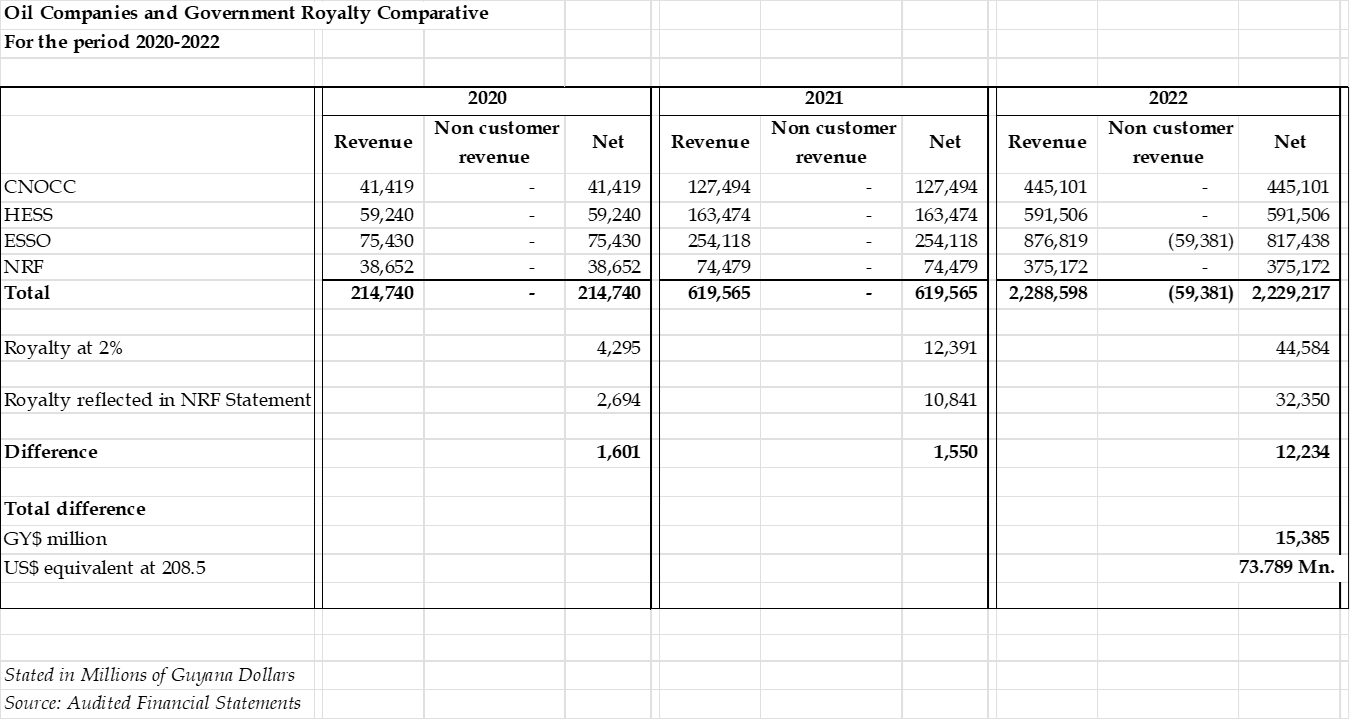
Even the most diligent journalist or forensic investigator cannot compute the royalty payable to Government in the absence of the cost of Petroleum used for fuel or transportation in Petroleum Operations. There is no real solace in the fact that the effect on royalty is 2% of that total. The other problem is that we will not know the value of petroleum sold by Exxon, Hess and CNOOC until their 2023 numbers are released in the form of audited financial statements within the next couple of months. To reduce the margin of error therefore, I have used just 2022 data from the financial statements of the three companies, plus the proceeds from sale of Government share of profit oil and apply to that total, a 2% for royalty. 

The results of that exercise are represented in the Table below showing the Oil Companies’ Revenue and Royalty due and received by the Government over the three years 2020-2022.

What is apparent is that there is indeed some US$73.8 Mn. of royalties unaccounted for and one can speculate whether this is all to do with the implausible absence of the cost of fuel used in production or transportation, or in the difference in the accounting methodology used – accrual in the case of the oil companies and cash basis in the case of the NRF. Yes, the numbers are lower than Hunte’s, but he extrapolated to the end of 2023 when production, and therefore royalty soared. His numbers ought not to be discounted or dismissed.

Conclusion

I repeat again, unless President Ali puts a Petroleum Commission in place, Guyana’s incompetence in oil and gas will continue to be exploited at the national expense. He has to act in the national interest rather than as if he is afraid of or beholden to Jagdeo. We must not forget as well that hundreds of thousands of US Dollars were spent on an audit. Did their report, which is shrouded in mystery and secrecy, touch on royalty and profit oil? Only a Petroleum Commission can save us from this tragic farce.   

Every Man, Woman and Child in Guyana Must Become Oil-Minded – Column 122 – March 1, 2024

Introduction

The Ali Administration has been promising continually that an independent, competent Petroleum Commission will be appointed to oversee the operations of the oil and gas sector. But like it has done in relation to the confirmation of the constitutional offices of Chancellor of the Judiciary and the Chief Justice, promises by the Administration seem not to count for much. The most immediate breach and broken commitment is of course in relation to the constitutional guarantee to workers that they have a right to free collective bargaining. Parents are painfully aware that that right is openly denied to teachers and worse, they are being victimised for exercising another constitutional right – the right to strike.

While these brazen acts by the Government cannot be exaggerated, it defies logic, commonsense and experience to belief that a political overseer of the dominant sector of the economy is better and more effective than an independent body made up of professionals. Worse, it is costing this country dearly in several ways. Surely such a body would have done a better job overseeing the operation of the 2016 Agreement under which ExxonMobil is allowed free rein to do whatever it pleases. Had we had a petroleum Commission, Exxon would not have been allowed to get away with overstating of its pre-contract costs; or in flouting the provisions of the Agreement regarding the audit of petroleum operations; the writing-off of US$211 Million in unsubstantiated expenses, or engaging and colluding with the government in violation of the Agreement with respect to the gas-to-shore project; or in violating the implied conditions regarding ring fencing.

The Vice President’s performance

All those violations are possible and permitted because a) the Government has for some reason reneged on its commitment to renegotiate the 2016 Agreement, b) is seen as a walkover, and c) not even capable of achieving the lesser standard of better contract administration. It is clear that the President did not appoint Mr. Jagdeo to oversee the oil sector: What is more likely is that he appointed himself, flexing his muscles as the General Secretary of the PPP/C. But who else can be responsible if not Jagdeo? Put under the microscope, the vice president’s performance in the oversight of the sector leaves a whole lot to be desired. This became so painfully obvious in an answer he gave to a newspaper reporter at his weekly press conference held at the office of the ruling party of which he is the general secretary.

Here is the question posed by a female reporter who from Mr. Jagdeo’s response came not from the Kaieteur News but from Mr. Glenn Lall. “Last week you said Exxon has $20 billion in assets out there which can be sold to take care of an oil spill in the event it occurs. Can you list the assets they have that equal twenty billion.”

My instinct was to quote Mr. Jagdeo’s response in its entirety, but I was not sure that that would get past the editor. Whether the tone of his answer was because it was a woman who asked the question or because she came from the Kaieteur News, or he wanted to impress the audience, is not clear.Yet, his response exposed his own limitations in oil and gas than was ever so glaring before. To parody Winston Churchill, never before have so many mistakes been made in so few words by such an elevated office holder. He asked and answered in the negative the question whether the reporter had read to balance sheet of Exxon, advising the reporter to look at the balance sheet but then demonstrated his own unfamiliarity of those numbers but diverting his audience to Hess and Chevron. For his information, one looks not only at assets but also at the liabilities. At 31 – 12 – 2023, the net assets of Exxon Guyana amounted to US$7 Billion.

His statement of a merger between Chevron and Hess is also wrong. It was a takeover by Chevron.

It was too much to expect vice president to know that if there are changes in the composition of the contractors, the agreement required that such assignment be permitted. Given the challenge by Exxon to the deal, it seems clear that Hess has been pushed aside, in fact if not technically.

The errors mounted. The VP challenged the reporter’s knowledge by asking and telling her that she does not know the value that Chevron placed on Hess, and that that figure was US$60 Mn. Wrong again, except if he disregards the small matter of US$7 billion. Then he goes into a story about the stock market, Hess’ global assets and how much is attributable to Guyana which with his fuzzy math, he put at US$30 billion. In fact, the balance sheet to which he pointed the reporter suggested that even the gross assets did not come close to the number, let alone the net assets, which was about one-tenth of that number. Yet, Jagdeo claims that given the “value that Chevron placed on Hess’ shares in Guyana, you have a $100 billion company in Guyana.”

To conflate stock market price with asset price is not something one expects from a former Finance Minister.

So, he completely evaded the question about Exxon’s US$20 billion and gives a lesson to the reporter that is wrong. But there is also a fundamental issue – Jagdeo expects the book value of an oil company to pay for the environmental disaster involving those very assets. Perhaps he was talking rather than thinking. With this display, clearly Mr. Jagdeo cannot perform as an oil minister, let alone a substitute for a Petroleum Commission.

Every Man, Woman and Child in Guyana Must Become Oil-Minded – Column 121 – February 16, 2024

ExxonMobil and Politics

Exxon is no stranger to politics. It understands the importance of billboards (India and Guyana) and the politics of Buses (the USA and the Tories BREXIT bus). Just in case anyone missed it, Exxon is now on a bus tour across the country to encourage communication with the public, promote employment opportunities and, according to a report in the media, to share information about the company’s operations and to ask questions. On the face of it, nothing is intrinsically wrong with the Bus Tour. Yet, there are some obvious concerns. Where is Hess and where is CNOOC and is this an Exxon only initiative? Did the oil company think that out of courtesy, it needed to discuss this with the Government?

It is hard to accept this as a mere public relations gimmick. Exxon has shown itself to be untrustworthy and unwilling to share information with a more informed public. Any information exchange will be more like propaganda delivered in the most cynical and contemptuous manner. We are all too well aware how the GGMC boss was treated in Texas, how Granger and Trotman buckled in front of Exxon’s officials, and witness how it treats the Government like a bedfellow, and the public as enemies with whom no information should ever be shared.

This tour brings to mind a willingness on the part of EXXON to play popular games with the people of Guyana, in an electoral environment in which both the PPP and the APNU have shown themselves absolutely unwilling to account for collections for elections. Exxon has ready cash with decades of clandestine experience in engaging in the political arena. So, the real question is whether and how Exxon plans to engage the political parties by making significant contributions to one party and offer crumbs to the other for the 2025 elections.  

Steve Coll’s book, appropriately titled Private Empire ExxonMobil and American Power, offers us some insight. It describes Exxon’s overt political action via what is called a Political Action Committee (PAC) and particularly its role in supporting the Republicans for the 2008 elections. The PAC invested $722,000 on candidates for federal political office, which amount might not seem particularly significant, but the real interest is in how the money was shared between the two parties. .

Only twenty-eight of the 207 recipients of Exxon Mobil P.A. C. contributions during the 2008 cycle were Democrats; in dollar terms, ExxonMobil gave just 11 percent of its money to Democrats. In fact, the corporate P.A.C. gave more heavily to Republicans than did the company’s employees when they made donations as individuals. Political contributions between 2000 and 2008 by individuals who declared an affiliation with ExxonMobil on disclosure forms-included Tillerson, Cohen, and other senior executives – totaled $I.22 million.

Exxon was not shy about its role – an executive involved in political spending decisions said that the PAC outfit was business-oriented, and it was looking for candidates who are pro-business. One of its mailings boldly proclaimed: “Electing people who will pursue policies that are good for our industry and make sense for our families is an important responsibility,”  This confirms some things we in Guyana have come to know. Exxon has no scruples, no red line, no moral compass and no threshold which it should not cross.

There is no such concept a PAC in Guyana and anything goes when it comes to donations to political parties, which we all know are not shy to accept moneys from all and sundry. The expectation then is that Exxon will play a part in elections financing in all forms, whether in paying for information and analytic specialists, printing, give away material and of course cash. The most troubling cause to worry is that there is nothing anyone can do about it.

GECOM is not interested in how democracy has become a commodity in Guyana, where there are no rules. The PPP/C and the APNU will always have excuses for taking money from tax evaders, money launderers and anyone else. For Exxon, there is a lot at stake, which is a wonderful and convenient environment.

No doubt, Exxon would prefer not to have to deal with the continuous stream of negative publicity which it receives almost on a daily basis. But it is fortified in the knowledge that Aubrey Norton, the Leader of the Opposition, after more than three years, has no understanding or position on the 2016 Agreement, the audits, the environment or the petroleum operations. And that the Government people, without exception, are its biggest defenders and protectors, willing to do its bidding.

It is not that Exxon necessarily like any of the two but the protection of the 2016 Agreement with all its benefits is the most important thing for the company. It needs to ensure that it can secure that blind support and for that it will do anything.

It is unclear whether the Bus Tour has received clearance from the Government. It is even an idea which it can share with Robb Street.

Every Man, Woman and Child in Guyana Must Become Oil-Minded – Column 120 – January 12, 2024

The myth of equal share (Part 2).

The infamous tax certificates

We recall from Column 119 that while the tax is paid by the Government of Guyana, the oil companies receive from the Guyana Revenue Authority ‘proper tax certificates’ in their names. These certificates are not some paper transactions but grant to the oil companies real economic value and substance since they produce them with their tax returns in their home countries as evidence of having paid those taxes and received a credit therefore. Just as a reminder, the current tax rate applicable to oil companies as a non-commercial company is 25% of their taxable profit.

Other tax goodies

This brings us to another tax benefit. Under Guyana tax laws, subject to any Double Taxation Agreement – which in any case does not apply to any of the oil companies – the remittance or deemed remittance of profits is subject to a withholding tax of 20%. The benefit of the exemption from withholding tax – for itself and its affiliated companies, (cousins and all!) – which is seen from this simple example: a Guyanese resident abroad who owns and leases her house in Guyana for an annual rental of G$100,000 will have to bear Withholding Tax of $20,000 on that amount. If for some reason, the Government agrees not to enforce that obligation, that person benefits from $20,000 – without a receipt! The value of the receipt is an additional benefit.

The 2016 Agreement provides that the oil companies are not subject to any “tax, duty, fee, withholding, charge or other impost, applicable on interest payments, dividends, dim dividends, transfer of profits or deem remittance of profits from contractors, affiliated companies or non-resident subcontractors branch in Guyana to its foreign or head office or to affiliated companies.”

As shown in the table, the value of that benefit is 20% of the 75%, or 15% .

Exclusive of the corporation tax receipt to the Government (into the Consolidated Fund from the Natural Resource Fund), but inclusive of the tax benefits to the oil companies, the Government gets 39.5% and the oil companies get 90%. If we include the tax receipt to the Government, the Government gets 52% while the oil companies benefit to the tune of 90%.

Table of Benefits

GovernmentOil CompaniesTotalGovernment  Oil CompaniesRatio
Share of Net Revenue37.5%62.5%  1:1.6
Tax Certificate12.5%   
Royalty2.0%   
Total39.5%75.0%114.5%8.6%16.4%1:1.9
WHT Waiver15.0%15.0%   
Total39.5%90.0%129.5%7.6%17.4%1:2.3
Corporation Tax received from GRA12.5%12.5%   
Total52.0%90.0%142.0%9.1%15.9%1:1.7
Source: Columnist’s compilation

As the Table shows, regardless of what is included or excluded, the oil companies receive far more from their operations in Guyana than the Government of Guyana does, ranging from 1:1.6 to 1:2.3. Or we can put it another way. For every barrel of oil Guyana gets, the oil companies can receive twice as many. Regardless of how it is computed, or what is included or excluded, our total gross share is 9.1%. It is simply amazing that any Guyanese would accept, let alone defend this atrocity.

Net versus gross

One final point. The receipts by the Government are gross of expenses. The oil companies walk away with pure economic value, including the cash proceeds from their share of profit oil. Out of its earnings, the Government has to meet all the expenses of the administration and oversight of the sector. These include the Ministry of Natural Resources, the Environmental Protection Agency, the ministerial audit, the use of the court system to fight Guyanese seeking a fairer deal and better contract administration.

This in no way is intended to suggest that the country has not benefitted from the production of oil. One only has to look at the national budget of which oil revenue accounted for 36% of budgeted revenues in 2023, and significant foreign exchange earnings from which the country benefits. Against these, the economist would consider the externalities arising from oil production. But that is outside the scope of column written by an accountant.

The debate of 50:50 profit share has blinded Guyanese about the obnoxious scale of generosity offered to Exxon and why it is so resistant to talk of renegotiation. Not only do the oil companies not pay any Corporation Taxes, but they walk away with a certificate for the taxes and are exempted from any taxes in Guyana – right up to 2057! Given that this is a post-discovery contract which should not have been awarded in the first place, it might possibly be the worst oil contact ever!

When Exxon threatened Newell Dennison in April 2016 at its Texas campus with no investment without a new Agreement, these were the benefits it wanted to secure. When Brooke Harris, Exxon’s top official, was bombarding Trotman and Legal Officer Ms. Joanna Homer of the Ministry of Natural Resources Ministry, with emails, the objective was no different. When Harris drafted the Cabinet Paper for Trotman, it was no different. And when Exxon complained to Granger that Trotman was having “misgivings”, Granger was blind to Exxon’s objective and the consequences for Guyana.

Over time, the media have unmasked the travesty with which the Granger Administration has shackled Guyana for more than a generation. It can be no excuse that the model used for the 2016 Agreement originated from then President Donald Ramotar and Natural Resources Minister Robert Persaud. To overcome the inconvenience that no oil company could get a second agreement over blocks already relinquished, it is highly unlikely that Exxon and some of our own people, did not have a hand in the concoction called the bridging deed. On top of all of these, Trotman unwisely used a pre-discovery model agreement for post-discovery circumstances. That was a most unforgivable and catastrophic error by the APNU+AFC.

Conclusion

The advertisement by Exxon reproduced in column 119 is more than mere distortions and propaganda. It is an insult to the senses and sensibilities of Guyanese. Not even the British colonisers ever boasted of “building Guyana”. Here, the greatest coloniser of all, aided, abetted and enabled by the current Government telling us that they are building Guyana. They are indeed, if by “building Guyana they mean exploiting our country’s natural resources for a measly 2% royalty, paying no taxes, forcing our government into an international conspiracy to defraud the US IRS, demands absolute security and protection while posing grave risks to the environment and eroding the country’s reputation as a protector of the environment.

I close with this thought. Would a counter-billboard to that placed by Exxon to rebut Exxon’s deception be permitted by the Demerara Harbour Bridge?