
Every Man, Woman and Child in Guyana Must Become Oil-Minded – Column 119 – January 09, 2024

The Myth of the equal share – Part 1

Introduction

On the occasion of the first column for 2024, I extend best wishes to readers for an informed and productive year and realisation of the hope of a fairer contract. Readers will recall the promise made in last week’s column to address the myth of the 50:50 share of profit oil under the 2016 Petroleum Agreement. For the research minded, please see sub-article 4 of Article 11 – Cost Recovery and Production Sharing of that Agreement.

Let us begin with the billboard below sponsored by Exxon and prominently displayed at the Demerara Harbour Bridge. It states that Guyana receives 52% of all profits from Stabroek Block – 50% profit share and 2% royalty. Let us forget for a moment Exxon’s reputation for fuzzy math and creative accounting, now adding two disparate and unrelated numbers – net oil profit and gross royalty – to arrive at Guyana’s share! What the billboard does not tell us is what Exxon and its co-contractors will be receiving from the Stabroek Block.
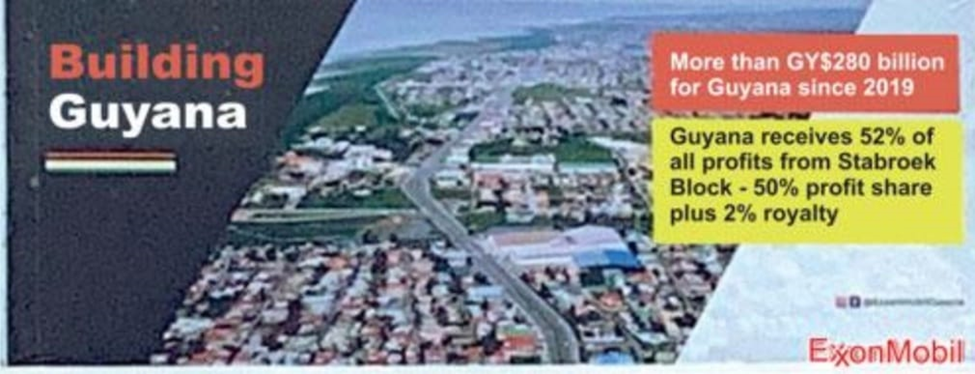
This two-part column will explore what Exxon and partners walk away with, in profit oil and tax benefits, compared with what the Government receives as net profit oil and royalty. Exxon would not admit, let alone publicise, an account of what it and its partners receive because that would expose the mantra of equal sharing of benefits and the information in its billboard as completely false and dishonest.

Guaranteed profit share

The 2016 Agreement sets a maximum 75% limit on recoverable cost in any year, leaving 25% to be shared 12.5% to the Government and 12.5% to the oil companies as a collective. In other words, for every barrel of profit oil accruing to the Government, the oil companies should receive not a barrel each, but one barrel to be shared among the three of them. However, the structure of the Agreement severely distorts this oversimplification being sold to Guyanese. A significant proportion of the costs expended in any period financed by the oil companies to be recovered from oil revenues. Additionally, the recoverable cost for any period includes unrecovered costs from previous periods.

Let us look at an example. If recoverable cost for any period amounts to say 60%, but there are unrecovered costs from the preceding period amounting to the equivalent of say 35% of revenue, 15% of those costs are recoverable in the current period with the remaining 20% carried forward to the next period.

This may help to explain why Budget Speech 2022 could report 69 lifts from the commencement of production in 2019 to December 2021 of which Guyana received only 9 lifts, or just over one for every seven received by the oil companies. In 2022, that situation remained the same, with the Guyana receiving 13 of 102 lifts. In percentage terms, Guyana received 13.04% in 2020/2021 and 12.74% in 2022. The Minister offered no explanation for these astounding numbers. The man who knows the reasons and who keeps the hard-to-audit books is Exxon’s Alistair Routledge, but his lips are sealed when it comes to facts.

Despite all the cant about transparency and accountability, neither the Ministry of Natural Resources, the financial statements of the oil companies nor the ministerial audits have given the public a running account of unrecovered costs. The public therefore is in the dark about how much of the 75% of recoverable costs in any period is made up of unrecovered costs from earlier periods. What the public has a general idea about is that the unrecovered costs are made up of significant pre-production costs, which this writer believes were fraudulently overstated by the oil companies, the low level of production in the early years (2020 – 2021), and the absence of ringfencing. In a ring-fenced environment, the cost in a single field or on a single project is recovered much faster, allowing for higher profits.

The situation is different when there is no ringfencing since costs will always be more than they should be as income is reduced by exploration expenses incurred on some other field or project. For better or worse, and if there are no further “force majeure” extensions of the relinquishments, exploration activities will cease on the expiration of the current prospecting licence in 2027. After that point, only the balance of unrecovered costs and production expenditure will be charged to oil revenue, resulting in higher levels of profit oil. Once this point is reached, Government revenue will increase but so too will the revenue of the oil companies, together with the unlimited tax benefits they enjoy.

First level benefits

As this column will show, even at the first level at which the Government pays the Corporation Tax liability of the oil companies in accordance with Article 15.4 of the Petroleum Agreement, the Government’s real or net share of oil revenue – what remains or ought to remain in the Natural Resource Fund – is 9.4 % (plus 2% royalty) while the oil companies get 15.6%. The money to pay those taxes comes from the Government share of profit oil, hence the deduction from Government and the addition to the oil companies.

The defenders of Exxon and the Agreement like to think, and go so far as to argue, against common sense, that this is all “massa cow and massa bull” stuff. They forget that like all companies operating in Guyana, the Agreement provides that Exxon and its partners are liable to Corporation Tax in Guyana, or that they do not recognise the difference between the Consolidated Fund and the Natural Resource Fund. Even as the tax is “payable” by the oil companies, the Government pays it on their behalf out of its share of oil revenues, while the GRA is required to issue the receipt in the name of the respective oil company, thus adding to their economic benefits under the Agreement. This constitutes an effective tax holiday until around 2057, that is eight times the standard tax holiday period allowed under the Income Tax (In aid of Industry) Act.

Friday’s column will look at other tax benefits including the tax certificate used to deceive the tax authorities in the home countries of the oil companies.
Every Man, Woman and Child in Guyana Must Become Oil-Minded – Part 118 – December 29, 2023

Natural Resource Fund overstated by $274,765 Mn., should be addressed as a matter of urgency.

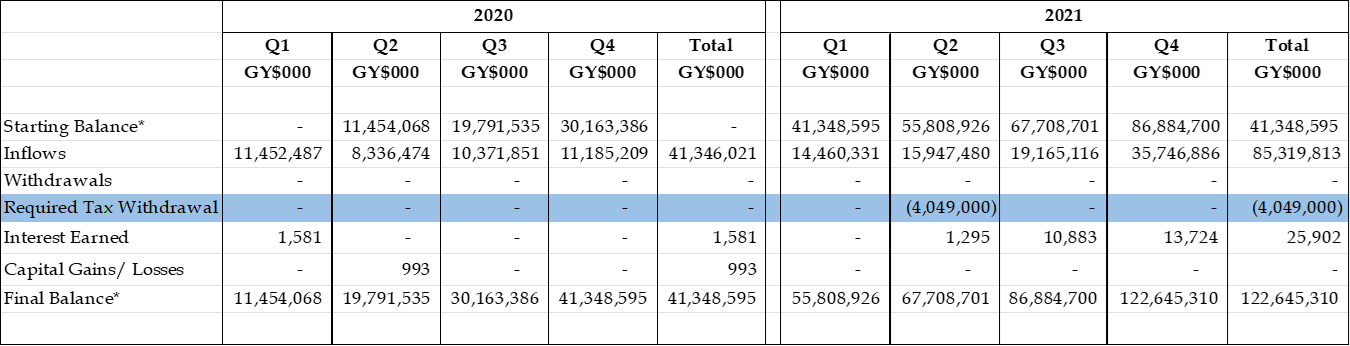
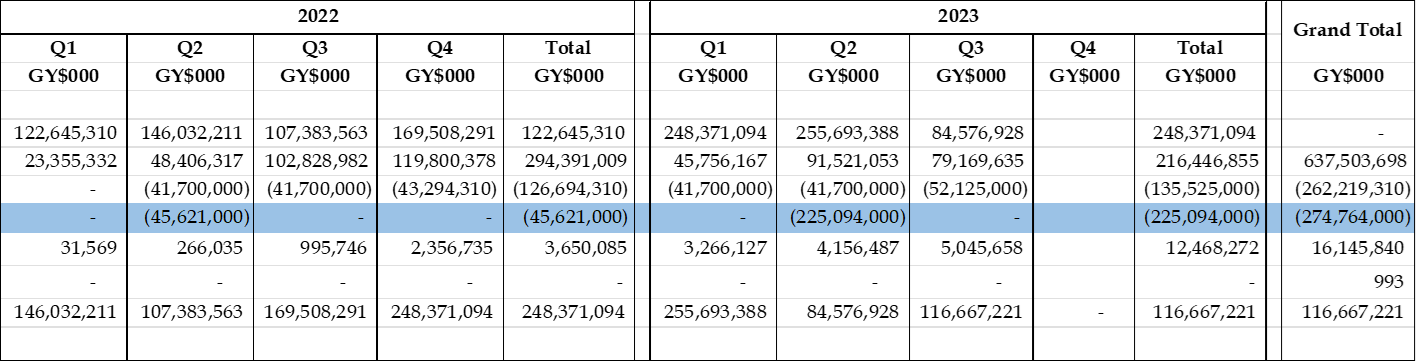
Among the several challenges facing the Natural Resource Fund (NRF) – also known internationally as a Sovereign Wealth Fund – identified in column 117 published on 22 December, was one which I described simply as “accounting”. Readers will recall that in the concluding sentence I opined that the balance in the NRF is overstated by “tens of billions of Guyana dollars”. To my horror, my research discovered that the overstatement at 30. June 2023 after the payment of 2022 corporation taxes for the oil companies, was $274.8 Bn. ($274,765 Mn.), representing 76% of the Fund balance at that date. The magnitude and significance of the error is evident from the 2022 financial statements of the Fund, which received a clean, unqualified opinion by the Audit Office of Guyana, showing the value of the Fund at that date of G$298 Bn. With taxes payable amounting to $49.7 Bn for the years 2020 and 2021 to be financed out of Guyana’s share of profit oil, the correct value of the Fund at 31st. December 2022 should have been G$248.4 Bn, the difference representing an overstatement of 20%. A similar overstatement for 2023 alone, amounted to a further G$225.1 Bn., hence the cumulative overstatement of $274.8 Bn.

Natural Resource Fund – Summary of Quarterly Reports

Source of Information: Bank of Guyana Quarterly Reports, *described as market value. Highlighted information from companies audited financial statements.

Summary of Contractor’s Income Statement (Exxon, Hess, CNOOC)

Source of Information: Audited Financials

As astonishing as it sounds, if just one of several persons or agencies involved – the Office of the President, the Ministry of Finance, including the Budget Office, the Ministry of Natural Resources, the Bank of Guyana, the Guyana Revenue Authority (GRA), the NRF Board and, I must say, the National Assembly and the Attorney General’s Chambers – had been paying attention to and discharging their respective responsibilities, this fiasco would have not arisen in the first place. What is worse, this situation has existed since at least 2021.

Relationship between NRF and the 2016 Petroleum Agreement

Let us look briefly at the operations of the NRF and its relationship to the 2016 Petroleum Agreement. The NRF receives three sources of income: royalty of 2% of all petroleum produced and sold (less cost of fuel used in production and transportation), the proceeds from the sale of the government’s share of profit oil and any interest received on investments, mainly cash balances held by the Fund. In accounting parlance, these are credits to the Fund account. Debits would represent withdrawals from the Fund, principally for two purposes. The first being transfers to the Consolidated Fund in accordance with sections 16, 19 and 20 of the NRF Act and second, money requested by the Minister of Natural Resources to pay to the Guyana Revenue Authority the taxes payable shown on the Company’s corporation tax returns for which the GRA issues certificates of taxes paid.

NRF Balances

Produced hereunder is a summary extract from the Audited financial statements of the three contracting oil companies for the years 2020 to 2022, highlighting the amount of taxes payable by them for each of those years. Those amount in total to a staggering G$274,765 Mn. If the transactions were accounted for in accordance with the Agreement, Corporation Tax receipts for the three years should have included $4,049 Mn. for 2020, $45,621 Mn. for 2021 and $225,094 Mn. for 2022, with corresponding reductions from the Natural Resource Fund for those years.

I am not asking cynics to believe me. They just need to look at Note 7 of the audited 2022 audited financial statements of Esso Exploration and Production Guyana Limited which states as follows:

“Under Article 15.2 of the petroleum agreement, the Company is subject to the income tax laws of Guyana with respect to filing returns, assessment of tax and keeping of records. (Emphasis mine). Under article 15.4 of the Petroleum Agreement, the sum equivalent to the tax assessed on [the] Company will be paid by the Minister responsible for petroleum to the Commissioner General, Guyana Revenue Authority and is reported as non-customer revenue.”

The observant reader will note the obligations of the three companies do not include the payment of taxes, which is done on their behalf by the Government. The reference to “non-customer revenue” is to comply with Article 15.4 (a) of the Agreement. For the answer to the question of the proper source of the money to pay the Commissioner General, one has to turn to Article 15.4 (b) of the Agreement. This agreement requires the tax to be paid out of the Government’s share of profit oil, the proceeds of which, under the NRF Act, are deposited into the Natural Resource Fund.

Screaming questions

The first question to arise is whether Minister Vickram Bharrat or Vice President Bharrat Jagdeo has ever read the financial statements of the company, which interprets for them the relevant provision of the Petroleum Agreement. Steve Coll’s masterpiece Private Empire ExxonMobil and American Power shows the oil giant at its ruthless and diabolical best when dealing with host countries whose governments are clueless, incompetent, malleable and spineless. They have found both the APNU+AFC and the PPP/C governments ticking all these boxes.

Like the majority of thinking Guyanese, I have always been offended by Article 15 of the Petroleum Agreement which the Granger/Trotman duo has locked us into until 2057, give or take a couple of years. And like the majority of thinking Guyanese, I feel painfully betrayed by the Ali/Jagdeo duo who now defend as sacred and inviolable an Agreement which they committed to “review and renegotiate” as part of their 2020 elections promises.

The next question is whether any, and if so what amount, of any actual tax payments made by Minister Vickram Bharrat to the Guyana Revenue Authority on behalf of the oil companies. That is a question which calls for an investigation in the absence of proper disclosure.

What I can state with a high level of confidence is that nothing emanating from several governmental agencies suggests that the Minister of Natural Resources has paid any actual cash to the Guyana Revenue Authority for which Certificates of Taxes Paid must be issued. These agencies include: the Office of the President, which has constitutional responsibility for the natural resources sector, the Ministry of Natural Resources whose Minister is responsible for the general oversight of petroleum and the mining sector, the Ministry of Finance which has responsibility for the Budget Office and for the annual Budgets, the Bank of Guyana which operationally manages the Natural Resource Fund, the Guyana Revenue Authority which is responsible for the collection of taxes and the Natural Resource Fund Board,

It is sad but not surprising that Minister Bharrat has once again failed in a major duty in his portfolio of responsibilities for which there will be no sanction, or consequence – not even the infamous two weeks salary deduction! If the Minister was familiar with the 2016 Agreement or has been following all the concerns in the press, he would not have been guilty of this grave act of omission. The oil companies of course, would know their entitlement and the procedures to access those entitlement. In other words, they would have had their tax advisers prepare their tax returns and deliver these returns to the Guyana Revenue Authority in accordance with Article 15.5 of the Agreement. The Article is carefully crafted with language like “properly prepare the receipts” and “proper tax certificates … evidencing the payment” by the Guyana Revenue Authority.

Conclusion

It is unquestionable that tax certificates evidencing receipt should have been issued. It is clear that no payment was made from NRF, nor was any such money accounted for in the Estimates of Receipts and Payments and paid into the Consolidated Fund. This omission reflects poorly on the Budget Office. The irrefutable but uncomfortable conclusion is that no money was paid to or received by the Guyana Revenue Authority. This is obviously a matter for the statutory auditors (the Auditor General) and the relevant government agencies, including the Natural Resource Fund Board. This Board needs a better understanding of the funds at its disposal to assure citizens that it is capable of defending and protecting the legitimacy, accuracy and integrity of the Fund.

Finally, having disparaged its predecessor’s Natural Resource Fund Act # 12 of 2019, both before and during the rushed parliamentary debate on its own NRF, the Government MP’s must be hugely embarrassed that not one of them understood the implication of the 2016 Petroleum Agreement on the Natural Resource Act. As a consequence, there is a clear disconnect between the Act and the Petroleum Agreement in that section 16 of the Act dealing with withdrawals does not include the taxes paid on behalf of the oil companies. That Act must therefore be amended urgently, to preserve the so-called sanctity of the 2016 “contract”. In doing so, the draftspersons would also have to address the overstatement of the Natural Resource Fund either by way of a belated cumulative transfer, or by some other legal device. While the parliamentary opposition had walked out the debate in protest about the allocation of speaking time, it appears that it too did not recognise the omission.

The overstatement of the balance in the Natural Resource Fund at the amount and in the current improper form must be addressed and corrected. This is not a “massa cow, massa bull matter”. They fall under separate legislation and the NRF is too important an inter-generational mechanism to this country to allow it to remain tainted.

Next week’s column will expose the myth of the 50/50 Profit Share.

Every Man, Woman and Child in Guyana Must Become Oil-Minded – Part 117 – December 22, 2023

Natural Resource Fund faces institutional, Capacity, investment and accounting challenges.


Introduction


The International Monetary Fund and the Inter-American Bank have both expressed concerns about the structure and operations of the Natural Resource Fund, one of the PPP/C’s flagship projects directly associated with the oil and gas economy. This column would like to add a couple of problems it too has identified: the absence of any appropriate investment strategy and the rather more basic issue whether the balance shown in the Fund is accurate and legally correct.


Let us recall that the APNU+AFC Coalition had passed and began the implementation of a its own Natural Resource Fund Act in 2019 but this was strongly criticised by the then Opposition PPP/C as being too complex and involving too many people. It was no surprise then that the repeal and replacement of that Act was one of the first major pieces of legislation by the successor PPP/C Government in the first year of Irfaan Ali’s term of office. Just as a reminder, the most famous event concerning this Fund during the Granger Administration was the so-called signing bonus which the APNU+AFC Coalition had for a considerable time sought to hide from the people of Guyana. I describe this as a “so-called signing bonus”, because its real purpose was to pay legal fees.


IMF and IDB


Institutions like the IMF, the World Bank and the IDB, recognising that they have to maintain an ongoing relationship with countries, are always careful in their criticisms of host governments. Yet even this disguised language in the recent comments and recommendations emanating from the IMF and the Inter-American Development Bank (IDB) suggest that the replaced Act may actually have been superior to the current Act. Indeed, the IMF is encouraging the government to carry out an in-depth analysis, by an independent consultant, of existing absorbative institutional capacity constraints on scaling up of public spending. Whether the government will heed such advice is uncertain, if not unlikely, but any improvement in the process may not be welcome since it will impose curbs on runaway spending.


Clearly not impressed with the existing arrangements, the IMF is also advising the government to establish a “precautionary stabilisation fund” in the medium to long term as a hedge against shocks. What this seems to suggest is that the IMF is actually recommending a stabilisation fund within the Natural Resource Fund!


The IMF Report further notes, using the shorthand term fiscal policy, that government tax and spending policies have a direct impact on economic conditions and that in ensuring that Guyana’s oil wealth is managed effectively and equitably, the Government is advised not to ignore long-term fiscal and debt sustainability. The context of course is not only that petroleum is an exhaustible nature but also that it is famous for large and unpredictable swings in prices. It is not in the DNA of the PPP/C to prefer management to spending and one fears what is likely to happen in the final year and months of an election cycle. We are not quite there yet and already for 2023, the PPP/C has gone back to the National Assembly on five occasions supplementary funding.


Turning to its specific recommendation of a “precautionary stabilisation fund”, the IMF noted that it would help smooth the fiscal adjustment while allowing the government to make an informed assessment on the gravity and permanence of the shock.


The IDB country strategy took a slightly different approach pointing out the possible imbalance from an overvaluation of the real exchange rate. The issue of the exchange rate of course is a two-edged sword. If the foreign exchange earned is all remitted and injected into the economy, the impact on the exchange rate could have serious implications for the rest of the economy, including the Dutch disease, with direct consequences for the export products of the country.


The Fund


The Bank of Guyana publishes quarterly financial summaries of the NRF, the most recent being for Quarter 2, and Quarter 3 ended at 30 September. The summary shows that the Fund had an opening balance at 1 January 2023 of G$298 BN and at the end of September the balance had increased to G$391 Bn. The return on the Fund however has been negligible with only G$12.5 BN earned in nine months.


What is disturbing about the Fund is that the entire portfolio is held in cash and cash equivalents, although the latter term is not defined in the Summary. The 2022 financial statements of the Fund, audited by the Office of the Auditor General, show the entire balance comprising balances with foreign banks. Since the financial statements are not accompanied by a directors report or a governance statement, it is therefore not possible to determine what decisions the Investment Committee has so far made on an appropriate portfolio that can maximise investment income while securing that investment.


And it is here where I have my biggest problem. We know as a fact that the oil companies are issued with certificates of taxes paid by the Minister of Natural Resources to the Guyana Revenue Authority for the taxes computed as payable by the oil companies. To see where that money comes from to pay the tax, one must turn to Article 15.4 (b) of the 2016 Petroleum Agreement. The Agreement provides that those taxes are paid from the Government’s share of profit oil. The problem is that the whole business of the payment of taxes and the issue of certificates has been withheld from the public.


I find it difficult to believe that the Guyana Revenue Authority would issue a receipt for moneys it does not collect. Forget for a moment, that those oil companies claim credits in their home countries for taxes represented by the Certificates but which they did not pay. This column considers this whole question a complete cover up involving key agencies of the state and one can only speculate whether the reason for this cover up is to prevent the Guyanese public from knowing the annual amount of taxes paid by the government on behalf of these avaricious oil companies.


When it comes to withholding information from the public, the PPP/C is not an iota different from that of its predecessor.

Every Man, Woman and Child in Guyana Must Become Oil-Minded – Part 116 – December 15, 2023

Understanding, or not understanding Ringfencing


Introduction


Today’s column returns to the very popular topic of ringfencing in petroleum operations. Column 115 appearing in the Stabroek News of November 24 addressed how Belize, a mini-petroleum state, used the industry’s regulator, the legislation and the courts to enforce the principle, to that country’s great credit, quite the reverse in the case of Guyana. Ringfencing is not new to this column, having been the single issue addressed in Column 68 Why Ringfencing matters, and why it does not.


Not that our oil czars are particularly interested in such esoteric, finer point of the petroleum sector, or its administration. Even though they should. The Natural Resource Governance Institute, a non-profit independent organisation describes ringfencing broadly to mean a “limitation on consolidation of income and deductions for tax purposes across different activities, or different projects, undertaken by the same taxpayer.”


To put the concept of ring-fencing in a commonsensical context, it simply means that the revenue from one field, or such revenue earned under one production licence, cannot be used to finance exploration in other fields, even under the same agreement. In applying for a Petroleum Agreement, the oil company – in this case Exxon, Hess and CNOOC – gives an undertaking that it has the resources to explore for petroleum resources and uses this not only to magnify and inflate its risks, but to justify a range of concessions.


Government now investing in Exxon’s exploration activities


Guyana’s forgoing of profit oil necessarily adds to the windfall of the oil companies, allowing them the use what is properly Guyana’s funds to finance petroleum activities. In other words, the government is putting up 50% of the exploration investment – equal to the combined investment of Exxon, Hess and CNOOC – in the exploration, but has no seat at the table, and no say in decision making. And guess what? The Government cannot extract in return, a single change in the concessions available to the oil companies.


I am not sure that Raphael Trotman or Vickram Bharrat was alert to this, but Vice-President Jagdeo must hopefully understand the implications of the practice, beyond its superficiality. Now, if he does understand this but allows it to happen, then he is either reckless of the consequences or could not care less. Yes, we care about our whole country and as a nation are prepared to confront Maduro the Bully. Indeed, five of our finest gave their lives in the protection and defence of this country. This column thanks and salutes them and hopes that their survivors are properly cared for by the state.

Ceding sovereignty


Now, with all our love and respect for our country, its sovereignty and territorial integrity, we have stripped Parliament, the essence of our statehood and sovereignty of its most essential power and function, and that is the power to “make laws for the peace, order and good government of Guyana.” (Article 65 of the Constitution). And how do we do it? By the burdensome stability clause contained in Article 32 of the 2016 Petroleum Agreement.
Here is what that Article states in sub-Article .1 and .2:


“Except as may be expressly provided herein, the Government shall not amend, modify, rescind, terminate, declare invalid or unenforceable, require renegotiation of, compel replacement or substitution, or otherwise seek to avoid, alter, or limit this Agreement without the prior written consent of Contractor.


“After the signing of this Agreement and in conformance with Article 15, the Government shall not increase the economic burdens of Contractor under this Agreement by applying to this Agreement or the operations conducted thereunder any increase of or any new petroleum related fiscal obligation, including, but not limited to, any new taxes whatsoever, any new royalty, duties, fees, charges, value-added tax (VAT) or other imports.”


Note, not for one year, five years or ten years but for a minimum of forty years, or more than a generation of Guyanese. And that is without all the force majeure which Exxon will request and the Government will grant.


Conclusion


The Vice President might not have intended it, but every time he allows a variation of relinquishment, unjustified force majeure, or the use of government share of profit oil for exploration, he is effectively changing the spirit and provisions of the Agreement – practically renegotiating it. Yet the Government parrots the canard about the sanctity of contract.


There is simply no plausible excuse for the Government’s adamant refusal to have a Commission of Inquiry into the circumstances of the 2016 Agreement, especially in the light of the Clyde & Co. Report, Granger’s granting to Exxon permission to charge the costs of its Head Office to the Contract, the commingling of petroleum operations and the gas to shore project and the granting of a Licence under the Companies Act to hold land in Guyana, in violation of the Companies Act. With nothing gained in return.


The inevitable conclusion is that in standing up to Maduro, the Government has been commendably courageous, demonstrating fortitude and spine. But when it comes to Exxon, this Government is totally supine.

Every Man, Woman and Child in Guyana Must Become Oil-Minded – Part 115 – November 24, 2023

Belize imposes ringfencing on petroleum companies through its tax legislation.

Introduction

Let me confess to being as surprised as many of the readers of this column, on learning that Belize is in fact an oil producing state! Not a major one – it produces a mere 5,000 barrels of oil per day – following first discovery in 2005. Like Guyana, while Belize has a number of oil contracts, only one company, Belize Natural Energy (BNE), has found and is producing and exporting oil from that country. Just a quick comparison. Companies in that country have up to 8 years to explore for oil, and 25 years to carry out production and pump oil commercially out of the ground. If no oil is found within the eight-year exploration phase, the contract “self-terminates,” meaning it is no longer in effect. These terms are reflected in a Pre-discovery agreement.


In Guyana, companies have up to ten years for exploration, thirty years for production and, for good measure, our politicians think they have to plead with oil companies to give us back what represents our patrimony, and what the law requires them to relinquish, anyway. And of course, we pay the taxes for the oil companies – out of our share of oil production. And to give them a certificate stating that they have paid taxes here, to enable them to fraudulently claim a rebate in their home country! This is the gift that keeps on giving.


Banning offshore drilling


Here is some other interesting information: Belize has banned offshore drilling – by way of a referendum and later by a decision of the Supreme Court in 2013. In Guyana, our practice is to use Sarah Palin’s famous words, “Drill Baby Drill” and do not worry too much about flaring. But what should make our various petroleum czars look worse than amateurs, are the terms under which oil companies operate.


Under Belize law, the first charge on oil revenue is royalty of a minimum of 7.5% for oil and 5% for natural gas; next is the government’s total share of petroleum and then followed by allowable petroleum operation expenditures. That country also has a petroleum surcharge fixed to rising oil prices, and then, after all the above, the profit left is subject to tax at 40%!
Compare that with the outlandish fiscal terms Guyana extended to Exxon and Company in a Post Discovery agreement! And no one takes responsibility, except that one can say that Trotman and Granger were fired.


Back to a real country

But let us get back to a saner and more responsible country. This is how their Courts ruled in a case involving ring-fencing when the oil company sought to charge against the income earned under one agreement the exploration expenditure under another such agreements.

“When a contractor enters into a contract, he is taking a risk as there may not be any production. The expenses incurred for taking such risk cannot be imposed on other Production Sharing Agreements where there is Initial Commercial Production without specific provisions in the Act.”

The Court added: The Legislature would have been specific if it had intended for Contractors to recover expenses from Production Sharing Agreement where there was no ….Production”. The appeal brought by the oil company, Chx Belize Lp against the Commissioner of Income Tax against a demand by the Commissioner for quarterly instalments before including expenses for exploration on other wells, was rejected and thrown out. Accepting the logic of the court, and the basic accounting principle of matching expenditure against related income, the company accepted the decision and paid the amount demanded. Sadly, that would be unheard of in Guyana under these administrations.

Next week’s column will examine the generosity of our agreements and how those in charge seem to be clueless about the nature and impact of not understanding the logic of ringfencing.
