
Column # 93 – It is doubtful that the law allows the Government to pay oil companies taxes.

This Article was Published on July 9, 2021

Introduction

The issue of taxation of the oil companies has aroused particular interest ever since it became known that the Government has to find some $5.391 billion to pay the tax liability of the two partners of Esso in the Stabroek Block – CNOOC and Hess – which reported pre-tax profit of the equivalent of $16.175 billion in 2020. For reasons identified in column 90, Esso, the senior partner and Operator of the Stabroek Block, reported a loss to be carried forward for recoupment in future years. Despite the industry’s well-known proclivity for financial engineering and creative accounting, at some point, Esso too will report a profit and will demand that Guyana pay its taxes as well.

Guyanese are not unfamiliar with the gay abandon with which our governments hand out tax exemptions to the powerful, the favoured, and the influential – the latest group to be rewarded with such fortune are shareholders of private hospitals, some of which are known for extortionate charges and dangerously poor service. But what Guyanese find hard to accept is that an agreement can state, as the 2016 Agreement does, that an entity is subject to the income tax laws of Guyana, including the Corporation Tax Act, and yet two paragraphs later, imposes on the taxpayers the burden of paying those taxes. But that is exactly what the 2016 Agreement and similar agreements have done. And which the Fiscal Affairs Department of the IMF, in a 2018 Technical Assistance Report, in a peculiarly didactic style, both asks and answers the questions whether post-tax sharing is unique to Guyana, and whether it has advantages.

Noise and nonsense purveyors 

The report’s authors – Thomas Baunsgaard, Honore Le Luche and Diego Mesa Puyo – are persons whose credentials cannot be summarily dismissed. At least two of them hold high office and would be the very opposite of noise and nonsense agents who according to our learned Professor “collude, connive and conspire to conceal the reality of today’s petroleum sector and pursues (sic) very outdated narratives.”

This column will examine what these distinguished and knowledgeable individuals wrote about “post tax sharing”, their description of the mechanism whereby the tax payable by the oil companies on their share of the profit under a production sharing agreement is paid by the Government out of its share. Here is their answer to their question about uniqueness and advantages:  

“No, this system is used in many producing countries such as Trinidad and Tobago, Azerbaijan and Qatar, just to name a few. Some advantages of the pay-on-behalf-of system is that it provides more certainty on the expected government revenue from oil projects and mitigates tax planning, while offering physical stability for both the government and contractor against changes in corporate tax rates.” 

This must rank as nonsensical a proposition as any that the IMF has published in its name for decades. How one might ask, does this giveaway bring certainty to Government revenue, or prevent tax planning, when the whole idea of pay-on-behalf-of (POB) is all about tax planning – to allow oil companies to receive a certificate issued by the tax authorities of a tax ostensibly but not actually paid by them so that they can claim a tax credit in their home country? And stability for Government? In fact, from all appearances, Budget 2021 does not acknowledge any awareness of this liability by the Government or make any provision for its payment. For the Government to meet this obligation to the oil companies outside of an Appropriation Act would be unlawful and may explain the silence of the authorities on this matter. 

IMF examples

The practical examples given by the IMF Team are only marginally more sustainable than their conceptual logic. The authors are right about Trinidad and Tobago but fail to acknowledge that this is a decades-old legacy which is no longer widely practised, and has never applied in a post-discovery Agreement. With respect to Azerbaijan, the assertion is effectively disputed by one of that country’s academics and by Deloitte, a Big Four Accountancy Firm. In an article in the July 2015 edition of Journal of World Energy Law and Business, Nurlan Mustafayev states that Contractors and sub-contractors are subject to taxes under the country’s Production Sharing Agreements. There is no pre-contract cost, capital expenditure is limited to 50% of gross production and the cost recovery base and taxes are ring-fenced. Deloitte goes further and gives a range of tax rates of 20% to 32% which petroleum operations must pay. They both note that each Agreement is the subject of a separate Act of Parliament and neither mentions the Government of that country settling the oil companies’ tax obligations.

And for Qatar, here is how PWC, another of the Big Four accounting giants, sums up that country’s tax regimes in respect of petroleum operations: “Generally, corporate income tax rate at a minimum of 35% is applicable to companies carrying out petroleum operations…” In fact, Qatar has moved away from Exploration and Production Sharing Agreements (PSAs) to Development and Fiscal Agreements (DFAs).    

The dangers of comparison

While comparisons can be useful benchmarks, they ignore the overall package and relevant local laws at their peril. In the case of Guyana, two such laws are particularly relevant: the Petroleum Exploration and Production Act Cap. 65:04 (PEPA) and the Financial Administration and Audit Act (FAA). Section 51 of the PEPA provides for the modification of four Acts in respect of licensees under a production sharing agreement. The Acts are the Income Tax Act, the Income Tax (In Aid of Industry) Act, the Corporation Tax Act and the Property Tax Act which extends to the Capital Gains Tax Act as well. In violation of section 10 of the PEPA which permits agreements not inconsistent with the Act, the minister went beyond his powers to extend concessions to persons who do not hold such licences, including persons not resident in or carrying on any operation or business in Guyana.   

The Granger Administration which signed the 2016 Agreement, and the PPP/C Administrations before and after it, will have an enormous task of justifying whether and how a modification or inapplicability of a tax law can amount to a reversal of a statutory obligation whereby a tax liability payable to the State ends up with the Government paying that tax. The FAA in particular appears to raise an insurmountable hurdle. It requires any remission, concession or waiver to be expressly provided for in a tax Act or subsidiary legislation. Seems that the oil companies might have thought that the vaguely worded Order No. 10 of 2016 to give effect to the Petroleum Agreement would allow the pay-on-behalf-of trick. But the FAA deals with that as well. It provides that no Order (or other subsidiary legislation) will be valid unless the Act under which the subsidiary legislation is made expressly permits the remission, concession or waiver. The Order is made under the PEPA which does not, even by implication, let alone expressly, permit[s] the POB formula.

Conclusion It seems clear that the taxation Article of the Agreement contains several provisions which do not meet the test of “not inconsistent” with the Act. The Government must surely be aware of this. In the final analysis, it has to decide whether it stands on the side of the law or with Esso and its partners. The choice should be an easy one. But logic and the law never apply to politics in this country, even when it involves substantial revenues to the State.
Oil and Gas Column 92

This Article was Published on July 2, 2021

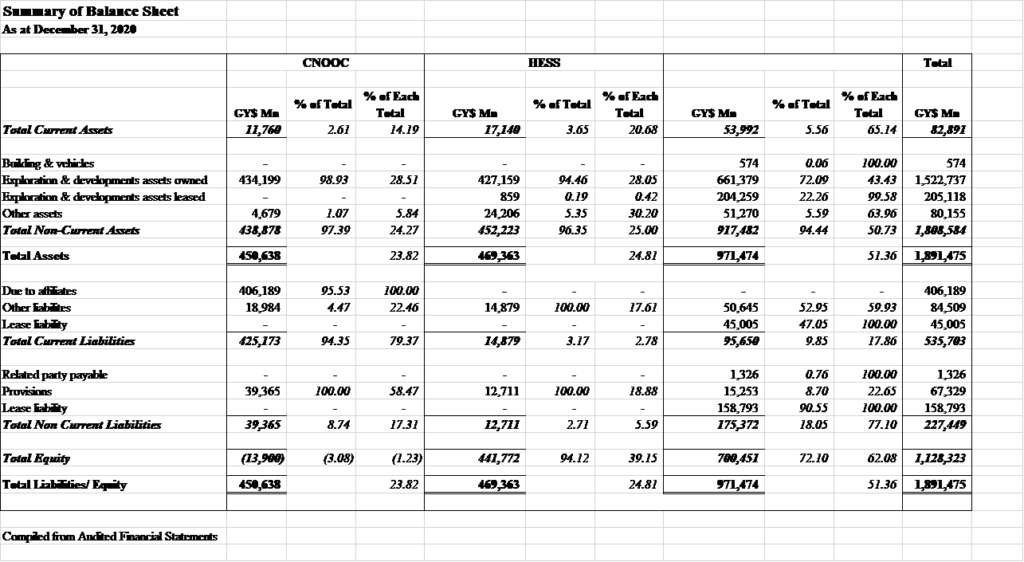
This final column of this mini-series examining the financial statements of the three Contractors under the 2016 Petroleum Agreement, reviews their balance sheets, sometimes referred to as statement of affairs, as at December 31, 2020. The Table below is designed in a similar fashion as the summary income statement presented in Column 91. The comments on that Table applies to the Balance Sheet summary as well and readers might therefore wish to go back to that Column for a better understanding of this column.

Table

The total value of assets is $1,891 billion (approximately US$9.1 billion), of which $82.9 billion constitutes current assets, while non-current assets account for $1,808.6 billion, (approximately US$8,612 billion). The total “Equity participation” by the oil companies in the Stabroek Block is $1,128 billion (US$5.4 billion). Put simply, 60% of the assets of the three companies is financed directly by the entities. However, given the nature of branch accounts, this sum can be withdrawn at any time.  

Non-current assets

Esso accounts for 51% of non-current assets while Hess and CNOOC share the balance almost equally. Exploration and development assets ($1,727 billion) make up 91% of the total assets of the three entities. Of this, assets owned by the entities account for $1,522 billion (US$724.8) while $205 billion (US$976 million) is leased from third parties, which accounting rules require inclusion on the balance sheet, along with their corresponding liability. Of the owned assets, CNOOC contributes 29%, Hess 28% and Esso 43%, which also accounts for practically all the leased assets.   

Of the three companies, only Esso has any interest in buildings, its financials disclosing net book value of $574 million in buildings and vehicles – a highly unusual combination of two very different classes of assets. More importantly, in violation of the intent of the Companies Act to restrict the ownership of land by external companies, Esso has been awarded a long-term lease of a substantial parcel of land controlled by Ogle Airport Inc. which however, is not separately identified in its financial statements.  

CNOOC and Hess show as non-current assets some $450 billion and $469 billion, including, dubiously Deferred Tax Asset of $4.7 billion and $10.9 billion respectively. Since the 2016 Agreement relieves all three companies from any obligation to pay taxes on profits, the concept of deferred tax does not apply and should be disregarded for accounting purposes, as Esso does.  

Current assets and liabilities

Current assets, comprising mainly of cash ($13.7 billion), receivables ($24.7 billion) and inventory of unsold crude oil ($36.2 billion) account for 4% of total assets. Of the current assets, Esso accounts for 65%, Hess 21% and CNOOC the remaining 14%. Of the $53.99 billion of current assets of Esso, 55% was held in inventory and 20% in accounts receivable. For Hess, 65% of current assets is held in accounts receivable and 35% in inventory. CNOOC holds 77% of its current assets in cash and its equivalent and 22% in receivables.    

If one side of the balance sheet states the assets owned by the companies, the other side is made up of $695.8 billion in liabilities, $67 billion in provisions and $1,128 billion in what Esso describes as Equity contribution and Hess as Capital contributions, both terms being atypical of branches.   

Total current liabilities of the three amounted to $535.7 billion (US$2.6 billion) with CNOOC accounting for 79%, Esso 18% and Hess 3%. The single most significant debt owed by CNOOC is an amount of $406.2 billion (US$1.9 billion) owed to an affiliate. The amount payable during 2021 on leased assets is G$45.0 billion, all by Esso. Other liabilities of the three partners amounted to $84.5 billion of which Esso is shown as owing $50.6 billion, Hess $14.9 billion and CNOOC $19.0 billion.

The joint-venture partners have a total of $67 billion in provision for decommissioning expenses at the end of the project life – possibly 25 years hence. By contrast, there is no provision for any emergency event, such as an oil spill. In this regard, the Agreement provides for the Government to fix any environmental damage if the companies do not promptly do so and to bill the companies for “reasonable costs and expenses” – not for all costs incurred. It is truly ironic that banks, insurance companies and airlines have to give bonds or lodge deposits to secure potential claims against them while oil companies, arguably engaged in the riskiest business of all, has no such obligation.

Hess shows $441 billion (US$2.1 billion) in Capital contribution or 39% of total capital contributed by the entities while Esso shows Equity contribution of $700.5 billion, representing 62% of the value of its assets. Incredibly, CNOOC had negative shareholders contribution, its assets being financed by short-term liabilities owed to an unnamed affiliate. In its 2020 Annual Report, ExxonMobil reports that “In partnership with the government of Guyana, we are efficiently developing these resources while maintaining active exploration to test multiple prospects.”

We recall from Column 91 that Esso’s direct exploration expenses of $18,286 billion (24% of its revenue), excluding the portion of General and administrative expenses of $20.8 billion (27% of revenue) which would also be allocable to its exploration activities. The claim that this is being done in the name of a partnership, not with Hess and CNOOC, but with the Government of Guyana, needs some explanation.   

Conclusion

There is clearly an underlying agreement among the companies which is not available to the Guyanese public. Former Minister of Natural Resources Raphael Trotman might argue, as he initially did concerning the 2016 Agreement itself, that the confidentiality of such agreement is protected by law. There is no legal basis for such a position. And in any case, the financial statements of each of the companies should disclose, in sufficient detail, the nature of the relationship and the company’s rights, responsibilities and obligations. 

Both the principles underlying their preparation and the contents of the financial statements reflect major deficiencies, including non-compliance with accounting Standards, requirements of the law and the Petroleum Agreement under which they operate. Reconciling the statements reviewed in this mini-series and the requirements of the Petroleum Agreement, or with the tax laws, would be a challenging task for those concerned.

Significantly, the Act requires financial statements of external companies, and not just of their Guyana branch which is what has been presented; the annual returns of these companies filed at the Commercial Registry are similarly non-compliant; and the Registrar of Companies was generous, if not careless, in permitting names of external companies which include the word “Guyana”.

These financial statements have vindicated the initial fears expressed about the limitations and weaknesses of the 2016 Petroleum Agreement. Those limitations and weaknesses have been compounded by the multitude of combined fatal deficiencies by the three oil companies in their financial reporting in the first year of oil production, averaging less than 100,000 barrel of oil per day. The opportunities for manipulation will increase correspondingly as production increases by eight and tenfold. It is incumbent on this Administration to separate itself as a partner in the financial shenanigans being perpetrated by the companies, introduce modern petroleum legislation, appoint independent and competent regulators and ensure that our laws are respected.

The Government should expect resolute pushback. The oil companies do not comply with a weak Agreement partly written by them, let alone a regime of regulation meeting international standards.    

Finally, a word of appreciation to the several persons who shared their perspective with me on the last four columns. Next week’s column will respond to the IMF’s defence of the arrangement whereby the Government pays the tax of the oil companies.  

Oil and Gas Column # 91 – June 25, 2021

Every man, woman and child must become oil minded

Introduction

Each of the past three columns (#’s 88 – 90) reviewed the financial statements of one of the three oil companies which signed the 2016 Petroleum Agreement with the Coalition Government of President Granger. Today’s column compiles the income statements from the separate financial statements, making some minimal reclassification for the sake of convenience, comparability and readability. But first, a brief explanation of the Table.

The Table is expressed in millions of Guyana Dollars (GYD Million). The top line of figures is the revenue of the three entities while the percentages represent their share of total revenue earned. The line items of expenditure show for each of the companies the reported expenditure on the stated categories such as Production Operating Costs; Depreciation, depletion and amortisation; General and administrative; etc. The percentages in the first column following the numbers show the percentage which the expenditure bears to the revenue of the respective entity while the percentage in the next column is the proportion which the class of expenditure bears to the sum of that class for the three entities. To take one example: Production/operating costs for CNOOC accounted for 41.9% of its revenue but 37.4% of the total Production/operating costs incurred by the three companies.

Commentary on Income statement

Esso holds a 45% interest in the Stabroek Block while Hess has 30% and CNOOC holds the remaining 25%. The reported revenue approximates to those interests with Esso’s share of revenue (rounded up) accounting for 43%, Hess 34% and CNOOC 24%. The disparity in sales to the companies’ interest in the operations can partly be accounted for by the unsold crude oil at December 31: Esso had some $1.731 billion dollars’ worth of unsold crude while Hess had approximately $334 million. CNOOC had none.  

Given that the relationship among the three is essentially one of a joint venture, not only is income expected to reflect the respective interest but so too is expenditure. On a total level, reported expenditure by CNOOC was 19% of the total expenditure, Hess 31%, and Esso, 49%. It is either that CNOOC, the most profitable of the three companies, is underspending or Esso is overspending. But that too is not consistent – as the share of their revenue used in production cost shows. In the case of CNOOC it was 42%, Hess 33% and Esso a mere 12%, which is hardly plausible. This lopsidedness extends into the total expenditure as well: of the combined production expenses of the three entities, CNOOC accounts for 37%, Hess 43% and Esso 20%.

The reverse is true for Depreciation, Depletion and Amortisation (DDA) for which CNOOC incurs 36% of its revenue, but representing 23% of the total on this class of non-cash expenditure incurred by the three companies. For Hess it is 42% and 39% respectively while for Esso it is 31% and 37% respectively. It needs some explaining that Hess would incur a higher cost or charge on DDA than Esso, the much larger partner.  

The next two classes of expenditure take some believing. CNOOC incurs just 1% of its revenue and 2% of the total incurred by the three companies on General and administrative expenses. For Hess it is 7% and 17% respectively while for Esso it is 28% and 81% respectively. Esso has two functions under the Petroleum Agreement – as a joint venturer, and as Operator, but it appears that these functions are not only conflated but are confused. It is noted that general and administrative expenses of Esso have moved from $6.982 billion in 2019 to $20.829 billion in 2020, almost treble. The question arises whether this entire sum is incurred in its role as the JV operator, as a separate entity, or as is more likely, both.  

CNOOC did not incur any Exploration expenses in 2020 and its financials actually show a credit of $524 million. It is possible that this represents cost recovery but that is pure speculation. On the other hand, exploration expenditure by Hess of $1.361 billion represents 2.3% of its income and 6.7% of the total Exploration expenses incurred by it and Esso in 2020. For Esso, the corresponding percentages are 24% and 93% respectively.

Interest and finance costs incurred by CNOOC were negligible, again with a small credit, while the $520 million incurred by Hess represents 1% of its revenue and 6% of the total finance costs incurred by it and Esso in 2020. And for Esso, it is 10% and 94% respectively. It does need an explanation that interest cost derived from leases would arise out of capital leases which require the lessee taking the asset and the obligations under the lease on its balance sheet. It is this liability which gives rise to interest charge. Typically, as the lease obligations are reduced by payment, such interest costs also reduce but in the context of a giant licensed area and a gold mine of discoveries, this is unlikely to happen for at least another decade as expensive assets are leased under new production licences. These costs would not arise if applicants for production licences did in fact possess the financial resources which the law requires them to have, or if Guyana insisted on thin capitalisation restriction.       

Royalty and revenue

The two American Joint Venturers disclose the amount of royalty paid to the Government of Guyana for petroleum produced and sold – CNOOC does not. Royalty paid by Hess was $1.493 billion and by Esso $2.049 billion, a total of $3.542 billion (roughly US$16.9 million), representing respectively 2.52% and 2.72% of sales revenue of the two companies. In early 2021, the Government of Guyana announced that its revenue from royalty in for 2020 was US$21.2 million (G$4.410 billion). By deduction, this means that CNOOC paid roughly US$4.3 million (G$903 million), equivalent to 2.2% of its revenue, making the overall average royalty paid by the three companies as 2.5% of sales. The Petroleum Agreement stipulates a royalty rate of 2% which suggests that all the companies are voluntarily paying more royalty than they are contractually required to pay. This raises the question whether the revenue figure of all three entities is in fact understated. 

Similar uncertainty arises in relation to the oil companies’ revenue declaration and the Government’s share of profit oil. The Government has announced that the revenue earned in 2020 from its share of profit oil was US$184.9 million. At a rate of US$1 to G$210, this amounts to approximately G$38.9 billion which means that as a share of gross oil revenues Guyana received 18.1% which added to the royalty of 2.5% gives a total return of 20.6%, compared with the 14.25% which everyone, including senior Exxon officials, expected would prevail beyond 2025.  

Efforts to obtain clarification of these anomalies have proved futile, again inviting speculation for which there are a number of possibilities. The first is that the companies’ revenue figures do not represent the true value of sales, and that there is undisclosed income. Another is that Guyana may have received what in the industry is referred to as an overlift, meaning that there is an imbalance in its favour in the apportionment of production during 2020, to be evened out in subsequent periods. A single shipment one way or the other can make a huge difference and it is probably safe to say that any overlift would be in Guyana’s favour. While Guyana has disclosed its oil lifts and the revenues per shipment, none of the oil companies presented any such information. 

Another possibility is that the oil companies might have deferred some of the precontract recoveries to which they were entitled. This has been a controversial issue since the 2016 Agreement was first made public, and has caused the companies’ numbers being challenged on a number of occasions. A further explanation is that Guyana’s revenue is at full market value while the revenue earned by the oil companies is depressed by inter-company sales.    

Taxation

CNOOC and Hess include a taxation charge in their financial statements when in substance, they and Esso are not liable to pay no taxes in Guyana. Their taxes are paid for them by the Government of Guyana but the Guyana Revenue Authority issues them with a Certificate of Taxes paid to enable them to receive a credit in their respective home countries. That appears to be a fraud disguised as a feature of some old-fashioned production sharing agreement. Esso has chosen not to reflect a credit for what is referred to as deferred tax and one has to wait to see how it will treat taxation when it finally declares a profit in Guyana. Meanwhile, it and its JV partners studiously avoid any clear reference to their tax position under the 2016 Agreement.

Conclusion    

Not all the questions raised by the inadequate information presented by the oil companies in their 2020 financial statements are negative to Guyana’s interest. But they are all significant. And they demand proper answers.    

Every Man, Woman and Child in Guyana Must Become Oil-Minded – Part 90 – June 22, 2021

Esso Exploration and Production Guyana Inc. reports $6.5 billion loss in 2020

Introduction

Esso Exploration and Production Guyana Inc. (Esso), the largest of three partners in the Stabroek Block, with a 45% share under the 2016 Petroleum Agreement, has declared a loss of $6,516 million in 2020. This compares with a profit of $9,298 million earned by the Chinese-owned CNOOC (25%), and $6,877 million by the American-owned Hess (30%). Esso was granted an exclusive petroleum exploration licence in 1999 under a pre-discovery Petroleum Agreement over an area of Guyana’s waters that was larger than the entire country. Following the running of the clock, powerful arm-twisting of the GGMC officials and not a little bit of deception by Exxon, Raphael Trotman and the APNU+AFC Coalition Government questionably “renewed” the Agreement over the same area and under the same terms even though the Area had produced at least two known world class discoveries at the time.  

In this special Tuesday edition of this column, we review the audited financial statements of Esso for 2020, the first year of oil production in and by Guyana. Like its joint venture partners, Esso was incorporated in a tax haven in The Bahamas on 16 October, 1998 and is registered as an external company in Guyana. The Bahamian company is owned by ExxonMobil Global Holding Investment B.V. of the Netherlands which in turn is owned by the American company ExxonMobil, for several years rated the world’s No. 1 company by revenue. As readers are aware, the financial statements of CNOOC and Hess were reviewed in this column over the past two Fridays. But first some general comments.

While Article 2 of the Agreement describes Esso as the Operator charged with conducting the day-to-day activities of the three companies, none of the three companies acknowledge this fact or what it means in practice. Perhaps inadvertently, Esso uses the term “joint venturers” even as each of them presents financial statements that differ from each other in principle, content and presentation. The only things they seem to share are a studious avoidance of references to the 2016 Agreement, and financial statements that are intended to disclose as little as possible, if not to mislead.

The next column due this Friday, will identify some of the major issues of substance which define the three entities, or set them apart. For now, however, it seems clear to me that the three entities are not in compliance with the relevant International Financial Reporting Standard (IFRS) governing such operations.    

Income Statement

What stands out in the Income statement is that not a single line item of income or expenditure carries a note reference to explain and expand on the numbers. Readers are therefore left to figure out for themselves what comprises these numbers and what they mean. For example, as presented, no transactions are carried out with related parties, production is sold to non-Exxon companies, there is no cost for management support from Exxon and that the only related parties are Hess and CNOOC. If that is not the case, then, again, the financial statements do not comply with IFRS.

The Income Statement is so bare that the reader has no idea of what constitutes Exploration costs ($18,286 million) or the composition of Administrative expenses of $20,829 million. Revenue is reported at $75,429 million and total operating expenditure at $81,945 million leaving a loss for the year of $6,515 million. Interestingly, Explorations costs account for 24% of total income, Depreciation and amortisation accounts for 31.4%, Administrative expenses for 27.6% and Lease interest for 10.3%. The income statement also shows Royalty payment of $2,049 million which translates to 2.7 % of revenue compared with a rate of 2 % under the Petroleum Agreement.

Now, Esso and its partners have a production licence for the Liza One project but it openly charges against production income expenses incurred in exploring in other areas. This is unacceptable by any measure and should be rejected both by those, if any, regulating the oil companies as well as the tax authorities. Indeed, such barebone accounting by an international company, coupled with careless (mis) references to “home office” and “head office”, is a measure of the contempt in which Esso holds Guyana, its people and the local accounting profession. 

Unlike CNOOC and Hess, Esso, correctly in my view, does not make any provision for deferred tax asset, as the tax value of the loss in future years. Indeed, the word “tax” is not used anywhere in Esso’s financial statements or in the notes thereon.  

Balance Sheet and Cash Flow

The total assets of the Branch, net of depreciation and write-offs, have moved by $400,313 million to $971,473 million. Of this total, Property, Plant and Equipment accounts for $866,213 million or 89%. The major additions to this class of assets were $231,353 million in work-in-progress for Wells and facilities and $110,320 million in leased Drill Rig assets. Other significant items of assets are Related party receivable of $48,985 million, Trade receivable of $10,917 million and Inventory – Materials and Supplies of $28,501 million representing drilling of 2021 exploratory and development wells. There is an amount of $7,511 million as Deferred receivable as due from cash call bookings, net of joint billing costs.

While there has been a contribution of $436,519 million in equity contribution, some of this was used to reduce amounts owing to related parties of $140,961 million and to finance a receivable in related party of $48,985 million. Now if this did not come from sales, one is left to guess how it arose in the first place. The company boasts to the public that it pays no interest on capital contributed, but with significant portions of capital expenditure financed by leases, lease interest paid for the year was $7,768 million, up from $345 million in 2019!  Committed capital expenditure over the next three years is $359,941 million while its cash balance at the end of 2020 was a more modest $4,546 million. As these companies race to drill as much as they can, they will encounter a cycle of massive borrowings or/and may have to liquidate assets in other parts of the world to exploit their new crown jewel.

Every Man, Woman and Child in Guyana Must Become Oil-Minded – Part 89 – June 18, 2021

Government to pay $5,391 million Corporation Tax for oil companies reporting after tax profits of $16,175 million. 

Introduction

This second part of a mini-series on the three oil companies which operate the Liza 1 project under the Stabroek Block reviews the 2020 financial statements of the Guyana branch of Hess Guyana Exploration Limited (Hess). For the better understanding of the financial statements, the comments last week (Part 88) on the rules governing financial statements by CNOOC are applicable to Hess and Esso as well. But first, a few words on Hess.  

Hess is a branch of a Cayman Islands company of the same name. It was registered as an external company under the Guyana Companies Act on 28 October 2014 and holds a 30% interest in the Stabroek Block. The Cayman Islands company is owned by Hess Corporation, a public company in the USA, which claims on its website that its purpose is to be “the world’s most trusted energy partner”.

The income statement shows an Income Tax expense of $1,725 million, referring the reader to Note 9 which states that “the Branch is subject to corporate income tax at a statutory rate of 25% (2019: 25%)”. Tucked away in a note on the branch’s accounting policies, is the statement that under the Petroleum Agreement, certain taxes are settled by the Government on behalf of the Branch. The Agreement does not use the word “settled”: it provides unambiguously that “the tax assessed will be paid by the Minister”.  

Financials

Income Statement

According to Note 10 to the financials, the Branch in 2020 sold approximately one million barrels of crude oil to a related marketing subsidiary of its parent, receiving net proceeds of approximately G$7.8 billion, or US$37 per barrel. This compares with data in the parent company’s annual report which gives the price of Guyana crude of US$46.41 inclusive of hedging, and US$37.40 excluding hedging. Since the G$7.8 billion accounts for only 13% of total sales of $59,240 million, the obvious questions are how many barrels in total did the Branch sell and the process for selling the remaining 87% by value.  

From the $59,240 million, deductions are made for Cost of Sales $21,295 million (35.6% of sales revenue) and Depreciation, depletion and amortisation (DPA) of $24,893 million (42.0% of sales revenue), leaving a gross margin of $13,051 million or 22.0%. A separate note shows that cost of sales is made up of production expenses of $19,571 million, royalty of $$1,493 million and change of inventory of $230 million. Based on sales, royalty works out at 2.52%, which is 0.52% over what the Petroleum Agreement calls for. The DPA is made up of $24,811 million in respect of development assets, representing approximately 7% of development assets, and $82 million on Leasehold costs, representing 7.8% of Leasehold assets.

Deductions are also made for General and Administrative expenses of $4,292 million, inclusive of pre-development and pre-production costs of future projects, and Exploration expenses of $1,360 million, suggesting multiple cases of the revenue of Liza I bearing non-Liza 1 expenses. This is a violation of the principle of ringfencing which our regulators appear to miss both conceptually and practically and therefore fail to address. An earlier column has suggested that the absence of a specific ringfencing provision in the Petroleum Agreement is not fatal since the Minister can impose conditions in every production licence.  

The income statement also shows financing cost of $520 million arising from provision for decommissioning, for which new and additional provisions and revisions of $3,514 million were made in 2020. While the $520 million can be traced to the income statement, the category of expense under which the provision for decommissioning is charged is not immediately apparent. 

After all these costs are deducted from revenue, the Branch reports net income before taxation of $6,877 million, which but for the Petroleum Agreement would be subject to Corporation tax (25%) and to withholding tax (20%) on the deemed distribution branch profit tax (BPT). A deemed distribution is the balance of profit after the Corporation tax less any re-investment of such profits, subject to the approval of the Commissioner General. In 2020, the Branch’s reinvestment was considerably higher than the balance of profit so that while withholding tax most likely would not apply to year 2020, corporation tax does. It gets a bit tricky here. The Agreement states that such tax must be included in the taxable income of the Contractor, meaning that the $6,877 million has to be treated as if it is a post-tax amount, requiring grossing up.

Petroleum Minister (Mr. Vickram Bharrat) must find, within the next few days, $2,292 million to pay to the GRA the tax owed by Hess for 2020. Failure to do so would constitute a breach of the Petroleum Agreement and would also incur late filing penalty (10%) and interest (18% p.a.). Similarly, for CNOOC (see column # 88), the Minister is required to pay to the GRA Corporation Tax of $3,099 million on the grossed-up value of post-tax profit of $9,298 million earned by it. The total of Corporation Tax to be paid by the Government for CNOOC and Hess earning a total of $16,175 million in 2020 is $5,391 million. Ironically, the tax payable would have been much more but for the liberal accounting applied by the two Branches.  

Balance Sheet

The total value of assets of the Branch at yearend was $469,363 million of which Property, plant and equipment accounted for 91%, with the remainder spread fairly evenly over cash, receivables and deferred income tax asset. At December 31, Hess is also shown as having an advance to Esso of some $13,167 million while an amount of $14,879 million is shown as owing to Esso.   

The Branch’s bank balance at year end was $66 million while its commitments for capital expenditure on the Stabroek Block was approximately $544.0 billion (United States Dollars: $2.6 billion), “to be incurred over the next several years”.  It is unclear where this money will come from – at December 31, 2020 the parent company’s cash resources stood at US$1,739 million while its total debt and lease obligations stood at US$8,534 million.

Note: All figures in Guyana Dollars unless otherwise stated.