
Stratospheric returns for Hess

Every Man, Woman and Child in Guyana Must Become Oil-Minded – Column 157

Introduction

Amid concerns about unresolved audit issues, mysterious tax certificates and controversial oil spill legislation, Hess Exploration Limited, a branch of a Hess subsidiary incorporated in the Cayman Islands, is the first of the Stabroek Block partners to lodge audited financial statements. The Cayman Islands company is a wholly owned subsidiary of Hess Corporation, incorporated in Delaware, USA, which is one of the most permissive jurisdictions in the United States.

Hess filed two sets of financial statements: Hess Guyana Exploration Limited, which operates the Stabroek Block as a subsidiary, and Hess Guyana (Block B) Exploration Limited, a subsidiary of a Bermuda-based company that holds a 20% interest in the Kaieteur Block. The separate external companies arrangement probably allows the two separate branches with similar names under the Guyana Companies Act. Another point of interest is that the financial statements of the Stabroek Block branch are stated in US Dollars, while those of the Kaieteur Block are stated in Guyana Dollars. Notwithstanding, both have the same Guyana auditors. The separate financial statements for this Block note that it was relinquished in 2023.  There is an additional anomaly that the financial statements for the Stabroek Block are expressed in United States Dollars, while those of the Canje Block are stated in Guyanese dollars.

The rest of this column examines the financial statements of Hess Guyana’s 30% participating interest in the Stabroek Block.  While the audited statements are stated in US$, we have converted these to Guyana Dollars.  All Tables sourced from the Branch’s financial statements.
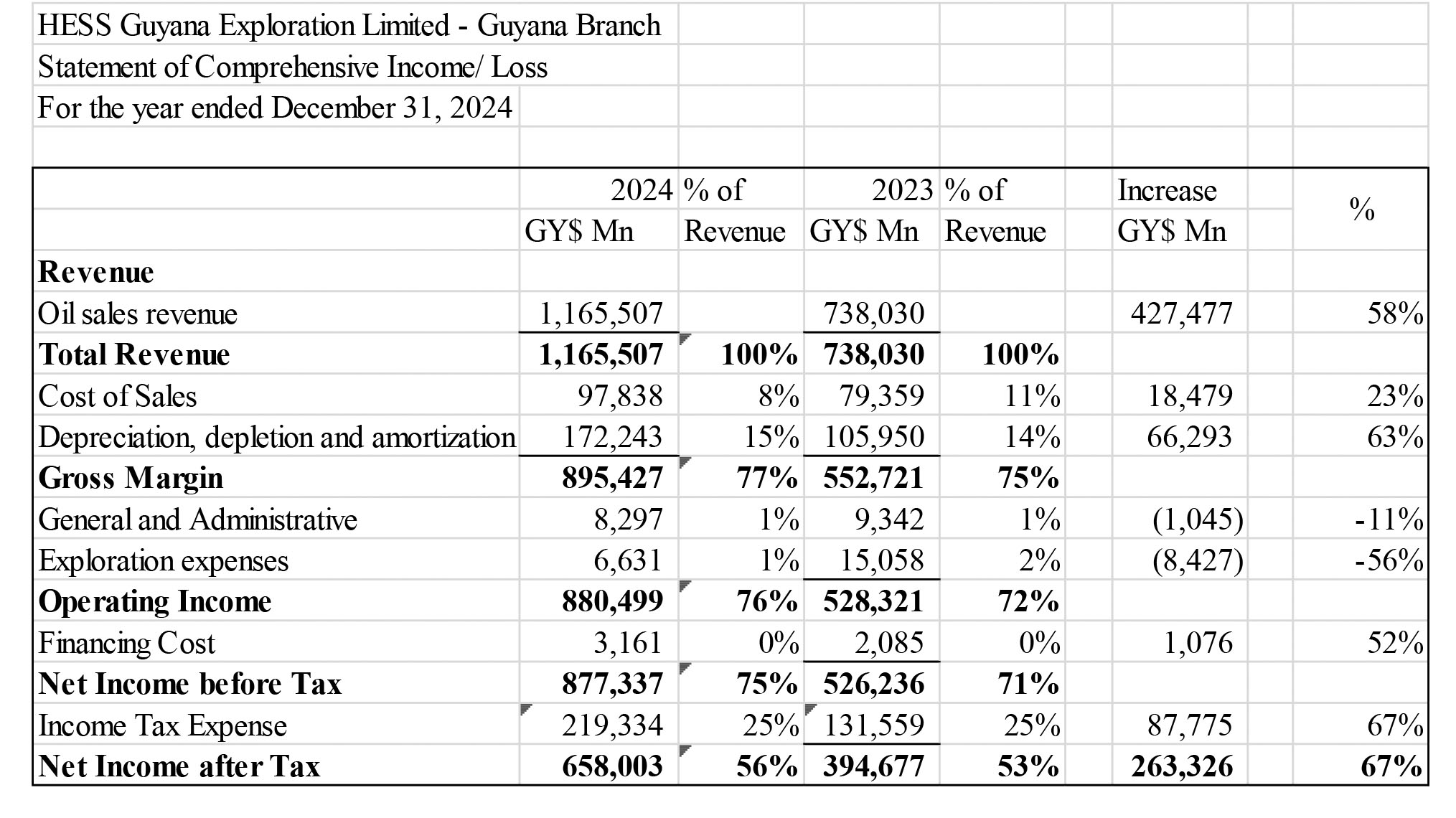
Except for the tax borne by the Government being accounted for as non-customer revenue, revenue is derived from the sale of 40 million barrels of crude oil in 2024 (up from 19 million in 2023) to a marketing subsidiary of Hess Corporation. Revenue rose by 58%, from GY$738.03 billion in 2023 to GY$1,165.51 billion in 2024. Cost of sales as a percentage of revenue fell from 11% to 8%, while Depreciation, Depletion and Amortisation accounted for 15% in 2024, up slightly from 14% in 2023. Gross margin reached 77%, up from 75%. General and Administrative expenses remained steady at 1% of revenue. Due to rounding, Operating Income was GY$880.5 billion before financing costs of GY$3.16 billion, leaving Net Income before tax of GY$877.34 billion—an increase of GY$351.10 billion or 67% over 2023.

Here comes the quirk. The Statement shows a tax expense of exactly 25% of pre-tax income, explained by Hess in a manner both confounding and misleading. Article 15.4 of the 2016 Stabroek Agreement clearly states that the Government of Guyana, not the contractor, pays the income tax liability using the State’s share of profit oil. Yet Hess describes this as a portion of “gross production,” separate from cost oil and profit oil, being used to “satisfy” the tax. This is not only misleading, it is false. There is no third allocation. The tax is paid from the Government’s share, exactly as agreed.

This dishonest accounting narrative is not the doing of local auditors or management. It originates in documents filed with the U.S. Securities and Exchange Commission and passed down to Guyana. That makes it not just a local embarrassment but an international one.

The Balance Sheet

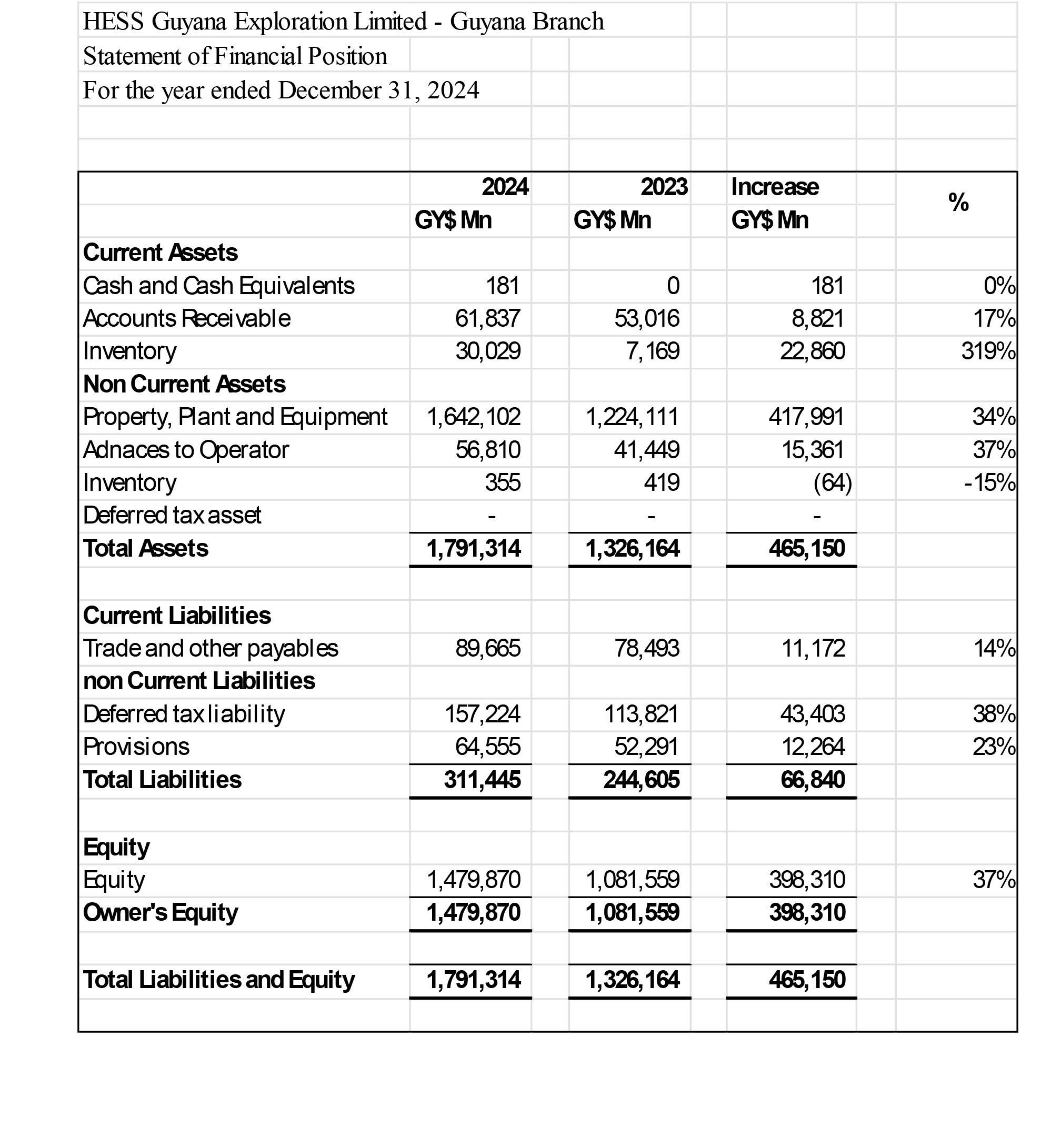
The Balance Sheet exhibited substantial asset growth, with total assets increasing by 35% to reach GY$1,791,314 Mn at year-end 2024, an increase of GY$465 billion from the prior year. Significant additions included the purchases of Liza Destiny and Prosperity FPSOs, as well as increases in material and supplies of over US$100 million in current inventory.  Receivables of $61,837 Mn were an increase of 17% over the previous year and represent amounts due from the sale of crude oil, all of which is sold to a related party.

Staggering returns

A key measure of financial performance is the return on capital, measured by income divided by average capital employed. Given that the profit before and after tax is the same (GY$ 877.34 billion), and the average of the 2023 and 2024 year-end equity figures is GY$1,280.714 million, the return on capital employed to Hess stands at a staggering 68.5%.

This means the company generated nearly 69 cents in operating profit for every dollar of equity capital deployed – an extraordinary return by global oil industry standards. Such a result confirms that HESS Guyana’s operations in the Stabroek Block are not only profitable, but exceptionally so, raising important questions about how much value is being retained by Guyana itself in this contractual relationship.

And this is the result. The Branch distributed to its head office – we are not sure which one – US$1,454,509,084! All for a 30% stake, and the extreme generosity of our politicians who accuse the nation of being “stupid” and “unable to understand.”  
Undoing Sandil Kissoon – Part 2

Every Man, Woman and Child in Guyana Must Become Oil-Minded – Column 156 – 17 May. 2025

Introduction

As feared, the Government ignored calls to refer the Oil Pollution Prevention, Preparedness, Response, and Responsibility Bill to a Select Committee and advanced it to a second reading. Listening to the exchange in the National Assembly, it was entertaining to see how members accused each other across the House of not having read the Bill. Standing among these was the Minister of Natural Resources, who spent most of his time discussing the IMF, the OAS, EITI, the World Bank, and the NRI.

Yesterday’s column spoke of the maze of institutions created by this Bill. At the top of the pile is the Civil Defence Commission, currently a loose body that, in a single clause, is transformed into a body corporate, a legal entity headed by a Governing Board. There is nothing to suggest how this body will relate to the Environmental Protection Agency and to the Ministry of Natural Resources.

One thing is sure: any idea of a Petroleum Commission is now dead, as dead as Review and Renegotiate. Another certainty is that the CDC has no capacity in personnel and assets to carry out the functions and duties imposed on it by this Bill. As the Competent National Authority, the CDC is required to develop, prepare, and publish a National Oil Spill Contingency Plan to guide all coordination and response operations of oil spill incidents or potential oil spill incidents. It faces an immediate uncertainty: the Bill provides no guidance on development processes, consultation requirements, approval mechanisms, or update frequency. Even though it is a “National” plan, there is no indication whether the plans of various companies and sectors, including those of the oil companies, are to be incorporated into the National Plan.

The other organisational issue is how this Bill will alter the CDC’s prior focus – the management of disasters.

The Prosecution Puzzle

Another feature of the Bill is the bewildering array of offences – from failing to submit plans to refusing to respond to spills – with penalties ranging from fines to mandatory three-year prison terms. Yet remarkably, it fails to specify who will bring these criminal charges or which courts will hear them. The legislation simply states that responsible parties “commit an offence” and “shall be liable on summary conviction” or “on conviction on indictment,” leaving prosecutors, defendants, and courts to guess whether the Director of Public Prosecutions, the CDC, the EPA or some other authority has the power to initiate proceedings. The Attorney General did not name the Office of the DPP as one of the persons and organisations consulted.

This omission creates potential chaos where administrative agencies like the EPA pursue civil penalties while criminal prosecutors pursue parallel charges in different courts for the same conduct.

The link with the Deal of the Millennium

The greatest threat from any environmental disaster comes from the operators of the Stabroek Block, which controls over eleven billion barrels of oil. Clause 10 of the Bill requires oil companies (the “responsible party”) to submit their contingency plans which must align with or be incorporated into the National Oil Spill Contingency Plan. The problem is that the 2016 Agreement has its own provisions dealing with environmental disasters, including oil spills. Yet, this Bill conspicuously avoids directly addressing how it interacts with the existing 2016 Petroleum Agreement between Guyana and the ExxonMobil consortium, particularly the Agreement’s powerful stability clause in Article 32.

Oil companies will therefore have two obligations and two options. They can point to either the Agreement or the Bill, whichever is more favorable, while taxpayers fund the oversight system.

International Outlier

Almost every speaker on the Government side spoke of the international standing of Guyana’s Bill, with several countries cited as sources from which this Bill was drawn. That is not supported by evidence from several countries. The United States’ Oil Pollution Act of 1990 makes operators the primary responders and creates a trust fund financed by a tax on oil companies. Norway imposes criminal liability on executives for willful violations and maintains strict liability without regard to fault. Canada requires operators to submit prevention plans while maintaining clear operator responsibilities. The UK’s approach focuses on vessel discharges with consolidated controls.

What makes Guyana’s Bill particularly troubling is its funding model – every other country either requires operators to pay directly or ensures operator liability, whereas Guyana’s taxpayers fund the entire bureaucracy. I found no other country with as many layers of bodies and overlapping jurisdictions. The effect of this Bill is that many of the costs are shifted from operators to taxpayers.

Conclusion

The Government has used its majority in the twilight of the 12th Parliament to rush this Bill through its second and third reading to passage. However, there is no funding for the massive structure and functions contemplated in the Bill, which, along with a range of marine, air, and land transportation assets and technical facilities, will be required to give the Bill a chance of success. Passage of the Bill will prove to be the easy part.

Undoing Sandil Kissoon

Every Man, Woman and Child in Guyana Must Become Oil-Minded – Column 155

Introduction

The National Assembly is scheduled to meet today, as the 12th Parliament moves to a close in preparation for historic elections. The Prime Minister will lead the second reading of the Oil Pollution Prevention, Preparedness, Response and Responsibility Bill tabled last week. At first glance, the unsuspecting reader and observer may believe that the law set out in the 56-page, 39-clause Bill, arranged over eleven parts from Preliminary to Miscellaneous, is progress and development. They would be dangerously mistaken.

Beneath this technical jargon and smooth veneer lies a troubling reality: this legislation may weaken the very protections it purports to strengthen. Perhaps most strikingly is the suspicion that one of the hidden objectives of the Bill is to neutralise the decision of Justice Sandil Kissoon in the successful action brought by Fred Collins and Godfrey Whyte vs. the EPA and (conveniently joined by) ExxonMobil Guyana. If that suspicion is true, it is infinitely worse than the Government seeking to reverse a ruling by the High Court for which an appeal is pending. Such practice is not unusual but is usually only done to plug loopholes and fix lacunae. In this case, it seems designed to relax the regulatory controls over which Exxon appears to call all the shots.

Legislative reversal of Kissoon

To recap, in the Collins and Whyte case v. EPA, Justice Kissoon found that ExxonMobil’s Guyana subsidiary, a major oil company, had operated for eleven months in violation of its permit by failing to provide unlimited liability insurance. Meanwhile, the EPA had “descended into a state of slumber” and acted as a “derelict, pliant, and submissive” regulator.

If the Government persists with this Bill, it is not just legislative malpractice but another egregious abandonment of the national interest, in which we moved from the President’s “Review and Renegotiate to supine capitulation. In close to five years, this Government has failed to close a single annual audit; it refuses to use its powers to set any conditions, such as ringfencing, in production licences. It has engaged in secret deals with Exxon concerning the Gas – to – Shore and, most incredibly, has not enforced the mandatory relinquishment clause in the Agreement.

Despite representing “one of the most critical environmental and economic bills ever presented to our Parliament,” this legislation is being fast-tracked without adequate scrutiny. The Bill’s technical provisions, multiple bodies, unconnected parts, divisions, and sections without clear interconnection, as well as vague drafting that special interests can exploit, make for an almost unworkable arrangement.

MBA – style creation

The legislation creates at least five major bodies: the Civil Defence Commission (as the “Competent National Authority”), its six-member Governing Board, a National Oil Spill Committee with over 20 agency representatives, ad hoc Oil Spill Incident Boards of Inquiry, and a National Emergency Operations Centre. Inescapably, 95% of all these positions are directly appointed by the Minister, with the remaining 5% being ex officio appointments of officials who were themselves politically appointed, creating a system where political loyalty takes precedence over technical expertise. This legislative masterpiece is worthy of a special case study at Harvard Business School under “Advanced Organisational Dysfunction: A Masterclass in Bureaucratic Architecture.” 

This maze of institutions, all operating under vague mandates with unclear lines of authority, virtually guarantees bureaucratic paralysis when swift action is needed. Rather than streamlining response capability, the Bill spreads functions and responsibilities across multiple layers of bureaucracy, creating enough regulatory confusion to allow oil companies to operate with even greater abandon. At the same time, appointees can always point to some other body as being responsible for enforcement. When a spill occurs, who exactly is in charge? The Bill’s answer seems to be everyone – and no one. A disaster dressed up as comprehensive governance.

Taxpayers Pay – Exxon creams

As the structure goes, so do the financial arrangements. Typically, in regulated sectors, it is the players who fund the regulators through a levy. Not with this Bill. The entire elaborate bureaucratic ecosystem – five major bodies, dozens of appointed officials, multiple committees, emergency centres, and boards of inquiry – is funded entirely by Guyanese taxpayers through the Consolidated Fund. This allows the oil companies to operate in Guyanese waters, as the ultimate spillers and polluters of Guyanese shores – and beyond.

What makes this sellout particularly galling is how it exceeds even ExxonMobil’s original expectations. The oil giant has operated for years, knowing it needed unlimited liability coverage – that was the deal from the start. Justice Kissoon insisted on the enforcement of existing obligations.

Clause 22, in plain terms, removed that obligation and placed it on a motley group of ill-defined entities known as the responsible party. In contrast, Clause 21 can be read to render a parent company’s guarantee invalid. Clyde & Co told us that Exxon’s Brook Harris wrote the Cabinet Paper recommending the signing of the 2016 Agreement. I have serious doubts that Brook Harris could have done a better job on this one. Or maybe Brook Harris has a twin. To be continued

The Tax Certificate mystery

Every Man, Woman and Child in Guyana must become oil-minded. Column 155

Introduction

The controversy over tax certificates issued to oil companies continues unabated. On March 17, the Minister of Parliamentary Affairs and Governance responded to the Oil and Gas Governance Network’s information request by suggesting that tax details could be found in Commercial Registry filings – a claim I discredited in my March 21 column as both factually incorrect and legally flawed.

Now, the overzealous Joel Bhagwandin has entered the fray with a March 25 letter attempting to “simplify” what he calls an “unnecessarily complicated” issue. In his quest for simplicity, however, Bhagwandin has simplified reality itself away. He states that “the profit share paid to the Government is treated as the taxes paid by the US oil companies, and it is this sum that the tax certificate in question is based on.” The vacuity of this statement is quite remarkable. If profit oil magically transforms into tax certificates, surely this fiscal alchemy must leave some trace in our public accounts? Yet the National Estimates show no such entries, and it would be helpful if Mr. Bhagwandin could say where these are concealed. 

Confusion

He compounds his error by claiming that “the profit share due to the Government is reported on the financial statements as the oil companies’ tax liabilities.” One wonders which financial statements Bhagwandin has been reading – certainly not those filed by Guyana’s oil companies. These documents show no such thing. The companies recognise only their portion of profit oil as income, and certainly no evidence of the Government’s share being recorded as tax liabilities.

He also appears to be confused about the distinction between payment “on behalf of” and payment “in lieu of” – two distinct legal concepts. Article 15.4 of the 2016 Petroleum Agreement states that “a sum equivalent to the tax assessed… will be paid by the Minister to the Commissioner General of the Guyana Revenue Authority on behalf of the Contractor.” A payment “on behalf of” is one you make for someone who remains obligated to pay; a payment “in lieu of” substitutes for the original obligation. His quotation is correct but is totally misconstrued. The Agreement specifies the former, while Bhagwandin’s explanation suggests the latter.

Magic wand

This is not merely semantic. The distinction determines whether actual money must change hands or whether profit oil can be waved about like a magic wand to conjure tax certificates. Bhagwandin correctly notes that this arrangement exists to satisfy US tax laws but fails to follow his logic to its conclusion – if certificates satisfy US tax authorities, they must represent actual transactions, not paper fiction.

The government finds itself in a legal and accounting quagmire of its own making. Unable to reconcile the requirements of the 2016 Petroleum Agreement with proper financial management, it deploys surrogates to confuse rather than clarify. The 2021 Natural Resource Fund Act further complicates matters. Because its framework for payments out of oil revenues does not permit this tax arrangement, it does not mean that the Government no longer has any such obligation. Exxon wants every drop of blood, sorry oil, and has been insisting on that certificate. After all, as the mantra goes, it is all about sanctity of contract.

The Commissioner of Information has become the Commissioner of No Information – deflecting, ducking, and dodging legitimate inquiries. In response to my formal request for details about these certificates, the Commissioner questioned whether I had searched for “critical financial records” – whatever that means – instead of addressing the substance of my questions. Corporate filings at the Commercial Registry could not possibly contain information about tax certificates issued by the Guyana Revenue Authority. We are, therefore, left with no evidence of tax payments and no information on tax certificates. 

Conclusion

It may seem to some that in a petroleum bubble, opacity, obfuscation, dereliction, over-simplification and incompetence do no harm. In fact, they are critical ingredients of the resource curse for the country. Dismissing unusual and complex fiscal arrangements as “simple matters” does severe damage to those they seek to help, to themselves and to their reputation. Let us get back to these straightforward questions that require direct answers.

What is the amount of corporation tax paid by the Minister of Natural Resources on behalf of the oil companies from 2021 to 2024?

Are these payments reflected in the revenue of the Guyana Revenue Authority and the Consolidated Fund?

What is the exact value of tax certificates issued to each oil company since production began?

If the GRA did not issue the certificates, who did?

Now, that is simple.

The Ministry of Governance and Parliamentary Affairs has it all wrong

Every Man, Woman and Child in Guyana Must Become Oil-Minded -Column 154

Introduction

By its very name, the Ministry of Governance and Parliamentary Affairs should defend and advance democracy, promote and ensure transparency, and strengthen and enforce accountability. Regrettably, the Ministry, in pursuit of the party’s agenda, is increasingly a convenient vehicle for political deflection and democratic reversal, where Parliament is reduced to a rubber stamp for government (read Party) plans and governance is engineered to serve narrow interests rather than the public good.

This was evident in a recent response from the Ministry, which, rather offensively, dismissed a legitimate request by OGGN, a civil society organisation, for information about oil tax payments and access to information. It would have been to its credit if it had simply advised the OGGN of the statutory framework for accessing public information. Instead, it misrepresented the law, ignored glaring conflicts of interest, and deflected the issue of accountability.

Law is the bedrock, information is the oxygen

The Ministry knows that law – including the Constitution – is the bedrock of governance and that information is the oxygen of democracy. Without compliance and sanctions, laws become hollow instruments, existing on paper but non-existent in practice. Given its mandate, the Ministry should ensure these principles are applied in every sphere of government. It should strengthen mechanisms allowing free and open access to information – not shielding the government from scrutiny. Instead, it has chosen to defend a system in which:

The Commissioner of Information is neither independent nor effective. In the meme “family, favourites and friends”, the Commissioner’s son is a minister, his wife chairs the Teaching Service Commission, and his office is his home! A more egregious combination of conflicts is hard to imagine.

Just coincidentally, the Commission has not filed an annual report since 1996!

Parliament is merely a tool for government use, convened when an appropriation bill is needed, or legislation passed to fulfill some international obligation or domestic unavoidable need. Under this form of governance, parliament can never function as a meaningful check on executive power. And, of course, in another part of the tripod, the Speaker’s role appears to be to restrict and, as necessary, prevent meaningful debate.

Proper governance is practically absent, with constitutional safeguards twisted to accommodate political interests. The all-important Judicial Service Commission and, to a lesser extent, the Constitutional Reform Commission stand as examples of how institutions meant to strengthen democracy can be sidelined and manipulated.

The Integrity Commission, often held up by the Ministry as a bastion of accountability and guarantee against governmental corruption, has never filed an annual report of its performance. Currently chaired by the wife of a late PPP/C Minister, the Commission has been filing annual audited financial statements that are only part of the annual reporting process.

Troublingly, this Commission seems to be operating as a mere repository with no sample audits or reviews undertaken by the Commission.

A weak and ineffective Access to Information System

The Ministry must be in self-delusion to think that Guyana’s Access to Information framework has served any purpose other than its own or can somehow be compared with that of Canada. It knew about the weaknesses in the Act before its introduction when the Transparency Institute of Guyana Inc. raised concerns in 2011. Yet, no amendment has been made to ensure its proper implementation, let alone strengthen the law.

This impotence starkly contrasts with Canada, which has continuously improved its own Act, most notably through Bill C-58 in 2019, which expanded the law’s scope, strengthened the powers of the Information Commissioner and introduced mandatory proactive disclosure obligations.

While Canada refined its legislation to promote openness, Guyana’s Access to Information framework remains stagnant and ineffective. The claim that Guyana’s Act was “modeled wholesale” on Canada’s is false in many fundamental respects:

Canada’s system is decentralised, meaning requests go directly to the government agency holding the records. Guyana’s centralised model forces everything through the Commissioner of Information, frustrating the process to make it non-operational.

Canada’s Commissioner of Information has enforcement powers and can order disclosures. Guyana’s Commissioner lacks meaningful authority and serves more as a postbox than an active entity.

Canada’s Office of Commissioner of Information has an active website full of information, advice and assistance. That of the Guyana Commissioner does not even have a letterhead, much less a website, and an “office” inaccessible to the public.

False Claims, Misdirection, and a Lack of Accountability

The Ministry’s response to the Oil and Gas Governance Network (OGGN) was factually incorrect and legally flawed. It claimed that companies in Guyana are required to file their tax returns with the Deeds and Commercial Registries Authority. This is false – tax filings are made at the Guyana Revenue Authority (GRA), not the Deeds Registry. Either the Ministry does not understand essential corporate compliance, or it is deliberately misleading the public. That is deliberate prevarication. The issue is not about financial statements but about whether or not certificates of assessment were properly issued, why the payments to support the certificates were made, and how they are accounted for. 

The Ministry is not even responsible for the Access to Information Act. Yet, it attempted to dismiss concerns about transparency while failing to address why the sole Commissioner of Information has been unresponsive and unproductive.

Conclusion

While the Ministry discredited itself with inappropriate language and style, citizens like Anand Goolsarran and Alfred Bhulai and organisations like TIGI and OGGN wait in vain for basic information on the petroleum sector. A Ministry that is properly informed and genuinely committed to governance would facilitate citizens. It would elevate Parliament to its proper role as an oversight body rather than reducing it to a rubber stamp for government approval. Such a Ministry would hold other ministers accountable for legal obligations, including filing annual reports as required by law. It would treat transparency as a fundamental democratic value rather than a threat to be contained.