Every Man, Woman and Child in Guyana Must Become Oil-Minded – Column 134 – August 23, 2024

Sanctity of Contract vs Sovereignty over Natural Resources – Part 2

Introduction

This column is a continuation from last week which featured an adaptation of a presentation I made at an OGGN sponsored activity in New York last July 27. Recall that last week’s column described the meaning of sanctity of contract and the several exceptions which would negate the principle. The column showed facts and examples which stripped the principle of its relevance and application, a pointed response to President Ali and Vice President Jagdeo who embrace “sanctity of contract”, as an excuse for their refusal to honour their election campaign commitment to renegotiate. Today’s column looks at the principle of sovereignty, approaching it from two angles – the issue of sovereignty over natural resources, and second, sovereignty as a constitutional right and power of states.  

Sovereignty over natural resources

The Petroleum Production Act (now repealed and set out in the Petroleum Activities Act) addressed the question of sovereignty in the context of ownership by providing as follows: The property in petroleum existing in its natural condition in strata in Guyana is hereby vested in the State, and the State shall have the exclusive right of searching for and getting such petroleum.” Put another way, the State has an inalienable right to the natural resources within its territory. That statutory provision goes back some eighty-five years, long before the 1962 UN General Assembly adopted Resolution 1803 which elevated the right to one recognised as part of the international legal framework, one that even trumps nationalisation, meaning that the only remedy available to any person would be monetary compensation, but not specific performance. I submit that no court or arbitral body would compel any state to return a concession.

A close look at the first three paragraphs of Resolution 1803 is most instructive. Summarised, they affirm a nation’s right to control its natural wealth while providing a framework for responsible development and attracting foreign investment, mandating that resource utilisation must foster national development and enhance citizens’ well-being. They also allow the state to set its own terms for resource management, to establish rules governing the exploration, development, and disposition of natural resources, including the regulation of foreign capital inflows and seeks a balance between foreign investment and national sovereignty.

The disagreers

Not everyone was happy with “allowing” sovereignty, let alone permanent sovereignty  to non-western countries. For example, in hardly disguised racist language, Henry Kissinger, the doyen of American diplomacy stated, “Oil is too important a commodity to be left in the hands of the Arabs”. To his hypocritical credit, Kissinger also said that “The contemporary world can no longer be encompassed in traditional stereotypes. The notion of the northern rich and the southern poor has been shattered. Mary Pillsbury Lord, the flour heiress, criticised the 1952 Resolution as “Unfortunate history”, while others went further, demanding equal terms to the trade and the raw materials of the world.

Sovereignty is no academic construct, but a foundational principle of international law recognised by a UN International Law Commission. Importantly, permanent sovereignty is intended to further national and collective interest. The very concept is designed to overcome economic injustice, the direct legacy of colonialism. Importantly too, is that economic sovereignty is the basis of political sovereignty. One does not exist without the other. Or as one of the original thinkers on the sovereignty question said: Sovereignty is or is not. There is no concept as partial sovereignty.

No silver bullet

It would be incorrect to identify the UN Resolution as transforming the international arrangements for the control of petroleum resources. The lock into which the West had gripped the Middle Eastern countries – colonial control, political structures and oil agreements – were shackles from which it was not easy to free themselves. Indeed, the 2016-type of Agreement signed by Guyana was certainly not atypical in the colonial era. We must remember too, that the West had installed leaders like the Shah of Iran who were favourably disposed to the American and British oil companies.

In fact, things really changed after the upheavals in the Middle East which eventually led to the OPEC countries flexing their muscles, taking control of the market via embargo and production and price fixing, all with grave consequences for the world economy. One undeniable consequence was that the countries exerted full sovereignty and control over their petroleum resources.

On the other hand, Guyana moved backwards, ceding sovereignty over its petroleum resources to two American and one Chinese companies. The shameful difference between Guyana and the OPEC countries is that our political leaders willingly sold us out (to use Jagdeo’s words), rendering irrelevant the UN Resolution on permanent sovereignty over natural resources. 

The final instalment on the subject will examine how we have ceded constitutional sovereignty to the oil giants.

Every Man, Woman and Child in Guyana Must Become Oil-Minded – Column 133 – August 16, 2024

Sanctity of Contract vs Sovereignty over Natural Resources

Introduction

This column is an adaptation of a presentation I made at an OGGN sponsored activity in New York last July 27. OGGN is a US registered NGO with its membership drawn from the Guyanese Diaspora in North America, Europe and the Caribbean. Dr. Vincent Adams and I were the two presenters. Adams spoke on the environmental implications of intensive fossil fuel production in a concentrated area of 26,000 km2 and of his tenure as head of the (Guyana) Environmental Production Agency from which the PPP/C Administration removed him following the 2020 elections in Guyana. Adams was able to embellish his presentation with anecdotes, incidents and several confrontations he had in the EPA’s oversight of the much discussed and criticised 2016 Petroleum Agreement. That agreement was signed by the APNU+AFC Coalition Government and a consortium of oil companies headed by the American giant ExxonMobil Guyana Inc. a far-removed subsidiary of ExxonMobil Corporation of the USA.

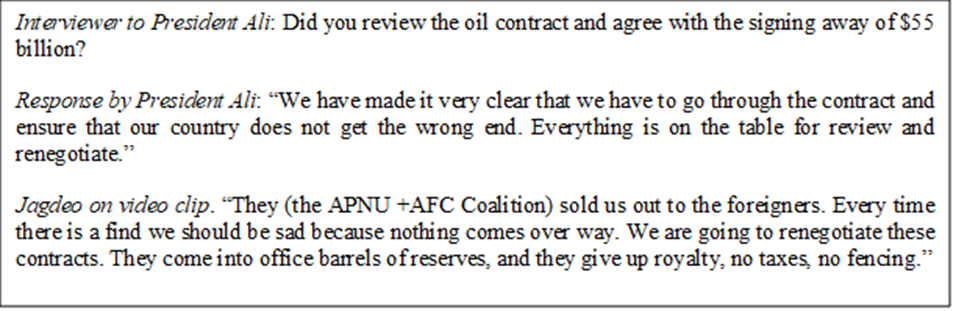
The theme of the activity was Sanctity of Contract  versus Sovereignty. Let me begin this presentation by showing two clips that are widely available on social media, one by President Irfaan Ali and the second by Vice President Bharrat Jagdeo.

Having come into Government, both Ali and Jagdeo have left those commitments behind, now repeating the mantra “Sanctity of Contract” . So, for today’s talk, I will look at sanctity and argue that this is not an absolute rule of law but rather is one that is subject to a number of exceptions, anyone of which could cause a contract to be set aside. As I hope to show, the 2016 Petroleum Agreement can be set aside under several of these exceptions.

In this first part of the adaptation, I invite you to look first at the excuse being used by the PPP/C.

Sanctity of Contract

The sanctity of contract is a legal principle which states that agreements, once freely made, should be honored and enforced. It means:

  1. Contracts are binding.
  2. Parties must fulfill their promises.
  3. Courts generally uphold valid contracts.

This principle is important, promoting trust and stability in business relationships. However, when called upon, the courts not only consider the exceptions such as fraud, duress, illegality and unconstitutionality, but may also balance “sanctity” with fairness and the public interest.

First and foremost, my view is that having exhausted an earlier 1999 Agreement between Esso and the Government, Exxon was NOT ENTITLED to a second Agreement. Section 10 of the Petroleum Exploration and Production Act of 1986 conceived of a single Agreement that is phased out after ten years, barring any production licences issued under the Agreement. In essence, section 10 grants the Minister the power to enter into an agreement not inconsistent with the Act with respect to any or all of four specified matters, namely, the granting of a licence, the conditions attaching thereto, the procedure to be followed in exercising any discretion granted to him under the Act and any matter incidental thereto.

Illegality

But this provision was turned on its head under a so-called Bridging Deed conceived by Houston Texas in which one of the recitals states as follows:

“Pursuant to section 10 of the Act, the Minister has entered into this Deed together with the Contractor Parties to set out the process whereby 1999 Licence and the 1999 Petroleum Agreement will be replaced by a new petroleum prospecting licence and petroleum agreement in respect of the Contract Area.”

It is ironic that the Exxon who is now hiding behind “Sanctity of Contract” described at the April 2016 meeting that “the current (1999) agreement with Esso was in several ways out-of-date with what prevails administratively in Guyana and that an approach to Esso in 2010/11 to deal with that was politely declined.” Exxon’s team added that their company was prepared to move to a new “current specimen format for their agreement,” prepared and ready for GGMC to review. Here for all to see is Exxon admitting that it wrote the 2012 Model Petroleum Agreement which was subsequently handed to then Natural Resources Minister and blessed by President Ramotar.

Of particular relevance too, is a report by Clyde & Co., an international law firm based in London, which discloses that Brooke Harris of Exxon was actively engaged in the drafting of the Cabinet Paper on the 2016 Agreement. To be clear, the illegality lies not in the Cabinet Paper but in the granting of a second Agreement and the infamous Bridging Deed. Drafting of the cabinet paper was a sovereignty issue.

Duress

In April 2016, a technical team from the Guyana Geology and Mines Commission visited Exxon in Houston to discuss technical matters relating to a first discovery of oil announced in May 2015. Exxon threatened the Guyana Team with withholding investment until they were granted a new contract. This is how the Head of the GGMC Team reported the threat.

“Esso then confronted with GGMC the matter of their Contract and Licence… For Esso to start spending, the replacement petroleum licence and agreement is needed, along with the undertaking that the Development Plan and permitting would be done in good time.”

Even the Minister whose signature appears on the 2016 Agreement had grave doubts about the Agreement, writing in a book published after he demitted office that he and his Legal Officer “harboured some discomfort about signing”, which he claims, “did not go down well with Exxon top brass”.

Fairness

On the question of fairness, here is how the 2016 Agreement has worked in terms of distribution of the number of millions of barrels of oil produced. Yes, the oil companies have a right to recover their costs but as the numbers below show, Guyana received 12 % of the total oil produced in the first four years of oil production. Twelve percent must rank as one of the lowest host Government take anywhere in the world. It seems that the 2016 Agreement effectively transferred Guyana’s patrimony and good fortune to Exxon, at the expense of its people.

Compiled by: Ram and McRae

Source of Information: Budget Speech

Next week’s column will discuss unconstitutionality as an element of sovereignty and ask which one the Government thinks ought to prevail.

Every Man, Woman and Child in Guyana Must Become Oil-Minded – Column 132 – June 28, 2024

Oil companies have earned five times more from oil than Guyana.

Modest investment, gargantuan returns

Last week’s column completed the review of the published financial statements of the three companies which signed the 2016 Agreement for the Stabroek Block. Table 1 is a summary of the Income Statements (Profit and Loss Accounts) of the three companies which operate as branches of external companies rather than as incorporated entities with their own share capital and directors. We were fortunate to have been able to access the balance sheet of the CNOOC intermediate parent showing that the Company has only US$200,000 in permanent capital invested in Guyana. But CNOOC, which has a 25% stake in the Block, is no outlier among the three.

That is a discredited narrative and myth. CNOOC is no outlier. Hess which owns a 30% interest, has permanent capital of US$50,000 or the equivalent of $10 Mn while ExxonMobil, the Operator and 45% holder, has permanent capital of US$500,000 and preferential capital of US$10 Mn. It is clear that those who have sought to justify the incredible, untouchable and sacrosanct tax concessions protected for forty years. Not only do they all operate in low or no tax jurisdictions, but the money that they themselves invest is negligible.

Back to the numbers

These are derived from the audited financial statements of the three companies for 2023. The total profit before the mythical tax for the three companies amounted to G$1,624,712 of which Exxon’s share is shown at 46%, Hess at G$526,236 Mn. or 32% and CNOOC of 21.8%. Readers can turn to Columns 129 to 131 for a review and commentary on the 2023 financial statements of each of the three oil companies, including both their income statement and balance sheet. I have commented in the past years about the lack of comparability of the financial statements and am amazed that the auditors appointed by the Government at considerable cost and amid big fanfare, never seem to have recognised this self-evident fact. But the leadership seems no less clueless.

Table 1.

Financing capital projects

I draw your attention to the line-item Depreciation, depletion and amortisation of $382,826 Mn. charged as an expense in the Income Statement, representing 53% of the total expenditure for the year. That is what is referred to as a non-cash expense and for the technically minded, that amount is a source of funds in the Cash Flow statement. But guess what? Guyana bears fifty percent of that cost, even as the funds are available to be used by the oil companies for further investment. Even after 25 years, Vice President Bharrat Jagdeo who was a key adviser to then President Janet Jagan when she signed the 1999 Agreement, does not seem to understand how that Agreement which has been “bridged” to the 2016 Agreement works. In fact, Mr. Jagdeo compounds that sad state of affairs by refusing to set any ringfencing conditions to any Production Licence. In that regard, he is in good company: Mr. Aubrey Norton, the Leader of the Opposition, is similarly in the dark.

What is clear too is that these companies have recovered their investments many times over while Guyana has to borrow billions to build roads and infrastructure, provide security, grant huge tax concessions, all because we love the foreign investors.

Taxation

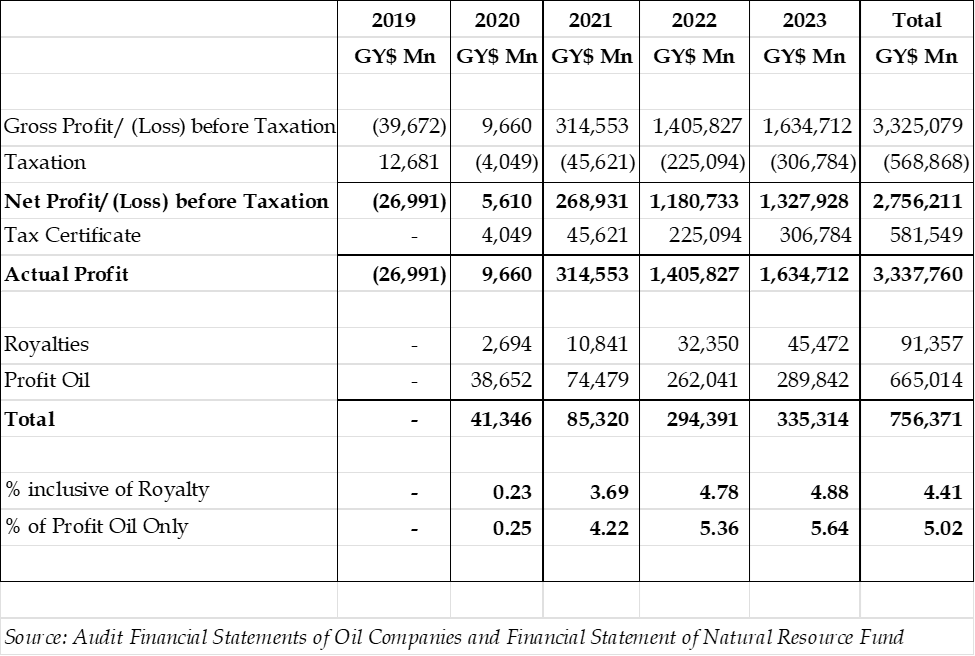
As the Table shows, Guyana will be paying out of our oil fund $306,784 Mn. as taxes for the trio, plus giving the oil companies tax receipts so that they can double-dip. Another grand idea from Mrs. Jagan and Mr. Jagdeo and taken up by David Granger and Raphael Trotman in 2016. We seem to have created our own oil curse!

Table 2: Five Year revenue compilation 2019 – 2023

Five to One is highway robbery 

The above Table shows how lopsided the 2016 Agreement in money terms is. Over the years since production began, the oil companies have walked away with the staggering sum of $3,337,760 Mn, inclusive of the tax certificate to which they are entitled. The taxes nominally payable by the oil companies, are paid by the government of Guyana but the receipt is written in the name of the respective oil company so that they can then present them to get tax credits in their own country. What a farce, what a fraud?

But that is only part of the story. The line Royalties represent the compensation to Guyana for the petroleum extracted and sold. Even the quarries, the sand pits, the loggers and the gold miners are envious of a 2% royalty when some of them pay as much as 8%! A 2% royalty is one of the lowest in the world, but the Government claims without any serious understanding of contract law, that there is sanctity. Mr. Nandlall would tell them that such a principle is not absolute and that there are several grounds for setting aside a contract. That will be the subject for another column.

So let me point out that the oil companies have earned five times more than the Government under a 50/50 profit share Agreement. It is clear that the oil companies are engaging in lopsided front-end loading to grab as much as possible, as fast as possible. While draining the natural resources of Guyana, they are squeezing every ounce of flesh and drop of blood from the body of Guyana. The government likes to boast that in 2027 and beyond we will be producing substantially more oil than we do now. That is indeed true but all the evidence from all the experts is that oil prices will begin to fall in another couple of years.

Conclusion

President Ali has disowned responsibility and instead of a professional, competent Petroleum Commission he has Is delegated responsibility for the sector to Mr. Jagdeo. To say that this is a grievous mistake is an understatement, and grievously are we paying for it.

Every Man, Woman and Child in Guyana Must Become Oil-Minded – Column 131 – June 21, 2024

STABROEK’S JUNIOR PARTNER CNOOC MAKES G$355.7 MN ON SHARE CAPITAL OF US200,000. YES, TWO HUNDRED THOUSAND US DOLLARS.       

Introduction

Today’s column features the financial statements of the Chinese-owned CNOOC which holds a 25% working interest in the Stabroek Block, as a “non-operated joint venture partner”. CNOOC, like its other two partners, is a branch of a company incorporated outside of Guyana and traces its parent to the People’s Republic of China.

The Income Statement

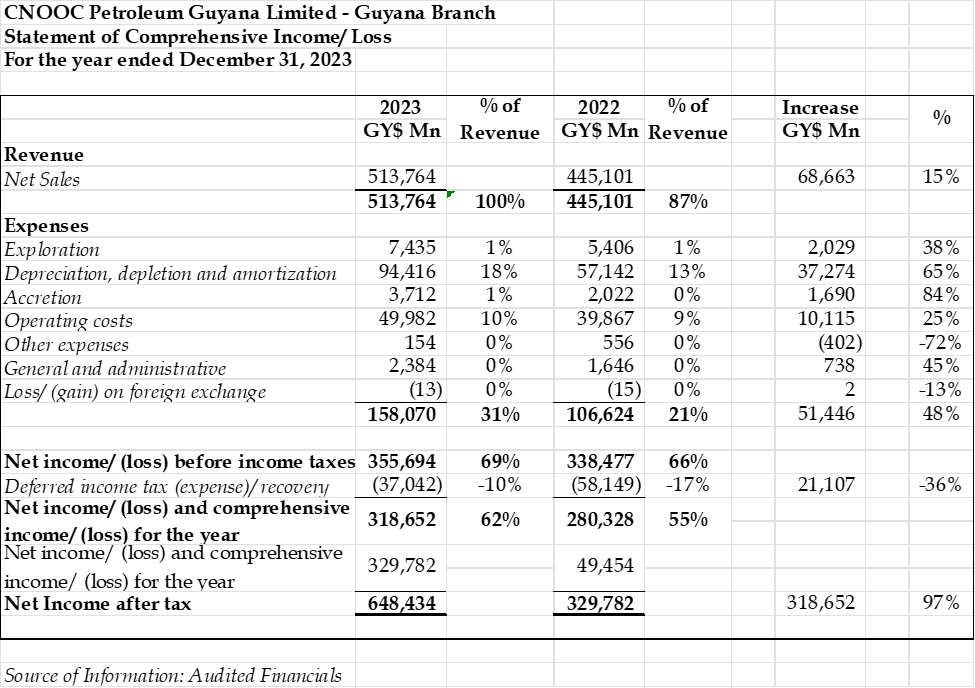
For the year 2023, the Branch reports net sales of $513 million, an increase of 15% over 2022, and net income before income taxes of $355,694 million, an increase of 5% over 2022.

Expenditure on exploration activities is shown at $7,435 million, an increase of 38% over 2022. Given the company’s status as a “non-operated joint venture partner,” it has to be assumed that that expenditure is merely a share of such expenditure of the entire project of which Exxon is the designated Operator. Operating costs of $49,982 million represent an increase of $10,115 million, or 25% more than 2022. Despite the significance of these amounts, there is no note or explanation of what these line items comprise. Depreciation, depletion and amortisation is reported as $94,416 million, an increase of $37,274 or 65%. This is a non-cash cost and represents 18% of revenue and 60% of total expenditure.

From the net income, there is a deduction of $37,042 million, described as Deferred income tax. Note 8 on Taxation explains that exploration and development costs are capitalised and written off over five years and that deferred tax asset as disclosed is in respect of tax losses, recognised only to the extent of future taxable profits. Of course, taxation for the three companies is a fiction since the Government pays the taxes for the companies. This is acknowledged by the same note and confirmed by the branch’s Cash Flow Statement which shows as an add-back the identical amount deducted in the income statement.

It does not appear that the branch transfers its net income for any year was transferred to the parent company. As a result, the after-tax profits are added to the opening net income of $329,782 million, bringing the total net income at the end of the year to $648,434 million, as shown in the Balance Sheet.

The Statement of Financial Position  (Balance Sheet).

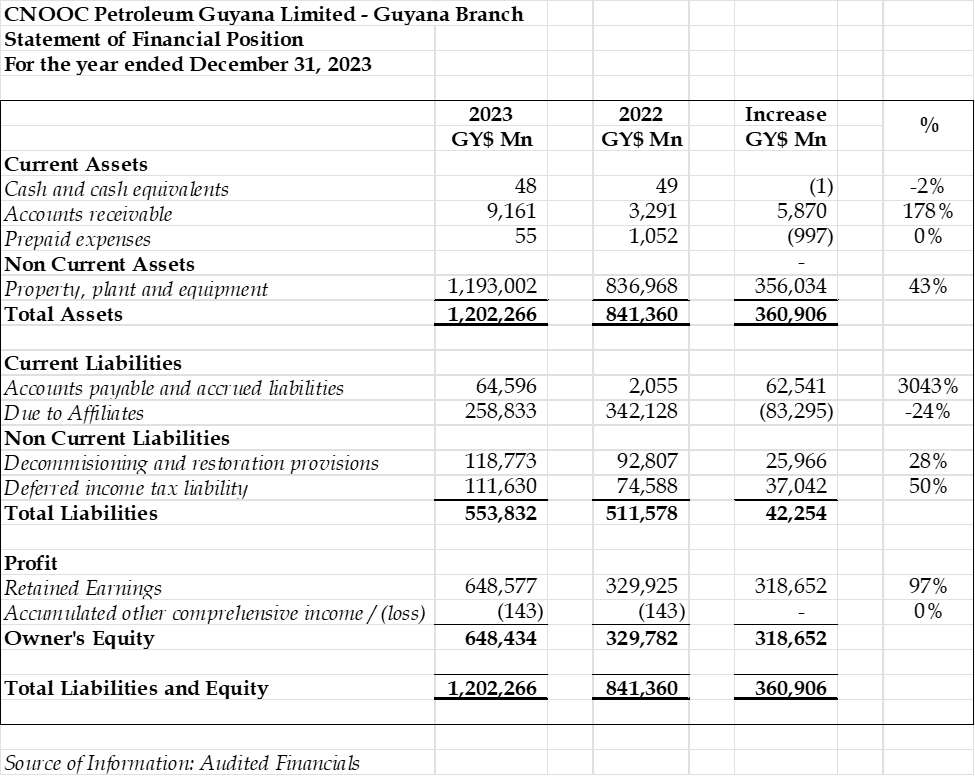
Turning to the Statement of Financial Position, total assets is made up mainly of Property, Plant and Equipment of $1,193,002 million, of which $1,176,600 million is invested in Development Assets, $204,022 million in Exploration and Evaluation Assets and $1,005 million is in Office Equipment and Others. Accumulated depreciation reduces the book value by $187,473 million, $771 million and $378 million, respectively. Accounts receivable reports a total of $9,161 million, an increase of $5,870 or 178%.

Current Liabilities mainly consist of Accounts payable and accrued liabilities of $64,596 million, an increase of $62,541million or 3043% over 2022.

Capital Expenditure in 2023 was $374,479 million, an increase of 42% over the amount expended in 2022. The provision for Decommissioning and restoration is shown at $118,773 million, an increase of $25,966 million which again is a strange item given that CNOOC self-describes as “non-operated joint venture partner”, since Guyana will have some legal barriers to holding a “non-operated joint venture partner” as a primary creditor for de-commissioning expenditure. As a practical matter, what if CNOOC pulls out of the venture before the end of the venture?

Unlike its two co-venturers, CNOOC maintains no inventory. It continues to sell its share of oil lifts to an affiliate in Singapore on a cargo-by-cargo basis. Despite this arrangement the company owes its related parties more than $258,000 million, the terms and conditions of which, including interest, are not stated. Unlike its co-venturers as well, the company’s financial statements do not disclose any royalty payment to the Government, which seems to violate the country’s Extractive Industry Transparency Initiative (EITI) obligations.

Conclusion

This columnist was able, by accident, to see the balance sheet of the company of which the Guyana operation is a branch. incredibly, that company has a share capital of US$200,000 or G$40,000,000. and for 2023 alone, it walks away with $355,694 million.  

The column has stated in the past – that most ordinary companies in Guyana produce financial statements that are more informative and reader-friendly that CNOOC’s.

Next week’s column will feature a compilation of the financial statements of the three companies and compare these with the takings of the Government, AND THE REAL STORY BEHIND CNOOC’S PAYMENT TO EXXON.

Every Man, Woman and Child in Guyana Must Become Oil-Minded – Column 130 – June 14, 2024

Exxon’s incredible (and unique) return on Equity

Introduction

This week’s column features the financial statements of the Guyana branch of ExxonMobil Guyana Limited, a 45% stakeholder, and the designated Operator, in the Stabroek Block. In what was a first for any company in Guyana, the financials, part of a wider report, were presented at a  media event hosted by the branch President Mr. Alistair Routledge. The very colourful cover pages mirror the annual report of the US parent, in appearance, content and excitement, except that the parent’s report flaunts metrics like earnings, shareholder distributions, return on average capital employed and annualised total shareholder returns. Perhaps with only mild exaggeration, the US parent report states that its work in Guyana continues to be among Exxon’s most exciting and successful – for its business, the people of Guyana, and the world. Exxon has brought prosperity to the world – truly a unique blessing.

In the case of the Guyana branch, it is about what the Deus ex Machine, our great white knight, has done for Guyana, including the 1,700 “unique” Guyanese companies which supply Exxon’s operations, the thousands of Guyanese individuals it employs, its contribution to the Natural Resource Fund, the monies invested in communities across Guyana, and the volume of business it brings Guyanese suppliers. Even when Exxon acknowledges the country’s natural resources, it takes the credit for the successful optimisation of those resources. To use its own words, “it is not that Exxon is merely extracting resources; [they] are expanding the potential of the nation.” Halleluiah!

Income statement

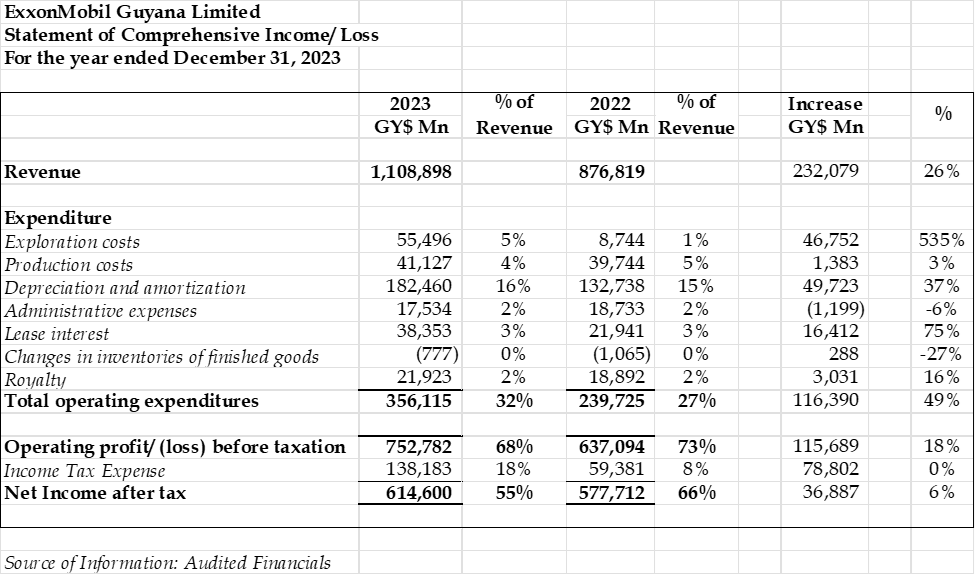
While its blurbs and Fast Facts confuse and mislead, no doubt deliberately so, the performance of the Guyana operations in 2023 is probably without industry equal. Revenue has moved from $876,819 Mn. to $1,108,898 Mn, an increase of 26% while its operating profit has moved from $637,094 Mn. to $750,782 Mn., an apparently more modest 18% increase. But that is largely due to the fact that this reckless government allows the Exxon and its co-venturers to use part of our share of profit to explore for new finds as the date for exploration comes to an end in 2027. It may sound harsh, but it is hard to think of anything more absurd and violative of Guyana’s interest.

Another astounding measure derived from the financials is the negligible production cost which in 2023 accounted for a mere 4% of revenue, down from 5% in 2022. In fact, the only cost which accounts for more that 10% of revenue is Depreciation and Amortisation, accounting for 16% of revenue. Lease interest, an accounting rather than an actual expenditure, is stated at $38,353 Mn., a 75% increase over 2022. This increase is due to a $206,777 Mn. addition to Drill Rigs.

The fake tax charge

After all actual and other expenses, the branch reports Operating Profit before tax of $752,782 Mn., an increase of $115,688 Mn., or 18.2% increase. The Income Statement which is summarised below shows a charge for taxation of $138,183 Mn. and it is only when one looks at Note 7 to the financial statements does one realise that the so-called tax expense is actually paid by the Government of Guyana – another unique feature of our oil arrangements. By now, we all know that there is no charge to the company, which not only walks away with the full amount of $752,782 Mn., but also with a receipt issued by the Guyana Revenue Authority which Exxon then uses to obtain a tax credit from the US Government. Without raising anything about exemption from withholding tax which is required to be paid by ordinary companies on distributions and interest, the actual money that Exxon walks away with is the $752,782 Mn. plus a tax receipt for $138,183 Mn., making a total of $890,965 Mn! In a single year.  

Balance Sheet

Total assets of the branch at the end of 2023 was $3,270,332 Mn., an increase of $997,678 Mn., or 43% over 2022. As is evident from the Summary Balance Sheet extracted from the branch’s audited financial statements, there were significant increases in Property, Plant and Equipment; Other Assets which had a 2,106% increase; Inventory of crude oil; and Deferred Receivable. The notes to the financial statements (found on chrisram.net) show that of the assets acquired, 35% were on lease but accounted for as additions, to meet accounting rules. It is worth noting that the item of asset with the most significant increase (Other Assets) is not supported by any explanatory note and is therefore uncertain. Like HESS, this branch also shows a significant closing inventory of crude oil, which is at least surprising, since their sales are more than likely within the Exxon family. Deferred Receivable increased by 252% but the only elucidation offered in the accompanying Notes is that the amount of $211,392 Mn. includes non-customer receivables. Interestingly, that includes the Tax Recoverable from the Government of Guyana – all part of an accounting myth.

Total liabilities of $1,071,770 Mn. represents a 37% increase over 2022 but here too, some of these arise out of accounting convention, such as Lease Liability and Income Tax payable which is totally misleading if not grossly incorrect. Accumulated Surplus at 31 December 2023 of $1,221,785 Mn. reflects an increase of $614,600 Mn. which is the amount of profit after (fictitious) taxation of $138,183 Mn.

Exxon’s contribution

By its own admission, and stripped of all its contrivances, the true value of the investment in the branch at 31 December 2023 is stated in the line item Equity Contributions as $976,392 Mn. The note explains that “Equity contribution relates to amounts paid into the Branch by its head office.” In other words, the return on average equity of $930,260 Mn. is a unique 96%! And we must not forget that the Branch’s Head Office was the architect of the fraudulent inflation of its pre-2015 costs and the diversion – in violation of the 2016 Agreement – of moneys received from Hess, CNOOC and Shell (twice), for their investment in the Stabroek Block.

Despite all these shocking revelations, disclosures and discoveries, our Oil Czar sees the 2016 Agreement as inviolable, sacred and untouchable. His only objection is that Exxon does not share the kudos for oil’s bonanza with him. Anyone who places the sanctity of a hugely questionable and lopsided contract above sovereignty is no better than the fool who signed the contract in the first place.

These results and the audited financial statements of Exxon and its two joint venture partners render as nonsense the proposition that Guyana and the oil companies are in a 50/50 partnership. This must surely be the petroleum equivalent of the Stockholm Syndrome.