
Looking back at Business Page – Part II

Introduction
Today as we celebrate Christmas, a day marked as much for its commercial opportunities as for its religious significance, Business Page concludes a look-back at some of the articles carried in these columns during 2011. Out of a pool of fifty, the selection was made based on what I consider to have been the ones which had continuing importance, as Guyana navigates the unchartered but exciting prospect of shared governance between the executive and the legislative branches of the state. Consequently, and with a slight departure from the first instalment begun last week, the number of articles has been reduced to allow for some greater depth of those addressed. Today, we look at Robert Persaud’s challenge and pusallinimity with respect to GuySuCo, the continuing failure by the opposition-chaired Public Accounts Committee to put teeth into the audit of the government’s accounts, the continuing abuse of the Contingencies Fund by Minister of Finance Dr Ashni Singh, the Amaila road and hydro-electricity project, NICIL, Clico and the Berbice Bridge Company Inc. With that introduction and Business Page’s wish to all Guyanese and readers for a peaceful but joyous Christmas, here is the selection.

Calling Robert Persaud’s bluff – Forensic Audit of GuySuCo
“In a letter in the Stabroek News of May 18, 2011 I … note[d too], that Agriculture Minister Mr Robert Persaud had challenged Kaieteur News and me “to conduct a forensic audit of GuySuCo and the Packaging Plant.” Responding to that challenge I wrote, “I hereby accept this challenge to undertake a professional audit, the cost of which will be borne by Kaieteur News.

“I hope this is not just bluff on Mr Persaud’s part and that he has both the authority and the courage to carry through with his challenge. I now await word from him.”

As the public is aware Mr. Persaud quietly resiled from that position, using the Audit Office as the excuse.

The ‘blasting’ Public Accounts Committee – May 22, 2011
“Unlike legislation which the National Assembly makes, requiring the specific qualification, experience and competence, appointees to boards, commissions and committees must possess, there is no specific requirement for eligibility to membership of the Public Accounts Committee. The PAC has no secretariat and must rely on the Auditor General Deodat Sharma and the Finance Secretary Nirmal Reekha as resource persons.

“One wag once said that an expenditure of $200 usual attracts more attention than a $200 million transaction, simply because that is how the ordinary mind works. That seems to hold very true for our PAC, and only a couple of days ago Ms Bibi Shaddick was blasting one region over vehicle log books while Ms Chandarpal was raising questions about some mystery “Economic Fund” and raising questions about advances of “amounts such as $400, $600 and $1,000,” while Chairperson Volda Lawrence was questioning an advance of $60,000. That is like auditing the petty cash and ignoring the bank accounts.”

Amaila: ‘Deals within a deal – Sunday, May 15, 2011
“President Jagdeo not too long ago had announced that the final cost for the hydro will be US$306 million, the transmission line US$145 million through a public tender and US$150 million is there for contingency and interest cost.” That leaves US$75 million of the US$675 million to be accounted for.” (SN Ed Note: We are now told that the cost is US$850 million. The government has so far not explained this escalation.)

Annual Reports of the NIS 2008 and 2009 – Sunday, May 8, 2011
“As the NIS enters its forty-second year … there is one egregious matter which I think deserves the widest exposure and that is risk to the Scheme of losing $5.8 billion invested by the NIS in the failed CLICO Life and General Insurance Co (SA) Limited. At December 31, 2009 the NIS had invested in CLICO’s so-called annuities the sum of $5.748 billion, in addition to $90 million of income earned but not yet received from CLICO. The reality is that because of this reckless and possibly unlawful investment by the board in a Jagdeo-favoured company, 20% or $1 of every $5 of the accumulated fund of workers’ contributions in NIS is now at grave risk, earning nothing in income.”

The biggest budget ever – and more! – Sunday, June 19, 2011
“The contingencies fund continues to be used and abused in the most unlawful manner with practically no regard being paid to basic principles of financial management. It is not without some irony that it is the serial violators of the precepts of proper financial management and controls who continue to be provided with increasing sums of money to be spent without regard for the interest of the country’s taxpayers. While the Report of the Auditor General often makes adverse comments on the use of the Fund, it never deals with some of the most troubling questions that the public would wish to see answered. Hopefully the Public Accounts Committee will at some time insist that these be addressed.”

The Clico fallout: Contrasting the action in Trinidad and Tobago with the silence in Guyana

“So far we have heard nothing but a deafening silence from the new insurance regulator the Bank of Guyana whose Governor has, probably dangerously, been appointed the company’s liquidator. I say dangerously because it is not unusual for legal actions to be brought against a liquidator and the person most likely to do so would be the regulator. That is not going to happen even as the liquidation has in essence been contracted out! Indeed my understanding is that CLICO’s former CEO Ms Gita Singh-Knight is still playing a paid role in the liquidation. We are truly an incredible country.

“We should long ago have started an enquiry into CLICO for possible criminal conduct and the Bank of Guyana should, like their counterparts in Trinidad and Tobago, have begun civil action against them and their Trinidadian masters. This would have been an excellent opportunity to expand on our jurisprudence while penalizing those who break our laws and cause our people and country huge losses.”

NICIL – Sunday, July 24, 2011
“NICIL, whose directors are mainly ministers of the government, continues to receive public monies and to spend it however it pleases. It infamously played the role of handmaiden to President Jagdeo and his cabinet in the unlawful tax concessions to Queen’s Atlantic Investment Inc and has failed to provide properly audited financial statements for its expenditure of hundreds of millions of dollars of GGMC funds to build hinterland roads. It is at the heart of the proposed Marriot Hotel deal and indeed has been busy shopping around for any partner, which would give the project legitimacy. No one knows where the funds will come from.”

Elections year mid-year report – September 18, 2011
“I also draw attention and comparisons with the half-year report of the Bank of Guyana which while using the same data used by the Minister of Finance, is less inclined than the Minister to put a political spin on the numbers. Readers may find it of some interest that in this election year and with so much at stake, it is the first year since the Fiscal Management and Accountability Act was brought into force in 2004 that the mid-year report has been presented within the two-month deadline, hence the title of this column. Guyanese who have become quite cynical may not have been too surprised, given that the same treatment was accorded the Guyana Prize for Literature which was held this year after last being held around the time of the 2006 elections.”

The Jagdeo Initiative – what is that? Sunday, October 23, 2011
“As President Jagdeo prepares to demit office in another few weeks there is a single issue with which his name will always be associated in Caricom. And that is the common regional agricultural repositioning strategy that has been given the name Jagdeo Initiative. That it will remain only an initiative without any success is evident by Jagdeo’s failure to carry through his initiative even in his own country. Quite what is the Jagdeo Initiative and how did it arise?

“The silent and dormant agro-processing/packaging plants at Parika and Sophia testify to Guyana’s failure to address its mounting food bill and exploit its huge potential in agricultural products. There must be a sense of both relief and sadness among Guyanese that other Caribbean countries long ago realised that under Jagdeo the region’s agricultural initiative was going nowhere.”

Berbice Bridge Company Inc – Not really a profit – Sunday, October 16, 2011
“Had it not been for some admirable creative financing and accounting the Berbice Bridge Company would not only have recorded continuing and significant losses but it would have been unable to meet the generous interest and dividend obligations to its investors.

“Despite substantial subsidies, the bridge is uneconomic for the body of investors as a whole, and most especially the government in the form of exempted taxes running into further hundreds of millions of dollars and in waivers of Preference Shares Dividends. The high cost necessitates an unbearable burden on the users of the bridge in the form of tolls.

“Even at, or because of the high tolls, the company will continue to have significant shortfalls to cover annual expenditure and current and future debt obligations. In the medium to long term the company would only be able to repay loans by further borrowings and would be insolvent, i.e. unable to pay its debts at the time of its contractual handover.”

Ever since October 16, when in the Business Page column I reviewed the Bridge Company’s annual return and the 2010 financial statements, I have been studying how the second issue – the high tolls – can be addressed. I am more than ever convinced that the legal structure, nature of ownership and the financing model are the cause of the high tolls.

Conclusion
The Jagdeo-Ashni Singh combination was largely responsible for the mess inherent in the issues raised by these transactions. I am hopeful that despite the re-appointment of Dr Singh by the new President, that good sense, better judgment and best practice will prevail, both on the initiative of the President and the determination of the opposition-controlled National Assembly.

The National Assembly has a duty to right the wrongs of the Jagdeo era. I think it is also committed to doing so.
Looking back at Business Page

Introduction
This, my closing column for what was a truly eventful, indeed historic year is not about introversion or narcissism but one that was forced by reality. I had really intended to review the annual report of the Demerara Bank Limited which will be holding its annual general meeting tomorrow. I could not anticipate that a public company would refuse to make available a copy of its annual report to be reviewed in the media. In fact, the bank indicated that it would not provide a copy of its annual report until after the general meeting. So much for transparency and good governance in twenty-first century Guyana.

I could have written about the economics and morality of that new buzzword ‘boycott’ which has been around for millennia. In the late eighteenth century the Society for the Abolition of the Slave Trade organised a highly successful boycott of sugar produced by the enslaved in an attempt to end the slave trade in the British colonies. In India’s struggle for independence, Gandhi called on Indians to boycott British-made products. And in the struggle for freedom in southern Africa, much of the non-aligned world participated in the boycott of South Africa in the days of white supremacist apartheid. As a student in the UK in the early seventies I responded to a call by the National Union of Students by closing my account with Barclays Bank which was funding the Kabora Bassa Dam.

Reflections
Boycotts of course can be misapplied as when they are used by the state to discriminate against someone they wish to punish or when citizens use them to pursue a racist agenda. The American embargo of everything Cuban must surely be considered immoral and hardly successful. Yet it has gone on for fifty years. But I have digressed too far.

I thought it might be useful to reflect on some of the columns published in these pages in 2011. One thing I noted and will address in 2012 is the emphasis in 2011 on public sector finance and economics rather than business proper. That it was an election year might have been a subconscious factor. That Ram & McRae had begun an award for the best annual report might be another. Hopefully 2012 will not be another election year – unless it is local government elections – and our public companies need to have the message they send out, their pronouncements and predictions, analysed and discussed.

The selection of 2011 Business Page extracts this week and next is largely random. They are not necessarily my favourites, nor of the greatest importance, seriousness or depth. Even continuing relevance may not apply in each case, but here goes starting with January and ending in April.

2010 corporate performance and reports (January 16)
“2010 had turned out as a bumper year for some of Guyana’s leading businesses. With several public companies having a September 30 year end, the results are welcome for the shareholders of Banks DIH Limited and its banking subsidiary Citizens Bank Guyana Limited; the DDL associated banking business Demerara Bank Limited and Republic Bank Guyana Limited.

“The annual reports [of public companies] have one limitation running through them. None of them even mentions the movement in their company’s share prices as reported by the local Stock Exchange. This is clearly wrong since people buy shares not only for dividends but also for capital appreciation as reflected in the price for shares.”

Mr Nadir on state entities’ audit and contract employees (January 24)
“Stating that I used a broadside to describe the state of audits of public entities, he dared me to name any of those entities. Does he need any more than NICIL, the entity of which the Finance Minister is Chairman and through which state assets are diverted for unlawful purposes, and which disdainfully refuses to have an audit or to file an annual return? Just in case he needs more, here we go: Go-Invest, Guyana Energy Agency, Institute of Applied Science and Technology, Integrity Commission, GINA. Need some more? What about National Sports Commission, Guyana National Bureau of Standards, Environmental Protection Agency, etc.”

Justiciability of Article 13 of the Constitution (January 27)
“On the question of the justiciability of what is now Article 13 of the Guyana constitution as well as enshrined in the fundamental rights article (149c), the then Chancellor said: ‘[The question] is therefore in Guyana at large for debate and decision. Now that it has arisen, the court cannot retreat into a state of intellectual agoraphobia, refusing to venture forth and to express an opinion one way or another.’ Responding to the question the Chancellor said: ‘I see no reason to think that the articles in Chapter II of the Constitution have no juridical relevance and are merely idealistic references with cosmetic value only. So to think would be to seek to debase the Constitution.’”

Driving tax policy (January 30)
‘Tax policy has to be driven by a vision and relevant information. This column has called for more relevant information to be disclosed in public documents. Principal among these would be the annual report of the Guyana Revenue Authority which the Minister of Finance has failed to table in the National Assembly for some time now. Let us see how much the construction sector, the bauxite sector, the forestry sector, the agriculture sector including rice, sugar and other crops sectors contribute to the national coffers, and how much remissions, rebates and holidays they receive which may amount to billions each year. And yes, we should be able to see how much each region contributes and compare this with their receipts from the central government.”

The Guyana Stock Exchange (February 16)
“We have not heard much from or about it recently. Passing its offices at High and Robb Streets it is hard to believe that this is the institution that was set up with much hype, expectation and hope that it will make access to capital easier and cheaper, widen shareholder ownership and raise the bar of corporate governance. The Guyana Stock Exchange, or to use its more formal name, the Guyana Association of Securities Companies and Intermediaries Inc, was incorporated on June 4, 2001 after several studies with the principal aim of encouraging companies to “go public,” a term generally used to mean companies offering their shares to the public. To encourage such companies the government offered them favourable tax treatment including waiver of duties payable on the transfer of shares in quoted companies and exemption from Capital Gains Tax on gains made on the disposal of shares in public companies.

“As the stock exchange enters its eighth year of operation, policy holders may wish to look at the steps taken by Jamaica, where its exchange too had slowed almost to a crawl. Jamaica’s answer was the creation of a Junior Stock Exchange that within a couple of years has seen eight companies entering the market with another ten lined up for listing in 2011.”

Dr Ashni Singh’s tongue (March 20)
“The World Bank office came in for a scathing attack from Dr Singh who accused the bank’s staff here of having ‘one of the largest appetites for publicity and self-promotion’ and seeking to increase their ‘creature comforts’ by relocating to ‘a grand former colonial residence opposite one of the city’s most fashionable cafés.’ [Ed’s note: I understand that the café now uses this abuse in its not so subtle self-promotion.] Coming in for his tongue-lashing was the Economic Intelligence Unit which had dared to question the final outturn for 2009 after the economy had performed poorly in the first three quarters. It was a case of how dare they question him.”

GBTI’s prediction and incredible run (March 27)
“Chairman Mr Robin Stoby in the 2010 annual report of the Guyana Bank for Trade and Industry exulted that the bank’s future was as ‘luminous in the vein as our head office’ and the predicted the Bank becoming ‘the leading bank, not only in Guyana but also further afield.’

“While there may be some over-enthusiasm in the Chairman’s predictions, they are understandable with net income before taxes increasing by 17.8% in 2010, 25.8% in 2009, 14.8% in 2008 and 23.9% in 2007, making for a cumulative increase since 2006 of 110.6%. Because of the tax effect, after-tax profits have increased cumulatively over the same period by 138.1%.”

Annual General Meetings generate interest (April 24)
“As the season for general meetings moves into high gear, members, or as some companies call them, shareholders, have been showing some interest in these meetings, although not always for what might be considered the right reasons. One complainant in a letter appearing in the press this week went so far as to make the charge of meanness against the directors and management of one of those companies. For good measure the writer reported that there was a ‘deep groundswell of resentment against the directors and management.’ One individual who takes a healthy interest in such meetings and is one of the younger breed of investors wrote me on a number of issues all of which he suggested indicate that the directors and management are generally insensitive to the convenience of their members, including the calling of meetings when most persons would be at work, the meetings of more than one company being held on the same day, and no facilities for the aged and infirm. The shareholder was so incensed that he suggested that despite the expense of putting out glossy annual reports, company management really do not want shareholders to attend, speculating that there must be ‘something to hide.’”

Vaitarna and 1.82 million acres of forest (April 28)
“When Agriculture Minister Mr Robert Persaud held his press conference on April 12, 2011 to defend the permit/agreement over 1.82 million acres granted to the Indian company Vaitarna Holdings Private Inc, there had been very few letters and questions about the manner in which the two parcels of the land had been allocated to the company owned by Mr Siddhartha, the coffee magnate of India. Mr Persaud’s accusation of a ‘misinformation’ and ‘sleazeball’ campaign seemed therefore both inappropriate and disproportionate particularly since Mr James Singh, Commissioner of Forests had spoken two days earlier on the matter.

“With regard to the actual sums collected, both the US$254,000 and the $600 million should have been paid into the GFC from which, subject to the Act, surpluses could be paid into the Consolidated Fund. Both Mr Singh and the Minister confirmed that the lesser amount was paid to the GFC but were ambivalent with respect to the $600 million. From a review of the Commission’s records it appears that the $600 million was paid straight into the CLICO fund, in a liquidation process that defies many laws but which the public is silent about for reasons of convenience.”

Ashni Singh criticizes Transparency International methodology

Introduction
December 9 was an important day for Guyana. For the first time since 2003 when the United Nations designated the day as International Anti-Corruption Day to raise awareness about corruption as an international and domestic agenda issue, the day was marked with a public activity – a seminar – in which the Government of Guyana took part. While President Ramotar could not be present his administration was represented by re-appointed Finance Minister Dr Ashni Singh who made a full-length presentation on behalf of the government, and Ms Gail Teixeira.

The event was sponsored and hosted by Transparency Institute Guyana Inc and its directors succeeded in having Ms Zoe Reiter, a senior programme officer of Transparency International come especially for the occasion to make a presentation. Ms Reiter used the occasion to launch formally the Transparency International’s 2011 Corruption Perception Index (CPI). She did not bring good news.

Guyana falls
The CPI ranks countries according to their perceived levels of public-sector corruption using a simple form of indexing to arrive at a score ranging between 0, perceived to be the most corrupt, and 10, perceived to be the least corrupt. The 2011 index draws on different assessments and business opinion surveys that are carried out by independent, reputable institutions. The surveys and assessments that are used to compile the index include questions which relate to the bribery of public officials, kickbacks in public procurement, embezzlement of public funds, and questions that probe the strength and effectiveness of public sector anti-corruption efforts.

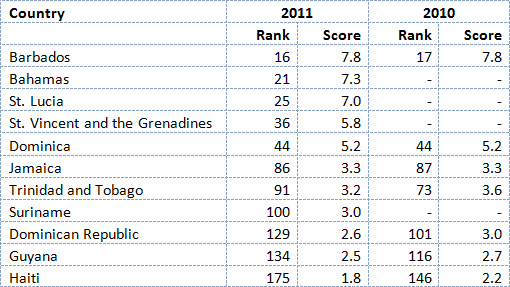
Guyana was first included in the CPI in 2005 and in 2010 was ranked at number 116. It plummeted to 134 this year. By comparison our Caribbean neighbours were ranked as follows:

Three of the Caribbean countries are included for the first time: the Bahamas, St Lucia, St Vincent and the Grenadines, and Suriname.

Not wealth nor size but systems
Wealth seems no easy antidote to corruption; some relatively rich countries, including Russia, fall at the bottom of the global league table. Meanwhile, some of the world’s poorer states do comparatively well: Botswana, Bhutan, Cape Verde, and Rwanda all appear among the 50 “cleanest” countries.

Nor is size a major issue either. Many of the smaller island states are in the top half of the corruption ladder while many larger countries are in the bottom half. What seems clear is that those countries with strong systems, independent institutions, modern laws and effective enforcement are likely to be at the head of the line.

New Zealand, a country that has shown a willingness to help Guyana develop systems for better parliamentary governance, occupies the top spot with a score of 9.5 followed by Finland and Denmark. The countries that occupy the bottom ranks in the index are Somalia, North Korea, Myanmar and Afghanistan, which are helmed by unstable governments and conflicts.

Jagdeo’s basket
In terms of corruption, the final year of the Jagdeo administration was not a good one for Guyana or for the PPP/C government. It was dominated by scandals surrounding persons high up in the administration being associated with deals involving state lands, containers, and shady characters. We saw too, the continued inability of the government to bring into operation the Public Procurement Commission, a failure that allows Cabinet to have the final word in contract awards. And it was too the year in which the excesses of the Former Presidents (Other Benefits and Facilities) Act were put under a harsh spotlight and the misuse of state resources for partisan purposes assumed new heights.

It is difficult to tell whether those revelations had any impact on Guyana’s decline but the news confronted Mr Jagdeo’s successor President Donald Ramotar, with both an obligation and an opportunity to establish the first marker on his administration’s attitude to corruption. As stated above, Mr Ramotar delegated that role to his Finance Minister and the abrasive Ms Teixeira. If it was intended to be a clear signal for change, Dr Singh failed both in substance and in style, alienating many if not the entire audience. It is unlikely that if Dr Singh appreciated the significance of November 28, 2011 or the concerns sweeping the world about corruption, from India to the EU countries, Brazil and Russia, that he would have been so hubristic in his reaction to responses and questions from the floor.

Missing the message
Dr Singh might have missed too that Transparency International (TI) chair Huguette Labelle recently pointed out that, “This year we have seen corruption on protestors‘ banners be they rich or poor. Whether in a Europe hit by debt crisis or an Arab world starting a new political era, leaders must heed the demands for better government.”

One wonders how someone as bright as Dr Singh could fail to understand that to continue doing exactly as he did under the Jagdeo administration was neither an option nor wise.

In what was programmed for a 15 minute presentation, Dr Ashni Singh spent no less than forty minutes in a criticism of the methodology used by Transparency International in constructing the CPI and in telling the overseas guest and the diplomatic community about the unrecognized and unacknowledged efforts by the PPP/C administration to deal with corruption. It was all about the significant changes to the constitution during the Jagdeo presidency, the many select committees of the National Assembly, the best Procurement Act in the world and the tremendous strides made in the Audit Office.

Dr Singh seems to have ignored the logic that if the methodology is weak for one it is no different for the others, and that whatever he may think of the CPI it is closely watched by investors, economists, and civil society campaigners and the international financial institutions. He might have noted too the direct comments from the head of the European Union that the EU as a major donor to Guyana is paying close attention to how concerns about corruption are addressed.

The future, not the past
From the floor I pointed out to the Minister that three months ago Ms Gail Teixeira had regaled a TIGI launch ceremony with the same information but only in a slightly more abrasive manner. For the majority in the audience, those acheivements were about the past while their interest was in the future. In other words, the current interest is whether the Ramotar administration would treat with corruption any differently. For Dr Singh – and I guess he intends for all of us – the future would be a continuation of the work-in-progress.

Perhaps Dr Singh’s most ironic and astounding claim was the enhancements in the Audit Office and the number of staff they now have. It was a case of ‘never mind the quality, feel the width.” I could not publicly and in that forum remind the Minister of the lack of appropriate qualification of the holder of the top post in that office, the unprecedented lack of independence of the holder of the second most top post and the fact that both were acting in their positions!

Maybe he should speak with Greg Christie, Contractor General of Jamaica which scored 3.3 out of 10. Mr Christie called on Jamaicans to demand major changes or face stagnation and in language that resonated in the southern-most Caricom state, Mr Christie said, “It should now be abundantly clear to all Jamaicans that unless they demand monumental changes in the country’s existing moral, ethical and legal anti-corruption codes, and in its approach to the co-joint issues of transparency, accountability and good governance in the administration of the affairs of the Jamaican state, 10 years from now we will still be at the same place, talking about the same things.”

So what can we do? Here are some obvious steps:

1. re-constitute the Integrity Commission;

2. constitute the Public Procurement Commission;

3. revamp the Audit Office, replace the head and deputy head, remove the Office from the financial controls of the Minister of Finance and modify the processes and procedures by which it conducts its audits;

4. strengthen the Public Accounts Committee of the National Assembly, widen its mandate and ensure that it is properly resourced and has access to independent professionals;

5. repeal and replace the Access to Information Act with one that brings in sunlight and that provides for protection for whistleblowers;

6. introduce anti-corruption legislation;

7. replace the expired Commissioner of Police and set up a strong anti-corruption unit in the Guyana Police Force;

8. punish in the court without fear or favour showing no mercy, those who feel it is their right to steal from society.

Bisram got it wrong

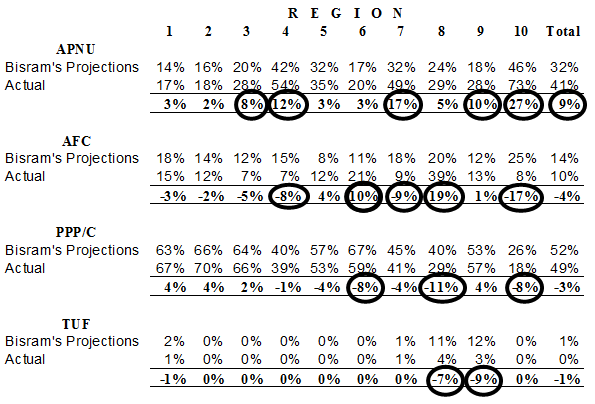
Now that some of the elections’ debris seems to be settling, I thought it might be a good time to review Vishnu Bisram’s pre-elections poll findings and compare these with how the electorate actually voted on November 28. In the following Table, I set out the share of the votes by region, as well as and the overall share of the votes which according to Mr Bisram would be in favour of the four parties contesting the elections. The table then compares these with the actual voting as reported by Gecom and highlights the significant differences.

Despite having a margin of error of 6% – high by any polling standard – Mr Bisram got it wrong in seven (3,4,6,7,8,9 and 10) of the ten regions. For good measure, his poll also had the overall result for the APNU off target by 9 percentage points. That is an error rate of 70%! As readers would note from the table, these are by no means small percentages and in six of the seven regions where he was wrong by more than the margin of error, the difference in percentage points was in the double digits. Indeed in those cases, the error ranged from 10% to 27% percentage points.

These huge margins are rare for any credible pollster and may vindicate those who have criticised NACTA and Mr Bisram for less than professional, objective and impartial polling. His last pre-election poll carried only in the Guyana Chronicle not only caused Mr Bisram’s reputation considerable if irreparable damage but quite possibly adversely affected the PPP/C’s electoral success as well. One day before the elections, the Guyana Chronicle converted his poll and its margin of error into a “landslide” for the PPP/C with APNU and the AFC trailing.

Maybe Mr Bisram should take some time out to review his methodology and in future offer to Guyanese polls that are more reliable, objective and useful.

Finally, while Mr Bisram got it wrong, the voters got it right. They have shown that no one party has a lock on the electorate and for the first time have given the country shared governance between two major arms of the state. I am more than just hopeful that our politicians will rise to the occasion and we will have balanced growth and development over the next five years.

NIS buys Clico building for $600 million

Introduction
At a time when the National Insurance Scheme is experiencing the results of more than two decades of bad governance it has just dished out some $600 million to buy the CLICO building on Camp Street. That building was the single most valuable asset of the failed giant insurance company which was placed first under judicial management and later ordered by Chief Justice (ag) Ian Chang after he found that information available to him in 2010 pointed “unerringly” in the direction of its insolvency. The Chief Justice appointed Bank of Guyana Governor Mr Lawrence Williams as liquidator of the company but in keeping with the law Mr Williams was appointed in his personal capacity.

The acquisition is an interesting transaction. On the one hand the building is one of the largest buildings in Georgetown and the transaction is the single largest real estate transaction ever entered into by the Scheme. Yet but not surprisingly, the board of the NIS headed by Dr Roger Luncheon has not made any statement on the matter. With one old but historic church site sold in Regent Street for $500 million dollars the NIS might have thought it was getting a fancy building at a steal.

Shortly after the danger signs appeared in February 2009, a report on the net assets of the company showed the building as CLICO’s single most valuable asset. According to the report done by a local accountancy firm the building had a going concern value of $1.5 billion and a liquidation value on a best case scenario of $1.112 billion and under a worst case, $750 million. So $600 million must be a good price for any buyer.

Bigger building
Hopefully the Liquidator can explain this and whether he sought out the widest possible prospects to ensure that he obtained the best possible price as his fiduciary obligations would require. The price at which the Liquidator sold the property ought to be of some concern to the creditors of CLICO since it is out of the pool of proceeds that they are paid. Fortunately for the Liquidator and despite several possible causes, no challenge has been raised in relation to the liquidation of CLICO.

The building which dominates Camp Street seems to have been built without any serious consideration for cost, and indications are that it would be extremely expensive to maintain. Perhaps in making the acquisition decision the directors might have felt that the existing head office built decades ago is no longer adequate to house the staff and records and cater for the persons who visit there daily.

Or perhaps it wants to consolidate its Georgetown operations which are now housed in three locations, hopefully leading to greater efficiency and economy. In that case, our pensioners and persons attending the NIS office for medical and other reasons will have to accustom themselves to use elevators!

Bigger issue
If the NIS moves offices it will then have to consider what it would do with the existing buildings and whether there is a market for them. If that turns out not to be the case, the NIS would regret its $600 million dollar decision in addition to other costly decisions and transactions it has had with CLICO. For example, as at December 31, 2009 the NIS had more than $5.8 billion invested in CLICO which it seemed most unlikely to recover, not withstanding the bravado of Mr Jagdeo that the “NIS would not lose a cent.”

And in his own peculiar style Dr Luncheon had assured the auditors during the course of the 2009 audit that “the Board of the National Insurance Scheme wishes to advise that it has noted the undertakings made by the President concerning the recovery of NIS investments in CLICO.

The Board is also mindful of the unanimous Parliamentary Resolution guaranteeing state support for recovery by NIS of its investments in CLICO. As such, the Board has the utmost confidence that the undertaking would be honoured and the investments of NIS in CLICO will be recovered.”

With recent parliamentary developments I do not think the matter will be that simple. The end of the Jagdeo presidency allows for all the questions that have gone unanswered for nearly two years to be answered fully and truthfully. It would be sad indeed that the NIS should be one of the first casualties of the newly configured National Assembly.

Clearly, Jagdeo’s undertaking is not worth a cent and the opposition controlled Assembly will no doubt demand a quid pro quo: an investigation into the collapse of CLICO including the unlawful transfer of money abroad, the relationship between Jagdeo and CLICO and its CEO and whether there was impropriety in the use of $1.5 billion the company received from the New Building Society to which it sold the bulk of its investments in the Berbice Bridge Company bonds.

More of CLICO and the NIS
Now let us return briefly to the liquidation. CLICO’s principal asset is now well and truly sold for $150 million less than the worst case fire-sale price. So that those larger investors who were hoping to get some more out of CLICO might just have experienced that sinking sensation which we have all felt at some time. Their situation is at least $150 million worse but even that to the NIS as a creditor of CLICO is chicken feed.

For several years, the NIS has been engaged in some quite interlocking, if not incestuous relationships with CLICO. It had lent CLICO and Hand-in-Hand Insurance Company tons of money at modest interest rates which they then invested in the Berbice Bridge Company at quite attractive rates of interest. Indeed CLICO was such a big investor that its CEO and Director Ms Gita Singh-Knight was hand-picked as the Chairperson of the Berbice Bridge Company Inc.

But there may be a bit of good news. As at the date of the net assets report referred to above CLICO is shown as an investor in the Bridge Company to the tune of $605 million made up of $400 million in Subordinated Loan Stock, unpaid interest of $89 million and short-term loans of $116 million.

There is no indication whether Mr Williams the Liquidator has sought to liquidate those funds or call in the unpaid interest. If not that is a good small piece and some consolation.

Conclusion
Finally, I saw a newspaper article refer to the payment of the building to be by way of a set-off. In my view this is not permissible under the law but then the liquidation of CLICO has had improper interference from then President Bharrat Jagdeo which was hardly consistent with the law.

The reason for set-off not being available is that it would amount to a preference to the detriment of the 39 policyholders who at the date of cessation of business had balances in excess of $30 million but who were paid up to a maximum of $30 million only.

I am sympathetic to the new members of the National Assembly whose task is almost as huge as the cleaning of the Augean stables.