Archive for January, 2012

If Mitt Romney was in Guyana, his 13.9% tax rate would have been lower

Sunday, January 29th, 2012

Introduction
If Governor Mitt Romney, a leading candidate for the Republican nomination in the US 2012 presidential elections thought that he would neutralise the attacks by his fellow candidates by publicising his 2010 tax returns, he was wrong.

In fact, the revelation that his effective tax rate – the percentage which the tax he pays bears to his total income – is a mere 13.9%, has served to internationalise a debate on what is a fair tax.

Fairness has been regarded as an indispensable ingredient of a proper tax system even before Adam Smith wrote it in stone as one of the canons of taxation.

It is now a hot topic and is the subject of three columns in last week’s Economist. It also made the editorial of the Stabroek News on January 26. The Trinidad and Tobago government too has announced another tax reform project, following a similar announcement by President Donald Ramotar. Let us return to Mr Romney for a moment.

Poor man
The poor man is worth a mere US$ quarter billion, and together with his wife paid about $3 million in federal income taxes on income of $21.7 million in 2010. His effective tax rate of 13.9 per cent is less than half the 35 per cent top rate of federal income tax applied to any annual income over $379,150 for most top earners.

It is no consolation to the fairer tax movement that the effective rate the Romneys will pay in 2011 is 15%.

Because so much of Mr Romney’s income comes from capital gains, dividends and interest on investments he holds in funds and stocks, he greatly benefits from America’s relatively low 15 per cent rate of capital gains tax (CGT).

Despite having a Swiss bank account and investments in the Caymans under a blind trust, there is no suggestion of impropriety by Mr Romney. He went to great lengths to point out that what he, or rather his trustees, were doing was all within the US tax code that has as many loopholes as our domestic cast net. Romney’s tax rate is below that of most wage-earning Americans because most of his income comes from capital gains on investments.

And that is part of the problem. The other part is Mr Romney’s insensitivity to the glaring income and wealth disparity at a time when there are fourteen million unemployed Americans; where poverty as defined in that country is on the increase, engendering the Occupy Wall Street movement that protested what its leaders consider the unfair share of the income and wealth that goes to the 1%.

Buffet by another name
The USA is a country of data: within days of the end of a month or quarter or year, figures on just about every quantitative measure are released by some department or the other. So it did not take long for Americans to learn that the top 1% of their households earned annually an average of US$1.2 million in 2011 while the national average was US$26,000; accounted for 17% of the income earned by all Americans; or that the top 0.1% earned 8% of the total income.

What accounts for some of the disparity is how the income is earned. The richest 1% receive half their income from wages, salaries and bonuses, a quarter from self-employment and the balance from dividends, interest and capital gains.

The problem lies in the tax treatment of the various sources of income with income from employment being taxed at a higher rate than investment income. And that is where the debate gets heated, philosophical and ideological.

In terms that could easily apply to Guyana, US President Barack Obama denounced that country’s bottom heavy tax system, arguing that persons whose annual income is a million and more should pay at least 30% tax, which is the rate paid by the average middle class household in employment. President Obama likes to cite the “Buffett Rule,” whereby the Omaha billionaire and third richest man in the world pays income tax at a lower effective rate than his secretary does, largely because so much of his income comes from investments. We too have our Buffet Rule except that it goes by another name.

Bush’s views on double taxation
In 1986, the US introduced tax reform measures eliminating the gap between the ordinary and capital gains rates. But while the gap began to widen again during President Bill Clinton’s second term, it became a chasm in 2003 when the George W Bush tax cuts sliced the top rate on dividends and long-term capital gains from 28 per cent to 15 per cent. As the share of income derived from investments has increased over that time, the gap has widened to a point where most persons, including Buffet but excluding the 1%, now believe that the situation is unsustainable and indefensible.

In seeking to justify the cuts, President Bush said he proposed to eliminate the US dividend tax saying that while “it’s fair to tax a company’s profits, it’s not fair to double-tax by taxing the shareholder on the same profits.” Not many people, including economists and almost all the G20 countries, agree with him. Ironically, Guyana and a number of countries in the Caribbean do and in 1994, the PPP/C government of Cheddi Jagan eliminated the tax on dividends received by residents from resident companies.

The argument that an income should not be taxed twice defies not only principle but practice as well, with Peter Ramsaroop’s 33⅓% income tax plus 16% VAT being a politically artful but technically incorrect case. Given that Guyana has a hybrid system of taxation, the income earned from employment is taxed at source on the Pay As You Earn basis and then again is subject to a range of expenditure taxes including most popularly the Value-Added Tax (VAT). Call it what you will, the income is taxed twice.

No surrogate
Those who support Bush’s argument miss the fundamental point that a company is in law a separate legal entity and not a surrogate for its members and shareholders. It can own property, enter into contracts, commit offences and sue or be sued in the courts. Indeed some companies in a single case, take up more of the court’s time than they pay in taxes. But the courts are not the only public goods a company uses: it uses the roads and other public physical and social infrastructure; it calls on the police for protection and security and has a whole department of government dedicated to serve it. It hardly seems unreasonable to expect the company, on its own, independent behalf to help pay for the availability and use of those public goods through taxes.

But apart from those monetary benefits there is another valuable benefit which a company enjoys and that is the benefit of limited liability.

The first UK Companies Act in 1844 was a transformational measure that was immediately embraced by the capitalist class, despite the fact that it came with high corporate and personal tax rates. One hundred and sixty-eight years later, despite several rounds of tax reform, dividends are taxable in the hands of the shareholder at rates varying from 10% to 42.5%.

Here in Guyana we do have statistics. The trouble is that they are not available to the general public and hardly ever feature in any public reports or pronouncements. It is a national embarrassment that we have to rely on the periodic reports by international organisations like the IMF and the World Bank to provide us with relevant information. It is illogical, and indeed immoral, that the capital gain on the disposal of a house is taxed at the rate of 20% but the gain on the shares in public companies is exempt. It is not as if the so-called incentives of no taxation of dividends has brought about a large number of companies or shares in which the average retiree can invest.

In fact, the incentives of no tax on dividends and the exemption from Capital Gains Tax of shares in public have spanned more than a decade in which none of our public companies has offered any shares to the public, nor has any private company gone public.

Budget 2012
As we approach the 2012 Budget and supplementaries for unfunded 2011 expenditure, the political parties on the opposition benches will be concretising the generous tax cut proposals in their 2011 elections manifestos. No doubt it will be a healthy and instructive exchange with Dr Ashni Singh under whose watch the VAT was introduced.

But before the parties start their tinkering and trading over some matters of percentages and detail to satisfy those who voted for them, it would be far more useful for the country, if not for them politically, to agree on some fundamental objectives of the changes and reforms they seek.

A challenge for both sides is to stem the widening deficit we experienced under the Jagdeo administration, accustomed to debt-write off, sale of public assets and ever increasing tax revenues.

The apparent endless stream of debt write-off has come to an end, and while tax collections continue to rise, they cannot compensate for the spending over-drive into which the Jagdeo-Singh team has taken us.

Conclusion
The evidence from the Reagan/Bush years to the experiences of Greece, Italy and others is that deficit reduction has to have at least an equal mix of increased taxes and spending cuts.

Tax concessions are considered in economics as a form of expenditure. They need to be re-evaluated and reduced.

We have both central and regional systems of government. We do not need the large number of ministries and ministers.

We have a number of statutory bodies charged with responsibilities which previously fell on the ministries. Some rationalisation seems inevitable.

Jagdeo, who saw himself as the country’s economist-in-chief for nearly two decades, did so much tinkering with the tax system in matters both great and small that a more comprehensive review is now overdue. Guyana is a republic committed to equality and the rule of law but with a constitution which places one person above our supreme law.

And the two leading justices who would be expected to rule on tax cases in the courts were granted exemption from tax on their emoluments during the Jagdeo administration.

There must be other and better ways to reward all our judges. We are a republic without republicans. Mr Romney may seriously consider becoming the first.
Guyana’s election machinery is not good value for money

Sunday, January 22nd, 2012

Introduction
Last week was not a mixed week for the nation. On one day, the front page of the Stabroek News read: ‘PPP/C addressing voter loss’ and ‘Granger says [APNU] not afraid of new elections,’ both reports arising out of press conferences by their respective parties. These followed comments made by AFC presidential candidate Mr Khemraj Ramjattan that suggested that as a politician he was not unopposed to the existing structure of the electoral body the Guyana Elections Commission (Gecom).

Instead of the PPP/C Central Committee at its first sitting of the 2011 Regional and General Elections deliberating on how its government would pursue its economic and social agenda in the light of the changed landscape in the National Assembly, the report suggests that the high priests of the party were more concerned about the [2011] election strategy, and why it lost votes. Apparently seething from the loss of the Speakership of the National Assembly, it accused the APNU and the Alliance For Change (AFC) of defenestrating tradition from Parliament.

Interestingly, the word ‘defenestration’ is associated with not one, but two wars in the fifteenth and seventeenth centuries, in both cases fuelled by persons being thrown out of windows.

Mr Granger is reported to have said that he was not afraid about the prospects of government calling a new election and his group’s confidence in contesting such elections, since he did not believe that the vote-costing attitude of the government had changed for the better in six weeks.

While Mr Granger was reacting to a question from a reporter, I raise my own question whether any of the country’s political parties or civil society has considered the cost of elections in Guyana. This country has not held constitutionally required local government elections since 1994 – eighteen years! – making the claim of democracy less than convincing. And while most Guyanese and the independent observers are satisfied that the results declared by Gecom reflected the votes cast in the November 28 General and Regional Elections, there is almost unanimity that the playing field was not level; that the elections were not fair.

Exploding cost
But that is not the principal concern of today’s column. Rather it is about the cost of elections in Guyana and whether or not the country gets value for the billions it spends not only for the elections but in the intervening years as well. It is about the apparent comfort of the political class in burdening the ordinary citizen with exorbitant VAT and personal income tax which disproportionately hurt the poor and the lower paid employee, while making decisions on spending that completely ignore cost and value for money, and are sometimes designed to feather and further personal, political and commercial interests.

Guyana, with a voting population of less than half a million, has six commissioners, an Executive Chairman as well as a Chief Elections Officer. It also has approximately three hundred full-time staff. By contrast the Electoral Commission of Australia, with a voting population of over thirteen million has three commissioners, a part-time Chairman and one part time non-judicial member. They are supported by a deputy electoral commissioner and an electoral officer for each of the six states and the Northern State. It has about 875 staff operating out of 157 offices.

India, the world’s most populous democracy has seven hundred million voters, many of them not as literate or educated as the average Guyanese voter. Yet the professionally managed and fiercely independent Election Commission of India, with responsibility for the oversight, direction and preparation of the electoral rolls as well as election-related interaction with the Parliament, state legislatures, and the offices of the president and vice president delivers efficient and low-cost elections generally seen as free and fair. Local elections for urban and rural bodies are conducted by the various State Election Commissions. That country has a mere three commissioners, one of whom is designated the Chief Election Commissioner and all of whom are subject to term (five years) and age (65) limits, whichever comes first.

And how much is that?
Gecom is constitutionally responsible for the general direction and supervision of registration of voters and the administrative conduct of elections. These should be carried out with a view to ensuring impartiality, fairness and compliance with the provisions of the Constitution and any relevant Act of Parliament. For reasons that go outside of this column – but which include Gecom’s (and the courts, and the Audit Office’s) failure to take action to protect its own independence from the executive – the Commission since 1992 has failed to deliver on its complete mandate. To use the political parties as the excuse why some things are not done is nothing but a cowardly cop out.

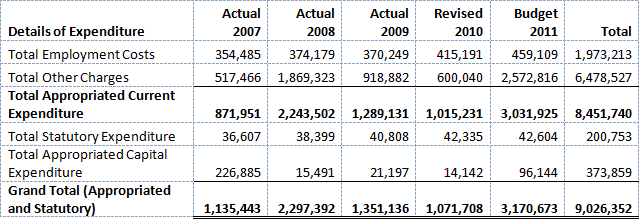
Here is a summary of the expenditure by Gecom over the post-2006 election period 2007 to 2011. It shows that over the five year period, Gecom was funded from the public purse to the tune of over nine billion dollars, excluding any request which the Minister of Finance may bring to the National Assembly for any supplementary expenditure. As expected, the cost rose significantly in 2011 but even so it was only about a third of the expenditure for the electoral cycle, with some of the cost in the intervening period being attributable to the new registration exercise when new ID cards were issued.

Figures: G$’000
Source: National Estimates

Using the number of 475,000 eligible voters on the updated list, it has cost this country an astounding $19,000 per voter between 2007 and 2011. I have seen no statistics from anywhere around the world that comes close to this figure, one that clearly suggests caution as we make sounds about another round of elections. What is equally remarkable is that even in a non-election year the cost runs above two thousand dollars per person when the international average cost for elections runs much, much lower. Of course some part of that is understandable with an element of fixed cost for any elections body, regardless of the size of the electorate.

An example of overspending
But let us take a simple example of why the culture of cost control and management is so completely absent. Over the past five years each of the part-time, non-executive commissioners has earned a minimum of twelve million dollars. Compare that with the salary of the lowly teacher, the often maligned nurse or police officer who would have earned a mere two million dollars over the same five years. There seems neither logic nor justice that a part-time, under-employed commissioner often sitting there to carry out the wishes of the party, should earn more than five times the full-time public servant.

This column has been a persistent critic of the Audit Office but even they have expressed concerns over the integrity of the controls in Gecom, including financial management and stores controls and purchases of millions of dollars from untraceable suppliers. We have to expect better management of the billions made available to Gecom and which naturally come out of the same block of funds that inadequately provide for the health, education and other sectors. Think what some of that money can do for the University of Guyana or to ensure that there is an adequate supply of drugs in the regional hospitals and health centres or to enhance security.

Let us look at another table.

Election expenses as a percentage of National Budget

Figures: G$’Mn
Source: National Estimates

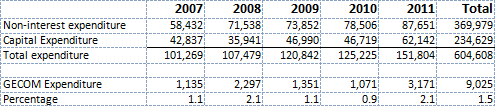
What this table tells us is that two out of every one hundred dollars spent in 2011 went towards Gecom for the administration of the elections. And to think that the cost of security is not included, or all the vote-buying and elections-related projects undertaken by the government, or the heavy campaign cost incurred by the parties!

Conclusion
I never feel safe making any claim for Guyana as the best or worst in the world but I can comfortably state that as a percentage of the national budget and on a per capita basis Guyana must have the most expensive election machinery in the world.

Following the elections there was much talk of reforming Gecom, talk that has subsided as APNU’s allegations of improprieties have receded into virtual silence. Something has to be done about our electoral machinery. A global survey published in June 2005 on the Cost of Registration and Elections offers some excellent insights on how we can cut down on the cost and yet deliver better results. Unfortunately Guyana was not included in the survey but one of the contributors was part of the Carter team that had recommended the 3-3-1 model for the 1992 elections.

That arrangement was intended to be temporary. It is time to bring it to an end and to introduce a cost efficient and politically effective model.

On the Line – The Banks Group

Sunday, January 15th, 2012

Comment
Co-incidences are rarely easy to explain. At the time of launching an award for the best Annual Report by any Guyanese company as one of the activities and initiatives for its 25th anniversary observed last year, this column carried a review of the financial statements of the two operating companies of the Banks DIH group: Banks DIH Limited (‘Banks’), the food and beverage giant, Citizens Bank Limited (‘Citizens’), a 51% owned retail bank and Caribanks Shipping Company Ltd, a dormant company.

This coming Tuesday – and regrettably belatedly – Ram & McRae will be announcing the winner of the award for the 2010 annual reports. That is as much as I am permitted to say at this time.

Introduction
Today’s Business Page looks at the financial statements of the two operating companies of the Banks DIH group. The group comprises Banks DIH Limited, the food and beverage giant, Citizens Bank Limited, a 51% owned retail bank, and Caribanks Shipping Company Ltd, a dormant company. Banks and Citizens are both public companies whose shares are traded on the Guyana Stock Exchange. The financial statements of the group also include as an associate company B&B Farms Inc, a Guyana private company, and BCL (Barbados) Limited in which Banks holds a 25% interest.

Both the public companies in the group have as their accounting year-ends September 30 and will be holding their annual general meetings later this week – Citizens on Tuesday 17 and Banks four days later.

The shareholdings in the two companies have changed little over the past year with Banks spreading just over 60% of its shareholdings among a vast network of private individuals while in the case of Citizens, four shareholders own 82% of the shares with the remainder spread among about seventy smaller shareholders. The Boards of Directors of both companies are chaired by Mr Clifford Reis, CCH, who is also the Managing Director of Banks.

In a Corporate Governance Code published last year, the Private Sector Commission boldly called for a clear division of responsibilities at the head of the company. The Code makes it mandatory that the positions of the Chairman and Chief Executive Officer (CEO) be held by separate persons. It also requires that the division of responsibilities between the Chairman and CEO be clearly established, be set out in writing, and be agreed by the Board.

Some observations
Another contrast between the parent and the banking subsidiary is evident in their annual reports; Banks’ high-quality, glossy report is designed and produced by Ross Advertising and printed by Scrip-J of Trinidad and Tobago while Citizens’ is on flatter type paper and produced by KRITI whose address is not stated.

There has been no change in the gender composition of both boards, each remaining steadfastly all-male, despite the constant chorus from progressive women like Stella Ramsaroop and Andaiye for more recognition to be given to women in Guyana. What makes the situation even more remarkable is that both entities have a large number of women staff and in the case of Citizens, six of the seven principal officers are women!

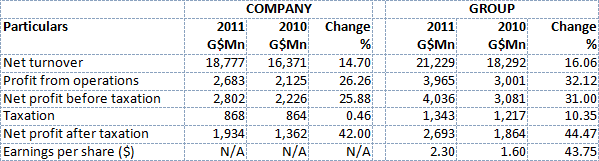
In any case, there can be no doubt that at both entities women make valuable contributions to the “exemplary growth in revenue and profit over that of previous years” reported by Chairman Reis in his report on the group. He had every reason to exude satisfaction: group profits from operations increased by 32% on a turnover increase of 16%. On the other hand, benefiting from the five per cent reduction in tax rates announced in the 2011 Budget, taxation increased by 10%, mainly from the banking subsidiary.

Banks DIH Limited

Source: Annual Report 2011

The company’s turnover (sales) increased by 15% from $16.3 billion to $18.8 billion, and its profit from operations increased by 27% while taxation at $868 million was a mere $4 million increase over 2010. As a result, net profit after taxation increased by 42%. Profit from operations as a percentage of sales which was 13% has increased to 14.3% while taxation as a percentage of net profit before tax decreased from 38.8% in 2010 to 30.9% in 2011.

Chairman Reis attributed the improved results to revenue garnered from the increase in physical sales, efficiencies derived from plant and machinery upgrades and an improved presell and distribution system. The performance was also attributed to capital expenditure of $3,142 million on major plant and machinery for the beverage, alcohol and water plants. The modern soft drinks plant which is expected to be put into use early in 2012 is expected to continue the trend of increasing productivity and profitability.

Growth
To get a clearer picture of how the profitability has changed one only has to go back to 2007 and 2008 when the profit before operations was 9.7% and 9.9% respectively, while the net tax effective rates in 2007 and in 2008 were 38.9% and 40.1%. Most impressively, two years after the company passed the $1 billion profit-after-tax mark, it is aiming to double that figure. Without taking anything away from the Guyana directors, it is perhaps more than merely coincidental that the company’s growth trajectory has been accelerated following the accidental partnership with Banks Barbados, aimed to repel an attempted take-over by Ansa McAl of Trinidad.

What is also significant is that the entire increase in the revenues of the company came not from exports but from domestic sources. Note 20 to the financial statements which gives a broad geographical breakdown of revenue, shows sales of goods and other services increasing by $2,478 million or 15% while revenue from exports actually declined by 24% to $233 million, down from $305 million.

Whether the company is satisfied with its domestic sales is not clear, but with the reputation of Guyana rum internationally, the company may wish to expand its horizons, a feature of the group since its launch in 1957, and indeed the theme for the 2011 report – the next level.

Source: Annual Report 2011

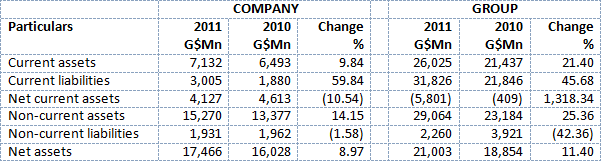
The balance sheet for the company and the group shows net assets increasing by $1,438 million and $2,149 million respectively. Payables and accruals included under current liabilities in the table above have increased from $1,538 million in 2010 to $2,625 million at September 30 last year.

Citizens Bank Limited
After a poor year in 2009 when the Bank had to make an impairment provision of $170 million for investments in Stanford International Bank and Clico Trinidad Limited – the region’s two financial catastrophes for that year – the results for 2010 were encouraging, while for 2011 they are impressive.

Profit after taxation in 2011 increased by 50.5% from $534 million to $804 million. Net Income for the year ended September 30, 2011 was $1,949 million compared to $1,469 million, an increase of 26.7%, double the increase in 2010 over 2009. Profit before Taxation was $1,279 million compared with $887 million in 2010, an increase of 44%.

Interest income increased by 32% and other income by 7.8% while operating expenses increased by 8.8%. Net Customers’ deposits had a significant 30.3% increase while interest expense increased by a more modest 8.5%.

Conclusion
The Banks Chairman was careful not to encourage too high expectations about the future. He avoided any comments about the future in the Banks DIH report while all the CEO of Citizens Bank was prepared to say – unhelpfully – was that 2012 “[would] bring both challenges and opportunities.”

It is my strong view, and indeed that of the Private Sector Commission, that companies need to enhance their communication with their members and the public. I noted a few weeks ago that Demerara Bank Limited had refused to release its 2011 annual report “until after their AGM.” I was met with a similar response when I sought a copy of the Citizens’ Bank Annual report. That is not a practice that should be encouraged by any institution, and certainly not one that has its sights firmly fixed on the next level.

It won’t be easy

Sunday, January 8th, 2012

Introduction
Nothing concentrates the mind like a deadline. With the date for the convening of the 10th Parliament fast approaching – it must be held within four months of the end of the previous session which ended in the last week of September, 2011 – it is expected that our politicians will soon resolve the uncertainties over who will be the Speaker as well as the simmering questions about the Statements of Poll. That would set the stage for the National Assembly to begin work in earnest over the dozens, or perhaps scores, of issues that cry out for attention. Since all of these cannot be addressed simultaneously, the Parliamentary Management Committee would have to agree on the priority issues and their timelines for completion. This will be no easy task.

The Jagdeo administration has left a damaging legacy of bad laws, unhelpful culture and lots and lots of square pegs. The parliamentary opposition, faced with exciting possibilities has promised much and they will be expected to deliver. They will be tempted to set extremely ambitious targets. How can they not want to deal with CLICO, GuySuCo, all of Jagdeo’s big money items, the legacy of corruption, constitutional reform, public sector pay within a broader wages policy, local government elections, a failed capital city, etc, etc?

It will be a huge challenge for our system of part-time politicians coming out of decades of a negative, adversarial culture which we are reminded is harder to change than people. But President Donald Ramotar can certainly assist the process if he willingly accepts the reality of the new parliamentary configuration and work with the Parliament which the constitution defines as comprising the President and the National Assembly.

Of course as Robert Burns reminded us, “The best laid schemes o’ mice an’ men
gang aft agley” (often go awry) and however carefully the members of this exciting National Assembly may plan their work there will be challenges, surprises and setbacks. Business Page today will highlight a potentially early challenge, identify an issue which I think warrants urgent attention and will comment briefly on the announcement of a tax reform committee.

Challenge
When the National Assembly met on the last occasion on September 22, Finance Minister Dr Ashni Singh obtained approval for expenditure of $3.3 billion in extra budgetary allocations via Supplementary Appropriation (No.3 for 2011) Act comprising Financial Papers 5 and 6. In paper 5, some $1,367 million was earmarked to replenish the Contingencies Fund for expenditure mainly for the procurement of drugs and medical supplies for the Georgetown, Lethem, Mabaruma and Bartica Hospitals, and some $25,871,000 of which was for the Ministry of Agriculture for expenditure associated with Phase 2 of the Grow More Campaign.

Paper 6 which was for $1,951 million was made up mainly of some $1.2 B in electricity charges and an additional $350M allocation for the Drainage and Irrigation Board and the National Agricultural Research and Extension Institute. What was significant was that just a few weeks before, Dr Singh had obtained approval from the National Assembly for $2,646 million of which $2,104 million was to replenish the Contingencies Fund, and $542 million in supplementary appropriations mainly to do with the roll on-off vessels.

From technocrat to politician
In the previous Parliament in which Dr Singh was an appointed technocratic minister, he seems to have had very easy rides when it came to getting the automatic approval of his colleagues who then enjoyed a dominant majority and who quite often never seemed to understand the financial implications of their votes. That situation has changed with the majority, albeit a razor-thin one, now on the other side. Dr Singh who has now become a political minister will find that he has far more questions to answer before obtaining such approval. This column has pointed out ad nauseam that the law provides very strict rules for the use of the Contingencies Fund.

Section 41 of the Fiscal Management and Accountability Act (FMAA) allows the Minister of Finance, by way of a drawing right, to make advances from the Contingencies Fund. The circumstances under which he may do so, however, are severely limited; the overriding test is threefold: urgent, unavoidable and unforeseen. Further, he can use this fund only where no or inadequate sums had previously been appropriated, or where reallocation under the FMAA is not possible, or finally, where delay would cause injury to the public interest. He cannot use the fund to meet a promise by the President to do something or the other, or because he failed to budget properly, or because some budget agency was careless.

The same section of the Act requires that the minister report at the next sitting of the National Assembly all advances made out of the Contingencies Fund, specifying (a) the amounts advanced; (b) to whom the amounts were paid; and (c) the purpose of the advances.

Strict compliance
If, as is feared, Dr Singh improperly spent moneys from the Contingencies Fund during the two months between the close of the last Parliament and the end of 2011, then I foresee some real difficulties for him. I expect that he has to face as the shadow Finance Minister Mr Carl Greenidge, who knows the system as well as the law. Public officers are also aware that an era of political fear from despotic ministers and political cover has ended and they will have to conform to the law. It is one of the unfortunate features of the FMAA that ministers cannot be prosecuted under section 85 of the Act. Only officers can, something that is unlikely to make them comfortable.

Two things the Minister needs to bear in mind: He must present to the first sitting of the 10th Parliament a report of any spending (advances) out of the Contingencies Fund since his last report. He should expect that report to be rigorously scrutinized to ensure each has met the three tests: urgent, unavoidable and unforeseen, and that any delay would have caused injury to the public interest. And second, the level of detail provided in his report of advances made out of the Fund in the past did not meet the requirements of the law.

Dr Singh is justifiably rated very highly within the PPP/C. Judging by their stout defence of Minister Irfaan Ally whose public accountability performance has been called into question by the National Assembly, the party will circle around Dr Singh. If there has been expenditure that does not meet the rigid standards of the law, there will be difficulties. I sincerely hope that this is all speculative and that if there was any expenditure from the Contingencies Fund, that it met the requirements of the FMAA.

The NIS
The National Insurance Scheme, which for nineteen years has been led by Dr Roger Luncheon, has for several of those years been faced with challenges of increasing seriousness. The problem is that no one has appeared willing to confront the challenges, some of which would have required politically unpalatable actions. Not FITUG which for several months has gone silent, not the GTUC, whose leaders are protesting everything else while ignoring the dangers faced by the Scheme, not the political parties, not anyone. The recommendations of the 2001 Actuarial Report on the Scheme were hardly acted upon except for a 1% increase in the contribution rate in 2004. The 2006 Report has largely gone unaddressed as well, in complete disregard of the actuaries’ cri de coeur that the NIS at then “40 years old, [was] at a stage where immediate measures need to be taken to maintain public confidence in the sustainability of the Scheme.”

In their 2010 country consultation the IMF staff had pointed out too that the mismatch between pension benefits and contributions and weak reserve management threatened the sustainability of the National Insurance Scheme.
They noted that under current parameters, the finances of the NIS are unsustainable. And using data provided by the NIS, they projected that after 2011 the NIS would shift from small surpluses to growing deficits.

More recently, the challenges of low rates of compliance, low investment returns, inefficient policy and executive administration, and deteriorating finances have been compounded by the Scheme’s potential loss of $5 billion in CLICO and the consequential loss of investment income thereon.

The 8th actuarial review as at December 31, 2011 is now due. The actuaries should be called in immediately, the review expedited and its recommendations acted upon. We can no longer tolerate the delays in taking remedial action or continue with a highly ineffective Board.

The Tax Reform Committee
President Ramotar had announced the appointment of a Tax Reform Committee, the terms of reference of which have not been made public. It is not clear whether the President consulted with interested groups including the political parties, consumers, the trade union movement and the Institute of Chartered Accountants of Guyana both about the scope and the membership of the committee. If he did not that is remarkable and unfortunate. VAT and personal income tax affect mainly consumers and workers, and I hope that on reflection, the President would recognize that the exclusion of representatives from those groups is a regrettable omission.

For the work of the committee to be really useful, its composition should be widened and its terms of reference publicised for comments.

A successful 2012 to all readers of this column.

Predicting the future

Sunday, January 1st, 2012

Introduction
This column has not had a good record when it comes to predicting the future, even into the next year. It has defied probability and its predictions were so overwhelmingly more wrong than right that Dr Beckles would diagnose the attempt at clairvoyance as being purely delusional. Sometimes it does not even get the year right. For example, if one was going to predict 2011 one should really have started on December 17, 2010 when a Tunisian vendor made the ultimate protest by burning himself after years of harassment by the police. His sister Basma earns for me the quote of the year: “Dignity is more important than bread.” It was the start of what has come to be known as the Arab Spring, a spontaneous revolution that led to the demise of long-term dictators like Ben Ali in Tunisia, Mubarak in Egypt and Gaddafi in Libya, and has shaken the foundations of oppression in more than a dozen Arab and North African countries, including Algeria, Bahrain, Jordan, Morocco, Syria, Yemen and that paragon of stability, Saudi Arabia.

If 2011 started as a work in progress – to use the commentator’s favourite loan expression from the accountants – the year 2012 is no different. The Arab Spring, a homegrown liberation movement using as its the main tool the ubiquitous imported cell phone and the social media and promoted by the expanding Al Jazeera news network, in turn might have spawned its own export to the democratic west in the form of the Occupy Movement. No one can say that the influence of one on the other or their respective role was not reciprocal. But as Syria and indeed Egypt are showing, any declaration of victory is dangerously premature. The old guard of militarism and the new establishment of religious fundamentalism are fighting back with a viciousness that suggests that in this new dispensation there is no room for prisoners; it is the ultimate zero sum game.

Remembering the Rapture (and Y2K)
2011 must also be remembered for some of the things that did not happen, with the most infamous but welcome being the non-arrival of the end-of-time Rapture which according to the American crazy horse Harold Camping should have taken place on May 21, 2011. It was also the International Year for People of African Descent, aimed to strengthen international, national and regional cooperation to benefit the people of African descent, and to recognize and promote their political, economic, social and cultural contributions. Hopefully our own African Cultural Development Association (ACDA) will present an end-of-year report to identify the gains made and challenges experienced in delivering on the ambitious targets which ACDA had set itself for the year.

And while the PIIGS (Portugal, Ireland, Italy, Greece and Spain) seem locked in a deathly economic vortex that is threatening to bring down the euro, the much feared double-dip recession did not take place, and in late December us President Barack Obama could actually go off on his annual Hawaii vacation against a background of some silver lining peering from behind still threatening but perceptibly receding dark clouds.

Jagdeo’s exit
In dear old Guyana the era of Jagdeo headed for an abrupt end as he almost singlehandedly guaranteed that for the first time since 1992, the PPP/C would lose control of the National Assembly. A painful blow for the unbearably arrogant PPP/C, the gift of power-sharing to the people of Guyana, long the forlorn cry of the WPA, suddenly came with the November 28 elections. A man who had pandered to the religious right by defying the unanimous vote of the National Assembly to abolish discrimination in sexual orientation then took an entire country on the road to casino gambling and worse, and seemed to become an adherent of the creed that hedonism and greed are good and that state power is for personal aggrandisement.

In a tragic reversal of fortune, the Champion of the Earth and wannabe Nobel Laureate could not face his own people. Unlike the dictators in Tunisia, Egypt and Libya, Jagdeo’s fall from grace was not the work of physical enemies from without, but those from within himself. It must surely be a lesson to all who come after him and to all of us who allowed him to transform from an ordinary country boy with a modest academic record and an even more modest professional work life into a dictator in a democrat’s clothing.

The Year of the Dragon
And now the column turns to 2012, a leap year and for the Chinese, the Year of the Dragon. I am annoyed that the Chinese do not make even a token concession to vegetarians by naming one year in each decade after a fruit or vegetable, with the Chinese sounding name Pak Choi offering an obvious possibility. It is time for the vegetarians to protest. My first prediction is that the world will not end on December 21, 2012, a claim wrongly attributed to the Mayans. Yes, on 21.12.12 — the winter solstice — the sun aligns with the centre of the Milky Way for the first time in about 26,000 years. Scientists think this will disrupt the energy streaming to Earth, but like the dread spawned by the Y2K scare (remember we all feared that all computers would shut down at midnight on January 1, 2000) and by Harold Camping’s Rapture, nothing extraordinary will happen on that date. On that I am prepared to bet my shirt.

Britain will host the 2012 Olympics in July immediately following Wimbledon which will see hometown lad Andy Murray continue the heartbreaking quest for a Grand Slam by a male Britisher (he is actually a Scotsman) since 1936. Bolt will not be as dominant nor will the Jamaicans be able to repeat their phenomenal final medal haul of 11 (comprising six gold, three silver and two bronze) achieved in China in 2008.

The Olympics will also compete with the traditionalists and the ‘nostalgienti’ who will celebrate in the 21st century, in endearing, cosmopolitan and expensive London the 200th birthday of Charles Dickens, the producer of some of the best literature ever written in any language. Nor will we be allowed to forget that the year marks a century since the unsinkable Titanic proved far more normal than its makers and its captain had imagined.

The best and the worst
Here at home, Chief of Staff Commodore Best will order an invasion of the National Stadium in a pre-emptive strike to stop the finals of the Kashif and Shanghai football tournament and request that the GDF budget be doubled to purchase missiles required for the exercise. The Minister of Finance agrees.

In cricket, sense will finally prevail and the West Indies Cricket Board will order that with immediate effect its teams will only compete in bumper ball tournaments and the West Indies team duly sweeps all and sundry before them and is crowned champion in Test, one day and 20/20 formats.

Elections everywhere
2012 will also be a year of national elections and it seems that everyone will be going to the polls. This prediction does not apply to Guyana which will seem always on the brink but never quite get there. Let us start with the US where BO (Barack Obama, of course) will be vying for a second term even as two independent candidates enter the US presidential elections. With help from Michelle, Barack Obama will be reelected by getting 270 Electoral College votes, the exact number needed to win. However, under the Patriot Act eavesdropping programme, a dozen emails surface showing that he had begged Bill Clinton to let Hillary be his running mate so that she and Bill would not harbour ambitions higher than the number two spot.

Meanwhile the Republicans win back enough Senate seats from the Democrats and get to 50 which results in a tie in the Senate, and the Democrats win enough seats in Congress to wrest the majority from the Republicans by one seat. In that regard, the US will become more like Guyana except that in the US they call it politics while in Guyana we think it is for real. Just look at the nightmare playing out between the AFC and the APNU – parties committed to sharing the spoils of victory but not defeat – in the selection of a Speaker!

The signs are that our good friend and neighbour Sr Hugo Chávez in a weakened state will still campaign to stave off defeat, while his friends in Cuba will worry about the possible loss of cheap oil in exchange for an army of semi-qualified doctors. China’s eighteenth Congress will say goodbye to both their handpicked President and Prime Minister and the new rulers will liberalise the one child per family rule to one and a half children per family. The regulations to put life (no pun intended) into this rule will take the better part of the Congress and our Priya Manickchand will be invited to assist on the technical details.

The Budget
In domestic politics a Speaker will be agreed upon in time for the Budget debate. Except for this, there can be no other prediction involving parties committed to power-sharing but who each starts from the position that it has a divine first right to all the powers before it can start sharing any. Meanwhile the storm about statements of polls will have fizzled out by early January and APNU chief spokesperson-for-the-week will react to questions about the lightning speed of APNU’s reconciliation of the SOPs by pointing out that APNU has other pressing matters to deal with, such as a grand farewell and pension package for Robert Corbin.

The Budget debate when it finally gets going will feature two of the shortest men in the National Assembly – Singh and Greenidge. Singh’s response to Greenidge’s professorial critique will be that since the PPP/C’s Budget for the past nineteen years was founded on the same ERP that Greenidge invented back when Singh was barely a young man, Greenidge has no “moral authority” to speak evil of the Budget.

Economics
Gold will lose some of its glitter while the Chinese and Russians will contract their international operations amid increasing resource nationalism and a fear of backlash. With Robert Persaud gone looking for oil, the four P’s of his former lavishly funded ministry – pepper, pineapple, pumpkin and plantains – will give way to a campaign to save sugar.

Jagdeo will refuse an invitation to take him at his word to become personally involved, saying that his appointees are doing an excellent job and that with all the money being spent on GuySuCo there is no place for production to go but up.

China’s growth will stall, but above mid-single digits, while India will continue to be mired in corruption and their Occupy Mumbai movement will be led by a septuagenarian with the unlikely name Anna Hazare. Guyana will look anxiously to see how India deals with prevention of corruption legislation; will make Geeta Singh-Knight answer for her (mis)management at CLICO and have Dr Ramroop and Odinga Lumumba pay a fair price for all the state assets handed to them by their now invisible benefactor.

Caricom will be like West Indian cricket and the less said about them the fairer it will reflect reality.

Wish list
Finally, here is my 2012 wish list which by definition is impossible to get wrong. That President Ramotar will reverse his prior commitment to more of the same and will:

Demand that the Public Accounts Committee perform its parliamentary duties with greater competence.

Push legislation to improve transparency by appointing a new Ombudsman, establish the Public Procurement Commission, revise the Access to Information Act and introduce anti-corruption legislation.

Revisit Jagdeo’s pet projects like the Kingston Marriot, the fibre-optic cable, Amaila and the speciality hospital.

Order the Cabinet-infested NICIL Board to bring its accounts up to date for independent audit. Declare the implementation of VAT was a rip-off but have a change of heart and compromise on a reduction in the rate to 10%.

Instruct the Guyana Revenue Authority to increase the volume of lifestyle audits of workers to try to understand why, like Leona Helmsley said, only the poor pay taxes.

Get rid of the deadwood in the Office of the President, otherwise known as presidential advisors, by the application of an integrity detector test and the ability to stay awake during meetings.

Until I get back to reality, here’s wishing us all a wonderfully productive 2012.