Public Procurement Commission and Commission of Information: How Constitutional Bodies Betray Their Purpose

Introduction

As Guyana’s economy expands at an unprecedented pace, driven by transformative oil revenues and ambitious infrastructure development, hundreds of billions of dollars in both recurrent and capital budget expenditures annually fall within the purview of the Public Procurement Commission (PPC). This massive scale of public spending, coupled with citizens’ constitutional right to access information about these procurement decisions through the Commission of Information, makes the oversight role of both bodies more critical than ever.

Unfortunately, the current PPC has failed to meet even the minimum standards of competence, accountability and integrity. They are made worse by a web of conflicts that undermine the very foundations of constitutional governance. This failure is particularly damning when contrasted with the exemplary work of the previous Corbin-Gopaul PC which included two persons with earned PhD’s, two with Masters – one in finance and one in Procurement – and the fifth person with both engineering and legal professional qualifications. They produced a comprehensive body of work, including a strategic plan, detailed investigation reports, policy guidance to procuring entities, an employee handbook that any organisation in Guyana would consider exemplary, and proactive correspondence addressing systemic procurement issues. They demonstrated courage and independence by compelling a senior Minister to appear before them in their investigation into drug purchases at the Georgetown Public Hospital Corporation.  

PPP/C’s failure

Fifteen years after the Constitution mandated a Procurement Commission and 13 years after the Procurement Act during which oversight under successive PPP/C Administrations was troublingly inadequate, the first Commission was appointed by President Granger in 2016, comprising the persons identified above. Mrs. Carol Corbin gave up a secure position at the CARICOM Secretariat and, supported by a team that met all the Constitution requirements, began discharging their constitutional duties. Commencing with no fixed place of abode, the Commission’s legacy includes strengthening Guyana’s entire public procurement framework and establishing proper rules of procedure, work that demonstrated the transformative potential of competent constitutional oversight.

The current Commission, headed by Ms. Chase and Vice-chair Berkley Wickham, a former Head of the National Procurement and Tender Administration (NPTAB), represents this standard’s complete antithesis. NPTAB was the subject of adverse criticisms during Mr. Wickham’s tenure there.

Egregious conflicts

At the centre of this institutional failure lies an extraordinary conflict of interest that spans both the Procurement and the Information Commissions. Ms. Chase continues to engage in private legal practice despite holding a full-time constitutional post, most troublingly serving as legal counsel for the Commissioner of Information in both his official and personal capacity. This interlocking relationship creates obvious consequences for the independence and effectiveness of both bodies, even if they were otherwise operating competently.

Under the Access to Information Act, the Commissioner exercises certain functions over the PPC. Without compromising both offices, the Chairperson cannot act as legal counsel for the very official to whom her Commission is answerable in a statutory relationship. Indeed, the PPC is also subject to the Commission of Information, exacerbating the conflicts and effectively neutering both institutions’ capacity to meet their intended purposes.

Ms. Chase’s position seems irretrievably egregious. Her relationship with Ramson appears to breach the PPC’s Code and the Code of Conduct under the Legal Practitioners Act, which prohibits attorneys from engaging in behaviour that undermines the dignity of the profession or the administration of justice.

This raises serious doubts about the judgment of both these senior lawyers.

Performance

The investigative record of the current PPC in its first year is equally indefensible. Only two of the ten complaints noted in its first-year report tabled in the National Assembly seem to have been satisfactorily concluded. The procedures for one were not followed, and there was no evidence of procedures being followed in another. Two were awaiting further information, and four were stalled pending the receipt of legal advice. Not only was the advice received several weeks before the end of the reporting period, but it was also months before the report’s submission date.

The Commission’s failure to act on these seems to evidence a high level of dysfunction. Even more astonishing is that legal advice was sought on a foundational issue: whether the Commission could investigate matters that predated its appointment. Any competent body or legal professional should resolve this basic jurisdictional point without external input. This contrasts with the previous Commission’s proactive investigations into major contracts like the New Demerara River Bridge feasibility study, their oversight of pharmaceutical procurement, and their systematic approach to addressing procurement irregularities across government agencies.

The report fails to note critical information, including contract values, procurement methods and the basis of selection. A separate compliance review of twelve projects is similarly limited, omitting the names of contractors, values and timelines. I would not wish to bore readers with another set of contrasts except to state that those set the benchmark for thoroughness and transparency.

Beyond these procedural and ethical failings, the Commission’s internal structure appears designed to obstruct functionality. The offices once assigned to Commissioners were repurposed, leaving Commissioners without a dedicated workspace. It is unacceptable and confidence-destroying for a constitutional body to operate in this manner, notably when the previous Commission had established proper operational procedures and professional standards, which the current Commission bizarrely sought to criticise in its first annual report. 

Conclusion

The current Commission’s term expires in about six weeks. We look forward to seeing the reports for the twelve months to July 2024 and 2025 to measure the decline. Commissioner Ramson appears entrenched for life – or at least as long as the PPP remains in power. There is little to look forward to there.

The previous PPC proved that this institution could excel. The current Commission’s standards represent institutional decline and a betrayal of constitutional principles. The vast resources over which they exercise constitutional and statutory functions make their poor performance too essential to ignore.
Critical Review of the ExxonMobil Guyana 2024 Annual Report

Every Man, Woman and Child in Guyana Must Become Oil-Minded – Column 159 – June 6,  2025

Exxon’s 2024 Financial Statements

1. Overview

Earlier this week ExxonMobil Guyana Limited (EMGL) summoned the Guyana press to the launch of its2024 Annual Report. Two conditions: only questions on the financial statements would be entertained and the number of questions strictly restricted. Like one of its junior partners Hess, the results for 2024 are staggering, and its profitability measures more that double the Exxon group as a whole. Guyana’s Stabroek Block now joins Kohinoor (India circa 1300) and the Cullinan (South Africa 1905) to create an imperial trinity of exploitation of plunder acquired under unequal terms, adorned as triumph and defended by the exploiter and the exploited.

Unusually for a branch or what is called an External Company incorporated in The Bahamas, Exxon publishes a glossy annual report with more photographs than our own public companies. It presents a glowing picture of economic transformation and partnership with the people and the Government of Guyana. However, beneath the positive narrative, the report glosses over – or buries – critical details about the tax treatment under the 2016 Petroleum Agreement, including the government’s controversial obligation to pay Exxon’s taxes.

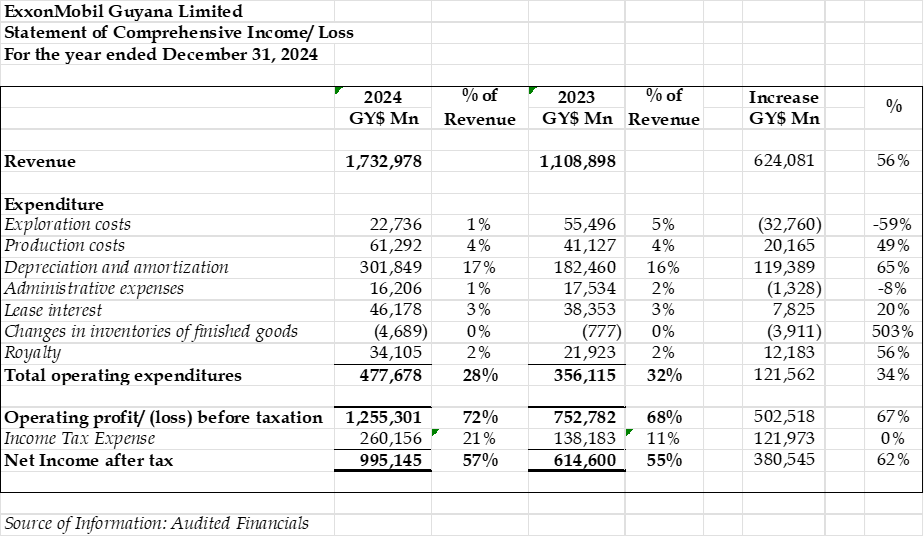
One cannot help but describe Exxon’s statements as a deliberate web of deception – as they have been since the overstating of pre-2016 costs. The Business Service Manager announced a 60% increase in revenue while the actual figures show 56%, a result of how far they will go to conceal the fact that they do not pay taxes – Guyana pays it on their behalf. The difference between the 56% shown above and the 60% announced is as a result of adding the tax shown as deducted – which they do not pay – to the revenue which in 2023 was shown as “includes] non-customer revenue related to Article 15.4 of the Agreement”. SHAME on the Company, SHAME on the Government and SHAME on our accounting profession which never calls them out.

As a percentage Production cost has remained at 4% of revenue, Exploration cost 1% of Revenue, Lease Interest 3% and Royalty 2%. The big cost is Depreciation and Amortisation of $301,849 Mn which makes up 17% of Revenue.  

One titillating statistic: Exxon’s total comprehensive income for the year – after accounting for taxes which the Government pays – is close one and a quarter trillion dollars. It took Guyana fifty-nine years before its budget reached one trillion dollars. Exxon earns in income for its foreign shareholders substantially more in less than ten years.

Thank you Trotman, thank you Jagdeo and thank you Ali!

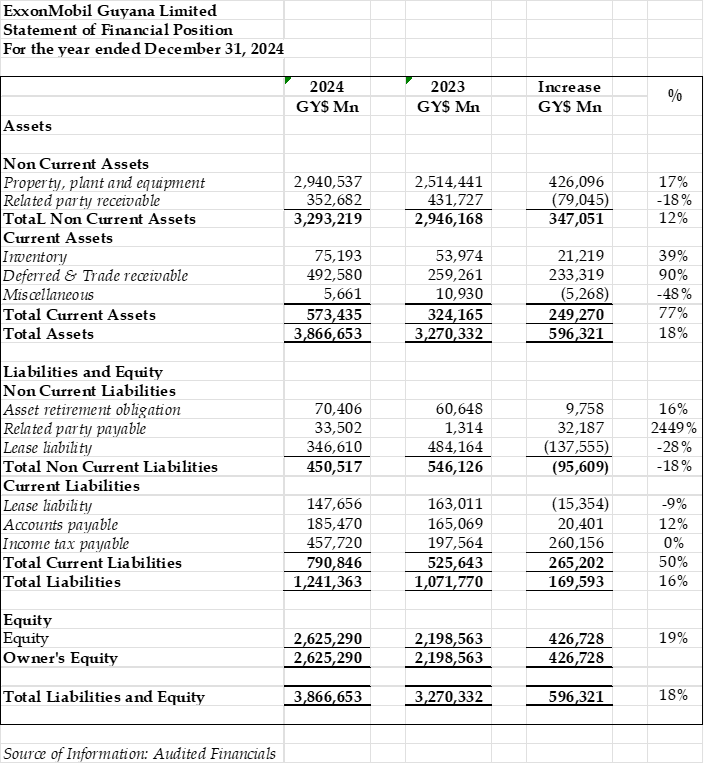
The Balance Sheet

The Balance Sheet is sometimes called the Statement of Affairs or Statement of Net worth or simply Statement of Assets and Liabilities. The table below is a (slightly) summarised restatement of the audited financial statements. The figures are stated in Guyana Dollars but for convenience, the table is prepared in millions of Guyana Dollars.


Highlights

Expenditure on Wells and Production facilities accounts for $605,000 Mn, of which a significant portion comes out of Work in Progress. Deferred and Trade Receivable has increased by 90% and requires some explanation. Deferred Receivable represents amount due from Joint Venture Partners from cash calls and also non-customer revenue which is probably the amount it expects to receive from the Government of Guyana to meet its tax obligations. An amount that will be cleared in four months’ time is hardly a deferred receivable but that is how flexible and creative Exxon is.  

What is even more astounding is the amount of $352,681 Mn. described as amounts due from the Home Office to fund Petroleum Operations. The average amount due from the Home Office over the year is just short of $400,000 Mn. That’s an embarrassment of wealth.

What makes this situation even more incredible, is that in 2024, this 45% interest in the Stabroek Block – our Stabroek Block – earned Exxon’s 45% interest a whopping $1,255,300 Mn, or $1.2 Trillion. That is more than 150% that Guyana is likely to earn by way of income through the Consolidated Fund.

The tax mystery

The mysterious tax arrangement is causing all kinds of contortion and deception among the oil companies. Here is a comparison of the note on tax charge in 2024 compared with 2023.

20242023
  Note 7 – INCOME TAX EXPENSE Income Tax Expense is recognised in respect of taxable profit calculated on the basis of the income tax laws of Guyana that have been enacted as of the date of these financial statements.
Note 7 – INCOME TAX EXPENSE Under Article 15.2 of the Petroleum Agreement, the Branch is subject to the Income Tax Laws of Guyana with respect to filing returns, assessment of tax, and keeping of records. Under Article 15.4 of the Petroleum Agreement, the sum equivalent to the tax assessed on the Branch will be paid by the Minister responsible for Petroleum to the Commissioner General, Guyana Revenue Authority and is reported as non-customer revenue.

Conclusion

ExxonMobil is the first Branch entity that produces an Annual Report. It is shiny, designed to present an image of corporate responsibility and national partnership. That is a trap. Exxon knows how to play gullible politicians like those they have met in Guyana. In the Coalition, they met amateurs, dazzled by oil, eager to please and out of their depth. In the PPP, they confuse the bright ones out of renegotiation, ring-fencing, an independent Petroleum Commission and into insider dealings, fears and cowardice. Exxon did not need to change its strategy. Just the faces across the table.

The Oil Spill Bill – Unfit for presidential assent

Every Man, Woman and Child Must Become Oil-Minded Part 158

Introduction

On May 17, 2025, the National Assembly passed the Oil Pollution Prevention, Preparedness, Response, and Responsibility Bill on a voice vote. The bill’s thirty-seven clauses and three schedules were considered en bloc, meaning that no clause-by-clause examination was conducted. One wonders whether the Speaker or the Mover of the bill wanted to avoid a critical analysis of the Bill’s provisions.

It may be coincidental that the architects have incorporated the ubiquitous PPP into the title. In any case, a Bill should be judged not by its title or acronyms, however unique, but by its contents. On that basis, when evaluated against international standards, this law collapses under its own inadequacies. In coming to this conclusion, I assessed the Bill against ten criteria drawn from international best practice, including the experience of countries like the United States, Canada, and Norway, as well as the principles set out in global instruments such as the IMO’s Oil Pollution Preparedness and Response Convention (1990). These criteria are not academic – they reflect solid, real-life experience.

Each has been forged in the crucible of real oil spills, corporate denials, and costly public clean-ups. They cover the core elements of effective legislation: scope, prevention, monitoring, financing, preparedness, liability, penalties, public participation, institutional design, and legal coherence. Although a senior Minister ruled out any input from me in the discussion on the Bill as “unhelpful”, what follows is not a partisan view – it is a professional assessment based on years of studying and writing on Oil and Gas.

Poor grade

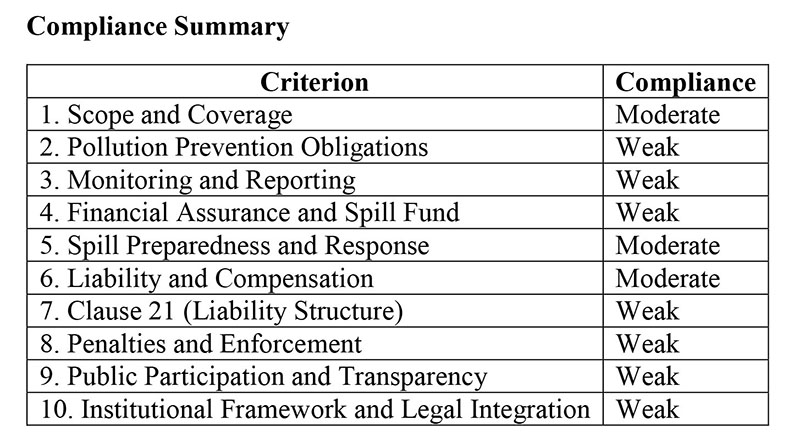
The analysis reveals that the Guyana Bill falls short of meeting objective standards: it is non-compliant with eight of the ten standards, partially compliant with two, and fully compliant with none.

“Strong” = Fully or substantially compliant; “Moderate” = Partially compliant or significant compliance with notable gaps; “Weak” = non-compliant or largely deficient

Structural weaknesses

There is no definition for the critical term “petroleum operations” in the Bill. The term is defined in the 1986 Petroleum Exploration and Production Act, adopted in the 1999 Agreement, and defined differently in the 2021 Petroleum Activities Act. Littering the Bill with undefined, critical terms like pipelines, transportation systems, subcontractors – often the source of actual pollution – is not just poor drafting, but an open invitation for litigation. The “helpful input” from relevant industry experts is woefully lacking. And that is not one of the ten criteria!

While Clause 12 imposes a general duty to prevent pollution, it delegates sweeping regulatory powers to the Minister, without prescribing scope, principles, or limitations. Even more troubling, the Minister is authorised to amend all three Schedules to the Bill by negative resolution, which avoids parliamentary scrutiny. In the context of a largely dormant National Assembly, this backdoor lawmaking is inappropriate and dangerous. Further, the Bill defers critical technical standards to future regulations, effectively legislating in blank. And while it references substantial penalties, it is silent on enforcement architecture: no inspectors, timelines or triggers.

Notable absences

Despite its ambitions, the Bill stops short of establishing a proper licensing regime for oil spill preparedness and response. Instead, it requires only the approval of contingency plans — an administrative hurdle rather than a substantive regulatory gatekeeping mechanism. This means that an operator may legally function without ever being granted or held to a formal licence under this Act. Compounding this shortfall is the Bill’s treatment of financial responsibility. While it nominally requires responsible parties to maintain financial assurance, it defers the standard by allowing coverage only “as far as practicable.” This vague qualifier erodes the principle of strict liability. It opens the door to discretionary interpretations and potential evasions – a troubling prospect in a country exposed to high-risk petroleum operations and limited enforcement capacity.

On liability and obligations, the Bill makes any director, manager, or secretary personally liable only if the offence is proved to have been committed with their consent or connivance. These are high thresholds for a prosecutor to overcome. If the framers were serious about prevention, they could have made the more egregious cases strict liability offences, shifting the burden onto those responsible for compliance, rather than requiring the prosecution to prove mental elements like intent or collusion.

Monitoring obligations fare no better. Operators must report pollution as soon as it occurs (Clause 14). Responsible parties must submit an oil spill contingency plan to the CDC, and Clause 29 requires them to conduct periodic inspections following that plan. But notably, it is empowered to audit only the records, not to conduct a physical or other inspection.

To be continued

In the next column, we will examine the special case of ships, funding, the relevance of the 2016 Agreement and guaranties and indemnities.

I strongly support Ms Janki’s appeal to withhold assent to oil spill prevention bill

Dear Editor,

I strongly support Attorney-at-Law Melinda Janki’s appeal to President Irfaan Ali, as reported in yesterday’s Stabroek News, not to give presidential assent to the rushed Oil Pollution Prevention, Pre-paredness, Response and Responsibility Bill.

Ms. Janki, who regularly provides high-value public service to Guyana, provided a strong case on why the legislation contravenes Guyana’s international legal obligations and violates multiple constitutional provisions, particularly Article 149J. As she rightly pointed out, a catastrophic oil spill would result in tens of billions of dollars in costs.

The danger in this legislation is that like the 2016 Agreement, we can be walking into an existential trap of our own making. The oil companies have shown that they are not averse to shifting any costs and liabilities to Guyana, given half a chance. Already, we are bound by a fateful Stability Clause that runs until 2056, which states that we can improve terms for the oil companies, but if we attempt to reduce their economic benefits, they could take us to arbitration or settle with local officials.

Melinda’s call follows calls for the Bill to be referred to a Select Committee, and we know where that went. Speaker after speaker from the Government side made several outlandish statements that hardly inspired confidence. Yet, after the political theatre and the customary “buse-out” of the opposition, “who did not have the intelligence to read and understand the Bill”, the Speaker farcically called for a vote on the entire Bill.

The Bill creates a regulatory façade without providing the necessary scientific capacity, independent verification mechanisms, or dedicated funding required for effective implementation. As one critic noted, it is “form without substance.”

I join Ms. Janki in calling for President Ali to withhold his assent to this dangerously flawed legislation. However, I would advise her not to hold her breath waiting for a response – the President appears too busy to respond to citizens, even when the matter falls directly within his own portfolio, such as the Commis-sioner of Information.

I am yet to see what it would take for the President to operate respectfully with citizens and in the broader interest of the country.

Sincerely,

Christopher Ram

Stratospheric returns for Hess

Every Man, Woman and Child in Guyana Must Become Oil-Minded – Column 157

Introduction

Amid concerns about unresolved audit issues, mysterious tax certificates and controversial oil spill legislation, Hess Exploration Limited, a branch of a Hess subsidiary incorporated in the Cayman Islands, is the first of the Stabroek Block partners to lodge audited financial statements. The Cayman Islands company is a wholly owned subsidiary of Hess Corporation, incorporated in Delaware, USA, which is one of the most permissive jurisdictions in the United States.

Hess filed two sets of financial statements: Hess Guyana Exploration Limited, which operates the Stabroek Block as a subsidiary, and Hess Guyana (Block B) Exploration Limited, a subsidiary of a Bermuda-based company that holds a 20% interest in the Kaieteur Block. The separate external companies arrangement probably allows the two separate branches with similar names under the Guyana Companies Act. Another point of interest is that the financial statements of the Stabroek Block branch are stated in US Dollars, while those of the Kaieteur Block are stated in Guyana Dollars. Notwithstanding, both have the same Guyana auditors. The separate financial statements for this Block note that it was relinquished in 2023.  There is an additional anomaly that the financial statements for the Stabroek Block are expressed in United States Dollars, while those of the Canje Block are stated in Guyanese dollars.

The rest of this column examines the financial statements of Hess Guyana’s 30% participating interest in the Stabroek Block.  While the audited statements are stated in US$, we have converted these to Guyana Dollars.  All Tables sourced from the Branch’s financial statements.

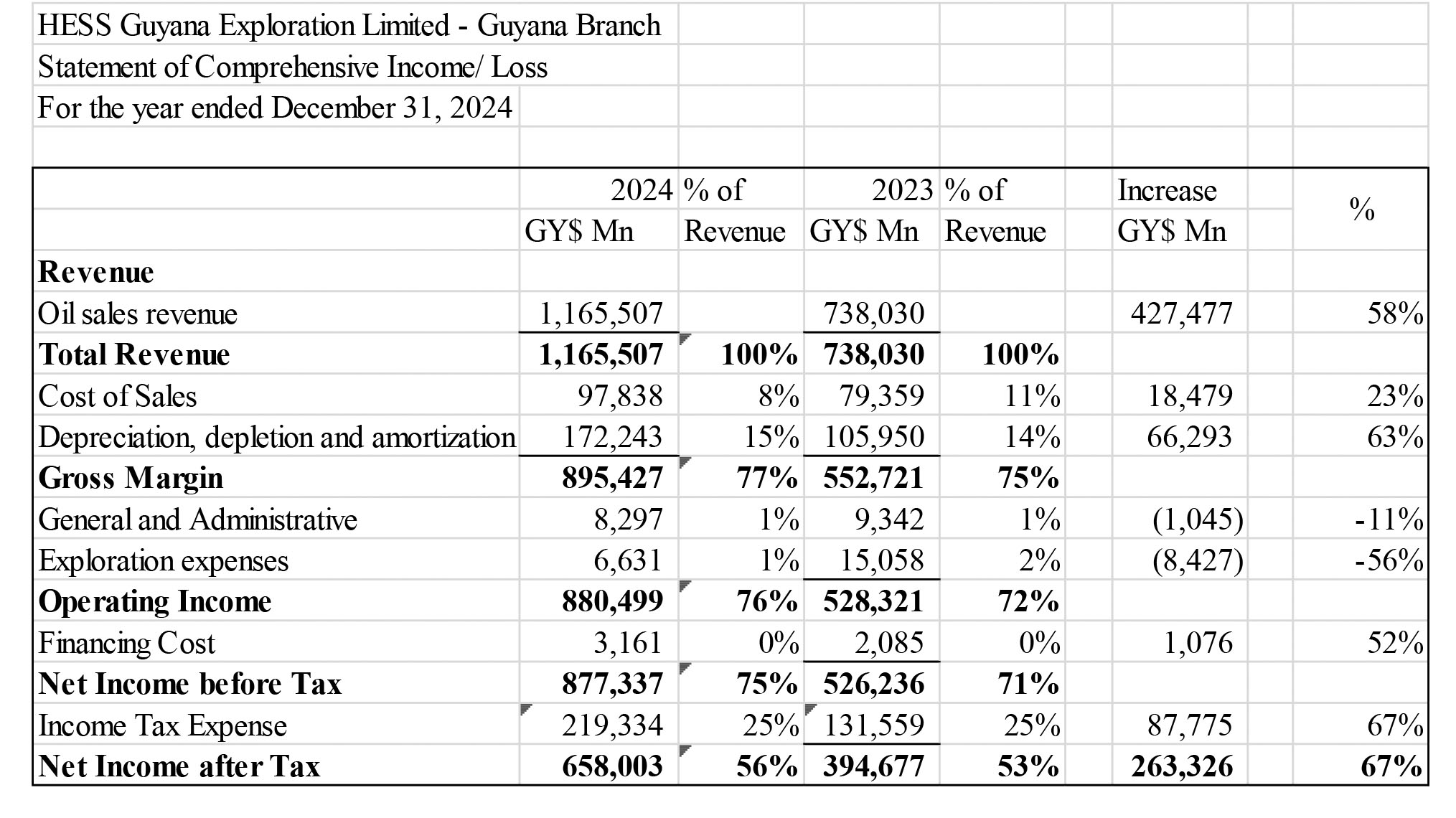
Except for the tax borne by the Government being accounted for as non-customer revenue, revenue is derived from the sale of 40 million barrels of crude oil in 2024 (up from 19 million in 2023) to a marketing subsidiary of Hess Corporation. Revenue rose by 58%, from GY$738.03 billion in 2023 to GY$1,165.51 billion in 2024. Cost of sales as a percentage of revenue fell from 11% to 8%, while Depreciation, Depletion and Amortisation accounted for 15% in 2024, up slightly from 14% in 2023. Gross margin reached 77%, up from 75%. General and Administrative expenses remained steady at 1% of revenue. Due to rounding, Operating Income was GY$880.5 billion before financing costs of GY$3.16 billion, leaving Net Income before tax of GY$877.34 billion—an increase of GY$351.10 billion or 67% over 2023.

Here comes the quirk. The Statement shows a tax expense of exactly 25% of pre-tax income, explained by Hess in a manner both confounding and misleading. Article 15.4 of the 2016 Stabroek Agreement clearly states that the Government of Guyana, not the contractor, pays the income tax liability using the State’s share of profit oil. Yet Hess describes this as a portion of “gross production,” separate from cost oil and profit oil, being used to “satisfy” the tax. This is not only misleading, it is false. There is no third allocation. The tax is paid from the Government’s share, exactly as agreed.

This dishonest accounting narrative is not the doing of local auditors or management. It originates in documents filed with the U.S. Securities and Exchange Commission and passed down to Guyana. That makes it not just a local embarrassment but an international one.

The Balance Sheet

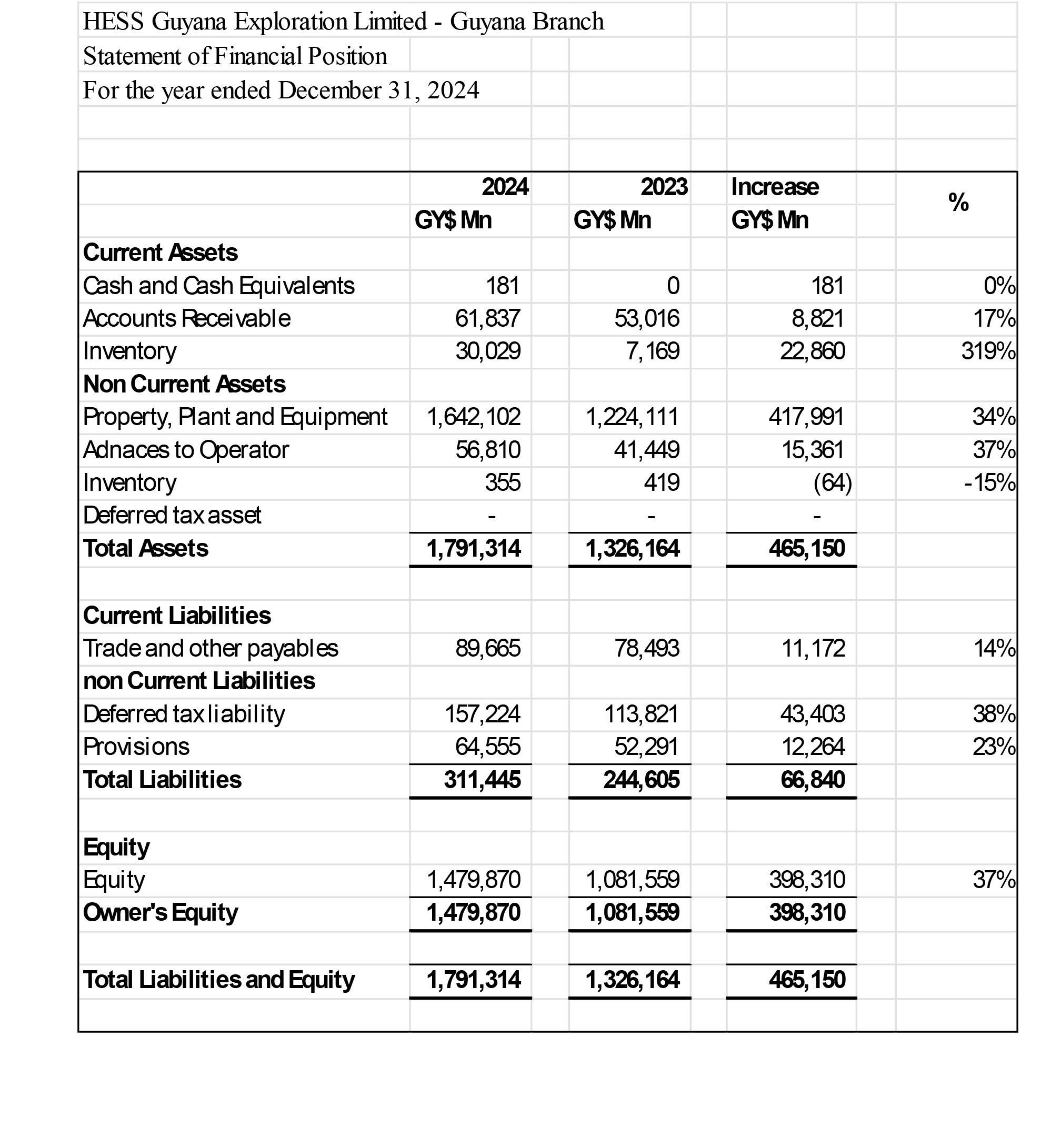
The Balance Sheet exhibited substantial asset growth, with total assets increasing by 35% to reach GY$1,791,314 Mn at year-end 2024, an increase of GY$465 billion from the prior year. Significant additions included the purchases of Liza Destiny and Prosperity FPSOs, as well as increases in material and supplies of over US$100 million in current inventory.  Receivables of $61,837 Mn were an increase of 17% over the previous year and represent amounts due from the sale of crude oil, all of which is sold to a related party.

Staggering returns

A key measure of financial performance is the return on capital, measured by income divided by average capital employed. Given that the profit before and after tax is the same (GY$ 877.34 billion), and the average of the 2023 and 2024 year-end equity figures is GY$1,280.714 million, the return on capital employed to Hess stands at a staggering 68.5%.

This means the company generated nearly 69 cents in operating profit for every dollar of equity capital deployed – an extraordinary return by global oil industry standards. Such a result confirms that HESS Guyana’s operations in the Stabroek Block are not only profitable, but exceptionally so, raising important questions about how much value is being retained by Guyana itself in this contractual relationship.

And this is the result. The Branch distributed to its head office – we are not sure which one – US$1,454,509,084! All for a 30% stake, and the extreme generosity of our politicians who accuse the nation of being “stupid” and “unable to understand.”