
On the Line: GBTI Half-year and Stockfeeds 2008

Introduction
In today’s Business Page we look at two reports – one on full year 2008 of the Guyana Stockfeeds Inc, published under the Companies Act 1991, and the other the half-year report of the Guyana Bank for Trade and Industry (GBTI) published under the Securities Industry Act, 1998. Because of the significantly different nature of the operations and the nature of the financial information and period ends of the two entities, no useful comparisons can be drawn and the appearance of the two reports in the same column is entirely co-incidental. Indeed, if any comparison can be drawn it is the poor quality of the editing that goes into these reports, leaving major errors, sometimes in the financial statements themselves, at other times in the narrative reports and yet others in both. For GBTI some of these were pointed out in a guest column in these pages by Robert McRae CPA on the 2008 Annual Report of the bank.

Such errors are often attributed to difficulties with printers but neither the management nor the auditors can absolve themselves from their duty to members and the public to have annual reports and accounts that meet minimum quality standards.

Guyana Stockfeeds Inc.

Highlights
2009.08.23_table1

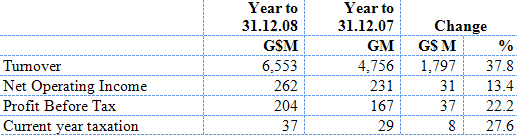
Despite what the Chairman referred to as “enormous challenges” the company recorded an increase in turnover of some 38% with sales of rice doubling while feed sales and hatchery sales increased by a more modest 29% and 21% respectively. As expected the Chairman was particularly pleased about the performance of the company’s brand of parboiled rice ‘Angel’ on the export Caricom market.

Of the net income for the year of $123M, after allowing for deferred taxation, the company proposes $60M in dividends or 49%. Dividends of $96M in respect of 2007, of which 50% is payable in additional shares, remain outstanding. The payment of dividends by the issue of shares was not effected as a result of a court matter with the National Industrial and Commercial Investment Limited.

How the company intends to fund the cash portion of dividends totalling over $100M is, however, not quite clear as the company’s liquidity position has deteriorated with the bank overdraft more than doubling to just under half a billion dollars and current liabilities other than dividends increasing over the 12-month period from $597M to $1,069M. Interestingly note 12 of the financial statements indicates that the company had exceeded its overdraft limit of $440M by more than $40M.

As is so common with public companies in Guyana, there is no mention in the annual report or the Chairman’s Report on the performance on the Stock Exchange of the company’s shares, although this may be entirely due to the fact that there is practically no trading in the company’s shares and that the company is developing into a family company with three of the top positions – CEO, corporate secretarial and finance – being held by members of the same family, which also holds some 69 million of the 80 million shares issued. This company is evidence of the permanent failure of the government’s privatisation policy, driven more by maximising short-term returns than long-term economic democracy. In all the government’s boast about macro-economic fundamentals, it does not appear to recognise that it has divested some highly profitable entities and has little to show for the proceeds. It is too late now for it to review the Privatisation Policy Paper issued under the presidency of Dr Cheddi Jagan, although it was under his presidency that we first saw the departure from policy under then Finance Minister Asgar Ally.

Accounting weaknesses
An observer of accounting and other disclosure requirements would find much of interest in terms of the contents of the Annual Report and the quality of the financial statements, even ignoring an obvious error of $400 million on the face of the balance sheet, which some may regard as the most important of the financial statements. These relate to the dating of the auditor’s report before the financial statements were even approved by the board, inconsistency in particulars about who the company recognises as key management personnel, disclosure about shareholdings, actuarial valuations and tax reconciliations.

That the company continues to pay US$50,000 management fees to a similarly named Trinidad and Tobago company for the payment of expenses on its behalf has continued to attract negative comments, since the logic and business purpose is not immediately apparent. On the other hand, the low effective tax rate suggests that the Revenue accepts the charge as reasonable having regard to the company’s business.

GBTI
In contrast to the financial statements discussed above, those of the GBTI are unaudited and cover the half-year only. In addition, there is no requirement for an Accountant’s Review or notes explaining the policies and judgmental matters relating to key financial statement items, and it is probably these limitations that explain the apparent lack of interest by the public and the business community in such half-yearly reports. Such statements should not be disregarded, since it must be assumed that they result from the accounting records prepared, subject to the limitations identified, in accordance with acceptable accounting standards.

Highlights
2009.08.23_table2

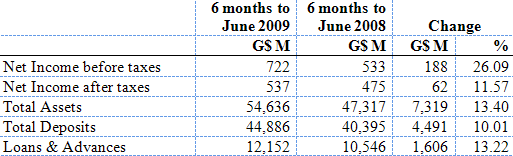
The bank’s performance for the half-year continues a run of excellent results not only for GBTI but indeed for all the commercial banks over the past three years. As the table above shows the bank has increased both deposits and loans, but with a barely discernible increase in the loan to deposit ratio. Our banks are performing so well that any observer of our banking sector would be bemused if told about a global financial crisis, although the anecdotal and empirical evidence is that the non-financial sector is having a lean time. We should therefore be anticipating with interest the publication of the 2009 mid-year report by the Minister of Finance which is unfortunately again late.

Net income before taxes has increased by a whopping 26% over the corresponding period in 2008, while the amount of $164.8M stated as Corporation Tax is the equivalent of 23% of net income. This represents a significant increase in corresponding equivalent percentage for 2008 when it was less than 9% and in the low teens for full-year 2008. This increase is so significant both for the corresponding period in 2008 as well as full year 2008 that we can only wait on the audited full year for some more evidence of such a dramatic swing over such a short period.

Tax policy
Robert McRae, CPA who did a guest column on the bank’s 2008 annual report had drawn attention to the bank’s effective tax rate and how little our economic managers seem to know or care about tax policy. A significant part of the problem is the VAT, a tax borne not by businesses but by consumers of goods and services. Guyana is stuck with a hugely miscalculated VAT rate that has masked any other concern that the government may have had about revenue collection.

In his column McRae had also raised the ire of the bank and the Bank of Guyana when he drew attention to a transaction between the bank and the Bank of Guyana, particularly in the context that the bank had for a second straight year had a significant deficit on its statutory reserve with the central bank.

The Bank of Guyana with unusual speed and generalisation reacted to the column but significantly has refused to answer some specific questions raised publicly by McRae. While commercial banks are, and indeed every person is, entitled to responsible financial reporting, they have a duty to respond to legitimate questions from the public on issues touching on their operations.

GBTI’s Chairman Stoby was noticeably pleased with the results and is upbeat about the bank’s performance for the second half of the year. Those results will certainly be eagerly awaited, but before then we will have some of the other banks including Republic Bank which has a September 30 year end. It will be an interesting period.

A review of the Low Carbon Development Strategy – Conclusion

Introduction
Today we conclude our review of the Low Carbon Development Strategy (LCDS) announced by President Jagdeo to the international community and now the subject of consultations taking place across Guyana. The first two parts of this series appeared in these columns on July 19 and July 26 and both before and since that time the reading public have had the benefit of a series of letters on the strategy both supportive and critical of it. More significantly, the Stabroek News has been carrying a ten-part review by Ms Janette Bulkan in which she addresses some of the more technical questions about forest carbon and our own forests about which she is extremely knowledgeable.

Not surprisingly, Ms Bulkan has drawn from a representative of the Guyana Forestry Commission and from the Office of Climate Change set up in the Office of the President strong criticisms, some of which have crossed the line into personal attacks. Ms Bulkan’s contribution has stood out for its scholarship and her responses to the criticisms have been measured and responsible. She and other critics have also been attacked for pointing out the serious weaknesses in the document and for not offering recommendations to improve it. That is regrettable for a number of reasons.

Confusion
One would expect those who are now employed as full-time specialists to recognise from the identified weaknesses the implicit recommendations for improvements. They cannot expect those from the outside to do their work for them. For all the money that is being spent on the LCDS, there seems to be no official voice and the structure of the website hardly fills the breach. As a result one is confused by the ambiguity created by the government’s assurance to the domestic audience that the country will not cede our sovereignty while the highly respected international weekly Economist informs the world that the Guyana President has committed the country to ceding to the world the stewardship of the country’s entire forests by outsiders.

Second, it is often easier to re-write than try to improve a document containing fundamental flaws; third, the government has refused to publish important information relevant to the strategy such as the McKinsey Study on which so much seems to hang, as well as the agreement the President signed with the Prime Minister of Norway which it seems will constitute some kind of model for developed countries to pay rainforest countries for drastically restricting forest operations. And there should be no valid reason for the government’s spokespersons being unwilling to concede the very valid points being made by others, and offering a commitment that these would be incorporated into the final document. Indeed no one is sure – and that seems to extend to the members of the LCDS Steering Committee – of the process for accepting and rejecting the submissions made by others.

Extravagant assumptions
In Part One of this series we said that the success of the LCDS would not be determined in Guyana but by what happens in Copenhagen in December this year, and in the more powerful countries of the world who the strategy expects to pay Guyana as much as US$580M per year for keeping our forests intact as our contribution to fight global warming. This column believes that there will be some money available but nothing on the transformative scale worked out by McKinsey. One has only to look at Exhibit 4 of the strategy which places the projections of expected government revenues for fruits and vegetables within a spread of US$40M–US$110M in 2013, an investment of US$80M–US$100M in 2009 and net exports of US$250M–US$350M after 2011. The estimate for aquaculture products seems even more exotic with a projection of 2013 government revenue of US$150M–US$200M, an investment of between US$135M and US$175M in 2009 and net exports after 2011 of US$500M–US$1,000M after 2011! It borders on the reckless to estimate government revenue in the form of taxation to be 30% of gross revenue, ie before expenses. Whoever did those numbers clearly does not understand our tax culture or the range of tax allowances including export allowances that are available for particular businesses.

I fail to see why anyone would not want to question seriously these projections, and inevitably the value arrived at by McKinsey of US$580M as the value debt owed to Guyana for keeping its forests intact. With Guyana having just 0.5% of the world’s standing forests, that figure which translates to a value of $116,000M, for all the rainforests is a huge sum indeed. No wonder even persons supportive of the LCDS do not believe that Guyana would receive anything like the sums quoted in the document.

And it is that kind of doubt that makes the proposed spending sound a mere wish list. There is nothing in the strategy that indicates how the government will adjust its proposed spending programme if the sums received are less than McKinsey tells us our forests are worth intact. And does the expenditure mean that the government will be engaging in these businesses or giving to particular businesses the money which should be for the country as a whole?

Poor accounting and accountability
As a columnist who has witnessed the bad accounting, misspending and unlawful spending which has become a defining trait of the Jagdeo administration, I shudder at the thought that this or a government with similar tendencies would have control of huge sums of money extracted from international donors to spend as they please. Our under-resourced Audit Office, minimal accountability, gross wastage, unprecedented extravagance, increasing corruption, widespread non-compliance with the financial regulations and poor accountability will hardly impress the international community, and it seems unjust and immoral to ask Norway or any other country to give us money to spend in a manner which their own taxpayers would find completely unacceptable. It is ironic that the LCDS may itself be an example of the absence of accountability. The 2009 Budget had no provision for all the structures, the huge consultancy fees, the costs of travel both locally and abroad being spent on the LCDS, and one has to wonder where the money is coming from (Lotto?) and who is controlling the spending. What we need to accompany any strategy is an accountability strategy that finds favour with our population.

Another reason for doubts about the strategy is that it is not rooted in the culture and habits of this government or in any strong commitment to the environment. For nearly two decades, Asian and Chinese logging companies and local chainsaw operators have been allowed to do almost as they wished with the forests, and efforts to reverse those practices will take time to produce results. The government imports for itself and allows the importation, often duty free, of large numbers of gas-guzzling vehicles; we have unlimited numbers of ministries and departments, no policy on recycling; we tolerate mining practices that are detrimental to the environment and dangerous to some communities and practise not big, but huge government. President Jagdeo most eloquently demonstrated that lack of commitment when he threatened to continue cutting down our forests if the rich countries do not pay up. Blackmail as Plan B can hardly be described as a strategy.
What if the money does not flow?

President Jagdeo is right that we need to protect the environment, but for the wrong reasons. By protecting our forests and our environment we are also protecting our present and future interests. He is also right that we need a strategy to lift the economy from its sub-par performance of below 2% since he became President to a level where the economy provides valuable jobs so that our artisans do not go knocking at the doors of our less-endowed neighbours only to be used and humiliated. He is wrong to believe that such a limited document can provide the blueprint for the economic growth and development of the country.

Guyana does not need a Development Strategy – it has one. Millions of real dollars was spent on versions 1 and 2 of the National Development Strategy (NDS) financed by the Carter Center during the last decade. It brought together the best that Guyana could offer in terms of time and talent and remains a sound document that could drive national development while caring for the environment. It recognised the value of the country’s forests, flora and fauna to eco-tourism which warrant mainly footnotes in the LCDS. It advocated a national forest policy with “guidelines for environmental protection and sustainable resource utilization.” President Jagdeo is half-right when he states that our forests are our most valuable resource – in truth it is the people – but the greatest value of that wealth can be derived if we sustainably manage them. It is not as the President seems to think, all or nothing. The NDS which President Jagdeo praised for its inclusiveness and comprehensiveness has languished largely unimplemented because of his own lack of commitment and attention span.

On the other hand, the LCDS is mainly a document for raising money. As such, it comes with too many shortcomings.

Those GT&T shares: To sell or not to buy; that is the question

Introduction
The decision by the Government of Guyana to sell its 20% holdings in the Guyana Telephone and Telegraph Co Limited (GT&T) has caused its fair share of discussion and debate in Guyana. That is not unusual or strange. Ever since the US Virgin Islands-based Atlantic Tele-Network, Inc took over GT&T, it has fascinated, annoyed, excited and generated intense interest among the public. It may have had to do with the process of the sale by the Hoyte administration of the highly profitable, foreign exchange earner under circumstances that still arouse some suspicion. It may have had to do with the revelation that the company was sold with hundreds of millions of Guyana dollars in the bank. It may have had to do with the distrust of multinationals of the late President Cheddi Jagan which seems to have been handed down to his party and some of the Guyanese public. Yet, like it or hate it GT&T has played a significant role in the modernisation of the telecommunication sector in Guyana.

The company boasts of the billions of dollars it has contributed to the national coffers. It is a major employer as well and appears to have had a very good relationship with its workers and their representatives. It has invested hundreds of millions of US dollars in new and modern plant and equipment and its service has reflected continuous improvement which may have been partly driven by the competition from the aggressive and agile newcomer Digicel in the cellular phone market. Of course none of this is due to altruism but to hard decisions about money. The company has also kept our courts busy and its conflicts with the Guyana Revenue Authority are legion.

FITUG and PNCR agree
Now the debate surrounding the company is about the sale of the government’s holdings with the government-backed FITUG and the opposition PNCR arguing against a sale and the government saying it would welcome a debate in the National Assembly. Business Page today considers the offer, which ATN has already refused, and some of the implications for a sale. From a review of my files (in the most innocuous sense of that word), the rights and obligations of the government as minority shareholder were never really clear and that is likely to muddy things a bit.

As a company incorporated under the old Companies Act Cap. 89:01, the company’s shares were under the control of the directors, and like any private company, GT&T was permitted to impose conditions and limitations on the transfer of its shares. Indeed Article 24 of the company’s Articles of Association gave the directors absolute powers to refuse to register the transfer of any shares in the company. Even though the new Companies Act takes a more enlightened view of the right of a shareholder to dispose of his property as he sees fit, sections 334 and 335 of the new act recognise as valid any of the old act’s provisions which may be inconsistent with the new act.

In 2007 I wrote that the government was not as free as it thinks it was to dispose of its 20% holding and that it would have to obtain the agreement of its senior partner if it wished to do so. I still hold that view. Unfortunately, no one appears to have given any attention to that first hurdle.

Ability to pay
The PNCR and FITUG have raised another hurdle and that is the sale of the shares to the employees of the company, which suggests that they are willing and able to pay for the shares, since they must know that the government has abandoned everything else for the maximization of sale price. But the PNCR and FITUG seem to have paid no attention to what a reasonable sale price per share could be. That could be huge. GT&T is in law a private company which means that its shares are not traded on a stock exchange and so the value of the share has to be calculated on what may be considered no better than an educated guess, using a range of factors and making a number of assumptions. Even in the best of circumstances there are at least six factors to be considered, but in the context of Guyana and the company, the number is considerably greater. Yet, one cannot escape the following six:

1. the nature of the business and the history of the enterprise from its inception;
2. the economic outlook in general, and the condition and outlook of the specific industry in particular;
3. the book value of the shares and the financial condition of the business;
4. the earnings capacity of the company;
5. the dividend paying capacity;
6. the market price of shares of corporations involved in the same or similar line of business, having their shares actively traded on the free and open market, either on an exchange or over the counter.

An uncertain future
While the computation of a price may be considered a mathematical exercise, it is based largely on the future, rife with its uncertainties. Consider, for example, the rapid changes in technology in the telecommunications industry, the not unreal possibility that the monopoly enjoyed by GT&T may soon end and the increasing and intense competition which Digicel poses to the company, and the uncertainties certainly mount up. The fact that ATN refused the government’s offer may very well be an indication that even the principal shareholder considers the future of the company far too uncertain for any further investment. In publicly filed documents the company’s parent has drawn attention to the uncertainty about the company’s licence resulting from action both by the government itself and the regulator. It would have been surprising as well if ATN did not consider that its 80% is as good as 100%. It really does not need any more shares in the company, so why not invest its money elsewhere? That is exactly what ATN has been doing and GT&T now accounts for less than half of the group’s revenues. The rest is all outside of Guyana.

So how much is one GT&T share worth? The Earnings per Share in GT&T exceeds $200,000 dollars, and if one values the share at a conservative P/E ratio of 8:1, the value per share is over $1.5 million. And if one uses the book value of the net assets of the company, which is generally considered a minimum price, the value per share is about $1.4 million. These are extremely rough numbers and it is likely that the value of each share on a more sophisticated basis, all things being equal, is an amount well outside the reach of the average worker in the company or the average member of the public.

Why sell a good thing?
Another issue is whether the government should be selling its interest in a company which has a guaranteed rate of return of 15% and which enjoys a monopoly in a still developing sector. There are arguments on both sides. The returns are clearly lucrative and the government does not seem to have any urgent need for funds given the continuous windfalls from VAT. Guyana must be one of the very few countries in the world which is recording increased government revenues in the crisis-prone 2009. High inflows from the Low Carbon Development Strategy are predicted, there are no pressures from its workers and the IDB seems to be as generous as ever, even in the face of increasingly costly and pervasive corruption in the public sector.

Will the government’s proposed regulations for the sector which it has so far not made available to the public have an adverse impact on the company and its share value? Is the proposed share sale more a jump-ship and the real intent of the government is to cash in while the going is good? These questions alone should cause potential buyers to hesitate and leave the government stuck as an unwilling partner to ATN while the value of its holdings depreciates.

On the other hand, the government has been remarkably negligent in managing its investment in GT&T. Under the Government of Guyana-ATN Agreement the government is entitled to board representation consistent with its percentage ownership, meaning that it can nominate two directors. Incredibly, the government has not taken up even one of these positions for the past five years, but yet complains about ATN’s management of the company. It is mind boggling that our NICIL/Privatisation Unit could have been so busy over the past five years that it was unaware of this gross dereliction of its duty to the nation to protect all the country’s investments.

What future for the shares?
It seems highly unlikely that the sale of these shares will take place any time soon. The government has clearly not thought through or prepared itself for what is a major and high value step; the calls by FITUG and the PNCR seem to be based more on emotion and politics than on the consideration of hard facts; and the potential for ATN to raise challenges cannot be underestimated. The government will continue to do nothing while the President spends the next few months looking for money from the ‘rich’ countries leaving the company to manage in the face of increasing uncertainties. If this government cannot mend an arrangement with a partner of close to twenty years, it is hard to see how it will deal with all the environment-friendly international businesses the President hopes to attract.

A review of the Low Carbon Development Strategy – Part 2

Introduction
We continue today with part two of the LCDS which President Jagdeo launched on June 8 and which is out for consultation up to the end of September, the timeline driven mainly by the need that it should be ready for the Copenhagen Conference in December of this year. That is when the world will be meeting to discuss a successor to Kyoto, the environmental treaty. The principle of the LCDS is simple enough. Rich countries, the thinking goes, have been destroying the environment at an alarming rate. And in its efforts to meet the demands of its people and not unusually the greed of illegal loggers, developing countries are unwittingly contributing to the impending crisis by the exploitation of their rainforests and eventual deforestation. Time is running out and there are few easy, inexpensive or quick solutions.
Cutting down the forests accounts for 20% of the world’s emission of greenhouse gases. The world then has an interest not only in halting but in reversing the trend of deforestation. To do so would be less expensive and faster than it would be to transform the world’s economies to make them more eco-friendly. In comes REDD – the acronym for “reduction of emissions from deforestation and degradation.” The basic outlines of REDD are clear. Rich countries will pay poor ones to keep their forests intact. In return, the rich will get credits that they can put towards their emissions-reduction targets under the proposed new climate treaty.

The promise
That on paper is simple and straightforward enough. As the Economist puts it, rainforest countries are being told “lay down your axe and you will get cash.” But it is far less simple than this or what the Government’s Frequently Asked Questions Booklet (FAQ) makes of it. In fact, that booklet along with the propaganda style of the consultations and public information programmes that are taking place to sell the LCDS do a disservice to the case, leaving serious and fundamental issues unaddressed which might not otherwise cause controversy. Which Guyanese would argue against higher and free revenue inflows, the preservation of our forests that help to protect the iconic Kaieteur Falls or, more mundanely, cheaper electricity? And who would oppose the promise of good governance, reduction of corruption, better delivery of education, health, water and housing?

If the LCDS promises holds true and the McKinsey arithmetic is more realistic than it appears, when the “money starts to flow” we will have the same level of public services, all capable of being financed not by taxes but from rich countries. The government will be able to charge a more honest rate of VAT and a reasonable rate of income tax. Our education system will offer many more QCs and Bishops’ and we will be able to afford a more functional and productive university. It must also be a huge incentive for the Guyanese public to support.

Cynicism
Yet the public has not warmed to the idea and even in areas where there are captive audiences, the average attendance to the consultation is, generously, less than 20. Despite the huge and expensive PR campaign the public is not engaging and is at best cynical. There are concerns about what the country has to give in return, the secret commitments the President has made to the world and the secrecy and apparent conflict between what he tells the world and what he says at home. The LCDS assures us that our sovereignty is not at stake, yet the President has committed the country and future governments to cede to the world the stewardship of the country’s entire forest by outsiders. That is according to the same Economist which has on more than one occasion spoken with admiration of Guyana and the President’s initiative. The consultations need to point out that no government can bind its successors and need to ask about any opt-out clauses under REDD. Would we have to pay back any money we receive as one country has been bound to under a bilateral arrangement, and are there going to be non-financial consequences as well?

The public is cynical too that President Jagdeo is already showing signs that his commitment to the environment is not guaranteed and only this week he issued a threat to continue forestry exploitation unless the rich countries put up the money to pay rainforest countries to keep their forests. The cynicism has been fed too by Mr Jagdeo’s fickle and inconsistent loyalty to strategies.

This is not the first strategy that the President has embraced. He effectively abandoned both versions of the National Development Strategy (NDS) when he realised that a debt-write off strategy was more lucrative and then jumped on the Poverty Reduction Strategy with its promise of more donor funds. Next has come the National Competitiveness Strategy that offers substantial funds from the Millennium Challenge Account sponsored and financed by the United States. Would Jagdeo’s successor – from whichever party – be as committed to the LCDS that he is now single-handedly offering? Or as some cynics see it, is the LCDS the case for a third term?

The LCDS and the NDS
Those who have pulled out their NDS to make comparisons with the LCDS are struck at the comparative absence of detail and the narrowness of the LCDS. By the standard of the NDS, the LCDS is a mini-sector strategy, and it is surprising that none of the 3,000 persons who have attended the consultations has asked about NDS 2 which covers the ten years 2001-10. How committed is the ruling party to the LCDS and does it know and agree with the ceding of control of three-quarters of the country to foreign control?

The LCDS seems extremely short on imagination and ignores any incentives to consumers in preference to investors. Why is there no incentive for solar heating or disincentives for those who contribute in no small measure to the huge fuel bill and non-friendly imports? As one colleague said to me, the owners of the Prados and Tundras that are allowed in daily under duty and tax concessions should give him a credit for driving a small vehicle. The LCDS leans to large-scale agriculture without recognising the role of the small operator or the damaging effect of illegal cross-border operators which is likely to worsen as the road to Brazil makes it easier for those operators to come, do and go as they please. With LCDS milk and honey flowing will Guyanese still have to bear one of the highest tax burdens in the world and would the President finally correct the VAT rate to what it should be?

Seeing REDD
A doubling of any country’s annual budget is not a small matter. The economy and the society can be transformed by simply doing nothing. That must be a huge incentive for any government. Not that that is how the government intends to spend the money. Under the strategy the government will set up new institutions in the Office of the President to drive major low-carbon programme priorities and manage and direct the use of the money coming in under REDD. It is of course hardly reassuring that the money will be placed not in some trust or the Consolidated Fund, but under the watchful eyes of the Office of the President which also currently controls the Lotto Funds in breach of the constitution. Since the President’s embrace of a low carbon economy is a new development, which fund did the money come from to pay McKinsey for its dazzling mathematics to show the worth of our forests? REDD on the other hand is premised on good governance, accountability and transparency which have been endangered by Jagdeo’s disregard for the constitution and the law.

Nor is it clear how the international community putting all this money into Guyana will view the two-tier approach of the LCDS, which provides for the forests under Amerindian control to be an opt-in arrangement. Effectively the country is committed to ceding the vast portion of the country to the international community, but not the Amerindian-controlled forests which that community would be at liberty to manage and/or exploit if it so chooses. While they have a historical and cultural interest in the forests’ preservation, if the Amerindians choose not to be part of the LCDS would they be excluded from LCDS funds or would they get the best of both worlds? And how does Jagdeo’s proposal to deal with LCDS funds fit in with Article 77 of the constitution?

The PPP/C government under President Jagdeo has allowed some Asian operators in the forest sector free rein to extract and export forest products under some of the most glaring transfer-pricing arrangements, with minimal returns to Guyana. Yet, the LCDS cannot be a legally acceptable excuse for breaking a binding agreement as the LCDS seems to assume. The same is true in mining which is probably doing as much immediate harm to the Guyana environment as forestry can do.

Image
Internationally Guyana has established quite a leadership role in forestry preservation due to the Iwokrama project, established under President Hoyte, whose foresight in all of this goes unacknowledged. With President Jagdeo’s promise to the world of what amounts to several more Iwokramas, our international image has been enhanced. But image is not enough. Clout is, and that would have come from the combined efforts of the six or eleven countries with rainforests, depending on definition. Brazil’s is infinitely larger than Guyana’s and surely it would have been to our advantage to team up at least with our neighbour and others in the hemisphere. Assuming there are funds for REDD which would be necessarily limited, criteria for entitlement will have to be established and instead of Guyana and Brazil being on the same side, they may be competing for the same funds.

The difficult questions
Nor is the REDD to be taken for granted, and while there is a recognition that rainforest countries should be rewarded for preserving their forests, the how, the how much, who receives and who pays and whether under a multilateral facility through the UN, or by way of bilateral arrangements as Guyana seems to be working towards with Norway, are still to be decided. Many European countries other than Norway have already entered into arrangements with developing countries. There is Plan Vivo under which donors channel money to Mexico, Mozambique and Uganda to protect forests and plant trees. External inspectors verify the results and issue credits which the UN has chosen not to recognise. Combining these into a ‘Kyoto 2’ will not be easy nor will an agreement be helped by reported corruption in the Office of Climate Change in Papua New Guinea.

Who pays and who benefits are also unresolved questions with one side effectively arguing in Guyana’s favour that those who have a good track record of forest management should be rewarded ahead of those who exploited and now want to re-forest. But the ‘who pays’ is even more controversial. China and India, despite their economies growing at a rapid rate and creating emissions in the process, consider themselves as developing countries and argue that they are not really ready to forgo development for the environment. Why not America? they ask, but America’s own recent climate change legislation shows that while preserving the environment is a universal issue, domestic politics dictate what can be agreed and delivered. And is Canada a special case for its vulnerability arising from the melting of the ice? To crown it all, the conference will be taking place in the year of the world’s worst economic crisis since WW 2.

For me the biggest question mark about the LCDS is its failure to consider a Plan B which hopefully is not the threat that President Jagdeo issued a couple of days ago – let’s continue cutting our forests under the prevailing lopsided arrangements with the Malaysian and Chinese operators who just could not give a damn about Guyana. One thing is for sure: the money he hopes to receive under REDD is several times more than the country currently earns from the sector.

Next week we take a break from the LCDS to cover some topical financial issues and return with a concluding part the following week.

A review of the Low Carbon Development Strategy – Part 1

Introduction
To all Guyanese, from Cabinet to Canal # 1, the announcement that the people of Guyana are willing to act in placing our rainforests under “globally-verified forest and other land use governance standards and transparent, accountable deployment of forest payments” must have come as a great surprise, if not a shock. Under what the government calls a Low Carbon Development Strategy (LCDS), the economy will take a new direction in which national development and combating climate change are complementary and not competing objectives. The strategy is premised on Guyana receiving huge annual sums from the international community for preserving its forests, sums in excess of what we now pay in taxes and also in the amounts of debt relief we have received in recent years. If the principle is accepted, not here in Guyana but in Copenhagen in December of this year when the United Nations convenes a conference to decide a replacement for the international treaty on the environment called the Kyoto Protocol, and if the strategy is properly implemented by Guyana, the LCDS can have a transformative effect on the country. It would be like the country discovering oil or gold from a non-exhaustible source, to last in perpetuity – economic nirvana. These are major ifs that have hardly been mentioned in all the exchanges witnessed so far in the public debate in Guyana.

Business Page will review the LCDS and engage in a reasoned assessment of the strategy, its perceived benefits, its practicability, weaknesses and chances of success. I will start by setting out and reproducing extensively from the Office of the President’s LCDS Draft for Consultation and its accompanying glossy Frequently Asked Questions, also described as a ‘Draft for Consultation.’ This will be followed by a discussion of the advantages and benefits to Guyana of the strategy, a critique of it and conclude with this columnist’s own views and recommendations. The series will try to avoid the unquestioning, simplistic and naïve attitude of those who are captivated by romantic notions about our forests or taken in by the consultations and commitments by President Jagdeo. Equally, it will avoid the dismissive reaction of those who decide that the messenger (President Jagdeo) could not in any circumstances deliver a good message. We will consider too whether and what the Plan B is or ought to be if Copenhagen does not accept or undertake to finance the fundamental assumptions and effect of the LCDS.

Background
Guyana is fortunate that it is one of the world’s last remaining rainforests with almost 80% of our territory still in its pristine state. This pleasant situation is the result of a combination of factors including the nature of our forests that does not allow for the extensive felling of trees, the preservation of the forests by our First People, mostly strong forest management by the regulator going back to fifty years and more, and the objection to the practices by some operators that generated the collective abhorrence of Guyanese of the exploitative practices of some of the recent entrants into the forestry sector.

According to the consultation document, Guyana’s pristine forests are its most valuable asset – the majority of its 15 million hectare (58,000 square miles) rainforest being suitable for timber extraction and post-harvest agriculture and estimated to contain significant mineral deposits below its surface. International Consultants, McKinsey & Company, appointed under a contract of which no Guyanese knew until recently, estimates the value of this forest – known as Economic Value to the Nation or EVN – to be the equivalent of an annual payment of US$580 million. According to the Office of the President, generating this EVN, while economically rational for Guyana, would have significant negative consequences for the world. The deforestation that would accompany this development path would reduce the critical environmental services that Guyana’s forests provide to the world – such as bio-diversity, water regulation and carbon sequestration. The draft states that conservative valuations of the Economic Value to the World (EVW) provided by Guyana’s forests suggest that, left standing, they contribute US$40 billion to the global economy each year.

Essentially the LCDS is arguing that since the world benefits by US$40 billion dollars per year from the conservation of our forests, and since to Guyana the annual worth of the forest in economic terms is US$580 million, then the world must pay us that sum. Unfortunately the basis on which the Office of the President has come up with these numbers is only summarised in the consultation draft. A more serious review of those numbers requires those studies being made available to those with the necessary skills to analyse such technical analysis, modelling techniques and econometrics.

Self-interest
But economics is only one of the reasons why Guyana should be willing to play its part in the preservation of its rainforest. Self-interest is another. We are dangerously vulnerable to and conscious of deteriorating and irreversible weather patterns placing us among the high-risk countries threatened by climate change. Much of the population and economic activity in Guyana exist at or below sea-level, and according to the draft, in-land flooding represents a significant and growing risk to investors. Major floods in 2005 were reported to have caused damage equivalent to 60 per cent of GDP.

One of the obvious consequences of climate change which only a handful of eccentrics are still prepared to dispute, is that sea levels will rise and more than likely at a faster rate than had been originally predicted. For example, researchers applying the possible scenarios outlined by the Intergovernmental Panel on Climate Change (IPCC) found that in 2100 sea levels would be 0.5-1.4m above 1990 levels, much greater than the 9-88cm forecast made by the IPCC itself in its Third Assessment Report, published in 2001. That would be devastating to coastlanders who would have to abandon everything and move scores of miles inland (or out).

The discussion draft notes the increasing global recognition that protecting forests is essential to the fight against climate change – forestry causes about 17% of global greenhouse gas emissions. Adding that the movement from recognising the need for action to actual action continues to be too slow, the discussion draft promotes the LCDS as seeking to provide insights on how to stimulate the creation of a low-deforestation, low-carbon, climate-resilient economy.

Epiphany
Even by his own admission President Jagdeo is a new convert to climate change and global warming and it was only as recently as December 2008 that he seems to have recognised the importance of these issues to Guyana. He has moved fast since then. In February 2009, he and the Prime Minister of Norway, Jens Stoltenberg, announced a partnership agreement designed to support a low-carbon strategy that includes employment and investment-creation opportunities in Guyana and sustained efforts to avoid deforestation and forest degradation. The consultation draft refers to a joint statement by the Guyana President and the Norwegian Prime Minister, but that statement has not been released to the public and I could not find it in the website reference in the consultation draft. There hardly seems any compelling reason for that statement not being available on the LCDS website and made available to the public-sector dominated LCDS Steering Committee.

In fact, given the implications for the country of the adoption of the strategy, it would be useful for the several documents referred to in the consultation draft to be made available to the nation. That will contribute enormously to an informed public and meaningful discussion. As we shall see many of the actions to be taken under the strategy would require substantial concessions and valuable incentives which will have to come either from the money received under the international arrangement or from taxation.

The four phases of the LCDS
The proposed LCDS will be introduced in four phases beginning in 2009 and continuing indefinitely. The following are the four phases and the intended Payments to Guyana.

Phase 1 (2009) – No sum indicated but the document refers to interim payments to launch the LCDS and funding for Monitoring, Reporting and Verification (MRV).

Phase 2 (2010 – 2012) – US$60M to US$350M for capacity building, human capital development and the investment required to build a low carbon economy.

Phase 3 (2012 – 2020) – US$350M to US$580M annually for essentially the same purposes in Phase 2 and for payments to avoid deforestation and climate change adaptation.

Phase 4 (2020 and onwards) – Greater than US$580M providing incentives at or above the Economic Value to Guyana.

What the strategy will do
The strategy comes perhaps midway in the National Competitiveness Strategy, promoted by the government as the centrepiece of its medium-term strategy and praised by the private sector for its inclusivity.

The NCS prioritises the modernisation of the four sectors on which our economy has relied for centuries – sugar, rice, forestry, and mining – and identifies five additional sectors with the greatest opportunities for new growth and diversification: nontraditional agriculture, aquaculture, manufacturing, business process outsourcing/information technology, and tourism.

The LCDS has more than just subtle differences with the NCS but these the private sector has so far ignored, at least publicly. Under the LCDS Guyana will:

Invest in strategic low-carbon economic infrastructure, such as a hydro plant at Amaila Falls; improved access to unused, non-forested land; and improved fibre optic bandwidth to facilitate the development of low-carbon business activities.

Nurture investment in high-potential low-carbon sectors, such as fruits and vegetables, aquaculture, and sustainable forestry and wood processing.

Invest in other low-carbon business development opportunities such as business process outsourcing and ecotourism.

Expand access to services and new economic opportunity for indigenous peoples through improved social services (including health and education), low-carbon energy sources, clean water and employment which does not threaten the forest.

Improve services to the broader Guyana citizenry, including improving and expanding job prospects, promoting private sector entrepreneurship, and improving social services with a particular focus on health and education.

Undertakings
To win support for the LCDS, the government is prepared to offer a number of undertakings to enhance operational efficiency, transparency and accountability for the execution of the LCDS. The principal new organisational units and systems include an Office of Climate Change (to coordinate all climate-related activities for the nation), a Low Carbon Strategy Project Management Office (to drive major low-carbon programme priorities), and a Guyana Low-Carbon Finance Authority (to manage forest payments and related investment flows into the country and promote investment efficiency to the benefit of Guyana’s economy). The first two of these will operate within the Office of the President.

And as mentioned in paragraph one, the government says it is prepared to subject the rainforests to globally-verified forest and other land use governance standards and transparent, accountable deployment of forest payments.