Insurance Commissioner should be addressing the public on Clico

Ms. Maria van Beek expressed surprise (SN letter of February 14, 2009) at what she describes as Business Page’s unspecified “assertions and suppositions” (February 8, 2009) on the role of her Office in the Clico issue. She claims that I did not seek her comments on it. She is wrong on both counts.

What did Business Page say about her Office? That it has been silent on the Clico issue (fact then and now); that it is very important for her Office to ask the right questions and to get hard information from the company (vital then, more so now); that the responsibility for supervising Clico’s operations falls entirely under the Commissioner of Insurance (is she disputing that?); that her Office should have been far more proactive than it has been in this matter (is that not a given?) and that the Office of the Commissioner of Insurance simply does not have the resources to properly regulate the sector (fact, just visit her room at the Privatisation Unit in Barrack Street).

But let us set the records straight. When I returned to Guyana on Friday, February 6th, to begin our firm’s preparation for the Budget 2009, I drove straight to Ms. van Beek’s office hoping to meet her in connection with Clico. She was not in office but her secretary spoke to her in my presence. She did not however call me until days later, after the column on Clico had appeared. To say therefore that I did not seek her comments is misleading for someone who regulates an industry subject to the principle of “utmost good faith”. I even had to do some special arm-twisting to get a copy of the 2007 annual report of Clico for which I had to pay her Office $5,400, at the prohibitive charge of $100 per photocopied page.

Almost as if there is nothing unusual about the Clico issue, Ms. van Beek expressed satisfaction that insurance companies have been addressed in BP, adding that she hoped that “this examination of an insurance company’s financials is one of many more to come.” There is no room for banality when $7.5 billion of people’s money in Clico is invested in related parties owned by the CL Financial Group, Clico’s parent which is facing serious liquidity and other difficulties. But yes, Ms. van Beek, just send me the financials and I will review them. Her office should be doing the same and providing informed periodic reports for the benefit of the public.

Too many public bodies are more concerned with protecting their image than in carrying out their mandate. Now that the Governor of the Central Bank of Trinidad and Tobago is claiming that the situation with the Trinidad group is more serious than first thought, Ms. van Beek should be addressing the public on the substantive issue instead of making small and wrong points about Business Page.

I appreciate Ms. van Beek’s offer of assistance and will be writing her for information to do a follow-up to the February 8 article.

Putting some sense in the 2009 Budget

Introduction
The National Assembly has the most unenviable task of making sense of the 2009 Budget presented last Monday in the National Assembly. The Minister of Finance apparently saw its greatest virtue as being the “biggest budget ever.” Not only is a boast on size from a Minister of Dr Singh’s stature interesting, but if size is the only thing that commends this budget, then there must be serious concern about its wisdom. Size only tells us how much of our money the government will be spending and where the money is coming from. It does not tell us how well the money is being spent and surely that is at least as important.

I understand that MPs, constituted as the Committee of Supply for purposes of Budget consideration, can at this stage, raise “any question relating to the line item being considered and all others relevant to the provided profile for capital items, description provided for each line item, etc.” They need to use that right to the hilt. In terms of ideas and direction, this Budget is by far the worst ever constructed under the Economic Recovery Programme, and even before. It perhaps reflects the involuntary departure from the Ministry of Finance of Mr Winston Jordan who long held the position of Budget Advisor and who was replaced by Ms Sonia Roopnauth, parachuted into the ministry, along with a Deputy Minister of Finance whose role and utility is hardly well communicated.

More resources for the Audit Office
Expenditure has been climbing inexorably over the years which Dr Singh sees, incredibly, as a virtue. The perpetual late availability of the annual report of the Audit Office on the annual public accounts is often of little more than curiosity interest. That adds to the responsibility on the committee to thoroughly review the entire Budget, even at the risk of being accused of stalling. They owe it to the nation.

By the time the year is over, with accurate accounting, we will likely see the highest deficit ever recorded by this country. If all goes to form we can expect that the audit report on the finances allocated in the 2009 Budget will not be available until some time in 2011, the year of the next general election. We can expect as well that the report will be subject to the usual defects expected from an office short of critical resources and accustomed to failure to meet statutory obligations. One of the urgent and most significant recommendations of the committee therefore is the provision of increased sums to finance a functioning Audit Office.

As usual, most of the big players know that because of weak supervisory oversight on spending, they have tremendous latitude on how they account and spend. There is still lots of money outside there that is not properly accounted for on the income or expenditure side of the accounts. That is the case with the Lotto funds and now NICIL headed by Mr Winston Brassington, involving over the years billions of dollars. Those are unconstitutional and unlawful acts. The committee must come down on this. Since a Budget deals with available resources and their application, the estimates (budget) as presented are not correct in that they leave out substantial resources. They should be referred to the Minister for amendment.

There is no known case in recent memory where any Budget figure was changed after debate. Additionally, a significant part of the Budget is based largely on the system of incremental budgeting − take last year and add x %. That is not budgeting but arithmetic. In other words if we spent $100 dollars last year we look at inflation and then do a top-up to arrive at the current year. If we assume even a modest 10% in fat, wastage and inefficiencies, a clinical surgery of that fat without going yet into “lean and clean” could cut the budget by $12 billion – allowing a reduction of several forms of taxation including the VAT.

Zero-based budgeting
No change will come about without a new approach and nothing ever will. But blame me for being an optimist. I think it can be done, even beginning in 2009. Dr Singh was keen to tell us again about his government’s plans for the constitutionally independent Office of the Auditor General. What he should be telling us is how he intends to improve and modernise the system of budgeting of government finances. As an academic and accountant the Minister would be very familiar with the system of zero-based budgeting (ZBB).

He would know that properly applied, zero-based budgeting is particularly useful in the public sector and that the UK government in its 2007 Comprehensive Spending Review carried out a set of zero-based reviews of baseline expenditure in government departments to assess the effectiveness of government spending and its long-term objectives. ZBB starts from the premise that no costs or activities should be factored into the plans for the coming budget period, just because they figured in the costs or activities for the current or previous periods. Rather, everything that is to be included in the budget must be considered and justified. In effect, start by saying the budget is zero and then add the cost of those things considered necessary.

The key benefit of ZBB is that it focuses attention on the actual resources that are required in order to produce an output or outcome, rather than the percentage increase or decrease compared to the previous year. Under ZBB, budgeting is no longer a number-crunching process of spreadsheets, but an exercise involving the budget agency and the spenders in an analytical and decision-making process. The stupidity of the government’s rhetorical question, where is the money going to come from if this or that tax is cut, is based on a lack of appreciation of ZBB and the whole budget matrix, a criticism I never thought I would make under this Minister’s stewardship.

Bloated government
ZBB is not rocket science. Admittedly our budget is distorted by political considerations like having to find ministries and placements for all those party loyalists and those willing to go on the elections slate, hardly a relevant factor for ZBB. Do we really need a Ministry of Sport with a Minister and a Parliamentary Secretary, when we have a Director of Sport and a National Sports Commission? Do we need two former ministers to advise the current Minister of Local Government which cannot deliver local government elections? And does the President need and use all those advisers in the Office of the President?

The committee looking at the line items in the Budget should ask for full particulars of the terms of employment of all advisers to the President and his ministers. Under ZBB there would have had to be good reasons to for their continuation.

Think what happens when you cut a ministry: savings on ministerial salaries and perks including chauffeur, guards, duty concessions, allowances, secretaries, public relations persons and property expenses. Even with the smallest ministry this can easily add up to hundreds of millions.

ZBB particularly lends itself to discretionary spending such as this and that activity, and showing overseas travel, etc. The committee should ask for details of the 2008 expenditure and 2009 projected expenditure on local and overseas travel by the President, ministers and other public officials. Almost on every occasion I travel I see some politician or other travelling first class. The committee should not be prepared to accept glib answers but only hard evidence on the amount and details of money spent for the President and his ministers’ overseas travel in 2008 and their specific spending plans for 2009.

Too many dollars, too little sense
The committee should ask about the $2.5 billion being spent on GECOM in 2009 – more than the amount spent on agriculture – and consider whether we are getting value for money. The Ministry of Foreign Affairs is getting $3.2 billion and cannot put a representative in the UK where even a government supporter has lamented we do not have a representative and miss many, many meetings. What contribution does former Home Affairs Minister Mr Gajraj’s presence in India bring us that cannot be achieved by contacts between our Ministry of Foreign Affairs and the Indian High Commission?

We need to know why with all this overseas representation the President has to go out of the country sometimes three times per month. Are our representatives not functioning and do the things the President goes to really require the presence of our head of state?

The committee should find out about the money allocated in 2008 for airstrips in Leguan and Wakenaam, for which no work was done. It should ask for information on the Hope Canal on which $3 billion is being spent this year – all from borrowings and on the basis of technical advice of which the public knows nothing. Should the committee not want to ensure that it acts before the money is spent and the problem remains? The committee should scrutinize the capital budget with the greatest of care – some $46 billion dollars are involved.

It should request the audited financial statements of the National Drainage and Irrigation Authority since it came into being in 2006. To give money to people who are derelict in their statutory duty to account is irresponsible. That of course applies to all the Budget agencies and those to whom public monies are given.

Conclusion
I do not expect that everything can be done immediately. But it is time that we move to serious budgeting and not indulge in politics and arithmetic as the 2009 Budget does. The Committee of Supply should request the presence of the Budget Director as it wades through the 2009 Budget. The accounting officer from the relevant ministry or department should be present to answer questions and if Minister Singh is too busy then his apparently under-worked deputy should be present at all the sessions.

Business Page would also like, respectfully of course, to recommend that we move to a system of zero-based budgeting and that we begin by identifying three or four ministries for the exercise in phase one, to begin in 2009. And to recommend as well that all positions paid from the public purse be listed in the Estimates, and not only those which have come through the Public Service Commission. Too much is being hidden.

Dr. Misir should respond to the issues

Dear Editor,

Dr Prem Misir suggests that I lighten up. Okay, I will. But first, an update. Dr Misir returned the copy of the Trinidad Guardian I sent him last Monday. The banner headline had reported on the en bloc resignation of the high-powered Trinidad and Tobago Integrity Commission after a judge of the High Court criticised its conduct. Dr Misir was too busy to write the cover note himself but not too busy to instruct someone to write it on his behalf. It must feel so good to have a part in the biggest budget ever!

I note that Dr Misir considers my reference to his fellow-team member from OP Mr Kwame McKoy as “possible implied ethnic allusion.” Disowning Mr McKoy − which I am sure was not because of ethnicity – Dr Misir claims he is a batsman with consistently high “scores.”

But I guess if I say like Lara and Chanderpaul or Gayle and Sarwan, on the charge of second-rating “our” boys, I will be taken to the Ethnic Relations Commission which has been picked just as has President Jagdeo’s new and improved Integrity Commission led by Dr James Rose – no ethnic allusion, implied or otherwise. Ignorant of Dr Misir’s score, I checked Wisden and Cricinfo under Prem Misir, Dr, spinner, batsman, twelfth man or scorer, but came up with nothing.

Then I checked the Guyana Chronicle which has faithfully continued the practice honed from the days of Burnham of “making the news.” Presto – he came up, circa 1992 – All round(er), can be intellectual but prefers to score with politicians, plays for PPP, UG, GINA and Office of the President. Bats, bowls and fields wherever told. Provides refreshments, scripts and endorsements when directed.

Instead of responding to the substantive issues addressed in my letter of February 8, Dr Misir provided a CV of his self-recorded scores. I admit that I could not see the relevance of his scores to any of the issues raised in my letter and directly related to corruption − the non-appointment of an Ombudsman and Procurement Commission by the President, a proper Anti-Money Laundering Unit, freeing-up the Guyana Revenue Authority from political influence, campaign financing rules, a respected Office of the DPP and the unique situation (and I really mean it in the strictest sense of that word) where financial statements signed off by a minister are audited by an Audit Office where his wife is a top level officer. Perhaps Dr Misir will tell us that they have constructed an Indian Wall (a la the Chinese Wall concept) in the Audit Office.

Dr Misir, wanting to explain why the President failed to address the Bradford Report on the Integrity Commission, was kind enough to educate us ordinary taxpayers that the report is just that. Would he then tell us why the government of President Jagdeo commissioned such a costly study and committed to having its recommendations implemented? And please no nonsense about us not paying for the study: the fungibility of money is an elementary and universally known principle. Was it a show? Like it was when the President told a meeting in Florida in 1999 that he would have zero-tolerance with corruption in his government?

Now some rather egregious acts of corruption actually take place in the Office of the President (Dolphin, Wildlife, disappearing bank statements). As a self-professed organisational specialist as well as a batsman, Dr Misir would know the price of irrational decision-making, which goes by many less complimentary names.

Then of course the organisational specialist-in-chief President Jagdeo, after considering the report for several weeks and after ordering that it be made public, discredits the report! But then for people like Dr Misir, Mr McKoy, etc, the President is the reinvention of the old English maxim that kings are infallible, although even they never behaved as if they were omniscient.

And what is this about the law of the land and the jurisdiction of the Integrity Commission? With his consistently high scores, Dr Misir must be aware that the Constitution of Guyana is the supreme law of the land which the President has sworn to uphold.

He must know that the President has on more than one occasion violated Article 170 of the constitution regarding his powers in relation to presidential assent of bills passed by the National Assembly and continuously violates Article 216 which requires all public monies to be placed in the Consolidated Fund.

He must know as well that neither under the constitution nor under the Fiscal Management and Accountability Act does the President have any authority to spend any public monies. And that under Article 94, the President may be removed from office if he commits any violation of this constitution.

Given his consistency, Dr Misir may wish to tell us whether he played in the cane-burning, strike-breaking, election-rigging game PPP versus the PNC when the PPP declared and conceded, citing critical support for the dictatorship. He may also wish to tell us about his practice of Eleanor Roosevelt’s famous quote about ideas, events and people.

Lighten up, Doc and then respond to the issues raised.

Yours faithfully,
Christopher Ram

The Integrity Commission is not a subject for spinning

Perhaps it is because in cricketing terms both Dr Prem Misir and Mr Kwame McKoy would be considered spinners of the pedigree of Ramadhin and Valentine; perhaps it is because they work at the same place, or that they write and think alike; or perhaps it is their knack for assigning a political party because they do not understand or practise independence, political or otherwise, but whatever it is, Dr Misir’s missive in the Stabroek News (February 3), repeated I believe in all the dailies, wishing me luck in my campaign in the 2011 elections surely extends their line about my political goals and plans. Dr Misir was even generous enough to wish me well, but then undermines his sincerity with the words, “I really mean it.” Or perhaps Dr Misir understands the need for such an attestation clause to add to his credibility. Whatever it is, I now make this public promise: If ever I decide to participate in the 2011 or the 2021 elections, which would be my preference, I will inform Dr Misir and Kwame first. After all they will, for their own purpose, publicise the news quickly and widely. And I really mean it!

In responding to the Business Page article on the Integrity Commission, Dr Misir made bold to say that the Integrity Commission exists with a functioning secretariat. What he did not tell us is how well it is functioning. Nor does he say that the secretariat as presently constituted cannot carry out its mandate under the Integrity Act, 1997. He does not say too that the commission, including the secretariat, has failed in routine administrative functions and that the commission and the commissioners have been derelict in their statutory duties. And that the commission has only an accounts clerk.

I can only wonder how Dr Misir can be so badly informed that he seems unaware of the rather uncomplimentary report done by external consultants Bradford and Associates, and that for over two years the accountable and self-appointed Minister, President Jagdeo, has been unable or unwilling to address the commission’s identified structural, organisational and operational deficiencies and the report’s recommendations, which this administration gave a commitment to the World Bank that it would implement. I am never sure whether the World Bank and the IMF are hopelessly spineless or dangerously gullible.

Dr Misir praises the President for sounding the alarm bell, which is the doctor’s euphemism for threatening a targeted group with prosecution. He does not say that the alarm came long into the still-born state of the commission and speculates on the President’s reasons for the timing of the chiming. Why he has to speculate given that he is the President’s spokesperson-in-chief is a bit of a mystery, every bit as surprising as penning his letter − apparently in his personal capacity. Perhaps it is because he described the episode started by the President as the “integrity thing.” But it is more than that; it is about possible criminal conduct, the rule of law, accountability and transparency. It is about how some politicians and “public servants” have come to acquire significant wealth on a bare state salary. It is about the kind of society and white collar criminality we as a society are prepared to tolerate. This is not something for spinning.

Some years ago when President Jagdeo appointed the wife of someone subsequently discredited to be a member of the Integrity Commission I wrote publicly that the commission itself needed a dose of integrity. I am now more convinced than then. As commissioners they need to be more virtuous than Caesar’s wife, ensuring that they comply with all the laws of the country and are scrupulously forthright about their compliance with all the country’s laws, including those relating to taxes.

But we need to fix more than the commission, which was part of the “integrity thing.” Imagine the President has not notified the commission of the resignation of Chairman George! Is this for real? We need to get the Office of the Ombudsman, the Procurement Commission and a proper Money Laundering Unit functioning. We need to free the Guyana Revenue Authority from political influence that may inhibit their zeal in going after the big-time tax evaders. We need proper campaign financing rules to free political parties from their secret and secretive donors.

We need an Office of the DPP which enjoys the total confidence of the public. And let us not forget, we need an Audit Office where the wife of a Minister does not hold a senior post.

It is time that we begin the serious and considerable work to be done; it is not a time to spin.

But back to Dr Misir’s letter. The letter jumps from me to the PNC, and then remembering what he had set out to do, ie respond to Business Page, he jumps right back to me in his closing paragraph. Perhaps Dr Misir was being too clever by half: accuse by association.

Finally, if Dr Misir wants to find out how a real Integrity Commission works I recommend that he consider what is happening with the Integrity Commission in Trinidad and Tobago.

If he does he will see that their Integrity Commission is enshrined in their constitution rather than a mere law; he will see the quality, qualification and background of its commissioners and the clout the commission has exercised in that country. In fact, just this past Thursday the entire commission comprising Chartered Accountant John C Martin, Chairman; retired Supreme Court Judge and former Chief Parliamentary Counsel Monica Barnes; Finance Consultant Peter Clarke and Chartered Accountant Vindar-Dean Mohammed, a full-time Member of the Tax Appeal Board resigned en bloc having been criticized by a judge. Their resignations took effect on submission to President Ellis.

Since I believe we have a duty to our fellow Guyanese to share knowledge and information, I am sending a copy of today’s (Friday) Trinidadian Guardian to Dr Misir. I hope he shares it with Kwame. And I really mean it!

Addressing the CLICO Issue

Introduction
Rumours that the region’s largest conglomerate CL Financial Limited (CL) was experiencing difficulties were confirmed at a dramatic press conference in Trinidad two Fridays ago, hosted by the Governor of the Central Bank and including CL’s chairman Lawrence Duprey and Finance Minister Karen Nunez-Tesheira. At the press conference it was announced that the group, better known by its founding acronym CLICO, had approached the Government of Trinidad and Tobago for a line of credit to meet some unusually large demands for withdrawals from CLICO Investment Bank (CIB), a subsidiary of CL.

The initial deal seemed clean, clinical and simple enough. The government and the central bank would take control of CLICO Investment Bank (CIB) while the assets and liabilities of CIB and another subsidiary, Caribbean Money Market Brokers (CMMB) would be transferred to state bank First Citizens. At the same time the Minister of Finance announced that the government and the central bank would guarantee the assets of depositors and policy holders at CLICO, CLICO Investment Bank (CIB), CMMB and British American Insurance by the injection of cash. In return CL was expected to give up vast swathes of its empire including its 55 per cent stake in Republic Bank Ltd (worth billions of dollars), its interest in Methanol Holdings Trinidad Ltd, which owns and operates the world’s largest methanol plant, and share its equity interest in CLICO and British American Insurance.

Jitters and praise
The government and the central bank were praised by the TT business community for their prompt and mature response and jitters appeared calmed. But things turned a bit sour when the government sought to pass necessary legislation to provide it with the remaining powers needed to extend supervision over insurance companies and to facilitate the transaction. The country’s Opposition Leader accused the government of having engaged in a hostile takeover; the press revealed that both the central bank Governor and the Minister of Finance had been connected with cashing out of deposits with CIB; Mr Duprey brought in UK Senior Counsel to advise him on the transaction while the government brought in financial specialists to assist in the valuation of the assets and in the restructuring of the companies. It was also reported that the Memorandum of Understanding among the central bank, the government and the Group was still being “clarified.” The government did however get the legislation that it wanted.

Guyana
The guarantees of policies and deposits by the Government of Trinidad related only to third parties and only in respect of the companies with which the memorandum was to be signed. They did not extend to other subsidiaries of CL Financial including the Guyana subsidiaries and those which are indebted to CLICO Guyana. Of particular interest to Guyana therefore is the impact on policies including annuities and deposits with CLICO Guyana, and deposits with Republic Bank (Guyana) Limited (RBGL), a subsidiary of the Trinidadian parent whose majority shareholders are those entities being taken over.

Let us look at the last first. Chairman of the local RBL and Managing Director of RBL Trinidad Mr David Dulal-Whiteway announced that government’s gain of Republic Bank’s shares from CL Financial is only an interim measure to secure financial support from the state and will not involve operational control of the bank. The Guyana Association of Bankers (GAB) gave full support to RBGL in a late-night statement issued on January 30 in which it welcomed the decision of the Trinidad Central Bank to intervene to support CL Financial Limited. It noted that commercial banks locally “held excess liquid assets of $29.6B or 71.6% above the statutorily required level,” and that “depositors can feel very confident and assured that the stability and integrity of the local financial system is guaranteed.”

CLICO Guyana, in which two of the three directors are Trinidadian, issued its own statement through its CEO Ms Geeta Singh-Knight in which she announced that the statutory fund (required by the Insurance Act 1998) of the company which is a separate entity within the CL Financial Group was “in good standing”; none of its assets are intertwined with CLlCO [TRINIDAD] or CLlCO Investment Bank”; and that developments involving its parent CL Financial Limited have no financial impact.

Meeting
On the day the news broke in Trinidad, Minister of Finance, Dr Ashni Singh summoned a meeting with CEO Singh-Knight and Commissioner of Insurance Maria van Beek. He wanted to ascertain the extent of exposure, if any, of CLICO Guyana to the events in Port-of-Spain and requested the company to supply to the Commissioner of Insurance by last Monday further “information on the financial status of the Group, details of the transaction agreed with the authorities in Trinidad and Tobago, and of the implications of these developments for the operations of the Group as a whole and the Guyana company in particular.”

Nothing further has been said publicly by the Minister who appears to have committed a procedural error of judgment since the better thing to do would have been to meet with the two parties consecutively. The public has not been told whether all the information requested has been provided and analysed and the Commissioner of Insurance has been silent.

Like Trinidad, CLICO Guyana takes money on deposit from the public but because of the Bank of Guyana’s interpretation of the law the company does not require a licence from the Bank of Guyana to do so. As a result the responsibility for supervising CLICO’s financial operations falls entirely under the Commissioner of Insurance and the office should have been far more proactive than it has been in this matter. There is a lot at stake, including insurance policies, annuities and pensions, and huge sums invested in the company by the NIS.

Monitoring
President Jagdeo announced that his government was watching the situation closely, and trying to put into context the scale of any potential problem the company may encounter, noting that CLICO (Guyana) makes up just three per cent of the country’s total financial assets. The President who has appointed the company’s CEO to the GuySuCo board added that the only problem he could envisage in the short term was a mismatch between liabilities and assets.

Then late on Friday Deputy Governor of the Bank of Guyana, Dr Gobind Ganga said that the central bank is “very much concerned” at the financial crisis within the CL Financial Group and confirmed that the bank is tracking every bit of information being provided on the issue as it develops – hardly a clear statement in these circumstances.

Such statements may sound good but what is needed is critical analysis of factual information, particularly given the attention span of politicians. The discussions between the government and the company seem to emphasise “investments or dealings with sister companies CIB or CLICO (Trinidad),” which can cause dealings with other related entities to be overlooked.

So far no one seems to be dissecting the 2007 financial statements, or requesting a copy of the Memorandum of Understanding and asking that the relevant transactions for 2008 be made public. It cannot be too hard to determine the liquidity situation of the company or the exposure to related parties – the issues that sparked the crisis in Trinidad. CL’s financial statements for 2008 are not yet out but the regulators in Trinidad have obviously requested and received them.

A limited financial perspective
The audit of the Guyana company’s books for 2008 is in progress and only the 2007 statements audited by Deloitte and Touche are available. I therefore sought some updated information from Ms Singh-Knight who was most forthcoming and extremely helpful.

The 2007 financial statements, which regrettably are not that reader-friendly and could benefit from significant enhancements, state that the company is a wholly-owned subsidiary of CL Financial Limited. At December 2007 it owed CLICO Trinidad $1.2 billion (representing 10% of its total assets) and reduced this balance in 2008 to $800 million. This amount is interest free but repayable on demand. Does the Memorandum of Understanding permit the deferral of the debt in the interest of the Guyana company or not?

The net assets of the company at December 31, 2007 amounted to $11.7 billion of which $1.2 billion was classified as current assets but which included accrued investment income of $500 million, largely from related parties. In the bank at that date was $127 million. Its current liabilities or payables are stated at $1.7 billion including the $1.2 billion owed to CLICO Trinidad. The company treats all policy holders’ funds as equity and these include $8.030 billion in Ordinary life policies, including annuities. The holders of these annuities can surrender their policies and expect to receive payment within one week.

The company’s primary investments are in Caribbean Resources Limited (CRL) and CLICO (Bahamas) Limited. At December 31, 2007, investments in these entities totalled $1.5B and $6.0B or 13% and 51% of total assets respectively. Investments in the Berbice Bridge Company Inc (BBCI) total $1.8B, or 16% of total assets bringing total investments in three related entities to 80% of total assets.
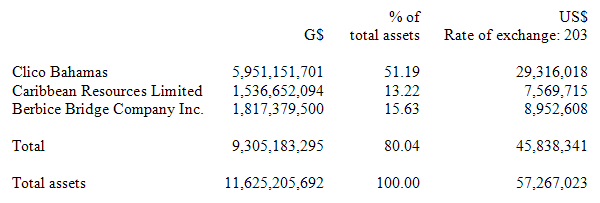
20090208_table
Source: CLICO Guyana Annual Report 2007

The last annual return filed by CRL was for 2001 and therefore updated information was not available for our review. The investment in CLICO (Bahamas) Limited, an insurance subsidiary of CL whose 2007 financial statements are available on the internet, represents approximately 30% of that company’s assets.

The Guyana company’s financial statements describe the investments in the Bahamas company as Fixed Deposits, which is misleading since that suggests a banking type deposit. In fact, despite the auditors of the two entities bearing the same international name, the Bahamas company in its corresponding account includes the amount not in Equity but as Annuities under the broad heading Future Policy Benefit Reserves.

It is apposite to note that as the 2007 financial statements indicate, the company is in breach of section 55 of the Insurance Act 1998 which requires that 85% of the statutory fund be held in Guyana. One now has to wonder whether the company has taken steps to remedy this situation.

Bahamas company
The CRL investment is guaranteed by the troubled CL Financial group while the investment in the BBCI would clearly not be liquid. The Bahamas company too has its own problems with the auditor’s report containing an Emphasis of Matter noting that 59% of the company’s assets were invested in a related company, CLICO Enterprises Limited. The audited financial statements did not show an amount due to the Guyana company at December 31, 2007 in its related party notes, but annuities total 70.0M Bahamian dollars, of which Guyana would hold 42%.

On August 21, 2008, AM Best Company Inc, a financial services credit rating organisation, downgraded CLICO (Bahamas) Limited’s financial strength rating to B (Fair) from B+ (Good) and issuer credit rating to “bb” from “bbb-”. The outlook for both ratings is stated as “negative.” The ratings for Colonial Life Insurance Company (Trinidad) Limited were similarly downgraded on February 2, 2009 as news broke of its troubles and both companies were placed “under review.”

Conclusion
I was informed by the company’s CEO that it has met all demands for funds since the news broke. The last thing the company needs is an unusual demand from its policy holders. What is now very important is for the Minister of Finance, the government and the Office of the Commissioner of Insurance to ask the right questions and to get hard information from the company. Now that everyone has been before the cameras and has had their photo opportunities, the hard work must begin.

It is not enough to downplay the impact of any potential difficulties and we should not forget that the NIS up to December 31, 2005 (the last date for which financial statements have been released) was heavily invested (to the tune of $7.7B) in the company. Unfortunately Ms Linda Gossai, a member of the scheme’s investment committee would not disclose to me the extent of its current investment, claiming that she does not “keep those figures in her head.” Instead of simply tracking information on the issue as it develops, the Bank of Guyana needs to start thinking whether, like Trinidad, there are regulatory issues which need to be addressed with respect to what amounts to deposit taking by some insurance companies.

The Bank of Guyana should have long contacted its counterpart on a confidential basis for a copy of the Memorandum of Understanding and to have an informed basis to deal with its concern. Too many people just seem to be waiting and that is not good enough at any time, let alone now. It is also clear that the Office of the Commissioner of Insurance simply does not have the resources, the authority or apparently the will to deal with issues like these. The local authorities should act quickly by first obtaining and analysing the relevant information and having further discussions and agreement with the company, and then following this by a visit to Trinidad and The Bahamas to meet with the relevant persons. Delay only drags the situation out, which is not good for either the company or the economy.