
A man for all seasons

As my family mourn the passing of our gardener who touched the lives of all seven of us, I cannot help but note how in our society, obituaries seem reserved for the rich, the powerful and the famous. And how the remarkable qualities of the less fortunate are ignored in their lifetimes and forgotten at their death. He was sixty-nine years old but no one, young or old, knew him by any name other than ‘Pops.’ Since his sudden death last Friday, the members of our family have been expressing their impressions of Pops and it is remarkable how we each saw him in our own special way.

Christelle who is ten remembers Pops not as the gardener but for the way, “We all felt like family,” for being there every day, not as work but as a hobby. She remembers Pops for always watching over her, her sister Christen and brother Christoff with care and love as they played outside in the yard.

Christen remembers seeing him coming to work on his red bike, putting on his hat when the sun was hot and taking refuge in the garden shed when it was unbearably so. She remembers him as always being at Ogle – in the morning when she woke up, to the time she came from school, and after she migrated, on her vacation from the US. She recalls how if there was a stray cat around, he didn’t get rid of it, he took it home and cared for it.

Ravee remembers Pops as simple a man as one can ever know. One who could neither read nor write but whose life proved that one does not have to be an intellect to be special. Having known Pops since he was an early teenager, Ravee’s fondest memories of Pops are the times he would sit outside on the patio at Ogle and just ‘gaff’ with Pops.

From those “dozens of conversations” over the years [and no doubt for Pops’ helping to slip him in the house when he came in late after the rest of us were asleep], Ravee remembers Pops as loyal, honest and caring.

Christoff who is perhaps the quietest of our children remembers Pops as “a man who you could talk to for hours on end no matter what you are doing.” He recalls how Pops could carry on a conversation about most things and how he had something to say whenever Christoff went outside.

Ena recalls that having first worked as a tiler while the house was being built, Pops brought a garden into being from what was up to then a pasture, giving life to their ideas and richness and warmth to the yard. He was always reluctant to prune the plants, arguing that to cut off the flowers or fruits was a sin. Practical man as he was, while taking care of the flower garden, he argued respectfully for more attention and space for the kitchen garden, noting, “You can’t eat flower plant.”

For me, Pops represented treasured values and an era that is sadly passing. He cared for our children with love and respect, treated his job as sacred, never missed a day’s work on account of rain or shine, ill-health or holiday, never quite trusted the motor car, thought the computer flash drive I sometimes carry around my neck as a “tabeej” (the Hindu phial to ward off evil), never questioned an instruction or a request that he cover for someone who had not turned up for work. He had a remarkable sense of humour and brought to the daily discussion with his colleagues the most practical point of view, scolding Benjie, who works in the house, “Man han(d) mek fuh wuk, nah clap roti,” or telling Ena, if she dabbles with her hands in the garden, “You nah doo dah, da ah me wuk, you guh look after de bass.”

He was caring and loving. I never heard him raise his voice to anyone and he would willingly offer to share his modest lunch with any of our other staff, even as he took out his false teeth to start his meal.
He was the only Indian among the Ogle staff but mixed freely, could discuss race without causing offence and was great fun to be with.

Recently he and I were discussing his future and as he looked forward, his words were, “Me nah ah guh nowhere, ah right ya me guh dead.” I thought there and then how much Ena, Ravee, Roger, the three youngest ones and I are indebted to him.

I actually looked forward to the day when we could do something for Pops, to help him through his old age, as he has done for us as a family for fifteen years. Now, that opportunity has gone and we are left with cherished memories of one of the greatest men I have met, my father included.

We were indeed fortunate to know him and have him as a member of our family for as long as the youngest children have been around.
When they went to live in the States it was Pops with whom I shared my Sunday mornings while he tended the plants and vegetables as if some divine authority was causing him to act with the highest standard of love for the land, for nature, for his colleagues, his grandchildren and for us.

Christen, as children do, thought that his enduring qualities would cause him to be there forever. He may not be, but his memories and values will be.

Farewell, Pops, you have done your duty, made your mark and as Ena suggests, you are called on to other gardens. We will miss you though.
China and India – Reshaping the world economy (conclusion)

Introduction

Not a day goes by without something being written about the miracle of China and India and the inevitability of these great countries graduating to superpower status. Their praises are sung in hyperbolic rhythms by a body of writers who have created a whole new cottage industry dedicated to them. The only question in the minds of many of these writers is not whether but how soon the two Asian giants – or as they are sometimes called the dragon and the elephant – will return to the glory days of four centuries ago when they were the dominant forces in world trade. One estimate is that by mid-century, India and China’s share of global output is expected to grow from 6% now to around 45%, spurred both by exports and burgeoning domestic purchasing power as more and more of their more than 2 billion people copy and can afford to live western lifestyles. All the measures suggest that China and India will overtake Germany and Japan and dwarf every other economy except America.

China is spending like a runaway train with expenditure on transportation infrastructure in the five years from 2001 to 2005 exceeding all the expenditure in the preceding fifty years. Spurred by the need to impress the world at the Summer Olympics later this year, it has built its new airport terminal which is 17% larger than Heathrow, faster than it would take London to complete an enquiry to consider whether it would add another terminal. Nothing seems impossible anymore so that when China announces that it will complete an expressway from Beijing to Taiwan’s capital Taipei by 2030, no one considers the challenges of crossing the 150 km Taipei Straits. What China does in one year, other countries seem unable to achieve in as many as ten.

More statues of Jesus

Some questions have however been creeping into the writings suggesting that the world needs to consider more than the marvel of these two giants which, even before their resurgence, had given the world so much. Among China’s many gifts going back more than one millennium are the clock, technology in hydraulics, shipbuilding, weaving and spinning machines, paper and ink, and more leisurely comforts like the toothbrush and playing card. Then like now India’s gifts were in know-how including mathematics from the decimal point to the Pi (the numerical ratio of the circumference to the diameter). Complacency overtook them both as power and politics placed a brake on their development.

Once again, in the blink of an eye, both countries have become so big that economies around the world – from its neighbours in Asia, Europe and North America – are now dependent on them for a full range of goods and services. In their separate ways, China’s workforce and work ethic and India’s information technology and back-office services have brought down prices for the family, the office and the factory. It is ironic that more statues of Jesus are made in atheistic China than are made in the entire Christian world! There are few products in the world that do not include some component or know-how from these giants and it would not be surprising if the harshest critics of out-sourcing among television commentators were wearing shoes or garments made from China. Indeed even those thousands in San Francisco protesting China’s Tibet policy during the passage of the Olympics Torch in their city last week might have been similarly attired. There simply is no getting away from the growing dominance of China and India.

Economic and military power

Yet, nothing should be taken for granted and admiration can easily turn to hatred if these countries behave like superpowers usually do, flexing their muscles and showing no regard for domestic and international concerns. China, for example, is accused by its critics as being willing to work with the most extreme regimes, as in Darfur, if only to source raw materials for its huge factories. Its size and economic power are fast translating into military ambitions and it has its sights set firmly on Taiwan which is now treated as a pariah by so many of its former friends, afraid to offend China. China’s patience is legendary but will it lose it and “reclaim” Taiwan and will the world stand idly by?

As world demand for Chinese goods and Indian technology increases, it brings with it increasingly affluent domestic populations aspiring to higher standards of comfort, if not luxury. To meet those growing demands, China and India are displaying an increased appetite for natural resources, contributing to the driving up of prices of commodities including food around the world. But as their factories produce the goods to meet both international and domestic demand, they add to the pollution problem of their people and the rest of the world. It is troubling that neither country, along with the USA and Australia seems willing to enter into binding commitments on pollution controls. They will need to learn a lesson from America when it comes to the use of economic and military might.

The mighty challenges

With the Communist Party still calling the shots in China and national and provincial politicians wielding considerable influence in India, corruption remains high in both nations. China is still to safeguard the intellectual property of manufacturers, the music industry and the arts. The state of the laws generally has not kept pace with development and cases of broken contracts and theft of intellectual-property are often not worth pursuing. India has a Western-style legal system that produces decisions that rank with the best the House of Lords can offer. But as they say, one cow does not make a herd and the country’s court system generally moves at a snail’s pace.

India’s growth can also suffer at the fiscal level. Budget deficits are high and with the considerable infrastructure deficit and the army of poor and hungry Indians wanting a piece of the Puri, it will require sustained growth to generate the taxes to meet the necessary demands on the federal and state budgets. Disease thrives on poverty and even as India promotes health tourism, the potential for a pandemic is ever present as AIDS and TB threaten hundreds of millions.

India has been relatively fortunate that it has been able to graduate from a low growth rate despite failing infrastructure, a bureaucracy controlled by a 10-million babu raj exercising impenetrable red tape, and an inhuman caste system that seems as unmovable as Mount Everest. The politicians in India are finding it difficult to erase the Gandhi/Nehru philosophy of self-reliance and restrictions on bank lending and foreign investment which impose limits to growth and development.

Unemployment

Despite all the economic achievements of China and India, each year tens of millions of youth join the job queue, some in front and others behind the estimated 200 million yet to reap the benefits of the Asian Miracle. The heavy hand of China was inadequate to prevent more than 57,000 labour strikes while social rights activists in India lament the failure of economic achievements or social programmes to reach the poor. In a federal democracy that could be a recipe for political instability which can derail any economic train.

China’s critics complain about the country’s labour practices which permit low wages paid to workers forced to perform under dehumanizing conditions, about large state subsidies, violations of WTO Rules including dumping at below market prices and an undervalued currency, the Chinese yuan. As the benefits of industrialisation stretch into the countryside and bring urban/rural wages in a more tolerable relationship, farms are being destroyed and farmers deprived of their lands creating serious tensions between the party and the people.

For all its greatness and growth, China is considered hugely wasteful. Even as the world marvels at its 9.5% growth rate in 2004, it should not ignore the fact that $850 billion – half of GDP – was mainly plowed into already-glutted sectors like crude steel, vehicles, and office buildings. Its factories burn fuel five times less efficiently than in the West, and more than 20% of bank loans are bad.

China is also confronting its biggest problem and one that can cause it to lose its competitive edge, its one-child policy introduced as a population control measure. By 2015, its working-age population will begin to decline and in 20 years, an estimated 300 million Chinese will be over sixty years old with no guarantee of any state assistance. With a growing middle class and persons less reliant on the State, can China continue its communist ways and treat any future Tiananmen Square-type uprising with the same heavy hand that it used in 1989 and will the world remain spineless as it tramples the rights of the Tibetans as it is doing now?

Conclusion

For all the dazzling performance of China and India, their continued success will take more than cheerleaders. They currently only account for 6% of global gross domestic product, half that of Japan, and while the signs are good, their success is not guaranteed. The expectations of the hundreds of millions of their people will only be satisfied if the economies of these countries continue to grow at rates that guarantee jobs for the tens of millions entering the workforce annually. That is a huge responsibility and for a world that depends on the goods and services from those countries, any setback in the two countries would have a huge and possibly disastrous effect.

China and India – Reshaping the world economy

Introduction

To be honest, this article was prompted by China’s harsh treatment of the people of Tibet who would just like to live in peace, free from the heavy hand of Beijing and to practice their Buddhist lifestyle. It is taking place in a glory year for China as the Olympics are held in that country whose government will simply not have anyone spoil their party, not even crusaders for human rights or nationalist respect. Even though such consideration and debate do not rightfully belong to this column – the first in a two-part article on the two fastest-growing economies of the world – such consideration is not entirely irrelevant since economics have social and other consequences as economic power sparks other ambitions and attracts fear if not respect. Indeed this perhaps explains why no country is planning to boycott the Beijing Olympics and why human rights abuses in China are discussed in only the most veiled terms.

In Guyana we must never ignore human rights issues anywhere, but an equally important consideration in any discussion on China and India is the importance of the right mix of policies to spur economic growth and development. Indeed the experiences in China and India are not entirely dissimilar to us here where we attempted to practice an extreme form of socialism beginning with the Sophia Declaration in 1973 and ending with Hoyte’s version of Glasnost, his embrace of the IMF and Cheddi Jagan’s continuation of the programme despite his personal and his party’s antagonistic position to the IMF. We too experienced good growth for some years but this fell off amid other conflicts and the economy has survived in great measure because of debt write-offs.

Reclaiming their rightful place

When in 2006 the Prime Minister of India proclaimed that India and China are on the way to reclaiming their rightful places in the world economy, the world did not see that as some idle boast or threat but rather a simple factual statement. America and the West called for globalisation and China and India opened their doors, not completely, but enough to cause huge consternation and fear among segments of the American population at the way these two countries are shifting the tectonic plates of the world economy. What makes the story of China and India is not only their similarities but their differences – ideologically, historically, culturally and economically. One is dictatorial while the other is democratic; the court system of one would be considered too free by the other; China is Communist but pro-business while India is free-market but at times highly suspicious of business; one emphasizes its human infrastructure while the other promotes the low wages of its people; one still operates with a Five-Year Development Plan while the other seems to worship not any omnipotent, all powerful, many handed deity but the invisible hand made famous by Adam Smith.

But it is not the differences that cause leading journalists like Lou Dobbs to worry – rather it is their similarities – up to recently they were considered part of the Third World, too large and too poor to succeed, over-populated and almost unmanageable. Yet before the world could appreciate the release of the latent powers of numbers, India and China have become the fastest-growing economies giving them the claim to superpower status in less, far less than twenty years. It is true that they will never be able to reclaim the position they held in 1600 when their combined economies accounted for more than half of the world’s economic output or even their position in the late nineteenth century as two of the largest economies in the world.

The decline

Several things intervened between then and now, including the meteoric rise of the United States of America, which with a workforce driven by a lust for things material and powered by enterprising migrants escaping from the famine in Ireland and war in Europe grabbed the lead in agriculture, apparel, and the high technologies of the era, such as steam engines, the telegraph, and electric lights. There were too the Marshall Plan in Europe and the rise of Japan and South Korea in Asia.

Yet, the decline in both absolute and relative terms of China and India had little to do with such external forces but was directly the result of inward-looking yet adventurous policies by these countries often on the brink of war, with daggers drawn and guns pointing at each other. For several decades political considerations dominated and shaped domestic policy as the countries were held spell-bound by their history of invasion and colonialism and the philosophies of great founding leaders – Mao Tse-tung in the case of China and Mahatma Gandhi for India, one a revolutionary who believed that power lay in the barrel of a gun the other a believer in the principle of non-violence. What would these great leaders think about the country they either killed or died for?

Ten years after announcing the formation of the People’s Republic of China in 1949, Chairman Mao’s disastrous Great Leap Forward caused the death of 30 million in four years of famine while his Cultural Revolution in 1966 saw the decimation of the intellectual and bourgeois class, the closure of universities and destruction of books. His policies according to the author Robyn Meredith in the book The Elephant and the Dragon, may have succeeded in the creation of a society in which private property was practically non-existent but also in a generally downward spiral in the well-being of the country and the people.

Signal left and turn right

The transformation began with the rise to power of Deng Xiaoping who beginning the reform in the countryside, broke up the collectives and introduced the rudiments of a market economy. Over 125 million jobs were created by 20 million entrepreneurs who rediscovered the capitalist instinct of the Chinese. While significant the changes were not nearly enough and it was time to look outward. Instead of heading to Europe and North America, however, Deng went into his own backyard, Malaysia and Singapore, whose Prime Minister Lee Kuan Yew he admired deeply and with whom several learning visits were exchanged. His “special economic zones” were characterized by employer-friendly labour laws and low taxes all the while formally remaining loyal to socialism. There is the joke of Deng being asked by his chauffeur which way to turn as they reached a junction. Deng, the quintessential pragmatist instructed the driver: “Signal left and turn right.”

Now fifty years on, the transformation is like the world has never seen. What makes the situation even more mind-boggling is what has taken place within the past decade. In 2000, 30% of the world’s toys came from China. In 2005 that grew to 75%. One out of every three pairs of shoes made today is the product of Chinese labour and between 1996 to 2004 exports of electronic equipment had increased 800%, from $20 billion to $160 billion. When last did we hear that Small Is Beautiful, the title of a series of books by E. F. Schumacher.

India

Pained by the experiences of colonialism and exploitation in which the masses of India lived in abject poverty while as a colony the country was the gem on the Royal Crown, Gandhi was a great believer and practitioner of economic independence while opposing mass industrialisation, preferring traditional means of production, symbolised by the spinning wheel on the Indian Flag. Even after his assassination in 1948, the Congress Party of India, first under Jawaharlal Nehru and later other members of the dynasty continued the policy of self-sufficiency, shutting India from the outside world, equally difficult for Indian producers to export as for foreigners to invest in the vast country. One of India’s best known companies, the Tata Group, formed in 1868 became a key part of the country’s freedom movement and out of its nationalist commitment built its mills to supply the steel for the country’s successive five-year development plans.

The productive capacity of the country was, however, kept in check by a rigid policy of licensing so that even a manufacturer of motor bikes could only produce as many as his licence permitted. With socialist instincts running through its veins, the government found its finances in perpetual deficit as it made efforts to create jobs which were in turn protected by costly guarantees that were a severe strain on companies. Ironically, it took the cataclysmic second oil shock sparked by the 1991 Gulf War to cause India to awake to the reality that having 330 million people, or 40% of the population, in total poverty was neither moral nor compatible with sustaining its position as the world’s largest democracy. Narasimha Rao who became Prime Minister after the assassination of Rajiv Gandhi, appointed the economist Manmohan Singh, current Prime Minister, as Finance Minister. Unlike China, India took the route of the IMF, devaluing the currency, removing import and export restrictions and expensive bureaucracy.

It is the result of the vision of these leaders and the number and energy of their people that is causing such consternation among Westerners and Americans in particular who see their solo superpower role under threat from the rapid growth of these two economies. For China the growth rate has been averaging 10% per annum while India’s at 6% may seem modest except when it is compared with the 3% in the US and other western countries. Indeed the admired has become the admirer and Lee Kuan Yew told a Forbes Conference in 2006 that he has been visiting China “every year and each time he is surprised at the rapid changes”.

These two countries both have young populations, high Asian saving rates and have put in place measures which barring some catastrophe can keep growth in the high single-digit range for decades. Admittedly they have come from a low economic base but with the substantial catching up they still have to do, there is no reason for them to slow down.

To be concluded next week.

On the line – Demerara Tobacco Company Limited and Guyana Bank for Trade and Industry 2007

Introduction

Over the course of the next two days corporate Guyana will come alive with annual general meetings scheduled to be held by two of the country’s public companies. Demerara Tobacco Company Limited (Demtoco), a subsidiary of the British American Tobacco, plc. will have its meeting on March 31 and one day later on April 1, the Guyana Bank of Trade and Industry (GBTI), a 61% subsidiary of Edward B. Beharry and Company Limited, will have its annual general meeting. The Companies Act 1991 allows companies six months to hold their AGMs and the companies are to be commended for their early meetings.

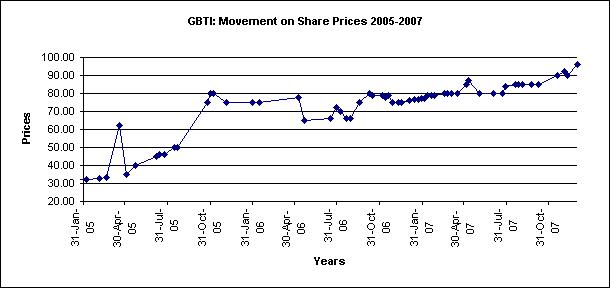
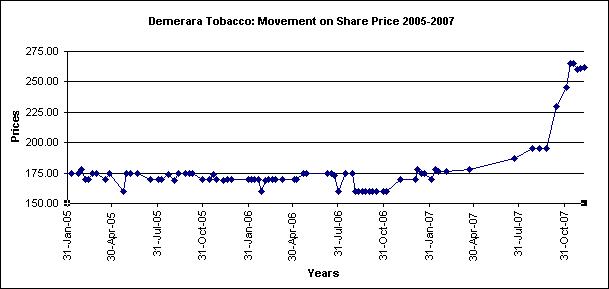
GBTI reports a 57% increase in after tax income for 2007 coming after a 51% increase in 2006 while Demtoco has had more modest increases, 34% in 2007 and 14% in 2006. By any measure these are extremely impressive results which are reflected in the performance of the companies’ share prices over the past three years and provide returns that ironically make bank deposits seem correspondingly unattractive. The average deposit account at the GBTI yielded a return of 3.5% while an investor in the shares of the bank earned 33% (26% of which represents capital appreciation) on his shares.

With inflation close to 15% in 2007, the depositor would have seen the real value of his/her deposit decline by about 12% while the investor’s return, which includes cash income by way of dividends and the increase in the market price for the share, amounts to a healthy 16%.

The lesson is that it is far more attractive to own shares in a reasonably profitable company than to put money in a bank account. The Guyana Stock Exchange (GSE) has not had the desired effect of increasing the number of public companies and with most of Guyana’s public companies being held by controlling shareholders the options for investment in Guyanese companies are limited. But with the removal of exchange controls, the operation of the CARICOM Double Taxation Treaty and the introduction of the CARICOM Single Market and Economy (CSME), there is no reason for limiting the options to Guyana.

It is true that the GSE has outperformed the regional exchanges since its inception in 2003 but much of that is due to what are called market corrections which are unlikely to continue unless all the companies on the Guyana Exchange can match the 2007 performance of Demtoco and GBTI.

Graph of share price movements

Source: The Guyana Association of Securities Companies and Intermediaries Inc., weekly trading reports

Demtoco

Turnover has barely managed to keep abreast with inflation increasing by 16% but the increase in the profit after tax is due to a 30% increase in gross profit – sales less cost of sales – as a result of two price increases in the year which unlike the increases in the price of rice and flour hardly earned a comment in the national press. There is little analysis offered by the Chairman in his one page report or by the Managing Director, neither of whom commented on any impact VAT may have had on the company’s product and performance. The company paid three interim dividends in 2007 amounting to $21.38 per share and is proposing to the shareholders a final dividend of $15.85 making a total of $37.23 giving shareholders a return of 17% on the average market price of the share during the year.

The group gets more however, having charged the company more than $600 million dollars for management services, royalties and technical and advisory services to what it is now no more than a marketing company. The company continues to justify a royalty for a product that can be bought almost anywhere outside of Guyana and seems able to justify exorbitant management services when all the company does is bring in a product sold mainly through at most a handful of distributors.

The balance sheet of the company shows a healthy situation with the company being able to make available to its fellow group companies more than $400 million dollars at the end of the year of which only 60% earns interest at the rate of 4% per annum.

Once again the company does not disclose the number of employees nor does it include anything on corporate governance. Readers will recall one past Country Manager publicly proclaiming defiance to any suggestion that it should comply with Corporate Governance Guidelines until these become legally binding prompting a rejoinder that corporate governance is not a matter of law but best practice (Stabroek News 22/5/04).

Financial Highlights

2007 2006

Change

G$M G$M G$M %
Gross turnover 4,574 3,933 641 16
Cost of sales (1,906) (1,880) (26) 1
Gross profit 2,668 2,053 615 30
Other operating income 20 18 2 12
Operating expenses (920) (772) (148) 19
Profit before taxation 1,768 1,299 469 36
Taxation (895) (648) (247) 38
Profit after taxation 873 651 222 34
Ordinary shares in issue (‘000) 23,400 23,400
Earnings per share (in dollars) 37.29 27.82
Dividends declared per share 37.23 27.75

GBTI

The report by GBTI is far more comprehensive than Demtoco’s, running to 86 pages of material and lots of pictures including two Ministers of Government. Unlike Demtoco the Bank produces a full page Statement on Corporate Governance and eye-catching Financial Highlights although the reader has to go through nineteen pages before s/he finds these.

All the indicators are positive in favour of the shareholders if not the depositors in the bank. Shareholders receive a return of 33% in dividends and capital appreciation, while depositors of interest bearing accounts earned 3.5% (3.4% in 2006) and the average of all depositors 2.6% (2.5% in 2006). Share prices during the year increased by 26% on an increase in earnings per share of 57% and if the bank’s outlook for itself and the economy is shared by investors, then it is quite possible that there will be a further movement in share prices over the next few months.

The company reports accumulated provision for loan losses amounting to 96% of its non-performing portfolio, having written off $831 million in 2006 but only $20 million in 2007. From a profit and loss account perspective the provision for loan losses declined by $70 million which has augmented the profits for the year.

Another contributor to the substantial after tax profits of the Bank is the reduced effective rate of tax it pays for the year – at 18% it is half the effective rate paid in 2006 and results from more than $300 million in interest earned being “not taxable”. The normal rate of corporation tax is 45% and if the effective rate had remained at 36%, after tax profits would be $170 million less.

Loans

A bank’s contribution to national development can be measured by its lending to key sectors of the economy. The sectoral analysis of the bank’s loan portfolio shows agriculture accounting for a mere 7.64%, a further reduction from the 9% in 2006. By contrast the share of the portfolio to the services sector has increased from 38% to 43%. Nationally agriculture accounts for approximately 25% of GDP. While the Bank was once considered the rice farmers’ bank (other than GNCB), some operators in the sector lament that the Bank has been taking a very harsh line on borrowers in the rice sector. Indeed this makes it somewhat paradoxical that the Bank won a bid to manage the EU G$1.6 billion facility to increase the efficiency and sustainability of the rice sector.

The loans to deposit ratio has declined slightly from 28% to 26% despite having won the bid and having received $825 million interest free under the Scheme. The Scheme comes to an end in June of this year but the annual report is unclear whether interest will then become payable on the amounts drawn down.

Highlights

2007 2006

Change

G$M G$M G$M %
Net Income before taxes 976 788 188 23.86
Net Income after taxes 796 506 290 57.25
Total assets 42,981 35,742 7,238 20.25
Total deposits 37,408 31,326 6,082 19.41
Loans and advances 9,745 8,745 1,000 11.43
Return on Average Assets % 2 1
Return on Average Equity % 66 42
Earnings per share $ 19.89 12.65

In their outlook for 2008 and beyond, the Chairman and the CEO were both upbeat about the prospects for the country, reflected in the extension of their branch network and new Head Office to be constructed during the year. Neither mentioned the events in Lusignan (January 26) or Bartica (February 17) and the consequential threats to the economy. It would be interesting to see which one of our two companies would be impacted more directly if the country does not solve events of that nature.

Finally, the results for both entities show how the tax system can be worked in favour of corporate taxpayers with the range of “tax shelters” that are available. Individuals, bound by a single personal allowance and a tax rate of 33⅓ %, can only read with envy.

Recession in the US: impact on Guyana

Introduction

If nothing else President George Bush is an incorrigible optimist. And on this occasion it is not about the Iraq War that defies costing in the sense that by the time this column appears two days after its submission the cost has gone up by more than US$650 million dollars, or by that much more than the half a trillion spent in the five years since the US invaded that country. It is about the state and outlook of the US economy which some say is already in a recession while others say in language more suited to diplomats that the economy is “moving sideways.”

What effect does the state of the US economy have on the rest of the world and more directly how will it affect us in Guyana? The answer to these questions is complicated by one further uncertainty – the presidential elections later this year. All the signs point to a race involving Senators Barack Obama for the Democrats and John McCain, a seasoned campaigner and maverick, for the Republicans. Obama is relatively new to foreign policy and his external connections have been mainly Indonesia where he spent part of his early life and Kenya, the country of his father.

Obama v McCain

Obama has made exit from Iraq a major plank of his campaign commitment, and assuming that he wins, getting out of Iraq may be far more complicated than he believes and resolving that may very well take the better part of a year. Any policy towards the Caribbean will be wrapped up in the wider Latin American question and the Free Trade Area of the Americas (FTAA). For all the support he has received from the Caribbean, he is unlikely to give our region any kind of priority.

John McCain, on the other hand, has strong foreign policy credentials but these have been manifested mainly towards Europe, Asia and the Middle East, including his unwavering support of the Iraq War. Regardless of who wins, unless that person appoints someone with clout and a genuine interest in the Caribbean, the region will not receive much attention in the first year or two of the new presidency.

Exchange rate

Yet what happens to the US economy is important to us mainly for two reasons – the Guyana dollar is largely measured in relation to the United States dollar and second, the Guyana economy benefits heavily from remittances from Guyanese in the United States. In 2007 the Guyana economy grew faster than that of the US and our international reserves did not deteriorate, yet counter-intuitively the rate of exchange of the Guyana dollar to the US fell, albeit slightly. To make matters worse, because the US dollar was falling against the other major international currencies, those declines were reflected in the rate of the Guyana dollar against those currencies, resulting in increased prices for imports from those countries.

Another major imported product – fuel – is priced in United States dollars and a significant part of the increase in the price of a barrel of oil is attributable to the fall in the rate of the US$. In passing, it should be noted that Guysuco and other exporters to non-US currency destinations would have benefited from the fall in the rate of the US$ and by extension of the Guyana dollar.

Remittances

The second major reason for the relevance of the outlook of the US economy to Guyana was shown in an article in this newspaper earlier this week referring to a report by the Multilateral Investment Fund (MIF) of the Inter-American Development Bank (IDB) that Guyana leads the Latin America and Caribbean region in remittance receipts in 2007 as a percentage of GDP, with US$424M or 43 per cent of GDP received. These are truly staggering numbers and warrant a response by way of an analysis from the Bank of Guyana and our academics.

The obvious question is whether such levels can be maintained. If the US economy continues to under-perform causing a loss of jobs and a fall in income, it would be difficult for Guyanese in the US to maintain the level of remittances they have been sending back home. It is true that increasing numbers of Guyanese are taking their chances in the Caribbean – with Antigua, Barbados and Trinidad and Tobago being the more prominent countries – and that so far the economies of these countries have been steady. This should mean that remittances from those countries should not be affected and may even increase as more Guyanese head in their direction. The real fear therefore lies with respect to the US economy.

Recession or not? – OECD

The Organisation for Economic Co-operation and Development (OECD), a grouping of 30 mostly developed democratic countries, including the three powers of North America, most of Europe and Asian Pacific members Australia, Japan, South Korea and New Zealand, in an assessment released in Paris last week was only prepared to say that the US economy is “teetering on the brink of recession” – defined as two consecutive periods of negative growth. The US economy is expected to grow 0.1 per cent in the first quarter, a sharp reduction from the 0.3 per cent estimated in December, and to show zero growth in the second, a sudden halt compared with the 0.4 per cent projection given previously. Despite the sharp downward revision, acting chief OECD economist Jorgen Elmeskov is of the opinion that “it may be premature to declare a recession” in the United States.

For the year as a whole, 2008 is projected by the OECD to grow 1.4 per cent, down from the December estimate of 2.0 per cent, Given the recent swings in the economy it would be surprising if this estimate is not subject to a number of revisions as the quarters progress.

IMF

The assessment is likely to be confirmed by the IMF in its twice-yearly World Economic Outlook, a leaked draft of which shows that it also believes that the US economy “remains very weak, certainly close to a possible recession.” Despite the dollar’s recent steep losses, the draft also suggested that the IMF saw its present value as still “rather strong.”

US businesses

The Conference Board, a major and influential US business group in a report released within the past 48 hours has reported that its index of future economic activity dropped for the fifth consecutive month in February, suggesting that the weakening American economy could, indeed, be slipping into recession. The index is designed to forecast where the nation’s economy is headed in the next three to six months.

Businesses and think tanks attribute the situation to rising gas prices, falling home prices and tightening credit markets which have begun squeezing consumers and businesses, forcing them to cut spending.

Billionaire US investor Warren Buffett dismissed the theoretical definition of recession saying that it is not a question of whether the American economy was in a recession but how far it will go. The legendary billionaire investor expressed concern about the declining wealth, purchasing power, employment and income and does not rule out the possibility that the country’s economic woes could worsen.

More positively, however, Buffett does not consider current conditions as bad as the downturn of 1973 and 1974 when Americans were also battered by skyrocketing oil prices, and he expressed optimism that the economy would rebound strongly in time. Buffett also repeated his belief that the US dollar will continue weakening for as long as the United States maintains a hefty current account deficit, particularly with China and the countries of the Middle East from which it imports oil.

Conclusion

These fears are not without merit. The dramatic meltdown and bail-out of Bear Stearns, one of the US’s largest underwriters of mortgage bonds resulting from the collapse in June of two of their internal hedge funds that had been heavily invested in mortgage securities, emphasises the continuing crisis in the housing sector which is affecting not only the pockets but the psyche of American consumers, who could always count on having some equity in their homes (the value less any debts owed on the house). Even the proverbial dream is evaporating to such an extent that illegal migrants are now voluntarily going back to their homes, something which would have been considered unthinkable one year ago.

The collapse in the US housing market coincides with rising food, energy and raw material costs, raising the spectre of inflation for consumers, but making it more difficult for central banks facing a choice between cutting interest rates to spur growth and keeping them high to curb prices.

As the US braces for troubled waters, those remittances may indeed be in doubt.