Every Man, Woman and Child in Guyana Must Become Oil-Minded – Column 131 – June 21, 2024

STABROEK’S JUNIOR PARTNER CNOOC MAKES G$355.7 MN ON SHARE CAPITAL OF US200,000. YES, TWO HUNDRED THOUSAND US DOLLARS.       

Introduction

Today’s column features the financial statements of the Chinese-owned CNOOC which holds a 25% working interest in the Stabroek Block, as a “non-operated joint venture partner”. CNOOC, like its other two partners, is a branch of a company incorporated outside of Guyana and traces its parent to the People’s Republic of China.

The Income Statement

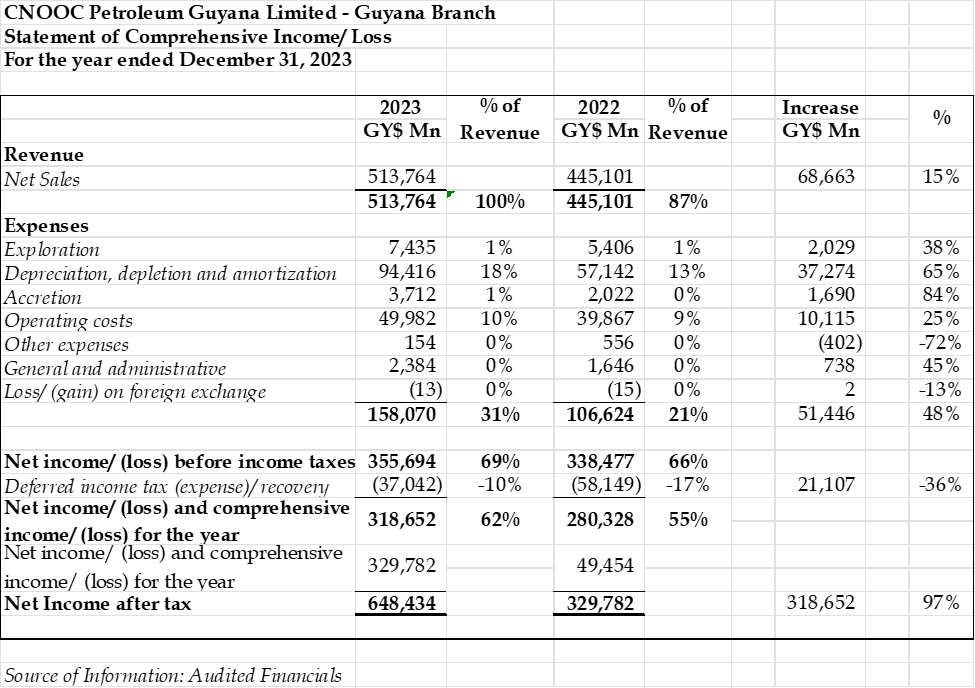
For the year 2023, the Branch reports net sales of $513 million, an increase of 15% over 2022, and net income before income taxes of $355,694 million, an increase of 5% over 2022.

Expenditure on exploration activities is shown at $7,435 million, an increase of 38% over 2022. Given the company’s status as a “non-operated joint venture partner,” it has to be assumed that that expenditure is merely a share of such expenditure of the entire project of which Exxon is the designated Operator. Operating costs of $49,982 million represent an increase of $10,115 million, or 25% more than 2022. Despite the significance of these amounts, there is no note or explanation of what these line items comprise. Depreciation, depletion and amortisation is reported as $94,416 million, an increase of $37,274 or 65%. This is a non-cash cost and represents 18% of revenue and 60% of total expenditure.

From the net income, there is a deduction of $37,042 million, described as Deferred income tax. Note 8 on Taxation explains that exploration and development costs are capitalised and written off over five years and that deferred tax asset as disclosed is in respect of tax losses, recognised only to the extent of future taxable profits. Of course, taxation for the three companies is a fiction since the Government pays the taxes for the companies. This is acknowledged by the same note and confirmed by the branch’s Cash Flow Statement which shows as an add-back the identical amount deducted in the income statement.

It does not appear that the branch transfers its net income for any year was transferred to the parent company. As a result, the after-tax profits are added to the opening net income of $329,782 million, bringing the total net income at the end of the year to $648,434 million, as shown in the Balance Sheet.
The Statement of Financial Position  (Balance Sheet).

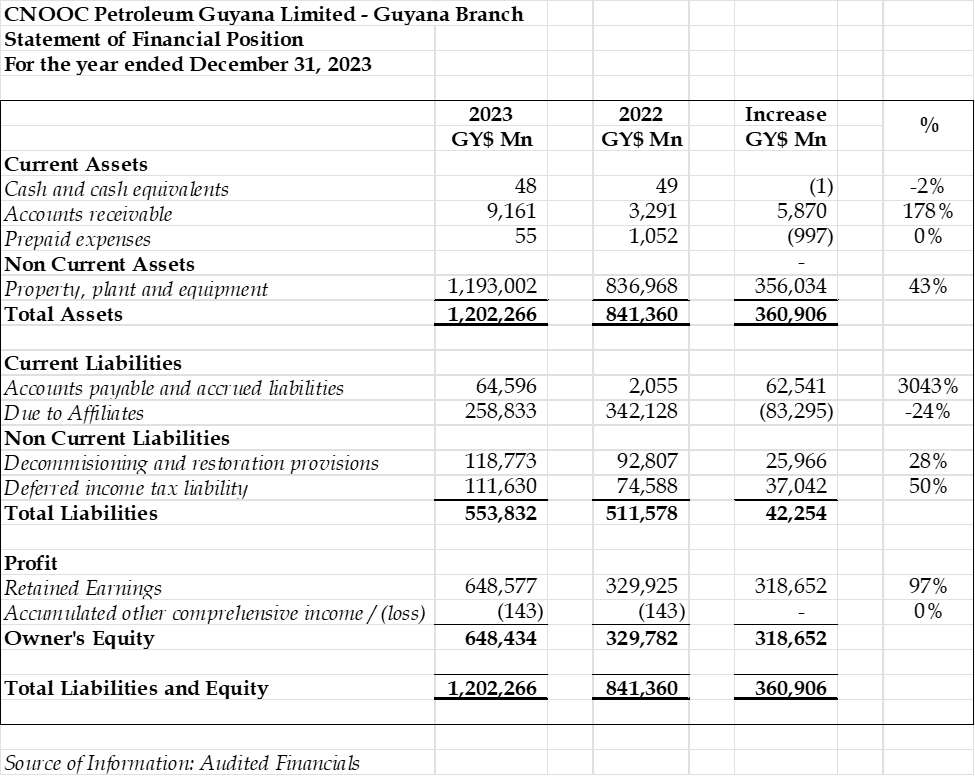
Turning to the Statement of Financial Position, total assets is made up mainly of Property, Plant and Equipment of $1,193,002 million, of which $1,176,600 million is invested in Development Assets, $204,022 million in Exploration and Evaluation Assets and $1,005 million is in Office Equipment and Others. Accumulated depreciation reduces the book value by $187,473 million, $771 million and $378 million, respectively. Accounts receivable reports a total of $9,161 million, an increase of $5,870 or 178%.

Current Liabilities mainly consist of Accounts payable and accrued liabilities of $64,596 million, an increase of $62,541million or 3043% over 2022.

Capital Expenditure in 2023 was $374,479 million, an increase of 42% over the amount expended in 2022. The provision for Decommissioning and restoration is shown at $118,773 million, an increase of $25,966 million which again is a strange item given that CNOOC self-describes as “non-operated joint venture partner”, since Guyana will have some legal barriers to holding a “non-operated joint venture partner” as a primary creditor for de-commissioning expenditure. As a practical matter, what if CNOOC pulls out of the venture before the end of the venture?

Unlike its two co-venturers, CNOOC maintains no inventory. It continues to sell its share of oil lifts to an affiliate in Singapore on a cargo-by-cargo basis. Despite this arrangement the company owes its related parties more than $258,000 million, the terms and conditions of which, including interest, are not stated. Unlike its co-venturers as well, the company’s financial statements do not disclose any royalty payment to the Government, which seems to violate the country’s Extractive Industry Transparency Initiative (EITI) obligations.
Conclusion

This columnist was able, by accident, to see the balance sheet of the company of which the Guyana operation is a branch. incredibly, that company has a share capital of US$200,000 or G$40,000,000. and for 2023 alone, it walks away with $355,694 million.  

The column has stated in the past – that most ordinary companies in Guyana produce financial statements that are more informative and reader-friendly that CNOOC’s.

Next week’s column will feature a compilation of the financial statements of the three companies and compare these with the takings of the Government, AND THE REAL STORY BEHIND CNOOC’S PAYMENT TO EXXON.
Every Man, Woman and Child in Guyana Must Become Oil-Minded – Column 130 – June 14, 2024

Exxon’s incredible (and unique) return on Equity

Introduction

This week’s column features the financial statements of the Guyana branch of ExxonMobil Guyana Limited, a 45% stakeholder, and the designated Operator, in the Stabroek Block. In what was a first for any company in Guyana, the financials, part of a wider report, were presented at a  media event hosted by the branch President Mr. Alistair Routledge. The very colourful cover pages mirror the annual report of the US parent, in appearance, content and excitement, except that the parent’s report flaunts metrics like earnings, shareholder distributions, return on average capital employed and annualised total shareholder returns. Perhaps with only mild exaggeration, the US parent report states that its work in Guyana continues to be among Exxon’s most exciting and successful – for its business, the people of Guyana, and the world. Exxon has brought prosperity to the world – truly a unique blessing.

In the case of the Guyana branch, it is about what the Deus ex Machine, our great white knight, has done for Guyana, including the 1,700 “unique” Guyanese companies which supply Exxon’s operations, the thousands of Guyanese individuals it employs, its contribution to the Natural Resource Fund, the monies invested in communities across Guyana, and the volume of business it brings Guyanese suppliers. Even when Exxon acknowledges the country’s natural resources, it takes the credit for the successful optimisation of those resources. To use its own words, “it is not that Exxon is merely extracting resources; [they] are expanding the potential of the nation.” Halleluiah!

Income statement

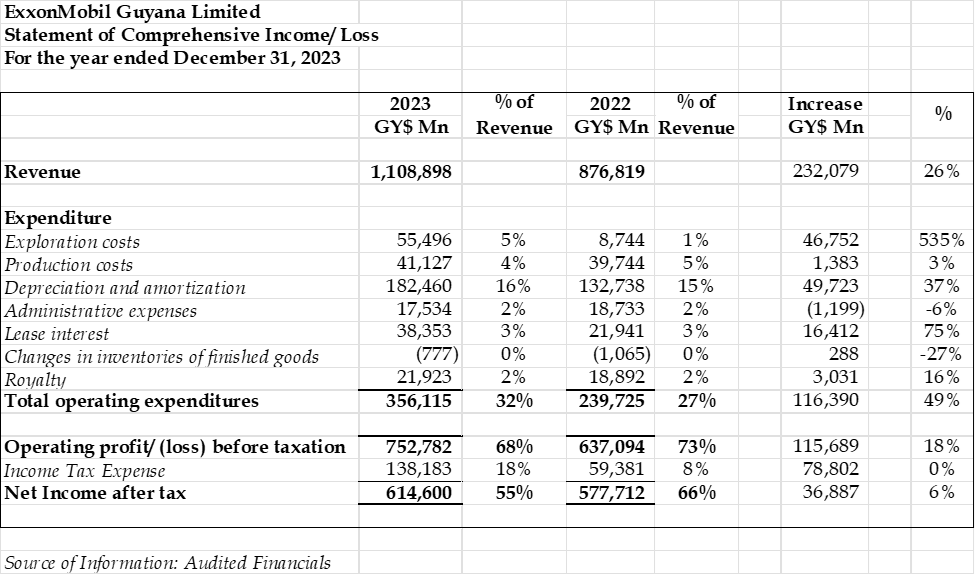
While its blurbs and Fast Facts confuse and mislead, no doubt deliberately so, the performance of the Guyana operations in 2023 is probably without industry equal. Revenue has moved from $876,819 Mn. to $1,108,898 Mn, an increase of 26% while its operating profit has moved from $637,094 Mn. to $750,782 Mn., an apparently more modest 18% increase. But that is largely due to the fact that this reckless government allows the Exxon and its co-venturers to use part of our share of profit to explore for new finds as the date for exploration comes to an end in 2027. It may sound harsh, but it is hard to think of anything more absurd and violative of Guyana’s interest.

Another astounding measure derived from the financials is the negligible production cost which in 2023 accounted for a mere 4% of revenue, down from 5% in 2022. In fact, the only cost which accounts for more that 10% of revenue is Depreciation and Amortisation, accounting for 16% of revenue. Lease interest, an accounting rather than an actual expenditure, is stated at $38,353 Mn., a 75% increase over 2022. This increase is due to a $206,777 Mn. addition to Drill Rigs.

The fake tax charge

After all actual and other expenses, the branch reports Operating Profit before tax of $752,782 Mn., an increase of $115,688 Mn., or 18.2% increase. The Income Statement which is summarised below shows a charge for taxation of $138,183 Mn. and it is only when one looks at Note 7 to the financial statements does one realise that the so-called tax expense is actually paid by the Government of Guyana – another unique feature of our oil arrangements. By now, we all know that there is no charge to the company, which not only walks away with the full amount of $752,782 Mn., but also with a receipt issued by the Guyana Revenue Authority which Exxon then uses to obtain a tax credit from the US Government. Without raising anything about exemption from withholding tax which is required to be paid by ordinary companies on distributions and interest, the actual money that Exxon walks away with is the $752,782 Mn. plus a tax receipt for $138,183 Mn., making a total of $890,965 Mn! In a single year.  

Balance Sheet

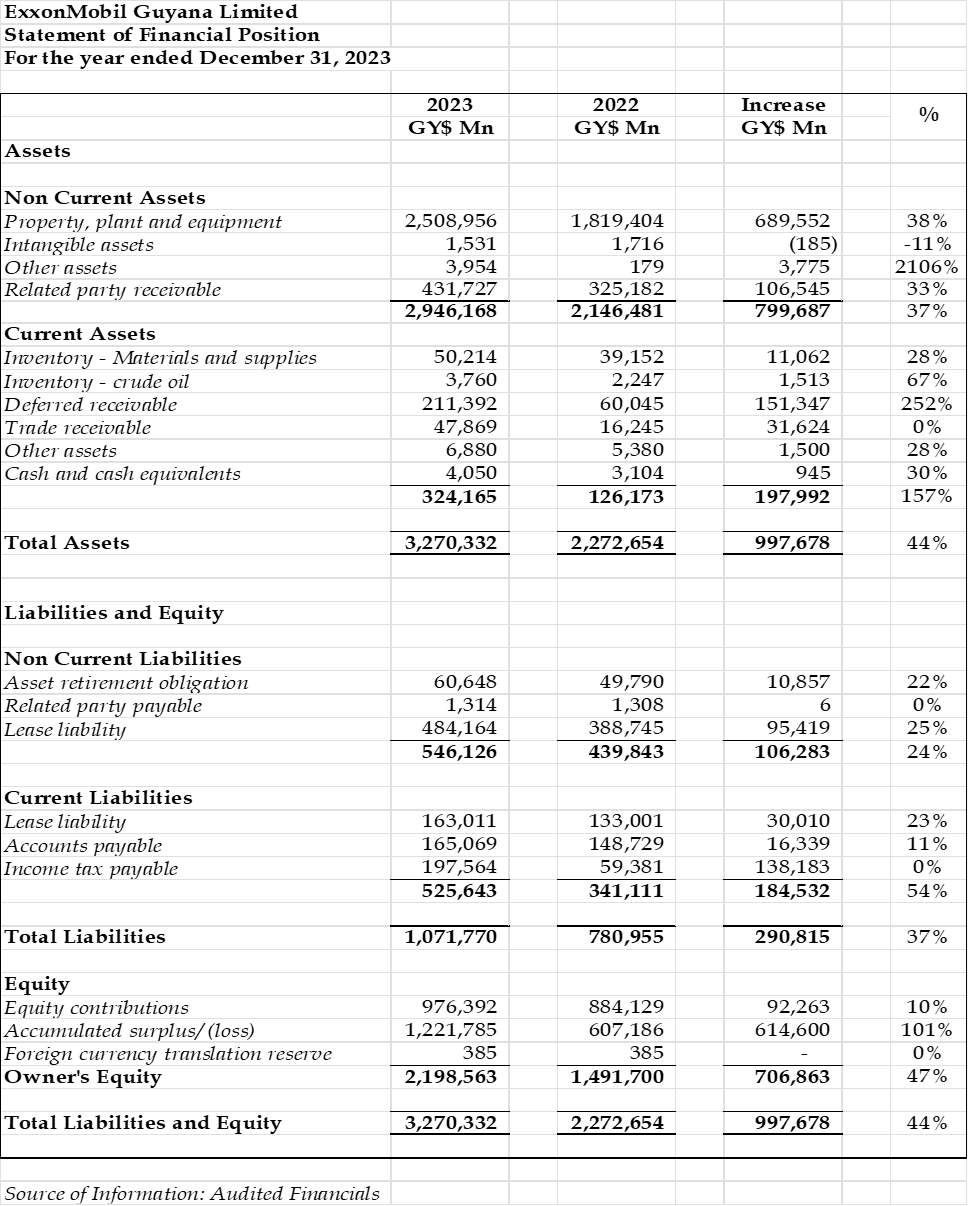
Total assets of the branch at the end of 2023 was $3,270,332 Mn., an increase of $997,678 Mn., or 43% over 2022. As is evident from the Summary Balance Sheet extracted from the branch’s audited financial statements, there were significant increases in Property, Plant and Equipment; Other Assets which had a 2,106% increase; Inventory of crude oil; and Deferred Receivable. The notes to the financial statements (found on chrisram.net) show that of the assets acquired, 35% were on lease but accounted for as additions, to meet accounting rules. It is worth noting that the item of asset with the most significant increase (Other Assets) is not supported by any explanatory note and is therefore uncertain. Like HESS, this branch also shows a significant closing inventory of crude oil, which is at least surprising, since their sales are more than likely within the Exxon family. Deferred Receivable increased by 252% but the only elucidation offered in the accompanying Notes is that the amount of $211,392 Mn. includes non-customer receivables. Interestingly, that includes the Tax Recoverable from the Government of Guyana – all part of an accounting myth.

Total liabilities of $1,071,770 Mn. represents a 37% increase over 2022 but here too, some of these arise out of accounting convention, such as Lease Liability and Income Tax payable which is totally misleading if not grossly incorrect. Accumulated Surplus at 31 December 2023 of $1,221,785 Mn. reflects an increase of $614,600 Mn. which is the amount of profit after (fictitious) taxation of $138,183 Mn.

Exxon’s contribution

By its own admission, and stripped of all its contrivances, the true value of the investment in the branch at 31 December 2023 is stated in the line item Equity Contributions as $976,392 Mn. The note explains that “Equity contribution relates to amounts paid into the Branch by its head office.” In other words, the return on average equity of $930,260 Mn. is a unique 96%! And we must not forget that the Branch’s Head Office was the architect of the fraudulent inflation of its pre-2015 costs and the diversion – in violation of the 2016 Agreement – of moneys received from Hess, CNOOC and Shell (twice), for their investment in the Stabroek Block.

Despite all these shocking revelations, disclosures and discoveries, our Oil Czar sees the 2016 Agreement as inviolable, sacred and untouchable. His only objection is that Exxon does not share the kudos for oil’s bonanza with him. Anyone who places the sanctity of a hugely questionable and lopsided contract above sovereignty is no better than the fool who signed the contract in the first place.

These results and the audited financial statements of Exxon and its two joint venture partners render as nonsense the proposition that Guyana and the oil companies are in a 50/50 partnership. This must surely be the petroleum equivalent of the Stockholm Syndrome.

Every Man, Woman and Child in Guyana Must Become Oil-Minded – Column 129 – June 7, 2024

Introduction

On 29th December 2023, in a letter to the press, I argued that the Natural Resource Fund was overstated by G$274 BN., the amount of the Corporation Taxes paid by the Government on behalf of the oil companies required under Article 15.4 of the 2016 Petroleum Agreement. Attorney General, Mr. Anil Nandlall, S.C., disputed my assertion in a direct, unnamed tirade against me.

Mr. Nandlall wrote that the supremacy provision (section 45) of the Natural Resource Fund Act overrode the provisions of the 2016 Petroleum Agreement, boldly asserting that the provisions in the Agreement on taxation have “obviously been overtaken by the Natural Resource Fund Act”.  In the process he completely ignored the Stability Clause of the Agreement, which requires the Government to pay the taxes of the Oil Companies out of its share of oil revenues. What is indisputable is that despite the so-called supremacy clause, the Government continues to pay the taxes for the oil companies.

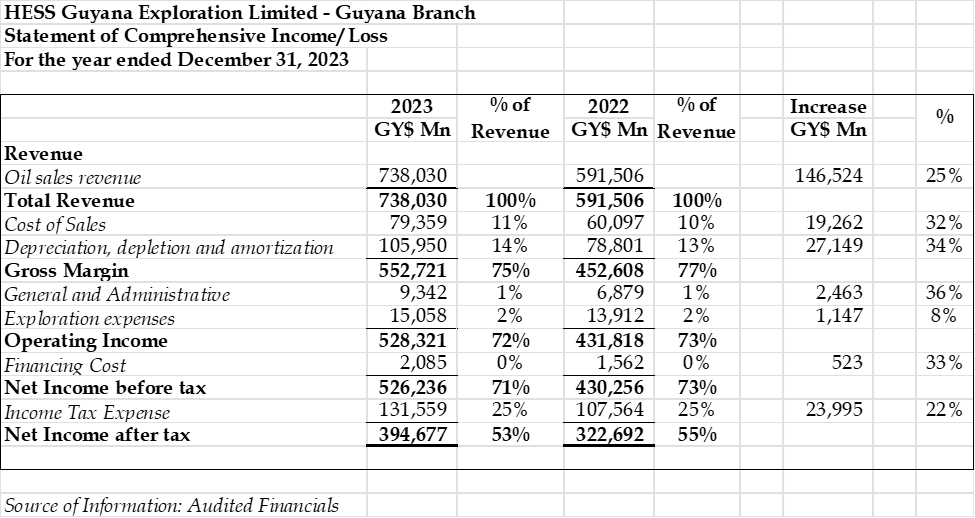
The 2023 financial statements of Hess, a 30% partner in the Exxon-led joint venture show a tax charge of G$131,559 million, or approximately 22% more than 2022. The Note to the financial statements shows that the charge includes Deferred Tax of $40,920 million. More significant than the 22% increase is how the tax charge measures up against the profit oil earned by Guyana for the whole of 2023. From figures available on the BoG website, the total tax charge is about 45% of the country’s earnings from profit oil earned by Guyana for the whole of 2023.

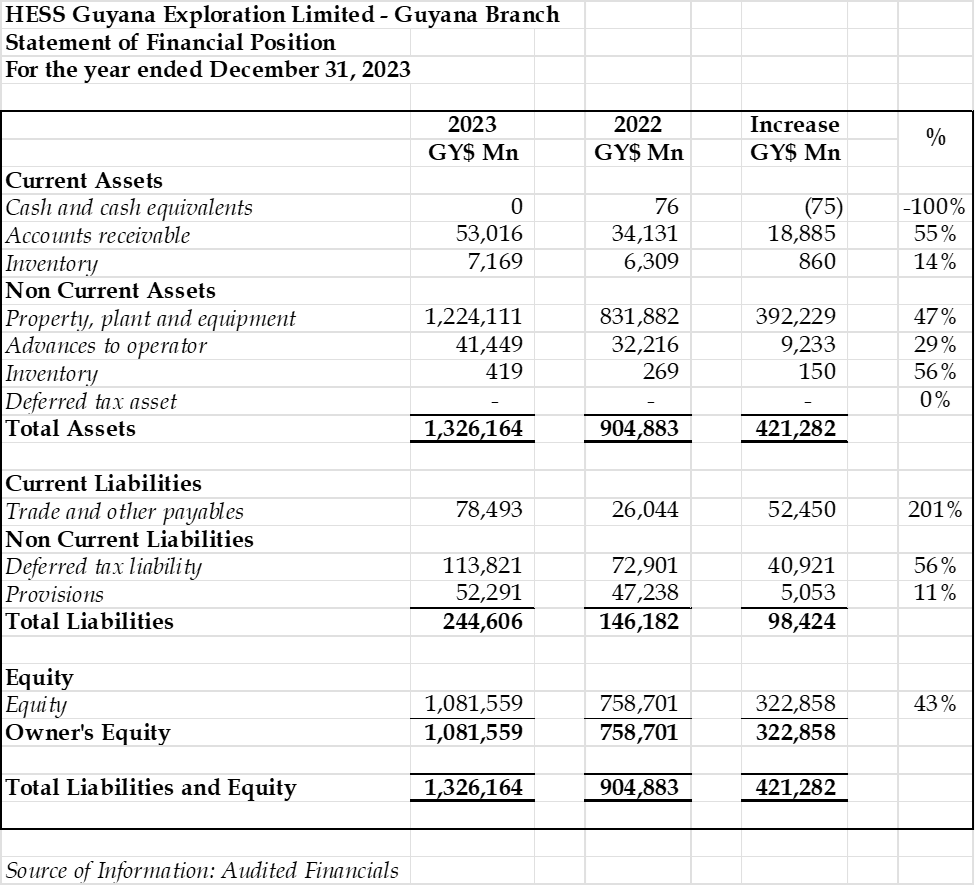
Let us have a look at how Hess performed. Its oil revenues grew to $738, 030 million, an increase of 25%, compared with an 8% decline in the Hess International group as a whole. In fact, all the key financial indicators for Hess in 2023 were down, compared with 2022. No wonder then that Guyana is likened to the Indo/British Kohinoor, the jewel of the Hess’ crown. It would be surprising if that comparability is significantly different in the case of Exxon and CNOOC.

 Cost of Sales for the Guyana branch grew by 32% over 2022 but remained constant as a percentage of revenue. Cost of sales is made up principally of Operating Cost and expenses and Royalties and whether and how useful this is as a predictive value is uncertain. Oil companies are generally expert at aggressive tax planning and even now, the financial statements disclose depreciation, depletion and amortisation at some 163 per cent of operating costs and expenses. This latter group of expenses in 2023 (13% of revenue), but a 34% increase over the preceding year. Because there is no ringfencing, exploration expenses are charged against income, but at 2% of revenue, even the dollar amount is not particularly significant. 

The Balance sheet

The growth in the total assets over 2022 is a significant 47% which is identical to the growth in Property, Plant and Equipment, shared between Exploration and Evaluation Assets (21%) and Development Assets (79%). Because of the uncertainty associated with such expenditure, Exploration and Evaluation Assets are not depreciated. Depreciation expenditure on Development Assets account for 99.9% of Depreciation charge for the year.

Exxon

Maybe it is purely by coincidence, ExxonMobil Guyana invited the domestic press for a briefing on its own 2023 audited financial statements and apparently to offer some guidance on how the press should report on financial matters. Whatever its motives, the company should be complimented on this display of accountability even as it has refused to answer questions concerning its own suspect accounting for moneys received from various entities.  

Next week’s Road to First Oil will review the company’s 2023 financial statements which reflect a bonanza year for the company.  

Dear Land of Guyana by Moses V. Nagamootoo – Part 6

A book review by Christopher Ram – May 28, 2024

Introduction

This is the sixth and final part of the review of Moses Nagamootoo’s autobiographical account of his political career starting in 1961 until the fall of the Coalition Government in 2020, of which he was the Prime Minister.

Under the title The New Normal, chapter 23 traces the history of the relationship between Guyanese of African and Indian descent, claiming that there was racial discrimination of both sides of the major ethnic divide which existed long before the 1953 elections. The chapter notes as an incontestable fact, that Indians suffered from racial violence, discrimination and alienation under the PNC rule. It highlights his parents’ choice to marry under Christian rites, then predominantly Afro Guyanese,  even as they continued their Hindu religious practices, and the role and contribution of the Afro village nurse and schoolteachers. Controversially, he sees as a response to the “anti-Indian dilemma,” the formation of the Indian Peoples’ Revolutionary Associates (IPRA) by Moses Bhagwan, described as Jagan’s successor-in-waiting, and the teaming-up of Dr. Fenton Ramsahoye, Doodnauth Singh, Ayube McDoom and Gunraj Kumar to form the Guyana Anti-Discrimination Movement.

Burnham policies and elections

According to Nagamootoo, the import substitution policies of Forbes Burnham, the struggle for trade union recognition by sugar workers, and the closure of the Cuban rice market, formed part of the racially charged backdrop for distrust between the two communities. In this context he also recalls the transfer of a murder charge from the mainly Indo-Guyanese Corentyne to the mainly Afro-Guyanese Georgetown in which Arnold Rampersaud was charged with the murder of an Afro-Guyanese policeman, increasing the odds of a conviction. Nagamootoo gives little or no recognition to the role of the multiracial WPA and Dr. Walter Rodney in helping to secure the acquittal of Rampersaud.

Demonstrating the ethnic cleavage in electoral politics in Guyana, Nagamootoo writes that the PNC received just over 40% of the votes cast in 1992, the same it got in 1964 when transparent elections were last held. Similarly, the support for the PPP was also unchanged, while the WPA, whose activism had resulted in widespread multiracial support in its campaign against the PNC, and for a government of national unity, received little support in those elections.

The chapter closes with comments on the emergence of “resource nationalism” where corrupt management and appropriation of the wealth of countries by foreign companies have led to the intervention of the army. Yet, in the very next chapter, he writes of “misconceptions of and about the process that ended in the 2016 petroleum.”

The hardliners

Even as he looks forward in chapter 24, Nagamootoo reminds readers of the infamous “kith and kin”, and “slo fire, mo fire” comments by Desmond Hoyte, former President as well as Leader of the Opposition, as being both “irresponsible and repugnant”. Interestingly, the name Hoyte does not appear anywhere in the book, nor does Hamilton Greene. On the other hand, he notes that his own publication The Political Situation And The Way Forward In Guyana was consigned to the bonfire by PPP hardliners, and that when he suggested to Janet Jagan the possibility of Cheddi Jagan being buried or his ashes interred in the Botanical Gardens, her response was: “No, no Moses they will dig up his bones and drag them in the streets of Georgetown”.

On the issue of Constitutional Reform, the book notes the work of the Ramkarran Commission (1999) and Nigel Hughes Sub-committee on Constitutional Reform as having started a dynamic process, but which needs political will to achieve the necessary changes, especially for a possible government of national unity, a most unlikely prospect. Yet, he expresses, double-handedly, that President Ali would keep his many promises and beat back “the perception that he is just a figurehead in the leadership troika”, which possibly includes the Prime Minister.

Chapter 25 returns to internal PPP matters under the caption Crooked Selection Process, the purpose of which was to give a full explanation for his walking from the PPP. The chapter features a letter he wrote to the General Secretary of the party in response to an invitation for him to address the Executive Committee of the Party. There were clearly irreconcilable differences.

My take on the book

While truth is indeed of virtue, for those who occupy the political space, it hardly ever wins friends. In the case of Nagamootoo’s Dear Land of Guyana, nothing can be more truthful. Whether he intended it or not, he is particularly harsh on several persons, including those who came lately to the PPP, and those with whom he had differences. These, and others, should find this book of interest, if not comfort. Nagamootoo accuses the PPP of engaging in military training; of rigging internal elections; of destroying the dreams of its founder leader Cheddi Jagan; and has exposed a different side of the late Janet Jagan.

The book is a contribution to the country’s political history by a contemporary writer, in his style and as he sees himself. It is not without its controversies and might therefore have been expected to generate debate and response from the persons named, even if only to defend their reputation. That has not happened. If no one else, President Granger owes it to the nation to confirm or deny the role of the Americans in the conclusion of the 2020 elections debacle.

Every Man, Woman and Child in Guyana Must Become Oil-Minded – Column 128 – May 24, 2024

Insurance and its adequacy (Part 3 final)

Introduction

The two previous parts on this subject carried on Monday (20th.) and Wednesday (22nd) dealt with the first of two documents published in the Official Gazette a week earlier. These were the Guarantee and Indemnity Agreements by the oil companies with the Guyana Government as the beneficiary, and an Insurance Policy taken out by the oil companies for the year 2024 – 2025. Since these are not documents required under any circumstances to be published in the Official Gazette, it is unclear why they appear in a medium reserved for official publications which describes itself as “Published by the Authority of the Government.” In fact, every one of the pages of Exxon’s Insurance Policy carries the heading Official Gazette! No stopping Exxon and the overwhelming influence of American Power.

Let me state one caveat: Insurance is a very specialised branch of law and is well known for its complexity and its “fine print” which challenges even the most meticulous reader. One characteristic of insurance policies is that the exceptions and exemptions are usually so many that they narrow the scope of coverage significantly, of which the Policy contains ample evidence. Maybe we can take comfort that the Ministry of Natural Resources, in exercising its oversight role, will regard the Policy as an area of interest to which particular interest needs to be paid.

Contract of Insurance

Today’s column deals with the second document – a 159-page Contract of Insurance issued by insurance giant AON UK Limited, considered among the top three insurance brokerage firms in the world, its reputation expertise covering all stages in the oil and gas sector. Exxon boasts of its contribution to the local economy but not a penny, not a dime, not a nod to local content. The premium on the Policy is not cheap – about US$5 Mn. Had the oil companies not been given blanket exemptions from all taxes – for forty years no less – this payment would have been subject to a withholding tax under the Income Tax Act. So, we lose on local content and local tax.

The choice of law and the jurisdiction for the Policy are the Courts of England and Wales. Although the cover page of the Policy gives prominence to ExxonMobil Guyana Limited as the Insured, the details show that its partners Hess and CNOOC, all covered to the extent of their respective interests in the Guyana operations. The Policy runs from 1st. February 2024 – 19th. February 2025 but there is strong evidence that this may be an extension of a previously existing policy.

The Policy extends limited coverage beyond the three companies, to a broader group of related entities and individuals, subject to specific policy provisions and more narrowly defined limitations. The individuals include employees, consultants or contractors. These collective entities and individuals are covered under the policy for various risks, including environmental liabilities, physical damage, and third-party legal liabilities.

The Policy contains a mix of coverages and exclusions that directly address certain environmental liabilities, especially seepage and pollution from wells and other insured property, while limiting or excluding pollution coverage in other respects.

Some arcane details

The Policy appears to offer sufficient coverage for moderate incidents, but clearly not for any major events. Interestingly, coverage under the Policy is substantially below asset values as shown in the financial statements of the three companies, perhaps betting that no single accident or occurrence would reach anywhere close to US$2.5 Bn. However, the real costly occurrence would be in respect of any spill arising from any accident at any of the wells.

Concerns about oil spills in the Stabroek Block are eminently justified, both as regards the operations, supervision, and oversight: the Block has an elevated level of petroleum activities in a fairly concentrated area; an ever-present potential for accidents, mishaps, human error, equipment failure and stress; and the complexity of the operations.

To put things in perspective, the Gulf of Mexico covers an area of 617,000 square miles while the Stabroek Block covers just over 10,000 square miles – one-tenth. Yet, on an area comparison by barrels of oil per day, Guyana can soon outperform the Gulf of Mexico. But that will come at a cost. Unlike the USA, The Gulf operators have had decades of experience operating in those waters and the sector is effectively managed, overseen by experts and strict laws, professionally and independently enforced.

Guyana’s totally contrasting circumstances contribute in no small measure to increasing overall fears and risks. We have seen numerous examples of poor oversight of the sector, preference for loyalty over competence, and the Government’s inability to recognise that the country needs to see more than just money from the sector.

Conclusion

It is time that President Irfaan Ali realise that Vice President Bharrat Jagdeo does not have the time, inclination or expertise for the challenge at hand. That incredibly, the regulation of the sector is on autopilot, if not self-regulated. The President must realise that there is no substitute for a properly constituted Petroleum Commission with a range of skills and experience. And that on the environment, it is naïve and reckless to believe that as currently staffed, the EPA can exercise any form of control over the oil companies. The President should see this both as a historic opportunity and an imperative that he needs to act before it is too late.

The US$2 Bn. guarantee might have been expected to silence the din. But it is no substitute for unlimited Parent Companies guarantees.