
Introduction
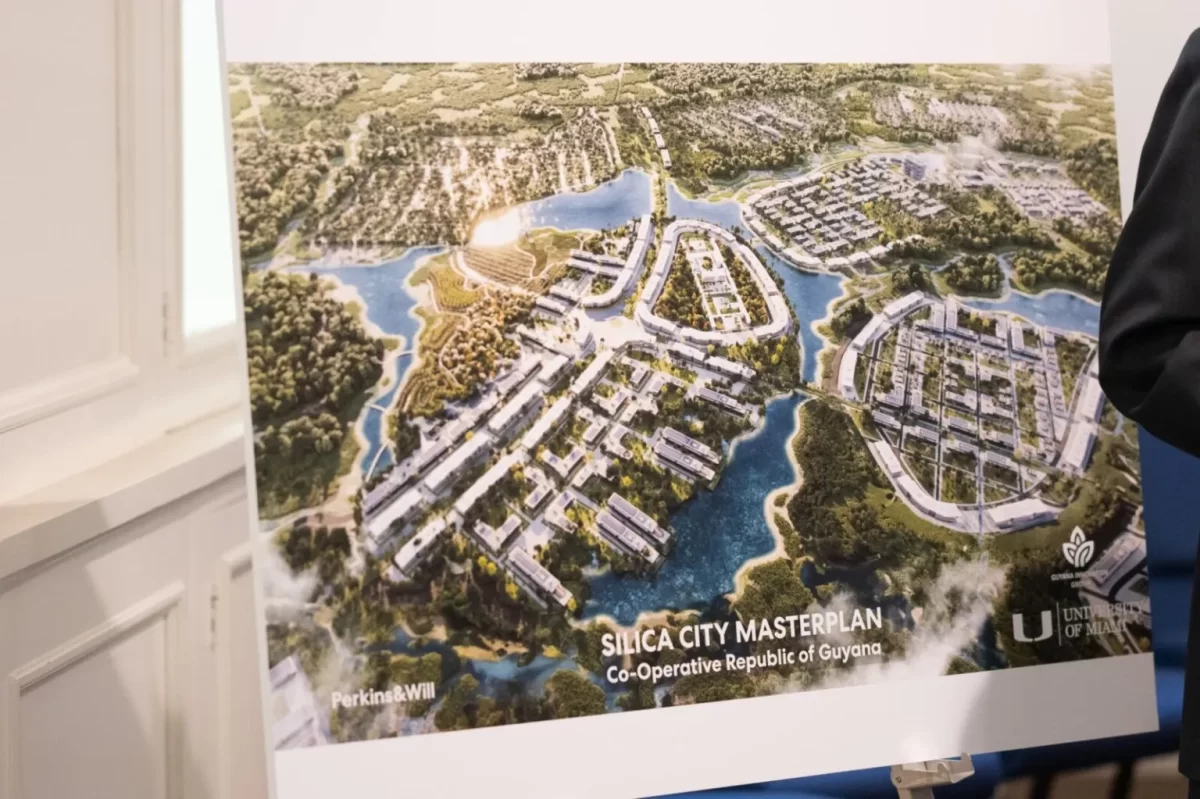
Other than periodic, campaign-style announcements, the Silica City project on the Soesdyke-Linden Highway operates in near-complete secrecy. It is repeatedly celebrated as the President’s “brainchild”, yet the public has been told nothing of how it is financed, how it is structured within government, or by what criteria the beneficiaries of its house lots will be selected. That pattern was maintained most recently as last week, when Collin Croal, Minister of Housing, announced that agreements have been signed and allocations of houses made, without accompanying disclosure of any legal authority, eligibility rules, pricing framework, or institutional approvals governing those allocations.
This silence is not accidental. Silica City has been variously described as a housing scheme, a “young professionals” enclave, a smart city, a decongestion strategy, and a commercial and healthcare hub. The descriptions shift with the audience – and with each statement. That is contrived confusion to avoid the project being pinned down to a single statutory regime, a single governance framework, or a single line of accountability. When a project is so flaky, when it begins to appear like a recycled scheme, it is time to raise the alarm.
We have seen this movie before. The Sparendaam housing project – Pradoville 2 – did not unravel by accident. The investigation showed that it was financed through multiple state entities, with no single institution carrying the full cost and no consolidated accounting of the project. That fragmentation diluted responsibility, obscured the true cost, and prevented scrutiny until long after land was transferred and beneficiaries entrenched. By the time the full picture emerged, accountability was already lost – and no one was ever held responsible.
The forensic investigation later showed how the absence of clear statutory footing, the bypassing of institutional processes, undisclosed allocation criteria, missing records, and political direction substituting for law produced outcomes that benefited a select few, including the then President, Ministers, party figures, and carefully chosen beneficiaries.
The project
Little has been said about Silica City’s administration, except that it appears to fall under the Central Housing and Planning Authority, established under the Housing Act, more noted for its outdatedness (1946) than for its relevance. The CHPA is a statutory authority governed by the Housing Act, with defined objectives – Housing of persons of the Working Class – procedures, reporting obligations, and safeguards designed to prevent the kind of opacity and looseness exposed by the Sparendaam investigation.
Yet, an enduring and necessary safeguard provided for under the Act has been dispensed with – too inconvenient for Silica City. Annual Reports have disappeared. There is no identifiable public accounting for the project. The project does not appear in the National Estimates, nor is it identifiable in the financial statements of the CHPA or any other government authority. This is despite the vast sums being spent on infrastructure and construction.
The chain of command compounds the danger. The Minister administering CHPA reports directly to Mohamed Irfaan Ali. There has been some reshuffling of junior ministers, but a party loyalist remains in charge. From all accounts, the administrative structure and key personnel unchanged. The result: a flagship housing project executed by CHPA under direct political oversight, with diminished reporting and no transparent disclosure of financing, governance, or allocation criteria. All in an environment of an explosion of funds accompanied by an erosion of accountability.
Loosening the reins of accountability
Since the PPP/C returned to office in 2020, CHPA has abandoned the comprehensive Annual Reports required by section 49 of the Housing Act, substituting bare audited financial statements that say nothing about projects, allocations, beneficiaries, or policy decisions. The stage was set: no meaningful statutory reporting. As a result, Silica City is rendered financially invisible to citizens and Parliament alike. This violation of the law shields the project from scrutiny while land is allocated, infrastructure constructed, and commitments locked in.
That this has gone undetected and unchallenged is itself a serious institutional failure. The Audit Office of Guyana exists to ensure compliance not only with accounting standards, but with the laws governing public authorities. The absence of Annual Reports, and the complete invisibility of Silica City in CHPA’s published accounts, should have been explicitly flagged.
Equally troubling is the silence of the National Assembly of Guyana, at least some of whose members know that the Housing Act requires far more than numbers stripped of context. When a statutory reporting framework collapses in plain sight, unnoticed by auditors and unchallenged by Parliament, accountability disappears, and lawful administration collapses.
President Ali
At this point, it is no longer credible to discuss Silica City without addressing the common role of President Ali himself. The Sparendaam investigation did not describe a single rogue decision or a momentary lapse. It documented an infrastructure of persons and practices through which housing projects were executed: political direction overriding statute, institutions reduced to conduits, records absent or reconstructed after the fact, and accountability dissolved by design.
What makes the current project more troubling is that many of the same enabling conditions have re-emerged on a far larger and more expensive scale. Then, Dr Ali operated as Housing Minister under a President. Now, he is the President. Then he reported to Cabinet. Now, Cabinet reports to him.
Silica City is framed as a legacy project. But vanity cannot come before legality, and legacy cannot be built on secrecy, evasion, and disregard for statutory accountability. History is unforgiving on this point. It judges leaders not by the size of their projects, but by whether those projects followed the law, the institutions of the state, and earned the public trust.
Conclusion
Having been involved in the investigation into the Sparendaam project, I recognise the warning signs. I fear that if this project is allowed to continue under existing conditions of opacity, avoidance of scrutiny, and deliberate invisibility, we will not later be wondering whether Silica City was Pradoville 3.
We will already know the answer.