Whatever the result of the elections they will not have been fair

Parliament was prorogued in late September, meaning that we now have no parliament and the passage of new laws including those for incurring of new debts must await the next parliament. However, to ensure that the wheels of government do not grind to a halt, the constitution provides for the executive, including the president and the cabinet, to remain in office until a new government is installed. The government meanwhile assumes a holding mode, sometimes loosely described as a lame duck government.

Our constitution does not specify, or indeed restrict, the powers of the government during this holding period. That does not mean the government can do as it pleases. Indeed what it should do is to follow convention and good practice and limit its actions, decisions and expenditure to what the National Assembly approved before prorogation. Accordingly, the decisions they should make and action taken should be restricted to routine, operational matters.

It would not be appropriate for example for the government to enter into a new international treaty or to make a decision on matters that would require parliamentary approval, whether in the form of authorisation or the provision of finance. I understand that the constitutions of some countries limit the actions such holding governments can take, thus making it unconstitutional for them to do the kinds of things that have become routine under the increasingly lawless PPP/C.

The thinly disguised Cabinet Outreach, outboard engines and fertilizer of 2006 are modest compared with the multibillion agreements we have been hearing about since the announcement of elections. A few days ago we learnt from Jamaica that Jagdeo has signed a secret deal with the Chinese for an investment of $27 billion on the Timehri Airport, and from the local press that he is borrowing $4 billion from India for a specialty hospital, and is committing several billion dollars for an overpriced Marriott Hotel.

We have become so accustomed to this lawlessness that we simply dismiss Mr Jagdeo’s actions as further cases of his routine violations of the constitution, some of which concern the protection afforded by the constitution. These include the appointment of an Ombudsman, the Public Procurement Commission and the integrity of the Consolidated Fund and the Contingencies Fund.

There are two important consequences to these actions: whether it is proper for the Jagdeo administration to tie the hands of the successor government; and the impact of such actions on the elections. The first touches on the constitutional issue of whether a successor government (PPP/C, APNU or AFC) should consider itself bound by these reckless decisions. Unfortunately Mr Donald Ramotar appears to be a party to most of the recent excesses and would seem to be allowing himself little or no room to revisit any of them. It would seem from their pronouncements that the other major parties are committed to revisiting and quite probably rescinding a number of the recent deals, with the Amaila Project heading the list. That could put Guyana on a collision course with investors and tarnish the country’s reputation as an investment destination.

On the issue of the fairness of the elections, I think it would be hard for anyone to conclude that house lots to communities, subventions for Veterans Homes, salary increases to public servants and the disciplined services, the signing of new contracts with major tax concessions and or state borrowings, the payment of discretionary sums from the ruling party office and the opening of miscellaneous facilities by the President and his ministers are not intended to and will not influence the vote. That means the elections – whatever the result – will not be free and fair and one hopes that the Elections Observer Missions are taking note.

Over the last fourteen years I have tried to convince GECOM and the political parties to have some form of campaign finance rules. Mrs Sheila Holder actually tabled a motion in the National Assembly on this. The PPP/C simply stalled. As a result we have neither campaign rules nor restrictions on the use of state resources for party political purposes.

It is a gift for a president who has no sense of constitutional convention or propriety, has no respect for the rule of law, and indulges himself with the belief that he is all powerful.

Issues to which Ramotar should make a commitment

PPP/C presidential candidate Donald Ramotar announced at a political rally on Sunday evening that he would be ready to listen to the views and ideas of national interest from persons, groups or organisations.

Indeed he was specific enough to say, “As long as they think they have ideas I would be ready to listen to them, I would be ready to discuss with them, I would be ready to debate with them and I would be ready to work with them in the interest of Guyana.”

Unfortunately, over the past nineteen years Mr Ramotar and his party have rejected every single proposal made by the parliamentary opposition during the annual budget debate. He and his party have been silent even as the party’s President and government have rejected hundreds of calls, suggestions and ideas made by Guyanese on issues ranging from murders of citizens, abuse of state power, financial management and good governance.

But Guyanese are a forgiving people and do not hold him personally responsible for all the violations that have taken place under his party’s watch. I am sure they are prepared to turn a new leaf with him. The question is: is he himself prepared to turn a new leaf? Here are twelve issues that citizens would like him to make a commitment to:

1. If elected President, ensuring that the constitutional bodies such as the Ombudsman, the Public Procurement Commission and the Local Government Commission are set up within thirty days of, or other specified period after his election;

2. Within sixty or other specified number of days but not exceeding four months of his election, working with Parliament to appoint a broad-based Constitutional Reform Commission to examine the constitution with a view to removing its dictatorial features and making it more democratic and consistent with republican status and the rule of law;

3. Appointing a Commission of Enquiry to look into all aspects of the crime spree that led to the deaths of hundreds of Guyanese including his party’s Minister, Mr Sash Sawh;

4. Ensuring that all public funds including money from the sale of government properties and the proceeds of the Lottery are placed in the Consolidated Fund;

5. Implementing the recommendations of the Chang and the Symonds Reports to strengthen the Guyana Police Force;

6. Removing party control of the state media and the restriction on the citizens of Region 10 to access to television of their choice;

7. Removing the state monopoly on radio;

8. Reviewing the Amaila Falls Hydro Electricity Project with a view to ensuring transparency and economy in the project and lower tariffs to the consumers;

9. The establishment of a full enquiry into the CLICO collapse and action to deal with wrongdoers;

10. Appointing qualified independent persons to the Audit Office and removing those who have a conflict of interest;

11. Repealing the Former Presidents (Other Benefits and Facilities) Act; and

12. The passing of modern anti-corruption legislation.

Mr Ramotar will note that the issues raised will either save money or lead to better governance. They do not involve any expenditure or loss of revenue such as the reduction of VAT and other taxes on which he may wish to take the lead.

Because I wanted to limit the list to a round dozen, and to make them as uncontroversial as possible, I have not asked about the Marriot Hotel, the Intelligence Agency in the Castellani House Compound, the Airport Expansion Project or the giveaway of state property to party leaders, comrades and friends. He is of course free to address these. Nor have I raised any matter that could cause him any embarrassment like his role as a Director of Omai and GuySuCo or how his daughter obtained state property in Pradoville 2.

These are not new matters or fresh ideas. They have been around and expressed by many “persons, groups [and] organizations.”

He would have no doubt addressed his mind to them. Each is capable of a yes or no answer. As a citizen, I am appealing to him to answer them promptly for the benefit of the electorate whose vote he now seeks.

Country heading for massive budget deficit

Introduction
As campaign 2011 moves into top gear, no one it seems has the least interest in the financial and economic consequences of the explosion in what appears to be uncontrolled expenditure by the government. The simple rule of financial management is that new expenditure must either come from increasing revenues, or from utilizing accumulated reserves or from new borrowings. That is as true of an individual as it is of a company or government. But the very simplicity of the rule may help to disguise the stark consequences of the option of overspending financed by borrowings.

Take Budget 2011 as a case in point. That budget presented in January this year showed significant increases in government spending over 2010. Current non-interest expenditure was projected to increase by $9B from $78.5B to $88B and capital expenditure from $47B to $62B. Not that these increases were justified by the funds available or by new or additional revenues. No. The Minister, recklessly in my view, proposed to the National Assembly a budget deficit of $34B financed by external borrowings of $32B and from domestic sources by $2B. Over all the protestations of the opposition, the government passed the Budget without a single modification.

Warning
At that time, Ram & McRae immediately sounded the warning bell pointing in its January 18 review of the Budget that:

– External debt service in 2011 would be US$28.8 million and domestic debt service $4.979 billion, an increase of 15.1% over the preceding year;

– The percentage of budgeted current revenue used to service debt had increased from 7.9% in 2007 to 13.3% in 2010; and

– The impact of the unrestrained expenditure would be an increase in the overall balance on the financial operations from a negative $20.5 billion in 2010 to a negative $33.9 billion in 2011, or 65%, and double that of 2009.

From all appearances, the situation is turning out to be much worse. Between January and September, the Minister of Finance presented to the National Assembly six financial papers for supplementary funds totalling $12.2 billion. A breakdown of the financial papers shows $5.449 billion coming out of the Contingencies Fund and $6.77 billion for proposed spending. Unless these are financed from new sources or increases in revenue the deficit would climb to $46B. But not only are these not coming from new sources or increases in revenue but President Jagdeo has now conceded that some $14B budgeted in 2011 as revenue flowing from the Guyana-Norway LCDS initiative is now certain not to be coming in this year.

No lame duck
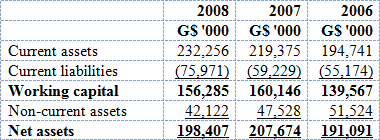
If we add this all together this is what we find:

In this table, I am conservatively and unrealistically assuming that there will be no further supplementary appropriations for 2011. Of course there will be. The problem is that no one knows the extent of the unbudgeted spending that has been going on since the last financial paper was submitted to the National Assembly before it expired in late September. It did not help that the parliamentary opposition had withdrawn from the National Assembly although it might have made no difference since the government is not known for its willingness to listen to any criticism of its actions, whether on money or otherwise.

What it did was to allow the distinctly un-lame duck President Jagdeo and the openly politicized Finance Minister to do as they wished, to spend as they wanted and to ignore the consequences. Even now, or rather moreso now, the President goes around handing out millions to all and sundry which the post-November 28 administration will have to add up and then approach the National Assembly to approve what he has been spending, as if it were coming out of his presidential pension package.

Out-turn
Let us return to the out-turn for the year. And let us assume that the government manages to shave as much as ten billion dollars of expenditure from the budget for the year. Here are two immediate consequences:

The resulting deficit will be approximately $50 billion or US$250M – more than the entire sum receivable from Norway over a five year period.

The total debt of the country – external and internal – expressed in US dollars, will exceed US$1.8 billion, just a little below the debt the PPP/C inherited in 1992.

Because of the depreciation of the Guyana dollar since 1992 from $125 to $204 to the US dollar, the per capita debt, which is the amount of debt divided by the number of Guyanese, would be higher in 2011 than it was in 1992.

The consequences of this will be severe on the taxpayer. In 2010, the interest cost of servicing the domestic debt in 2010 was $3.9B while the interest on the external debt was $2B. Total debt service inclusive of interest cost is 13.28% of current revenue. While servicing of the external debt in 2011 is projected to increase by 27.6%, the internal debt service is projected to fall in 2011 because of a substantial projected decrease in domestic debt repayment. That is an apparently painless way to say that the government never intended to pay down on the domestic debt in 2011.

Mid-year hope
I was hoping that the Mid-Year report prepared by the Minister of Finance would have offered some comfort. Unfortunately, while the National Estimates include a table giving an accounting classification of the Central Government Financial Operations, the Mid-Year report does not. The narrative in the later report indicates that full-year 2011 revenues are projected to exceed 2010 by about $7 billion while for the first half of 2011 non-interest current expenditure amounted to $38.3 billion, an increase of 16.2 per cent over the same period last year. Similarly capital expenditure for the first half of 2011 amounted to $17 billion compared to $13.7 billion in the corresponding period in 2010.

One other possibility is that the new expenditure will come from one of the many slush funds or padded line items such as the provisions for wage increases dealt with in Business Page last week. The economy cannot bear the kind of debt burden which reckless spending involves.

New money
Earlier in this column reference was made to the financial papers for additional money for the government. The principal agencies for which monies were voted were:

The vote for GPL was a single amount for the acquisition of a 15.2 MW power plant at Kingston. The allocation for Ministry of Finance was to buy fuel for the LINMINE Community Power Plant, flood victims in regions 6 (?), 9 and 10 and $1.2 billion for additional electricity charges. One expects the Ministry of Finance to be best at budgeting costs and to have its allocation for the payment of electricity charges is a poor reflection of its ability to manage and control costs.

Public Works had much to do with road expansion on the East Bank and East Coast Demerara, preparation of the Supenaam and Parika Stellings for Chinese vessels and cost for replacement of ferry spares. Health was mainly for the purchase of drugs while Agriculture was for D&I and other projects, some of which are related to the Grow More Food Campaign which the government is trying hard to justify against the huge sums spent so far.

Conclusion
For now, ‘boat gone ah falls.’ The Jagdeo administration will soon expire and hopefully a government with some commitment to financial discipline will see the need to cap borrowings to levels that are sustainable. It is what the economy and the country will need to cushion any challenges which inevitably happen even to the best managed economy.

The tax exemption of the president’s pension package is an abomination

The defenders of the Former Presidents (Benefits and Other Facilities) Act 2009 including Prime Minister Sam Hinds, Dr. Roger Luncheon, Mr. Robert Persaud and now Dr. Nanda Gopaul are having a hard time trying to convince the Guyanese taxpayer that President Bharrat Jagdeo was less than greedy in initiating and approving legislation providing for benefits that are patently overgenerous.

The best that Mr. Persaud could do was question the timing of the questions, seemingly unaware that as far back as May 2009 Prime Minister Sam Hinds was vainly defending the Act with misrepresentations.

Mr. Hinds incorrectly wrote that all Mr. Jagdeo and his spouse would have is a single vehicle owned and maintained by the State. In fact Mr. Jagdeo is entitled to an unspecified number of such vehicles with drivers. In addition, Mr. Jagdeo is also entitled to duty-free concessions for motor vehicles and every other item he chooses to import. Mr. Hinds would also wish us to believe that free medical expenses are limited to the former president and his spouse. In fact taxpayers would have to pay for the medical costs for him and the dependent members of his family, for the rest of his life. And if Mr. Jagdeo or any one of them opts for treatment abroad, no big deal – the Act places no restriction.

Dr. Luncheon and others have been saying that all the Act did was to put into law payments made to former presidents, completely forgetting that neither Burnham nor Jagan lived to become former presidents.

With a slight twist Dr. Gopaul then tries to confuse the issue by listing eight types of expenses that former presidents were entitled to but fails to state what they actually received which is the real concern over the Act. What Dr. Gopaul seems to miss is what the parliamentary opposition and civil society have been saying all along, i.e. that there are no caps to any of the facilities; no conditions for receipt of benefits and no consideration of cost.

A former president working abroad is still entitled to tax-free pensions and most if not all the benefits and facilities permitted under the Act. And even if resident, s/he is entitled to clerical and technical staff even for private consultancy work, and can run up the most outrageous utilities bill for electricity, telephone and water to be paid for by the state. As drafted, the legislation would seem to impose on the state all the costs where the former president decides to have two or more residences. And we know from the advertisements, our soon-to-be former President is actually constructing on the sprawling state-owned land he awarded himself two houses and a distinctly un-low carbon hot and cold swimming pool for which the monthly electricity bill will easily run to $600,000. We will pay for all of that.

Even while visiting friends that individual likes to travel with an entourage often consisting of five vehicles and several staff providing security. If he is unwilling or unable to give up such show of power and influence, we the taxpayers will pay for them too, including overtime late into the night.

We may take some comfort in the two services that seem to be limited in number – the gardener, though even that could be circumvented by retaining a landscaping service, and an attendant. And if the soon-to-be former president joins one of his buddies in business or enters in business in name, either on his own account or for their benefit, all the income will be tax-free. This abomination has no parallel or precedent anywhere in the world and is deserving of its own Champion of the World Award.

The menu of benefits and facilities hardly seems what the Constitution intended as payments to former presidents when it states that “A person who has held the office of President shall receive such pension or, upon the expiration of his term of office, such gratuity as may be prescribed by Parliament. Any such pension or gratuity shall be a charge on the Consolidated Fund.”

One is forced to wonder whether the attempts by Hinds, Luncheon and others to confuse the public about the contents and consequences of the Act really show their inability to defend its inherent obscenity. What one does not have to wonder about is the frightening disregard for rules and cost on the one hand, and the interest of self on the other, which are symptomatic of how the PPP/C has been managing the financial resources of the country.

Over-budgeting or underpayment of public sector wage and pension increases

Introduction
In his presentation to the National Assembly of the 2011 Budget on January 17, Dr Ashni Singh announced that public assistance was then being paid at a rate of $4,900 per month to approximately 9,000 beneficiaries. He went on to announce a 12% increase to $5,500 per month from February 1. And in the same speech, he announced that “in like manner,” old age pensions then being paid at a rate of $6,600 per month to approximately 42,000 pensioners would be increased to a rate of $7,500 per month, a 14% increase. Even allowing for the word “approximately,” the information was specific enough to allow for a reasonable calculation of the total cost – inclusive of the announced increases – of $4,330 million, made up of Public Assistance of $590 million and Old Age Pension of $3,740 million.

But the 2011 Estimates themselves tell a very confusing story which could easily mislead readers. What is clear however is that a one-line item from page 21, Table 9 of the 2011 National Estimates accounts for the entire year’s pensions cost – without the need for any further increase. Yet, there is a provision for increased pensions of $2,106 billion or 31% of the year’s pensions cost, exclusive of the increase. To emphasise, the increases are already built into the non-statutory pension cost and there ought to be no further provision, unless of course tens of thousands of persons suddenly become eligible for pensions! I would unhesitatingly dismiss any suggestion that the provision relates to persons in receipt of statutory pensions and gratuities since that would amount to an increase of nearly 100%!

Moreover, there was no indication in the announcement by GINA that those in receipt of statutory pensions would also receive the 14% increase, usually intended for persons classified as vulnerable. But even if one charitably assumes that they too will share in the 14% previously announced, the increase is still only $325 million, leaving a huge amount to be accounted for.

Padding
The situation is no different in 2010 or indeed 2009. Unlike wages and salaries, OAP and Social Security are not subject to any negotiations, and any proposed increases should be included in the year’s budget, or explained somewhere in the budget. Indeed any uncertainty would be removed if Dr Singh would comply with the requirement of the Fiscal Management and Accountability Act that the assumptions underlying the budget should be stated. Without subscribing to any conspiratorial fear, for the Minister to do this might expose the budget to some of the padding that takes place, allowing for “authorised” slush funds, many of which are controlled by the Minister of Finance and his President.

This is more than a procedural or presentational point. It is about serious and substantial over-budgeting while somehow the government still manages to utilise the full amounts budgeted. If this is indeed a case of utilising over-budgeted funds, it would compound questions asked about Ms Manickchand’s pensioners‘ register, which has been the subject of adverse comments in a report by opposition parliamentarian Sheila Holder, and me in the letter columns.

According to Mrs Holder that register may contain as many as 17,640 phantom persons, with an annual loss to the state of over $1.3 billion. My estimate was higher because I applied the law strictly which would eliminate those returning Guyanese who have not been here for the minimum period specified by law and those persons who on account of assets and income would not qualify for the receipt of pension.

Wages
Let us now turn to similar provisions for wage increases. It took the Guyana Information Agency rather than the Accountant General or the Secretary to the Treasury to report the President’s announcement of his pre-elections wage increase for public servants. According to GINA, the “8 percent increase is payable to all public servants and members of the disciplined services, while teachers will get a 3 percent across the board hike with effect from 1st January 2011 on top of the 5 percent increase previously paid by Government with effect from the same date in accordance with the multiyear agreement concluded between Government and the Guyana Teachers Union.”

Here is a summary of the estimates raising similarly disturbing questions as they do in relation to wages and salaries.

WAGES AND SALARIES EXTRACTS 2011

Source: 2011 National Estimates

Affordability
What seems clear is that the government can afford to pay much more than the 8% that it has announced. Forget for a moment that as the employer and tax collector the government gets back 33.33% of any wages and salaries it pays to taxable persons. And forget too that the so-called contract employees like Ms Teixeira, Reepu Daman Persaud and Odinga Lumumba have fixed remuneration contracts and would therefore not be entitled to the 8%. The allocation in the Estimates for revision of wages and salaries in the 2011 Budget allows the government to pay a minimum of 13% to all public sector employees, or 17% if the contract employees are excluded. And since the government gets back 33.33% of what it pays out as remuneration, it can afford to pay as much as 20% to 25%, depending on whether it excludes or includes the contract employees.

Readers will recall that the increase announced in 2010 was 5% when the National Assembly had approved increases equivalent to anywhere between 10% and 13%. No one knows how the substantial difference of about $1.2 billion was spent. The only certainty is that it was spent.

Similarly, in 2011, a payment of 8% will leave the government with a hefty surplus or slush fund of about $1.5 billion.

Poor oversight
While the unearthing of some of the missing information requires some kind of detailed investigation, the public sector unions and especially the Public Service Union have been in the business long enough to alert themselves to the fact that the government might be shortchanging them. They ought to be aware that given the attitude of the government to its own employees, public servants deserve strong leadership from their unions.

The teachers too, have perhaps as weak a leadership as ever and one recalls their President Mr Colin Bynoe describing a 5% annual increase over the next five years as a “giant step.” One wonders whether he thinks President Jagdeo has made a giant leap of benevolence or has convinced him of what many felt when he accepted the five year, five per cent annual increase for his members. While he might have been overwhelmed, what is unforgivable is that his union might not have been aware of the budgetary allocation for public sector employees, including teachers.

But let us not blame the unions alone. What about the parliamentarians, including those sitting on the Public Accounts Committee which is chaired by an opposition member? They should be challenging rather than following the tepid report of the Auditor General who seems to see no evil even in the most glaring impropriety. That the Estimates are so unfriendly to readers and incomprehensible to most persons should suggest to them that they should ask probing questions, seek independent advice and ensure that they are capable of doing the job the taxpayers of this country pay them to do.

Hopefully, the next parliament will do a better job.