
New anti-money laundering act in place – or is it?

Introduction
After two years before a Special Select Committee, new anti-money laundering legislation was passed by the National Assembly on April 30, 2009 and assented to by the President on August 14, 2009, a gap of close to one hundred days. Given the track record of the President in assenting to legislation presented to him, these dates are relevant. Under Article 170 the President must notify the Parliament within 21 days of the date of presentation to him of the bill any reason for withholding his assent. Logically then if the President is not refusing, he should assent within 21 days. No reason has ever been given for the delay.

Not only is this new legislation more than about the prevention of money laundering – it is also about countering the financing of terrorism. And that is why I think that barring some mini-miracle, this Act will be as little-used as the predecessor Act (the Money Laundering (Prevention) Act 2000) which is now repealed. In a submission I made to the Select Committee I wrote that the bill is an immensely complex piece of legislation covering some one hundred and fifteen sections – it is now one hundred and sixteen – and will require several pieces of supplementary legislation to support it. I did not use the words “to make it work” because given the country’s capacity, I did not consider that the bill if passed in its present form would be enforceable. Our parliamentarians are a stubborn lot who have learnt little from their past experience.

Sun-Tai-Lees
While Guyanese have been told, not without some justification, that the previous anti-money laundering legislation had deficiencies and was short of some important provisions, the new Act simply has too many. And what was it short of? Seizure yes, but just look at the Narcotics Act and see who is caught. In my view, it is not that the former Act was bad but that there was no real effort at making it work. I do not recall a single piece of subsidiary legislation passed under the Act and the hand-picked Director of the Financial Intelligence Unit (FIU) was reported in the Stabroek News of Monday, January 8, 2007 as saying that he did not wish to speak to the media on the work that the FIU was doing.

The new Act is largely imported legislation in which almost fifty sections are concerned with the international fight against terrorism but which completely ignores our domestic circumstances. The New York courts have exposed the huge amounts of narco-money that have been flowing into and out of Guyana by well-known Guyanese, and yet the FIU and other agencies concerned with illegally obtained gains have failed to prosecute even one of the perpetrators over the course of more than five years. Some of the streets and areas in Guyana are as well-known for washing dirty money as Sun-Tai-Lee was renowned for cleaning dirty linen. And some non-bank cambios operate with their own laws and rules of accountability facilitating all forms of laundering including widespread tax evasion. Why did we not use the law as it existed, given that we have had a unit specifically set up to deal with that? And why did the Select Committee not try to find answers to these questions? In fact it seems that the committee was almost entirely dependent on that person who appears to have actively participated in the proceedings of the committee.

Shared responsibilities and cosmetics
The Select Committee met on fifteen occasions under the chairmanship of the Minister of Finance who shares ministerial responsibility for this Act with the Minister of Legal Affairs. At the end of the process, however, the bill remained largely intact with many of the changes being no more than cosmetic. Inserting one word here and another word there is hardly what one would expect from a group of a dozen Members of Parliament working for over two years. With no disrespect meant, many of the changes made to the original draft, were the type that a careful editor or draftsperson makes. It did not need twelve wise persons sitting around for hundreds of hours. A similar, notable precedent was the poorly drafted Value-Added Tax Bill in which the only changes accepted by another Select Committee from the substantial submission by the Private Sector Commission were refinements to inadequate drafting. I would mention too the Companies Act 1991, which has shared responsibility but which has remained almost unchanged despite some glaring deficiencies. One fears a repetition of such inaction.

It seems that in common with everything else, the committee was hampered by political loyalty trumping professional judgment. During my presentation to the Select Committee I could not help but notice the contrast between the openness of the members from the parliamentary opposition and the rigid positions taken by those from the government side. I remember in particular being castigated by one member from the government side for making a comment that he often makes, not only privately but publicly as well, so great is the political spell under which some persons seem to fall. The membership of the Select Committee reflects the proportion of seats in the National Assembly so the views of the members of the PPP/C almost invariably prevail.

Bureaucracy, reporting entities and activities
Section 9 of the legislation gives to the FIU powers and duties, some of which are mandatory and others within its discretion, but even if only some of these were to be carried out with minimum efficiency, it would require a significant bureaucracy and budget which the government may be unwilling or unable to finance. Will we again go begging external donors? Just look at how the government has had the Stock Exchange, the Securities Council and the Office of the Commissioner of Insurance struggling for funds. Why would the government be more serious on money-laundering when political parties in the past were known beneficiaries of laundered and illicit money? In fact when the history of money-laundering in Guyana is written it will be found that political parties and key trade unions were the earliest players in the money laundering game, and there is no reason to suggest that some of that no longer exists.

Under the Act the reporting entities are classified under two broad headings – Financial Institutions and Designated Non-financial Business or Profession. Financial businesses are mainly those engaged in banking and financial business while the second category includes casinos, betting shops and lotteries when their customers engage in financial transactions in excess of $500,000. It includes dealers in precious metals, accountants and attorneys acting in relation to specific activities, trustees etc.

The activities subject to the Act are wide-ranging and include finance leasing, credit unions and advisory services including undertakings on capital structure which is part of the daily fare of attorneys-at-law and accountants. Included as well are cambios, pawn-broking, used cars dealers, exporters and importers of valuable items and dealers in real estate.

Section 18 of the Act places an obligation on reporting entities to pay special attention to suspicious transactions and to report promptly such transactions to the FIU. Which cambio dealer would feel safe that he can report an approach from one of our drug lords or which pawnbroker would have the resources to set up the mechanism for detecting suspicious transactions?

It seems that the only people who have taken the prevention of money-laundering seriously are the financial institutions. Only today I asked a prominent real estate agent how he was coping with the Act. His response was a blank stare. I have no doubt that the same would be true of many pawnbrokers, accountants and lawyers. And why should we believe that accountants who help their clients to duck income from the taxman would report his clients to the Financial Intelligence Unit? And is it likely to be any different with the lawyer who manufactures documents for the benefit of his client? It is time for us to get real.

Conclusion
One of my biggest concerns about the Act is that its architects consider that the FIU is a role which can be carried out by a single person operating with an accountant, (it is not stated whether this is required to have a professional qualification) and an attorney at law along with one support staff member. I am aware that the Barbados model was commended to the committee but obviously ignoring any fears about corruption it has decided not to follow the Barbados model which has at the supervisory level a Anti-Money Laundering Authority comprising the Commissioner of Police, the heads of Income Tax and Customs, the Supervisor of Insurance, the Registrar of Corporate Affairs and representatives of the Governor of the Central Bank and the Solicitor General. This is clearly not a function which should be placed under a single person accountable to a minister. It may be particularly helpful to examine the Barbados model.

One serious weakness in the Act is that it does not appear to require the investigation of the source of funds of “foreign investors” some of whom are engaged in the international laundering of money.

The Act has been passed but it is practically useless without the necessary regulations for the various sectors and activities it covers. Until these are done, except for the financial institutions, there is really a gap – albeit temporary – in anti-money laundering activities. It is remarkable but during the past year there has been growing evidence of massive money laundering. Until we get serious the launderers are having a field day.
Drivers of presidential vehicles behaved inappropriately

Last Sunday afternoon at around 4.30 I was driving west along Carifesta Avenue, when I heard the approaching sounds of a siren and almost instantaneously was overtaken by four speeding presidential vehicles including the one bearing the presidential crest. Having duly pulled up, I then continued on my way when, just before the traffic lights at Camp and Lamaha Streets, I saw one of the cars with its driver’s door open and the driver under a tree chatting with a young lady.

As if that were not bad enough, as I proceeded along Lamaha Street I saw another of the presidential vehicles veer dangerously towards a man who, as I got closer, I recognised as a mechanic I know by the name ‘Cappie.’ A moment later the driver alighted from his vehicle and approached Cappie threateningly. I stopped and warned the driver against assaulting the man whereupon I was told by the driver of the lead vehicle to go my way. I did not until I was satisfied that no direct harm had been done to the man.

Taking the behaviour of the drivers collectively, I could not help but wonder whether these state-owned, expensive vehicles and their staff may have been returning from a fete. One wonders too whether there is a protocol regarding the conduct of the drivers of the presidential vehicles and at the abuses and lawlessness in the name of the President. For those who pay their taxes and abide by the law such behaviour is an affront to good sense, decency and the rule of law.

The boring auditor

Introduction
The stereotypical auditor as a fat, prematurely aging, bald, boring and unenterprising man probably says as much about the audit profession as it does about its practitioners. For many forced to use their services, they are just a necessary cost imposed by the law, spending several weeks at great inconvenience to the management and staff, to write a single page report for which they charge a bomb. They are not even worth a good joke, and the most famous but yet barely quotable one is how many auditors it takes to change a light bulb, with the answer being the question: How many did it take last year? It is also true that on most occasions when we consider the auditor, it is to ask the question, but where were the auditors? Where were they in the Enron saga or the spate of frauds that rocked America in the early part of this decade? Where are the auditors when a government squanders billions in corruption, nepotism and mismanagement? It is not entirely unfair to say that the profession is often perceived as concerned more with self-protection and self-preservation and limiting its liability for negligence than in adding value to its clients. This column is really not about the audit profession but only incidental to it, with a view to showing that the profession can be interesting for the practitioners (and hopefully their clients as well).

A week is a long time
After more than thirty-five years, I still find the profession interesting, so much so that I look forward to a visit I make annually to Berbice on audit business to meet not only with the clients of Ram & McRae, but with the business community and ordinary, everyday folks as well. To say that this year was the most interesting would be unfair to those staff of Ram & McRae, who were holed up in a small room while the heavily armed bandits created havoc at the Republic Bank Rose Hall branch a couple of years ago. But this year too had its own interest, even without guns or bandits. I learnt for example that in Guyana we still have cocoa tea and coffee tea and Milo tea. I was greeted by a businessman who made an unsolicited offer for my old-model car with the assurance that payment will be all in cash! I also had to fetch my suitcase up three flights of stairs in what described itself as a business hotel, even though there was no writing desk or telephone in the room in which I stayed. When I complained to the proprietor he lamented that the guard did not come to work that afternoon and that “no one wants to work these days.” Like his Georgetown counterparts he could not recognise that people want to work in a job that offers a remunerative salary, self-respect and dignity. That an economy built on plantation-type businesses is a backward concept, even though it is now being embraced by no less than our Russian-trained President.

As I carried my suitcase up those stairs I reflected whether our under-worked and over-exposed Ministry of Tourism has ever thought that these facilities should be rated so that potential guests can inform themselves in advance of the type of premises and services they can expect for the price they are called upon to pay. Many of these facilities that describe themselves as hotels are no more than guest houses, fit for nothing more than a few hours, and hardly the type of place for the businessperson or to take the family.

Guyana Times and Chronicle
At 10.30 am one working day, I could only find the Guyana Times and the Guyana Chronicle and wondered whether the Kaieteur News and Stabroek News, unblessed with state resources could not have vendors on the Corentyne. I learnt instead that the latter two were already sold out, while the Times and Chronicle were slow sellers, even in the strongholds. The vendor even offered to sell me these two at a discount! Seems that even the ordinary person on the street understands the principles of business better than those who manage and control the state-owned or state-friendly papers, which ignore any ideas of journalistic independence, impartiality and balance.

I experienced first hand as well the difference in the cost of living between what we in Georgetown pay and those in the countryside. I had a full, fairly balanced meal and a beverage for half the price of what one would expect to pay in Georgetown. I was so struck by what appeared to have been a mistake by the person who served me that I challenged the price charged. No, it was not a mistake.

In all of this I was an interested observer, noting some of the differences between rural and urban life. The one incident in which I was just more than an observer was when I went into a shop to buy an item and was given a small piece of square cardboard with the price written on it and told to go pay the amount stated to the cashier. I approached the cashier with money in hand and asked for a bill/receipt. It was just as if an alien or a bandit had entered the store! Some other person who I assume was the proprietor was summoned, and I found myself explaining that I needed the bill so I could claim back my expense from the office, which was not quite true.

One of those generic receipt books was then pulled out from somewhere and I left the store convinced that I had just become complicit in a tax-evasion scam.

The Republic
Berbice of course is not unique for its tax-evasion but it certainly has a reputation. Many years ago one senior politician well known for his creative language, described Berbice as a Republic with its own laws, customs and practices. Seems that nothing has changed. A Georgetown-based client of the firm recently told us customers and potential customers in Berbice were refusing to do business with him if he issued any invoices to them since they did not want to be part of the official records. I confirmed this with a Corriverton businessman who lamented the unfairness of a system in which the honest businesses are driven out by the tax-dodging ones.

The Berbice business person of course feels protected and special. With the knowledge that they are the home of the ruling party, they demand and receive anything they want, whether it is a bridge, a university, the removal of a police officer or a disproportionate share of the national budget. The businessman who hoards millions in his home to evade taxes expects the police to protect him and to respond at a minute’s notice to his call in an emergency. There are some homes in Berbice which would make you forget that you are in Guyana, because of their extravagance and opulence which borders on vulgarity. One wonders how the owners of these properties would account, if in fact they do, for such wealth in their Property and Income Tax Returns.

Berbice is very much part of Guyana and deserves to have services like everyone else. And should the rest of the nation begrudge that part of the country because it seems to be favoured by the ruling party and the government? But is it not right for the rest to expect that the Berbice businessman should be willing or if not, be forced to contribute to the coffers of the state? Some years ago I was told that one of the tax offices in this country did not bring in enough revenue to pay salaries for its own staff, and am aware that some senior owner-managers earned no more than the tax-free threshold. That would no doubt have changed by now, but by how much is anyone’s guess.

TRIP them up
That does not mean that I do not understand that a tax office may not collect all the taxes that arise from the businesses in a particular area or region, with GuySuCo being an obvious case in point. But I still do not understand the failure to make the annual reports of the Guyana Revenue Authority more informative and meaningful. We hear of the marvellous flexibility and capability of the multi-million dollar new computer programme TRIPS now used by the GRA. Could it not produce information by tax offices, regions, sectors, types of taxes, etc?

Part of the problem as well is that the GRA is too Georgetown-centric so that the best of its resources are devoted and dedicated to the better-equipped offices in Georgetown with staff in the regions being far less qualified and capable, comparatively, than their Georgetown counterparts. Corriverton is generally regarded as the smuggling capital of Guyana, but only the Georgetown Customs Officers have been the objects of presidentially-directed investigations.

And I continue to wonder why the GRA continues to issue so-called tax accountants and consultants with tax practice certificates to go out there and aid and abet businesses to evade taxes. In fact these certificates amount to licences to cheat and to rob the revenues of the country at the expense of the working poor and the unemployed, who have to pay PAYE and VAT at a rate that the government knows was wrongly calculated. In fact on the question of VAT I have heard of discussions among businessmen that they are better off with VAT, since only they know how much they collect and can therefore decide how much they share with the government. In practice, it makes them look better to the GRA because they use some of the VAT money they improperly withhold to pay their other tax liability. Let me not hesitate to state that such collusion is not restricted to the “tax consultants” but to the qualified accountants as well, who enjoy statutory exclusivity but many of whom seem not to understand that there should be corresponding professional and ethical integrity.

Ring the Bell and tell the working poor, the consumer and the unemployed: The recession is over!

Introduction
After all the fears of economic Armageddon, the Great Depression Mark II and no recovery until after mid-2010, the economies of the world have bounced back, and for the economists at least, the recession is over. So is it safe to pop the champagne and celebrate? That may be just a bit premature. As Newsweek, the US weekly notes, when economists proclaim a recession over, they’re celebrating a technicality: they mean economic output has stopped contracting. Readers who have been following Professor Clive Thomas would know the globally accepted definition of recession is the “two quarter” decline in economic output, but this definition is not accepted by all economists as it ignores key economic variables such as unemployment rates, consumer confidence and spending. In the US the agency that is officially in charge of declaring a recession in the United States is known as the National Bureau of Economic Research, or NBER. The NBER defines a recession as a “significant decline in economic activity lasting more than a few months.”

So how exactly are the world’s economies faring and how did the world avoid the worst fear – the collapse of capitalism – and why did the Great Recession not turn into the second Great Depression? The two persons who have been credited with the economic miracle and hailed as the ‘Man Who Saved the World’ are Gordon Brown, the embattled Prime Minister of the Britain, and Mr Ben Bernanke, the Chairman of the US Federal Reserve Board. Brown of course was Chancellor to Tony Blair and presided over one of the longest periods of sustained growth in the UK while in the case of Bernanke, as providence would have it, his doctoral studies and expertise were coincidentally on the 1929-1934 Great Depression. That allowed him to exude the quiet but commanding and reassuring performance before the US Congress and Senate and guaranteed his nomination by President Obama for another five years when his current term ends early next year.

Across continents, Keynesian economics ruled the day, as governments primed their economies with newly printed money to prevent their collapse. It seems that the action taken produced results that exceeded the expectations of the politicians and economists, although not everyone is convinced that the recovery is permanent. For that we will have to wait and see. For now, however, the evidence of a recovery is strong, and while the economies and countries have grown at vastly different rates, everyone is impressed by their resilience. In today’s Business Page we look at the performance of the major economies and their prospects in the near and medium term.

The US
The bursting of the housing market bubble in the US had a domino effect, not only on the rest of the US economy, but across the world as a result of the investments by overseas investors in derivatives based on the housing market. Well, home sales have now risen for three straight months, and while this may be due to speculators cashing in on the bargains available on foreclosed properties, it is the first time since 2004 that the US experienced such a sales trend.

From its disastrous decline over a year, the stock market grew by 44 per cent since March, and many of the troubled banks which received bail-out money from Uncle Sam have reported a dramatic turnaround. In June, seven of the 10 indicators in the Conference Board Leading Economic Index pointed upward, including manufacturing hours worked and unemployment claims. But the US economy lost 6.5 million jobs since December 2007 and current unemployment now stands at 9.7 per cent and climbing. Compounding the problems for the US economy is the national debt which has risen dramatically and is projected to reach 77% of GDP in 2019 – up from 41% in 2008. This poses a huge challenge to President Obama who is losing political capital on health care reform and who needs the private sector to create millions of new jobs even as they face potential tax increases.

Asia
Once again the region astounds and confounds the critics, observers and the pundits. When the region experienced a financial crisis in 1997-98, the literature and conventional wisdom was that Asia was falling. The story of the region following the dot.com bubble was no different. Now we have the amazing story of how the region not only survived but has prospered during the most recent crisis. Conventional wisdom was that since the countries of the region were export-dependent, their recovery had to follow that of the rich world that bought its imports. Look at what happened – while the economies of the countries of Asia have galloped at close to 10% annually, those of the rich countries have contracted by close to 4%.

China’s economy – give and take some fudging of figures – grew at about 10%, the same as South Korea, while Taiwan’s industrial output grew by an annualised rate of a whopping 89% in the second quarter, and India’s industrial production was an impressive 14% growth in the second quarter. The Economist attributes the remarkable performance as arising from cyclical factors, the unfreezing of global finance, the comparatively more effective fiscal packages and the strength of the economies as the countries entered the recession. Other factors would of course include the work ethic of the Asians and their propensity to save.

Japan, the world’s second largest economy officially came out of recession in the second quarter of the year with a growth of 0.9%, after four consecutive quarters of contraction. The rebound was attributed to one of the largest and aggressive fiscal stimulus packages in the rich world, and so there is some concern among analysts whether the momentum can be sustained. Ever since the early nineties when its economy suffered a bursting of a land bubble the government has been grappling with how to rebalance the country’s economy. It has been less than successful, and a country known for Toyota, high tech and Buddhism has seen a boom in the brothel business and Toyota recording losses for the first time in its history. Yet, if Japan’s latest quarterly rate were maintained for a full year, the economy would grow 3.7%, slightly less than the 3.9% which the stock market was hoping for.

Europe
The United Kingdom: The end of the recession was pronounced by the prestigious Institute of Chartered Accountants in England and Wales (ICAEW) following a recent study which showed the biggest rise in business confidence in two years. The Labour government which once appeared unbeatable is now heading for almost certain defeat next year, while the resurgent Conservatives dub the country as ‘Broken Britain.’ But the upbeat mood in the financial centre of the City and the emergence from the recession have been confirmed by detailed forecasts published by the Bank of England showing that gross domestic product (GDP) will rise by 0.2 per cent between July and September, marking the first economic expansion since the first three months of last year. The bank expects the economy to continue to expand in the fourth quarter, by 0.4 per cent, and sustain the recovery throughout next year.

Contributing to the recovery were huge stimulus packages particularly in the financial sector, interest rate cuts by the Bank of England and a temporary reduction in the VAT from 17.5 per cent to 15 per cent in December, all designed to boost consumer spending. The reduction in the VAT rate has however led to a huge budget deficit and has now come to an end.

The rest: France and Germany have posted surprising growth of 0.3 per cent in the second quarter, a big turnaround fuelled by massive stimulus spending and Asian demand for exports. The exit from the recession was fuelled by massive government spending, strong social safety nets and a crucial boost from Asia and China in particular, causing one economist to describe the rebound as “made in China” as exports to that country particularly from France have surged.

Germany is Europe’s biggest economy and the world’s biggest exporter of manufactured goods. Not surprisingly then the German performance sets the pace and direction for the rest of the euro zone, whose members share a common currency. Those countries saw their economies shrink by only 0.1 per cent in the second quarter – far less than expected – after dropping 2.5 per cent in the first quarter.

Brazil: This South American giant and neighbour, more famous for its football and the Rio Carnival dubbed the greatest show on earth, has been one of the world’s great success stories and has chalked up some impressive successes in the midst of the global recession. Its President, Mr Luiz Inacio Lula da Silva, trade unionist and one of the most popular and inspirational leaders in the world has presided over an economic boom with rising Foreign Direct Investment, stable consumption and near zero inflation. We in Guyana have such opportunities right over the bridge!

Caricom: The economies of the Caribbean, other than Trinidad and Tobago and Guyana, dependant as they are on tourists from the countries of Europe and North America have all been struggling with some turning to the IMF to shore up their weak economies, and one must wonder whether there is a positive relationship between the state of West Indian cricket and the performance of their economies. Like our cricket administrators, our politicians seem to be in a different world, and only last month T&T Energy Minister Conrad Enill denied that the country was ever in a recession, despite a decline in economic performance by more than four per cent between October 2008 and March 2009. To boost his argument, Mr Enill sought to give his own definition of recession.

With respect to Guyana, the Statistical Bureau simply refuses to publish any data, no doubt waiting on their political bosses for direction. I understand that figures must first be “cleared” by the Minister of Finance and until he gets around to providing the country with his mid-year report we will have to wait to see where and how we are. Let us hope however that our few outstanding exporters will move rapidly to take advantage of the new opportunities that the end of the recession offers.

On the Line: GBTI Half-year and Stockfeeds 2008

Introduction
In today’s Business Page we look at two reports – one on full year 2008 of the Guyana Stockfeeds Inc, published under the Companies Act 1991, and the other the half-year report of the Guyana Bank for Trade and Industry (GBTI) published under the Securities Industry Act, 1998. Because of the significantly different nature of the operations and the nature of the financial information and period ends of the two entities, no useful comparisons can be drawn and the appearance of the two reports in the same column is entirely co-incidental. Indeed, if any comparison can be drawn it is the poor quality of the editing that goes into these reports, leaving major errors, sometimes in the financial statements themselves, at other times in the narrative reports and yet others in both. For GBTI some of these were pointed out in a guest column in these pages by Robert McRae CPA on the 2008 Annual Report of the bank.

Such errors are often attributed to difficulties with printers but neither the management nor the auditors can absolve themselves from their duty to members and the public to have annual reports and accounts that meet minimum quality standards.

Guyana Stockfeeds Inc.

Highlights

2009.08.23_table1

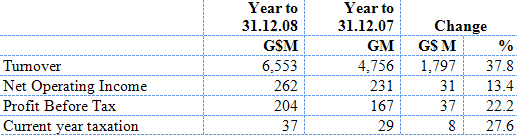
Despite what the Chairman referred to as “enormous challenges” the company recorded an increase in turnover of some 38% with sales of rice doubling while feed sales and hatchery sales increased by a more modest 29% and 21% respectively. As expected the Chairman was particularly pleased about the performance of the company’s brand of parboiled rice ‘Angel’ on the export Caricom market.

Of the net income for the year of $123M, after allowing for deferred taxation, the company proposes $60M in dividends or 49%. Dividends of $96M in respect of 2007, of which 50% is payable in additional shares, remain outstanding. The payment of dividends by the issue of shares was not effected as a result of a court matter with the National Industrial and Commercial Investment Limited.

How the company intends to fund the cash portion of dividends totalling over $100M is, however, not quite clear as the company’s liquidity position has deteriorated with the bank overdraft more than doubling to just under half a billion dollars and current liabilities other than dividends increasing over the 12-month period from $597M to $1,069M. Interestingly note 12 of the financial statements indicates that the company had exceeded its overdraft limit of $440M by more than $40M.

As is so common with public companies in Guyana, there is no mention in the annual report or the Chairman’s Report on the performance on the Stock Exchange of the company’s shares, although this may be entirely due to the fact that there is practically no trading in the company’s shares and that the company is developing into a family company with three of the top positions – CEO, corporate secretarial and finance – being held by members of the same family, which also holds some 69 million of the 80 million shares issued. This company is evidence of the permanent failure of the government’s privatisation policy, driven more by maximising short-term returns than long-term economic democracy. In all the government’s boast about macro-economic fundamentals, it does not appear to recognise that it has divested some highly profitable entities and has little to show for the proceeds. It is too late now for it to review the Privatisation Policy Paper issued under the presidency of Dr Cheddi Jagan, although it was under his presidency that we first saw the departure from policy under then Finance Minister Asgar Ally.

Accounting weaknesses
An observer of accounting and other disclosure requirements would find much of interest in terms of the contents of the Annual Report and the quality of the financial statements, even ignoring an obvious error of $400 million on the face of the balance sheet, which some may regard as the most important of the financial statements. These relate to the dating of the auditor’s report before the financial statements were even approved by the board, inconsistency in particulars about who the company recognises as key management personnel, disclosure about shareholdings, actuarial valuations and tax reconciliations.

That the company continues to pay US$50,000 management fees to a similarly named Trinidad and Tobago company for the payment of expenses on its behalf has continued to attract negative comments, since the logic and business purpose is not immediately apparent. On the other hand, the low effective tax rate suggests that the Revenue accepts the charge as reasonable having regard to the company’s business.

GBTI
In contrast to the financial statements discussed above, those of the GBTI are unaudited and cover the half-year only. In addition, there is no requirement for an Accountant’s Review or notes explaining the policies and judgmental matters relating to key financial statement items, and it is probably these limitations that explain the apparent lack of interest by the public and the business community in such half-yearly reports. Such statements should not be disregarded, since it must be assumed that they result from the accounting records prepared, subject to the limitations identified, in accordance with acceptable accounting standards.

Highlights

2009.08.23_table2

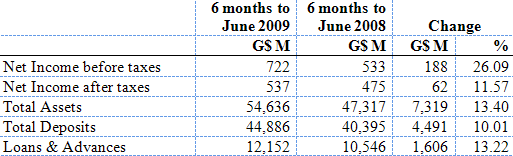
The bank’s performance for the half-year continues a run of excellent results not only for GBTI but indeed for all the commercial banks over the past three years. As the table above shows the bank has increased both deposits and loans, but with a barely discernible increase in the loan to deposit ratio. Our banks are performing so well that any observer of our banking sector would be bemused if told about a global financial crisis, although the anecdotal and empirical evidence is that the non-financial sector is having a lean time. We should therefore be anticipating with interest the publication of the 2009 mid-year report by the Minister of Finance which is unfortunately again late.

Net income before taxes has increased by a whopping 26% over the corresponding period in 2008, while the amount of $164.8M stated as Corporation Tax is the equivalent of 23% of net income. This represents a significant increase in corresponding equivalent percentage for 2008 when it was less than 9% and in the low teens for full-year 2008. This increase is so significant both for the corresponding period in 2008 as well as full year 2008 that we can only wait on the audited full year for some more evidence of such a dramatic swing over such a short period.

Tax policy
Robert McRae, CPA who did a guest column on the bank’s 2008 annual report had drawn attention to the bank’s effective tax rate and how little our economic managers seem to know or care about tax policy. A significant part of the problem is the VAT, a tax borne not by businesses but by consumers of goods and services. Guyana is stuck with a hugely miscalculated VAT rate that has masked any other concern that the government may have had about revenue collection.

In his column McRae had also raised the ire of the bank and the Bank of Guyana when he drew attention to a transaction between the bank and the Bank of Guyana, particularly in the context that the bank had for a second straight year had a significant deficit on its statutory reserve with the central bank.

The Bank of Guyana with unusual speed and generalisation reacted to the column but significantly has refused to answer some specific questions raised publicly by McRae. While commercial banks are, and indeed every person is, entitled to responsible financial reporting, they have a duty to respond to legitimate questions from the public on issues touching on their operations.

GBTI’s Chairman Stoby was noticeably pleased with the results and is upbeat about the bank’s performance for the second half of the year. Those results will certainly be eagerly awaited, but before then we will have some of the other banks including Republic Bank which has a September 30 year end. It will be an interesting period.